

Cocos Island

Encyclopedia
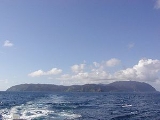
Cocos Island is an uninhabited island
(except for the permanent ranger station) located off the shore of Costa Rica
(to be distinguished from Cocos Island, Isla de Cocos, Panama in the Pearl Islands). It constitutes the 11th district (one of 13) of Puntarenas Canton
of the province of Puntarenas. It is one of the National Parks of Costa Rica
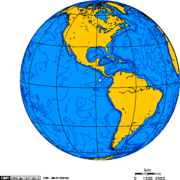
. It is located in the Pacific Ocean
, approximately 550 km (340 mi) from the Pacific shore of Costa Rica, at 05°31′08"N 087°04′18"W. With an area of approximately 23.85 km² (9.2 mi²), about 8×3 km (5×1.9 mi) and a perimeter of around 23.3 km, this island is more or less rectangular in shape.
Surrounded by deep waters with counter-currents, Cocos Island is admired by scuba
divers for its populations of Hammerhead shark
s, rays
, dolphins and other large marine species. The extremely wet climate and oceanic character give Cocos an ecological character that is not shared with either the Galapagos Archipelago or any of the other islands (e.g., Malpelo
or Coiba
) in this region of the world.
by NESCO] www.unesco.com] in 1997. In 2002, the World Heritage Site designation was extended to include an expanded marine zone of 1,997 km². In addition, it is included in the list of "Wetlands of International Importance".
Cocos Island was short-listed as a candidate to be one of the New7Wonders of Nature by the New Seven Wonders of the World
Foundation. As of June 2009 it is ranking second in the islands category.
Thanks to the breathtaking marine life in its waters (see Fauna section below), Cocos Island was named one of the best 10 scuba diving spots in the world by PADI (Professional Association of Diving Instructors) and a "must do" according to diving experts. For many, the main attractions are the large pelagic species, which are very abundant in this unique meeting point between deep and shallow waters. The largest schools of hammerhead sharks in the World are consistently reported there. Encounters with dozens if not hundreds of these and other large animals are nearly certain in every dive. Smaller and colorful species area also abundant in one of the most extensive and rich reefs of the south eastern Pacific. The famous oceanographer Jacques Cousteau visited the island several times and in 1994 called it "the most beautiful island in the world". These numerous accolades highlight the urgent need to protect Cocos Island and surrounding waters from illegal large-scale fishing, poaching and other problems (see Threats section below).
The only persons allowed to live on Cocos Island are Costa Rican Park Rangers, who have established two encampments, including one at English Bay. Tourists and ship crew members are allowed ashore only with permission of island rangers, and are not permitted to camp, stay overnight or collect any flora, fauna or minerals from the island. Occasional amateur radio
Dxpeditions are allowed to visit.
This island is popular in pirate lore as well. It is said that over 300 expeditions have gone in search of treasure such as the hoard of Benito Bonito
, the Treasure of Lima
, and many others. Some incidents of small caches have been discovered, leading many to believe the stories of vast pirate treasures to be valid.
 Cocos Island is an oceanic island of both volcanic and tectonic origin. It is the only emergent island of the Cocos Plate
, one of the minor tectonic plates
. An Argon
–Potassium
radiometric determination established the age of the oldest rocks between 1.91 and 2.44 million years (Late Pliocene) and is composed primarily of basalt
, which is formed by cooling lava. The landscape is mountainous and irregular and the summit is Cerro Iglesias at 575.5 m. In spite of its mountainous character, there are flatter areas between 200–260 m in elevation in the central part of the island, which are said to be a transitional stage of the geomorphological cycle of V-shaped valleys. With four bays, three of them in the north side (Wafer, Chatham and Weston), Cocos Island has a number of
short rivers and streams that drain the abundant rainfall into them. The largest rivers are the Genio and the Pittier, which drain their water into Wafer Bay. The mountainous landscape and the tropical climate combine to create over 200 waterfalls throughout the island. The island's soils are classified as entisol
s which are highly acidic and could be easily eroded by the Island's high rainfall on the steep slopes, were it not for the dense forest coverage.
which creates cloudiness and precipitation that is constant throughout the year. This makes the climate in the island humid and tropical with an average annual temperature of 23.6 ºC (74.5 ºF) and an average annual rainfall of over 7,000 mm (275 in). Rainfall is high throughout the year, although lower from January through March and slightly lower during late September and October. Numerous oceanic currents from the central Pacific Ocean
that converge on the island also have an important influence.
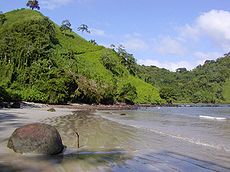 Cocos Island is home to dense and exuberant tropical moist forests
. It is the only oceanic island in the eastern Pacific region with such rain forests and their characteristic types of flora and fauna. The cloud forest
s at higher elevations are also unique in the eastern Pacific. The island was never linked to a continent, so the flora and fauna arrived via long distance dispersal from the Americas
. The island has therefore a high proportion of endemic species
.
s, of which 70, or nearly 30%, are endemic. A good comprehensive study on the flora of the island is provided in the journal Proceedings of the California Academy of Sciences. Also, 74 species of fern
s and fern allies (lycopodiophytes and pteridophyte
s, see), and 128 species of moss
es and liverworts (bryophyte
s, see), 90 species of fungi and 41 species of slimemolds have been reported. Nevertheless, more exhaustive investigations are expected to reveal many more species.
The island has three main plant communities. The coastal forests extend from the seacoast up to 50 meters elevation. Purple Coral Tree (Erythrina fusca
), Coconut Palm (Cocos nucifera), and Pond-apple (Annona glabra) are the predominant trees, with an understory of ferns, shrubs of the Rubiaceae
and Solanaceae
families, sedges and grasses, and herbaceous plants of the Leguminosae and Malvaceae
families.
The inland forests extend from 50 to 500 meters elevation. "Palo de hierro" or huriki (Sacoglottis holdridgei), "avocado" (Ocotea insularis) and the endemic Cecropia pittieri are the most common canopy trees. The trees are festooned at all levels with epiphytic plants, including as orchids, ferns, bromeliads and mosses. The understory includes sedges such as Hypolitrum amplum and various species of ferns and tree ferns including Cyathea armata and Danaea
media. The endemic palm Rooseveltia frankliniana is also common.
Cloud forests are found at the highest elevations, over 500 meters. Melastoma
spp. is predominant.
The general vegetation of Cocos Island has greatly changed since the island was first named and described by Europeans. Captain Wafer, who visited the island in 1685 and whose name was given to the landing place, describes extensive coconut groves extending inland into the interior of the island. It is very unlikely that these groves developed naturally, and it seems evident that pre-European man must once have cleared considerable areas in the ravine bottoms and interior plateaus and ridges, utilizing the clearings for coconut plantations of substantial extent. It has been posited that these plantations were used to provide fresh liquid and food for pre-Columbian voyages (balsa rafts using guara navigation) between Guatemala and northwestern South America. After the Spanish conquest and its consequences, these voyages ended and the tropical jungle recovered the land that had been laboriously cleared by early human hands.
and Formicidae. Over 50 species of other arthropods have been described (spider
s, centipede
s, millipede
s, and isopods).
Two species of lizard
are found on the island, an anole
(Anolis townsendii) and a gecko
(Sphaerodactylus pacificus); both are endemic. No amphibian
s have been reported.
Nearly 90 bird species have been reported. The island and neighboring rocks are home to large nesting colonies of migratory seabird
s, including the Brown Booby
(Sula leucogaster), Red-footed Booby
(Sula sula), Great Frigatebird
(Fregata minor), White Tern
(Gygis alba) and Brown Noddy
(Anous stolidus). Seven species of land birds inhabit the island, including three endemics: the Cocos Cuckoo
(Coccyzus ferrugineus), Cocos Flycatcher
(Nesotriccus ridgwayi) and Cocos Finch (Pinaroloxias inornata).
The island has five land mammal
species, including pigs, deer, cats and rats. All these land mammals were introduced by humans. The Costa Rican government has vowed to control the populations of these animals, as they are harmful to the local ecosystems.
(Thunnus albacares), giant mantas (Manta birostris), sailfish
(Istiophorus platypterus) and shark
s, such as Whitetip reef shark
(Triaenodon obesus) and Scalloped hammerhead shark (Sphyrna lewini). The largest of all species of fish is also present, the whale shark
(Rhincodon typus).
Other large marine animals include humpback whale
s (Megaptera novaeangliae), pilot whale
s (Globicephala macrorhynchus), bottlenose dolphin
s (Tursiops truncatus), and sea lions
(Zalophus californianus).
There are also reptiles; hawksbill turtle
s (Eretmochelys imbricata), green turtles (Chelonia mydas) and olive ridley turtles (Lepidochelys olivacea).
sailor but an Asturian. D. Lievre, Una isla desierta en el Pacífico; la isla del Coco in Los viajes de Cockburn y Lievre por Costa Rica (1962: 134) tells that the first document with the name "Isle de Coques" is a map painted on parchment
, called that of Henry II
that appeared in 1542 during the reign of Francis I of France
. The planisphere
of Nicolás Desliens (1556, Dieppe) places this Ysle de Coques about one and half degrees north of the Equator
. (See also Mario A. Boza and Rolando Mendoza, Los parques nacionales de Costa Rica, Madrid, 1981.) Blaeu's Grand Atlas, originally published in 1662, has a colour world map on the back of its front cover which shows I. de Cocos right on the Equator. Frederik De Witt's Atlas, 1680 shows it similarly. The Hondius
Broadside map of 1590 shows I. de Cocos at the latitude of 2 degrees and 30 minutes northern latitude, while in 1596 Theodore de Bry shows the Galapagos Islands
near 6 degrees north
of the Equator. Emanuel Bowen
, A Complete system of Geography, Volume II (London, 1747: 586) states that the Galapagos stretch 5 degrees north
of the Equator.
Whaler
s stopped at Cocos Island regularly until the mid-19th century, when their industry in the region collapsed due to overfishing.
In October 1863 the ship the "Adelante" dumped 426 Polynesia
n ex-slaves on the island, the captain being too lazy to bring them home as promised. When they were saved by the "Tumbes", one month later, only 38 survived, the rest had already perished from smallpox. (See: 'Ata
).
In 1897 the Costa Rican government named the German adventurer and treasure hunter August Gissler
the first Governor of Cocos Island and allowed him to establish a short-lived colony there.
On May 12, 1970 the insular territory of Cocos Island was incorporated administratively into Central Canton of the Province of Puntarenas by means of Executive Decree No. 27, making it the Eleventh District of Central Canton.
The island's 33 residents, the Costa Rican park rangers, were allowed to vote for the first time in Costa Rica's February 5, 2006 election.
Another pirate supposed to have buried treasure on the island was the Portugese Benito Bonito
. Though Bonito was hunted down and executed, his treasure was never retrieved.
The best known of the treasure legends tied to the island is that of the Treasure of Lima
. In 1820, with the army of José de San Martín
approaching Lima
, Viceroy José de la Serna is supposed to have entrusted treasure from the city to British trader Captain William Thompson
for safekeeping until the Spaniards
could secure the country. Instead of waiting in the harbor as they were instructed, Thompson and his crew killed the Viceroy's men and sailed to Cocos, where they buried the treasure. Shortly afterwards, they were apprehended by a Spanish warship. All of the crew bar Thompson and his first mate were executed for piracy. The two said they would show the Spaniards where they had hidden the treasure in return for their lives- but after landing on Cocos, they escaped away into the forest.
Hundreds of attempts to find treasure on the island have failed. Several early expeditions were mounted on the basis of claims by a man named Keating, who was supposed to have befriended Thompson. On one trip, Keating was said to have retrieved gold and jewels from the treasure. Prussian adventurer August Gissler
lived on the island for most of the period from 1889 until 1908, hunting the treasure with small success of finding six gold coins.
and other seafood is threatening the island's fragile ecosystems. The government of Costa Rica
has been openly accused of passivity and even benefiting corruptly from illegal shark fin and other seafood trade to large markets, such as China and other Asian countries. The government has shown some willingness to protect the island's natural richnesses and prosecute poachers. However, efforts to effectively patrol the waters and enforce environmental laws face big financial and bureaucratic difficulties, as well as being prone to the corruption of local, national and international authorities.
Recent events show that large-scale illegal poaching keeps happening. Despite initial hope in stopping and charging poachers, who have been caught with abundant evidence, they have been quickly released under suspicious circumstances. Also, efforts to raise funds for protection have been dwarfed.
Marvin Orlando Cerdas, a judge with the local Puntarenas Court of Justice, obscurely allowed 22 poachers caught red-handed to escape the country.
Also under highly suspicious and allegedly corrupt circumstances, the District Attorney Michael Morales Molina, stopped the auction for public benefit of confiscated goods, immediately after the spokesman of the large illegal poacher ship "Tiuna" simply made the request.
used the Isla dell Cocoze as an accurate model for his descriptions of the island inhabited by the marooned Robinson Crusoe
. However Defoe placed Crusoe's island not in the Pacific, but rather off the coast of Venezuela in the Atlantic Ocean.
Robinson's neighbouring Terra Firma
is shown on the colour map of Joannes Jansson (Amsterdam) depicting the northeastern corner of South America
, entitled Terra Firma et Novum Regnum Granatense et Popayan. It belongs to the early group of plates printed by William Blaeu from 1630 onwards. The properly called Terra Firma was the Isthmus of Darien. Crusoe's two references to Mexico are against a South American island as well.
The Michael Crichton
novel Jurassic Park centers on the fictitious Isla Nublar that is off of the west coast of Costa Rica. Isla del Coco may be the inspiration for this island. Supporting this argument is the Dreamworks Interactive game Jurassic Park: Trespasser
(1998) which used Cocos Island's topography as a substitute for the fictional island on which it takes place. Also, "Isla Nublar" is intended to mean "Cloudy Island", and Cocos Island is the only island with cloud forests in the eastern Pacific.
Island
An island or isle is any piece of sub-continental land that is surrounded by water. Very small islands such as emergent land features on atolls can be called islets, cays or keys. An island in a river or lake may be called an eyot , or holm...
(except for the permanent ranger station) located off the shore of Costa Rica
Costa Rica
Costa Rica , officially the Republic of Costa Rica is a multilingual, multiethnic and multicultural country in Central America, bordered by Nicaragua to the north, Panama to the southeast, the Pacific Ocean to the west and the Caribbean Sea to the east....
(to be distinguished from Cocos Island, Isla de Cocos, Panama in the Pearl Islands). It constitutes the 11th district (one of 13) of Puntarenas Canton
Puntarenas Canton
Puntarenas is the name of the first canton in the province of Puntarenas in Costa Rica. The canton covers an area of 1,842.33 km², and has a population of 109,798. Its capital is the provincial capital city of Puntarenas....
of the province of Puntarenas. It is one of the National Parks of Costa Rica
National Parks of Costa Rica
There are currently 26 National Parks of Costa Rica, which are managed under the umbrella of SINAC , a department of Costa Rica's Ministry of Environment and Energy ....
. It is located in the Pacific Ocean
Pacific Ocean
The Pacific Ocean is the largest of the Earth's oceanic divisions. It extends from the Arctic in the north to the Southern Ocean in the south, bounded by Asia and Australia in the west, and the Americas in the east.At 165.2 million square kilometres in area, this largest division of the World...
, approximately 550 km (340 mi) from the Pacific shore of Costa Rica, at 05°31′08"N 087°04′18"W. With an area of approximately 23.85 km² (9.2 mi²), about 8×3 km (5×1.9 mi) and a perimeter of around 23.3 km, this island is more or less rectangular in shape.
Surrounded by deep waters with counter-currents, Cocos Island is admired by scuba
Scuba set
A scuba set is an independent breathing set that provides a scuba diver with the breathing gas necessary to breathe underwater during scuba diving. It is much used for sport diving and some sorts of work diving....
divers for its populations of Hammerhead shark
Hammerhead shark
The hammerhead sharks are a group of sharks in the family Sphyrnidae, so named for the unusual and distinctive structure of their heads, which are flattened and laterally extended into a "hammer" shape called a "cephalofoil". Most hammerhead species are placed in the genus Sphyrna while the...
s, rays
Batoidea
Batoidea is a superorder of cartilaginous fish commonly known as rays and skates, containing more than 500 described species in thirteen families...
, dolphins and other large marine species. The extremely wet climate and oceanic character give Cocos an ecological character that is not shared with either the Galapagos Archipelago or any of the other islands (e.g., Malpelo
Malpelo Island
Malpelo Island is an island located from Colombia's Pacific coast, and approximately from Panama's coast. It has a land area of . It is uninhabited except for a small military post manned by the Colombian Army, which was established in 1986. Visitors need a written permit from the Colombian...
or Coiba
Coiba
Coiba is the largest island in Central America, with an area of 503 square kilometers, off the Pacific coast of the Panamanian province of Veraguas. It is part of the Montijo District of that province.-History:...
) in this region of the world.
Present status and international distinctions
Cocos Island was declared a Costa Rican National Park by means of Executive Decree in 1978 . Cocos Island National Park was designated a World Heritage SiteWorld Heritage Site
A UNESCO World Heritage Site is a place that is listed by the UNESCO as of special cultural or physical significance...
by NESCO] www.unesco.com] in 1997. In 2002, the World Heritage Site designation was extended to include an expanded marine zone of 1,997 km². In addition, it is included in the list of "Wetlands of International Importance".
Cocos Island was short-listed as a candidate to be one of the New7Wonders of Nature by the New Seven Wonders of the World
New Seven Wonders of the World
New7Wonders of the World was an initiative started in 2001 by the Swiss corporation New7Wonders Foundation to choose Wonders of the World from a selection of 200 existing monuments. A popularity poll was led by Canadian-Swiss Bernard Weber and organized by the New7Wonders Foundation based in...
Foundation. As of June 2009 it is ranking second in the islands category.
Thanks to the breathtaking marine life in its waters (see Fauna section below), Cocos Island was named one of the best 10 scuba diving spots in the world by PADI (Professional Association of Diving Instructors) and a "must do" according to diving experts. For many, the main attractions are the large pelagic species, which are very abundant in this unique meeting point between deep and shallow waters. The largest schools of hammerhead sharks in the World are consistently reported there. Encounters with dozens if not hundreds of these and other large animals are nearly certain in every dive. Smaller and colorful species area also abundant in one of the most extensive and rich reefs of the south eastern Pacific. The famous oceanographer Jacques Cousteau visited the island several times and in 1994 called it "the most beautiful island in the world". These numerous accolades highlight the urgent need to protect Cocos Island and surrounding waters from illegal large-scale fishing, poaching and other problems (see Threats section below).
The only persons allowed to live on Cocos Island are Costa Rican Park Rangers, who have established two encampments, including one at English Bay. Tourists and ship crew members are allowed ashore only with permission of island rangers, and are not permitted to camp, stay overnight or collect any flora, fauna or minerals from the island. Occasional amateur radio
Amateur radio
Amateur radio is the use of designated radio frequency spectrum for purposes of private recreation, non-commercial exchange of messages, wireless experimentation, self-training, and emergency communication...
Dxpeditions are allowed to visit.
This island is popular in pirate lore as well. It is said that over 300 expeditions have gone in search of treasure such as the hoard of Benito Bonito
Benito Bonito
Benito "Bloody Sword" Bonito is the subject of a legend about a pirate who raided the west coast of the Americas. His career began around 1818 but from there on sources differ. According to one legend his ship was boarded by a British man-o'-war after Bonito exited Port Phillip Bay after hiding...
, the Treasure of Lima
Treasure of Lima
The Treasure of Lima is a treasure reputedly removed from Lima, Peru, in 1820 and never recovered. It is estimated to be worth up to US$60 million in today's money.-History:...
, and many others. Some incidents of small caches have been discovered, leading many to believe the stories of vast pirate treasures to be valid.
Geology and landscape
Cocos Plate
The Cocos Plate is an oceanic tectonic plate beneath the Pacific Ocean off the west coast of Central America, named for Cocos Island, which rides upon it.-Geology:...
, one of the minor tectonic plates
Tectonic Plates
Tectonic Plates is a 1992 independent Canadian film directed by Peter Mettler. Mettler also wrote the screenplay based on the play by Robert Lepage. The film stars Marie Gignac, Céline Bonnier and Robert Lepage.-Plot summary:...
. An Argon
Argon
Argon is a chemical element represented by the symbol Ar. Argon has atomic number 18 and is the third element in group 18 of the periodic table . Argon is the third most common gas in the Earth's atmosphere, at 0.93%, making it more common than carbon dioxide...
–Potassium
Potassium
Potassium is the chemical element with the symbol K and atomic number 19. Elemental potassium is a soft silvery-white alkali metal that oxidizes rapidly in air and is very reactive with water, generating sufficient heat to ignite the hydrogen emitted in the reaction.Potassium and sodium are...
radiometric determination established the age of the oldest rocks between 1.91 and 2.44 million years (Late Pliocene) and is composed primarily of basalt
Basalt
Basalt is a common extrusive volcanic rock. It is usually grey to black and fine-grained due to rapid cooling of lava at the surface of a planet. It may be porphyritic containing larger crystals in a fine matrix, or vesicular, or frothy scoria. Unweathered basalt is black or grey...
, which is formed by cooling lava. The landscape is mountainous and irregular and the summit is Cerro Iglesias at 575.5 m. In spite of its mountainous character, there are flatter areas between 200–260 m in elevation in the central part of the island, which are said to be a transitional stage of the geomorphological cycle of V-shaped valleys. With four bays, three of them in the north side (Wafer, Chatham and Weston), Cocos Island has a number of
short rivers and streams that drain the abundant rainfall into them. The largest rivers are the Genio and the Pittier, which drain their water into Wafer Bay. The mountainous landscape and the tropical climate combine to create over 200 waterfalls throughout the island. The island's soils are classified as entisol
Entisol
In USA soil taxonomy, Entisols are defined as soils that do not show any profile development other than an A horizon. An Entisol has no diagnostic horizons, and most are basically unaltered from their parent material, which can be unconsolidated sediment or rock...
s which are highly acidic and could be easily eroded by the Island's high rainfall on the steep slopes, were it not for the dense forest coverage.
Climate
The climate of the island is mostly determined by the latitudinal movement of the Intertropical Convergence ZoneIntertropical Convergence Zone
The Intertropical Convergence Zone , known by sailors as The Doldrums, is the area encircling the earth near the equator where winds originating in the northern and southern hemispheres come together....
which creates cloudiness and precipitation that is constant throughout the year. This makes the climate in the island humid and tropical with an average annual temperature of 23.6 ºC (74.5 ºF) and an average annual rainfall of over 7,000 mm (275 in). Rainfall is high throughout the year, although lower from January through March and slightly lower during late September and October. Numerous oceanic currents from the central Pacific Ocean
Pacific Ocean
The Pacific Ocean is the largest of the Earth's oceanic divisions. It extends from the Arctic in the north to the Southern Ocean in the south, bounded by Asia and Australia in the west, and the Americas in the east.At 165.2 million square kilometres in area, this largest division of the World...
that converge on the island also have an important influence.
Ecology
Tropical and subtropical moist broadleaf forests
Tropical and subtropical moist broadleaf forests , also known as tropical moist forests, are a tropical and subtropical forest biome....
. It is the only oceanic island in the eastern Pacific region with such rain forests and their characteristic types of flora and fauna. The cloud forest
Cloud forest
A cloud forest, also called a fog forest, is a generally tropical or subtropical evergreen montane moist forest characterized by a persistent, frequent or seasonal low-level cloud cover, usually at the canopy level. Cloud forests often exhibit an abundance of mosses covering the ground and...
s at higher elevations are also unique in the eastern Pacific. The island was never linked to a continent, so the flora and fauna arrived via long distance dispersal from the Americas
Americas
The Americas, or America , are lands in the Western hemisphere, also known as the New World. In English, the plural form the Americas is often used to refer to the landmasses of North America and South America with their associated islands and regions, while the singular form America is primarily...
. The island has therefore a high proportion of endemic species
Endemic (ecology)
Endemism is the ecological state of being unique to a defined geographic location, such as an island, nation or other defined zone, or habitat type; organisms that are indigenous to a place are not endemic to it if they are also found elsewhere. For example, all species of lemur are endemic to the...
.
Flora
The island has 235 known species of flowering plantFlowering plant
The flowering plants , also known as Angiospermae or Magnoliophyta, are the most diverse group of land plants. Angiosperms are seed-producing plants like the gymnosperms and can be distinguished from the gymnosperms by a series of synapomorphies...
s, of which 70, or nearly 30%, are endemic. A good comprehensive study on the flora of the island is provided in the journal Proceedings of the California Academy of Sciences. Also, 74 species of fern
Fern
A fern is any one of a group of about 12,000 species of plants belonging to the botanical group known as Pteridophyta. Unlike mosses, they have xylem and phloem . They have stems, leaves, and roots like other vascular plants...
s and fern allies (lycopodiophytes and pteridophyte
Pteridophyte
The pteridophytes are vascular plants that produce neither flowers nor seeds, and are hence called vascular cryptogams. Instead, they reproduce and disperse only via spores. Pteridophytes include horsetails, ferns, club mosses, and quillworts...
s, see), and 128 species of moss
Moss
Mosses are small, soft plants that are typically 1–10 cm tall, though some species are much larger. They commonly grow close together in clumps or mats in damp or shady locations. They do not have flowers or seeds, and their simple leaves cover the thin wiry stems...
es and liverworts (bryophyte
Bryophyte
Bryophyte is a traditional name used to refer to all embryophytes that do not have true vascular tissue and are therefore called 'non-vascular plants'. Some bryophytes do have specialized tissues for the transport of water; however since these do not contain lignin, they are not considered to be...
s, see), 90 species of fungi and 41 species of slimemolds have been reported. Nevertheless, more exhaustive investigations are expected to reveal many more species.
The island has three main plant communities. The coastal forests extend from the seacoast up to 50 meters elevation. Purple Coral Tree (Erythrina fusca
Erythrina fusca
Erythrina fusca is a species of flowering tree in the legume family, Fabaceae. It is known by many common names, including purple coraltree, gallito, bois immortelle, bucayo, and the more ambiguous "bucare" and "coral bean". E...
), Coconut Palm (Cocos nucifera), and Pond-apple (Annona glabra) are the predominant trees, with an understory of ferns, shrubs of the Rubiaceae
Rubiaceae
The Rubiaceae is a family of flowering plants, variously called the coffee family, madder family, or bedstraw family. The group contains many commonly known plants, including the economically important coffee , quinine , and gambier , and the horticulturally valuable madder , west indian jasmine ,...
and Solanaceae
Solanaceae
Solanaceae are a family of flowering plants that include a number of important agricultural crops as well as many toxic plants. The name of the family comes from the Latin Solanum "the nightshade plant", but the further etymology of that word is unclear...
families, sedges and grasses, and herbaceous plants of the Leguminosae and Malvaceae
Malvaceae
Malvaceae, or the mallow family, is a family of flowering plants containing over 200 genera with close to 2,300 species. Judd & al. Well known members of this family include okra, jute and cacao...
families.
The inland forests extend from 50 to 500 meters elevation. "Palo de hierro" or huriki (Sacoglottis holdridgei), "avocado" (Ocotea insularis) and the endemic Cecropia pittieri are the most common canopy trees. The trees are festooned at all levels with epiphytic plants, including as orchids, ferns, bromeliads and mosses. The understory includes sedges such as Hypolitrum amplum and various species of ferns and tree ferns including Cyathea armata and Danaea
Danaea
Danaea Sm. is a fern genus of approximately 50 species in the eusporangiate fern family Marattiaceae.they are small to intermediately large ferns with erect or creeping rhizomes and usually once pinnate leaves with opposite pinnae. The fertile leaves are contracted, acrostichoid and covered below...
media. The endemic palm Rooseveltia frankliniana is also common.
Cloud forests are found at the highest elevations, over 500 meters. Melastoma
Melastoma
Melastoma is a genus in the family Melastomataceae. It has about 50 species distributed around Southeast Asia, India, and Australia. It is undergoing taxonomic revision. Many species have been planted around the world for the aesthetic value of their bright purple flowers...
spp. is predominant.
The general vegetation of Cocos Island has greatly changed since the island was first named and described by Europeans. Captain Wafer, who visited the island in 1685 and whose name was given to the landing place, describes extensive coconut groves extending inland into the interior of the island. It is very unlikely that these groves developed naturally, and it seems evident that pre-European man must once have cleared considerable areas in the ravine bottoms and interior plateaus and ridges, utilizing the clearings for coconut plantations of substantial extent. It has been posited that these plantations were used to provide fresh liquid and food for pre-Columbian voyages (balsa rafts using guara navigation) between Guatemala and northwestern South America. After the Spanish conquest and its consequences, these voyages ended and the tropical jungle recovered the land that had been laboriously cleared by early human hands.
Land fauna
The island has over 400 known species of insects, of which 65 (16%) are endemic. The greatest diversity is found among the LepidopteraLepidoptera
Lepidoptera is a large order of insects that includes moths and butterflies . It is one of the most widespread and widely recognizable insect orders in the world, encompassing moths and the three superfamilies of butterflies, skipper butterflies, and moth-butterflies...
and Formicidae. Over 50 species of other arthropods have been described (spider
Spider
Spiders are air-breathing arthropods that have eight legs, and chelicerae with fangs that inject venom. They are the largest order of arachnids and rank seventh in total species diversity among all other groups of organisms...
s, centipede
Centipede
Centipedes are arthropods belonging to the class Chilopoda of the subphylum Myriapoda. They are elongated metameric animals with one pair of legs per body segment. Despite the name, centipedes can have a varying number of legs from under 20 to over 300. Centipedes have an odd number of pairs of...
s, millipede
Millipede
Millipedes are arthropods that have two pairs of legs per segment . Each segment that has two pairs of legs is a result of two single segments fused together as one...
s, and isopods).
Two species of lizard
Lizard
Lizards are a widespread group of squamate reptiles, with nearly 3800 species, ranging across all continents except Antarctica as well as most oceanic island chains...
are found on the island, an anole
Polychrotidae
Polychrotidae is a family of lizards commonly known as anoles . NCBI places the anole in subfamily Polychrotinae of the family Iguanidae. Four genera are common: Anolis, Norops, Phenacosaurus, and Polychrus....
(Anolis townsendii) and a gecko
Gecko
Geckos are lizards belonging to the infraorder Gekkota, found in warm climates throughout the world. They range from 1.6 cm to 60 cm....
(Sphaerodactylus pacificus); both are endemic. No amphibian
Amphibian
Amphibians , are a class of vertebrate animals including animals such as toads, frogs, caecilians, and salamanders. They are characterized as non-amniote ectothermic tetrapods...
s have been reported.
Nearly 90 bird species have been reported. The island and neighboring rocks are home to large nesting colonies of migratory seabird
Seabird
Seabirds are birds that have adapted to life within the marine environment. While seabirds vary greatly in lifestyle, behaviour and physiology, they often exhibit striking convergent evolution, as the same environmental problems and feeding niches have resulted in similar adaptations...
s, including the Brown Booby
Brown Booby
The Brown Booby is a large seabird of the booby family, Sulidae. The adult brown booby reaches about in length. Its head and upper body are covered in dark brown, with the remainder being a contrasting white. The juvenile form is gray-brown with darkening on the head, wings and tail...
(Sula leucogaster), Red-footed Booby
Red-footed Booby
The Red-footed Booby, Sula sula, is a large seabird of the booby family, Sulidae. As suggested by the name, adults always have red feet, but the colour of the plumage varies. They are powerful and agile fliers, but they are clumsy in takeoffs and landings...
(Sula sula), Great Frigatebird
Great Frigatebird
The Great Frigatebird is a large dispersive seabird in the frigatebird family. Major nesting populations are found in the Pacific and Indian Oceans, as well as a population in the South Atlantic....
(Fregata minor), White Tern
White Tern
The White Tern is a small seabird found across the tropical oceans of the world. It is sometimes known as the Fairy Tern although this name is potentially confusing as it is the common name of the Fairy Tern Sternula nereis...
(Gygis alba) and Brown Noddy
Brown Noddy
The Brown Noddy or Common Noddy is a seabird from the tern family. The largest of the noddies, it can be told from the closely related Black Noddy by its larger size and plumage, which is dark brown rather than black...
(Anous stolidus). Seven species of land birds inhabit the island, including three endemics: the Cocos Cuckoo
Cocos Cuckoo
The Cocos Cuckoo is a species of cuckoo in the Cuculidae family.It is endemic to Cocos Island, an Island in the Pacific Ocean which is part of Costa Rica....
(Coccyzus ferrugineus), Cocos Flycatcher
Cocos Flycatcher
The Cocos Flycatcher is a species of bird in the Tyrannidae family, and the only species in the genus Nesotriccus.It is endemic to Cocos Island off Costa Rica...
(Nesotriccus ridgwayi) and Cocos Finch (Pinaroloxias inornata).
The island has five land mammal
Mammal
Mammals are members of a class of air-breathing vertebrate animals characterised by the possession of endothermy, hair, three middle ear bones, and mammary glands functional in mothers with young...
species, including pigs, deer, cats and rats. All these land mammals were introduced by humans. The Costa Rican government has vowed to control the populations of these animals, as they are harmful to the local ecosystems.
Marine fauna
The rich coral reef, volcanic tunnels, caves, massifs and deeper waters surrounding Cocos Island are home to more than 30 species of coral, 60 species of crustaceans, 600 species of molluscs and over 300 species of fish. These include large populations of yellowfin tunaYellowfin tuna
The yellowfin tuna is a species of tuna found in pelagic waters of tropical and subtropical oceans worldwide.Yellowfin is often marketed as ahi, from its Hawaiian name ahi although the name ahi in Hawaiian also refers to the closely related bigeye tuna. The species name, albacares can lead to...
(Thunnus albacares), giant mantas (Manta birostris), sailfish
Sailfish
'Sailfish' are two species of fish in the genus Istiophorus, living in warmer sections of all the oceans of the world. They are predominately blue to gray in color and have a characteristic erectile dorsal fin known as a sail, which often stretches the entire length of the back...
(Istiophorus platypterus) and shark
Shark
Sharks are a type of fish with a full cartilaginous skeleton and a highly streamlined body. The earliest known sharks date from more than 420 million years ago....
s, such as Whitetip reef shark
Whitetip reef shark
The whitetip reef shark is a species of requiem shark, family Carcharhinidae, and the only member of its genus. A small shark usually not exceeding in length, this species is easily recognizable by its slender body and short but broad head, as well as tubular skin flaps beside the nostrils, oval...
(Triaenodon obesus) and Scalloped hammerhead shark (Sphyrna lewini). The largest of all species of fish is also present, the whale shark
Whale shark
The whale shark, Rhincodon typus, is a slow-moving filter feeding shark, the largest extant fish species. The largest confirmed individual had a length of and a weight of more than , but unconfirmed claims report considerably larger whale sharks...
(Rhincodon typus).
Other large marine animals include humpback whale
Humpback Whale
The humpback whale is a species of baleen whale. One of the larger rorqual species, adults range in length from and weigh approximately . The humpback has a distinctive body shape, with unusually long pectoral fins and a knobbly head. It is an acrobatic animal, often breaching and slapping the...
s (Megaptera novaeangliae), pilot whale
Pilot whale
Pilot whales are cetaceans belonging to the genus Globicephala. There are two extant species, the long-finned pilot whale and the short-finned pilot whale . The two are not readily distinguished at sea and analysis of the skulls is the best way to tell the difference between them...
s (Globicephala macrorhynchus), bottlenose dolphin
Bottlenose Dolphin
Bottlenose dolphins, the genus Tursiops, are the most common and well-known members of the family Delphinidae, the family of oceanic dolphins. Recent molecular studies show the genus contains two species, the common bottlenose dolphin and the Indo-Pacific bottlenose dolphin , instead of one...
s (Tursiops truncatus), and sea lions
California Sea Lion
The California sea lion is a coastal sea lion of western North America. Their numbers are abundant , and the population continues to expand about 5% annually. They are quite intelligent and can adapt to man-made environments...
(Zalophus californianus).
There are also reptiles; hawksbill turtle
Hawksbill turtle
The hawksbill sea turtle is a critically endangered sea turtle belonging to the family Cheloniidae. It is the only extant species in its genus. The species has a worldwide distribution, with Atlantic and Pacific subspecies. E. imbricata imbricata is the Atlantic subspecies, while E...
s (Eretmochelys imbricata), green turtles (Chelonia mydas) and olive ridley turtles (Lepidochelys olivacea).
Discovery of Cocos Island and early cartography
J. Lines (Diario de Costa Rica, May 12, 1940) cites Fernández de Oviedo who claims that the first discoverer of the island was Johan Cabeças. Other sources claim that Joan Cabezas de Grado was not a PortuguesePortugal
Portugal , officially the Portuguese Republic is a country situated in southwestern Europe on the Iberian Peninsula. Portugal is the westernmost country of Europe, and is bordered by the Atlantic Ocean to the West and South and by Spain to the North and East. The Atlantic archipelagos of the...
sailor but an Asturian. D. Lievre, Una isla desierta en el Pacífico; la isla del Coco in Los viajes de Cockburn y Lievre por Costa Rica (1962: 134) tells that the first document with the name "Isle de Coques" is a map painted on parchment
Parchment
Parchment is a thin material made from calfskin, sheepskin or goatskin, often split. Its most common use was as a material for writing on, for documents, notes, or the pages of a book, codex or manuscript. It is distinct from leather in that parchment is limed but not tanned; therefore, it is very...
, called that of Henry II
Henry II of France
Henry II was King of France from 31 March 1547 until his death in 1559.-Early years:Henry was born in the royal Château de Saint-Germain-en-Laye, near Paris, the son of Francis I and Claude, Duchess of Brittany .His father was captured at the Battle of Pavia in 1525 by his sworn enemy,...
that appeared in 1542 during the reign of Francis I of France
Francis I of France
Francis I was King of France from 1515 until his death. During his reign, huge cultural changes took place in France and he has been called France's original Renaissance monarch...
. The planisphere
Planisphere
A planisphere is a star chart analog computing instrument in the form of two adjustable disks that rotate on a common pivot. It can be adjusted to display the visible stars for any time and date. It is an instrument to assist in learning how to recognize stars and constellations...
of Nicolás Desliens (1556, Dieppe) places this Ysle de Coques about one and half degrees north of the Equator
Equator
An equator is the intersection of a sphere's surface with the plane perpendicular to the sphere's axis of rotation and containing the sphere's center of mass....
. (See also Mario A. Boza and Rolando Mendoza, Los parques nacionales de Costa Rica, Madrid, 1981.) Blaeu's Grand Atlas, originally published in 1662, has a colour world map on the back of its front cover which shows I. de Cocos right on the Equator. Frederik De Witt's Atlas, 1680 shows it similarly. The Hondius
Hondius
Hondius can refer to two possibly unrelated families of engravers and cartographers, who both moved from Flanders to the Dutch Republic in the 1590s:* Amsterdam family originating from Ghent:** Jodocus Hondius ** Jodocus Hondius II Hondius can refer to two possibly unrelated families of engravers...
Broadside map of 1590 shows I. de Cocos at the latitude of 2 degrees and 30 minutes northern latitude, while in 1596 Theodore de Bry shows the Galapagos Islands
Galápagos Islands
The Galápagos Islands are an archipelago of volcanic islands distributed around the equator in the Pacific Ocean, west of continental Ecuador, of which they are a part.The Galápagos Islands and its surrounding waters form an Ecuadorian province, a national park, and a...
near 6 degrees north
6th parallel north
The 6th parallel north is a circle of latitude that is 6 degrees north of the Earth's equatorial plane. It crosses Africa, the Indian Ocean, Southeast Asia, the Pacific Ocean, South America and the Atlantic Ocean....
of the Equator. Emanuel Bowen
Emanuel Bowen
Emanuel Bowen was an English map engraver, who worked for George II of England and Louis XV of France as a geographerHe published a 'Complete Atlas of Geography,' 1744-7; an 'English Atlas, with a new set of maps,' 1745; a 'Complete Atlas .....
, A Complete system of Geography, Volume II (London, 1747: 586) states that the Galapagos stretch 5 degrees north
5th parallel north
The 5th parallel north is a circle of latitude that is 5 degrees north of the Earth's equatorial plane. It crosses the Atlantic Ocean, Africa, the Indian Ocean, Southeast Asia, the Pacific Ocean and South America....
of the Equator.
Administrative history
The island became part of Costa Rica in 1832 by the decree No. 54 of the Constitutional Assembly of the free state of Costa Rica.Whaler
Whaler
A whaler is a specialized ship, designed for whaling, the catching and/or processing of whales. The former included the whale catcher, a steam or diesel-driven vessel with a harpoon gun mounted at its bows. The latter included such vessels as the sail or steam-driven whaleship of the 16th to early...
s stopped at Cocos Island regularly until the mid-19th century, when their industry in the region collapsed due to overfishing.
In October 1863 the ship the "Adelante" dumped 426 Polynesia
Polynesia
Polynesia is a subregion of Oceania, made up of over 1,000 islands scattered over the central and southern Pacific Ocean. The indigenous people who inhabit the islands of Polynesia are termed Polynesians and they share many similar traits including language, culture and beliefs...
n ex-slaves on the island, the captain being too lazy to bring them home as promised. When they were saved by the "Tumbes", one month later, only 38 survived, the rest had already perished from smallpox. (See: 'Ata
'Ata
Ata is a small, rocky island in the far south of the Tonga archipelago, situated on . It is also known as Pylstaart island. It should not be confused with Atā, which is an uninhabited, low coral island in the string of small atolls along the Piha passage along the northside of Tongatapu, nor should...
).
In 1897 the Costa Rican government named the German adventurer and treasure hunter August Gissler
August Gissler
August Gissler was a German adventurer and treasure hunter, who lived with short interruptions on Cocos Island from 1889 until 1908....
the first Governor of Cocos Island and allowed him to establish a short-lived colony there.
On May 12, 1970 the insular territory of Cocos Island was incorporated administratively into Central Canton of the Province of Puntarenas by means of Executive Decree No. 27, making it the Eleventh District of Central Canton.
The island's 33 residents, the Costa Rican park rangers, were allowed to vote for the first time in Costa Rica's February 5, 2006 election.
Piracy and hidden treasures
The first claims of treasure buried on the island came from a woman named Mary Welsh, who claimed 350 tons of gold raided from Spanish galleons had been buried on the island. She had been a member of a pirate crew lead by Captain Bennett Graham, and was transported to an Australian penal colony for her crimes. She possessed a chart showing where Graham's treasure was supposed to be hidden. On her release she returned to the island with a expedition, which had no success in finding anything, with the points of reference in the chart having disappeared.Another pirate supposed to have buried treasure on the island was the Portugese Benito Bonito
Benito Bonito
Benito "Bloody Sword" Bonito is the subject of a legend about a pirate who raided the west coast of the Americas. His career began around 1818 but from there on sources differ. According to one legend his ship was boarded by a British man-o'-war after Bonito exited Port Phillip Bay after hiding...
. Though Bonito was hunted down and executed, his treasure was never retrieved.
The best known of the treasure legends tied to the island is that of the Treasure of Lima
Treasure of Lima
The Treasure of Lima is a treasure reputedly removed from Lima, Peru, in 1820 and never recovered. It is estimated to be worth up to US$60 million in today's money.-History:...
. In 1820, with the army of José de San Martín
José de San Martín
José Francisco de San Martín, known simply as Don José de San Martín , was an Argentine general and the prime leader of the southern part of South America's successful struggle for independence from Spain.Born in Yapeyú, Corrientes , he left his mother country at the...
approaching Lima
Lima
Lima is the capital and the largest city of Peru. It is located in the valleys of the Chillón, Rímac and Lurín rivers, in the central part of the country, on a desert coast overlooking the Pacific Ocean. Together with the seaport of Callao, it forms a contiguous urban area known as the Lima...
, Viceroy José de la Serna is supposed to have entrusted treasure from the city to British trader Captain William Thompson
William Thompson
-Academics and scientists:* William Thompson , Irish ornithologist and botanist* William Thompson , Englishman who developed the Thompson Seedless grape...
for safekeeping until the Spaniards
Spanish Empire
The Spanish Empire comprised territories and colonies administered directly by Spain in Europe, in America, Africa, Asia and Oceania. It originated during the Age of Exploration and was therefore one of the first global empires. At the time of Habsburgs, Spain reached the peak of its world power....
could secure the country. Instead of waiting in the harbor as they were instructed, Thompson and his crew killed the Viceroy's men and sailed to Cocos, where they buried the treasure. Shortly afterwards, they were apprehended by a Spanish warship. All of the crew bar Thompson and his first mate were executed for piracy. The two said they would show the Spaniards where they had hidden the treasure in return for their lives- but after landing on Cocos, they escaped away into the forest.
Hundreds of attempts to find treasure on the island have failed. Several early expeditions were mounted on the basis of claims by a man named Keating, who was supposed to have befriended Thompson. On one trip, Keating was said to have retrieved gold and jewels from the treasure. Prussian adventurer August Gissler
August Gissler
August Gissler was a German adventurer and treasure hunter, who lived with short interruptions on Cocos Island from 1889 until 1908....
lived on the island for most of the period from 1889 until 1908, hunting the treasure with small success of finding six gold coins.
Dangers threatening Cocos Island
The mostly unperturbed habitats are, however, under growing human pressure. Illegal poaching of large marine species in and around its protected waters has become a main concern. Growing local and worldwide demand for tuna, shark fin soupShark fin soup
Shark fin soup is a popular soup item of Chinese cuisine usually served at special occasions such as weddings and banquets, or as a luxury item in Chinese culture. The shark fins provide texture while the taste comes from the other soup ingredients.There is controversy over the practice of shark...
and other seafood is threatening the island's fragile ecosystems. The government of Costa Rica
Costa Rica
Costa Rica , officially the Republic of Costa Rica is a multilingual, multiethnic and multicultural country in Central America, bordered by Nicaragua to the north, Panama to the southeast, the Pacific Ocean to the west and the Caribbean Sea to the east....
has been openly accused of passivity and even benefiting corruptly from illegal shark fin and other seafood trade to large markets, such as China and other Asian countries. The government has shown some willingness to protect the island's natural richnesses and prosecute poachers. However, efforts to effectively patrol the waters and enforce environmental laws face big financial and bureaucratic difficulties, as well as being prone to the corruption of local, national and international authorities.
Recent events show that large-scale illegal poaching keeps happening. Despite initial hope in stopping and charging poachers, who have been caught with abundant evidence, they have been quickly released under suspicious circumstances. Also, efforts to raise funds for protection have been dwarfed.
Marvin Orlando Cerdas, a judge with the local Puntarenas Court of Justice, obscurely allowed 22 poachers caught red-handed to escape the country.
Also under highly suspicious and allegedly corrupt circumstances, the District Attorney Michael Morales Molina, stopped the auction for public benefit of confiscated goods, immediately after the spokesman of the large illegal poacher ship "Tiuna" simply made the request.
Cocos Island in fiction
The book Desert Island proposed the highly detailed theory that Daniel DefoeDaniel Defoe
Daniel Defoe , born Daniel Foe, was an English trader, writer, journalist, and pamphleteer, who gained fame for his novel Robinson Crusoe. Defoe is notable for being one of the earliest proponents of the novel, as he helped to popularise the form in Britain and along with others such as Richardson,...
used the Isla dell Cocoze as an accurate model for his descriptions of the island inhabited by the marooned Robinson Crusoe
Robinson Crusoe
Robinson Crusoe is a novel by Daniel Defoe that was first published in 1719. Epistolary, confessional, and didactic in form, the book is a fictional autobiography of the title character—a castaway who spends 28 years on a remote tropical island near Trinidad, encountering cannibals, captives, and...
. However Defoe placed Crusoe's island not in the Pacific, but rather off the coast of Venezuela in the Atlantic Ocean.
Robinson's neighbouring Terra Firma
Terra firma
Terra firma is a Latin phrase meaning "solid earth" . The phrase refers to the dry land mass on the earth's surface and is used to differentiate from the sea or air.Terra Firma may also refer to:...
is shown on the colour map of Joannes Jansson (Amsterdam) depicting the northeastern corner of South America
South America
South America is a continent situated in the Western Hemisphere, mostly in the Southern Hemisphere, with a relatively small portion in the Northern Hemisphere. The continent is also considered a subcontinent of the Americas. It is bordered on the west by the Pacific Ocean and on the north and east...
, entitled Terra Firma et Novum Regnum Granatense et Popayan. It belongs to the early group of plates printed by William Blaeu from 1630 onwards. The properly called Terra Firma was the Isthmus of Darien. Crusoe's two references to Mexico are against a South American island as well.
The Michael Crichton
Michael Crichton
John Michael Crichton , best known as Michael Crichton, was an American best-selling author, producer, director, and screenwriter, best known for his work in the science fiction, medical fiction, and thriller genres. His books have sold over 200 million copies worldwide, and many have been adapted...
novel Jurassic Park centers on the fictitious Isla Nublar that is off of the west coast of Costa Rica. Isla del Coco may be the inspiration for this island. Supporting this argument is the Dreamworks Interactive game Jurassic Park: Trespasser
Jurassic Park: Trespasser
Jurassic Park: Trespasser is a video game released in 1998 for Microsoft Windows after much hype and anticipation. The player assumes the role of Anne, the sole survivor of a plane crash on InGen's "Site B" one year after the events of The Lost World: Jurassic Park...
(1998) which used Cocos Island's topography as a substitute for the fictional island on which it takes place. Also, "Isla Nublar" is intended to mean "Cloudy Island", and Cocos Island is the only island with cloud forests in the eastern Pacific.