

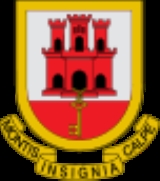
Coat of arms of Gibraltar

Encyclopedia
The coat of arms of Gibraltar
was first granted by a Royal Warrant
passed in Toledo on July 10, 1502, by Isabella I of Castile
during Gibraltar's Spanish period. The arms consists of an escutcheon and features a three-towered red castle under which hangs a golden key.
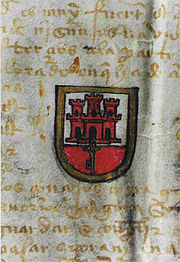 The arms were described in the Royal Warrant as consisting of:
The arms consist of a shield parted per fess
:
The castle has its roots in the heraldry of the Kingdom of Castile
, the largest and most important medieval Spanish kingdom, of which Isabella was Queen. The preamble to the warrant granting the coat of arms to Gibraltar said:
The idea of Gibraltar being the key to Spain or the Mediterranean originated well before the Spanish conquest. The followers of Tariq ibn-Ziyad
, who invaded Spain via Gibraltar in 711, are said to have adopted the symbol of the key when they settled in Granada
. The coat of arms was accompanied by the inscription "Seal of the noble city of Gibraltar, the Key of Spain".
Today, the official coat of arms as used by the government of Gibraltar consists of the original coat of arms with the addition of the motto
, Montis Insignia Calpe ("Insignia of the Mountain of Calpe", i.e., the Rock of Gibraltar
), which was granted by the College of Arms
in 1836 to commemorate the 1779-83 Great Siege of Gibraltar
. It is the oldest coat of arms in use in an overseas territory
of the United Kingdom
and is unique in that it is the only armorial insignia that dates from before the period of British colonial
administration.
The arms differ from the seal of Gibraltar, which is an image of the Rock of Gibraltar with a sailing ship
in the forefront. There is no evidence available as to when this image was created. From 1982, a banner of the arms has been used as the flag of Gibraltar
. The arms also appear in the flag of the governor of Gibraltar
. The arms of the government of Gibraltar are the same as the royal coat of arms of the United Kingdom
combined with a badge featuring the coat of arms of Gibraltar.
 A very similar coat of arms is in use by the nearby Spanish municipality of San Roque, using a slightly different version of the same main heraldic elements (the escutcheon with the castle and key), with the addition of a Royal Crown
above the escutcheon.
When Gibraltar was captured by an Anglo-Dutch force
on behalf of the pretender to the Spanish Throne, the Archduke Charles
, in 1704, the city council
and much of the population established a new town near the existing chapel of Saint Roch
to the west of Gibraltar, in an area that remained under Spanish control. The Royal Warrant of 1502 which granted the coat of arms was taken by the city council to San Roque along with Gibraltar's standard and records, and is now in the San Roque municipal archives. The establishment became a new town in 1706, addressed by King Philip V of Spain
as "My city of Gibraltar resident in its Campo", and becoming the Spanish Gibraltar. Therefore, they kept the old coat of arms granted to Gibraltar in 1502.
Gibraltar
Gibraltar is a British overseas territory located on the southern end of the Iberian Peninsula at the entrance of the Mediterranean. A peninsula with an area of , it has a northern border with Andalusia, Spain. The Rock of Gibraltar is the major landmark of the region...
was first granted by a Royal Warrant
Royal Warrant
Royal warrants of appointment have been issued for centuries to those who supply goods or services to a royal court or certain royal personages. The warrant enables the supplier to advertise the fact that they supply to the royal family, so lending prestige to the supplier...
passed in Toledo on July 10, 1502, by Isabella I of Castile
Isabella I of Castile
Isabella I was Queen of Castile and León. She and her husband Ferdinand II of Aragon brought stability to both kingdoms that became the basis for the unification of Spain. Later the two laid the foundations for the political unification of Spain under their grandson, Charles V, Holy Roman Emperor...
during Gibraltar's Spanish period. The arms consists of an escutcheon and features a three-towered red castle under which hangs a golden key.
Heraldic description
The arms consist of a shield parted per fess
Fess
In heraldry, a fess or fesse is a charge on a coat of arms that takes the form of a band running horizontally across the centre of the shield. Writers disagree in how much of the shield's surface is to be covered by a fess or other ordinary, ranging from one-fifth to one-third...
:
- 1st Division: Two thirds ArgentArgentIn heraldry, argent is the tincture of silver, and belongs to the class of light tinctures, called "metals". It is very frequently depicted as white and usually considered interchangeable with it...
, a triple-towered castle of GulesGulesIn heraldry, gules is the tincture with the colour red, and belongs to the class of dark tinctures called "colours". In engraving, it is sometimes depicted as a region of vertical lines or else marked with gu. as an abbreviation....
, masoned and ajouré of SableSable (heraldry)In heraldry, sable is the tincture black, and belongs to the class of dark tinctures, called "colours". In engravings and line drawings, it is sometimes depicted as a region of crossed horizontal and vertical lines or else marked with sa. as an abbreviation.The name derives from the black fur of...
. - 2nd Division: One third Gules, a key of OrOr (heraldry)In heraldry, Or is the tincture of gold and, together with argent , belongs to the class of light tinctures called "metals". In engravings and line drawings, it may be represented using a field of evenly spaced dots...
hanging by a chain also of Or from the castle.
The castle has its roots in the heraldry of the Kingdom of Castile
Kingdom of Castile
Kingdom of Castile was one of the medieval kingdoms of the Iberian Peninsula. It emerged as a political autonomous entity in the 9th century. It was called County of Castile and was held in vassalage from the Kingdom of León. Its name comes from the host of castles constructed in the region...
, the largest and most important medieval Spanish kingdom, of which Isabella was Queen. The preamble to the warrant granting the coat of arms to Gibraltar said:
The idea of Gibraltar being the key to Spain or the Mediterranean originated well before the Spanish conquest. The followers of Tariq ibn-Ziyad
Tariq ibn-Ziyad
Tariq ibn Ziyad was a Muslim Berber general who led the Islamic conquest of Visigothic Hispania in 711 A.D. He is considered to be one of the most important military commanders in Iberian history. Under the orders of the Umayyad Caliph Al-Walid I he led a large army from the north coast of...
, who invaded Spain via Gibraltar in 711, are said to have adopted the symbol of the key when they settled in Granada
Granada
Granada is a city and the capital of the province of Granada, in the autonomous community of Andalusia, Spain. Granada is located at the foot of the Sierra Nevada mountains, at the confluence of three rivers, the Beiro, the Darro and the Genil. It sits at an elevation of 738 metres above sea...
. The coat of arms was accompanied by the inscription "Seal of the noble city of Gibraltar, the Key of Spain".
Use
Today, the official coat of arms as used by the government of Gibraltar consists of the original coat of arms with the addition of the motto
Motto
A motto is a phrase meant to formally summarize the general motivation or intention of a social group or organization. A motto may be in any language, but Latin is the most used. The local language is usual in the mottoes of governments...
, Montis Insignia Calpe ("Insignia of the Mountain of Calpe", i.e., the Rock of Gibraltar
Rock of Gibraltar
The Rock of Gibraltar is a monolithic limestone promontory located in Gibraltar, off the southwestern tip of Europe on the Iberian Peninsula. It is high...
), which was granted by the College of Arms
College of Arms
The College of Arms, or Heralds’ College, is an office regulating heraldry and granting new armorial bearings for England, Wales and Northern Ireland...
in 1836 to commemorate the 1779-83 Great Siege of Gibraltar
Great Siege of Gibraltar
The Great Siege of Gibraltar was an unsuccessful attempt by Spain and France to capture Gibraltar from the British during the American War of Independence. This was the largest action fought during the war in terms of numbers, particularly the Grand Assault of 18 September 1782...
. It is the oldest coat of arms in use in an overseas territory
British overseas territories
The British Overseas Territories are fourteen territories of the United Kingdom which, although they do not form part of the United Kingdom itself, fall under its jurisdiction. They are remnants of the British Empire that have not acquired independence or have voted to remain British territories...
of the United Kingdom
United Kingdom
The United Kingdom of Great Britain and Northern IrelandIn the United Kingdom and Dependencies, other languages have been officially recognised as legitimate autochthonous languages under the European Charter for Regional or Minority Languages...
and is unique in that it is the only armorial insignia that dates from before the period of British colonial
British Empire
The British Empire comprised the dominions, colonies, protectorates, mandates and other territories ruled or administered by the United Kingdom. It originated with the overseas colonies and trading posts established by England in the late 16th and early 17th centuries. At its height, it was the...
administration.
The arms differ from the seal of Gibraltar, which is an image of the Rock of Gibraltar with a sailing ship
Sailing ship
The term sailing ship is now used to refer to any large wind-powered vessel. In technical terms, a ship was a sailing vessel with a specific rig of at least three masts, square rigged on all of them, making the sailing adjective redundant. In popular usage "ship" became associated with all large...
in the forefront. There is no evidence available as to when this image was created. From 1982, a banner of the arms has been used as the flag of Gibraltar
Flag of Gibraltar
The flag of Gibraltar is an elongated banner of the coat of arms of Gibraltar, granted by Royal Warrant Queen Isabella I of Castile on 10 July 1502.-Description:...
. The arms also appear in the flag of the governor of Gibraltar
Governor of Gibraltar
The Governor and Commander-in-Chief of Gibraltar is the representative of the British monarch in the British overseas territory of Gibraltar. The Governor is appointed by the British Monarch on the advice of the British Government...
. The arms of the government of Gibraltar are the same as the royal coat of arms of the United Kingdom
Royal coat of arms of the United Kingdom
The Royal coat of arms of the United Kingdom is the official coat of arms of the British monarch, currently Queen Elizabeth II. These arms are used by the Queen in her official capacity as monarch of the United Kingdom, and are officially known as her Arms of Dominion...
combined with a badge featuring the coat of arms of Gibraltar.
Variations
Crown (heraldry)
A Crown is often an emblem of the monarchy, a monarch's government, or items endorsed by it; see The Crown. A specific type of crown is employed in heraldry under strict rules....
above the escutcheon.
When Gibraltar was captured by an Anglo-Dutch force
Capture of Gibraltar
The Capture of Gibraltar by the Anglo-Dutch forces of the Grand Alliance occurred between 1–3 August 1704 during the War of the Spanish Succession. Since the beginning of the war the Allies had been looking for a harbour in the Iberian Peninsula to control the Strait of Gibraltar and facilitate...
on behalf of the pretender to the Spanish Throne, the Archduke Charles
Charles VI, Holy Roman Emperor
Charles VI was the penultimate Habsburg sovereign of the Habsburg Empire. He succeeded his elder brother, Joseph I, as Holy Roman Emperor, King of Bohemia , Hungary and Croatia , Archduke of Austria, etc., in 1711...
, in 1704, the city council
City council
A city council or town council is the legislative body that governs a city, town, municipality or local government area.-Australia & NZ:Because of the differences in legislation between the States, the exact definition of a City Council varies...
and much of the population established a new town near the existing chapel of Saint Roch
Roch
Saint Roch or Rocco ; lived c.1348 - 15/16 August 1376/79 was a Christian saint, a confessor whose death is commemorated on 16 August; he is specially invoked against the plague...
to the west of Gibraltar, in an area that remained under Spanish control. The Royal Warrant of 1502 which granted the coat of arms was taken by the city council to San Roque along with Gibraltar's standard and records, and is now in the San Roque municipal archives. The establishment became a new town in 1706, addressed by King Philip V of Spain
Philip V of Spain
Philip V was King of Spain from 15 November 1700 to 15 January 1724, when he abdicated in favor of his son Louis, and from 6 September 1724, when he assumed the throne again upon his son's death, to his death.Before his reign, Philip occupied an exalted place in the royal family of France as a...
as "My city of Gibraltar resident in its Campo", and becoming the Spanish Gibraltar. Therefore, they kept the old coat of arms granted to Gibraltar in 1502.
See also
- List of coats of arms of the United Kingdom and dependencies
- History of GibraltarHistory of GibraltarThe history of Gibraltar portrays how The Rock gained an importance and a reputation far exceeding its size, influencing and shaping the people who came to reside here over the centuries.-Prehistoric:...
- Spanish heraldrySpanish heraldryThe tradition and art of heraldry first appeared in Spain at about the beginning of the eleventh century AD and its origin was similar to other European countries: the need for knights and nobles to distinguish themselves from one another on the battlefield, in jousts and in tournaments...