


Clinker brick

Encyclopedia

Glass transition
The liquid-glass transition is the reversible transition in amorphous materials from a hard and relatively brittle state into a molten or rubber-like state. An amorphous solid that exhibits a glass transition is called a glass...
brick
Brick
A brick is a block of ceramic material used in masonry construction, usually laid using various kinds of mortar. It has been regarded as one of the longest lasting and strongest building materials used throughout history.-History:...
stones used in the construction
Construction
In the fields of architecture and civil engineering, construction is a process that consists of the building or assembling of infrastructure. Far from being a single activity, large scale construction is a feat of human multitasking...
of building
Building
In architecture, construction, engineering, real estate development and technology the word building may refer to one of the following:...
s.
Clinkers are burnt under temperatures so high that the pores of the fuel property are closed by the beginning sinter process. Thus they are considerably denser and therefore heavier than regular bricks. Clinkers hardly take up water and are very resistant.
In early brick firing kilns, the surface of the bricks that were too close to the fire changed into the volcanic textures and darker/purplish colors. They were often discarded, but around 1900, these bricks were discovered by architect
Architect
An architect is a person trained in the planning, design and oversight of the construction of buildings. To practice architecture means to offer or render services in connection with the design and construction of a building, or group of buildings and the space within the site surrounding the...
s to be usable, distinctive and charming in architectural detailing, adding the earthy quality favored by Arts & Crafts style
Arts and Crafts movement
Arts and Crafts was an international design philosophy that originated in England and flourished between 1860 and 1910 , continuing its influence until the 1930s...
designers. Modern brick-making techniques can recreate the appearance of these bricks and produce a more consistent product.
In the United States
United States
The United States of America is a federal constitutional republic comprising fifty states and a federal district...
, clinker bricks were made famous by the Pasadena, California
Pasadena, California
Pasadena is a city in Los Angeles County, California, United States. Although famous for hosting the annual Rose Bowl football game and Tournament of Roses Parade, Pasadena is the home to many scientific and cultural institutions, including the California Institute of Technology , the Jet...
architecture firm Greene and Greene
Greene and Greene
Greene and Greene was an architectural firm established by brothers Charles Sumner Greene and Henry Mather Greene , influential early 20th Century American architects...
who used them (often in combination with native rocks) in walls, foundations, and chimneys.
The name "clinker" is also used for the hardened residue of coal fires, that can have a similar texture.
Dutch / Low German Origins
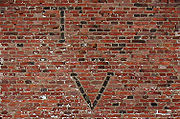
Clinker bricks are also known as hard Dutch paving bricks. In 18th century New York, the Dutch interspersed dark clinkers with regular bricks. Some used clinkers to spell out their family initials on brick dwellings. See Jan Van Hoesen House
Jan Van Hoesen House
Jan Van Hoesen House is an early 18th century house in New York State. Driving northeast on NY 66 from Hudson to Chatham, just east of Claverack Creek, stands sentinel a vacant medieval-looking brick structure over the Dutch Acres Mobile Home Park...
.
Technical Information
Clinkers consist of bits and ends, field-late and white-burning or red-burning clays. Through different mixtures of the raw ingredients, many varied colour nuances can be achieved. For the production of masonry units the source materials—clay and water—are mixed and formed industrially in a string extrusion process. For special purposes, for example the restoration of listed buildings, hand-formed clinkers are used. During the drying process, the water concentration decreases to approximately 3%. Then clinkers are fired at temperatures between 1100°C and 1300°C in the tunnel stove (earlier in ring stoves), in contrast to the 800°C to 1200°C temperature range seen with normal bricks.Klinker in Germany
In Germany, clinkers are normed according to the German Institute for Standardization’s DIN 105 They differ between full clinker (KMz) with a density of 2.0 kg / dm ³ to 2.2 kg / dm ³ and high hole clinker (KHLz) with a density of 1.6 kg / dm ³ to 1.8 kg / dm ³. Because of their low porosity, clinker bricks are inferior thermal insulators, compared to normal bricks. Canal clinkers are normed according to the German Institute for Standardization’s DIN 4051. Clinkers are frost resisting and, thus are suited particularly for facades. The formats of the clinker stones are normed according to the German Institute for Standardization’s DIN 1053. Base for the different formats is the normal format (NF) with length 240 mm, width 115 mm and height 71 mm (other measures see baked brick). For facade layouts architects also order clinkers produced in special dimensions.For use with facades, it is possible to cope varied shaped elements (e.g., clinker expressionism, see picture). Earlier clinkers were often used in civil engineering works, for example in bridge building , the construction of sewers and hydraulic structures, for mortar floodgates and hoppers or as paving stones for road construction.
Sculptor Ernst Barlach also worked with clinkers which then were produced according to his drafts, for example by the brickyard of Ilse Bergbau AG.
Peat fire clinker
A special colouring, above all green tones, clinker adopts if burnt with peat. Famous buildings with peat fire clinker are the Chile house and the Ramada Hotel in Hamburg. The last, still operating ring stove for peat fire clinker works is located in Nenndorf near Aurich (East Frisia). That clinker product is marketed under the name “Wittmunder Torfbrandklinker” (peat fire clinker of Wittmund).
Greppin clinker
A hard-burnt yellow clinker stone, which receives a closed surface by burning it at temperatures clearly higher compared to normal brick stones, is called Greppiner Klinker (clinker of Greppin). At the end of the 19th and in the early 20th century, such clinkers were mostly used to line facades of railway constructions.
External links
- Clinker Bricks from Historical Bricks
- The Accidental Charm of Clinker Bricks, Old House Journal