
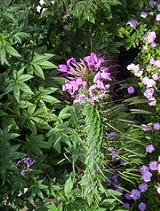
Cleome is a genus of
flowering plantThe flowering plants or angiosperms are the most diverse group of land plants. The flowering plants and the gymnosperms are the only extant groups of seed plants...
s in the family
CleomaceaeCleomaceae is a small family of flowering plants in the order Brassicales, comprising about 300 species in 10 genera. These genera were previously included in the family Capparaceae, but were raised to a distinct family when DNA evidence showed that the genera included in it are more closely...
. Previously it had been placed in family
CapparaceaeCapparaceae , commonly known as the Caper family, is a family of plants in order Brassicales. As currently circumscribed, it contains 33 genera and about 700 species...
, until DNA studies found the Cleomaceae genera to be more closely related to
BrassicaceaeBrassicaceae or Cruciferae, also known as the crucifers, the mustard family or cabbage family is a family of flowering plants . The name Brassicaceae is derived from the included genus Brassica. Cruciferae is an older name, meaning "cross-bearing", because the four petals of their flowers are...
than Capparaceae. The
APG II systemA modern system of plant taxonomy, the APG II system of plant classification was published in 2003 by the Angiosperm Phylogeny Group, APG, in*Angiosperm Phylogeny Group . An update of the Angiosperm Phylogeny Group classification for the orders and families of flowering plants: APG II. Botanical...
allows for
Cleome and the other members of Cleomaceae to be included in Brassicaceae.
The genus
sensu stricto includes about 170 species of
herbaceousA herbaceous plant is a plant that has leaves and stems that die down at the end of the growing season to the soil level. They have no persistent woody stem above ground...
annualAn annual plant is a plant that usually germinates, flowers, and dies in a year or season. True annuals will only live longer than a year if they are prevented from setting seed...
or
perennialA perennial plant or perennial is a plant that lives for more than two years. When used by gardeners or horticulturalists, this term applies specifically to perennial herbaceous plants...
plants and
shrubA shrub or bush is a horticultural rather than strictly botanical category of woody plant, distinguished from a tree by its multiple stems and lower height, usually less than 5-6 m tall. A large number of plants can be either shrubs or trees, depending on the growing conditions they experience...
s.
Cleome is a genus of
flowering plantThe flowering plants or angiosperms are the most diverse group of land plants. The flowering plants and the gymnosperms are the only extant groups of seed plants...
s in the family
CleomaceaeCleomaceae is a small family of flowering plants in the order Brassicales, comprising about 300 species in 10 genera. These genera were previously included in the family Capparaceae, but were raised to a distinct family when DNA evidence showed that the genera included in it are more closely...
. Previously it had been placed in family
CapparaceaeCapparaceae , commonly known as the Caper family, is a family of plants in order Brassicales. As currently circumscribed, it contains 33 genera and about 700 species...
, until DNA studies found the Cleomaceae genera to be more closely related to
BrassicaceaeBrassicaceae or Cruciferae, also known as the crucifers, the mustard family or cabbage family is a family of flowering plants . The name Brassicaceae is derived from the included genus Brassica. Cruciferae is an older name, meaning "cross-bearing", because the four petals of their flowers are...
than Capparaceae. The
APG II systemA modern system of plant taxonomy, the APG II system of plant classification was published in 2003 by the Angiosperm Phylogeny Group, APG, in*Angiosperm Phylogeny Group . An update of the Angiosperm Phylogeny Group classification for the orders and families of flowering plants: APG II. Botanical...
allows for
Cleome and the other members of Cleomaceae to be included in Brassicaceae.
The genus
sensu stricto includes about 170 species of
herbaceousA herbaceous plant is a plant that has leaves and stems that die down at the end of the growing season to the soil level. They have no persistent woody stem above ground...
annualAn annual plant is a plant that usually germinates, flowers, and dies in a year or season. True annuals will only live longer than a year if they are prevented from setting seed...
or
perennialA perennial plant or perennial is a plant that lives for more than two years. When used by gardeners or horticulturalists, this term applies specifically to perennial herbaceous plants...
plants and
shrubA shrub or bush is a horticultural rather than strictly botanical category of woody plant, distinguished from a tree by its multiple stems and lower height, usually less than 5-6 m tall. A large number of plants can be either shrubs or trees, depending on the growing conditions they experience...
s. The genus has a
subcosmopolitanIn biogeography, cosmopolitan distribution is a state of being found almost anywhere around the world. A cosmopolitan biological category, e.g. genus, may be called a cosmopolite.Examples of cosmopolitan species:* Humans* House dust mite...
distribution throughout the tropical and warm temperate regions of the world. However a recent DNA study failed to separate
Cleome,
PodandrogynePodandrogyne is a genus of plant in family Cleomaceae. It contains about 100 species, including:* Podandrogyne brevipedunculata, Cochrane* Podandrogyne jamesonii, Cochrane* Podandrogyne trichopus, H.H.Iltis & Cochrane...
and
PolanisiaPolanisia is a genus within the caper family .James' Polanisia is listed as endangered in Minnesota. P. Dodecandra is found throughout North America....
from each other, so some taxonomists have abandoned the last two of these genera, treating them as part of
Cleome sensu lato; in this case
Cleome contains about 275 species, the vast majority of the Cleomaceae.
As a genus it contains species which show a developmental progression from
C3 carbon fixation is a metabolic pathway for carbon fixation in photosynthesis. This process converts carbon dioxide and ribulose bisphosphate into 3-phosphoglycerate through the following reaction:...
photosynthesisPhotosynthesis is a process that converts carbon dioxide into organic compounds, especially sugars, using the energy from sunlight. Photosynthesis occurs in plants, algae, and many species of Bacteria, but not in Archaea...
to
C4C
4 carbon fixation is one of three biochemical mechanisms, along with C
3 and CAM photosynthesis, functioning in land plants to "fix" carbon dioxide for sugar production through photosynthesis...
photosynthesisPhotosynthesis is a process that converts carbon dioxide into organic compounds, especially sugars, using the energy from sunlight. Photosynthesis occurs in plants, algae, and many species of Bacteria, but not in Archaea...
. This combined with its being a
BrassicaceaeBrassicaceae or Cruciferae, also known as the crucifers, the mustard family or cabbage family is a family of flowering plants . The name Brassicaceae is derived from the included genus Brassica. Cruciferae is an older name, meaning "cross-bearing", because the four petals of their flowers are...
(and therefore closely related to the model plant species
ArabidopsisArabidopsis is a genus in the family Brassicaceae. They are small flowering plants related to cabbage and mustard. This genus is of great interest since it contains thale cress , one of the model organisms used for studying plant biology and the first plant to have its entire genome sequenced...
) make it an ideal genus in which to study how C4 photosynthesis occurs and how it evolved.
MorphologicalIn biology morphology is the form, structure and configuration of an organism.This includes aspects of the outward appearance as well as the form and structure of the internal parts like bones and organs...
differences that demonstrate the transition from C3 to C4 include C3 species having more veins and larger
bundle sheath cellsA vascular bundle is a part of the transport system in vascular plants. The transport itself happens in vascular tissue, which exists in two forms: xylem and phloem. Both these tissues are present in a vascular bundle, which in addition will include supporting and protective tissues...
. There are also
proteinsProteins are organic compounds made of amino acids arranged in a linear chain and folded into a globular form. The amino acids in a polymer chain are joined together by the peptide bonds between the carboxyl and amino groups of adjacent amino acid residues...
present in species such as
Cleome gynandraCleome gynandra is a species of cleome known by the common name African cabbage. It is an annual wildflower native to Africa but has become widespread in many tropical and sub-tropical parts of the world. It is an erect, branching plant generally between 25cm and 60cm tall. Its sparse leaves are...
which are needed for C4 photosynthesis.
Selected species
Sources:
- Cleome aculeata L. , tropical
- Cleome anomala Kunth; neo-tropical
- Cleome arborea Kunth
- Cleome augustinensis (Hochr.) Briq.
- Cleome chilensis DC.
- Cleome cordobensis Eichler ex Griseb.
- Cleome diffusa Banks ex DC.
- Cleome eosina J.F.Macbr.
- Cleome flexuosa F.Dietr.
- Cleome gigantea L.
- Cleome glabra Taub. ex Glaz.
- Cleome guianensis Aubl.
- Cleome gynandra
Cleome gynandra is a species of cleome known by the common name African cabbage. It is an annual wildflower native to Africa but has become widespread in many tropical and sub-tropical parts of the world. It is an erect, branching plant generally between 25cm and 60cm tall. Its sparse leaves are... L.
- Cleome hassleriana
Cleome hassleriana, also called spider-flower, is a species of Cleome, native to southern South America in Argentina, Paraguay, Uruguay, and southeast Brazil.It is an annual plant growing to a height of 150 cm, with spirally arranged leaves... Chodat
- Cleome herrerae J.F.Macbr.
- Cleome hirta (Klotzsch) Oliv.
- Cleome iberica DC.
- Cleome isomeris
Cleome isomeris is a species of cleome known by the common names bladderpod, burrofat, and California cleome. It is native to California and Baja California where it grows in a variety of habitats from coastal bluffs to desert arroyos. It is a densely branching shrub reaching one half to two... Greene
- Cleome lanceolata (Mart. & Zucc.) H.H.Iltis
- Cleome lechleri Eichler
- Cleome lutea
Cleome lutea is a species of cleome known by the common names yellow bee plant and yellow spiderflower. This annual wildflower is native to the western United States where it is most common in desert scrub and plateau habitats. It is a sprawling plant often exceeding a meter in height... Hook.
- Cleome micrantha Desv. ex Ham.
- Cleome monophylla L.
|
Cleome multicaulis DC.
Cleome ornithopodioides Cleome ornithopodioides or bird spiderflower is the type species of the genus Cleome which is part of the family Cleomaceae or Brassicaceae. The species epithet means "birds-foot like" .-Description:C... L.
Cleome paludosa Willd. ex Eichler
Cleome parviflora Kunth
Cleome pilosa
Cleome platycarpaCleome platycarpa is a species of flowering plant in the cleome family known by the common names golden bee plant and golden spiderflower. It is native to the western United States from northeastern California to Idaho, including the Modoc Plateau, where it grows on clay and volcanic soils in the... Torr.
Cleome psoraleifolia DC.
Cleome rubella Burch.
Cleome rutidosperma DC.
Cleome serrata Jacq.
Cleome serrulata Pursh
Cleome sparsifoliaCleome sparsifolia is a species of cleome known by the common names fewleaf cleome and fewleaf spiderflower. This annual wildflower is native to California and Nevada where it grows in desert sand. This is an erect, branching plant not exceeding a meter in height. Its sparse leaves are each made up... S.Wats.
Cleome speciosa Raf.
Cleome spinosa Jacq.
Cleome stenophylla Klotzsch ex Urban
Cleome stylosa Eichler
Cleome titubans Speg.
Cleome trachycarpa Klotzsch ex Eichler
Cleome tucumanensis H.H.Iltis
Cleome violacea L.
Cleome viridiflora Schreb.
Cleome viscosa L.
Cleome werdermannii A. Ernst |
Cultivation and uses
Cleome hassleriana (spider flower) is a commonly cultivated garden plant, which can become invasive if attention is not paid to removing it before it can shed its seeds.