
|
|
|
|
Clay pigeon shooting
|
| |
|
| |
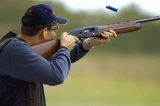
Clay pigeon shooting, formally known as Inanimate Bird Shooting, is the art of shooting at special flying targets, known as clay pigeons or clay targets, with a shotgun or any type of firearm.
The terminology commonly used by clay shooters often relates to times past, when live pigeon competitions were held. Although such competitions were made illegal in the UK in 1921, a target is still called a 'target' or 'bird', a hit is referred to as a 'hit' or 'kill', a missed target might be described as a 'bird away' and the machine which projects the targets is known as a 'trap'.
class="link1" onMouseover='showByLink("m4550333",this)' onMouseout='hide("m4550333")'href="http://www.absoluteastronomy.com/topics/Shotgun">shotgun, as defined by UK law, is a smooth barrelled gun - not being an air gun - with barrel length in excess of (24inches) and a barrel with a bore not exceeding 5.08cm (2 inches) - and either has no magazine, or a non detachable magazine incapable of holding more than two cartridges - and is not a revolver gun.
For clay pigeon shooting at CPSA registered events and CPSA affiliated grounds, the maximum permitted bore of shotguns is 12, equivalent to 0.729 inches diameter.

Discussion
Ask a question about 'Clay pigeon shooting'
Start a new discussion about 'Clay pigeon shooting'
Answer questions from other users
|
Encyclopedia
Clay pigeon shooting, formally known as Inanimate Bird Shooting, is the art of shooting at special flying targets, known as clay pigeons or clay targets, with a shotgun or any type of firearm.
The terminology commonly used by clay shooters often relates to times past, when live pigeon competitions were held. Although such competitions were made illegal in the UK in 1921, a target is still called a 'target' or 'bird', a hit is referred to as a 'hit' or 'kill', a missed target might be described as a 'bird away' and the machine which projects the targets is known as a 'trap'.
Guns
A shotgun, as defined by UK law, is a smooth barrelled gun - not being an air gun - with barrel length in excess of (24inches) and a barrel with a bore not exceeding 5.08cm (2 inches) - and either has no magazine, or a non detachable magazine incapable of holding more than two cartridges - and is not a revolver gun.
For clay pigeon shooting at CPSA registered events and CPSA affiliated grounds, the maximum permitted bore of shotguns is 12, equivalent to 0.729 inches diameter. Barrel lengths typically vary from 26 to 34 inches, and side-by-side, over and under and single barrelled two shot semi-automatics are commonly used. Pump action guns are generally considered unsuitable for clay pigeon shooting.
Cartridges
Shotgun cartridges are readily available in gun shops and at shooting grounds, and within limitations as to the shot size and the weight of the shot load are suitable for clay shooting at CPSA affiliated grounds and for use in events coming under CPSA rules. Though home loaded cartridges allow the user to customize the ballistic characteristics of their shells, they are generally not allowed at clay pigeon shooting events unless specified otherwise.
Care should be taken that cartridges to be used are compatible with the shotgun that is going to fire them. The instructions and specifications are printed on the boxes. For clay competition, shot size must not exceed 2.6 mm, English No 6. The shot load must be a maximum 28 gram (1 oz) for all domestic disciplines, or 24 gram for Olympic Trap, Olympic Skeet and Double Trap, and up to 28 gram [from 2005] for FITASC Sporting and 36g for Helice.
Clay pigeons/targets
The targets used for the sport are usually in the shape of an inverted saucer, made from a mixture of pitch and pulverized limestone rock designed to withstand being thrown from traps at very high speeds, but at the same time being easily broken when hit by just a very few lead or steel pellets shot from a shotgun.
The targets are usually fluorescent orange or black, but other colours such as white, or yellow are frequently used in order that they can be clearly seen against varying backgrounds and/or light conditions.
Clay pigeons are made to very exacting specifications with regard to their weight and dimensions and must conform to set international standards.
There are several types of targets that are used for the various disciplines, with a "standard" 108 mm size being the most common used in American Trap, Skeet, and Sporting Clays while International disciplines of these same games use a slightly larger 110 mm diameter size. Only the standard 108/110 mm target is used in all of the trap and skeet disciplines. Sporting shoots feature the full range of targets (except ZZ) to provide the variety that is a hallmark of the discipline.
All three sports use a shotgun, and in the sporting disciplines are sub-classified by the type of game the clay target represents (pigeon, rabbit, etc.). The two primary methods of projecting clay targets are airborne and ground (rolling).
Naturally, the simplest method of throwing a clay target is by hand, either into the air or along the ground. This method is the simplest, and many "trick shot" shooters throw their own targets (some able to throw as many as ten birds up and hit each individually before any land). However, a multitude of devices have been developed to throw the birds more easily and with more consistency. A plastic sling-like device is the simplest, though modern shooting ranges will usually have machines that throw the clay targets in consistent arcs at the push of a button.
- Standard: The most commonly used target of all, must weigh 105 grams and be of 110 mm overall diameter and 25-26 mm in height for International competitions and for American competitions they must weigh approximately 100 grams and be of 108 mm overall diameter and 28-29 mm in height.
- Midi: Same saucer shape as the standard but with a diameter of only 90 mm, are faster than mini and standard targets.
- Mini: This target is sometimes likened to a flying bumblebee at only 60 mm in diameter and 20 mm in height.
- Battue: A very thin, flat, wafer of a target of about 110 mm or 108 mm in diameter which flies very fast and falls off very suddenly simulating a duck landing, they are generally more expensive(2008 United States) than other targets.
- Rabbit: A standard sized 108/110 mm (but thicker) flat target in the shape of a wheel designed to run fast along the ground, if these targets get warped but heat/cold or the thrower arm gets too small they can fly in the air, people at Twin Creek gun club Shetland Ontario call these "Turkeys" .
- ZZ: This is a plastic, standard sized target attached to the center of a two-blade propeller of different colour designed to zigzag in flight in a totally unpredictable manner.
Types of Thrown Target
These are names for different types of targets thrown and rules used at Twin Creek Shooting Club Shetland Ontario, Canada. You may only load your gun with 2 shots at any time for either a single or a pair.
- Bird: Any type of target that flies. Includes Standard, Midi, mini and battue targets, when called generally means a single bird unless used in combination with other words or types of targets.
- rabbit: A rabbit, a target that rolls and usually bounces across the ground, it can sometimes go into the air and when it does it becomes known as a flying rabbit.
- flying rabbit: A rabbit target that flies into the air.
- Squirrel Slang for a rabbit that does not bounce but only rolls.
- Turkey: Slang for a rabbit target that sometimes comes out in the air and sometimes rolls and/or bounces along the ground.
- Single: one target is thrown, you may take 2 shots at it, when called alone refers to birds. If an odd amount of targets are thrown, the first target is generally a single(rarely is it thrown not as the first target because this confuses the shooters), new shooters will sometimes play games in which the trapper will only throw singles, rarely will more advanced shooter play with more singles than needed(only stations with odd amounts of targets thrown).
- Single Rabbit: subset of Single, one rabbit is thrown, you may take 2 shots at it
- Single Bird: a subset of Single, one bird is thrown, although if all birds are used it is generally just called a single. You may take 2 shots at it.
- Pair: two targets are thrown, you may take 2 shots in combination. Also can be called double almost anywhere the word pair is used(may change grammar slightly), when called generally refers to bird targets.
- True Pair: a subset of Pair, two targets bird targets thrown together, you may take 2 shots in combination, they are generally called a "Pair", this ambiguous name makes it confusing when if you are unfamiliar with the way things are called.
- Pair of Rabbits: a subset of pair, this is called when two rabbits are thrown together, you may take 2 shots in combination
- Bird-Rabbit Pair/ Rabbit-Bird Pair: When a bird or rabbit are released at the same time, rarely if ever used, very difficult targets(requires a quick shot and good eyes to find the next target)
- Nested pair: a subset of pair, two targets are thrown, a mini is put under a regular and when released simulate a bird and a young, most people find that shooting the small one first and than the larger one is easiest if attempting to hit both, however new shooters often shoot at the big one first to have a higher probability of getting at least hitting one of the two targets
- Following Pair: a subset of pair, a target is released and than another target is released soon after(generally as fast as the machine or trapper can reload another single, however not always). When called generally refers to birds.
- Rabbit following Pair: a subset of following pair, a rabbit is thrown and another rabbit is thrown(generally as fast as the machine or trapper can reload another single, however not always).
- Bird following pair: a subset of following pair, is when a following pair of birds are going to be thrown, almost only called that when rabbits are being thrown at that station.
- Bird-Rabbit following pair: a subset of following pair, a bird is thrown and than a rabbit with a timed delay as the targets are loaded in separate parts on 2 machines(with 2 trappers for manual machines, or 2 buttons for automatic machines) or on one combination machine(almost always manual by 1 trapper), rarely if ever thrown
- Rabbit-Bird following pair: a subset of following pair, same as bird-Rabbit following pair but rabbit is thrown first, rarely ever thrown, even more rare as bird-rabbit following pair and generally will confuse shooter.
- Report pair: is a subset of pair, a single target is thrown and as soon as the shooter shoots, another target is thrown, usually refers to bird targets.
- Bird-Rabbit: subset of report pair, when a bird is thrown and than a rabbit is released after the gamer takes a shot.
- Rabbit-Bird: subset of report pair, when a Rabbit is thrown and than a Birds released after the gamer takes a shot, rarely if ever used because its harder for the gamer to follow and is generally confusing.
The traps
These are purpose made, spring loaded, flywheel or rotational devices especially designed to launch the different types of targets in singles or pairs at distances of up to 100 metres.
These machines vary from the very simple, hand cocked(like the chattel one on the right) , hand loaded and hand released types to the highly sophisticated, fully automatic(like the one on the left) variety which can hold up to 600 targets in their own magazine and are electrically or pneumatically operated. Target release is by remote control either by pressing a button or by an acoustic system activated by the shooter's voice.
Target speeds and trajectories can be easily modified and varied to suit the discipline or type of shooting required.
The disciplines
Clay pigeon shooting has at least 20 different forms of regulated competition called disciplines. These can be roughly divided into three main groups:
Trap shooting
Targets are thrown either as singles or doubles from one or more traps situated some 15 m in front of the shooter and are generally going away from the firing point at varying speeds, angles and elevations. The most common disciplines in this group are:- Down-The-Line (DTL) Single Barrel, Double Rise, Automatic Ball Trap (ABT), Olympic Trap, Double Trap and Universal Trench.
Skeet shooting
Skeet is a word of Scandinavian origin, though the discipline originated in America. Targets are thrown in singles and doubles from 2 trap houses situated some 40 metres apart, at opposite ends of a semicircular arc on which there are seven shooting positions. The targets are thrown at set trajectories and speeds. The main disciplines in this group are English Skeet, Olympic Skeet and American (NSSA) Skeet.
Sporting Clays (shooting)
The English Sporting discipline has the sport's biggest following. While the other disciplines only use standard targets, in Sporting almost anything goes. Targets are thrown in a great variety of trajectories, angles, speeds, elevations and distances and the discipline was originally devised to simulate live quarry shooting, hence some of the names commonly used on Sporting stands: Springing Teal, Driven Pheasant, Bolting Rabbit, Crossing Pigeon, Dropping Duck, etc. Disciplines in this group include English Sporting, International (FITASC) Sporting, Super Sporting Sportrap and Compak Sporting.
Electrocibles or Helice shooting
Originated in Belgium during 1960's, Helice shooting is similar to Trap Shooting, but the clays are equipped with an helice that will give the clay an erratic and unpredictable flight. The helice is composed of two winged plastic propellers with a white clay in the center.
Maze Clays shooting
This is a new shotgun game that offers Sporting Clays and FITASC target presentations on a Skeet/Trap or Open field. This is possible by using a Movable Support System that carries the release buttons (wired or wireless setup) from 6 to 9 traps and the dual safety screen in any place on the field. As a result the shooter can shoot in safe conditions upon target presentations in varying range (10 to 60 yards) and varying angles (sharp to wide).
Laser clay pigeon shooting
Laser Clay Pigeon Shooting, also known as Laser Clay Shooting or even Laser Shooting, is a variation on the traditional sport of Clay Pigeon Shooting where the shotguns are disabled and fitted with laser equipment that can detect hits on specially modified reflective clays. Laser clay pigeon shooting offers a safe alternative for beginners.
The rules and disciplines are normally the same as the traditional sport using live weapons.
The activity can be done indoors. In most equipment the register of hits and misses is recorded electronically, and the sounds of the shotgun firing and the clay being hit can be played from simulated sounds. It is intended as a fun sport and can be played by children.
External links
-
-
- (UK)
-
- (USA)
-
- (USA - UAE - UK)
|
| |
|
|