

.gif)
Clave (rhythm)

Encyclopedia
The clave rhythm
ic pattern is used as a tool for temporal
organization in Afro-Cuban music, such as rumba
, conga de comparsa
, son
, son montuno
, mambo, salsa
, Latin jazz
, songo
and timba
. The five-stroke
clave pattern represents the structural core of many Afro-Cuban rhythms. Just as a keystone
holds an arch
in place, the clave pattern holds the rhythm together in Afro-Cuban music.
The clave pattern originated in sub-Saharan African music traditions
, where it serves essentially the same function as it does in Cuba. The pattern is also found in the African diaspora
musics of Haitian vodou drumming
, Afro-Brazilian music and Afro-Uruguayan music (Candombe
). The clave pattern is used in North American popular music
as a rhythmic motif
or ostinato
, or simply a form of rhythmic decoration.
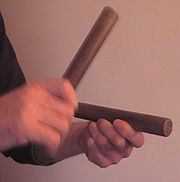 Anglicized pronunciation: clah-vay
s across much of Africa. Son and rumba clave can be played in either a triple-pulse [12/8 or 6/8] or duple-pulse [4/4, 2/4 or 2/2] structure. The contemporary Cuban practice is to write the duple-pulse clave in a single measure of 4/4. "Clave" is also written in a single measure in ethnomusicological writings about African music.
Although they subdivide the beats differently, the 12/8 and 4/4 versions of each clave share the same pulse names. The correlation between the triple-pulse and duple-pulse forms of clave, as well as other patterns, is an important dynamic of sub-Saharan-based rhythm. Every triple-pulse pattern has its duple-pulse correlative.
Son clave has strokes on: 1, 1a, 2&, 3&, 4.
12/8:
1 & a 2 & a 3 & a 4 & a ||
X . X . X . . X . X . . ||
4/4:
1 e & a 2 e & a 3 e & a 4 e & a ||
X . . X . . X . . . X . X . . . ||
Rumba clave has strokes on: 1, 1a, 2a, 3&, 4.
12/8:
1 & a 2 & a 3 & a 4 & a ||
X . X . . X . X . X . . ||
4/4:
1 e & a 2 e & a 3 e & a 4 e & a ||
X . . X . . . X . . X . X . . . ||
Both clave patterns are used in rumba. What we now call son clave (also known as Havana clave) used to be the key pattern played in Havana-style yambú and guaguancó
. Some Havana-based rumba groups still use "son clave" for yambú. The musical genre known as son probably borrowed the clave pattern from rumba when it migrated from eastern Cuba
to Havana
at the beginning of the 20th century.
, containing two rhythmically opposing halves; the first is antecedent, moving, and the second is consequent, grounded.
The second branch comes from the ethnomusicological
studies of sub-Saharan African rhythm. In 1959 Arthur Morris Jones
published his landmark work Studies in African Music. Jones identified the triple-pulse "clave" as the guide pattern for many musics, from different ethnic groups across Africa. The most important contribution of ethnomusicology to clave theory is the understanding that the clave matrix is generated by cross-rhythm.
The third branch comes from the United States. Ironically, there are more books published about Cuban-based music in the US than in Cuba itself. Perhaps because North Americans come to the music as outsiders, there has been more of a need to explain the intricacies of the music. The most important North American contribution to clave theory is the worldwide propagation of the 3-2/2-3 concept and terminology, which arose from the fusion of Cuban rhythms with jazz in New York
City.
Only in the last couple of decades have these three branches of clave theory begun to reconcile their shared and conflicting concepts. This article addresses the main tenets of each branch of clave theory, where they coincide and where they differ.
clave, named after the Cuban musical genre of the same name.
Clave is the basic period (music)
, composed of two rhythmically opposed cells, one antecedent and the other consequent. Clave was initially written in two measures of 2/4 in Cuban music. When written this way, each cell or clave half is represented within a single measure.
The antecedent half has three strokes and is called the three-side of clave. In Cuban popular music, the first three strokes of son clave are also known collectively as tresillo
, a Spanish word meaning 'triplet' (three equal beats in the same time as two main beats). However, in the vernacular of Cuban popular music, the term refers to the figure shown below.
The consequent half (second measure above) of clave has two strokes and is called the two-side.
(2/2); this is most likely the influence of jazz conventions. When clave is written in two measures changing from one clave sequence to the other is a matter of reversing the order of the measures.
The 3-2/2-3 concept and terminology was developed in New York City during the 1940s by Cuban-born Mario Bauza
while he was the music director of Machito
and his Afro-Cubans. Bauzá was a master at moving the song from one side of clave to the other (for example: "Que vengan los rumberos"). Tito Puente
learned the concept from Bauzá. Tito Puente's "Philadelphia Mambo" is an example of a song that moves from one side of clave to the other. The technique eventually became a staple of composing and arranging in salsa and Latin jazz.
Within the 3-2/2-3 framework, the harmonic structure is the prime referent, rather than clave. Cuban folkloric musicians do not use the 3-2/2-3 system. Many Cuban performers of popular music do not use it either. The great Cuban conga player and band leader Mongo Santamaria
said: "Don’t tell me about 3-2 or 2-3! In Cuba we just play. We feel it, we don’t talk about such things." "In Cuba we don’t think about [clave]. We know that we’re in clave. Because we know that we have to be in clave to be a musician." According to Cuban pianist Sonny Bravo
, the late Charlie Palmieri
would insist: "There’s no such thing as 3-2 or 2-3, there’s only one clave!" The contemporary Cuban bassist, composer and arranger Alain Pérez flatly states: "In Cuba we do not use that 2-3, 3-2 formula . . . 2-3, 3-2 [is] not used in Cuba. That is how people learn Cuban music outside Cuba."
. Use of the triple-pulse form of rumba clave in Cuba can be traced back to the iron bell (ekón) part in abakuá
music. The form of rumba known as columbia is culturally and musically connected with abakuá. Columbia also uses this pattern. Sometimes 12/8 rumba clave is clapped in the accompaniment
of Cuban batá drums
. The 4/4 form of rumba clave is used in yambú, guaguancó and popular music.
There is some debate as to how the 4/4 rumba clave should be notated for guaguancó and yambú. In actual practice, the third stroke on the three-side and the first stroke on the two-side often fall in rhythmic positions that do not fit neatly into music notation. Triple-pulse strokes can be substituted for duple-pulse strokes. Also the clave strokes are sometimes displaced in such a way that they don't fall within either a triple-pulse or duple-pulse "grid." Therefore, many variations are possible.
When used in popular music (such as songo
, timba
or Latin jazz) rumba clave can be perceived in either a 3-2 or 2-3 sequence. The example below shows rumba clave in 3-2 and 2-3 sequence, written in cut-time as it would be typically represented in a North American salsa or Latin jazz chart.
The first regular use of rumba clave in Cuban popular music began with the mozambique (music)
, created by Pello el Afrokan in the early 1960s.
The standard pattern has strokes on: 1, 1a, 2& 2a, 3&, 4, 4a.
12/8:
1 & a 2 & a 3 & a 4 & a ||
X . X . X X . X . X . X ||
4/4:
1 e & a 2 e & a 3 e & a 4 e & a ||
X . . X . . X X . . X . X . . X ||
The ethnomusicologist A.M. Jones observes that what we call son clave, rumba clave and the standard pattern are the most commonly used key patterns (also called bell patterns, timeline patterns and guide patterns) in Sub-Saharan African music traditions
and he considers all three to be basically one and the same pattern. Clearly, they are all expressions of the same rhythmic principles. The three key patterns are found within a large geographic belt extending from Mali
in northwest Africa
to Mozambique
in southeast Africa.
Conversely, in salsa and Latin jazz, especially as played in North America, 4/4 is the basic framework and 6/8 is considered something of a novelty and in some cases, an enigma. The cross-rhythmic structure (multiple beat schemes) is frequently misunderstood to be metrically ambiguous. North American musicians often refer to Afro-Cuban 6/8 rhythm as a feel, a term usually reserved for those aspects of musical nuance not practically suited for analysis. As used by North American musicians, "6/8 clave" can refer to one of three types of triple-pulse key patterns.
1 & a 2 & a |1 & a 2 & a ||
X . X . . X |. X . X . . ||
Because 6/8 clave-based music is generated from cross-rhythm, it is possible to count or “feel” the 6/8 clave in several different ways. The ethnomusicologist A.M. Jones correctly identified the importance of this key pattern, but he mistook its accents as indicators of meter rather than the counter-metric phenomena they actually are. Similarly, while Anthony King identified the triple-pulse "son clave" as the ‘standard pattern’ in its simplest and most basic form, he did not correctly identify its metric structure.
It wasn't until African musicologists like C.K. Ladzekpo entered into the discussion in the 1970s and 80s that the metric structure of sub-Saharan rhythm was unambiguously defined. The writings of Victor Kofi Agawu and David Locke must also be mentioned in this regard.
In the diagram below 6/8 (son) clave is shown on top and a beat cycle is shown below it. Any or all of these structures may be the emphasis at a given point in a piece of music using the "6/8 clave."
The example on the left (6/8) represents the correct count and ground of the "6/8 clave." The four dotted quarter-notes across the two bottom measures are the main beats. All clave patterns are built upon four main beats. The bottom measures on the other two examples (3/2 and 6/4) show cross-beats. Observing the dancer’s steps almost always reveals the main beats of the music. Because the main beats are usually emphasized in the steps and not the music, it is often difficult for an "outsider" to feel the proper metric structure without seeing the dance component.
was developed in the western part of Cuba, particularly the cities of Matanzas
and Havana
. Some writings have claimed that the clave patterns originated in Cuba. One frequently repeated theory is that the triple-pulse African bell patterns morphed into duple-pulse forms as a result of the influence of European musical sensibilities. "The duple meter feel [of 4/4 rumba clave] may have been the result of the influence of marching bands and other Spanish styles . . ."— Washburne (1995).
However, the duple-pulse forms have existed in sub-Saharan Africa for centuries. The patterns the Cubans call clave are two of the most common bell parts used in Sub-Saharan African music traditions
. Natalie Curtis
, A.M. Jones, Anthony King and John Collins
document the triple-pulse forms of what we call “son clave” and “rumba clave” in West, Central and East Africa. Francis Kofi and C.K. Ladzekpo document several Ghana
ian rhythms that use the triple or duple-pulse forms of "son clave." Royal Harington identifies the duple-pulse form of "rumba clave" as a bell pattern used by the Yoruba
and Ibo of Nigeria
, West Africa. There are many recordings of traditional African music where one can hear the five-stroke "clave" used as a bell pattern.
in North Africa to Indonesia
in South Asia is the single-celled figure the Cubans call tresillo:
Tresillo is used in many different types of music across the entire continent of Africa. Use of the pattern in Moroccan music can be traced back to slaves brought north across the Sahara Desert from present-day Mali
. This pattern may have migrated east from North Africa to Asia through the spread of Islam
.
African-based music has a divisive rhythm structure. Tresillo is generated through cross-rhythm: 8 pulses ÷ 3 = 2 cross-beats (consisting of three pulses each), with a remainder of a partial cross-beat (spanning two pulses). In other words, 8 ÷ 3 = 2, r2.
In Middle East and Asian music the figure is generated through additive rhythm
, 3+3+2:
In divisive form, the strokes of tresillo contradict the beats. In additive form, the strokes of tresillo are the beats. From a metrical perspective then, the two ways of perceiving tresillo constitute two different rhythms. On the other hand, from the perspective of simply the pattern of attack-points, tresillo is a shared element of traditional folk music from the northwest tip of Africa to southeast tip of Asia. Today through the global spread if hip-hop music we hear the tresillo bass drum superimposed over traditional genres in dance clubs across the vast Africa-Asia "tresillo-belt."
and Congolese
slaves. Therefore, it is not surprising that we find the bell pattern the Cubans call clave in the Afro-Brazilian musics of Candomblé
, Macumba
and Maculelê (dance)
. "Son clave" and "rumba clave" are also used as a tamborim
part in some batucada
arrangements. Although a few contemporary Brazilian musicians have adopted the 3-2/2-3 terminology, it is traditionally not a part of the Brazilian rhythmic concept.
music. The pattern is shown below in 2/4, as it is written in Brazil. In North American charts it is more likely to be written in cut-time.
According to drummer Bobby Sanabria
the Brazilian composer Antonio Carlos Jobim
, who developed the pattern, considers it to be merely a rhythmic motif and not a clave (guide pattern). Jobim later regretted that Latino musicians misunderstood the role of this bossa nova pattern.
Legend: Time signature: 2/4; L=low bell, H=high bell, O = open surdo hit, X = muffled surdo hit, and | divides the measure:
For 3rd example above, the clave pattern is based on a common accompaniment pattern played by the guitarist. B=bass note played by guitarist's thumb, C=chord played by fingers.
&|1 & 2 & 3 & 4 &|1 & 2 & 3 & 4 &||
C|B C . C B . C .|B . C . B C . C||
The singer enters on the wrong side of the clave and the ago-gô player adjusts accordingly. This recording cuts off the first bar so that it sounds like the bell comes in on the third beat of the second bar. This is suggestive of a pre-determined rhythmic relationship between the vocal part and the percussion, and supports the idea of a clave-like structure in Brazilian music.
. Just as likely however is the possibility that claves and the clave rhythm spread to Jamaica, Trinidad and the other small islands of the Caribbean through the popularity of Cuban son recordings from the 1920s onward.
, R&B, rock and roll
, funk
and hip-hop) since the 1920s. One of its earliest manifestations was the Charleston
dance and James P. Johnson
's "Charleston
" song. The song's driving rhythm, basically the first bar of a 3 2 clave, came to have widespread use in jazz
and is still referenced by name by musicians.
(known outside of Cuba as the habanera
). Musicians from Havana
and New Orleans would take the twice-daily ferry between both cities to perform and not surprisingly, the habanera quickly took root in the musically fertile Crescent City. Whether tresillo was directly transplanted from Cuba, or if the habanera merely reinforced tresillo-like "rhythmic tendencies" already present in New Orleans music is probably impossible to determine. There are examples of tresillo-like rhythms in a few African American folk musics such as the foot stomping patterns in ring shout
and the post-Civil War drum and fife music. Tresillo is also heard prominently in New Orleans second line music.
The symphonic work "A Night in the Tropics" (1860) by New Orleans musician Louis Moreau Gottschalk
was influenced by the composer's studies in Cuba. Because of the popularity of the habanera, the tresillo pattern and a variant known as the habanera rhythm were adopted into European art music. For example Georges Bizet
's opera Carmen
(1874) has a famous habanera movement.
The habanera rhythm (above) consists of tresillo combined with the second main beat (known in North America as the backbeat
). The habanera is also known as the congo, tango-congo, and tango.
Tresillo and the habanera are two of the most fundamental rhythmic motifs of ragtime
. Early ragtime pianists would buy habanera sheet music and then interpret them as ragtime pieces. Scott Joplin
's "Solace
" (1909) is considered a habanera. For the more than quarter-century in which the cakewalk
, ragtime and proto-jazz were forming and developing, the habanera was a consistent part of African American popular music. Early New Orleans jazz bands had habaneras in their repertoire and the tresillo/habanera was a rhythmic staple of jazz at the turn of the 20th century. For example "St. Louis Blues" (1914) by W.C. Handy has a tresillo bass line. Jelly Roll Morton
considered the tresillo/habanera (which he called the Spanish tinge
) to be an essential ingredient of jazz. The two rhythmic figures can be heard in his left hand on songs like "The Crave" (1910, recorded 1938).
James P. Johnson
's influential "Charleston
" rhythm is based on tresillo. Johnson said he learned the rhythm from dockworkers in the South Carolina
city of the same name. Although the exact origins of jazz syncopation may never be known, there’s evidence that the habanera/tresillo was there at its conception. Buddy Bolden
, the first known jazz musician, is credited with creating the big four, a tresillo/habanera-based pattern. The big four (below) was the first syncopated bass drum pattern to deviate from the standard on-the-beat march. As the example below shows, the second half of the big four pattern is the habanera rhythm.
In the late 1940s R&B music borrowed tresillo directly from Cuban music.
In a 1988 interview with Robert Palmer (writer), Bartholomew revealed how he initially superimposed tresillo over swing rhythm.
Bartholomew referred to son by the misnomer rumba, a common practice of that time. On Bartholomew's 1949 tresillo-based "Oh Cubanas" we clearly hear an attempt to blend African American and Afro-Cuban music.
was "re-Africanized," through the borrowing of figures like clave and instruments like the conga drum, maracas
and claves
. Although clave-like phrases are found in early twentieth-century African American music, the use of the clave pattern as a dominant rhythmic motif does not appear until the 1940s and 50s, coinciding with the rising popularity of Cuban music in the U.S.
The first jazz song to be overtly based in-clave was "Tanga" (1942) by Mario Bauza
. Bauzá introduced be-bop innovator Dizzy Gillespie
to the Cuban conga drummer Chano Pozo
. The short musical collaboration of Gillespie and Pozo introduced Cuban rhythms into mainstream jazz. However, their groundbreaking experiments did not always mesh rhythmically. For example, in their 1948 performance of "Manteca" the clave pattern is played in 3-2, while the rest of the band is in 2-3. The best attempts at superimposing jazz over a clave-based structure in the 1950s were perhaps achieved by Machito
and his Afro-Cubans' big band (under the musical direction of Mario Bauzá) and the smaller Latin jazz combos of Cal Tjader
(featuring drummers Mongo Santamaria
, Armando Peraza
and Willie Bobo
).
In response to the popularity of the mambo, New Orleans musicians such as Dave Bartholomew and Professor Longhair
incorporated Cuban instruments, as well as the clave pattern and related two-celled figures in songs such as "Carnival Day," (Bartholomew 1949) and "Mardi Gras In New Orleans" (Longhair). While some of these early experiments were awkward fusions, it wasn't long before the Afro-Cuban elements were integrated into the New Orleans sound.
The "Bo Diddley
beat" (1955) is perhaps the first true fusion of clave and R&B/rock 'n' roll. It remains unclear where Bo Diddley first heard the rhythm. According to Bo Diddley himself in an interview published in French music magazine Best in 1990, his inspiration was American spirituals. Johnny Otis
' "Willie and the Hand Jive" is another example of this successful blend. The song "Little Darling" is also built around clave. The bass riffs of "China Grove
" by the Doobie Brothers use clave. The bass line in the 1973 arrangement of Herbie Hancock
's "Watermelon Man" (from the album Head Hunters
) is based on "son" clave. The Macarena
uses clave. There are hundreds of other examples throughout jazz and popular music.
context.
Dafnis Prieto About the Monks (Zoho).
Sebastian Schunke Symbiosis (Pimienta Records).
Paoli Mejias Mi Tambor (JMCD).
John Benitez Descarga in New York (Khaeon).
Deep Rumba A Calm in the Fire of Dances (American Clave).
Nachito Herrera Bembe en mi casa (FS Music).
Bobby Sanabria Quarteto Aché (Zoho).
Julio Barretto Iyabo (3d).
Michel Camilo Triangulo (Telarc).
Samuel Torres Skin Tones (www.samueltorres.com).
Horacio "el Negro" Hernandez Italuba (Universal Latino).
Tony Lujan Tribute (Bella Records).
Edward Simon La bikina (Mythology).
Jorge Sylvester In the Ear of the Beholder (Jazz Magnet).
Rhythm
Rhythm may be generally defined as a "movement marked by the regulated succession of strong and weak elements, or of opposite or different conditions." This general meaning of regular recurrence or pattern in time may be applied to a wide variety of cyclical natural phenomena having a periodicity or...
ic pattern is used as a tool for temporal
Meter (music)
Meter or metre is a term that music has inherited from the rhythmic element of poetry where it means the number of lines in a verse, the number of syllables in each line and the arrangement of those syllables as long or short, accented or unaccented...
organization in Afro-Cuban music, such as rumba
Rumba
Rumba is a family of percussive rhythms, song and dance that originated in Cuba as a combination of the musical traditions of Africans brought to Cuba as slaves and Spanish colonizers. The name derives from the Cuban Spanish word rumbo which means "party" or "spree". It is secular, with no...
, conga de comparsa
Comparsa
A comparsa is the band which plays a conga during a Latin American Carnival celebration. It consists of a large group of dancers dancing and traveling on the streets, followed by a Carrosa where the musicians play...
, son
Son (music)
The Son cubano is a style of music that originated in Cuba and gained worldwide popularity in the 1930s. Son combines the structure and elements of Spanish canción and the Spanish guitar with African rhythms and percussion instruments of Bantu and Arará origin...
, son montuno
Son montuno
The son montuno is a style of the Cuban son, but exactly what it means is not an easy question to answer. The son itself is the most important genre of Cuban popular music. In addition, it is perhaps the most flexible of all forms of Latin-American music...
, mambo, salsa
Salsa music
Salsa music is a genre of music, generally defined as a modern style of playing Cuban Son, Son Montuno, and Guaracha with touches from other genres of music...
, Latin jazz
Latin jazz
Latin jazz is the general term given to jazz with Latin American rhythms.The three main categories of Latin Jazz are Brazilian, Cuban and Puerto Rican:# Brazilian Latin Jazz includes bossa nova...
, songo
Songo music
Songo is a type of Cuban music originating in Havana which combines elements from the rumba, son Cubano, and other contemporary afro-American styles like jazz and funk...
and timba
Timba
Timba is a Cuban genre of music sometimes referred as salsa cubana . However, the historical development of timba has been quite independent of the development of salsa in the United States and Puerto Rico and the music has its own trademark aspects due to the Cuban embargo and strong Afro-Cuban...
. The five-stroke
Drum stroke
In music, a drum stroke is a note performed on percussion instruments known as a drum. There are four basic strokes.The Full Stroke begins with the tip of the drumstick held 8-12" above the striking surface...
clave pattern represents the structural core of many Afro-Cuban rhythms. Just as a keystone
Keystone (architecture)
A keystone is the wedge-shaped stone piece at the apex of a masonry vault or arch, which is the final piece placed during construction and locks all the stones into position, allowing the arch to bear weight. This makes a keystone very important structurally...
holds an arch
Arch
An arch is a structure that spans a space and supports a load. Arches appeared as early as the 2nd millennium BC in Mesopotamian brick architecture and their systematic use started with the Ancient Romans who were the first to apply the technique to a wide range of structures.-Technical aspects:The...
in place, the clave pattern holds the rhythm together in Afro-Cuban music.
The clave pattern originated in sub-Saharan African music traditions
Sub-Saharan African music traditions
Sub-Saharan African music traditions exhibit so many common features that they may in some respects be thought of as constituting a single musical system. While some African music is clearly contemporary-popular music and some is art-music, still a great deal is communal and orally transmitted...
, where it serves essentially the same function as it does in Cuba. The pattern is also found in the African diaspora
African diaspora
The African diaspora was the movement of Africans and their descendants to places throughout the world—predominantly to the Americas also to Europe, the Middle East and other places around the globe...
musics of Haitian vodou drumming
Haitian vodou drumming
In Haiti, Vodou ceremonies and drumming are inextricably linked. While drumming does exist in other contexts in the country, by far the richest traditions come from this distinctly Haitian religion. As such, before one can come to play, appreciate, and understand this music one should view it in...
, Afro-Brazilian music and Afro-Uruguayan music (Candombe
Candombe
Candombe is a musical genre that has its roots in the African Bantu, and is proper of Uruguay, Argentina and Brazil .Uruguayan Candombe is the most practiced and spread internationally and has been recognized by UNESCO as Intangible Cultural Heritage of Humanity...
). The clave pattern is used in North American popular music
American popular music
American popular music had a profound effect on music across the world. The country has seen the rise of popular styles that have had a significant influence on global culture, including ragtime, blues, jazz, swing, rock, R&B, doo wop, gospel, soul, funk, heavy metal, punk, disco, house, techno,...
as a rhythmic motif
Motif (music)
In music, a motif or motive is a short musical idea, a salient recurring figure, musical fragment or succession of notes that has some special importance in or is characteristic of a composition....
or ostinato
Ostinato
In music, an ostinato is a motif or phrase, which is persistently repeated in the same musical voice. An ostinato is always a succession of equal sounds, wherein each note always has the same weight or stress. The repeating idea may be a rhythmic pattern, part of a tune, or a complete melody in...
, or simply a form of rhythmic decoration.
Etymology
Clave is a Spanish word meaning 'code,' 'key,' as in key to a mystery or puzzle, or 'keystoneKeystone (architecture)A keystone is the wedge-shaped stone piece at the apex of a masonry vault or arch, which is the final piece placed during construction and locks all the stones into position, allowing the arch to bear weight. This makes a keystone very important structurally...
,' the wedge-shaped stone in the center of an arch that ties the other stones together. Clave is also the name of the patterns played on clavesClavesClaves are a percussion instrument , consisting of a pair of short Claves (Anglicized pronunciation: clah-vays, IPA:[ˈklαves]) are a percussion instrument (idiophone), consisting of a pair of short Claves (Anglicized pronunciation: clah-vays, IPA:[ˈklαves]) are a percussion instrument (idiophone),...
; two hardwood sticks used in Afro-Cuban music ensembles.—Peñalosa (2009: 81)
The key to Afro-Cuban rhythm
The two main clave patterns used in Afro-Cuban music outside Cuba are the son clave and the rumba clave. Both are used as bell patternBell pattern
A bell pattern is a rhythmic pattern, often a key pattern , performed on metal bells such as an agogô, gankoqui, cowbell or similar percussion instruments such as the metal shell of the timbales or drum kit cymbal.-sub-Saharan African music:The use of iron bells in sub-Saharan African music is...
s across much of Africa. Son and rumba clave can be played in either a triple-pulse [12/8 or 6/8] or duple-pulse [4/4, 2/4 or 2/2] structure. The contemporary Cuban practice is to write the duple-pulse clave in a single measure of 4/4. "Clave" is also written in a single measure in ethnomusicological writings about African music.
Although they subdivide the beats differently, the 12/8 and 4/4 versions of each clave share the same pulse names. The correlation between the triple-pulse and duple-pulse forms of clave, as well as other patterns, is an important dynamic of sub-Saharan-based rhythm. Every triple-pulse pattern has its duple-pulse correlative.
Son clave has strokes on: 1, 1a, 2&, 3&, 4.
12/8:
1 & a 2 & a 3 & a 4 & a ||
X . X . X . . X . X . . ||
4/4:
1 e & a 2 e & a 3 e & a 4 e & a ||
X . . X . . X . . . X . X . . . ||
Rumba clave has strokes on: 1, 1a, 2a, 3&, 4.
12/8:
1 & a 2 & a 3 & a 4 & a ||
X . X . . X . X . X . . ||
4/4:
1 e & a 2 e & a 3 e & a 4 e & a ||
X . . X . . . X . . X . X . . . ||
Both clave patterns are used in rumba. What we now call son clave (also known as Havana clave) used to be the key pattern played in Havana-style yambú and guaguancó
Guaguancó
Guaguancó is a sub-genre of Cuban rumba, a complex rhythmic music and dance style. The traditional line-up consists of:* three drums, similar to conga drums: the tumba , llamador , and quinto...
. Some Havana-based rumba groups still use "son clave" for yambú. The musical genre known as son probably borrowed the clave pattern from rumba when it migrated from eastern Cuba
Cuba
The Republic of Cuba is an island nation in the Caribbean. The nation of Cuba consists of the main island of Cuba, the Isla de la Juventud, and several archipelagos. Havana is the largest city in Cuba and the country's capital. Santiago de Cuba is the second largest city...
to Havana
Havana
Havana is the capital city, province, major port, and leading commercial centre of Cuba. The city proper has a population of 2.1 million inhabitants, and it spans a total of — making it the largest city in the Caribbean region, and the most populous...
at the beginning of the 20th century.
During the nineteenth century, African music and European music sensibilities were blended together in original Cuban hybrids. Cuban popular music became the conduit through which sub-Saharan rhythmic elements were first codified within the context of European ('Western') music theoryMusic theoryMusic theory is the study of how music works. It examines the language and notation of music. It seeks to identify patterns and structures in composers' techniques across or within genres, styles, or historical periods...
. The first written music rhythmically based on clave was the Cuban danzónDanzónDanzón is the official dance of Cuba. It is also an active musical form in Mexico and is still beloved in Puerto Rico where Verdeluz, a modern danzón by Puerto Rican composer Antonio Cabán Vale is considered the unofficial national anthem...
, which premiered in 1879. The contemporary concept of clave with its accompanying terminology reached its full development in Cuban popular music during the 1940s. Its application has since spread to folkloric music as well. In a sense, the Cubans standardized their myriad rhythms, both folkloric and popular, by relating nearly all of them to the clave pattern. The veiled code of African rhythm was brought to light due to clave’s omnipresence. Consequently, the term clave has come to mean both the five-stroke pattern and the total matrix it exemplifies. In other words, the rhythmic matrix is the clave matrix. Clave is the key that unlocks the enigma; it de-codes the rhythmic puzzle. It’s commonly understood that the actual clave pattern does not need to be played in order for the music to be 'in clave.'—Peñalosa (2009: 81)
One of the most difficult applications of the clave is in the realm of composition and arrangement of Cuban and Cuban-based dance music. Regardless of the instrumentation, the music for all of the instruments of the ensemble must be written with a very keen and conscious rhythmic relationship to the clave . . . Any ‘breaks’ and/or ‘stops’ in the arrangements must also be ‘in clave’. If these procedures are not properly taken into consideration, then the music is 'out of clave' which, if not done intentionally, is considered an error. When the rhythm and music are ‘in clave,’ a great natural ‘swing’ is produced, regardless of the tempo. All musicians who write and/or interpret Cuban-based music must be ‘clave conscious,’ not just the percussionists.—Santos (1986: 32)
Clave theory
There are three main branches of what could be called clave theory. First is the set of concepts and related terminology, which were created and developed, in Cuban popular music from the mid-19th to mid-20th centuries. In Popular Cuban Music (1939), Emilio Grenet defined in general terms, how the duple-pulse clave pattern guided all members of the music ensemble. The most important Cuban contribution to this branch of music theory is the concept of the clave as the period (music)Period (music)
In music, a period is a group of phrases consisting usually of at least one antecedent phrase and one consequent phrase totaling about 8 measures in length . Generally, the antecedent ends in a weaker and the consequent in a stronger cadence; often, the antecedent ends in a half cadence while the...
, containing two rhythmically opposing halves; the first is antecedent, moving, and the second is consequent, grounded.
The second branch comes from the ethnomusicological
Ethnomusicology
Ethnomusicology is defined as "the study of social and cultural aspects of music and dance in local and global contexts."Coined by the musician Jaap Kunst from the Greek words ἔθνος ethnos and μουσική mousike , it is often considered the anthropology or ethnography of music...
studies of sub-Saharan African rhythm. In 1959 Arthur Morris Jones
Arthur Morris Jones
Arthur Morris Jones , was a missionary and musicologist who worked in Zambia during the early 20th century. He was stationed at St Mark's School in Mapanza in the Southern Province of present-day Zambia . He is best known for his ethnomusicological work, particularly his two-volume Studies in...
published his landmark work Studies in African Music. Jones identified the triple-pulse "clave" as the guide pattern for many musics, from different ethnic groups across Africa. The most important contribution of ethnomusicology to clave theory is the understanding that the clave matrix is generated by cross-rhythm.
The third branch comes from the United States. Ironically, there are more books published about Cuban-based music in the US than in Cuba itself. Perhaps because North Americans come to the music as outsiders, there has been more of a need to explain the intricacies of the music. The most important North American contribution to clave theory is the worldwide propagation of the 3-2/2-3 concept and terminology, which arose from the fusion of Cuban rhythms with jazz in New York
New York
New York is a state in the Northeastern region of the United States. It is the nation's third most populous state. New York is bordered by New Jersey and Pennsylvania to the south, and by Connecticut, Massachusetts and Vermont to the east...
City.
Only in the last couple of decades have these three branches of clave theory begun to reconcile their shared and conflicting concepts. This article addresses the main tenets of each branch of clave theory, where they coincide and where they differ.
Son clave
The most common clave pattern used in Cuban popular music is called the sonSon (music)
The Son cubano is a style of music that originated in Cuba and gained worldwide popularity in the 1930s. Son combines the structure and elements of Spanish canción and the Spanish guitar with African rhythms and percussion instruments of Bantu and Arará origin...
clave, named after the Cuban musical genre of the same name.
Clave is the basic period (music)
Period (music)
In music, a period is a group of phrases consisting usually of at least one antecedent phrase and one consequent phrase totaling about 8 measures in length . Generally, the antecedent ends in a weaker and the consequent in a stronger cadence; often, the antecedent ends in a half cadence while the...
, composed of two rhythmically opposed cells, one antecedent and the other consequent. Clave was initially written in two measures of 2/4 in Cuban music. When written this way, each cell or clave half is represented within a single measure.
Tresillo
Anglicized pronunciation: tray-see-yo.The antecedent half has three strokes and is called the three-side of clave. In Cuban popular music, the first three strokes of son clave are also known collectively as tresillo
Tresillo
Tresillo is a letter of the Latin alphabet, based on the numeral 3. It was invented by Jesuit missionaries in the 16th century in order to represent the uvular ejective consonant found in Mayan languages....
, a Spanish word meaning 'triplet' (three equal beats in the same time as two main beats). However, in the vernacular of Cuban popular music, the term refers to the figure shown below.
The consequent half (second measure above) of clave has two strokes and is called the two-side.
Going only slightly into the rhythmic structure of our music we find that all its melodic design is constructed on a rhythmic pattern of two measures, as though both were only one, the first is antecedent, strong, and the second is consequent, weak.—Grenet (1939)
[With] clave . . . the two measures are not at odds, but rather, they are balanced opposites like positive and negative, expansive and contractive or the poles of a magnet. As the pattern is repeated, an alternation from one polarity to the other takes place creating pulse and rhythmic drive. Were the pattern to be suddenly reversed, the rhythm would be destroyed as in a reversing of one magnet within a series. . .the patterns are held in place according to both the internal relationships between the drums and their relationship with clave. . .Should the drums fall out of clave (and in contemporary practice they sometimes do) the internal momentum of the rhythm will be dissipated and perhaps even broken.—Amira and Cornelius (1992: 23, 24)
"3-2"/"2-3" clave concept and terminology
In Cuban popular music, a chord progression can begin on either side of clave. When the progression begins on the three-side, the song or song section is said to be in 3-2 clave. When the chord progression begins on the two-side, it is in 2-3 clave. In North America, salsa and Latin jazz charts commonly represent clave in two measures of cut-timeAlla breve
In music, alla breve Italian: at the breve] refers to a musical meter notated by the time signature symbol , which is the equivalent of 2/2. Alla breve is a "simple-duple meter with a half-note pulse"...
(2/2); this is most likely the influence of jazz conventions. When clave is written in two measures changing from one clave sequence to the other is a matter of reversing the order of the measures.
The 3-2/2-3 concept and terminology was developed in New York City during the 1940s by Cuban-born Mario Bauza
Mario Bauza
Mario Bauzá was an important Cuban musician. He was one of the first to introduce Latin music to the United States by bringing Cuban musical styles into the New York jazz scene...
while he was the music director of Machito
Machito
Machito , born as Francisco Raúl Gutiérrez Grillo, was an influential Latin jazz musician who helped refine Afro-Cuban jazz and create both Cubop and salsa music...
and his Afro-Cubans. Bauzá was a master at moving the song from one side of clave to the other (for example: "Que vengan los rumberos"). Tito Puente
Tito Puente
Tito Puente, , born Ernesto Antonio Puente, was a Latin jazz and Salsa musician. The son of native Puerto Ricans Ernest and Ercilia Puente, of Spanish Harlem in New York City, Puente is often credited as "El Rey de los Timbales" and "The King of Latin Music"...
learned the concept from Bauzá. Tito Puente's "Philadelphia Mambo" is an example of a song that moves from one side of clave to the other. The technique eventually became a staple of composing and arranging in salsa and Latin jazz.
Within the 3-2/2-3 framework, the harmonic structure is the prime referent, rather than clave. Cuban folkloric musicians do not use the 3-2/2-3 system. Many Cuban performers of popular music do not use it either. The great Cuban conga player and band leader Mongo Santamaria
Mongo Santamaría
Ramón "Mongo" Santamaría Rodríguez was an Afro-Cuban Latin jazz percussionist. He is most famous for being the composer of the jazz standard "Afro Blue," recorded by John Coltrane among others. In 1950 he moved to New York where he played with Perez Prado, Tito Puente, Cal Tjader, Fania All...
said: "Don’t tell me about 3-2 or 2-3! In Cuba we just play. We feel it, we don’t talk about such things." "In Cuba we don’t think about [clave]. We know that we’re in clave. Because we know that we have to be in clave to be a musician." According to Cuban pianist Sonny Bravo
Sonny Bravo
Sonny Bravo , born Elio Osacar, is an Afro-Cuban jazz and Latin jazz pianist. He was once a very good baseball player with many prospects born in New York, New York, though due to an injury in 1956 he sought out a career in music. It was then he started performing with Many Campo, El Casino de...
, the late Charlie Palmieri
Charlie Palmieri
Charlie Palmieri was a renowned Bandleader and musical director of salsa music. He was known as "The Giant of the Keyboards".-Early years:...
would insist: "There’s no such thing as 3-2 or 2-3, there’s only one clave!" The contemporary Cuban bassist, composer and arranger Alain Pérez flatly states: "In Cuba we do not use that 2-3, 3-2 formula . . . 2-3, 3-2 [is] not used in Cuba. That is how people learn Cuban music outside Cuba."
Rumba clave
The other main clave pattern is the rumba clave. Rumba clave is the key pattern used in rumbaCuban Rumba
In Cuban music, Rumba is a generic term covering a variety of musical rhythms and associated dances. The rumba has its influences in the music brought to Cuba by Africans brought to Cuba as slaves as well as Spanish colonizers...
. Use of the triple-pulse form of rumba clave in Cuba can be traced back to the iron bell (ekón) part in abakuá
Abakuá
Abakua or Abakuá is an Afro-Cuban men's initiatory fraternity, or secret society, which originated from fraternal associations in the Cross River region of southeastern Nigeria and southwestern Cameroon...
music. The form of rumba known as columbia is culturally and musically connected with abakuá. Columbia also uses this pattern. Sometimes 12/8 rumba clave is clapped in the accompaniment
Accompaniment
In music, accompaniment is the art of playing along with an instrumental or vocal soloist or ensemble, often known as the lead, in a supporting manner...
of Cuban batá drums
Batá drums
A Batá drum is a double-headed drum shaped like an hourglass with one cone larger than the other. The percussion instrument is used primarily for the use of religious or semi-religious purposes for the native culture from the land of Yoruba, located in Nigeria, as well as by worshippers of...
. The 4/4 form of rumba clave is used in yambú, guaguancó and popular music.
There is some debate as to how the 4/4 rumba clave should be notated for guaguancó and yambú. In actual practice, the third stroke on the three-side and the first stroke on the two-side often fall in rhythmic positions that do not fit neatly into music notation. Triple-pulse strokes can be substituted for duple-pulse strokes. Also the clave strokes are sometimes displaced in such a way that they don't fall within either a triple-pulse or duple-pulse "grid." Therefore, many variations are possible.
When used in popular music (such as songo
Songo
Songo may refer to:* Songo music, a type of contemporary Cuban music originating in Havana* Songo people, of northern Angola* Songo-salsa, a style of music that blends Spanish rapping and hip hop beats with salsa music and songo- Places :...
, timba
Timba
Timba is a Cuban genre of music sometimes referred as salsa cubana . However, the historical development of timba has been quite independent of the development of salsa in the United States and Puerto Rico and the music has its own trademark aspects due to the Cuban embargo and strong Afro-Cuban...
or Latin jazz) rumba clave can be perceived in either a 3-2 or 2-3 sequence. The example below shows rumba clave in 3-2 and 2-3 sequence, written in cut-time as it would be typically represented in a North American salsa or Latin jazz chart.
The first regular use of rumba clave in Cuban popular music began with the mozambique (music)
Mozambique (music)
Mozambique is a vigorous style of Cuban music and dance derived, like the conga, from music of Cuban street carnivals or comparsas. It was invented or developed by Pello el Afrokan in 1963...
, created by Pello el Afrokan in the early 1960s.
Standard bell pattern
The seven-stroke standard bell pattern contains the strokes of both clave patterns. Some North American musicians call this pattern clave. Other North American musicians refer to the triple-pulse form as the 6/8 bell because they write the pattern in two measures of 6/8. Like clave, the standard pattern is expressed in both triple and duple-pulse.The standard pattern has strokes on: 1, 1a, 2& 2a, 3&, 4, 4a.
12/8:
1 & a 2 & a 3 & a 4 & a ||
X . X . X X . X . X . X ||
4/4:
1 e & a 2 e & a 3 e & a 4 e & a ||
X . . X . . X X . . X . X . . X ||
The ethnomusicologist A.M. Jones observes that what we call son clave, rumba clave and the standard pattern are the most commonly used key patterns (also called bell patterns, timeline patterns and guide patterns) in Sub-Saharan African music traditions
Sub-Saharan African music traditions
Sub-Saharan African music traditions exhibit so many common features that they may in some respects be thought of as constituting a single musical system. While some African music is clearly contemporary-popular music and some is art-music, still a great deal is communal and orally transmitted...
and he considers all three to be basically one and the same pattern. Clearly, they are all expressions of the same rhythmic principles. The three key patterns are found within a large geographic belt extending from Mali
Mali
Mali , officially the Republic of Mali , is a landlocked country in Western Africa. Mali borders Algeria on the north, Niger on the east, Burkina Faso and the Côte d'Ivoire on the south, Guinea on the south-west, and Senegal and Mauritania on the west. Its size is just over 1,240,000 km² with...
in northwest Africa
Africa
Africa is the world's second largest and second most populous continent, after Asia. At about 30.2 million km² including adjacent islands, it covers 6% of the Earth's total surface area and 20.4% of the total land area...
to Mozambique
Mozambique
Mozambique, officially the Republic of Mozambique , is a country in southeastern Africa bordered by the Indian Ocean to the east, Tanzania to the north, Malawi and Zambia to the northwest, Zimbabwe to the west and Swaziland and South Africa to the southwest...
in southeast Africa.
"6/8 clave"
In Afro-Cuban folkloric genres the triple-pulse (12/8 or 6/8) rumba clave is the archetypal form of the guide pattern. Even when the drums are playing in duple-pulse (4/4), as in guaguancó, the clave is often played with displaced strokes that are closer to triple-pulse than duple-pulse. "The proper feel of this [rumba clave] rhythm, is actually closer to triple meter”—John Santos (1986: 33).Conversely, in salsa and Latin jazz, especially as played in North America, 4/4 is the basic framework and 6/8 is considered something of a novelty and in some cases, an enigma. The cross-rhythmic structure (multiple beat schemes) is frequently misunderstood to be metrically ambiguous. North American musicians often refer to Afro-Cuban 6/8 rhythm as a feel, a term usually reserved for those aspects of musical nuance not practically suited for analysis. As used by North American musicians, "6/8 clave" can refer to one of three types of triple-pulse key patterns.
Triple-pulse standard pattern
When one hears triple-pulse rhythms in Latin jazz the percussion is most often replicating the Afro-Cuban rhythm bembé. The standard bell is the key pattern used in bembé and so with compositions based on triple-pulse rhythms, it is the seven-stroke bell, rather than the five-stroke clave that is the most familiar to jazz musicians. Consequently, some North American musicians refer to the triple-pulse standard pattern as "6/8 clave."Triple-pulse rumba clave
Some refer to the triple-pulse form of rumba clave as "6/8 clave." When rumba clave is written in 6/8 the four underlying main beats are counted: 1, 2, 1, 2.1 & a 2 & a |1 & a 2 & a ||
X . X . . X |. X . X . . ||
Claves . . . are not usually played in Afro-Cuban 6/8 feels . . . [and] the clave [pattern] is not traditionally played in 6/8 though it may be helpful to do so to relate the clave to the 6/8 bell pattern.—Thress (1994: 9)
Triple-pulse son clave
Triple-pulse son clave is the least common form of clave used in Cuban music. It is however, found across an enormously vast area of sub-Saharan Africa. The first published example (1920) of this pattern identified it as a hand-clap part accompanying a song from Mozambique.Because 6/8 clave-based music is generated from cross-rhythm, it is possible to count or “feel” the 6/8 clave in several different ways. The ethnomusicologist A.M. Jones correctly identified the importance of this key pattern, but he mistook its accents as indicators of meter rather than the counter-metric phenomena they actually are. Similarly, while Anthony King identified the triple-pulse "son clave" as the ‘standard pattern’ in its simplest and most basic form, he did not correctly identify its metric structure.
It wasn't until African musicologists like C.K. Ladzekpo entered into the discussion in the 1970s and 80s that the metric structure of sub-Saharan rhythm was unambiguously defined. The writings of Victor Kofi Agawu and David Locke must also be mentioned in this regard.
In the diagram below 6/8 (son) clave is shown on top and a beat cycle is shown below it. Any or all of these structures may be the emphasis at a given point in a piece of music using the "6/8 clave."
The example on the left (6/8) represents the correct count and ground of the "6/8 clave." The four dotted quarter-notes across the two bottom measures are the main beats. All clave patterns are built upon four main beats. The bottom measures on the other two examples (3/2 and 6/4) show cross-beats. Observing the dancer’s steps almost always reveals the main beats of the music. Because the main beats are usually emphasized in the steps and not the music, it is often difficult for an "outsider" to feel the proper metric structure without seeing the dance component.
Controversy over use and origins
Perhaps the greatest testament to the musical vitality of the clave is the spirited debate it engenders, both in terms of musical usage and historical origins. This section presents examples from non-Cuban music, which some musicians (not all) hold to be representative of clave. The most common claims, those of Brazilian and subsets of American popular music, are described below.A widely used African bell pattern
Clave is a Spanish word and its musical usage as a pattern played on clavesClaves
Claves are a percussion instrument , consisting of a pair of short Claves (Anglicized pronunciation: clah-vays, IPA:[ˈklαves]) are a percussion instrument (idiophone), consisting of a pair of short Claves (Anglicized pronunciation: clah-vays, IPA:[ˈklαves]) are a percussion instrument (idiophone),...
was developed in the western part of Cuba, particularly the cities of Matanzas
Matanzas
Matanzas is the capital of the Cuban province of Matanzas. It is famed for its poets, culture, and Afro-Cuban folklore.It is located on the northern shore of the island of Cuba, on the Bay of Matanzas , east of the capital Havana and west of the resort town of Varadero.Matanzas is called the...
and Havana
Havana
Havana is the capital city, province, major port, and leading commercial centre of Cuba. The city proper has a population of 2.1 million inhabitants, and it spans a total of — making it the largest city in the Caribbean region, and the most populous...
. Some writings have claimed that the clave patterns originated in Cuba. One frequently repeated theory is that the triple-pulse African bell patterns morphed into duple-pulse forms as a result of the influence of European musical sensibilities. "The duple meter feel [of 4/4 rumba clave] may have been the result of the influence of marching bands and other Spanish styles . . ."— Washburne (1995).
However, the duple-pulse forms have existed in sub-Saharan Africa for centuries. The patterns the Cubans call clave are two of the most common bell parts used in Sub-Saharan African music traditions
Sub-Saharan African music traditions
Sub-Saharan African music traditions exhibit so many common features that they may in some respects be thought of as constituting a single musical system. While some African music is clearly contemporary-popular music and some is art-music, still a great deal is communal and orally transmitted...
. Natalie Curtis
Natalie Curtis
Natalie Curtis was an American ethnomusicologist. Curtis, along with Alice Cunningham Fletcher and Frances Densmore, was one of a small group of women doing important ethnological studies in North America at the beginning of the 20th century...
, A.M. Jones, Anthony King and John Collins
John Collins (musician/researcher)
John Collins came to Ghana in 1952 and has been involved in the West African music scene since 1969.- Biography :John Collins is a guitarist, harmonica player and percussionist and has worked, recorded and played with numerous Ghanaian and Nigerian bands; the Jaguar Jokers, Francis Kenya, E.T...
document the triple-pulse forms of what we call “son clave” and “rumba clave” in West, Central and East Africa. Francis Kofi and C.K. Ladzekpo document several Ghana
Ghana
Ghana , officially the Republic of Ghana, is a country located in West Africa. It is bordered by Côte d'Ivoire to the west, Burkina Faso to the north, Togo to the east, and the Gulf of Guinea to the south...
ian rhythms that use the triple or duple-pulse forms of "son clave." Royal Harington identifies the duple-pulse form of "rumba clave" as a bell pattern used by the Yoruba
Yoruba people
The Yoruba people are one of the largest ethnic groups in West Africa. The majority of the Yoruba speak the Yoruba language...
and Ibo of Nigeria
Nigeria
Nigeria , officially the Federal Republic of Nigeria, is a federal constitutional republic comprising 36 states and its Federal Capital Territory, Abuja. The country is located in West Africa and shares land borders with the Republic of Benin in the west, Chad and Cameroon in the east, and Niger in...
, West Africa. There are many recordings of traditional African music where one can hear the five-stroke "clave" used as a bell pattern.
Tresillo in Middle Eastern and Asian music
There are also rhythms resembling the clave found in parts of the Middle East and Southern Asia. The most common clave-related pattern found within a wide geographic belt stretching from MoroccoMorocco
Morocco , officially the Kingdom of Morocco , is a country located in North Africa. It has a population of more than 32 million and an area of 710,850 km², and also primarily administers the disputed region of the Western Sahara...
in North Africa to Indonesia
Indonesia
Indonesia , officially the Republic of Indonesia , is a country in Southeast Asia and Oceania. Indonesia is an archipelago comprising approximately 13,000 islands. It has 33 provinces with over 238 million people, and is the world's fourth most populous country. Indonesia is a republic, with an...
in South Asia is the single-celled figure the Cubans call tresillo:
Tresillo is used in many different types of music across the entire continent of Africa. Use of the pattern in Moroccan music can be traced back to slaves brought north across the Sahara Desert from present-day Mali
Mali
Mali , officially the Republic of Mali , is a landlocked country in Western Africa. Mali borders Algeria on the north, Niger on the east, Burkina Faso and the Côte d'Ivoire on the south, Guinea on the south-west, and Senegal and Mauritania on the west. Its size is just over 1,240,000 km² with...
. This pattern may have migrated east from North Africa to Asia through the spread of Islam
Islam
Islam . The most common are and . : Arabic pronunciation varies regionally. The first vowel ranges from ~~. The second vowel ranges from ~~~...
.
African-based music has a divisive rhythm structure. Tresillo is generated through cross-rhythm: 8 pulses ÷ 3 = 2 cross-beats (consisting of three pulses each), with a remainder of a partial cross-beat (spanning two pulses). In other words, 8 ÷ 3 = 2, r2.
In Middle East and Asian music the figure is generated through additive rhythm
Additive rhythm
In music, additive and divisive are terms used to distinguish two types of both rhythm and meter.A divisive rhythm is a rhythm in which a larger period of time is divided into smaller rhythmic units or, conversely, some integer unit is regularly multiplied into larger, equal units; this can be...
, 3+3+2:
Although the difference between the two ways of notating this rhythm may seem small, they stem from fundamentally different conceptions. Those who wish to convey a sense of the rhythm’s background [main beats], and who understand the surface morphology in relation to a regular subsurface articulation, will prefer the divisive format. Those who imagine the addition of three, then three, then two sixteenth notes will treat the well-formedness of 3+3+2 as fortuitous, a product of grouping rather than of metrical structure. They will be tempted to deny that African music has a bona fide metrical structure because of its frequent departures from normative grouping structure.—Agawu (2003: 87)
In divisive form, the strokes of tresillo contradict the beats. In additive form, the strokes of tresillo are the beats. From a metrical perspective then, the two ways of perceiving tresillo constitute two different rhythms. On the other hand, from the perspective of simply the pattern of attack-points, tresillo is a shared element of traditional folk music from the northwest tip of Africa to southeast tip of Asia. Today through the global spread if hip-hop music we hear the tresillo bass drum superimposed over traditional genres in dance clubs across the vast Africa-Asia "tresillo-belt."
Guide-patterns in Cuban versus non-Cuban music
There is some debate as to whether or not clave, as it appears in Cuban music, functions in the same way as its sister rhythms in other forms of music (Brazilian, North American and African). Certain forms of Cuban music demand a strict relationship between the clave and other musical parts, even across genres. This same structural relationship between the guide-pattern and the rest of the ensemble is easily observed in many sub-Saharan rhythms, as well as rhythms from Haiti and Brazil. However, the 3-2/2-3 concept and terminology is limited to certain types of Cuban-based popular musics and is not used in the music of Africa, Haiti, Brazil or in Afro-Cuban folkloric music. In American pop music the clave pattern tends to be used as an element of rhythmic color, rather than a guide-pattern and as such is superimposed over many types of rhythms.In Brazilian music
Some musicians claim that clave also exists in Brazilian music. Both Cuba and Brazil imported Yoruba, FonFon people
The Fon people, or Fon nu, are a major West African ethnic and linguistic group in the country of Benin, and southwest Nigeria, made up of more than 3,500,000 people. The Fon language is the main language spoken in Southern Benin, and is a member of the Gbe language group...
and Congolese
Kongo people
The Bakongo or the Kongo people , also sometimes referred to as Kongolese or Congolese, is a Bantu ethnic group which lives along the Atlantic coast of Africa from Pointe-Noire to Luanda, Angola...
slaves. Therefore, it is not surprising that we find the bell pattern the Cubans call clave in the Afro-Brazilian musics of Candomblé
Candomblé
Candomblé is an African-originated or Afro-Brazilian religion, practised chiefly in Brazil by the "povo de santo" . It originated in the cities of Salvador, the capital of Bahia and Cachoeira, at the time one of the main commercial crossroads for the distribution of products and slave trade to...
, Macumba
Macumba
Macumba is a word of African origins. Various explanations of its meaning include "a musical instrument", the name of a Central African deity, and simply "magic". It was the name used for all Bantu religious practices mainly in Bahia Afro-Brazilian in the 19th Century...
and Maculelê (dance)
Maculelê (dance)
thumb|Maculele in New York.Maculelê is an Afro Brazilian dance where a number of people gather in a circle called a roda....
. "Son clave" and "rumba clave" are also used as a tamborim
Tamborim
A tamborim is a small, round Brazilian frame drum of Portuguese and African origin.The frame is 6" in width and may be made of metal, plastic, or wood. The head is typically made of nylon and is normally very tightly tuned in order to ensure a high, sharp timbre and a minimum of sustain...
part in some batucada
Batucada
Batucada is a substyle of samba and refers to an African influenced Brazilian percussive style, usually performed by an ensemble, known as a Bateria...
arrangements. Although a few contemporary Brazilian musicians have adopted the 3-2/2-3 terminology, it is traditionally not a part of the Brazilian rhythmic concept.
Bossa nova pattern
The so-called "bossa nova clave" (or "Brazilian clave") has a similar rhythm to that of the son clave, but the second note on the two-side is delayed by one pulse (subdivision). The rhythm is typically played as a snare rim pattern in bossa novaBossa nova
Bossa nova is a style of Brazilian music. Bossa nova acquired a large following in the 1960s, initially consisting of young musicians and college students...
music. The pattern is shown below in 2/4, as it is written in Brazil. In North American charts it is more likely to be written in cut-time.
According to drummer Bobby Sanabria
Bobby Sanabria
Bobby Sanabria is an American drummer, percussionist, composer, arranger, bandleader, educator, producer, and writer specializing in Latin jazz.-Biography:Sanabria was born at St. Francis Hospital in the South Bronx, where he grew up...
the Brazilian composer Antonio Carlos Jobim
Antônio Carlos Jobim
Antônio Carlos Brasileiro de Almeida Jobim , also known as Tom Jobim , was a Brazilian songwriter, composer, arranger, singer, and pianist/guitarist. He was a primary force behind the creation of the bossa nova style, and his songs have been performed by many singers and instrumentalists within...
, who developed the pattern, considers it to be merely a rhythmic motif and not a clave (guide pattern). Jobim later regretted that Latino musicians misunderstood the role of this bossa nova pattern.
Other Brazilian examples
The examples below are transcriptions of several patterns resembling the Cuban clave that are found in various styles of Brazilian music, on the ago-gô and surdo instruments.Legend: Time signature: 2/4; L=low bell, H=high bell, O = open surdo hit, X = muffled surdo hit, and | divides the measure:
- Style: Samba 3:2; LL.L.H.H|L.L.L.H. (More common 3:2: .L.L.H.H|L.L.L.H.)
- Style: Maracatu 3:2; LH.HL.H.|L.H.LH.H
- Style: Samba 3:2; L|.L.L..L.|..L..L.L|
- Instrument: 3rd Surdo 2:3; X...OO.O|X...O.O.
- Variation of samba style: Partido Alto 2:3; L.H..L.L|.H..L.L.
- Style: Maracatu 2:3; L.H.L.H.|LH.HL.H.
- Style: Samba-Reggae or Bossanova 3:2; O..O..O.|..O..O..
- Style: Ijexa 3:2; LL.L.LL.|L.L.L.L. (HH.L.LL.|H.H.L.L.)
For 3rd example above, the clave pattern is based on a common accompaniment pattern played by the guitarist. B=bass note played by guitarist's thumb, C=chord played by fingers.
&|1 & 2 & 3 & 4 &|1 & 2 & 3 & 4 &||
C|B C . C B . C .|B . C . B C . C||
The singer enters on the wrong side of the clave and the ago-gô player adjusts accordingly. This recording cuts off the first bar so that it sounds like the bell comes in on the third beat of the second bar. This is suggestive of a pre-determined rhythmic relationship between the vocal part and the percussion, and supports the idea of a clave-like structure in Brazilian music.
In Jamaican and French Caribbean music
The son clave rhythm is present in Jamaican mento music, and can be heard on 1950s-era recordings such as "Don’t Fence Her In", "Green Guava" or "Limbo" by Lord Tickler, "Mango Time" by Count Lasher, "Linstead Market/Day O" by The Wigglers, "Bargie" by The Tower Islanders, "Nebuchanezer" by Laurel Aitken and others. The Jamaican population is partly of the same origin (Congo) as many Cubans, which perhaps explains the shared rhythm. It is also heard frequently in Martinique's biguineBiguine
Biguine is a style of music that originated in Guadeloupe and Martinique in the 19th century.-History:Two main types of French antillean biguine can be identified based on the instrumentation in contemporary musical practice, which is call the drum biguine and the orchestrated biguine . Each of...
. Just as likely however is the possibility that claves and the clave rhythm spread to Jamaica, Trinidad and the other small islands of the Caribbean through the popularity of Cuban son recordings from the 1920s onward.
In North American music
The clave rhythm has been used in North American musical genres (jazzJazz
Jazz is a musical style that originated at the beginning of the 20th century in African American communities in the Southern United States. It was born out of a mix of African and European music traditions. From its early development until the present, jazz has incorporated music from 19th and 20th...
, R&B, rock and roll
Rock and roll
Rock and roll is a genre of popular music that originated and evolved in the United States during the late 1940s and early 1950s, primarily from a combination of African American blues, country, jazz, and gospel music...
, funk
Funk
Funk is a music genre that originated in the mid-late 1960s when African American musicians blended soul music, jazz and R&B into a rhythmic, danceable new form of music. Funk de-emphasizes melody and harmony and brings a strong rhythmic groove of electric bass and drums to the foreground...
and hip-hop) since the 1920s. One of its earliest manifestations was the Charleston
Charleston (dance)
The Charleston is a dance named for the harbor city of Charleston, South Carolina. The rhythm was popularized in mainstream dance music in the United States by a 1923 tune called "The Charleston" by composer/pianist James P. Johnson which originated in the Broadway show Runnin' Wild and became one...
dance and James P. Johnson
James P. Johnson
James P. Johnson was an American pianist and composer...
's "Charleston
Charleston (song)
"The Charleston" is a jazz composition that was written to accompany the Charleston dance. It was composed in 1923, with lyrics by Cecil Mack and music by James P. Johnson, who first introduced the stride piano method of playing. The song was featured in the American black Broadway musical comedy...
" song. The song's driving rhythm, basically the first bar of a 3 2 clave, came to have widespread use in jazz
Jazz
Jazz is a musical style that originated at the beginning of the 20th century in African American communities in the Southern United States. It was born out of a mix of African and European music traditions. From its early development until the present, jazz has incorporated music from 19th and 20th...
and is still referenced by name by musicians.
Single-celled tresillo pattern in African American music
However, the borrowing of Cuban musical motifs began in the 1800s with the popularity of the Cuban contradanzaContradanza
The Cuban contradanza was a popular dance music genre of the 19th century.- Origins and Early Development:...
(known outside of Cuba as the habanera
Habanera (music)
The habanera is a genre of Cuban popular dance music of the 19th century. It is a creolized form which developed from the contradanza. It has a characteristic "Habanera rhythm", and is performed with sung lyrics...
). Musicians from Havana
Havana
Havana is the capital city, province, major port, and leading commercial centre of Cuba. The city proper has a population of 2.1 million inhabitants, and it spans a total of — making it the largest city in the Caribbean region, and the most populous...
and New Orleans would take the twice-daily ferry between both cities to perform and not surprisingly, the habanera quickly took root in the musically fertile Crescent City. Whether tresillo was directly transplanted from Cuba, or if the habanera merely reinforced tresillo-like "rhythmic tendencies" already present in New Orleans music is probably impossible to determine. There are examples of tresillo-like rhythms in a few African American folk musics such as the foot stomping patterns in ring shout
Ring shout
A shout or ring shout is an ecstatic, transcendent religious ritual, first practiced by African slaves in the West Indies and the United States, in which worshipers move in a circle while shuffling and stomping their feet and clapping their hands...
and the post-Civil War drum and fife music. Tresillo is also heard prominently in New Orleans second line music.
[There] is an absence of drums and complex polyrhythms in early blues; there is, in addition, the very specific absence of . . . timeline patterns in virtually all early twentieth-century U.S. African American music, except in cases where these patterns were borrowed from Puerto Rico or Cuba. Only in New Orleans genres does a hint of simple timeline patterns [occur]. . . These do not function in the same way as African timeline patterns.—Kubik (1999: 51)
The symphonic work "A Night in the Tropics" (1860) by New Orleans musician Louis Moreau Gottschalk
Louis Moreau Gottschalk
Louis Moreau Gottschalk was an American composer and pianist, best known as a virtuoso performer of his own romantic piano works...
was influenced by the composer's studies in Cuba. Because of the popularity of the habanera, the tresillo pattern and a variant known as the habanera rhythm were adopted into European art music. For example Georges Bizet
Georges Bizet
Georges Bizet formally Alexandre César Léopold Bizet, was a French composer, mainly of operas. In a career cut short by his early death, he achieved few successes before his final work, Carmen, became one of the most popular and frequently performed works in the entire opera repertory.During a...
's opera Carmen
Carmen
Carmen is a French opéra comique by Georges Bizet. The libretto is by Henri Meilhac and Ludovic Halévy, based on the novella of the same title by Prosper Mérimée, first published in 1845, itself possibly influenced by the narrative poem The Gypsies by Alexander Pushkin...
(1874) has a famous habanera movement.
The habanera rhythm (above) consists of tresillo combined with the second main beat (known in North America as the backbeat
Beat (music)
The beat is the basic unit of time in music, the pulse of the mensural level . In popular use, the beat can refer to a variety of related concepts including: tempo, meter, rhythm and groove...
). The habanera is also known as the congo, tango-congo, and tango.
Tresillo and the habanera are two of the most fundamental rhythmic motifs of ragtime
Ragtime
Ragtime is an original musical genre which enjoyed its peak popularity between 1897 and 1918. Its main characteristic trait is its syncopated, or "ragged," rhythm. It began as dance music in the red-light districts of American cities such as St. Louis and New Orleans years before being published...
. Early ragtime pianists would buy habanera sheet music and then interpret them as ragtime pieces. Scott Joplin
Scott Joplin
Scott Joplin was an American composer and pianist. Joplin achieved fame for his ragtime compositions, and was later dubbed "The King of Ragtime". During his brief career, Joplin wrote 44 original ragtime pieces, one ragtime ballet, and two operas...
's "Solace
Solace
Solace, from Old French solas, from Latin sōlācium "consolation",meaning comfort or consolation in a time of distress.Solace may refer to:* Solace , a 1991 music album by Sarah McLachlan...
" (1909) is considered a habanera. For the more than quarter-century in which the cakewalk
Cakewalk
The Cakewalk dance was developed from a "Prize Walk" done in the days of slavery, generally at get-togethers on plantations in the Southern United States. Alternative names for the original form of the dance were "chalkline-walk", and the "walk-around"...
, ragtime and proto-jazz were forming and developing, the habanera was a consistent part of African American popular music. Early New Orleans jazz bands had habaneras in their repertoire and the tresillo/habanera was a rhythmic staple of jazz at the turn of the 20th century. For example "St. Louis Blues" (1914) by W.C. Handy has a tresillo bass line. Jelly Roll Morton
Jelly Roll Morton
Ferdinand Joseph LaMothe , known professionally as Jelly Roll Morton, was an American ragtime and early jazz pianist, bandleader and composer....
considered the tresillo/habanera (which he called the Spanish tinge
Spanish Tinge
The phrase Spanish Tinge is a reference to the belief that a Latin American touch offers a reliable method of spicing the more conventional 4/4 rhythms commonly used in jazz and pop music. The phrase is a quotation from Jelly Roll Morton...
) to be an essential ingredient of jazz. The two rhythmic figures can be heard in his left hand on songs like "The Crave" (1910, recorded 1938).
Now in one of my earliest tunes, “New Orleans Blues,” you can notice the Spanish tinge. In fact, if you can’t manage to put tinges of Spanish in your tunes, you will never be able to get the right seasoning, I call it, for jazz.—Morton (1938: Library of Congress Recording)
James P. Johnson
James P. Johnson
James P. Johnson was an American pianist and composer...
's influential "Charleston
Charleston (song)
"The Charleston" is a jazz composition that was written to accompany the Charleston dance. It was composed in 1923, with lyrics by Cecil Mack and music by James P. Johnson, who first introduced the stride piano method of playing. The song was featured in the American black Broadway musical comedy...
" rhythm is based on tresillo. Johnson said he learned the rhythm from dockworkers in the South Carolina
South Carolina
South Carolina is a state in the Deep South of the United States that borders Georgia to the south, North Carolina to the north, and the Atlantic Ocean to the east. Originally part of the Province of Carolina, the Province of South Carolina was one of the 13 colonies that declared independence...
city of the same name. Although the exact origins of jazz syncopation may never be known, there’s evidence that the habanera/tresillo was there at its conception. Buddy Bolden
Buddy Bolden
Charles "Buddy" Bolden was an African American cornetist and is regarded by contemporaries as a key figure in the development of a New Orleans style of rag-time music which later came to be known as jazz.- Life :...
, the first known jazz musician, is credited with creating the big four, a tresillo/habanera-based pattern. The big four (below) was the first syncopated bass drum pattern to deviate from the standard on-the-beat march. As the example below shows, the second half of the big four pattern is the habanera rhythm.
It is probably safe to say that by and large the simpler African rhythmic patterns survived in jazz . . . because they could be adapted more readily to European rhythmic conceptions. Some survived, others were discarded as the Europeanization progressed. It may also account for the fact that patterns such as [tresillo have] . . . remained one of the most useful and common syncopated patterns in jazz.—Schuller (1968: 19)
In the late 1940s R&B music borrowed tresillo directly from Cuban music.
New Orleans producer-bandleader Dave BartholomewDave BartholomewDave Bartholomew is a musician, band leader, composer and arranger, prominent in the music of New Orleans throughout the second half of the 20th century...
first employed this figure (as a saxophone-section riff) on his own 1949 disc "Country Boy" and subsequently helped make it the most over-used rhythmic pattern in 1950’s rock ‘n’ roll. On numerous recordings by Fats DominoFats DominoAntoine Dominique "Fats" Domino, Jr. is an American R&B and rock and roll pianist and singer-songwriter. He was born and raised in New Orleans, Louisiana, and Creole was his first language....
, Little RichardLittle RichardRichard Wayne Penniman , known by the stage name Little Richard, is an American singer, songwriter, musician, recording artist, and actor, considered key in the transition from rhythm and blues to rock and roll in the 1950s. He was also the first artist to put the funk in the rock and roll beat and...
and others, Bartholomew assigned this repeating three-note pattern not just to the string bass, but also to electric guitars and even baritone sax, making for a very heavy bottom. He recalls first hearing the figure – as a bass pattern on a Cuban disc.—Palmer (1995: 60)
In a 1988 interview with Robert Palmer (writer), Bartholomew revealed how he initially superimposed tresillo over swing rhythm.
I heard the bass playing that part on a 'rumba' record. On "Country Boy" I had my bass and drums playing a straight swing rhythm and wrote out that rumba bass part for the saxes to play on top of the swing rhythm. Later, especially after rock ‘n’ roll came along, I made the 'rumba' bass part heavier and heavier. I’d have the string bass, an electric guitar and a baritone all in unison.— Palmer (1988)
Bartholomew referred to son by the misnomer rumba, a common practice of that time. On Bartholomew's 1949 tresillo-based "Oh Cubanas" we clearly hear an attempt to blend African American and Afro-Cuban music.
Two-celled clave pattern in African American music
Afro-Cuban music became the conduit through which African American musicAfrican American music
African-American music is an umbrella term given to a range of musics and musical genres emerging from or influenced by the culture of African Americans, who have long constituted a large and significant ethnic minority of the population of the United States...
was "re-Africanized," through the borrowing of figures like clave and instruments like the conga drum, maracas
Maracás
Maracás is a town and municipality in the state of Bahia in the North-East region of Brazil.-References:...
and claves
Claves
Claves are a percussion instrument , consisting of a pair of short Claves (Anglicized pronunciation: clah-vays, IPA:[ˈklαves]) are a percussion instrument (idiophone), consisting of a pair of short Claves (Anglicized pronunciation: clah-vays, IPA:[ˈklαves]) are a percussion instrument (idiophone),...
. Although clave-like phrases are found in early twentieth-century African American music, the use of the clave pattern as a dominant rhythmic motif does not appear until the 1940s and 50s, coinciding with the rising popularity of Cuban music in the U.S.
The first jazz song to be overtly based in-clave was "Tanga" (1942) by Mario Bauza
Mario Bauza
Mario Bauzá was an important Cuban musician. He was one of the first to introduce Latin music to the United States by bringing Cuban musical styles into the New York jazz scene...
. Bauzá introduced be-bop innovator Dizzy Gillespie
Dizzy Gillespie
John Birks "Dizzy" Gillespie was an American jazz trumpet player, bandleader, singer, and composer dubbed "the sound of surprise".Together with Charlie Parker, he was a major figure in the development of bebop and modern jazz...
to the Cuban conga drummer Chano Pozo
Chano Pozo
Chano Pozo was a percussionist, singer, dancer and composer who played a major role in the founding of Latin jazz...
. The short musical collaboration of Gillespie and Pozo introduced Cuban rhythms into mainstream jazz. However, their groundbreaking experiments did not always mesh rhythmically. For example, in their 1948 performance of "Manteca" the clave pattern is played in 3-2, while the rest of the band is in 2-3. The best attempts at superimposing jazz over a clave-based structure in the 1950s were perhaps achieved by Machito
Machito
Machito , born as Francisco Raúl Gutiérrez Grillo, was an influential Latin jazz musician who helped refine Afro-Cuban jazz and create both Cubop and salsa music...
and his Afro-Cubans' big band (under the musical direction of Mario Bauzá) and the smaller Latin jazz combos of Cal Tjader
Cal Tjader
Callen Radcliffe Tjader, Jr. a.k.a. Cal Tjader was a Latin jazz musician, though he also explored various other jazz idioms. Unlike other American jazz musicians who experimented with the music from Cuba, the Caribbean, and Latin America, he never abandoned it, performing it until his...
(featuring drummers Mongo Santamaria
Mongo Santamaría
Ramón "Mongo" Santamaría Rodríguez was an Afro-Cuban Latin jazz percussionist. He is most famous for being the composer of the jazz standard "Afro Blue," recorded by John Coltrane among others. In 1950 he moved to New York where he played with Perez Prado, Tito Puente, Cal Tjader, Fania All...
, Armando Peraza
Armando Peraza
Armando Peraza is a Latin jazz percussionist. Through his long associations with jazz pianist George Shearing, vibraphonist Cal Tjader and guitarist Carlos Santana, he has been internationally known from the 1950s through to the 1990s...
and Willie Bobo
Willie Bobo
Willie Bobo was the stage name of William Correa , an American jazz percussionist.-Biography:William Correa grew up in Spanish Harlem, New York City. He made his name in Latin Jazz, specifically Afro-Cuban jazz, in the 1960s and '70s, with the timbales becoming his favoured instrument...
).
In response to the popularity of the mambo, New Orleans musicians such as Dave Bartholomew and Professor Longhair
Professor Longhair
Professor Longhair was a New Orleans blues singer and pianist...
incorporated Cuban instruments, as well as the clave pattern and related two-celled figures in songs such as "Carnival Day," (Bartholomew 1949) and "Mardi Gras In New Orleans" (Longhair). While some of these early experiments were awkward fusions, it wasn't long before the Afro-Cuban elements were integrated into the New Orleans sound.
The "Bo Diddley
Bo Diddley
Ellas Otha Bates , known by his stage name Bo Diddley, was an American rhythm and blues vocalist, guitarist, songwriter , and inventor...
beat" (1955) is perhaps the first true fusion of clave and R&B/rock 'n' roll. It remains unclear where Bo Diddley first heard the rhythm. According to Bo Diddley himself in an interview published in French music magazine Best in 1990, his inspiration was American spirituals. Johnny Otis
Johnny Otis
Johnny Otis is an American singer, musician, talent scout, disc jockey, composer, arranger, recording artist, record producer, vibraphonist, drummer, percussionist, bandleader, and impresario.He is commonly referred to as The Godfather Of Rhythm And Blues.-Personal life:Otis, the son of Alexander...
' "Willie and the Hand Jive" is another example of this successful blend. The song "Little Darling" is also built around clave. The bass riffs of "China Grove
China Grove (song)
"China Grove" is a song from The Doobie Brothers' 1973 album The Captain and Me. It was written by original lead singer Tom Johnston, before he fell ill in 1975 and was replaced by Michael McDonald. The song is based on a real town in Texas with the same name. The connection is obvious given its...
" by the Doobie Brothers use clave. The bass line in the 1973 arrangement of Herbie Hancock
Herbie Hancock
Herbert Jeffrey "Herbie" Hancock is an American pianist, bandleader and composer. As part of Miles Davis's "second great quintet," Hancock helped to redefine the role of a jazz rhythm section and was one of the primary architects of the "post-bop" sound...
's "Watermelon Man" (from the album Head Hunters
Head Hunters
Head Hunters is the twelfth studio album by American jazz musician Herbie Hancock, released October 13, 1973, on Columbia Records in the United States. Recording sessions for the album took place during September 1973 at Wally Heider Studios and Different Fur Trading Co. in San Francisco, California...
) is based on "son" clave. The Macarena
Macarena (song)
"Macarena" is a Spanish dance song by Los del Río about a woman of the same name. Appearing on the 1994 album A mí me gusta, it was an international hit between 1995 and 1996, and continues to have a cult following. It was ranked the "#1 Greatest One-Hit Wonder of all Time" by VH1 in 2002.The song...
uses clave. There are hundreds of other examples throughout jazz and popular music.
Odd meter "clave"
Technically speaking, the term odd meter clave is an oxymoron. Clave consists of two even halves, in a divisive structure of four main beats. However, in recent years jazz musicians from Cuba and outside of Cuba have been experimenting with creating new "claves" and related patterns in various odd meters. Clave which is traditionally used in a divisive rhythm structure, has inspired many new creative inventions in an additive rhythmAdditive rhythm
In music, additive and divisive are terms used to distinguish two types of both rhythm and meter.A divisive rhythm is a rhythm in which a larger period of time is divided into smaller rhythmic units or, conversely, some integer unit is regularly multiplied into larger, equal units; this can be...
context.
. . . I developed the concept of adjusting claves to other time signatures, with varying degrees of success. What became obvious to me quite quickly was that the closer I stuck to the general rules of clave the more natural the pattern sounded. Clave has a natural flow with certain tension and resolve points. I found if I kept these points in the new meters they could still flow seamlessly, allowing me to play longer phrases. It also gave me many reference points and reduced my reliance on "one."—Guilfoyle (2006: 10)
Recommended listening
Here are some examples of recordings that use odd meter clave concepts.Dafnis Prieto About the Monks (Zoho).
Sebastian Schunke Symbiosis (Pimienta Records).
Paoli Mejias Mi Tambor (JMCD).
John Benitez Descarga in New York (Khaeon).
Deep Rumba A Calm in the Fire of Dances (American Clave).
Nachito Herrera Bembe en mi casa (FS Music).
Bobby Sanabria Quarteto Aché (Zoho).
Julio Barretto Iyabo (3d).
Michel Camilo Triangulo (Telarc).
Samuel Torres Skin Tones (www.samueltorres.com).
Horacio "el Negro" Hernandez Italuba (Universal Latino).
Tony Lujan Tribute (Bella Records).
Edward Simon La bikina (Mythology).
Jorge Sylvester In the Ear of the Beholder (Jazz Magnet).
See also
- Salsa
- ChachacháCha-cha-cha (music)The Cha-cha-chá is a style of Cuban music. It is popular dance music which developed from the danzón in the early 1950s.- Origin :As a dance music genre, cha-cha-chá is unusual in that its creation can be attributed to a single composer, Enrique Jorrín, then violinist and songwriter with the...
- DanzónDanzónDanzón is the official dance of Cuba. It is also an active musical form in Mexico and is still beloved in Puerto Rico where Verdeluz, a modern danzón by Puerto Rican composer Antonio Cabán Vale is considered the unofficial national anthem...
- RumbaRumbaRumba is a family of percussive rhythms, song and dance that originated in Cuba as a combination of the musical traditions of Africans brought to Cuba as slaves and Spanish colonizers. The name derives from the Cuban Spanish word rumbo which means "party" or "spree". It is secular, with no...
- Bell patternBell patternA bell pattern is a rhythmic pattern, often a key pattern , performed on metal bells such as an agogô, gankoqui, cowbell or similar percussion instruments such as the metal shell of the timbales or drum kit cymbal.-sub-Saharan African music:The use of iron bells in sub-Saharan African music is...
- Sub-Saharan African music traditionsSub-Saharan African music traditionsSub-Saharan African music traditions exhibit so many common features that they may in some respects be thought of as constituting a single musical system. While some African music is clearly contemporary-popular music and some is art-music, still a great deal is communal and orally transmitted...
External links
- The Four Great Clave Debates
- Clave Concepts; Afro Cuban Rhythms
- An introduction to clave theory
- Clave Patterns
- Clave Changes in the Music of Charanga Habanera
- Clave Analysis of Charanga Habanera's Tremendo delirio
- Bossa Nova Clave
- Video about Bossa Nova Clave
- family of cuban clave patterns
- BBC World Service - Special Reports - A Short History of Five Notes