

Clapham Junction rail crash

Encyclopedia
The Clapham Junction rail crash was a serious railway accident involving two collisions between three commuter trains
at 08:10 on the morning of Monday, 12 December 1988.
The collisions occurred 800 m (half a mile) southwest of Clapham Junction railway station
in southwest London
, England
, UK
. Thirty-five people died and five hundred were injured, making the crash one of the worst in the UK in recent times.
to London Waterloo saw a signal in front of him abruptly change from green to red. As required, the driver stopped his train at the next signal post telephone to report to the signalman at Clapham Junction 'A' signal box that his train had passed a red signal. He was advised there was no fault and that he was free to proceed. The driver told the signalman that he intended to make a formal report when he reached Waterloo. As the driver hung up the phone his train was hit from behind by a following train at a speed of 35mph to 40mph (56 km/h to 64 km/h), the late-running 06:14 from Poole
, running under false clear signals.
A second collision, consequent on the first, involved the second, third and fourth coaches of an empty train leaving Clapham Junction (travelling on an adjacent line in the opposite direction) which hit the wreckage of the Poole train, causing derailment and separation of the first carriage of that third train. A fourth train approaching, also under false clear signals at the time, managed to stop about 70 yd (60 m) clear of the rear of the Poole train. This fourth train had lost power as the accident had shorted and discharged the traction current from the third rail.
Pupils from the adjacent Emanuel School
were first on the scene of the disaster. They were commended for their service by the then Prime Minister, Margaret Thatcher
.
senior management to recognise that the re-signalling of the Clapham Junction area – and indeed the re-signalling of all the lines out of Waterloo, of which this was a part – should have been treated as a major, safety-critical project, controlled throughout by a single, senior, named project manager. Instead the job was left to middle-level technical staff, stressed, poorly supervised by their seniors and poorly supported by their juniors. Staffing levels were inadequate and the staff, dulled by months of voluntary seven-days-a-week work, were carrying out the complete re-signalling of the largest and, on some measures, busiest junction on the whole British rail system. British Rail
were forced to overhaul their signal works testing regime and adopted the tried and tested method employed on the London Underground
.
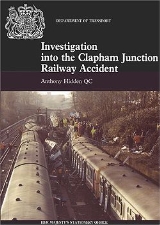
 The inquiry into the Clapham rail crash, chaired by Anthony Hidden QC, also recommended the introduction of the Automatic Train Protection
(ATP) system; however the inquiry's recommendation was not acted on. Subsequent crashes such as at Southall
in 1997 and Ladbroke Grove
in 1999 led to further recommendations for the introduction of ATP, and although it has been installed on some lines, it has not to date been specified for the entire network. In the statement on the Ladbroke Grove crash, the Department for Transport
sought to make the point that "no workable system was available in Britain" at the time.
A memorial marking the location of the crash site is atop the embankment above the railway on Windmill Road by Spencer Park, Battersea
.
Regional rail
Commuter rail, also called suburban rail, is a passenger rail transport service that primarily operates between a city center, and the middle to outer suburbs beyond 15km and commuter towns or other locations that draw large numbers of commuters—people who travel on a daily basis...
at 08:10 on the morning of Monday, 12 December 1988.
The collisions occurred 800 m (half a mile) southwest of Clapham Junction railway station
Clapham Junction railway station
Clapham Junction railway station is near St John's Hill in the south-west of Battersea in the London Borough of Wandsworth. Although it is in Battersea, the area around the station is commonly identified as Clapham Junction....
in southwest London
London
London is the capital city of :England and the :United Kingdom, the largest metropolitan area in the United Kingdom, and the largest urban zone in the European Union by most measures. Located on the River Thames, London has been a major settlement for two millennia, its history going back to its...
, England
England
England is a country that is part of the United Kingdom. It shares land borders with Scotland to the north and Wales to the west; the Irish Sea is to the north west, the Celtic Sea to the south west, with the North Sea to the east and the English Channel to the south separating it from continental...
, UK
United Kingdom
The United Kingdom of Great Britain and Northern IrelandIn the United Kingdom and Dependencies, other languages have been officially recognised as legitimate autochthonous languages under the European Charter for Regional or Minority Languages...
. Thirty-five people died and five hundred were injured, making the crash one of the worst in the UK in recent times.
Incident
The first collision occurred after the driver of the 07:18 from BasingstokeBasingstoke railway station
Basingstoke railway station, in the town of Basingstoke in the county of Hampshire in England, is on the South Western Main Line from London Waterloo, with local and fast services operated by South West Trains. It is also the terminus of First Great Western local services on the Reading to...
to London Waterloo saw a signal in front of him abruptly change from green to red. As required, the driver stopped his train at the next signal post telephone to report to the signalman at Clapham Junction 'A' signal box that his train had passed a red signal. He was advised there was no fault and that he was free to proceed. The driver told the signalman that he intended to make a formal report when he reached Waterloo. As the driver hung up the phone his train was hit from behind by a following train at a speed of 35mph to 40mph (56 km/h to 64 km/h), the late-running 06:14 from Poole
Poole railway station
thumb|right|Down stopping train in 1958Poole railway station is a railway station on the South Western Main Line serving the town of Poole in Dorset, England. The station is situated in the town centre next to Holes Bay...
, running under false clear signals.
A second collision, consequent on the first, involved the second, third and fourth coaches of an empty train leaving Clapham Junction (travelling on an adjacent line in the opposite direction) which hit the wreckage of the Poole train, causing derailment and separation of the first carriage of that third train. A fourth train approaching, also under false clear signals at the time, managed to stop about 70 yd (60 m) clear of the rear of the Poole train. This fourth train had lost power as the accident had shorted and discharged the traction current from the third rail.
Pupils from the adjacent Emanuel School
Emanuel School
Emanuel School is a co-educational independent school in Battersea, south-west London. The school was founded by Lady Dacre and Elizabeth I in 1594. Today it has some 710 pupils, aged between ten and eighteen.-History:...
were first on the scene of the disaster. They were commended for their service by the then Prime Minister, Margaret Thatcher
Margaret Thatcher
Margaret Hilda Thatcher, Baroness Thatcher, was Prime Minister of the United Kingdom from 1979 to 1990...
.
Investigation
The immediate cause of the crash was incorrect wiring work in which an old wire, incorrectly left in place after rewiring work and still connected at the supply end, created a false feed to a signal relay, thereby causing its related signal to show a green, double yellow or single yellow aspect (depending on the position of traffic around Clapham Junction station) when the track beyond it was occupied when it should have shown red. Indeed, the signal continued to display a single yellow aspect after the accident even though there were now three trains occupying the section beyond it . The larger cause of the accident was the failure by British RailBritish Rail
British Railways , which from 1965 traded as British Rail, was the operator of most of the rail transport in Great Britain between 1948 and 1997. It was formed from the nationalisation of the "Big Four" British railway companies and lasted until the gradual privatisation of British Rail, in stages...
senior management to recognise that the re-signalling of the Clapham Junction area – and indeed the re-signalling of all the lines out of Waterloo, of which this was a part – should have been treated as a major, safety-critical project, controlled throughout by a single, senior, named project manager. Instead the job was left to middle-level technical staff, stressed, poorly supervised by their seniors and poorly supported by their juniors. Staffing levels were inadequate and the staff, dulled by months of voluntary seven-days-a-week work, were carrying out the complete re-signalling of the largest and, on some measures, busiest junction on the whole British rail system. British Rail
British Rail
British Railways , which from 1965 traded as British Rail, was the operator of most of the rail transport in Great Britain between 1948 and 1997. It was formed from the nationalisation of the "Big Four" British railway companies and lasted until the gradual privatisation of British Rail, in stages...
were forced to overhaul their signal works testing regime and adopted the tried and tested method employed on the London Underground
London Underground
The London Underground is a rapid transit system serving a large part of Greater London and some parts of Buckinghamshire, Hertfordshire and Essex in England...
.
Automatic Train Protection
Automatic Train Protection in Great Britain refers to either of two implementations of a train protection system installed in some trains in order to help prevent collisions through a driver's failure to observe a signal or speed restriction...
(ATP) system; however the inquiry's recommendation was not acted on. Subsequent crashes such as at Southall
Southall rail crash
The Southall rail crash was an accident on the British railway system that occurred on 19 September 1997, on the Great Western Main Line at Southall, west London. Seven people were killed and 139 injured...
in 1997 and Ladbroke Grove
Ladbroke Grove rail crash
The Ladbroke Grove Rail Crash was a rail accident which occurred on 5 October 1999 at Ladbroke Grove, London, England. Thirty-one people were killed and more than 520 injured...
in 1999 led to further recommendations for the introduction of ATP, and although it has been installed on some lines, it has not to date been specified for the entire network. In the statement on the Ladbroke Grove crash, the Department for Transport
Department for Transport
In the United Kingdom, the Department for Transport is the government department responsible for the English transport network and a limited number of transport matters in Scotland, Wales and Northern Ireland which are not devolved...
sought to make the point that "no workable system was available in Britain" at the time.
A memorial marking the location of the crash site is atop the embankment above the railway on Windmill Road by Spencer Park, Battersea
Battersea
Battersea is an area of the London Borough of Wandsworth, England. It is an inner-city district of South London, situated on the south side of the River Thames, 2.9 miles south-west of Charing Cross. Battersea spans from Fairfield in the west to Queenstown in the east...
.
External links
- BBC News story on the crash
- Image of crash scene