
Clan Stewart of Appin is a west
highlandThe Highlands is an historic region of Scotland. The area is sometimes referred to as the "Scottish Highlands". It was culturally distinguishable from the Lowlands from the later Middle Ages into the modern period, when Lowland Scots replaced Scottish Gaelic throughout most of the Lowlands...
branch of the Clan Stewart and have been considered a distinct
clanScottish clans , give a sense of identity and shared descent to people in Scotland and to their relations throughout the world, with a formal structure of Clan Chiefs recognised by the court of the Lord Lyon, King of Arms which acts as an authority concerning matters of heraldry and Coat of Arms...
since the 15th century. They are descended from Sir James Stewart of Perston, who was himself the grandson of
Alexander Stewart, 4th High Steward of ScotlandAlexander Stewart was 4th hereditary High Steward of Scotland from his father's death in 1246.A son of Walter Stewart, 3rd High Steward of Scotland by his wife Bethóc, daughter of Gille Críst, Earl of Angus, Alexander is said to have accompanied Louis IX of France on the Seventh Crusade...
. (See:
High Steward of ScotlandThe title of High Steward or Great Steward was given in the 12th century to Walter Fitzalan, whose descendants became the House of Stewart. In 1371, the last High Steward inherited the throne, and thereafter the title of High Steward of Scotland has been held as a subsidiary title to that of Duke...
).
Origins
The Appin Stewarts, also known as “The Loyal Clan”, is the West Highland branch of the royal surname Stewart, descend from Sir James Stewart of Perston, 4th son of
Sir John Stewart of BonkillJohn Stewart of Bonkyll was a son of Alexander Stewart the High Steward of Scotland and Jean, daughter of Séamus Macrory, Lord of Bute. He was a military commander during the First Scottish War of Independence and during the Battle of Falkirk, he commanded the Scottish archers, and was killed on 22...
, second son of Alexander, the 4th High Steward of Scotland. Sir James was the grandfather of John Stewart of Innermeath, who, through marriage to Isabell NicDougall (MacDougall) of Lorn, became the first Stewart Lord of Lorn. The Lordship of Lorn passed down for 2 more generations to Sir John Stewart, the third Stewart Lord of Lorn.
AppinAppin is a remote coastal district of the Scottish West Highlands bounded west by Loch Linnhe, south by Loch Creran, east by the districts of Benderloch and Lorne, and north by Loch Leven...
is located in the West Highlands between
BenderlochBenderloch is a village in Argyll and Bute, Scotland.Benderloch lies on the A828 road in the coastal area of Appin, Argyll, Scotland. Its railway station closed in 1966.Benderloch forms part of the Lynn of Lorn National Scenic Area, one of 40 in Scotland....
to the South and the
BallachulishThe village of Ballachulish in Lochaber, Highland, Scotland, is centred around former slate quarries. The name Ballachulish was more correctly applied to the area now called North Ballachulish, to the north of Loch Leven, but was usurped for the quarry villages at East Laroch and West Laroch,...
Narrows to the North in modern day
ArgyllArgyll , archaically Argyle , is a region of western Scotland corresponding with most of the part of ancient Dál Riata that was located on the island of Great Britain, and in a historical context can be used to mean the entire western coast between the Mull of Kintyre and Cape Wrath...
. Today the primary towns include Port Appin and Portnacroish. Both are scenic and are surrounded by forests and water. To the West are islands including the beautiful Isle of Lismore, home to the
MacLeaThe Clan MacLea is a Highland Scottish clan, which was traditionally located in the district of Lorn in Argyll, Scotland, and is seated on the Isle of Lismore. There is a tradition of some MacLeas Anglicising their names to Livingstone, thus the also refers to clan as the Highland Livingstones...
s and the Baron Buchull, keeper of the Buchull Mhòr (the crosier of St. Moluag). There are numerous sights of interest including Ardsheal's Cave, the Clach Ruric, Cnap a-Chaolais,
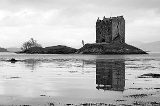
Castle StalkerCastle Stalker is a four-storey tower house or keep picturesquely set on a tidal islet on Loch Laich, an inlet off Loch Linnhe. It is located about north east of Port Appin, Argyll, Scotland, and is visible from the A828 road around mid-way between Oban and Glen Coe. The islet is accessible from...
,
Eilean MundeEilean Munde is a small island in Loch Leven, close to Ballachulish. It is the site of a chapel built by St. Fintan Mundus , who travelled here from Iona in the 7th Century. The church was burnt in 1495 and rebuilt in the 16th Century. The last service in the church was held in July, 1653...
and Keil churchyard.
15th century
In 1403 a band of Highlanders, said to have been the Clan Stewart of Appin led by
Alexander Stewart-Biography:He was an illegitimate son of Alexander Stewart, Earl of Buchan and probably Mairead inghean Eachann.Alexander held the Earldom of Mar and the Lordship of the Garioch in right of his first wife Isabel Douglas, Countess of Mar . Alexander's marriage to Isabella followed his capture of...
, the son of the Wolf of Badenoch murdered Sir Malcolm Drummond, chief of the
Clan DrummondClan Drummond is a Scottish clan deriving its name from the parish of Drymen, in what was western Stirlingshire. Legend gives Maurice of Hungary as founder of the clan...
.
Tradition tell us that in 1445, while returning to his seat at Dunstaffnage Castle from the great cattle tryst at Crieff, Sir John met and fell in love with the daughter of MacLaren of Ardvech. Although married, he began an affair with his new love which one year later produced a son. He was christened Dugald and was to be the first Chief of the Stewarts of Appin. Sir John Stewart was born around 1410, putting him at about 35 when he met the woman that would become his second wife.
After the death of his first wife, Sir John waited, for reasons we are unaware of today, for 5 years until setting up the marriage between himself and Dugald's mother, but it may have had something to do with the politics of the day. In 1463, Sir John set a wedding date and sent for Dugald and his mother to come to Dunstaffnage. Unknown to Sir John, there was a plot to kill the Lord of Lorn. It is not fully known, but it is thought to have been set up by the Lord of the Isles who was in a power struggle with the King of Scots, and who saw it as being in his best interest to neutralize this powerful and loyal representative of the King in the west highlands. The other plotters, which some feel included Colin Campbell, Lord Argyll, Sir John's son-in-law, were primarily represented by Alan MacCoul, the illegitimate grandson of an earlier MacDougall Chief. As the lightly armed wedding party made its way from Dunstaffnage to the small chapel located approximately 180 yards from the castle walls, they were attacked by a superior force led by Alan MacCoul. Although better armed, MacCoul's force was defeated, but not before mortally wounding Lord of Lorn. Sir John was rushed into the chapel and MacCoul and his henchmen ran into and occupied the deserted Dunstaffnage. With his last breath Sir John married Dugald's mother, legitimizing him and making him the de jure Lord of Lorn. After receiving the last rites, Sir John expired and a new chapter in west highland history was opened. Dugald gathered all the adherents of the Lord of Lorn and with the assistance of the MacLarens laid siege to Dunstaffnage, but to no avail. Unbeknownst to Dugald, Colin Campbell, Lord Argyll who seemed to have been involved in the plot, raised a group of MacFarlanes to aid MacCoul in his struggle against the de jure Lord of Lorn. MacCoul's men with the MacFarlanes met the men of Lorn and MacLaren in what was to be known as the battle of Leac a dotha. It was a fierce battle with both sides leaving the field with very heavy losses.
For the next few years Dugald, who had lost the title of Lord of Lorn through the treachery of his uncle Walter Stewart and the lord of Argyll, but had retained Appin and Lismore, consolidated his power and fortified the hunting lodge of Castle Stalker on the Cormant's Rock in Loch Laich. He also ensured that the Campbells were in no doubt about his displeasure over the loss of the Lordship of Lorn, by having the Campbell territory surrounding Appin regularly raided by the clan. Finally, in 1468, in a bid to finally destroy the power of Appin, Colin Campbell and Walter Stewart, the latter now recognized as the Lord of Lorn (but with no authority in Lorn), organized a massive raid against Dugald and his clan. Alan MacCoul was again involved and they met at what was to be known as the Battle of Stalc. Though losing many men, Dugald virtually destroyed the military strength of the MacFarlanes (a destruction from which they were never to recover) and personally killed Alan MacCoul, his father's murderer. The battle solidified Dugald's claim to Appin and the surrounding area, which was formally granted to him by King James III on the 14th of April 1470.
In 1497 some of the
Clan MacLarenClan MacLaren is a Highland Scottish clan.-History:-Origins:The origins of the clan are uncertain, but by tradition the MacLarens are descended from Loarn mac Eirc of Dál Riata, who landed in & settled Argyll in 503 A.D. The clan name is supposedly derived from Lorn ; these variations are all...
stole cattle from the Braes of
LochaberDistrict of Lochaber 1975 to 1996Highland council area shown as one of the council areas of ScotlandLochaber is one of the 16 ward management areas of the Highland Council of Scotland and one of eight former local government districts of the two-tier Highland region...
from the
Clan MacDonald of KeppochClan MacDonald of Keppoch, also known as Clan Ranald of Lochaber, is a Scottish clan and a branch of Clan Donald.-History:The MacDonalds of Keppoch are descended from Alistair Carrach Macdonald who was a younger son of Good John of Islay, Lord of the Isles, 6th chief of Clan Donald and his second...
. The MacDonalds followed them and overtook them at a place called Glenurchy where a battle took place. The MacDonalds won and recovered their cattle. However the MacLarens then looked for assistance from Dugald Stuart of Appin. Another battle then took place where the MacLarens were now joined by the Stuarts against the MacDonalds. During the battle Dugald, the chief of the Clan Stewart of Appin and the Clan MacDonald of Keppoch chief were both killed.
17th century and Civil War
The Stewart of Appin clan served with
James Graham, 1st Marquess of MontroseJames Graham, 1st Marquess of Montrose was a Scottish nobleman and soldier, who initially joined the Covenanters in the Wars of the Three Kingdoms, but subsequently supported King Charles I as the English Civil War developed...
and participated in
Battle of Inverlochy (1645)The Battle of Inverlochy was a battle of the Scottish Civil War in which Montrose routed the pursuing forces of the Marquess of Argyll....
where they defeated
Archibald Campbell, 9th Earl of ArgyllArchibald Campbell, 9th Earl of Argyll was a Scottish peer.He was born in 1629 in Dalkeith, Scotland, the son of Archibald Campbell, 1st Marquess of Argyll....
at
Inverlochy CastleInverlochy Castle is a ruined, 13th-century castle near Fort William, Scotland. The site of two battles, the castle remains largely unchanged since its construction. It is now in the care of Historic Scotland.-History:...
in February 1645. After James VII was deposed in 1688, the Stewarts of Appin supported the deposed
House of StuartThe House of Stuart is a European royal house. Founded by Robert II of Scotland, the Stewarts first became monarchs of the Kingdom of Scotland during the late 14th century, and subsequently held the position of the Kings of Great Britain and Ireland...
.
18th century and Jacobite risings
Appin naturally supported the Jacobite Risings and sent men to fight in both The 'Fifteen' and The 'Forty Five'. At the
Battle of CullodenThe Battle of Culloden was the final confrontation of the 1745 Jacobite Rising. Taking place on 16 April 1746, the battle pitted the Jacobite forces of Charles Edward Stuart against an army commanded by William Augustus, Duke of Cumberland, loyal to the British government...
in 1746, the Appin Regiment suffered 92 killed and 65 wounded out of a fighting force of approximately 300. Charles Stewart of Ardsheal led the men of the regiment (which included men of ~19 other clans) during the rising of 1745. Ardsheal later escaped Scotland to meet his family in Europe where he spent the rest of his days.
Ardsheal's Cave
On 23 July 1745 Prince
Charles Edward StuartPrince Charles Edward Louis John Casimir Sylvester Severino Maria Stuart commonly known as Bonnie Prince Charlie or The Young Pretender was the second Jacobite pretender to the thrones of Great Britain , and Ireland...
(Bonnie Prince Charlie) landed on the white sands of the Outer Hebridean island of
EriskayEriskay , from the Old Norse for "Eric's Isle", is an island and community council area of the Outer Hebrides in northern Scotland. It lies between South Uist and Barra and is connected to South Uist by a causeway which was opened in 2001. In the same year Eriskay became the ferry terminal for...
, accompanied only by a small band of companions known as the "Seven Men of Moidart. This was the start of his claim to the Scottish and English throne and the second Jacobite uprising; on 16 April 1746 the Jacobite cause was finally put to rest at the battle of Culloden. Charles Stewart of Ardsheal, one of the Prince’s commanding officers, hid from the English Red Coats in a cave as they searched up and down the country for those involved. This place was henceforth known as Ardsheal’s Cave. Sitting on a steep hillside at above Kentallen Bay in
Loch LinnheLoch Linnhe is a sea loch on the west coast of Scotland....
on the West coast of Scotland, between
ObanOban Oban Oban ( is a resort town within the Argyll and Bute council area of Scotland. It has a total resident population of 8,120. Despite its small size, it is the largest town between Helensburgh and Fort William and during the tourist season the town can be crowded by up to 25,000 people. Oban...
and
Fort WilliamFort William is the second largest settlement in the highlands of Scotland and the largest town: only the city of Inverness is larger.Fort William is a major tourist centre with Glen Coe just to the south, Aonach Mòr to the north and Glenfinnan to the west, on the Road to the Isles...
, the cave is no more than forty minutes scramble from the loch side.
The Stewarts of Ardsheal were the most important Cadet family of the Stewarts of Appin. Totally loyal to the Jacobite cause, Stewart of Ardsheal led the regiment raised by the Stewarts of Appin at Culloden. They suffered appalling casualties when breaking the ranks of Barrell’s and Munro’s regiments of foot of the
HanoverThe House of Hanover is a deposed German royal dynasty which has ruled the Duchy of Brunswick-Lüneburg , the Kingdom of Hanover, the Kingdom of Great Britain, the Kingdom of Ireland and the United Kingdom of Great Britain and Ireland...
ian army. However the outcome of Culloden was almost certain before it began. The Jacobite army, tired, hungry, improperly equipped and grossly out numbered were decisively defeated. After their victory the English, led by the Duke of Cumberland, were ordered to execute all the Jacobite wounded and imprisoned. For this he was hereafter known as “The Butcher”.
Having escaped death both in battle and the immediate aftermath Stewart of Ardsheal made for his family seat, Ardsheal House, Kentallen Bay. His hope was that if he could evade capture for long enough some sort of amnesty or deal would eventually be struck. Nevertheless none of the Jacobite’s in this predicament could imagine the determination and ruthlessness of Cumberland.
Over the coming months 3,500 Jacobite’s were rounded up and imprisoned; of these 120 were immediately executed (mainly clan leaders) and a further 90 died in prison. 1,000 were transported to the colonies and 250 “banished”. 700 disappeared, their fate unknown. In addition the clan system was destroyed with the Act of Proscription, they were disarmed and the kilt and tartan banned. It was in this climate that Ardsheal returned home and knowing full well his fate, should he be caught, immediately went into hiding. He wanted to be near his wife and new born son so with her help he hid in the cave above his house. His wife would bring food and occasionally he would venture out under cover of darkness.
Eventually the Red Coats came and Ardsheal House was cordoned off and his wife and child held prisoner. She must have been a brave woman because she gave nothing away claiming that she hadn’t seen or heard of her husband since he left with the Jacobite army. The Red Coats thoroughly searched the surrounding area whilst Ardsheal himself was hiding under their noses. One account states that on two occasions they walked within yards of his hideout.
The secret of Ardsheal’s success was with the cave itself or more importantly its situation. It lies behind a tall waterfall which completely hides the entrance especially when the burn is in flood. Unless you know of its whereabouts you could be standing five yards away and never find it. It stretches back some fifteen or twenty feet and is easy to stand up in however; it tapers down to no more than two or three feet at the back. The walls and floor are a bit damp but there is a dryer place towards the rear. Nevertheless it is perfectly comfortable and completely sheltered from the elements outside. It can only be approached from one way – directly up the steep sided burn and is far enough away from Ardsheal House to make it a fairly arduous and demanding climb. If however, your position is known then escape is virtually impossible. The constant noise of falling water drowns out any approaching sounds and your only way out is the same as the way in. Your pursuers would be on you in seconds before you could take a step – you’d be caught like a rat in a trap. On the whole though it makes a perfect hiding place and one can imagine avoiding detection indefinitely and in complete safety. That said, Charles Stewart of Ardsheal was known to have been a large man of great personal strength and a proficient swordsman - one of the best in the highlands. One can’t help but think that he was like a caged lion and impatient to leave.
The threat of capture for Charles Stewart of Ardsheal continued long after the Red Coats had left Ardsheal House. If it wasn’t an English soldier who turned him in it was more likely to be a fellow Scotsman particularly from the South. The Jacobite cause was to put a catholic King back on the throne, this was considered by many as taking a step backwards. For the Lowland Presbyterians the defeat of the Jacobites was a cause for celebration. The Union and the Presbyterian system of church government were safe. Realising that no amnesty was ever likely to be forthcoming Ardsheal eventually fled to France and his lands were forfeited to the Crown. His son
Duncan Stewart of ArdshealDuncan Stewart was 10th Chief of the Clan Stewart of Appin and 6th of Ardsheal, and a friend of James Boswell. He was the eldest surviving son of Charles Stewart, 5th of Ardsheal, the Jacobite leader of the Clan at the Battle of Culloden, 16 April 1746, during the Jacobite Rising of 1745 and...
succeeded in having the lands restored later in the eighteenth century and the Stewarts of Ardsheal then succeeded to the Chiefdom of Appin upon the extinction of the Appin family.
Appin Murder
Appin was the site of the infamous
Appin MurderThe Appin Murder occurred on May 14, 1752 near Appin in the north-west of Scotland, and it resulted in what is often held to be a notorious miscarriage of justice...
of 1752, when Colin Roy Campbell of Glenure, 'the Red Fox' - who had been placed as government factor of the forfeited Stewart lands in Appin - was shot by an unknown
sniperA sniper is a marksman who shoots targets from concealed positions or distances exceeding the capabilities of regular personnel. Snipers typically have specialized training and distinct high-precision rifles....
while riding along the shore of
Loch LevenLoch Leven is a fresh water loch in Perth and Kinross council area, central Scotland.Roughly triangular, the loch is about 6 km at its longest. The burgh of Kinross lies at its western end. Loch Leven Castle lies on an island a short way offshore...
at
BallachulishThe village of Ballachulish in Lochaber, Highland, Scotland, is centred around former slate quarries. The name Ballachulish was more correctly applied to the area now called North Ballachulish, to the north of Loch Leven, but was usurped for the quarry villages at East Laroch and West Laroch,...
. Whoever the shooter may have been, after the chief suspect, Alan Breck Stewart, made his escape,the half-brother of the chief, a cadet named
James of the GlenJames Stewart, known as James of the Glens, Seamus a’ Ghlinne and James Stewart of Acharn was a Scotsman famous for being wrongfully accused and hanged for being accessory to the killing of Colin Roy Campbell...
s was charged with the murder, tried by a Campbell jury in the Campbell stronghold of
InverarayInveraray is a royal burgh in Argyll and Bute, Scotland. It is on the western shore of Loch Fyne, near its head, and on the A83 road. It is the traditional county town of Argyll and ancestral home to the Duke of Argyll.-Coat of arms:...
presided over by Argyll himself, and, perhaps not surprisingly, was convicted and hanged on the shore of Loch Leven at Cnap a-Chaolais in Ballachulish. The consensus at the time and the general opinion of historians has been that James Stewart had nothing to do with the shooting. The incident was made famous by
Robert Louis StevensonRobert Louis Balfour Stevenson was a Scottish novelist, poet, essayist and travel writer. His best-known books include Treasure Island, Kidnapped, and Strange Case of Dr Jekyll and Mr Hyde....
, the plot of whose novel
KidnappedKidnapped is a historical fiction adventure novel by the Scottish author Robert Louis Stevenson. Written as a "boys' novel" and first published in the magazine Young Folks from May to July 1886, the novel has attracted the praise and admiration of writers as diverse as Henry James, Jorge Luis...
incorporated the death of Glenure. As an interesting postscript many have tried to identify the shooter but without success. The identity is known within the Chief's family and when asked the current Chief stated that he had read and heard every theory and that none were close to being correct. The "mystery" continues.
The Daoine Uaisle
The daoine uaisle (Gaelic: noble people), as they were known into the 18th Century are synonymous with the term "
TacksmenA tacksman was a land-holder of intermediate legal and social status in Scottish Highland society.-Tenant and landlord:...
" and the modern designation of "Cadet." These were/are the gentry of the clan (all clans incorporated these positions). Related by birth to the Chief, these men controlled areas, or "tacks", within the greater clan lands. Rents were collected in various forms and rents from the daoine uaisle were in turn paid to the Chief within some clans, and not in others. The primary "Cadets" of Appin are Ardsheal, Achnacone, Fasnacloich, Invernahyle, and Strathgarry. The major branches of Appin stem from the sons of Alan Stewart, 3rd of Appin. Originally they comprised John, 1st of Strathgarry, Dugald, 1st of Achnacone, James, 1st of Fasnacloich and Alexander, 1st of Invernahyle. Ardshiel, the branch our Chief hails from, was given to John, 1st of Ardshiel by his father, John Stewart, 5th of Appin. Andrew Francis Stewart of Lorn, Appin and Ardsheal, 17th of Appin & 12th of Ardsheal, the current Chief of Appin is descended from Charles Stewart, 7th of Ardsheal who ascended as Chief upon the death of Dugald Stewart, our 10th Chief, who died without sons in 1769. Today Andrew Francis Stewart holds the title of both "Appin" (denoting the Chief) and Ardsheal.
Adherents and clansmen
Most of the clan did not use the surname "Stewart", or indeed any surname as their use was not the norm in Highland and Island society. The average clansman was descended from family groups (not clans), each of which represent a
sept (social)A sept is an English word for a division of a family, especially a division of a clan. The word might have its origin from Latin saeptum "enclosure, fold", or it can be an alteration of sect.The term is found in both Ireland and Scotland...
, and many of which had lived in North Lorn long before Dugald, 1st of Appin formed the clan. These septs included the Carmichaels, MacCombichs, MacColls, MacGillemichaels, McIlmichaels, MacInness, MacLeays, MacMichaels and MacRobbs (related by blood to the Stewarts).
External links