


Circumpolar star

Encyclopedia
Celestial pole
The north and south celestial poles are the two imaginary points in the sky where the Earth's axis of rotation, indefinitely extended, intersects the imaginary rotating sphere of stars called the celestial sphere...
s. Circumpolar stars are therefore visible towards the north pole (from said location) for the entire night on every night of the year (and would be continuously visible throughout the day too, were they not overwhelmed by the Sun's glare).
All circumpolar stars are within the circumpolar circle. This was in fact the original meaning of "Arctic Circle", before the current geographical meaning
Arctic Circle
The Arctic Circle is one of the five major circles of latitude that mark maps of the Earth. For Epoch 2011, it is the parallel of latitude that runs north of the Equator....
, meaning "Circle of the Bears" (Ursa Major
Ursa Major
Ursa Major , also known as the Great Bear, is a constellation visible throughout the year in most of the northern hemisphere. It can best be seen in April...
, the Great Bear; and Ursa Minor
Ursa Minor
Ursa Minor , also known as the Little Bear, is a constellation in the northern sky. Like the Great Bear, the tail of the Little Bear may also be seen as the handle of a ladle, whence the name Little Dipper...
, the Little Bear), from Greek ρκτικός (arktikos), "near the Bear", from the word άρκτος (arktos) bear.
Explanation
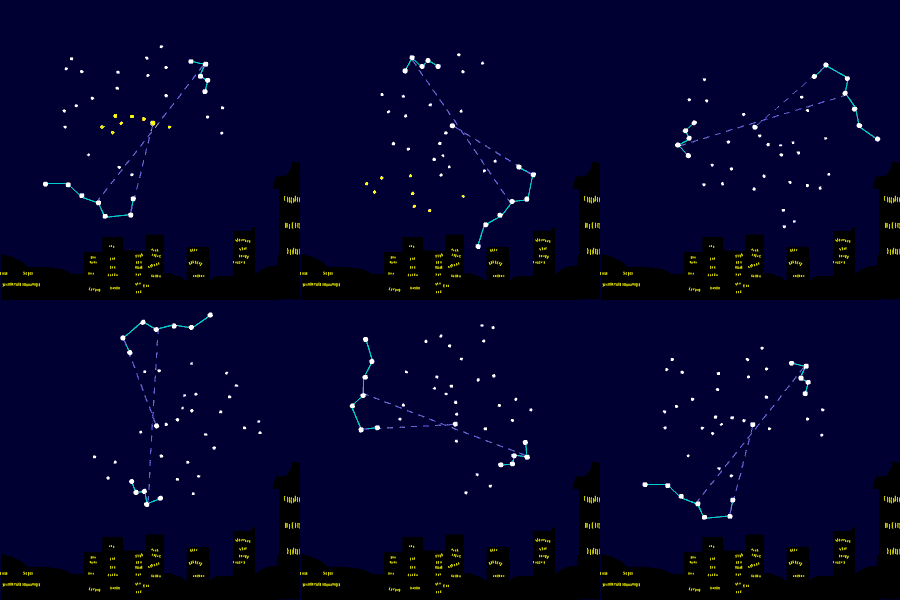
As Earth spins daily on its axis, the stars appear to rotate in circular paths around one of the celestial poles (the north celestial pole for observers in the northern hemisphereNorthern Hemisphere
The Northern Hemisphere is the half of a planet that is north of its equator—the word hemisphere literally means “half sphere”. It is also that half of the celestial sphere north of the celestial equator...
, or the south celestial pole for observers in the southern hemisphere
Southern Hemisphere
The Southern Hemisphere is the part of Earth that lies south of the equator. The word hemisphere literally means 'half ball' or "half sphere"...
). Stars far from a celestial pole appear to rotate in large circles; stars located very close to a celestial pole rotate in small circles and hence hardly seem to engage in any diurnal motion
Diurnal motion
Diurnal motion is an astronomical term referring to the apparent daily motion of stars around the Earth, or more precisely around the two celestial poles. It is caused by the Earth's rotation on its axis, so every star apparently moves on a circle, that is called the diurnal circle. The time for...
at all. Depending on the observer's latitude on Earth, some stars — the circumpolar ones — are close enough to the celestial pole to remain continuously above the horizon, while other stars dip below the horizon
Horizon
The horizon is the apparent line that separates earth from sky, the line that divides all visible directions into two categories: those that intersect the Earth's surface, and those that do not. At many locations, the true horizon is obscured by trees, buildings, mountains, etc., and the resulting...
for some portion of their daily circular path (and others remain permanently below the horizon).
The circumpolar stars appear to lie within a circle that is centered at the celestial pole and tangential to the horizon. At the Earth's North Pole
North Pole
The North Pole, also known as the Geographic North Pole or Terrestrial North Pole, is, subject to the caveats explained below, defined as the point in the northern hemisphere where the Earth's axis of rotation meets its surface...
, the north celestial pole is directly overhead, and all stars that are visible at all (that is, all stars in the northern celestial hemisphere
Celestial sphere
In astronomy and navigation, the celestial sphere is an imaginary sphere of arbitrarily large radius, concentric with the Earth and rotating upon the same axis. All objects in the sky can be thought of as projected upon the celestial sphere. Projected upward from Earth's equator and poles are the...
) are circumpolar. As one travels south, the north celestial pole moves towards the northern horizon. More and more stars that are at a distance from it begin to disappear below the horizon for some portion of their daily "orbit", and the circle containing the remaining circumpolar stars becomes increasingly small. At the Earth's equator this circle vanishes to a single point – the celestial pole itself – which lies on the horizon, and there are therefore effectively no circumpolar stars at all.
As one travels south of the equator the opposite happens. The south celestial pole appears increasingly high in the sky, and all the stars lying within an increasingly large circle centred on that pole become circumpolar about it. This continues until one reaches the Earth's South Pole
South Pole
The South Pole, also known as the Geographic South Pole or Terrestrial South Pole, is one of the two points where the Earth's axis of rotation intersects its surface. It is the southernmost point on the surface of the Earth and lies on the opposite side of the Earth from the North Pole...
where, once again, all visible stars are circumpolar.
The north celestial pole is located very close to the Pole star
Pole star
The term "Pole Star" usually refers to Polaris, which is the current northern pole star, also known as the North Star.In general, however, a pole star is a visible star, especially a prominent one, that is approximately aligned with the Earth's axis of rotation; that is, a star whose apparent...
(Polaris or North Star), so, from the northern hemisphere all circumpolar stars appear to rotate around Polaris. Polaris itself remains almost stationary, always at the north (i.e., the azimuth is 0°), and always at the same altitude
Altitude
Altitude or height is defined based on the context in which it is used . As a general definition, altitude is a distance measurement, usually in the vertical or "up" direction, between a reference datum and a point or object. The reference datum also often varies according to the context...
(angle from the horizon), equal to the latitude
Latitude
In geography, the latitude of a location on the Earth is the angular distance of that location south or north of the Equator. The latitude is an angle, and is usually measured in degrees . The equator has a latitude of 0°, the North pole has a latitude of 90° north , and the South pole has a...
of the point of observation on Earth.
Definition of circumpolar stars
Whether a star is circumpolar depends upon the observer's latitudeLatitude
In geography, the latitude of a location on the Earth is the angular distance of that location south or north of the Equator. The latitude is an angle, and is usually measured in degrees . The equator has a latitude of 0°, the North pole has a latitude of 90° north , and the South pole has a...
. Since the altitude of the north celestial pole (NCP) or south celestial pole (SCP) (whichever is visible) is the same as the absolute value of the observer's latitude , any star whose angular distance from the visible celestial pole is less than the absolute latitude will be circumpolar. For example, if the observer has latitude +50°, any star will be circumpolar if it is less than 50° from the north celestial pole. If the observer's latitude is −35°, then all stars within 35° of the south celestial pole will be circumpolar. Stars on the celestial equator are not circumpolar when observed from any latitude in either hemisphere of the Earth.
Whether a given star is circumpolar at the observer's latitude (θ) may be calculated in terms of the star's declination
Declination
In astronomy, declination is one of the two coordinates of the equatorial coordinate system, the other being either right ascension or hour angle. Declination in astronomy is comparable to geographic latitude, but projected onto the celestial sphere. Declination is measured in degrees north and...
(δ). The star is circumpolar if θ+δ is greater than +90° (observer in northern hemisphere), or θ+δ is less than −90° (observer in southern hemisphere).
Similarly, the star will never rise above the local horizon if δ−θ is less than −90° (observer in northern hemisphere), or δ−θ is greater than +90° (observer in southern hemisphere).
Some stars within the far northern constellation
Constellation
In modern astronomy, a constellation is an internationally defined area of the celestial sphere. These areas are grouped around asterisms, patterns formed by prominent stars within apparent proximity to one another on Earth's night sky....
s, such as Cassiopeia
Cassiopeia (constellation)
Cassiopeia is a constellation in the northern sky, named after the vain queen Cassiopeia in Greek mythology, who boasted about her unrivalled beauty. Cassiopea was one of the 48 constellations listed by the 2nd century Greek astronomer Ptolemy, and it remains one of the 88 modern constellations today...
, Cepheus
Cepheus (constellation)
Cepheus is a constellation in the northern sky. It is named after Cepheus, King of Aethiopia in Greek mythology. It was one of the 48 constellations listed by the 2nd century astronomer Ptolemy, and remains one of the 88 modern constellations.-Stars:...
, Ursa Major, and Ursa Minor, roughly north of the Tropic of Cancer
Tropic of Cancer
The Tropic of Cancer, also referred to as the Northern tropic, is the circle of latitude on the Earth that marks the most northerly position at which the Sun may appear directly overhead at its zenith...
(+23½°), will be circumpolar stars that never rise or set.
For British
United Kingdom
The United Kingdom of Great Britain and Northern IrelandIn the United Kingdom and Dependencies, other languages have been officially recognised as legitimate autochthonous languages under the European Charter for Regional or Minority Languages...
observers, for example, the first magnitude stars Capella
Capella (star)
Capella is the brightest star in the constellation Auriga, the sixth brightest star in the night sky and the third brightest star in the northern celestial hemisphere, after Arcturus and Vega. Although it appears to be a single star to the naked eye, it is actually a star system of four stars in...
(declination +45° 59) and Deneb
Deneb
Deneb is the brightest star in the constellation Cygnus and one of the vertices of the Summer Triangle. It is the 19th brightest star in the night sky, with an apparent magnitude of 1.25. A blue-white supergiant, Deneb is also one of the most luminous nearby stars...
(+45° 16') do not set from anywhere in the country. Vega
Vega
Vega is the brightest star in the constellation Lyra, the fifth brightest star in the night sky and the second brightest star in the northern celestial hemisphere, after Arcturus...
(+38° 47') is technically circumpolar north of latitude +51° 13' (just south of London
London
London is the capital city of :England and the :United Kingdom, the largest metropolitan area in the United Kingdom, and the largest urban zone in the European Union by most measures. Located on the River Thames, London has been a major settlement for two millennia, its history going back to its...
); taking atmospheric refraction
Atmospheric refraction
Atmospheric refraction is the deviation of light or other things like humanelectromagnetic wave from a straight line as it passes through the atmosphere due to the variation in air density as a function of altitude...
into account it will probably only be seen to set at sea level from Cornwall
Cornwall
Cornwall is a unitary authority and ceremonial county of England, within the United Kingdom. It is bordered to the north and west by the Celtic Sea, to the south by the English Channel, and to the east by the county of Devon, over the River Tamar. Cornwall has a population of , and covers an area of...
and the Scilly Isles.
Some Stars within the far southern constellations, such as Crux, Musca, and Hydrus, roughly south of the Tropic of Capricorn
Tropic of Capricorn
The Tropic of Capricorn, or Southern tropic, marks the most southerly latitude on the Earth at which the Sun can be directly overhead. This event occurs at the December solstice, when the southern hemisphere is tilted towards the Sun to its maximum extent.Tropic of Capricorn is one of the five...
(-23½°), will also be circumpolar stars.
Stars (and constellations) that are circumpolar in one hemisphere are always invisible in the high latitudes of the opposite hemisphere, and these never rise above the horizon. For example, the southern circumpolar star Acrux is invisible from most of the Continental United States, likewise, the seven stars of the northern circumpolar Big Dipper
Big Dipper
The Plough, also known as the Big Dipper or the Saptarishi , is an asterism of seven stars that has been recognized as a distinct grouping in many cultures from time immemorial...
asterism
Asterism (astronomy)
In astronomy, an asterism is a pattern of stars recognized on Earth's night sky. It may form part of an official constellation, or be composed of stars from more than one. Like constellations, asterisms are in most cases composed of stars which, while they are visible in the same general direction,...
are invisible from most of the Patagonia
Patagonia
Patagonia is a region located in Argentina and Chile, integrating the southernmost section of the Andes mountains to the southwest towards the Pacific ocean and from the east of the cordillera to the valleys it follows south through Colorado River towards Carmen de Patagones in the Atlantic Ocean...
region of South America
South America
South America is a continent situated in the Western Hemisphere, mostly in the Southern Hemisphere, with a relatively small portion in the Northern Hemisphere. The continent is also considered a subcontinent of the Americas. It is bordered on the west by the Pacific Ocean and on the north and east...
.
See also
- Pole starPole starThe term "Pole Star" usually refers to Polaris, which is the current northern pole star, also known as the North Star.In general, however, a pole star is a visible star, especially a prominent one, that is approximately aligned with the Earth's axis of rotation; that is, a star whose apparent...
- Voyages of Christopher ColumbusVoyages of Christopher ColumbusIn the early modern period, the voyages of Columbus initiated European exploration and colonization of the American continents, and are thus of great significance in world history. Christopher Columbus was a navigator and an admiral for Castile, a country that later founded modern Spain...
- North Star
- South Star
- Celestial sphereCelestial sphereIn astronomy and navigation, the celestial sphere is an imaginary sphere of arbitrarily large radius, concentric with the Earth and rotating upon the same axis. All objects in the sky can be thought of as projected upon the celestial sphere. Projected upward from Earth's equator and poles are the...
- Celestial poleCelestial poleThe north and south celestial poles are the two imaginary points in the sky where the Earth's axis of rotation, indefinitely extended, intersects the imaginary rotating sphere of stars called the celestial sphere...