
All Topics  
Circular motion


   Email Print
   Bookmark   Link


Circular motion


In physics
Physics

Physics is the natural science which examines basic concepts such as energy, force, and spacetime and all that derives from these, such as mass, charge, matter and its Motion ....
, circular motion is rotation
Rotation

A rotation is a movement of an object in a circular motion. A two-dimensional object rotates around a center of rotation. A Three-dimensional space object rotates around a line called an axis....
 along a circle
Circle

A circle is a simple shape of Euclidean geometry consisting of those point in a plane which are the same distance from a given point called the center....
: a circular path or a circular orbit
ORBit

ORBit is a Common Object Request Broker Architecture 2.4 compliant Object Request Broker . It features mature C , C++ and Python bindings, and less developed bindings for Perl, Lisp , Pascal , Ruby , and Tcl....
. It can be uniform
Uniform circular motion

There are two types of circular motion: uniform circular motion and non-uniform circular motion.Uniform circular motion describes motion in which an object moves with constant speed along a circular path....
, that is, with constant angular rate of rotation, or non-uniform
Non-uniform circular motion

Non-uniform circular motion is any case in which an object moving in a circular path has a varying speed. Some examples of non-uniform circular motion include a roller coaster, a vertical pendulum, and a car riding over a hill....
, that is, with a changing rate of rotation. The rotation around a fixed axis
Rotation around a fixed axis

Rotation around a fixed axis is a special case of rotational motion. It does not involve rotation around more than one axis, and cannot describe such phenomena as wobbling or precession....
 of a three-dimensional body involves circular motion of its parts. We can talk about circular motion of an object if we ignore its size, so that we have the motion of a point mass in a plane. For example, the center of mass
Center of mass

The center of mass of a system of wiktionary:Particles is a specific point at which, for many purposes, the system's mass behaves as if it were concentrated....
 of a body can undergo circular motion.

Examples of circular motion are: an artificial satellite orbiting the Earth in geosynchronous orbit
Geosynchronous orbit

A geosynchronous orbit is an orbit around the Earth with an orbital period matching the Earth's sidereal day rotation period. This synchronization means that for an observer at a fixed location on Earth, a satellite in a geosynchronous orbit returns to exactly the same place in the sky at exactly the same time each day....
, a stone which is tied to a rope and is being swung in circles (cf.


Discussion
Ask a question about 'Circular motion'
Start a new discussion about 'Circular motion'
Answer questions from other users
Full Discussion Forum


Encyclopedia


In physics
Physics

Physics is the natural science which examines basic concepts such as energy, force, and spacetime and all that derives from these, such as mass, charge, matter and its Motion ....
, circular motion is rotation
Rotation

A rotation is a movement of an object in a circular motion. A two-dimensional object rotates around a center of rotation. A Three-dimensional space object rotates around a line called an axis....
 along a circle
Circle

A circle is a simple shape of Euclidean geometry consisting of those point in a plane which are the same distance from a given point called the center....
: a circular path or a circular orbit
ORBit

ORBit is a Common Object Request Broker Architecture 2.4 compliant Object Request Broker . It features mature C , C++ and Python bindings, and less developed bindings for Perl, Lisp , Pascal , Ruby , and Tcl....
. It can be uniform
Uniform circular motion

There are two types of circular motion: uniform circular motion and non-uniform circular motion.Uniform circular motion describes motion in which an object moves with constant speed along a circular path....
, that is, with constant angular rate of rotation, or non-uniform
Non-uniform circular motion

Non-uniform circular motion is any case in which an object moving in a circular path has a varying speed. Some examples of non-uniform circular motion include a roller coaster, a vertical pendulum, and a car riding over a hill....
, that is, with a changing rate of rotation. The rotation around a fixed axis
Rotation around a fixed axis

Rotation around a fixed axis is a special case of rotational motion. It does not involve rotation around more than one axis, and cannot describe such phenomena as wobbling or precession....
 of a three-dimensional body involves circular motion of its parts. We can talk about circular motion of an object if we ignore its size, so that we have the motion of a point mass in a plane. For example, the center of mass
Center of mass

The center of mass of a system of wiktionary:Particles is a specific point at which, for many purposes, the system's mass behaves as if it were concentrated....
 of a body can undergo circular motion.

Examples of circular motion are: an artificial satellite orbiting the Earth in geosynchronous orbit
Geosynchronous orbit

A geosynchronous orbit is an orbit around the Earth with an orbital period matching the Earth's sidereal day rotation period. This synchronization means that for an observer at a fixed location on Earth, a satellite in a geosynchronous orbit returns to exactly the same place in the sky at exactly the same time each day....
, a stone which is tied to a rope and is being swung in circles (cf. hammer throw
Hammer throw

The modern or Olympic Games hammer throw is an athletic throwing event where the object is to throw a heavy metal ball attached to a wire and handle....
), a racecar turning through a curve in a race track
Race track

A race track is a purpose-built facility for racing of animals , automobiles, motorcycles or sportsperson. A race track may also feature grandstands or concourses....
, an electron moving perpendicular to a uniform magnetic field
Magnetic field

A magnetism field is a vector field which can exert a magnetic force on moving electric charges and on magnetic dipoles . When placed in a magnetic field, magnetic dipoles tend to align their axes parallel to the magnetic field....
, a gear
Gear

A gear is a component within a Transmission device that transmits rotational force to another gear or device. A gear is different from a pulley in that a gear is a round wheel that has linkages that mesh with other gear teeth, allowing force to be fully transferred without slippage....
 turning inside a mechanism.

Circular motion is accelerated even if the angular rate of rotation is constant, because the object's velocity vector is constantly changing direction. Such change in direction of velocity involves acceleration
Acceleration

File:Acceleration.JPGFile:Acceleration components.JPGIn physics, and more specifically kinematics, acceleration is the change in velocity over time....
 of the moving object by a centripetal force
Centripetal force

The centripetal force is the external force required to make a body follow a curved path. Hence centripetal force is a kinematic force requirement, not a particular kind of force like gravity or electromagnetism....
, which pulls the moving object towards the center of the circular orbit. Without this acceleration, the object would move in a straight line, according to Newton's laws of motion
Newton's laws of motion

Newton's laws of motion are three physical laws that form the basis for classical mechanics, Direct relationship the forces acting on a Physical body to the motion of the body....
.

Formulas for uniform circular motion


For motion in a circle of radius R, the circumference of the circle is C = 2p R. If the period for one rotation is T, the angular rate of rotation ? is:
The speed of the object traveling the circle is
The angle ? swept out in a time t is:
The acceleration due to change in the direction of the velocity is found by noticing that the velocity completely rotates direction in the same time T the object takes for one rotation. Thus, the velocity vector sweeps out a path of length 2p v every T seconds, or:


and is directed radially inward.

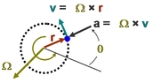
The vector relationships are shown in Figure 1. The axis of rotation is shown as a vector O perpendicular to the plane of the orbit and with a magnitude ? = d? / dt. The direction of O is chosen using the right-hand rule
Right-hand rule

In mathematics and physics, the right-hand rule is a common mnemonic for understanding notation conventions for vector in 3 dimensions. It was invented for use in electromagnetism by British physicist Zachariah William Cole in the late 1800s....
. With this convention for depicting rotation, the velocity is given by a vector cross product
Cross product

In mathematics, the cross product is a binary operation on two vector s in a three-dimensional Euclidean space that results in another vector which is orthogonal to the plane containing the two input vectors....
 as

which is a vector perpendicular to both O and r ( t ), tangential to the orbit, and of magnitude ? R. Likewise, the acceleration is given by

which is a vector perpendicular to both O and v ( t ) of magnitude ? |v| = ?2 R and directed exactly opposite to r ( t ).

Constant speed

In the simplest case the speed, mass and radius are constant.

Consider a body of one kilogram
Kilogram

The kilogram or kilogrammeThe spelling kilogram is used by the International Committee for Weights and Measures and the U.S....
, moving in a circle of radius
RADIUS

Remote Authentication Dial In User Service is a networking protocol that provides centralized access, authorization and accounting management for people or computers to connect and use a network service....
 one metre
Metre

The metre or meter is a Unit of measurement of length. It is the SI base unit of length in the metric system and in the International System of Units , used around the world for general and scientific purposes....
, with an angular velocity
Angular velocity

In physics, the angular velocity is a vector quantity which specifies the angular speed, and axis about which an object is rotating. The SI unit of angular velocity is radians per second, although it may be measured in other units such as degrees per second, revolutions per second, degrees per hour, etc....
 of one radian
Radian

The radian is a unit of plane angle, equal to 180/pi Degree , or about 57.2958 degrees, or about 57?17'45?. It is the standard unit of angular measurement in all areas of mathematics beyond the elementary level....
 per second
Second

The second , sometimes abbreviated sec., is the name of a units of measurement of time, and is the International System of Units SI base unit of time....
.
  • The speed
    Speed

    Speed is the rate of Motion , or equivalently the rate of change of distance.Speed is a Scalar quantity with dimensions length/time; the equivalent Vector quantity to speed is velocity....
     is one meter per second
  • The inward acceleration
    Acceleration

    File:Acceleration.JPGFile:Acceleration components.JPGIn physics, and more specifically kinematics, acceleration is the change in velocity over time....
     is one metre per second per second.
  • It is subject to a centripetal force
    Centripetal force

    The centripetal force is the external force required to make a body follow a curved path. Hence centripetal force is a kinematic force requirement, not a particular kind of force like gravity or electromagnetism....
     of one kilogram metre per second per second, which is one newton
    Newton

    The newton is the International System of Units SI derived unit of force, named after Isaac Newton in recognition of his work on classical mechanics....
    .
  • The momentum
    Momentum

    In classical mechanics, momentum is the product of the mass and velocity of an object . For more accurate measures of momentum, see the section Momentum#Modern definitions of momentum on this page....
     of the body is one kg·m·s−1.
  • The moment of inertia
    Moment of inertia

    Moment of inertia, also called mass moment of inertia or the angular mass, is a measure of an object's resistance to changes in its rotation rate....
     is one kg·m2.
  • The angular momentum
    Angular momentum

    In physics, the angular momentum of a particle about an origin is a vector quantity related to rotation, equal to the mass of the particle multiplied by the cross product of the position vector of the particle with its velocity vector....
     is one kg·m2·s−1.
  • The kinetic energy
    Kinetic energy

    The kinetic energy of an object is the extra energy which it possesses due to its motion. It is defined as the mechanical work needed to accelerate a body of a given mass from rest to its current velocity....
     is 1/2 joule
    Joule

    The joule is the SI derived unit of energy in the International System of Units. It is defined as:One joule is the amount of energy required to perform the following actions:...
    .
  • The circumference
    Circumference

    The circumference is the distance around a closed curve. Circumference is a kind of perimeter....
     of the orbit
    ORBit

    ORBit is a Common Object Request Broker Architecture 2.4 compliant Object Request Broker . It features mature C , C++ and Python bindings, and less developed bindings for Perl, Lisp , Pascal , Ruby , and Tcl....
     is 2π
    Pi

    Pi or p is a mathematical constant whose value is the ratio of any circle's circumference to its diameter in Euclidean geometry; this is the same value as the ratio of a circle's area to the square of its radius....
     (~ 6.283) metres.
  • The period
    Periodicity

    Periodicity is the quality of occurring at regular intervals or periods and can occur in different contexts:In timing devices:* A clock marks time at periodic intervals....
     of the motion is 2p seconds per turn
    Turn (geometry)

    A turn is a unit of plane angle, equal to 360? or 2p radians. As an angular unit it is mainly useful for large angles, such as in connection with coils and rotation objects....
    .
  • The frequency
    Frequency

    Frequency is the number of occurrences of a repeating event per unit time. It is also referred to as temporal frequency.The period is the duration of one cycle in a repeating event, so the period is the reciprocal of the frequency....
     is (2p)−1 hertz
    Hertz

    The hertz is a measure of frequency per unit of time, or the number of list of cycles per second. It is the SI base unit of frequency in the International System of Units , and is used worldwide in both general-purpose and scientific contexts....
    .
  • From the point of view of quantum mechanics
    Quantum mechanics

    Quantum mechanics is a set of principles underlying the most fundamental known description of all physical systems at the microscopic scale . Notable amongst these principles are both a dual wave-like and particle-like behavior of matter and radiation, and prediction of probabilities in situations where classical physics predicts certaintie...
    , the system is in an excited state having quantum number ~ 9.48×1035.


Then consider a body of mass
Mass

In physical science, mass refers to the degree of acceleration a body acquires when subject to a force: bodies with greater mass are accelerated less by the same force....
 m, moving in a circle of radius r, with an angular velocity
Angular velocity

In physics, the angular velocity is a vector quantity which specifies the angular speed, and axis about which an object is rotating. The SI unit of angular velocity is radians per second, although it may be measured in other units such as degrees per second, revolutions per second, degrees per hour, etc....
 of ?
Omega

Omega is the 24th and last letter of the Greek alphabet. In the Greek numerals it has a value of 800. The word literally means "great O" , as opposed to Omicron, which means "little O" ....
.
  • The speed is v = r·?.
  • The centripetal (inward) acceleration is a = r·? 2 = r −1·v 2.
  • The centripetal force is F = m·a = r·m·? 2 = r−1·m·v 2.
  • The momentum of the body is p = m·v = r·m·?.
  • The moment of inertia is I = r 2·m.
  • The angular momentum is L = r·m·v = r 2·m·? = I·?.
  • The kinetic energy is E = 2−1·m·v 2 = 2−1·r 2·m·? 2 = (2·m)−1·p 2 = 2−1·I·? 2 = (2·I)−1·L 2 .
  • The circumference of the orbit
    ORBit

    ORBit is a Common Object Request Broker Architecture 2.4 compliant Object Request Broker . It features mature C , C++ and Python bindings, and less developed bindings for Perl, Lisp , Pascal , Ruby , and Tcl....
     is 2·p·r.
  • The period of the motion is T = 2·p·? −1.
  • The frequency is f = T −1 . (Instead of letter f, the frequency is often denoted by the Greek letter ?
    Nu (letter)

    Nu , is the 13th letter of the Greek alphabet. In the system of Greek numerals it has a value of 50. Its Latin Alphabet equivalent is N, though the lowercase resembles the Roman lowercase v....
    , which however is almost indistinguishable from the letter v used here for velocity).
  • The quantum number is J = 2·p·L h−1


Variable speed

In the general case, circular motion requires that the total force can be decomposed into the centripetal force required to keep the orbit circular, and a force tangent to the circle, causing a change of speed.

The magnitude of the centripetal force depends on the instantaneous speed.

In the case of an object at the end of a rope, subjected to a force, we can decompose the force into a radial and a lateral component. The radial component is either outward or inward.

Description of circular motion using polar coordinates

During circular motion the body moves on a curve that can be described in polar coordinate system
Polar coordinate system

In mathematics, the polar coordinate system is a dimension coordinate system in which each point on a plane is determined by an angle and a distance....
 as a fixed distance R from the center of the orbit taken as origin, oriented at an angle ? (t) from some reference direction. See Figure 2. The displacement vector is the radial vector from the origin to the particle location:

where is the unit vector
Unit vector

In mathematics, a unit vector in a normed vector space is a Vector space whose Norm is 1 . A unit vector is often denoted by a lowercase letter with a superscribed caret or ?hat?, like this: ....
 parallel to the radius vector at time t and pointing away from the origin. It is handy to introduce the unit vector orthogonal
Orthogonality

In mathematics, two vectors are orthogonal if they are perpendicular, i.e., they form a right angle. The word comes from the Greek language ' , meaning "straight", and ' , meaning "angle"....
 to as well, namely . It is customary to orient to point in the direction of travel along the orbit.

The velocity is the time derivative of the displacement:

Because the radius of the circle is constant, the radial component of the velocity is zero. The unit vector has a time-invariant magnitude of unity, so as time varies its tip always lies on a circle of unit radius, with an angle ? the same as the angle of . If the particle displacement rotates through an angle d? in time dt, so does , describing an arc on the unit circle of magnitude d?. See the unit circle at the left of Figure 2. Hence:

where the direction of the change must be perpendicular to (or, in other words, along ) because any change d in the direction of would change the size of . The sign is positive, because an increase in d? implies the object and have moved in the direction of . Hence the velocity becomes:

The acceleration of the body can also be broken into radial and tangential components. The acceleration is the time derivative of the velocity:


The time derivative of is found the same way as for . Again, is a unit vector and its tip traces a unit circle with an angle that is p/2 + ?. Hence, an increase in angle d? by implies traces an arc of magnitude d?, and as is orthogonal to , we have:

where a negative sign is necessary to keep orthogonal to . (Otherwise, the angle between and would decrease with increase in d?.) See the unit circle at the left of Figure 2. Consequently the acceleration is:


The centripetal acceleration
Centripetal force

The centripetal force is the external force required to make a body follow a curved path. Hence centripetal force is a kinematic force requirement, not a particular kind of force like gravity or electromagnetism....
 is the radial component, which is directed radially inward: while the tangential component changes the magnitude of the velocity:

Description of circular motion using complex numbers

Circular motion can be described using complex number
Complex number

In mathematics, the complex numbers are an extension of the real numbers obtained by adjoining an imaginary unit, denoted i, which satisfies:...
s. Let the axis be the real axis and the axis be the imaginary axis. The position of the body can then be given as , a complex "vector": where is the imaginary unit
Imaginary unit

In mathematics, physics, and engineering, the imaginary unit is denoted by  or the Latin   or the Greek iota . It allows the real number system, to be extended to the complex number system,   Its precise definition is dependent upon the particular method of extension....
, and is the angle of the complex vector with the real axis and is a function of time t. Since the radius is constant: where a dot indicates time differentiation. With this notation the velocity becomes: and the acceleration becomes:


The first term is opposite to the direction of the displacement vector and the second is perpendicular to it, just like the earlier results.

External links

  • - a chapter from an online textbook


See also

  • Angular momentum
    Angular momentum

    In physics, the angular momentum of a particle about an origin is a vector quantity related to rotation, equal to the mass of the particle multiplied by the cross product of the position vector of the particle with its velocity vector....
  • Rotational equations of motion
  • Pendulum (mathematics)
    Pendulum (mathematics)

    The mathematics of pendulums are in general quite complicated. Simplifying assumptions can be made, which in the case of a simple pendulum allows the equations of motion to be solved analytically for small-angle oscillations....
  • Uniform circular motion
    Uniform circular motion

    There are two types of circular motion: uniform circular motion and non-uniform circular motion.Uniform circular motion describes motion in which an object moves with constant speed along a circular path....
  • Simple harmonic motion
    Simple harmonic motion

    Simple harmonic motion is the motion of a Harmonic oscillator#Simple harmonic oscillator, a motion that is neither driven nor Damping. The motion is Periodic function - as it repeats itself at standard intervals in a specific manner - and sine wave, with constant amplitude; the acceleration of a body executing SHM is directly proportional t...
  • Example: circular motion
    Time derivative

    A time derivative is a derivative of a function with respect to time, usually interpreted as the rate of change of the value of the function. The variable denoting time is usually written as ....
  • Centripetal force
    Centripetal force

    The centripetal force is the external force required to make a body follow a curved path. Hence centripetal force is a kinematic force requirement, not a particular kind of force like gravity or electromagnetism....
  • Fictitious force
    Fictitious force

    A fictitious force, also called a pseudo force, d'Alembert force or inertial force, is an apparent force that acts on all masses in a non-inertial reference frame, such as a rotating reference frame....
  • Non-uniform circular motion
    Non-uniform circular motion

    Non-uniform circular motion is any case in which an object moving in a circular path has a varying speed. Some examples of non-uniform circular motion include a roller coaster, a vertical pendulum, and a car riding over a hill....