

Cinema of China

Encyclopedia
Chinese language
The Chinese language is a language or language family consisting of varieties which are mutually intelligible to varying degrees. Originally the indigenous languages spoken by the Han Chinese in China, it forms one of the branches of Sino-Tibetan family of languages...
cinema
Film
A film, also called a movie or motion picture, is a series of still or moving images. It is produced by recording photographic images with cameras, or by creating images using animation techniques or visual effects...
has three distinct historical threads: Cinema of Hong Kong
Cinema of Hong Kong
The cinema of Hong Kong is one of the three major threads in the history of Chinese language cinema, alongside the cinema of China, and the cinema of Taiwan...
, Cinema of China, and Cinema of Taiwan
Cinema of Taiwan
The history of Chinese-language cinema has three separate threads of development: Cinema of Hong Kong, Cinema of Mainland China and Cinema of Taiwan . Taiwanese cinema grew up outside of the Hong Kong mainstream and the censorship of the People's Republic of China.Taiwanese cinema is deeply rooted...
. Since 1949 the cinema of mainland China
Mainland China
Mainland China, the Chinese mainland or simply the mainland, is a geopolitical term that refers to the area under the jurisdiction of the People's Republic of China . According to the Taipei-based Mainland Affairs Council, the term excludes the PRC Special Administrative Regions of Hong Kong and...
has operated under restrictions imposed by the Communist Party of China
Communist Party of China
The Communist Party of China , also known as the Chinese Communist Party , is the founding and ruling political party of the People's Republic of China...
's State Administration of Radio, Film, and Television
State Administration of Radio, Film, and Television
The State Administration of Radio, Film, and Television is an executive branch under the State Council of the People's Republic of China...
and the Publicity Department. Many films with political overtones made in China are still censored or banned in China itself; however, some of these films are distributed abroad commercially or at film festival
Film festival
A film festival is an organised, extended presentation of films in one or more movie theaters or screening venues, usually in a single locality. More and more often film festivals show part of their films to the public by adding outdoor movie screenings...
s. China also restricts the showing of foreign-made films in Chinese cinemas to 20 each year.
Currently, the vast majority of the Mainland-produced movies uses Mandarin
Standard Chinese
Standard Chinese, or Modern Standard Chinese, also known as Mandarin or Putonghua, is the official language of the People's Republic of China and Republic of China , and is one of the four official languages of Singapore....
. Mainland films are often dubbed into Cantonese
Standard Cantonese
Cantonese, or Standard Cantonese, is a language that originated in the vicinity of Canton in southern China, and is often regarded as the prestige dialect of Yue Chinese....
when exported to Hong Kong for theatrical runs.
As of 2010 Chinese cinema is the third largest film industry by number of feature films produced annually.
The Beginnings: Shanghai as the centre, 1896-1945
Motion pictures were introduced to ChinaChina
Chinese civilization may refer to:* China for more general discussion of the country.* Chinese culture* Greater China, the transnational community of ethnic Chinese.* History of China* Sinosphere, the area historically affected by Chinese culture...
in 1896. The first recorded screening of a motion picture in China occurred in Shanghai
Shanghai
Shanghai is the largest city by population in China and the largest city proper in the world. It is one of the four province-level municipalities in the People's Republic of China, with a total population of over 23 million as of 2010...
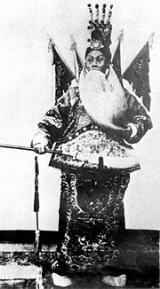
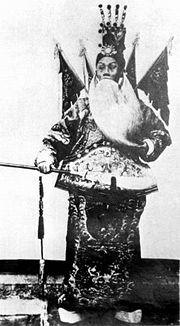
on August 11, 1896, as an "act" on a variety bill. The first Chinese film, a recording of the Beijing Opera
Beijing opera
Peking opera or Beijing opera is a form of traditional Chinese theatre which combines music, vocal performance, mime, dance and acrobatics. It arose in the late 18th century and became fully developed and recognized by the mid-19th century. The form was extremely popular in the Qing Dynasty court...
, The Battle of Dingjunshan
The Battle of Dingjunshan
The Battle of Dingjunshan was a 1905 Chinese film directed by Ren Jingfeng . The film was made by Beijing's Fengtai Photography . It was based on an episode from Luo Guanzhong's Romance of the Three Kingdoms and starred Tan Xinpei...
, was made in November 1905. For the next decade the production companies were mainly foreign-owned, and the domestic film
Film
A film, also called a movie or motion picture, is a series of still or moving images. It is produced by recording photographic images with cameras, or by creating images using animation techniques or visual effects...
industry, centering around Shanghai
Shanghai
Shanghai is the largest city by population in China and the largest city proper in the world. It is one of the four province-level municipalities in the People's Republic of China, with a total population of over 23 million as of 2010...
, a thriving entrepot
Entrepôt
An entrepôt is a trading post where merchandise can be imported and exported without paying import duties, often at a profit. This profit is possible because of trade conditions, for example, the reluctance of ships to travel the entire length of a long trading route, and selling to the entrepôt...
center and the largest city in the Far East
Far East
The Far East is an English term mostly describing East Asia and Southeast Asia, with South Asia sometimes also included for economic and cultural reasons.The term came into use in European geopolitical discourse in the 19th century,...
, did not start in earnest until 1916. During the 1920s film technicians from the United States
United States
The United States of America is a federal constitutional republic comprising fifty states and a federal district...
trained Chinese technicians in Shanghai, and American influence continued to be felt there for the next two decades.
It was during this period that some of the more important production companies first came into being, notably Mingxing Film Company
Mingxing Film Company
Mingxing Film Company was one of the largest Chinese production companies during the 1920s, and 1930s in Shanghai and Hong Kong. The company lasted from 1922 until 1937 when it was closed permanently by the Second Sino-Japanese War.-History:...
("Bright Star" Pictures) and the Shaw Brothers' Tianyi Film Company ("Unique"). Mingxing, founded by Zheng Zhengqiu
Zheng Zhengqiu
Zheng Zhengqiu was a Chinese filmmaker and is often considered one of the "founding fathers" of the Cinema of China.-Biography:...
and Zhang Shichuan initially focused on comic shorts, including the oldest surviving Chinese film, Laborer's Love
Laborer's Love
Laborer's Love is a 1922 short film produced in China. It is also known as Romance of a Fruit Peddler . It constitutes the earliest complete film from China's early cinematic history that survives today...
(1922). This soon shifted, however, to feature length films and family dramas including Orphan Rescues Grandfather (1923). Meanwhile, Tianyi shifted their model towards folklore dramas, and also pushed into foreign markets; their film White Snake (1926) proved a typical example of their success in the Chinese communities of Southeast Asia.
The Leftist movement
However, the first truly important Chinese films were produced beginning in the 1930s, with the advent of the "progressive" or "left-wing" movement, like Cheng BugaoCheng Bugao
Cheng Bugao was a prominent Chinese film director during the 1930s. Employed by the Mingxing Film Company, Cheng was responsible for several important "leftist" films in the period, including the Wild Torrents and Spring Silkworms...
's Spring Silkworms
Spring Silkworms (film)
Spring Silkworms is a 1933 silent film from China. It was directed by Cheng Bugao and was adapted by Cai Chusheng and Xia Yan from the novella of the same name by Chinese author Mao Dun....
(1933), Sun Yu
Sun Yu (director)
Sun Yu was a major leftist film director active in the 1930s in Shanghai. One of the core directors of the Lianhua Film Company, Sun Yu made a name for himself with a series of socially conscious dramas in the early to mid 1930s...
's The Big Road
The Big Road
The Big Road , also known as The Highway is a 1934 Chinese silent film directed by Sun Yu and starring Jin Yan and Li Lili. The film deals with a group of workers who are constructing a highway for use in the war against the Japanese....
(1935), and Wu Yonggang
Wu Yonggang
Wu Yonggang was a prominent Chinese film director during the 1930s. Today Wu is best known for his directorial debut, The Goddess. Wu had a long career with the Lianhua Film Company in the 1930s, in Chongqing during the war, and in the mainland after the 1949 communist revolution...
's The Goddess
The Goddess (1934 film)
The Goddess is a 1934 Chinese silent film released by the United Photoplay Service. It starred Ruan Lingyu in one of her final roles, and was directed by Wu Yonggang....
(1934). These progressive films were noted for their emphasis on class struggle and external threats (i.e. Japanese aggression), as well as on their focus on common people, such as a family of silk farmers in Spring Silkworms and a prostitute in The Goddess. In part due to the success of these kinds of films, this post-1930 era is now often referred to as the first "golden period" of Chinese cinema. The Leftist cinematic movement often revolved around the Western-influenced Shanghai, where filmmakers portrayed the struggling lower class of an overpopulated city.
Three production companies
Production company
A production company provides the physical basis for works in the realms of the performing arts, new media art, film, television, radio, and video.- Tasks and functions :...
dominated the market in the early to mid- 1930s: the newly formed Lianhua
Lianhua Film Company
The Lianhua Film Company was one of two major production companies based in Shanghai, China during the 1930s, the other being the Mingxing Film Company.-Names:...
("United China"), the older and larger Mingxing and Tianyi. Both Mingxing and Lianhua leaned left (Lianhua's management perhaps more so), while Tianyi continued to make less socially conscious fare.
The period also produced the first big Chinese movie star
Movie star
A movie star is a celebrity who is well-known, or famous, for his or her starring, or leading, roles in motion pictures. The term may also apply to an actor or actress who is recognized as a marketable commodity and whose name is used to promote a movie in trailers and posters...
s, namely Zhang Zhiyun, Hu Die, Ruan Lingyu
Ruan Lingyu
Ruan Lingyu , born Ruan Fenggen , was a Chinese silent film actress. One of the most prominent Chinese film stars of the 1930s, her death at the age of 24 led her to become an icon of Chinese cinema.- Career :...
, Zhou Xuan
Zhou Xuan
Zhou Xuan was a popular Chinese singer and film actress. By the 1940s, she had become one of China's seven great singing stars. She is probably the most well-known of the seven, as she had a concurrent movie career until 1953.-Biography:...
, Zhao Dan
Zhao Dan
Zhao Dan was a Chinese actor popular in the golden age of Chinese Cinema.-Biography:Zhao first became famous working in the Mingxing Film Company in the 1930s including playing opposite Zhou Xuan in Street Angel...
and Jin Yan
Jin Yan
Jin Yan was a Korean-born actor who gained fame in China during that country's golden age of cinema, based in Shanghai. His acting talents and good looks gained him much popularity in the 1930's. He was dubbed "The Emperor of Cinema" and "The Rudolph Valentino of Shanghai".- Filmography :-...
. Other major films of the period include New Women
New Women
New Women was a silent Chinese film released in early 1935 in Shanghai by the Lianhua Film Company. It is sometimes translated as New Woman. The film starred Ruan Lingyu and was directed by Cai Chusheng....
(1934), Song of the Fishermen
Song of the Fishermen
Song of the Fishermen is an early Chinese silent film directed by Cai Chusheng in 1934, and produced by the Lianhua Film Company. The film, like many of the period details the struggle of the poorer classes, in this case a family of fishermen who are forced to sing on the streets in order to...
(1934), Crossroads
Crossroads (1937 film)
Crossroads is a 1937 Chinese seriocomedy film directed by Shen Xiling and starring Bai Yang and Zhao Dan. The film exemplified the growing trend of Chinese films by the mid-1930s of incorporating references to the war with Japan...
(1937), and Street Angel
Street Angel (1937 film)
Street Angel is a Chinese film released in 1937. The film was directed by Yuan Muzhi and stars the popular singer Zhou Xuan.-Synopsis:The film deals with two sisters, Xiao Hong and Xiao Yun who have fled from the war in Northeast China to Shanghai, where they are living under the brutal thumb of...
(1937). Throughout the 1930s, the Nationalists
Kuomintang
The Kuomintang of China , sometimes romanized as Guomindang via the Pinyin transcription system or GMD for short, and translated as the Chinese Nationalist Party is a founding and ruling political party of the Republic of China . Its guiding ideology is the Three Principles of the People, espoused...
and the Communists
Communist Party of China
The Communist Party of China , also known as the Chinese Communist Party , is the founding and ruling political party of the People's Republic of China...
struggled for power and control over the major studios; their influence can be seen in the films the studios produced during this period.
Shanghai, the Solitary Island
The Japanese invasion of ChinaSecond Sino-Japanese War
The Second Sino-Japanese War was a military conflict fought primarily between the Republic of China and the Empire of Japan. From 1937 to 1941, China fought Japan with some economic help from Germany , the Soviet Union and the United States...
, in particular their occupation of Shanghai, ended this golden run in Chinese cinema. All production companies except Xinhua Film Company
Xinhua Film Company
The Xinhua Film Company , was one of the film companies to capitalize on the popularity of the leftist film movement in 1930s Shanghai, that had begun with the Mingxing and Lianhua Film Companies. It should not be mistaken for the modern-day Xinhua News Agency...
("New China") closed shop, and many of the filmmakers fled Shanghai, relocating to Hong Kong
Hong Kong
Hong Kong is one of two Special Administrative Regions of the People's Republic of China , the other being Macau. A city-state situated on China's south coast and enclosed by the Pearl River Delta and South China Sea, it is renowned for its expansive skyline and deep natural harbour...
, the wartime Nationalist capital Chongqing
Chongqing
Chongqing is a major city in Southwest China and one of the five national central cities of China. Administratively, it is one of the PRC's four direct-controlled municipalities , and the only such municipality in inland China.The municipality was created on 14 March 1997, succeeding the...
, and elsewhere. The Shanghai film industry, though severely curtailed, did not stop however, thus leading to the so-called "Solitary Island" period (also known as the "Sole Island", "Isolated Island", or "Orphan Island"), with Shanghai's foreign concessions serving as an "island" of production in the "sea" of Japanese occupied territory. It was during this period that artists and directors (who remained in the city) had to walk a fine line between staying true to their leftist and nationalist beliefs and Japanese pressures. Director Bu Wancang
Bu Wancang
Bu Wancang was a prolific Chinese film director and screenwriter active between the 1920s and the 1960s. He is also known by his Cantonese name, Baak Maan Chong, and his English name, Richard Poh. He was born in Anhui.-Career:...
's Mulan Joins the Army
Mulan Joins the Army (1939 film)
Mulan Joins the Army is a 1939 Chinese historical war film. It is one of several film adaptations of the Hua Mulan legend, which have included two silent versions: Hua Mulan Joins the Army by Tianyi Film Company, and a less successful Mulan Joins the Army produced by Minxin...
(1939), with its story of a young Chinese peasant fighting against a foreign invasion, was a particularly good example of Shanghai's continued film-production in the midst of war. Following declared war with the Western allies in the aftermath of December 7, 1941, this period largely ended; the solitary island finally being engulfed by the rest of the Japanese occupation. With the Shanghai industry firmly in Japanese control, films like the Greater East Asia Co-Prosperity Sphere
Greater East Asia Co-Prosperity Sphere
The Greater East Asia Co-Prosperity Sphere was a concept created and promulgated during the Shōwa era by the government and military of the Empire of Japan. It represented the desire to create a self-sufficient "bloc of Asian nations led by the Japanese and free of Western powers"...
-promoting Eternity (1943) were produced. By the end of World War II
World War II
World War II, or the Second World War , was a global conflict lasting from 1939 to 1945, involving most of the world's nations—including all of the great powers—eventually forming two opposing military alliances: the Allies and the Axis...
one of the most controversial Japanese-authorized company, Manchukuo Film Association
Manchukuo Film Association
, also known as the "Manchuria Film Production", was a Japanese film production company in Manchukuo in the 1930s and 40s.-Early history:...
, would be separated and integrated into Chinese cinema.
The Second Golden Age, the late 1940s
The film industry continued to develop after 1945. Production in Shanghai once again resumed as a new crop of studios took the place that Lianhua and Mingxing had occupied in the previous decade. In 1946, Cai ChushengCai Chusheng
Resting Place= Babaoshan Revoluntionary CemeteryCai Chusheng was a Chinese film director of the pre-Communist era. Known best for his progressive output in the 1930s, Cai Chusheng later became a victim to the persecutions of the Cultural Revolution.- Early career :Born in Shanghai to Cantonese...
returned to Shanghai to revive the Lianhua name as the "Lianhua Film Society." This in turn became Kunlun Studios which would go on to become one of the most important studios of the era, putting out the classics, Myriad of Lights
Myriad of Lights
Myriad of Lights , also translated as Lights of Ten Thousand Homes, is a 1948 Chinese film directed by Shen Fu and starring Shangguang Yunzhu, Hu Yin and Lan Ma....
(1948), The Spring River Flows East (1947), and Crows and Sparrows
Crows and Sparrows
Crows and Sparrows was a 1949 Chinese film made by Kunlun Studios on the eve of the Communist victory and directed by Zheng Junli. Notable for its extremely critical view of corrupt Nationalist bureaucrats, the film was made as Chiang Kai-shek's Nanjing-based government was on the verge of...
(1949).
Many of these films showed the disillusionment with the oppressive rule of Chiang Kai-shek
Chiang Kai-shek
Chiang Kai-shek was a political and military leader of 20th century China. He is known as Jiǎng Jièshí or Jiǎng Zhōngzhèng in Mandarin....
's Nationalist Party. The Spring River Flows East, a three-hour-long two-parter directed by Cai Chusheng and Zheng Junli
Zheng Junli
Zheng Junli was a Chinese actor and director born in Shanghai and who rose to prominence in the golden age of Chinese Cinema.-Early years:...
, was a particularly strong success. Its depiction of the struggles of ordinary Chinese during the Sino-Japanese war, replete with biting social and political commentary struck a chord with audiences of the time.
Meanwhile, companies like the Wenhua Film Company
Wenhua Film Company
The Wenhua Film Company was a major privately-owned film production company of the immediate post-war period in China.- History :The film company was founded in 1946 by Wu Xingzai, a businessman who had previously controlled assets of the Lianhua Film Company during the mid-1930s...
("Culture Films"), moved away from the leftist tradition and explored the evolution and development of other dramatic genres. Wenhua's romantic drama Spring in a Small Town
Spring in a Small Town
Spring in a Small Town is a Chinese film released in 1948 and directed by Fei Mu . The film was based on a short story by Li Tianji , and was produced by the Wenhua Film Company....
(1948), a film by director Fei Mu
Fei Mu
Fei Mu was a major Chinese film director from the pre-Communist era.-Biography:Born in Shanghai, China, Fei Mu is considered by many to be one of the major film directors prior to the communist revolution in 1949...
shortly prior to the revolution, is often regarded by Chinese film critics as one of the most important films in the history of Chinese cinema, with it being named by the Hong Kong Film Awards
Hong Kong Film Awards
The Hong Kong Film Awards , founded in 1982, are the most prestigious film awards in Hong Kong and among the most respected in mainland China and Taiwan. Award ceremonies are held annually, typically in April. The Awards recognize achievement in all aspects of filmmaking, such as directing,...
in 2004 as the greatest Chinese-language film ever made. Ironically, it was precisely its artistic quality and apparent lack of "political grounding" that led to its labeling by the Communists
Communist Party of China
The Communist Party of China , also known as the Chinese Communist Party , is the founding and ruling political party of the People's Republic of China...
as rightist or reactionary, and the film was quickly forgotten by those on the mainland following the Communist victory
Chinese Civil War
The Chinese Civil War was a civil war fought between the Kuomintang , the governing party of the Republic of China, and the Communist Party of China , for the control of China which eventually led to China's division into two Chinas, Republic of China and People's Republic of...
in China in 1949. However, with the China Film Archive's re-opening after the Cultural Revolution, a new print was made from the original negative, allowing Spring of the Small Town to find a new and admiring audience and to influence an entire new generation of filmmakers. Indeed, an acclaimed remake
Springtime in a Small Town
Springtime in a Small Town is a 2002 Chinese film directed by Tian Zhuangzhuang. The film is a remake of director Fei Mu's 1948 film, Spring in a Small Town...
was made in 2002 by Tian Zhuangzhuang
Tian Zhuangzhuang
Tian Zhuangzhuang is a Chinese film director and producer.Tian was born to an influential actor and actress in China. Following a short stint in the military, Tian began his artistic career first as an amateur photographer and then as an assistant cinematographer at the Beijing Agricultural Film...
.
The Communist era, 1950s-1960s
With the communist revolution in China in 1949, the government saw motion pictures as an important mass production art form and tool for propagandaPropaganda
Propaganda is a form of communication that is aimed at influencing the attitude of a community toward some cause or position so as to benefit oneself or one's group....
. Starting from 1951, pre-1949 Chinese films and Hollywood and Hong Kong productions were banned as the Communist Party of China
Communist Party of China
The Communist Party of China , also known as the Chinese Communist Party , is the founding and ruling political party of the People's Republic of China...
sought to tighten control over mass media, producing instead movies centering around peasants, soldiers and workers such as Bridge
Bridge (1949 film)
Bridge is a 1949 Chinese war film made shortly after the Communist revolution in China; as such, it is considered the first film completed after the founding of the People's Republic of China...
(1949) and The White Haired Girl (1950). One of the production bases in the middle of all the transition was the Changchun Film Studio.
The number of movie-viewers increased sharply, from 47 million in 1949 to 415 million in 1959. Movie attendance reached an all-time high of 4.17 billion entries in that same year. In the 17 years between the founding of the People's Republic of China
People's Republic of China
China , officially the People's Republic of China , is the most populous country in the world, with over 1.3 billion citizens. Located in East Asia, the country covers approximately 9.6 million square kilometres...
and the Cultural Revolution
Cultural Revolution
The Great Proletarian Cultural Revolution, commonly known as the Cultural Revolution , was a socio-political movement that took place in the People's Republic of China from 1966 through 1976...
, 603 feature films and 8,342 reels of documentaries and newsreel
Newsreel
A newsreel was a form of short documentary film prevalent in the first half of the 20th century, regularly released in a public presentation place and containing filmed news stories and items of topical interest. It was a source of news, current affairs and entertainment for millions of moviegoers...
s were produced, sponsored mostly as Communist
Communist Party of China
The Communist Party of China , also known as the Chinese Communist Party , is the founding and ruling political party of the People's Republic of China...
propaganda
Propaganda
Propaganda is a form of communication that is aimed at influencing the attitude of a community toward some cause or position so as to benefit oneself or one's group....
by the government. For example, in Guerilla on the Railroad (铁道游击队), dated 1956, the Chinese Communist Party was depicted as the primary resistance force against the Japanese in the war against invasion
Second Sino-Japanese War
The Second Sino-Japanese War was a military conflict fought primarily between the Republic of China and the Empire of Japan. From 1937 to 1941, China fought Japan with some economic help from Germany , the Soviet Union and the United States...
. Chinese filmmakers were sent to Moscow
Moscow
Moscow is the capital, the most populous city, and the most populous federal subject of Russia. The city is a major political, economic, cultural, scientific, religious, financial, educational, and transportation centre of Russia and the continent...
to study Soviet
Soviet Union
The Soviet Union , officially the Union of Soviet Socialist Republics , was a constitutionally socialist state that existed in Eurasia between 1922 and 1991....
filmmaking. In 1956, the Beijing Film Academy
Beijing Film Academy
Beijing Film Academy is a coeducational state-run higher education institution in Beijing, China. The film school is the largest institution specialised in the tertiary education for film and television production in Asia...
was opened. The first wide-screen Chinese film was produced in 1960. Animated films using a variety of folk arts
Chinese folk art
Chinese folk art are artistic forms inherited from a regional or ethnic scene in China. Usually there are some variation between provinces. Individual folk arts have a long history, and many traditions are still practiced today...
, such as papercuts
Chinese paper art
Chinese Paper Cutting or Jianzhi is the first type of papercutting design, since paper was invented by Cai Lun in the Eastern Han Dynasty in China. The art form later spread to other parts of the world with different regions adopting their own cultural styles...
, shadow plays
Shadow Theatre
The Shadow Theatre is an Edmonton-based theatre company born of the Edmonton International Fringe Festival in 1990.-History:Shadow Theatre was incorporated in 1992, operating under the governance of a volunteer Board of Directors...
, puppetry, and traditional paintings
Chinese painting
Chinese painting is one of the oldest continuous artistic traditions in the world. The earliest paintings were not representational but ornamental; they consisted of patterns or designs rather than pictures. Early pottery was painted with spirals, zigzags, dots, or animals...
, also were very popular for entertaining and educating children. The most famous of these, the classic Havoc in Heaven
Havoc in Heaven
Havoc in Heaven , also known as Uproar in Heaven, is a Chinese animated feature film directed by Wan Laiming and produced by all four of the Wan brothers. The film was created at the height of the Chinese animation industry in the 1960s, and received numerous awards...
(two parts, 1961, 4), was made by Wan Laiming
Wan Laiming
Wan Lai-Ming was born in Nanjing, China. He was one of the Wan brothers who pioneered the Chinese animation industry, and became China's first animator. As the director of the Shanghai Animation Film Studio, he would raise the standard to International level before other historical events...
of the Wan Brothers
Wan brothers
The Wan Brothers were born in the early 20th century in Nanjing, China. They became the founders and pioneers of the Chinese animation industry and made the first Asian animation feature-length film, Princess Iron Fan in 1941.-Background:...
and won Best Film award at the London International Film Festival.
The thawing of censorship in 1956-7 and the early 1960s led to more indigenous Chinese films being made which were less reliant on their Soviet counterparts. The most prominent filmmaker of this era was Xie Jin
Xie Jin
Xie Jin was an important Chinese film director. He rose to prominence in 1957, directing the film Woman Basketball Player No. 5. Most recently he was known for the direction of The Opium War....
, whose two films in particular, The Red Detachment of Women (1961) and Two Stage Sisters
Two Stage Sisters
Two Stage Sisters is a 1964 Chinese drama film produced by Shanghai Tianma Film Studio and directed by Xie Jin, starring Xie Fang and Cao Yindi. Made just before the Cultural Revolution, it tells the story of two female Yue Opera practitioners from the same troupe who end up taking very different...
(1964), exemplify China's increased expertise at filmmaking during this time.
The Cultural Revolution and its aftermath, 1960s-1980s
During the Cultural RevolutionCultural Revolution
The Great Proletarian Cultural Revolution, commonly known as the Cultural Revolution , was a socio-political movement that took place in the People's Republic of China from 1966 through 1976...
, the film industry was severely restricted. Almost all previous films were banned, and only a few new ones were produced, the most notable being a ballet version of the revolutionary opera The Red Detachment of Women (1971). Feature film production came almost to a standstill in the early years from 1967 to 1972. Movie production revived after 1972 under the strict jurisdiction of the Gang of Four
Gang of Four
The Gang of Four was the name given to a political faction composed of four Chinese Communist Party officials. They came to prominence during the Cultural Revolution and were subsequently charged with a series of treasonous crimes...
until 1976, when they were overthrown. The few films that were produced during this period, such as 1975's Breaking with Old Ideas
Breaking with Old Ideas
Breaking with Old Ideas is a 1975 Chinese film directed by Li Wenhua. The film is one of the few that were produced during the Cultural Revolution...
, were highly regulated in terms of plot and characterization.
In the years immediately following the Cultural Revolution, the film industry again flourished as a medium of popular entertainment. Domestically produced films played to large audiences, and tickets for foreign film festival
Film festival
A film festival is an organised, extended presentation of films in one or more movie theaters or screening venues, usually in a single locality. More and more often film festivals show part of their films to the public by adding outdoor movie screenings...
s sold quickly. The industry tried to revive crowds by making more innovative and "exploratory" films like their counterparts in the West.
In the 1980s the film industry fell on hard times, faced with the dual problems of competition from other forms of entertainment and concern on the part of the authorities that many of the popular thriller and martial arts films were socially unacceptable. In January 1986 the film industry was transferred from the Ministry of Culture to the newly formed Ministry of Radio, Cinema, and Television to bring it under "stricter control and management" and to "strengthen supervision over production."
The end of the Cultural Revolution brought the release of "scar dramas", which depicted the emotional traumas left by this period. The best-known of these is probably Xie Jin's Hibiscus Town
Hibiscus Town
Hibiscus Town is a 1986 Chinese film directed by Xie Jin, based on a novel by the same name written by Gu Hua. The film, a melodrama, follows the life and travails of a young woman who lives through the turmoil of the Cultural Revolution and as such is an example of the "scar drama" genre that...
(1986), although they could be seen as late as the 1990s with Tian Zhuangzhuang
Tian Zhuangzhuang
Tian Zhuangzhuang is a Chinese film director and producer.Tian was born to an influential actor and actress in China. Following a short stint in the military, Tian began his artistic career first as an amateur photographer and then as an assistant cinematographer at the Beijing Agricultural Film...
's The Blue Kite
The Blue Kite
The Blue Kite is a film directed by Tian Zhuangzhuang in 1993. Though banned by the Chinese government upon its completion , the film soon found a receptive international audience...
(1993). In the 1980s, open criticism of certain past Communist Party policies was encouraged by Deng Xiaoping as a way reveal the excesses of the Cultural Revolution and the earlier Anti-Rightist Campaign, also helping to legitimize Deng's new policies of "reform and opening up." For instance, the inaugural 1981 Golden Rooster Award was given to two scar dramas, Evening Rain
Evening Rain
Evening Rain reflects the fight between Chinese people and the "Gang of Four" during the ten years of turmoil in China. It was directed by Wu Yigong with Li Zhiyu, Zhang Yu, Lin Bin playing the leading role...
(Wu Yonggang
Wu Yonggang
Wu Yonggang was a prominent Chinese film director during the 1930s. Today Wu is best known for his directorial debut, The Goddess. Wu had a long career with the Lianhua Film Company in the 1930s, in Chongqing during the war, and in the mainland after the 1949 communist revolution...
, Wu Yigong
Wu Yigong
-Biography:Born in Hangzhou, Zhejiang Province, Wu Yigong enrolled in the directing department of the Beijing Film Academy in 1956. After graduation in 1960, he was appoint as director assistant in Shanghai Haiyan Film Factory....
, 1980) and Legend of Tianyun Mountain
Legend of Tianyun Mountain
Legend of Tianyun Mountain is a 1980 Chinese film about Chinese people's sufferings from the long-term political campaigns from "Anti-rightists" in 1950s until the fall of Gang of Four. It depicted the individuals' hardship in the political turmoils and critically reflected the impact of that...
(Xie Jin
Xie Jin
Xie Jin was an important Chinese film director. He rose to prominence in 1957, directing the film Woman Basketball Player No. 5. Most recently he was known for the direction of The Opium War....
, 1980).
Most scar dramas were made by members of the Fourth Generation whose own careers or lives had suffered during the events in question, while younger, Fifth Generation directors such as Tian tended to focus on less controversial subjects of the immediate present or the distant past. Official enthusiasm for scar dramas waned by the 1990s when younger filmmakers began to confront negative aspects of the Mao era. The Blue Kite, though sharing a similar subject as the earlier scar dramas, was more realistic in style, and was made only through obfuscating its real script. Shown abroad, it was banned from release in mainland China, while Tian himself was banned from making any films for nearly a decade afterward. After the events of June 4, 1989 in Tiananmen Square, few if any scar dramas were released domestically in mainland China.
The rise of the Fifth Generation, 1980s-1990s
Beginning in the mid-late 1980s, the rise of the so-called Fifth Generation of Chinese filmmakers brought increased popularity of Chinese cinema abroad. Most of the filmmakers who constitute the Fifth Generation had graduated from the Beijing Film AcademyBeijing Film Academy
Beijing Film Academy is a coeducational state-run higher education institution in Beijing, China. The film school is the largest institution specialised in the tertiary education for film and television production in Asia...
in 1982 and included Zhang Yimou
Zhang Yimou
Zhang Yimou is a Chinese film director, producer, writer and actor, and former cinematographer. He is counted amongst the Fifth Generation of Chinese filmmakers, having made his directorial debut in 1987 with Red Sorghum....
, Tian Zhuangzhuang
Tian Zhuangzhuang
Tian Zhuangzhuang is a Chinese film director and producer.Tian was born to an influential actor and actress in China. Following a short stint in the military, Tian began his artistic career first as an amateur photographer and then as an assistant cinematographer at the Beijing Agricultural Film...
, Chen Kaige
Chen Kaige
Chen Kaige is a Chinese film director and a leading figure of the fifth generation of Chinese cinema. His films are known for their visual flair and epic storytelling.-Early life:...
, Zhang Junzhao
Zhang Junzhao
Zhang Junzhao is a Chinese film director and screenwriter who was mainly active in the 1980s. A graduate of the Beijing Film Academy and a contemporary of such acclaimed directors as Zhang Yimou, Chen Kaige, and Tian Zhuangzhuang, Zhang Junzhao was a prominent early member of China's Fifth...
and others. These graduates constituted the first group of filmmakers to graduate since the Cultural Revolution
Cultural Revolution
The Great Proletarian Cultural Revolution, commonly known as the Cultural Revolution , was a socio-political movement that took place in the People's Republic of China from 1966 through 1976...
and they soon jettisoned traditional methods of storytelling and opted for a more free and unorthodox approach. After the so-called scar literature
Scar literature
Scar literature or literature of the wounded is a genre of Chinese literature which emerged in the late 1970s, soon after the death of Mao Zedong, portraying the sufferings of cadres and intellectuals during the tragic experiences of the Cultural Revolution and the rule of the Gang of Four.The...
in fiction had paved the way for frank discussion, Zhang Junzhao's One and Eight
One and Eight
One and Eight is a landmark Chinese film from 1983. The film tells the story of eight criminals and a deserting Chinese officer in the communist Eighth Route Army caught in the midst of the Second Sino-Japanese War. Directed by Zhang Junzhao, One and Eight also features cinematography by the...
(1983) and Chen Kaige's Yellow Earth
Yellow Earth
Yellow Earth is a 1984 Chinese drama film. It was the directorial debut for Chen Kaige. The film's notable cinematography is by Zhang Yimou. At the 24th Hong Kong Film Awards ceremony on 27 March 2005, a list of 100 Best Chinese Motion Pictures was tallied, and Yellow Earth came in...
(1984) in particular were taken to mark the beginnings of the Fifth Generation. The most famous of the Fifth Generation directors, Chen Kaige and Zhang Yimou, went on to produce celebrated works such as King of the Children
King of the Children
King of the Children is a 1987 drama film directed by Chen Kaige and starring Chen Shaohua. The film was based on a novella of the same name by Ah Cheng. The film was entered into the 1988 Cannes Film Festival.-External links:...
(1987), Ju Dou
Ju Dou
Ju Dou is a 1990 Chinese film directed by Zhang Yimou and Yang Fengliang and starring Gong Li as the title character. It is notable for being shot in vivid Technicolor long after the process had been abandoned in the United States...
(1989), Farewell My Concubine (1993) and Raise the Red Lantern
Raise the Red Lantern
Raise the Red Lantern is a 1991 film directed by Zhang Yimou and starring Gong Li. It is an adaption by Ni Zhen of the 1990 novel Wives and Concubines by Su Tong...
(1991), which were not only acclaimed by Chinese cinema-goers but by the Western arthouse
Art film
An art film is the result of filmmaking which is typically a serious, independent film aimed at a niche market rather than a mass market audience...
audience. Tian Zhuangzhuang
Tian Zhuangzhuang
Tian Zhuangzhuang is a Chinese film director and producer.Tian was born to an influential actor and actress in China. Following a short stint in the military, Tian began his artistic career first as an amateur photographer and then as an assistant cinematographer at the Beijing Agricultural Film...
's films, though less well known by Western viewers, were well noted by directors such as Martin Scorsese
Martin Scorsese
Martin Charles Scorsese is an American film director, screenwriter, producer, actor, and film historian. In 1990 he founded The Film Foundation, a nonprofit organization dedicated to film preservation, and in 2007 he founded the World Cinema Foundation...
. It was during this period that Chinese cinema began reaping the rewards of international attention, including the 1988 Golden Bear for Red Sorghum
Red Sorghum
Red Sorghum is a 1987 Chinese film about a young woman's life working on a distillery for sorghum liquor. It is based on a novel by Mo Yan....
, the 1992 Golden Lion
Golden Lion
Il Leone d’Oro is the highest prize given to a film at the Venice Film Festival. The prize was introduced in 1949 by the organizing committee and is now regarded as one of the film industry's most distinguished prizes...
for The Story of Qiu Ju
The Story of Qiu Ju
The Story of Qiu Ju is a 1992 Chinese comedy-drama film. The film was directed by Zhang Yimou and, as in many of his films, stars Gong Li in the title role. The screenplay is an adaption of Chen Yuanbin's novella The Wan Family's Lawsuit....
, the 1993 Palme d'Or
Palme d'Or
The Palme d'Or is the highest prize awarded at the Cannes Film Festival and is presented to the director of the best feature film of the official competition. It was introduced in 1955 by the organising committee. From 1939 to 1954, the highest prize was the Grand Prix du Festival International du...
for Farewell My Concubine, and three Best Foreign Language Film
Academy Award for Best Foreign Language Film
The Academy Award for Best Foreign Language Film is one of the Academy Awards of Merit, popularly known as the Oscars, handed out annually by the U.S.-based Academy of Motion Picture Arts and Sciences...
nominations from the Academy Awards. All these award-winning films starred actress Gong Li
Gong Li
Gong Li is a Chinese film actress. Gong first came into international prominence through close collaboration with Chinese director Zhang Yimou and is credited with helping to bring Chinese cinema to Europe and the United States....
, who became the Fifth Generation's most recognizable star, especially to international audiences.
Extremely diverse in style and subject, the Fifth Generation directors' films ranged from black comedy
Black comedy
A black comedy, or dark comedy, is a comic work that employs black humor or gallows humor. The definition of black humor is problematic; it has been argued that it corresponds to the earlier concept of gallows humor; and that, as humor has been defined since Freud as a comedic act that anesthetizes...
(Huang Jianxin
Huang Jianxin
Huang Jianxin is a Chinese film director. He is normally considered part of the fifth generation of Chinese filmmakers , due to shared traits in his works, although he was not a strictly a member of the inaugural 1982 class of the Beijing Film Academy...
's The Black Cannon Incident
The Black Cannon Incident
The Black Cannon Incident is a 1985 Chinese black comedy film satirizing the bureaucracy and paranoia of Chinese authority. Presented by Xi'an Film Studio and directed by Huang Jianxin, it stars Gao Ming, Gerhard Olschewski, and Liu Zifeng....
, 1985) to the esoteric (Chen Kaige's Life on a String
Life on a String (film)
Life on a String is a 1991 Chinese film by acclaimed film director Chen Kaige. Made before his international breakthrough Farewell, My Concubine, Life on a String is a more intimate and philosophical affair, telling the story of a blind sanxian player and his young disciple. The film was based on...
, 1991), but they share a common rejection of the socialist-realist tradition worked by earlier Chinese filmmakers in the Communist era. Other notable Fifth Generation directors include Wu Ziniu
Wu Ziniu
Wu Ziniu , is a Chinese film director and a member of the "Fifth Generation" film movement, a movement of filmmakers who graduated from the Beijing Film Academy in the early 1980s. Unlike his better-known contemporaries, Zhang Yimou and Chen Kaige, who made their names with historical dramas, Wu...
, Hu Mei
Hu Mei
Hu Mei is a Chinese director and producer. Usually classed as a Fifth Generation director, since she graduated from the Directors' class of the 1982 Beijing Film Academy cohort, she is a classmate of more famous Fifth Generation directors like Chen Kaige and Tian Zhuangzhuang.In 1997, she...
, and Zhou Xiaowen
Zhou Xiaowen
Zhou Xiaowen is a Chinese filmmaker. He graduated from the Cinematography Department of the Beijing Film Academy in 1975 and is part of the so-called Fifth Generation of Chinese filmmakers.-Selected filmography:-External links:...
. Some of their bolder works with political overtones were banned by Chinese authorities.
The Fourth Generation also returned to prominence. Given their label after the rise of the Fifth Generation, these were directors whose careers were stalled by the Cultural Revolution and who were professionally trained prior to 1966. Wu Tianming
Wu Tianming
Wu Tianming is a Chinese film director.-Biography:Born in Shaanxi Province, China, Wu Tianming attended the Beijing Film Academy, majoring in directing before the Cultural Revolution...
, in particular, made outstanding contributions by helping to finance major Fifth Generation directors under the auspices of the Xi'an Film Studio, while continuing to make films like Old Well
Old Well (film)
Old Well is a 1986 Chinese film about a village worker's effort of digging a well in his water-starved hometown located in northwest China and his affairs with his old girlfriend...
(1986) and The King of Masks
The King of Masks
The King of Masks is a 1996 Chinese film directed by Wu Tianming.-Synopsis:Wang is The King of Masks, an aged street performer who practices the change-mask opera art of bian lian. He laments that he has no male heirs to carry on his mysterious and complicated art and trade...
(1996).
The Fifth Generation movement ended in part after the 1989 Tiananmen Incident
Tiananmen Square protests of 1989
The Tiananmen Square protests of 1989, also known as the June Fourth Incident in Chinese , were a series of demonstrations in and near Tiananmen Square in Beijing in the People's Republic of China beginning on 15 April 1989...
, although its major directors continued to produce notable works, such as The Emperor's Shadow
The Emperor's Shadow
The Emperor's Shadow is a 1996 Chinese historical film directed by Zhou Xiaowen and starring Jiang Wen, Ge You, Xu Qing and Ge Zhijun. It was the most expensive Chinese film produced at the time of its release.-Plot:...
(1996) by Zhou Xiaowen. Several of its filmmakers went into self-imposed exile: Wu Tianming moved to the United States
United States
The United States of America is a federal constitutional republic comprising fifty states and a federal district...
(but has since returned), Huang Jianxin left for Australia
Australia
Australia , officially the Commonwealth of Australia, is a country in the Southern Hemisphere comprising the mainland of the Australian continent, the island of Tasmania, and numerous smaller islands in the Indian and Pacific Oceans. It is the world's sixth-largest country by total area...
, while many others went into television-related works.
Sixth Generation
The post-1990 era has seen what some observers term the "return of the amateur filmmaker" as state censorshipCensorship
thumb|[[Book burning]] following the [[1973 Chilean coup d'état|1973 coup]] that installed the [[Military government of Chile |Pinochet regime]] in Chile...
policies after the Tiananmen Square demonstrations
Tiananmen Square protests of 1989
The Tiananmen Square protests of 1989, also known as the June Fourth Incident in Chinese , were a series of demonstrations in and near Tiananmen Square in Beijing in the People's Republic of China beginning on 15 April 1989...
produced an edgy underground film movement loosely referred to as the Sixth Generation. Owing to the lack of state funding and backing, these films were shot quickly and cheaply, using materials like 16 mm film
16 mm film
16 mm film refers to a popular, economical gauge of film used for motion pictures and non-theatrical film making. 16 mm refers to the width of the film...
and digital video
Digital video
Digital video is a type of digital recording system that works by using a digital rather than an analog video signal.The terms camera, video camera, and camcorder are used interchangeably in this article.- History :...
and mostly non-professional actors and actresses, producing a documentary feel, often with long takes, hand-held cameras, and ambient sound; more akin to Italian neorealism
Italian neorealism
Italian neorealism is a style of film characterized by stories set amongst the poor and working class, filmed on location, frequently using nonprofessional actors...
and cinéma vérité
Cinéma vérité
Cinéma vérité is a style of documentary filmmaking, combining naturalistic techniques with stylized cinematic devices of editing and camerawork, staged set-ups, and the use of the camera to provoke subjects. It is also known for taking a provocative stance toward its topics.There are subtle yet...
than the often lush, far more considered productions of the Fifth Generation. Unlike the Fifth Generation, the Sixth Generation brings a more individualistic, anti-romantic life-view and pays far closer attention to contemporary urban life, especially those affected by disorientation, rebellion and dissatisfaction with China's contemporary social tensions. Many were made at an extremely low budget (an example is Jia Zhangke
Jia Zhangke
Jia Zhangke is a Chinese film director. He is generally regarded as a leading figure of the "Sixth Generation" movement of Chinese cinema, a group that also includes such figures as Wang Xiaoshuai and Zhang Yuan....
, who shoots on digital video and formerly on 16 mm; Wang Xiaoshuai
Wang Xiaoshuai
Wang Xiaoshuai is a Chinese film director, screenwriter and occasional actor. He is commonly grouped under the loose association of filmmakers known as the Sixth Generation of the Cinema of China....
's The Days
The Days (film)
The Days is filmmaker Wang Xiaoshuai's 1993 directorial debut. Filmed entirely in black-and-white, The Days follows the life of Dong , and Chun , married artists who have recently graduated from the Beijing Art Institute...
were made on US$10,000) and as such their films lack the rich aesthetics of the Fifth Generation. The title and subjects of many of these films reflect the Sixth Generation's concerns. The Sixth Generation takes an interest in marginalized individuals and the less represented fringes of society. For example, Zhang Yuan
Zhang Yuan
Zhang Yuan is a Chinese film director who has been described by film scholars as a pioneering member of China's Sixth Generation of filmmakers...
's hand-shot Beijing Bastards
Beijing Bastards
Beijing Bastards is a 1993 drama film by sixth generation director Zhang Yuan, and is one of the first independently produced Chinese films....
focuses on youth punk
Punk rock
Punk rock is a rock music genre that developed between 1974 and 1976 in the United States, the United Kingdom, and Australia. Rooted in garage rock and other forms of what is now known as protopunk music, punk rock bands eschewed perceived excesses of mainstream 1970s rock...
subculture
Subculture
In sociology, anthropology and cultural studies, a subculture is a group of people with a culture which differentiates them from the larger culture to which they belong.- Definition :...
, featuring artists like Cui Jian
Cui Jian
Cui Jian is a Beijing-based Chinese singer-songwriter, trumpeter and guitarist. Affectionately called "Old Cui" , he is considered to be a pioneer in Chinese rock music and one of the first Chinese artists to write rock songs...
, Dou Wei
Dou Wei
Dou Wei is a Chinese musician, singer-songwriter and composer. Dou Wei is a multi-instrumentalist and produces music across many genres. He first came to prominence as a member of the heavy rock group Black Panther . His album Dark Dreams draws influences from The Cure and Bauhaus, was a landmark...
and He Yong frowned upon by many state authorities, while Jia Zhangke's debut film Xiao Wu
Xiao Wu
Xiao Wu also known as The Pickpocket is a 1997 Chinese movie directed by Jia Zhangke.The film was the directorial debut of Jia Zhangke, one of the major figures of the so-called Sixth Generation of Chinese cinema and stars Wang Hongwei in the titular role along with Hao Hongjian and Zuo Baitao...
(1997) concerns a provincial pickpocket.
As the Sixth Generation were further exposed internationally, many of their subsequent movies were joint ventures and projects with international investments, but remained quite resolutely low-key and low budget. Jia's Platform (2000) was funded in part by Takeshi Kitano
Takeshi Kitano
is a Japanese filmmaker, comedian, singer, actor, film editor, presenter, screenwriter, author, poet, painter, and one-time video game designer who has received critical acclaim, both in his native Japan and abroad, for his highly idiosyncratic cinematic work. The famed Japanese film critic...
's production house, while his Still Life was shot on HD interlaced video. Still Life was a surprise addition and Golden Lion winner of the 2006 Venice International Film Festival. Still Life, which concerns provincial workers around the Three Gorges region, was a vast contrast with the works the Fifth Generation Chinese directors like Zhang Yimou and Chen Kaige were directing then, like House of Flying Daggers
House of Flying Daggers
House of Flying Daggers is a 2004 wuxia film directed by Zhang Yimou. It differs from other wuxia films in that it is more of a love story than a straight martial arts film....
(2004) and The Promise
The Promise (2005 film)
The Promise is a 2005 Chinese epic fantasy film directed by Chen Kaige and starring Jang Dong-gun, Hiroyuki Sanada, Cecilia Cheung and Nicholas Tse. The film is based on the wuxia romance The K'un-lun Slave, written by P'ei Hsing at the time of the Tang Dynasty.First released in mainland China on...
(2005). It featured no star of international renown and was acted mostly by non-professionals.
Many of Sixth Generation films have highlighted the negative attributes of China's entry into the modern capitalist
Capitalism
Capitalism is an economic system that became dominant in the Western world following the demise of feudalism. There is no consensus on the precise definition nor on how the term should be used as a historical category...
market
Market economy
A market economy is an economy in which the prices of goods and services are determined in a free price system. This is often contrasted with a state-directed or planned economy. Market economies can range from hypothetically pure laissez-faire variants to an assortment of real-world mixed...
. Li Yang
Li Yang (director)
Li Yang is a Chinese writer-director. Though often grouped with the so-called Sixth Generation of Chinese filmmakers, he is in fact closer in age to the Fifth Generation and in interviews has denied membership with either group, claiming that such labels are only artificial differentiations.Born...
's Blind Shaft
Blind Shaft
Blind Shaft is a 2003 film about a pair of brutal con artists operating in the illegal coal mines of present-day northern China. The film was written and directed by Li Yang , and is based on Chinese writer Liu Qingbang's short novel Shen Mu .-Production history:Most of the filming took place 700...
for example, is an account of two murderous con-men in the unregulated and notoriously dangerous mining industry of northern China. (Li refused the tag of Sixth Generation, although he admitted he was not Fifth Generation either). While Jia Zhangke's The World
The World (film)
The World is a 2004 Chinese film written and directed by Jia Zhangke. Starring Jia's muse, Zhao Tao, as well as Chen Taisheng, The World was filmed on and around an actual theme park located in Beijing, Beijing World Park, which recreates world landmarks at reduced scales for Chinese tourists. The...
emphasizes the emptiness of globalization
Globalization
Globalization refers to the increasingly global relationships of culture, people and economic activity. Most often, it refers to economics: the global distribution of the production of goods and services, through reduction of barriers to international trade such as tariffs, export fees, and import...
in the backdrop of an internationally-themed amusement park.
Some of the important Sixth Generation directors to have emerged are Wang Xiaoshuai
Wang Xiaoshuai
Wang Xiaoshuai is a Chinese film director, screenwriter and occasional actor. He is commonly grouped under the loose association of filmmakers known as the Sixth Generation of the Cinema of China....
(The Days
The Days (film)
The Days is filmmaker Wang Xiaoshuai's 1993 directorial debut. Filmed entirely in black-and-white, The Days follows the life of Dong , and Chun , married artists who have recently graduated from the Beijing Art Institute...
, Beijing Bicycle
Beijing Bicycle
Beijing Bicycle is a 2001 Chinese drama film by Sixth Generation Chinese director Wang Xiaoshuai, with joint investment from the Taiwanese Arc Light Films and the French Pyramide Productions. The film stars first-time actors Cui Lin and Li Bin, supported by the already established actresses Zhou...
), Zhang Yuan
Zhang Yuan
Zhang Yuan is a Chinese film director who has been described by film scholars as a pioneering member of China's Sixth Generation of filmmakers...
(Beijing Bastards
Beijing Bastards
Beijing Bastards is a 1993 drama film by sixth generation director Zhang Yuan, and is one of the first independently produced Chinese films....
, East Palace West Palace), Jia Zhangke
Jia Zhangke
Jia Zhangke is a Chinese film director. He is generally regarded as a leading figure of the "Sixth Generation" movement of Chinese cinema, a group that also includes such figures as Wang Xiaoshuai and Zhang Yuan....
(Xiao Wu
Xiao Wu
Xiao Wu also known as The Pickpocket is a 1997 Chinese movie directed by Jia Zhangke.The film was the directorial debut of Jia Zhangke, one of the major figures of the so-called Sixth Generation of Chinese cinema and stars Wang Hongwei in the titular role along with Hao Hongjian and Zuo Baitao...
, Unknown Pleasures
Unknown Pleasures (film)
Unknown Pleasures is a 2002 Chinese film directed by Jia Zhangke, starring Wu Qiong, Zhao Weiwei and Zhao Tao as three disaffected youths living in Datong in 2001, part of the new "Birth Control" generation...
, Platform, The World
The World (film)
The World is a 2004 Chinese film written and directed by Jia Zhangke. Starring Jia's muse, Zhao Tao, as well as Chen Taisheng, The World was filmed on and around an actual theme park located in Beijing, Beijing World Park, which recreates world landmarks at reduced scales for Chinese tourists. The...
), He Jianjun
He Jianjun
He Jianjun is a Chinese film director and screenwriter. A graduate of the Beijing Film Academy, He is considered a leading voice in the so-called "Sixth Generation." He is occasionally credited under the name "He Yi."- Career :...
(Postman
Postman (film)
Postman is a Chinese film made in 1995 and directed by He Jianjun. His second feature, Postman tells the story of a shy mailman played by Feng Yuanzheng who steals and reads the letters of people on his route...
) and Lou Ye
Lou Ye
Lou Ye , born 1965, is a Chinese writer-director who is commonly grouped with the "Sixth Generation" directors of Chinese cinema.-Films:Born in Shanghai, Lou was educated at the Beijing Film Academy. In 1993, he made his first film Weekend Lover, but it was not released until two years later in 1995...
(Suzhou River
Suzhou River (film)
Suzhou River is a 2000 film by Lou Ye about a tragic love story set in contemporary Shanghai. The film, though stylistically distinct, is typical of "Sixth Generation" Chinese filmmakers in its subject matter of contemporary China's gritty urban experience...
, Summer Palace
Summer Palace (film)
Summer Palace , is a 2006 Chinese film and the fourth feature film by director Lou Ye. The film was a Chinese-French collaboration produced by Dream Factory, Laurel Films, Fantasy Pictures and Sylvain Bursztejn's Rosem Films...
). One young director who does not share most of the concerns of the Sixth Generation is Lu Chuan
Lu Chuan
Lu Chuan is a Chinese filmmaker and screenwriter. He is the son of the novelist, Lu Tianming.-Education:Educated at the People's Liberation Army International Relations University in Nanjing, Lu spent two years serving in the Army as a secretary to a general. After his time in the army, Lu...
(Kekexili: Mountain Patrol
Kekexili: Mountain Patrol
Kekexili: Mountain Patrol is a 2004 film by Chinese director Lu Chuan that depicts the struggle between vigilante rangers and bands of poachers in the remote Tibetan region of Kekexili...
, 2004; City of Life and Death, 2010).
Post-Sixth Generation: the dGeneration independent movement
There is a growing number of independent post-Sixth Generation filmmakers making films for extremely low budgets and using digital equipment. They are the so-called dGenerationDGenerate Films
dGenerate Films is a non-theatrical distributor of award-winning independent films from China. Their aim is to bring more images of contemporary life in mainland China to U.S. audiences. The company was launched in 2008 by American independent film veterans, including producer Karin Chien...
(for digital). These films, like those from Sixth Generation filmmakers, are mostly made outside of the Chinese film system and are played mostly on the international film festival circuit. Ying Liang
Ying Liang
Ying Liang is a Chinese independent film director and screenwriter.-Biography:Ying Liang graduated from the Department of Directing at the Chongqing Film Academy and Beijing Normal University...
and Jian Yi
Jian Yi
Jian Yi is a Chinese independent filmmaker, visual artist, and writer.-Biography:He received an MA in International Peace Studies from University of Notre Dame in 1998 and an MA in International Journalism from Beijing Broadcasting Institute in 1999...
are two of these dGeneration filmmakers. Ying's Taking Father Home
Taking Father Home
Taking Father Home is an award winning independent Chinese film. It's the first feature from a Chinese director Ying Liang.-Awards:* at the San Francisco International Film Festival* Golden Digital Award at the Hong Kong International Film Festival...
(2005) and The Other Half (2006) are both representative of the dGeneration trends of feature film. Liu Jiayin
Liu Jiayin
Liu Jiayin is a Chinese independent filmmaker and educator, born in Beijing in 1981. She has made two experimental features combining documentary and narrative elements, Oxhide and Oxhide II , both of which received international awards....
made two dGeneration feature films Oxhide
Oxhide
Oxhide , directed by Liu Jiayin, is a 2005 narrative independent Chinese film that portrays the director's family and their apartment in Beijing...
(2004) and Oxhide II (2010), blurring the line between documentary and narrative film. Oxhide, made by Liu when she was just a film student, frames herself and her parents in their claustrophobic Beijing apartment in a sly, wickedly funny narrative much praised by critics Tony Rayns
Tony Rayns
Antony Rayns is a British writer, commentator, film festival programmer and screenwriter. Much inspired in his youth by the films of Kenneth Anger, he wrote for the underground publication Cinema Rising before contributing to the Monthly Film Bulletin from the December 1970 issue until its demise...
and Shelly Kraicer.
New Documentary Movement
Two decades of reform and commercialization have brought dramatic social changes in mainland China, reflected not only in fiction film but in a growing documentary movement. Wu WenguangWu Wenguang
Wu Wenguang 吴文光 is a Chinese independent documentary filmmaker. He is known internationally as one of the founding figures of Chinese independent documentary. His first film, Bumming in Beijing: The Last Dreamers, featured a large amount of handheld camerawork and unscripted interviews...
's 70-minute Bumming in Beijing: The Last Dreamers (1990) is now seen as one of the first work of this "New Documentary Movement" (NDM) in China of China's New Documentary. Bumming, made between 1988 and 1990, contains interviews with six young artists eking out a living in Beijing
Beijing
Beijing , also known as Peking , is the capital of the People's Republic of China and one of the most populous cities in the world, with a population of 19,612,368 as of 2010. The city is the country's political, cultural, and educational center, and home to the headquarters for most of China's...
, subject to state authorized tasks. Shot using a camcorder
Camcorder
A camcorder is an electronic device that combines a video camera and a video recorder into one unit. Equipment manufacturers do not seem to have strict guidelines for the term usage...
, the documentary ends with five of the artists moving abroad after the 1989 Tiananmen Protests. Dance with the Farm Workers (2001) is another documentary by Wu.
Another internationally acclaimed documentary is Wang Bing
Wang Bing (director)
Wang Bing is a Chinese director, often referred to as one of the foremost figures in documentary film-making. Wang is the founder of his own production company, Wang Bing Studios, which produces most of his films...
's nine-hour tale of deindustrialization Tie Xi Qu: West of the Tracks
Tie Xi Qu: West of the Tracks
Tie Xi Qu: West of the Tracks is a Chinese documentary film by Wang Bing. Over 9 hours long, the film consists of three parts, "Rust," "Remnants" and "Rails."...
(2003). Wang's subsequent documentaries, Fengming: A Chinese Memoir (2007), Crude Oil
Crude Oil (film)
Crude Oil is a 2008 Chinese documentary film directed by Wang Bing. Filmed in the Inner Mongolian portion of the Gobi Desert, it follows a group of oil field workers as they go about their daily routine....
(2008) and The Ditch
The Ditch
The Ditch, also known as Goodbye Jiabiangou is a 2010 fiction film produced and directed by Wang Bing, an independent Chinese filmmaker better known for his work on documentaries...
(2010), cemented his reputation as a leading documentarist of the movement.
Li Hong, the first woman in the NDM, in Out of Phoenix Bridge (1997) relates the story of four young women, who moving from rural areas to the big cities like millions of other men and women, have come to Beijing to make a living.
The New Documentary Movement in recent times has overlapped with the dGeneration filmmaking, with most documentaries being shot cheaply and independently in the digital format. Huang Weikai's Disorder (2009), Zhao Dayong's Ghost Town (2009), Du Haibing's 1428 (2009), Xu Tong's Fortune Teller (2010), Li Ning’s Tape (2010) and Xu Xin's Karamay
Karamay (film)
Karamay is a 2010 documentary film of almost six hours about the 1994 Karamay fire. It is largely black-and-white.-External links:* at the 34th Hong Kong International Film Festival...
(2010) were all shot in digital format. All had made their impact in the international documentary scene and the use of digital format allows for works of vaster lengths.
Commercial success
With China's liberalization in the late 1970s and its opening up to foreign markets, commercial considerations have made its impact in post-1980s filmmaking. Traditionally arthouse movies screened seldom make enough to break even. An example is Fifth Generation director Tian Zhuangzhuang's The Horse ThiefThe Horse Thief
The Horse Thief is a 1986 Chinese film by acclaimed director, Tian Zhuangzhuang. It follows one of Tian's favorite topics, Chinese minorities, a topic he touched upon in 1984's On the Hunting Ground and would return to in 2004's documentary, Delamu...
(1986), a narrative film with minimal dialog on a Tibet
Tibet
Tibet is a plateau region in Asia, north-east of the Himalayas. It is the traditional homeland of the Tibetan people as well as some other ethnic groups such as Monpas, Qiang, and Lhobas, and is now also inhabited by considerable numbers of Han and Hui people...
an horse thief. The film, showcasing exotic landscapes, was well received by Chinese and some Western arthouse audiences, but did poorly at the box office.
Tian's later The Warrior and the Wolf
The Warrior and the Wolf
The Warrior and the Wolf is an Chinese historical action film directed by veteran filmmaker Tian Zhuangzhuang. The film tells the story of the battle between two ancient warriors. It is Tian's latest directorial effort since 2006's The Go Master....
(2010) was a similar commercial failure. Prior to these, there were examples of successful commercial films in the post-liberalization period. One was the romance film Romance on the Lu Mountain
Romance on Lushan Mountain
Romance on Lushan Mountain is a 1980 colour film produced in China. It was in its entirety shot at Lushan Mountain in Jiangxi province of China and was directed by Huang Zumu...
(1980), which was a success with older Chinese. The film broke the Guiness Book of Records as the longest-running film on a first run. Jet Li
Jet Li
The fame gained by his sports winnings led to a career as a martial arts film star, beginning in mainland China and then continuing into Hong Kong. Li acquired his screen name in 1982 in the Philippines when a publicity company thought his real name was too hard to pronounce...
's cinematic debut Shaolin Temple
Shaolin Temple (film)
The Shaolin Temple is a 1982 Hong Kong martial arts film directed by Chang Hsin-yen and starring Jet Li in his debut role. The film is based on Shaolin Monastery in China and depicts Shaolin Kung Fu...
(1982) was an instant hit at home and abroad (in Japan
Japan
Japan is an island nation in East Asia. Located in the Pacific Ocean, it lies to the east of the Sea of Japan, China, North Korea, South Korea and Russia, stretching from the Sea of Okhotsk in the north to the East China Sea and Taiwan in the south...
and the Southeast Asia
Southeast Asia
Southeast Asia, South-East Asia, South East Asia or Southeastern Asia is a subregion of Asia, consisting of the countries that are geographically south of China, east of India, west of New Guinea and north of Australia. The region lies on the intersection of geological plates, with heavy seismic...
, for example). Another successful commercial film was Murder in 405 (1980), a murder thriller.
Feng Xiaogang
Feng Xiaogang
Feng Xiaogang , in is a Chinese film director. He is famous in China as being perhaps the most successful "commercialized" filmmaker whose comedy films do consistently well in the box office, although Feng has attempted to break out from that mold by making drama or period drama films...
's The Dream Factory (1997) was one of the first to bridge the gap between critical acclaim and successful commercialism. The Dream Factory was heralded as a turning point in Chinese movie industry, a hesui pian (Chinese New Year-screened film) which demonstrated the viability of the commercial model in China's socialist market
Socialist market economy
The socialist market economy or socialist market economy with Chinese characteristics is the official term used to refer to the economic system of the People's Republic of China after the reforms of Deng Xiaoping. It is also referred to as socialism with Chinese characteristics...
society. Feng has become the most successful commercial director in the post-1997 era. All of his films made high returns domestically while he used ethnic Chinese co-stars like Rosamund Kwan
Rosamund Kwan
Rosamund Kwan Chi-lam is a Chinese actress born in Hong Kong with ancestry in Shenyang, Liaoning in China on her father's side and from Shanghai on her mother's side. She is the daughter of Shaw Brothers star Kwan Shan and actress Cheung Bing Sai...
, Jacqueline Wu, Rene Liu
René Liu
René Liu was born June 1, 1969. She is a Taiwanese actress and singer. She is the first to win Best Actress awards at the Asia Pacific Movie Festival in both television and film productions...
and Shu Qi
Shu Qi
Shu Qi is the stage name of a Taiwanese actress born Lin Li-Hui . Her stage name is occasionally romanized as Hsu Chi or Shu Kei . Her name is sometimes seen in the Western order as Qi Shu.-Early life:...
to boost his films' appeal.
Today, owing to the influx of Hollywood films (though the number screened each year is curtailed), Chinese domestic cinema faces mounting challenges. Though the industry is growing, few domestic films save those by Feng make the box office impact of major Hollywood blockbusters like Titanic
Titanic (1997 film)
Titanic is a 1997 American epic romance and disaster film directed, written, co-produced, and co-edited by James Cameron. A fictionalized account of the sinking of the RMS Titanic, it stars Leonardo DiCaprio as Jack Dawson, Kate Winslet as Rose DeWitt Bukater and Billy Zane as Rose's fiancé, Cal...
(1997). In January 2010 James Cameron
James Cameron
James Francis Cameron is a Canadian-American film director, film producer, screenwriter, editor, environmentalist and inventor...
's Avatar was pulled out from non-3D theaters for Hu Mei
Hu Mei
Hu Mei is a Chinese director and producer. Usually classed as a Fifth Generation director, since she graduated from the Directors' class of the 1982 Beijing Film Academy cohort, she is a classmate of more famous Fifth Generation directors like Chen Kaige and Tian Zhuangzhuang.In 1997, she...
's biopic Confucius, but this move led to a backlash on Hu's film. Zhang Yang
Zhang Yang
Zhang Yang is a Chinese film director, screenwriter, and occasional actor. He is the son of Zhang Huaxun, who is also a Chinese film director....
's 2005 Sunflower
Sunflower (2005 film)
Sunflower is a 2006 Chinese film directed by Zhang Yang. Zhang's fourth film, Sunflower is a joint production of Ming Productions, the Beijing Film Studio and the Hong Kong subsidiary of the Netherlands-based Fortissimo Films...
also made little money, but his earlier, low-budget Spicy Love Soup
Spicy Love Soup
Spicy Love Soup is a 1997 Chinese film directed by Zhang Yang and written by Zhang, Liu Fendou, Cai Shangjun, and Diao Yi'nan based on a story by Zhang and Peter Loehr...
(1997) grossed ten times its budget of ¥3 million. Likewise, the 2006 Crazy Stone
Crazy Stone
Crazy Stone is a 2006 mainland Chinese black comedy film directed by Ning Hao and produced by Andy Lau. It was immensely popular, earning 6 million RMB in its first week and more than 23 million RMB in total box office in Mainland China, despite its low budget and cast of unknowns...
, a sleeper hit
Sleeper hit
A sleeper hit, a.k.a. surprise hit , refers to a film, book, single, album, TV show, or video game that gains unexpected success or recognition...
, was made for just 3 million HKD/US$400,000. In 2009-11, Feng's Aftershock
Aftershock (film)
Aftershock or Aftershocks, named in Chinese as the "Tangshan Great Earthquake" is a 2010 Chinese drama film depicting the aftermath of the 1976 Tangshan earthquake directed by Feng Xiaogang. The film stars Xu Fan and Zhang Jingchu, with a supporting cast including Li Chen...
(2009) and Jiang Wen
Jiang Wen
Jiang Wen is a Chinese film actor and director. As a director, he is sometimes grouped with the "sixth generation" that emerged in the 1990s. Jiang is also well known internationally as an actor, having starred with Gong Li in Zhang Yimou's debut film Red Sorghum...
's Let the Bullets Fly
Let the Bullets Fly
Let the Bullets Fly is a 2010 China-Hong Kong co-production action comedy film written and directed by Jiang Wen, based on a story by Ma Shitu, a famous Sichuanese writer. The film is set in Sichuan during the 1920s when the bandit Zhang descends upon a town posing as its new mayor...
(2010) became China's highest grossing domestic films, with Aftershock
Aftershock (film)
Aftershock or Aftershocks, named in Chinese as the "Tangshan Great Earthquake" is a 2010 Chinese drama film depicting the aftermath of the 1976 Tangshan earthquake directed by Feng Xiaogang. The film stars Xu Fan and Zhang Jingchu, with a supporting cast including Li Chen...
earning RMB 640 million (US$97.4 million) and Let the Bullets Fly RMB 730 million (US$111 million).
Other directors
Chinese cinema's successes beyond 1980 has led to the classifications of "The Fifth Generation" and "Sixth Generation", but some major directors have not been categorized into either, owing to the rather specialized genres they work under. He PingHe Ping
He Ping is a Chinese film director, whose main filmography consists of a hybrid genre of Western-wuxia movies. He made three movies along this genre - Swordsmen in Double Flag Town , Sun Valley and Warriors of Heaven and Earth .He is an ethnic Manchu whose ancestors were members of the Blue...
is a director of mostly Western-like films set in Chinese locale. His Swordsmen in Double Flag Town
Swordsmen in Double Flag Town
Swordsmen in Double Flag Town or The Swordman in Double Flag Town is a 1991 Mandarin-language film directed by Chinese director He Ping, starring Gao Wei and Zhang Manna. It is a hybrid sort of Western and wuxia film which was acted by a cast of largely unknowns...
(1991) and Sun Valley
Sun Valley (film)
Sun Valley is a 1996 Chinese film directed by He Ping. Along with his film, Swordsmen in Double Flag Town, Sun Valley is considered one of He Ping's "Chinese westerns." The film stars Zhang Fengyi as The Avenger, a mysterious hero who arrives at the eponymous valley to await his enemies.Sun Valley...
(1995) explore narratives set in the sparse terrain of West China near the Gobi Desert
Gobi Desert
The Gobi is a large desert region in Asia. It covers parts of northern and northwestern China, and of southern Mongolia. The desert basins of the Gobi are bounded by the Altai Mountains and the grasslands and steppes of Mongolia on the north, by the Hexi Corridor and Tibetan Plateau to the...
. His historical drama Red Firecracker, Green Firecracker
Red Firecracker, Green Firecracker
Red Firecracker, Green Firecracker is a 1994 film directed by He Ping, starring Ning Jing, Wu Gang, Zhao Xiaorui, Gao Yang, Xu Zhengyun and Zhao Liang.- Plot :A young woman inherits her father's fireworks factory, as he had no son...
(1994) won a myriad of prizes home and abroad.
Recent cinema has seen Chinese cinematographers direct some acclaimed films. Other than Zhang Yimou, Lü Yue
Lü Yue
Lü Yue is a Chinese cinematographer and film director. Born in Tianjin, Lü is today among the most important cinematographers of recent Chinese cinema, and is particularly well known for his collaborations with director Zhang Yimou with whom he served as director of photography in three films...
made Mr. Zhao
Mr. Zhao
Mr. Zhao is a 1998 Chinese dark comedy film. It is the directorial debut of Lü Yue, already a well-established cinematographer for director Zhang Yimou.Mr. Zhao tells the story of a philandering doctor living in Shanghai...
(1998), a black comedy
Black comedy
A black comedy, or dark comedy, is a comic work that employs black humor or gallows humor. The definition of black humor is problematic; it has been argued that it corresponds to the earlier concept of gallows humor; and that, as humor has been defined since Freud as a comedic act that anesthetizes...
film well received abroad. Gu Changwei
Gu Changwei
Gu Changwei is a Chinese cinematographer and film director. Gu was born in Xi'an, Shaanxi in the People's Republic of China. Gu is considered one of the major Chinese cinematographers working today.-Career:...
's minimalist
Minimalism
Minimalism describes movements in various forms of art and design, especially visual art and music, where the work is set out to expose the essence, essentials or identity of a subject through eliminating all non-essential forms, features or concepts...
epic Peacock (2005), about a quiet, ordinary Chinese family with three very different siblings in the post-Cultural Revolution
Cultural Revolution
The Great Proletarian Cultural Revolution, commonly known as the Cultural Revolution , was a socio-political movement that took place in the People's Republic of China from 1966 through 1976...
era, took home the Silver Bear prize for 2005 Berlin International Film Festival
Berlin International Film Festival
The Berlin International Film Festival , also called the Berlinale, is one of the world's leading film festivals and most reputable media events. It is held in Berlin, Germany. Founded in West Berlin in 1951, the festival has been celebrated annually in February since 1978...
. Hou Yong is another cinematographer who made films (Jasmine Women
Jasmine Women
Jasmine Women is a 2004 film, adapted from Su Tong's novel called Funü Shenghuo which means Women's Lives. It is directed by Hou Yong, formerly a well known cinematographer. Zhang Ziyi plays the youngest of three generations of women who leads lives in Shanghai. Joan Chen plays the...
, 2004) and TV series. There are actors who straddle the dual roles of acting and directing. Xu Jinglei
Xu Jinglei
Xu Jinglei is an actress, director and editor most famous in her native mainland China. Xu graduated from the prestigious Beijing Film Academy in 1997. Along with Zhao Wei, Zhou Xun and Zhang Ziyi, the mainland Chinese media considers her a member of the Four Young Dan actresses...
, a popular Chinese actress, has made four movies to date. Her second film Letter from an Unknown Woman
Letter from an Unknown Woman (2004 film)
Letter from an Unknown Woman is a 2004 Chinese film written and directed by Xu Jinglei and is her second feature film as director after 2002's My Father and I. The film is an adaptation of Stefan Zweig's 1922 novella of the same name which was also adapted in 1948 by screenwriter Howard Koch. The...
(2004) landed her the San Sebastián International Film Festival
San Sebastián International Film Festival
The San Sebastián International Film Festival is an annual FIAPF A category film festival held in the Spanish city of San Sebastián .-History:The festival was founded in 1953...
Best Director award. The most highly regarded Chinese actor-director is undoubtedly Jiang Wen
Jiang Wen
Jiang Wen is a Chinese film actor and director. As a director, he is sometimes grouped with the "sixth generation" that emerged in the 1990s. Jiang is also well known internationally as an actor, having starred with Gong Li in Zhang Yimou's debut film Red Sorghum...
, who has directed several critically acclaimed movies while following on his acting career. His directorial debut, In the Heat of the Sun
In the Heat of the Sun
In the Heat of the Sun is a 1994 movie directed by Jiang Wen. This was Jiang Wen's first foray into directing after years as a leading man. The film is based on author Wang Shuo's novel Wild Beast .-Synopsis:...
(1994) was the first PRC film to win Best Picture at the Golden Horse Film Awards held in Taiwan
Taiwan
Taiwan , also known, especially in the past, as Formosa , is the largest island of the same-named island group of East Asia in the western Pacific Ocean and located off the southeastern coast of mainland China. The island forms over 99% of the current territory of the Republic of China following...
. His other films, like Devils on the Doorstep (2000, Cannes Grand Prix) and Let the Bullets Fly
Let the Bullets Fly
Let the Bullets Fly is a 2010 China-Hong Kong co-production action comedy film written and directed by Jiang Wen, based on a story by Ma Shitu, a famous Sichuanese writer. The film is set in Sichuan during the 1920s when the bandit Zhang descends upon a town posing as its new mayor...
(2010), were similarly well received. By the early 2011, Let the Bullets Fly has become the highest grossing domestic film in China's history.
Chinese International Cinema and successes abroad
Since the late 1980s and progressively in the 2000s, Chinese films have enjoyed considerable box office success abroad. Formerly viewed only by cinetastes in the 1980s, its international appeal mounted after the immense international success of Ang LeeAng Lee
Ang Lee is a Taiwanese film director. Lee has directed a diverse set of films such as Eat Drink Man Woman , Sense and Sensibility , Crouching Tiger, Hidden Dragon , Hulk , and Brokeback Mountain , for which he won an Academy...
's period wuxia
Wuxia
Wuxia is a broad genre of Chinese fiction concerning the adventures of martial artists. Although wuxia is traditionally a form of literature, its popularity has caused it to spread to diverse art forms like Chinese opera, manhua , films, television series, and video games...
film Crouching Tiger, Hidden Dragon
Crouching Tiger, Hidden Dragon
Crouching Tiger, Hidden Dragon is a 2000 wuxia film. An American-Chinese-Hong Kong-Taiwanese co-production, the film was directed by Ang Lee and featured an international cast of ethnic Chinese actors, including Chow Yun-Fat, Michelle Yeoh, Zhang Ziyi, and Chang Chen...
in 2000, which earned Ang and Chinese cinema massive commercial and critical acclaim abroad. The multi-national production Crouching Tiger, Hidden Dragon achieved success at the Western box office, particularly in the United States
United States
The United States of America is a federal constitutional republic comprising fifty states and a federal district...
, providing an introduction to Chinese cinema (and especially the Wuxia
Wuxia
Wuxia is a broad genre of Chinese fiction concerning the adventures of martial artists. Although wuxia is traditionally a form of literature, its popularity has caused it to spread to diverse art forms like Chinese opera, manhua , films, television series, and video games...
genre) for many and increased the popularity of many earlier Chinese films which may have otherwise been relatively unknown to Westerners. To date Crouching Tiger remains the most commercially successfully foreign-language film in U.S. history. Similarly, in 2002, Zhang Yimou's Hero
Hero (2002 film)
Hero is a 2002 wuxia film directed by Zhang Yimou. Starring Jet Li as the nameless protagonist, the film is based on the story of Jing Ke's assassination attempt on the King of Qin in 227 BC....
was another international box office success. Its cast featured many of the most famous Chinese actors who were also known to some extent in the West, including Jet Li
Jet Li
The fame gained by his sports winnings led to a career as a martial arts film star, beginning in mainland China and then continuing into Hong Kong. Li acquired his screen name in 1982 in the Philippines when a publicity company thought his real name was too hard to pronounce...
, Zhang Ziyi
Zhang Ziyi
Zhang Ziyi is a Chinese film actress. Zhang is coined by the media as one of the Four Young Dan actresses in the Film Industry in China, along with Zhao Wei, Xu Jinglei, and Zhou Xun...
, Maggie Cheung
Maggie Cheung
Maggie Cheung Man yuk is a Chinese actress from Hong Kong. Raised in England and Hong Kong, she has over 70 films to her credit since starting her career in 1983...
and Tony Leung Chiu-Wai. Despite criticisms by some that these two films pander somewhat to Western tastes, Hero was a phenomenal success in most of Asia
Asia
Asia is the world's largest and most populous continent, located primarily in the eastern and northern hemispheres. It covers 8.7% of the Earth's total surface area and with approximately 3.879 billion people, it hosts 60% of the world's current human population...
and topped the U.S. box office for two weeks, making enough in the U.S. alone to cover the production costs.
Other films such as Farewell My Concubine, 2046
2046 (film)
2046 is a 2004 Hong Kong film written and directed by Wong Kar-wai. It is a loose sequel to the 1991 Hong Kong film Days of Being Wild and the 2000 Hong Kong film In the Mood for Love...
, Suzhou River
Suzhou River (film)
Suzhou River is a 2000 film by Lou Ye about a tragic love story set in contemporary Shanghai. The film, though stylistically distinct, is typical of "Sixth Generation" Chinese filmmakers in its subject matter of contemporary China's gritty urban experience...
, The Road Home
The Road Home (1999 film)
The Road Home is a 2000 Chinese romantic drama film directed by Zhang Yimou. It also marked the cinematic debut of the Chinese actress Zhang Ziyi...
and House of Flying Daggers
House of Flying Daggers
House of Flying Daggers is a 2004 wuxia film directed by Zhang Yimou. It differs from other wuxia films in that it is more of a love story than a straight martial arts film....
have also been critically acclaimed around the world. The Hengdian World Studios
Hengdian World Studios
Hengdian World Studios is the largest film studio in the world. It is located in Hengdian, a town in the city of Dongyang in Zhejiang Province. The movie studio is operated by the privately-owned Hengdian Group founded by a farmer turned millionaire Xu Wenrong. Sometimes called "Chinawood", Xu...
can be seen as the "Chinese Hollywood", with a total area of up to 330 ha. and 13 shooting bases, including a 1:1 copy of the Forbidden City
Forbidden City
The Forbidden City was the Chinese imperial palace from the Ming Dynasty to the end of the Qing Dynasty. It is located in the middle of Beijing, China, and now houses the Palace Museum...
.
The successes of Crouching Tiger, Hidden Dragon and Hero increasingly makes it difficult to demarcate what may be called the boundary between "Mainland Chinese" cinema and a more international-based "Chinese-language cinema". Crouching Tiger, for example, was directed by a Taiwan
Taiwan
Taiwan , also known, especially in the past, as Formosa , is the largest island of the same-named island group of East Asia in the western Pacific Ocean and located off the southeastern coast of mainland China. The island forms over 99% of the current territory of the Republic of China following...
ese American director (Ang Lee
Ang Lee
Ang Lee is a Taiwanese film director. Lee has directed a diverse set of films such as Eat Drink Man Woman , Sense and Sensibility , Crouching Tiger, Hidden Dragon , Hulk , and Brokeback Mountain , for which he won an Academy...
). Its ethnic Chinese leads include Mainland Chinese (Zhang Ziyi
Zhang Ziyi
Zhang Ziyi is a Chinese film actress. Zhang is coined by the media as one of the Four Young Dan actresses in the Film Industry in China, along with Zhao Wei, Xu Jinglei, and Zhou Xun...
), Hong Kong (Chow Yun-Fat
Chow Yun-Fat
Chow Yun-fat, SBS is an actor from Hong Kong. He is best known in Asia for his collaboration with filmmaker John Woo in heroic bloodshed genre films A Better Tomorrow, The Killer, and Hard Boiled; and to the West for his role as Li Mu-bai in Crouching Tiger, Hidden Dragon...
), Taiwanese (Chang Chen
Chang Chen
Chang Chen is a Taiwanese actor, born in Taipei, Taiwan. His name is sometimes seen in the Western order . He is the son of a Taiwanese actor Chang Kuo Chu and brother of a Taiwanese actor, Chang Han .-Career:...
) and Malaysian (Michelle Yeoh
Michelle Yeoh
Michelle Yeoh Choo-Kheng is a Hong Kong-based Malaysian Chinese actress, well known for performing her own stunts in the action films that brought her to fame in the early 1990s....
) actors and actresses; the film was co-produced by an array of Chinese, American, Hong Kong, Taiwanese film companies. Likewise, Lee's Chinese-language Lust, Caution (2007) draws a crew and cast from Mainland China, Hong Kong and Taiwan, and includes an orchestral score by French composer Alexandre Desplat
Alexandre Desplat
Alexandre Michel Gérard Desplat is a French film composer. He has received four Academy Award nominations, five BAFTA nominations, five Golden Globe nominations, winning a Golden Globe for his work on The Painted Veil in 2006, and two Grammy nominations. In 2011, Desplat won his first British...
. This merging of people, resources and expertise from the three regions and the broader Sinosphere
Sinosphere
In areal linguistics, Sinosphere refers to a grouping of countries and regions that are currently inhabited with a majority of Chinese population or were historically under Chinese cultural influence...
and the world, marks the movement of Chinese-language cinema into a domain of large scale international influence. Other examples of films in this mold include The Promise
The Promise (2005 film)
The Promise is a 2005 Chinese epic fantasy film directed by Chen Kaige and starring Jang Dong-gun, Hiroyuki Sanada, Cecilia Cheung and Nicholas Tse. The film is based on the wuxia romance The K'un-lun Slave, written by P'ei Hsing at the time of the Tang Dynasty.First released in mainland China on...
(2005), The Banquet (2006), Fearless
Fearless (2006 film)
Fearless, known in Chinese as Huo Yuanjia and Jet Li's Fearless in the United Kingdom and the United States, is a 2006 film directed by Ronny Yu and starring Jet Li...
(2006), The Warlords
The Warlords
The Warlords, previously known as The Blood Brothers, is a 2007 epic war film directed by Peter Chan and starring Jet Li, Andy Lau, Takeshi Kaneshiro and Xu Jinglei. The film was released on December 13, 2007 simultaneously in most of Asia, except Japan...
(2007), Bodyguards and Assassins
Bodyguards and Assassins
Bodyguards and Assassins is a 2009 Hong Kong film directed by Teddy Chan, featuring an all-star cast, including Donnie Yen, Nicholas Tse, Tony Leung Ka-fai, Leon Lai, Wang Xueqi, Simon Yam, Hu Jun, Eric Tsang and Fan Bingbing.-Plot:...
(2009) and Red Cliff (2008-9). The ease with which ethnic Chinese actresses and actors straddle the mainland and Hong Kong has significantly increased the number of co-productions in Chinese-language cinema. Some artistes originating from the mainland, like Hu Jun
Hu Jun
Hu Jun is a Chinese actor of Manchu ethnicity. He is known for his dramatic roles in various films and television series.-Filmography:-External links:***** - Official recognition fan site...
, Zhang Ziyi
Zhang Ziyi
Zhang Ziyi is a Chinese film actress. Zhang is coined by the media as one of the Four Young Dan actresses in the Film Industry in China, along with Zhao Wei, Xu Jinglei, and Zhou Xun...
, Tang Wei
Tang Wei
Tang Wei is a Chinese actress. She rose to prominence for her appearance in Lust, Caution.-1979–2006: Early life and beginnings:...
and Zhou Xun
Zhou Xun
Zhou Xun is a Chinese actress and singer. She is regarded as one of the "Four Young Dan actresses" in China in the early 2000s, along with Zhang Ziyi, Xu Jinglei and Zhao Wei.-Early life:...
, obtained Hong Kong residency under the Quality Migrant Admission Scheme
Quality Migrant Admission Scheme
The Quality Migrant Admission Scheme is a points-based immigration system in the Hong Kong Special Administrative Region of the People's Republic of China...
and have acted in Hong Kong productions.
Main Sources
- Film History: An Introduction. Kristin Thompson and David Bordwell. Second edition. New York: McGraw-HillMcGraw-HillThe McGraw-Hill Companies, Inc., is a publicly traded corporation headquartered in Rockefeller Center in New York City. Its primary areas of business are financial, education, publishing, broadcasting, and business services...
, 2002. - The Oxford History of World Cinema. Geoffrey Nowell-Smith (ed). Oxford University PressOxford University PressOxford University Press is the largest university press in the world. It is a department of the University of Oxford and is governed by a group of 15 academics appointed by the Vice-Chancellor known as the Delegates of the Press. They are headed by the Secretary to the Delegates, who serves as...
, 1999.
See also
- East Asian cinemaEast Asian cinemaEast Asian cinema is a term used to refer to the film industry and films produced in and/or by natives of East Asia. It can be seen as a sub-section of Asian cinema, which in turn is a sub-section of world cinema, a catchall term used in the English-speaking world to refer to all foreign language...
- Chinese animationChinese animationChinese animation or Manhua Anime, in narrow sense, refers to animations that are made in China. In broad sense, it may refers to animations that are made in any Chinese speaking countries such as People's Republic of China , Republic of China , Hong Kong, Singapore, Malaysia, etc.- History :The...
- Chinese artChinese artChinese art is visual art that, whether ancient or modern, originated in or is practiced in China or by Chinese artists or performers. Early so-called "stone age art" dates back to 10,000 BC, mostly consisting of simple pottery and sculptures. This early period was followed by a series of art...
Lists
- List of Chinese actors
- List of Chinese actresses
- List of Chinese directors
- List of Chinese films
- List of Chinese film production companies (pre-PRC)
Further reading
- Rey ChowRey ChowRey Chow is an American cultural critic, specializing in 20th-century Chinese fiction and film, postcolonial theory and critical and cultural theory...
, Primitive Passions: Visuality, Sexuality, Ethnography, and Contemporary Chinese Cinema, Columbia University PressColumbia University PressColumbia University Press is a university press based in New York City, and affiliated with Columbia University. It is currently directed by James D. Jordan and publishes titles in the humanities and sciences, including the fields of literary and cultural studies, history, social work, sociology,...
1995. - Cheng, Jim, Annotated Bibliography For Chinese Film Studies, Hong Kong University Press 2004.
- Shuqin Cui, Women Through the Lens: Gender and Nation in a Century of Chinese Cinema, University of Hawaii Press 2003.
- Dai Jinhua, Cinema and Desire: Feminist Marxism and Cultural Politics in the Work of Dai Jinhua, eds. Jing Wang and Tani E. Barlow. London: Verso 2002.
- Jay LeydaJay LeydaJay Leyda was an American avant-garde filmmaker and film historian, noted for his work on U.S, Soviet and Chinese Cinema. His The Melville Log was a day to day compilation of documents which he had painstakingly collected on the life of Herman Melville. He was a member of the Workers Film and...
, Dianying, MIT Press, 1972. - Harry H. Kuoshu, Celluloid China: Cinematic Encounters with Culture and Society, Southern Illinois University Press 2002 - introduction, discusses 15 films at length.
- Laikwan Pang, Building a New China in Cinema: The Chinese Left-Wing Cinema Movement, 1932-1937, Rowman & Littlefield Pub Inc 2002.
- Zhen Ni, Chris Berry, Memoirs From The Beijing Film Academy, Duke University PressDuke University PressDuke University Press is an academic publisher of books and journals, and a unit of Duke University. It publishes approximately 120 books annually and more than 40 journals, as well as offering five electronic collections...
2002. - Semsel, George, ed. "Chinese Film: The State of the Art in the People's Republic", Praeger, 1987.
- Semsel, George, Xia Hong, and Hou Jianping, eds. Chinese Film Theory: A Guide to the New Era", Praeger, 1990.
- Semsel, George, Chen Xihe, and Xia Hong, eds. Film in Contemporary China: Critical Debates, 1979-1989", Praeger, 1993.
- Gary G. Xu, Sinascape: Contemporary Chinese Cinema, Rowman & Littlefield, 2007.
- Yingjin Zhang, Chinese National Cinema (National Cinemas Series.), Routledge 2004 - general introduction.
- Yingjin Zhang (Author), Zhiwei Xiao (Author, Editor), Encyclopedia of Chinese Film, Routledge, 1998.