

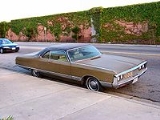
Chrysler New Yorker

Encyclopedia
The Chrysler New Yorker was a premium automobile built by the Chrysler Corporation
from 1939–1996, serving for several years as the brand's flagship
model. A model named the "New York Special" first appeared in the 1930s. Until its discontinuation in 1996, the New Yorker had made its mark as the longest running American car nameplate.
The New Yorker name helped define the Chrysler brand as a maker of upscale models priced and equipped above mainstream brands like Ford
, Chevrolet
/Pontiac
, and Dodge
/Plymouth
, but below full luxury brands like Cadillac
, Lincoln and Packard
. During the New Yorker's tenure, it competed against models from Buick
, Oldsmobile
and Mercury.
.
The model's popularity caused the car to become its own series for 1939, based on the same platform as the Chrysler Imperial
and that year's other new introduction, the Chrysler Saratoga
. The New Yorker was available in 1938 as a 4-door sedan with a 323 CID Straight-8
and a generous amount of comfort and space to the passengers. For 1939, New Yorker was expanded with 2 more Coupe versions and a 2-door sedan. The first convertibles were introduced with the all-new body-design of the 1940 models.
1940 also saw the introduction of Fluid Drive
, a fluid coupling between the engine and the clutch. The only transmission available was the basic three speed manual
.
Completely new bodies were introduced for 1941, with the business coupe now being of the three window design. Another new model was the Town Sedan with the rear doors having the hinges at the forward edge of the doors. This year, the Vacamatic
was made available, although unlike the version sold on six-cylinder models, the Saratoga/New Yorker version was a three speed transmission with overdrive.
With America entering World War II on 7 December 1941, all automobile production came to an end at the beginning of February, 1942. Thus, the 1942 model year was roughly half the normal length.
Chrysler would produce and experiment with engines for tanks and aircraft during World War II
. One post-war application of this would lead to the creation of the first generation Hemi of the 1950s.
Postwar Chryslers continued to offer Fluid Drive, with the New Yorker now offering the true four speed semi-automatic transmission.
, three-box
styling. The engine continued to be the 323.5-cid straight eight coupled to Fluid Drive and the Prestomatic four-speed semi-automatic
. Body styles were reduced to club coupe, 4-door sedan and convertible. Wheelbase on the New Yorker was increased to 131.5 in (3,340.1 mm) from the 127.5 in (3,238.5 mm) frame introduced in 1941.
The 1950 New Yorker was the more deluxe of the regular eight-cylinder Chryslers (Saratoga being the eight with plainer trim) with cloth upholstery available in (unusual for 1950) several colors, 135 hp Spitfire straight-eight engine and roomy interior featuring "chair height" seats. The "Prestomatic" fluid drive transmission had two forward ranges, each with two speeds. In normal driving, high range was engaged using the clutch. The car could then be driven without using the clutch (unless reverse or low range was required); at any speed above 13 mph (20.9 km/h), the driver released the accelerator and the transmission shifted into the higher gear of the range with a slight "clunk". When the car came to a stop, the lower gear was again engaged.
The big news for 1950 was the two-door hardtop, or Special Club Coupe as Chrysler called it, in the New Yorker series. The model was called the Newport in sales literature. Also, Chrysler added foam rubber padding on the dashboard for safety.
Rocket engine of that time.
The New Yorker also offered Fluid Torque Drive, a true torque converter, in place of Fluid Drive. Cars with Fluid Torque Drive came only with Fluid Matic semi-automatic transmission
and had a gear selector quadrant on the steering column. Power steering, an industry first, appeared as an option on Chrysler cars with the Hemi engine. It was sold under the name Hydraguide.
A station wagon was offered for 1951, with 251 built.
The standard model had a mild 195 hp output while the DeLuxe was used as a testbed of the engine's capabilities by outputting 235 hp. (Such power was unheard of in 1954 from its competitors.)
Although introduced very late in the 1953 model year, all 1954 New Yorkers were available with the new two speed Powerflite automatic transmission
. Fluid Torque Drive and Fluid Matic were dropped.
1954 was the last year the long wheelbase sedan was offered by Chrysler.
produces 250 hp this year. The result would become an ongoing trend for increasing engine output throughout the next two decades with Chrysler and its rival competitors. The Powerflite transmission was controlled by a lever on the instrument panel.
The series was called New Yorker DeLuxe with the base New Yorker dropped. The club coupe was dropped being replaced by the Newport two-door hardtop. A new higher priced St.Regis two-door hardtop filled the spot of the former Newport. The sedan, convertible and Town & Country wagon were still offered.
. The New Yorker gained a new mesh grille, leather seats, pushbutton PowerFlite selector, and a V8 with 280 hp.
The St. Regis two-door hardtop gave a unique three-tone paint job for a higher price and the Town and Country Wagon model was Chrysler's most expensive vehicle of 1956 at US$
4,523. This was the first year for the New Yorker 4-door pillarless hardtop. Only 921 convertibles were made.
" at the cost of $300 million. The 1957 New Yorker had a powerful 392 cu in (6.4 l) Hemi V8 engine rated at 325 hp. This stylish car sold well with 10,948 built, but only 1,049 convertible models. The 1957 models also came with the TorqueFlite
3-speed automatic transmission
and a Torsion bar suspension called Torsion-Aire that gave smoother handling and ride quality to the car. The New Yorker also sported fins that swept up from just behind the front doors.
Early model year production had single headlamps with quad headlamps optional where state regulations permitted them. The single headlamps were dropped later in the year.
The convertible model was still available, with only 666 made and only 15 working convertibles are known to still exist in 2008. Sales were steady, but decreased from last year due to The Recession of 1958
. The car's reputation was also tainted due to rust problems caused by rushed production and testing.
The biggest news from Chrysler in 1958 was the introduction of a cruise control system called "Auto-Pilot"
The FirePower Hemi ended production and was replaced by the cheaper wedge head 413-cid RB engine. The Hemi would never return to the New Yorker and slowly ended its image as a performance car and re-branded it as a luxury car. The Hemi engine itself would not return to Mopar cars until 1964 with the second generation 426 Hemi.
construction, Ram Induction and the new RB engine had an output of 350 hp. This was the last year for the New Yorker convertible, of which 556 were built.
The finless car was considered "bizarre" by many critics and sales were slow compared to its entry level sister car, the Newport which was identical in body style and offered a convertible model.
The New Yorker was the last Chrysler to have a 126 in (3,200.4 mm) wheelbase.
The 413 RB had a 4.1875 in (106 mm) bore and was used from 1959-1965 in cars. During that period, it powered all Chrysler New Yorker and Imperial models, and was also available on the lesser Chryslers, as well Dodge's Polara and Monaco, and the Plymouth Fury as an alternative to the 383-cubic-inch B series engine and/or the 318 Poly. With a compression ratio of 10:1, it developed 340 brake horsepower in 1X4-Bbl trim.
redesigned the New Yorker with styling cues from his 1961 Lincoln Continental
— square side view with chrome trim along the top edges of the fenders. The options were: a 413 CID V8, dual pipe exhaust and power options (A/C, windows, antenna and steering). The engine itself put out 375 hp and was phased out for the 440 Firepower next model year.
Factory options for 1965 included a 350 hp 413 ci Firepower engine, vinyl rear roof pillar insert, Tilt 'N Telescopic steering wheel and standard power options.
For 1965, the 4-door sedan used the six-window Town Sedan style which also used by the 1965 Chrysler Newport and Dodge Custom 880. The two-door hardtop was now sold in the U.S. Wheelbase of New Yorker models, except the wagon, was 124 in (3,149.6 mm). The Town & Country wagon was on the Dodge's 121 in (3,073.4 mm) wheelbase as all C body wagons shared the same basic body.
Overall, 1966 was a good sales year for Chrysler with a steady increase in production and sales.
Sales slumped 20%, the company's lowest in five years due to an economic slump this year.
, the New Yorker continued with the roofline first introduced for 1965.
Sales rebounded with the year setting a record at 263,266 cars built.
, and later LeBaron models.
In 1976, the New Yorker inherited the front and rear end styling of the discontinued Imperial, and its interiors as well. The Imperial styling gave the New Yorker an unforeseen boost in sales, as the car looked distinctly different from the lower priced Newport. The styling cues formerly used on the 1974 and 1975 New Yorkers in turn were passed on to the base Chrysler Newport. It is interesting to note that Chrysler was the only "upscale" model to never recover its full size model sales to pre-energy crisis levels. Oldsmobile, Buick, & Cadillac eclipsed their old records in 1976, the last year before their downsizing, and continued to sell extremely well until the next gas crisis in 1979. Ford's Lincoln-Mercury benefited from any backlash from GM downsizing and set new records in 1977-78. Sales of the Newport and New Yorker continued to decline. The full size Chrysler line remained virtually unchanged until the advent of the downsized 1979 models.
began as a submodel of the New Yorker in 1979, after the nameplate was shifted to the Chrysler R platform
. The R-body series was a "Pillared Hardtop". The NYR now used the 318 V8 and the 360 engine was optional. While shorter and much lighter than the previous generation, these cars still had a big car look and ride. Hidden headlamps and full-width taillights distinguished it from its R-body siblings Newport
, St. Regis
and Gran Fury
. A Fifth Avenue "Limited Edition" was offered mid-1980 and included a stainless steel roof cap and smaller rear window. Other than exterior colors and fabrics there were virtually no changes. A bold new grille, with simple vertical ribs, appeared for 1981. The example in the accompanying photo, shown with its headlamp-concealing doors in the open position, is a 1981 New Yorker Fifth Avenue with the optional alloy road wheels and power moon roof.
. In turn, the Chrysler LeBaron
, which had previously used the M-body, moved to the compact K-body
this year. The 1982 New Yorker was not a completely new vehicle. It was essentially a restyled and upgraded version of the LeBaron which had been produced since 1977. This M-body New Yorker used Chrysler's slant 6 engine. The 318 in³ engine was optional.
The 1982 New Yorker was available in two models: Base and Fifth Avenue trim. Both used the formal roof treatment. The Fifth Avenue package gave buyers pillowed leather seats, base Models had cloth seats. This car became the Chrysler New Yorker Fifth Avenue
for 1983 and for 1984 the "New Yorker" prefix was dropped altogether.
The other was an all new K-car based New Yorker, which used the front-wheel drive
Chrysler E platform
, the beginning of the extended K-car years. The E-platform New Yorker came with state-of-the-art 1980s technology, including a digital dashboard and Electronic Voice Alert
, which spoke notifications such as "A door is ajar." Among other standard features was a Landau vinyl roof, complete with electroluminescent opera lamps. It was the only Chrysler New Yorker generation with an inline-four engine.
) and bore no resemblance to the E-body model (which remained for a portion of the 1988 model year, and was now dubbed New Yorker Turbo). Most underbody and suspension components were carryover. It shared similar upright body styling with the newly introduced Dodge Dynasty
. This new version had a V6 engine
— a Mitsubishi-sourced 3.0 liter
powerplant, and optional anti-lock brakes. Base and Landau trim choices were offered, the latter of which carried a rear-quarter vinyl top. Hidden headlamps, a feature lost when the R-body cars were discontinued, made a return with this redesign.
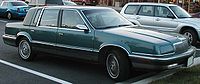 Beginning in 1990, a new stretched-wheelbase version was offered, carrying the additional moniker of Fifth Avenue from the just-departed M-body platform. Short-wheelbase New Yorkers continued with Landau and a new base model called Salon. The Salon was a rebadged Dynasty with exposed headlamps, horizontal taillights, and grille similar to the Dodge. All models carried a new Chrysler-built 3.3 L V6 engine that year. The Landau model was dropped for 1991, but even Salon models now came with hidden headlights, vertical taillights, and a traditional Chrysler grille. A new 3.8 L V6 engine became an available option. A styling update for 1992 produced a more rounded appearance front and rear.
.
and was shown at the 1992 North American International Auto Show
in Detroit. It was released along with the nearly identical Chrysler LHS
for the 1994 model year, a year after the original LH cars: the Chrysler Concorde
, Dodge Intrepid
, and Eagle Vision
, were introduced. The New Yorker came standard with the 3.5 L EGJ which produced 214 hp. For 1995, the New Yorker received Chrysler's new logo on its grille, which replaced the old pentastar. Chrysler gave the New Yorker a more "traditional American" luxury image, and the LHS a more European performance image (as was done with the Eagle Vision
). Besides for different color choices, in reality, little separated New Yorker from LHS in appearance, with New Yorker's chrome exterior trim, gray body cladding, optional chrome wheel covers, column shifter and front bench seat, being the only noticeable differences. LHS also came with many of New Yorker's optional features as standard equipment, and featured a firmer tuned suspension, to go with its more European image. Because of the similarities between the two, and LHS's strong sales, the New Yorker name was dropped after 1996, in favor of a six-passenger option on the more-popular LHS. Despite being far more contemporary and monochromatic in design compared to previous models, the traditional New Yorker, with its 2 tone cladding and chrome trim, still did not follow the modern, monochromatic styling trend of the division's other vehicles in 1997.
It was also at this time that the Chrysler Corporation purchased bankrupt Italian
sports car
manufacturer Lamborghini
. The Navajo's exterior design was reworked and became the Lamborghini Portofino
, released as a concept at the 1987 Frankfurt Auto Show. The Portofino was heralded as a design triumph, setting in motion Chrysler's decision to produce a production sedan with the Portofino's revolutionary exterior design, called "cab-forward".
The cab forward
design was characterized by the long, low slung windshield, and relatively short overhangs. The wheels were effectively pushed to the corners of the car, creating a much larger passenger cabin than the contemporaries of the time.
Design of the chassis began in the late 1980s, after Chrysler had bought another automaker: American Motors Corporation (AMC) in 1987. During this time, Chrysler began designing the replacement for the Dodge Dynasty
and Chrysler Fifth Avenue
as well as a potential Plymouth
. The initial design of Dodge's LH bore resemblance to the Dynasty, and this design was scrapped entirely after François Castaing
, formerly AMC's Vice President of product engineering and development, became Chrysler's Vice President of vehicle engineering in 1988. The new design, under Castaing's leadership, began with the Eagle Premier
, also sold later as the Dodge Monaco
.
The Premier's longitudinal engine mounting layout was inherited, as was the front suspension geometry, and parts of the braking system. The chassis itself became a flexible architecture capable of supporting front or rear-wheel drive (designated "LH" and "LX" respectively).
The chassis design was continually refined throughout the following years, as it underpinned more Chrysler prototypes: the 1989 Chrysler Millennium and 1990 Eagle Optima
.
The transmission was inspired by the Premier's Audi and ZF automatics. Borrowing heavily from Chrysler's A604 (41TE) "Ultradrive
" transversely mounted automatic, it became the A606 (also known as 42LE). This "Ultradrive" transmission however was not without critics as The New York Times reported on January 25, 1991 that Consumers Union would publish in the February 1991 issue of the magazine Consumer Reports a warning for consumers to NOT purchase a vehicle with this "Ultradrive" transmission citing poor reliability and safety hazards.
By 1990, it was decided that the new technologically advanced car would need a new technologically advanced engine to power it. Until that time, the only engine confirmed for use was Chrysler's 3.3 L pushrod V6, which would be used in the three original LH cars, the Intrepid, Vision, and Concorde, in base form. The 3.3 L engine's 60° block was bored out to 3.5 L, while the pushrod-actuated valves were replaced with SOHC cylinder heads with four valves per cylinder, creating an advanced 3.5 L V6 optional in the three smaller cars, but standard in LHS and New Yorker.
The general LH appearance, still based on the cab forward exterior design of the 1987 Lamborghini Portofino
concept
, with its aerodynamic shape, made for little wind noise inside this large car. This sleek styling gives the LH cars a low drag coefficient which was ahead of its time.
The New Yorker featured a more monochromatic design inside and out (but less so than its LHS sibling, which had very little chromed trim), and aluminum wheels with a Spiralcast design. The single color motif was more pronounced on models without the grey lower cladding.
Upscale New Yorker models feature leather-trimmed seats, steering wheel, shift knob and door inserts. Passenger comforts include rear center rear armrest, and 8-way power seat
s for both the driver and passenger, as well as personal reading lamps.
Power windows and central door locks were standard, as was climate control with air conditioning, and cruise control. remote keyless entry
available as an option, as was a remote activated alarm, an overhead console with computer, power moonroof and alloy wheels. The best stock audio options found in New Yorker are the Infinity
sound systems having eight speakers positioned throughout the cabin along with an equalizer. Head units include a radio with either cassette or CD playback, and up to a five-band adjustable graphic equalizer, with joystick balance and fade control
Standard safety features included dual front airbags, anti-lock brakes (ABS
), and traction control
.
Dual-way power sunroofs were available on this car. They were designed and installed by American Sunroof Corp. (now ASC Global) from its Columbus, Ohio plant, not by Mopar itself. An installed sunroof eliminated most of the front overhead console that featured storage bins for a garage door opener and sunglasses. However, the Overhead Travel Information System (OTIS), or onboard computer with integrated map lights, was retained.
Chrysler
Chrysler Group LLC is a multinational automaker headquartered in Auburn Hills, Michigan, USA. Chrysler was first organized as the Chrysler Corporation in 1925....
from 1939–1996, serving for several years as the brand's flagship
Flagship
A flagship is a vessel used by the commanding officer of a group of naval ships, reflecting the custom of its commander, characteristically a flag officer, flying a distinguishing flag...
model. A model named the "New York Special" first appeared in the 1930s. Until its discontinuation in 1996, the New Yorker had made its mark as the longest running American car nameplate.
The New Yorker name helped define the Chrysler brand as a maker of upscale models priced and equipped above mainstream brands like Ford
Ford Motor Company
Ford Motor Company is an American multinational automaker based in Dearborn, Michigan, a suburb of Detroit. The automaker was founded by Henry Ford and incorporated on June 16, 1903. In addition to the Ford and Lincoln brands, Ford also owns a small stake in Mazda in Japan and Aston Martin in the UK...
, Chevrolet
Chevrolet
Chevrolet , also known as Chevy , is a brand of vehicle produced by General Motors Company . Founded by Louis Chevrolet and ousted GM founder William C. Durant on November 3, 1911, General Motors acquired Chevrolet in 1918...
/Pontiac
Pontiac
Pontiac was an automobile brand that was established in 1926 as a companion make for General Motors' Oakland. Quickly overtaking its parent in popularity, it supplanted the Oakland brand entirely by 1933 and, for most of its life, became a companion make for Chevrolet. Pontiac was sold in the...
, and Dodge
Dodge
Dodge is a United States-based brand of automobiles, minivans, and sport utility vehicles, manufactured and marketed by Chrysler Group LLC in more than 60 different countries and territories worldwide....
/Plymouth
Plymouth (automobile)
Plymouth was a marque of automobile based in the United States, produced by the Chrysler Corporation and its successor DaimlerChrysler.-Origins:...
, but below full luxury brands like Cadillac
Cadillac
Cadillac is an American luxury vehicle marque owned by General Motors . Cadillac vehicles are sold in over 50 countries and territories, but mostly in North America. Cadillac is currently the second oldest American automobile manufacturer behind fellow GM marque Buick and is among the oldest...
, Lincoln and Packard
Packard
Packard was an American luxury-type automobile marque built by the Packard Motor Car Company of Detroit, Michigan, and later by the Studebaker-Packard Corporation of South Bend, Indiana...
. During the New Yorker's tenure, it competed against models from Buick
Buick
Buick is a premium brand of General Motors . Buick models are sold in the United States, Canada, Mexico, China, Taiwan, and Israel, with China being its largest market. Buick holds the distinction as the oldest active American make...
, Oldsmobile
Oldsmobile
Oldsmobile was a brand of American automobile produced for most of its existence by General Motors. It was founded by Ransom E. Olds in 1897. In its 107-year history, it produced 35.2 million cars, including at least 14 million built at its Lansing, Michigan factory...
and Mercury.
First generation
The New Yorker Special model was originally introduced as a distinct sub-series of the 1938 Chrysler ImperialChrysler Imperial
The Chrysler Imperial, introduced in 1926, was the company's top of the range vehicle for much of its history. Models were produced with the Chrysler name until 1954, and again from 1990 to 1993. The company tried to position the cars as a prestige marque that would rival Cadillac and Lincoln...
.
The model's popularity caused the car to become its own series for 1939, based on the same platform as the Chrysler Imperial
Chrysler Imperial
The Chrysler Imperial, introduced in 1926, was the company's top of the range vehicle for much of its history. Models were produced with the Chrysler name until 1954, and again from 1990 to 1993. The company tried to position the cars as a prestige marque that would rival Cadillac and Lincoln...
and that year's other new introduction, the Chrysler Saratoga
Chrysler Saratoga
The Chrysler Saratoga was a full-sized automobile produced by the Chrysler Division of the Chrysler Corporation. Chrysler first used the Saratoga nameplate on its 1939 models and continued to use the name through to 1952. The name was used again by Chrysler from 1957 until 1960 when it retired the...
. The New Yorker was available in 1938 as a 4-door sedan with a 323 CID Straight-8
Straight-8
The straight-eight engine or inline-eight engine is an eight-cylinder internal combustion engine with all eight cylinders mounted in a straight line along the crankcase...
and a generous amount of comfort and space to the passengers. For 1939, New Yorker was expanded with 2 more Coupe versions and a 2-door sedan. The first convertibles were introduced with the all-new body-design of the 1940 models.
1940 also saw the introduction of Fluid Drive
Fluid Drive
Fluid Drive is the trademarked name that Chrysler Corporation assigned to a transmission driveline combination offered from 1939 through 1953 in Chryslers, 1940 through 1953 in Desotos, and from 1941 through 1954 in Dodge models...
, a fluid coupling between the engine and the clutch. The only transmission available was the basic three speed manual
Manual transmission
A manual transmission, also known as a manual gearbox or standard transmission is a type of transmission used in motor vehicle applications...
.
Completely new bodies were introduced for 1941, with the business coupe now being of the three window design. Another new model was the Town Sedan with the rear doors having the hinges at the forward edge of the doors. This year, the Vacamatic
Vacamatic
The 1941 M4 Vacamatic transmission by Chrysler was, historically, the first semi-automatic transmission which was marketed by a major manufacturer. It was an attempt to compete against rival's automatic transmissions, though it still had a clutch, primarily to change range. In normal driving, the...
was made available, although unlike the version sold on six-cylinder models, the Saratoga/New Yorker version was a three speed transmission with overdrive.
With America entering World War II on 7 December 1941, all automobile production came to an end at the beginning of February, 1942. Thus, the 1942 model year was roughly half the normal length.
Chrysler would produce and experiment with engines for tanks and aircraft during World War II
World War II
World War II, or the Second World War , was a global conflict lasting from 1939 to 1945, involving most of the world's nations—including all of the great powers—eventually forming two opposing military alliances: the Allies and the Axis...
. One post-war application of this would lead to the creation of the first generation Hemi of the 1950s.
1946 to 1949
Unlike most car companies, Chrysler did not make changes with each model year from 1946 to the first series of 1949. Thus models for 1946 through 1949 Chryslers have the same basic appearance, noted for their 'harmonica' grille, based on the body introduced with the 1941 models. 1947 saw a minor redesign in tires, trim, and instrument panel, while the first 1949s were just 1948s with no visible changes.Postwar Chryslers continued to offer Fluid Drive, with the New Yorker now offering the true four speed semi-automatic transmission.
1949–1950
The true 1949 New Yorker, or second series, used Chrysler Corporation's new postwar body also shared by Dodge and DeSoto with pontonPonton (automobile)
Ponton or Pontoon styling refers to a 1930s-1960s design genre — ultimately the precursor of modern automotive styling. The trend emerged as distinct running boards and fully articulated fenders became less common and bodywork began to enclose the full width and uninterrupted length of a car...
, three-box
Three-box styling
Three-box design is a broad automotive styling term describing a coupé, sedan, notchback or hatchback where — when viewed in profile — principal volumes are articulated into three separate compartments or boxes: engine, passenger and cargo....
styling. The engine continued to be the 323.5-cid straight eight coupled to Fluid Drive and the Prestomatic four-speed semi-automatic
Semi-automatic transmission
A semi-automatic transmission is an automobile transmission that does not change gears automatically, but rather facilitates manual gear changes by dispensing with the need to press...
. Body styles were reduced to club coupe, 4-door sedan and convertible. Wheelbase on the New Yorker was increased to 131.5 in (3,340.1 mm) from the 127.5 in (3,238.5 mm) frame introduced in 1941.
The 1950 New Yorker was the more deluxe of the regular eight-cylinder Chryslers (Saratoga being the eight with plainer trim) with cloth upholstery available in (unusual for 1950) several colors, 135 hp Spitfire straight-eight engine and roomy interior featuring "chair height" seats. The "Prestomatic" fluid drive transmission had two forward ranges, each with two speeds. In normal driving, high range was engaged using the clutch. The car could then be driven without using the clutch (unless reverse or low range was required); at any speed above 13 mph (20.9 km/h), the driver released the accelerator and the transmission shifted into the higher gear of the range with a slight "clunk". When the car came to a stop, the lower gear was again engaged.
The big news for 1950 was the two-door hardtop, or Special Club Coupe as Chrysler called it, in the New Yorker series. The model was called the Newport in sales literature. Also, Chrysler added foam rubber padding on the dashboard for safety.
1951
Chrysler introduces the 180 hp FirePower Hemi engine. The engine becomes a popular choice among hot rodders and racers alike, a trend that continues to thrive today with its namesake second generation model. The FirePower Hemi equipped cars could accelerate 0 to 60 in 10 seconds, faster than the Oldsmobile 88Oldsmobile 88
The Oldsmobile 88 was a full-size car sold by the Oldsmobile division of General Motors and produced from 1949 until 1999. From 1950 to 1974 the 88 was the division's top-selling line, particularly the entry-level models such as the 88 and Dynamic 88...
Rocket engine of that time.
The New Yorker also offered Fluid Torque Drive, a true torque converter, in place of Fluid Drive. Cars with Fluid Torque Drive came only with Fluid Matic semi-automatic transmission
Semi-automatic transmission
A semi-automatic transmission is an automobile transmission that does not change gears automatically, but rather facilitates manual gear changes by dispensing with the need to press...
and had a gear selector quadrant on the steering column. Power steering, an industry first, appeared as an option on Chrysler cars with the Hemi engine. It was sold under the name Hydraguide.
A station wagon was offered for 1951, with 251 built.
1952
Small redesign on taillights with the backup lights in the lower section. Last year for the 131.5 in (3,340.1 mm) wheelbase chassis for the New Yorker.1953
A less bulky look with the wheelbase reduced to 125.5 in (3,187.7 mm), a one-piece curved windshield and rear fenders integrated into the body. Wire wheels were now an option. The Saratoga of 1952 became the New Yorker for 1953 while the former New Yorker was now the New Yorker DeLuxe. The convertible and Newport hardtop were available only in the New Yorker DeLuxe while the base New Yorker offered a long wheelbase sedan and a Town & Country wagon. The convertible was New Yorker's costliest model on the 125.5 in (3,187.7 mm) chassis for 1953 at $3,980 with only 950 built. Also new was exterior pull handles.1954
The 1954 was a premium version of a standard 1950s size body. Chrysler's interest in six cylinder vehicles began to wane in favor of the popular FirePower Hemi V8. The New Yorker was priced a little more affordable at $3,230 for the standard and $3,400 for the DeLuxe.The standard model had a mild 195 hp output while the DeLuxe was used as a testbed of the engine's capabilities by outputting 235 hp. (Such power was unheard of in 1954 from its competitors.)
Although introduced very late in the 1953 model year, all 1954 New Yorkers were available with the new two speed Powerflite automatic transmission
Automatic transmission
An automatic transmission is one type of motor vehicle transmission that can automatically change gear ratios as the vehicle moves, freeing the driver from having to shift gears manually...
. Fluid Torque Drive and Fluid Matic were dropped.
1954 was the last year the long wheelbase sedan was offered by Chrysler.
Third generation
In 1955, Chrysler did away with the previous and generic "lead sled" design of the 1940s with a new sedan that borrowed styling cues from the custom 1952 Imperial Parade Phaeton. The hemi engineChrysler Hemi engine
The Chrysler Hemi engine, known by the trademark Hemi, is a series of V8 engines built by Chrysler with a hemispherical combustion chamber. Three different types of Hemi engines have been built by Chrysler for automobiles: the first from 1951–1958, the second from 1964–1971, and the third...
produces 250 hp this year. The result would become an ongoing trend for increasing engine output throughout the next two decades with Chrysler and its rival competitors. The Powerflite transmission was controlled by a lever on the instrument panel.
The series was called New Yorker DeLuxe with the base New Yorker dropped. The club coupe was dropped being replaced by the Newport two-door hardtop. A new higher priced St.Regis two-door hardtop filled the spot of the former Newport. The sedan, convertible and Town & Country wagon were still offered.
1956
In 1956, Chrysler christened this model year "PowerStyle" and it was one of the design works of Virgil ExnerVirgil Exner
Virgil Max "Ex" Exner, Sr. was an automobile designer for numerous American companies, notably Chrysler and Studebaker. He is known for his "Forward Look" design on the 1955-1963 Chrysler products and his fondness of fins on cars for both aesthetic and aerodynamic reasons.-Early life:Born in Ann...
. The New Yorker gained a new mesh grille, leather seats, pushbutton PowerFlite selector, and a V8 with 280 hp.
The St. Regis two-door hardtop gave a unique three-tone paint job for a higher price and the Town and Country Wagon model was Chrysler's most expensive vehicle of 1956 at US$
United States dollar
The United States dollar , also referred to as the American dollar, is the official currency of the United States of America. It is divided into 100 smaller units called cents or pennies....
4,523. This was the first year for the New Yorker 4-door pillarless hardtop. Only 921 convertibles were made.
1957
This year, Chrysler cars were redesigned with Virgil Exner's "Forward LookForward Look
Forward Look was a design theme employed by Virgil Exner in styling the 1955 through 1961 Chrysler Corporation vehicles.When Exner joined Chrysler, the company's vehicles were being fashioned by engineers instead of designers, and so were considered outmoded, unstylish designs...
" at the cost of $300 million. The 1957 New Yorker had a powerful 392 cu in (6.4 l) Hemi V8 engine rated at 325 hp. This stylish car sold well with 10,948 built, but only 1,049 convertible models. The 1957 models also came with the TorqueFlite
TorqueFlite
TorqueFlite is the trademarked name of Chrysler Corporation's automatic transmissions, starting with the three-speed unit introduced late in the 1956 model year as a successor to Chrysler's two-speed PowerFlite...
3-speed automatic transmission
Automatic transmission
An automatic transmission is one type of motor vehicle transmission that can automatically change gear ratios as the vehicle moves, freeing the driver from having to shift gears manually...
and a Torsion bar suspension called Torsion-Aire that gave smoother handling and ride quality to the car. The New Yorker also sported fins that swept up from just behind the front doors.
Early model year production had single headlamps with quad headlamps optional where state regulations permitted them. The single headlamps were dropped later in the year.
1958
Forward Look remains intact but with new body-side trim, shrunken taillights and 345 hp.The convertible model was still available, with only 666 made and only 15 working convertibles are known to still exist in 2008. Sales were steady, but decreased from last year due to The Recession of 1958
Recession of 1958
The Recession of 1958 was a sharp worldwide economic downturn in 1958, and the most significant one during the post-World War II boom between 1945 and 1970....
. The car's reputation was also tainted due to rust problems caused by rushed production and testing.
The biggest news from Chrysler in 1958 was the introduction of a cruise control system called "Auto-Pilot"
1959
The New Yorkers this year had 350 hp, new tailfins, new front end, and no Hemi.The FirePower Hemi ended production and was replaced by the cheaper wedge head 413-cid RB engine. The Hemi would never return to the New Yorker and slowly ended its image as a performance car and re-branded it as a luxury car. The Hemi engine itself would not return to Mopar cars until 1964 with the second generation 426 Hemi.
1960
This year had unibodyMonocoque
Monocoque is a construction technique that supports structural load by using an object's external skin, as opposed to using an internal frame or truss that is then covered with a non-load-bearing skin or coachwork...
construction, Ram Induction and the new RB engine had an output of 350 hp. This was the last year for the New Yorker convertible, of which 556 were built.
1961
The New Yorker entered 1961 with a new grille, slanted headlights, a continental kit on the trunk lid, and a 413 CID Golden Lion V-8. This is the last of the "Forward Look" models. Chrysler built 2,541 New Yorker two-door hardtops this year, the last until 1964 in Canada and 1965 in the U.S.1962
The classic Chrysler fins that made the car unique no longer existed and now only 4-door models were offered in wagon, sedan, and hardtop models.The finless car was considered "bizarre" by many critics and sales were slow compared to its entry level sister car, the Newport which was identical in body style and offered a convertible model.
The New Yorker was the last Chrysler to have a 126 in (3,200.4 mm) wheelbase.
The 413 RB had a 4.1875 in (106 mm) bore and was used from 1959-1965 in cars. During that period, it powered all Chrysler New Yorker and Imperial models, and was also available on the lesser Chryslers, as well Dodge's Polara and Monaco, and the Plymouth Fury as an alternative to the 383-cubic-inch B series engine and/or the 318 Poly. With a compression ratio of 10:1, it developed 340 brake horsepower in 1X4-Bbl trim.
1963
Chrysler got a boost in sales in 1963 with the introduction of a 5-year/50,000-mile warranty, a business practice that was unheard of by its competitors in the 1960s. The New Yorker used Chrysler's completely redesigned body with only the windshield showing traces of the previous Forward Look designs. A new, more luxurious Salon four-door hardtop was added at midyear as a trim package. Engine output is 340 hp and the wheelbase is now 122 in (3,098.8 mm).1964
Changes for 1964 included a new grille, larger rear window and small tailfins giving the car a boxier look from the side. Canadians were given the choice of a new two-door hardtop, while Americans got the Salon option on the four-door hardtop.1965
Elwood EngelElwood Engel
-Early days:Engel first joined General Motors as a student under Harley Earl's watchful eye at GM's school of design. In 1939 he met classmates Joe Oros and George W. Walker at the school. During World War II, Engel served four years in the U.S. Army as a mapmaker, in both the European and Pacific...
redesigned the New Yorker with styling cues from his 1961 Lincoln Continental
Lincoln Continental
The Lincoln Continental is an automobile which was produced by the Lincoln division of Ford Motor Company from 1939 to 1948 and again from 1956 to 2002...
— square side view with chrome trim along the top edges of the fenders. The options were: a 413 CID V8, dual pipe exhaust and power options (A/C, windows, antenna and steering). The engine itself put out 375 hp and was phased out for the 440 Firepower next model year.
Factory options for 1965 included a 350 hp 413 ci Firepower engine, vinyl rear roof pillar insert, Tilt 'N Telescopic steering wheel and standard power options.
For 1965, the 4-door sedan used the six-window Town Sedan style which also used by the 1965 Chrysler Newport and Dodge Custom 880. The two-door hardtop was now sold in the U.S. Wheelbase of New Yorker models, except the wagon, was 124 in (3,149.6 mm). The Town & Country wagon was on the Dodge's 121 in (3,073.4 mm) wheelbase as all C body wagons shared the same basic body.
1966
For 1966, the Chrysler New Yorker adopted the new 440-cid V8 engine. Styling changes included a new grille, taillamps and revised side trim. The Town & Country wagon was dropped as the model was now marketed as a series on its own.Overall, 1966 was a good sales year for Chrysler with a steady increase in production and sales.
1967
1967 brought sheetmetal redesign below the belt line with wraparound parking lights at the front and taillights at the rear. A new fasttop design for the two-door hardtop replaced the more formal look of 1965-1966. The four-door sedan reverted to the four window style as used on the Newport sedan.Sales slumped 20%, the company's lowest in five years due to an economic slump this year.
1968
Changes included new front and rear treatments. Although the Newport and 300 four-door hardtops received a new, sportier roofline shared with Dodge and PlymouthPlymouth (automobile)
Plymouth was a marque of automobile based in the United States, produced by the Chrysler Corporation and its successor DaimlerChrysler.-Origins:...
, the New Yorker continued with the roofline first introduced for 1965.
Sales rebounded with the year setting a record at 263,266 cars built.
1969
Chrysler big C bodies received a major reworking with curved sides and a higher belt line. Underneath the new look were the underpinnings of 1965. The new look was called "Fuselage Styling" and was not received as warmly as the 1968 models. The two-door hardtop received a new look harking back to the club coupes of the 1940s.1970
The 1970 Chryslers received minor styling changes to the grille, taillamps and trim. The small vent windows on the front doors were dropped on the two-door hardtops.1971
Due to sales that were less than expected, the facelift scheduled for 1971 was put off until 1972. Thus the 1971 models received new grilles and revised taillamps, changes that took a sharp eye to note. Ventless front-door windows on the four-door sedan and hardtop were new this year.1972
For 1972, Engine power dropped to meet stricter emissions standards and rising gas prices. Chryslers received a new 'split grille' somewhat similar to the Dodge Chargers of 1971-1974. This would be the last year for the 'loop'-style front bumpers on Chryslers.Sixth generation
The so called "fuselage" styling featured on all full size Chrysler products remained relatively unchanged until the introduction of the 1974 models which featured a far more massive slab sided effect. These 1974 models timed to coincide precisely with the 1973 OPEC oil embargo, and were a significant part of Chrysler's economic woes in the late 1970s. The 1974 models were the last full-size models Chrysler designed from the ground up, as the short lived 1979-81 R-bodies were stretched versions of the old mid-sized B-bodies. Chrysler, as the corporation's only division without a smaller "personal" size model, suffered worse than most, stimulating the introduction of the new Chrysler CordobaChrysler Cordoba
The Chrysler Cordoba was an intermediate personal luxury coupe sold by Chrysler Corporation in North America from 1975-1983. It was the company's first model produced specifically for the personal luxury market and the first Chrysler-branded vehicle that was less than full-size.-History:In the...
, and later LeBaron models.
In 1976, the New Yorker inherited the front and rear end styling of the discontinued Imperial, and its interiors as well. The Imperial styling gave the New Yorker an unforeseen boost in sales, as the car looked distinctly different from the lower priced Newport. The styling cues formerly used on the 1974 and 1975 New Yorkers in turn were passed on to the base Chrysler Newport. It is interesting to note that Chrysler was the only "upscale" model to never recover its full size model sales to pre-energy crisis levels. Oldsmobile, Buick, & Cadillac eclipsed their old records in 1976, the last year before their downsizing, and continued to sell extremely well until the next gas crisis in 1979. Ford's Lincoln-Mercury benefited from any backlash from GM downsizing and set new records in 1977-78. Sales of the Newport and New Yorker continued to decline. The full size Chrysler line remained virtually unchanged until the advent of the downsized 1979 models.
Seventh generation
The Chrysler Fifth AvenueChrysler Fifth Avenue
With the R-body out of production and the LeBaron name transferred to the Chrysler K platform for 1982, the New Yorker was downsized once again, becoming a mid-sized car ....
began as a submodel of the New Yorker in 1979, after the nameplate was shifted to the Chrysler R platform
Chrysler R platform
The Chrysler R platform, introduced for 1979, was essentially a slightly modernized version of Chrysler's 1971-78 intermediate B platform, which had its roots in the company's downsized 1962 full-size models . It was a response to the downsized 1977 Chevrolet Caprice and Ford LTD, but proved...
. The R-body series was a "Pillared Hardtop". The NYR now used the 318 V8 and the 360 engine was optional. While shorter and much lighter than the previous generation, these cars still had a big car look and ride. Hidden headlamps and full-width taillights distinguished it from its R-body siblings Newport
Chrysler Newport
The Newport was a name used by the Chrysler division of the Chrysler Corporation used as both a hardtop body designation and also for its lowest priced model between 1961 and 1981...
, St. Regis
Dodge St. Regis
The Dodge St. Regis is a full-size Dodge automobile built from 1979 to 1981. The St. Regis was based on Chrysler's rear wheel drive R-body platform, itself based on a modified version of the circa 1971 B-body design that provided the underpinnings for such cars as the Dodge Charger and the...
and Gran Fury
Plymouth Gran Fury
The Plymouth Gran Fury is an automobile manufactured by the Chrysler Corporation to signify Plymouth's largest full-size automobile from 1975 to 1977. The nameplate would be used on successive downsizings, first in 1980, and again in 1982, through what would originally have been intermediate and...
. A Fifth Avenue "Limited Edition" was offered mid-1980 and included a stainless steel roof cap and smaller rear window. Other than exterior colors and fabrics there were virtually no changes. A bold new grille, with simple vertical ribs, appeared for 1981. The example in the accompanying photo, shown with its headlamp-concealing doors in the open position, is a 1981 New Yorker Fifth Avenue with the optional alloy road wheels and power moon roof.
| Year | Units |
|---|---|
| 1979 | 54,640 |
| 1980 | 13,513 |
| 1981 | 6,548 |
| Total Production = 74,701 | |
Eighth generation
In an effort of downsizing, the 1982 Chrysler New Yorker (and the Fifth Avenue trim) moved to the corporate M-bodyChrysler M platform
The M-Bodies were Chrysler Corporation's successor to the F-body Aspen/Volare. The platform, almost identical to the F, was introduced in 1977 and was the basis for some mid-sized Chrysler models until its demise in 1989. The M-body was also the successor to the short-lived R-body, as the Chrysler...
. In turn, the Chrysler LeBaron
Chrysler LeBaron
The Chrysler LeBaron was originally a classic luxury car of 1930s manufactured by Chrysler which competed with other luxury cars of the era such as Lincoln and Packard....
, which had previously used the M-body, moved to the compact K-body
Chrysler K platform
The Chrysler Corporation's K-cars were compact-to-midsize cars designed to carry six adults on two bench seats and were aimed not only to replace Chrysler's nominally-compact F-body Aspen and Volaré, but also to compete with intermediates like the Chevrolet Malibu and Ford Fairmont...
this year. The 1982 New Yorker was not a completely new vehicle. It was essentially a restyled and upgraded version of the LeBaron which had been produced since 1977. This M-body New Yorker used Chrysler's slant 6 engine. The 318 in³ engine was optional.
The 1982 New Yorker was available in two models: Base and Fifth Avenue trim. Both used the formal roof treatment. The Fifth Avenue package gave buyers pillowed leather seats, base Models had cloth seats. This car became the Chrysler New Yorker Fifth Avenue
Chrysler Fifth Avenue
With the R-body out of production and the LeBaron name transferred to the Chrysler K platform for 1982, the New Yorker was downsized once again, becoming a mid-sized car ....
for 1983 and for 1984 the "New Yorker" prefix was dropped altogether.
| Year | Units |
|---|---|
| 1982 | 50,509 |
Ninth generation
In 1983, the New Yorker name was used on two different models. The M-body car was now the "New Yorker Fifth Avenue," a name which changed to simply "Fifth Avenue" from 1984 to 1989.The other was an all new K-car based New Yorker, which used the front-wheel drive
Front-wheel drive
Front-wheel drive is a form of engine/transmission layout used in motor vehicles, where the engine drives the front wheels only. Most modern front-wheel drive vehicles feature a transverse engine, rather than the conventional longitudinal engine arrangement generally found in rear-wheel drive and...
Chrysler E platform
Chrysler E platform
Chrysler used the designation E platform for two separate car ranges.One was used for rear wheel drive cars in the 1970s:* 1970-1974 Dodge Challenger, wheelbase* 1970-1974 Plymouth Barracuda, wheelbase...
, the beginning of the extended K-car years. The E-platform New Yorker came with state-of-the-art 1980s technology, including a digital dashboard and Electronic Voice Alert
Electronic Voice Alert
The Electronic Voice Alert, or EVA, was an option available on many Chrysler Corporation K-car-based vehicles in the mid-1980s. Using technology from Texas Instruments similar to what was used in the Speak & Spell, the EVA would automatically lower the radio volume and deliver eleven different...
, which spoke notifications such as "A door is ajar." Among other standard features was a Landau vinyl roof, complete with electroluminescent opera lamps. It was the only Chrysler New Yorker generation with an inline-four engine.
Tenth generation
The "new" New Yorker was bigger (see Chrysler C platformChrysler C platform
Chrysler's C platform was the basis for rear wheel drive full-size cars from 1965 to 1978. Although often misclassified, 1964 and earlier full-size Chrysler products, and 1966 and earlier Imperials are not C-bodies.Wheelbases:* 119 in...
) and bore no resemblance to the E-body model (which remained for a portion of the 1988 model year, and was now dubbed New Yorker Turbo). Most underbody and suspension components were carryover. It shared similar upright body styling with the newly introduced Dodge Dynasty
Dodge Dynasty
The Dodge Dynasty was a front-wheel drive sedan that was introduced in 1987 as a 1988 model to replace the 600 as Dodge's mid-size car. The Dodge Dynasty was related to the Chrysler New Yorker; both car lines were built on the Chrysler C platform in Belvidere, Illinois.The Dynasty is also similar...
. This new version had a V6 engine
V6 engine
A V6 engine is a V engine with six cylinders mounted on the crankcase in two banks of three cylinders, usually set at either a right angle or an acute angle to each other, with all six pistons driving a common crankshaft...
— a Mitsubishi-sourced 3.0 liter
Litér
- External links :*...
powerplant, and optional anti-lock brakes. Base and Landau trim choices were offered, the latter of which carried a rear-quarter vinyl top. Hidden headlamps, a feature lost when the R-body cars were discontinued, made a return with this redesign.
Trim levels
Trim levels for 1988–1993; See also Chrysler Fifth AvenueChrysler Fifth Avenue
With the R-body out of production and the LeBaron name transferred to the Chrysler K platform for 1982, the New Yorker was downsized once again, becoming a mid-sized car ....
.
- base - 1988–1989
- Landau - 1988–1990
- Salon - 1990–1993
- Fifth AvenueChrysler Fifth AvenueWith the R-body out of production and the LeBaron name transferred to the Chrysler K platform for 1982, the New Yorker was downsized once again, becoming a mid-sized car ....
- 1990–1993
| Year | Units |
|---|---|
| 1988 | 70,968 |
| 1989 | 100,461 |
| 1990 | 86,004 |
| 1991 | 55,229 |
| 1992 | 51,650 |
| 1993 | 52,128 |
| Total Production = 416,440 | |
Eleventh generation
The last generation of the New Yorker continued with front-wheel drive on an elongated version of the new Chrysler LH platformChrysler LH platform
The LH platform served as the basis for the Chrysler Concorde, Chrysler LHS, Chrysler 300M, Dodge Intrepid, Eagle Vision, and the final Chrysler New Yorker. A Plymouth to be called the "Accolade" was planned, but never saw production...
and was shown at the 1992 North American International Auto Show
North American International Auto Show
The North American International Auto Show is an annual auto show held in Detroit, Michigan at Cobo Center, usually in January. It is among the largest auto shows in North America.-History:...
in Detroit. It was released along with the nearly identical Chrysler LHS
Chrysler LHS
The Chrysler LHS is a full-size, front wheel drive car based on the Chrysler LH platform.Having been praised throughout its production run as offering a blend of high-end features, along with solid performance, the LHS was marketed as a rival to other cars costing thousands more...
for the 1994 model year, a year after the original LH cars: the Chrysler Concorde
Chrysler Concorde
The Chrysler Concorde was a large four-door, full-size, front wheel drive sedan produced by Chrysler from 1993 to 2004. It replaced the Chrysler Fifth Avenue on the lineup. One of Chrysler's 3 original Chrysler LH platform models derived from the American Motors/Renault-designed Eagle Premier, it...
, Dodge Intrepid
Dodge Intrepid
The Dodge Intrepid is a large four-door, full-size, front-wheel drive sedan car model that was produced for model years 1993 to 2004. It was mechanically related to the Chrysler Concorde, Chrysler LHS, Chrysler New Yorker, Eagle Vision, and also the 300M sedans...
, and Eagle Vision
Eagle Vision
The Eagle Vision was a full-size, front-wheel drive sedan, marketed as a sports version of the Chrysler LH platform, produced from 1993-1997. It was sold by the Eagle division of the Chrysler Corporation, replacing the AMC/Renault-designed Eagle Premier...
, were introduced. The New Yorker came standard with the 3.5 L EGJ which produced 214 hp. For 1995, the New Yorker received Chrysler's new logo on its grille, which replaced the old pentastar. Chrysler gave the New Yorker a more "traditional American" luxury image, and the LHS a more European performance image (as was done with the Eagle Vision
Eagle Vision
The Eagle Vision was a full-size, front-wheel drive sedan, marketed as a sports version of the Chrysler LH platform, produced from 1993-1997. It was sold by the Eagle division of the Chrysler Corporation, replacing the AMC/Renault-designed Eagle Premier...
). Besides for different color choices, in reality, little separated New Yorker from LHS in appearance, with New Yorker's chrome exterior trim, gray body cladding, optional chrome wheel covers, column shifter and front bench seat, being the only noticeable differences. LHS also came with many of New Yorker's optional features as standard equipment, and featured a firmer tuned suspension, to go with its more European image. Because of the similarities between the two, and LHS's strong sales, the New Yorker name was dropped after 1996, in favor of a six-passenger option on the more-popular LHS. Despite being far more contemporary and monochromatic in design compared to previous models, the traditional New Yorker, with its 2 tone cladding and chrome trim, still did not follow the modern, monochromatic styling trend of the division's other vehicles in 1997.
LH design background
The eleventh, and final, generation New Yorker's design can be traced to 1986, when designer Kevin Verduyn completed the initial exterior design of a new aerodynamic concept sedan called Navajo. The design never passed the clay model stage.It was also at this time that the Chrysler Corporation purchased bankrupt Italian
Italy
Italy , officially the Italian Republic languages]] under the European Charter for Regional or Minority Languages. In each of these, Italy's official name is as follows:;;;;;;;;), is a unitary parliamentary republic in South-Central Europe. To the north it borders France, Switzerland, Austria and...
sports car
Sports car
A sports car is a small, usually two seat, two door automobile designed for high speed driving and maneuverability....
manufacturer Lamborghini
Lamborghini
Automobili Lamborghini S.p.A., commonly referred to as Lamborghini , is an Italian car manufacturer. The company was founded by manufacturing magnate Ferruccio Lamborghini in 1963, with the objective of producing a refined grand touring car to compete with established offerings from marques like...
. The Navajo's exterior design was reworked and became the Lamborghini Portofino
Lamborghini Portofino
The Lamborghini Portofino was a concept car developed for Lamborghini by Kevin Verduyn, one of Chrysler's chief designers. Introduced at the 1987 Frankfurt Auto Show, it was a fully functional, four-door, four-seat sport sedan....
, released as a concept at the 1987 Frankfurt Auto Show. The Portofino was heralded as a design triumph, setting in motion Chrysler's decision to produce a production sedan with the Portofino's revolutionary exterior design, called "cab-forward".
The cab forward
Cab forward
The term cab forward refers to various rail and road vehicle designs which place the driver's compartment substantially farther towards the front than is common practice.- Rail locomotives :...
design was characterized by the long, low slung windshield, and relatively short overhangs. The wheels were effectively pushed to the corners of the car, creating a much larger passenger cabin than the contemporaries of the time.
Design of the chassis began in the late 1980s, after Chrysler had bought another automaker: American Motors Corporation (AMC) in 1987. During this time, Chrysler began designing the replacement for the Dodge Dynasty
Dodge Dynasty
The Dodge Dynasty was a front-wheel drive sedan that was introduced in 1987 as a 1988 model to replace the 600 as Dodge's mid-size car. The Dodge Dynasty was related to the Chrysler New Yorker; both car lines were built on the Chrysler C platform in Belvidere, Illinois.The Dynasty is also similar...
and Chrysler Fifth Avenue
Chrysler Fifth Avenue
With the R-body out of production and the LeBaron name transferred to the Chrysler K platform for 1982, the New Yorker was downsized once again, becoming a mid-sized car ....
as well as a potential Plymouth
Plymouth (automobile)
Plymouth was a marque of automobile based in the United States, produced by the Chrysler Corporation and its successor DaimlerChrysler.-Origins:...
. The initial design of Dodge's LH bore resemblance to the Dynasty, and this design was scrapped entirely after François Castaing
François Castaing
François J. Castaing is a 27-year veteran automotive executive with Renault, American Motors, and Chrysler. He is an engineering graduate from École Nationale Supérieure d'Arts et Métiers in Paris, and worked in Europe for Gordini and Renault before being named Vice President for Product...
, formerly AMC's Vice President of product engineering and development, became Chrysler's Vice President of vehicle engineering in 1988. The new design, under Castaing's leadership, began with the Eagle Premier
Eagle Premier
The Eagle Premier was a full-size automobile developed by the American Motors Corporation and Renault partnership, inherited by Chrysler Corporation when it acquired AMC in 1987, and marketed from 1987 through 1992...
, also sold later as the Dodge Monaco
Dodge Monaco
The Dodge Monaco was a full-size automobile built and sold by the Dodge division of the Chrysler Corporation between 1965 to 1978, and 1990 to 1992.-A Grand Prix competitor:...
.
The Premier's longitudinal engine mounting layout was inherited, as was the front suspension geometry, and parts of the braking system. The chassis itself became a flexible architecture capable of supporting front or rear-wheel drive (designated "LH" and "LX" respectively).
The chassis design was continually refined throughout the following years, as it underpinned more Chrysler prototypes: the 1989 Chrysler Millennium and 1990 Eagle Optima
Eagle Optima
The Eagle Optima, was a 1990 concept car by the Eagle division of the Chrysler Corporation. It was a four-door sedan that used cab forward design. It was one of a series of concepts that lead up to the 1993 LH Eagle Vision and its siblings...
.
The transmission was inspired by the Premier's Audi and ZF automatics. Borrowing heavily from Chrysler's A604 (41TE) "Ultradrive
Ultradrive
The Ultradrive is a 4-speed automatic transmission from Chrysler Corporation. It was produced starting in 1989. It was originally paired primarily with the Chrysler 3.3 engine in vehicles with transverse engines...
" transversely mounted automatic, it became the A606 (also known as 42LE). This "Ultradrive" transmission however was not without critics as The New York Times reported on January 25, 1991 that Consumers Union would publish in the February 1991 issue of the magazine Consumer Reports a warning for consumers to NOT purchase a vehicle with this "Ultradrive" transmission citing poor reliability and safety hazards.
By 1990, it was decided that the new technologically advanced car would need a new technologically advanced engine to power it. Until that time, the only engine confirmed for use was Chrysler's 3.3 L pushrod V6, which would be used in the three original LH cars, the Intrepid, Vision, and Concorde, in base form. The 3.3 L engine's 60° block was bored out to 3.5 L, while the pushrod-actuated valves were replaced with SOHC cylinder heads with four valves per cylinder, creating an advanced 3.5 L V6 optional in the three smaller cars, but standard in LHS and New Yorker.
The general LH appearance, still based on the cab forward exterior design of the 1987 Lamborghini Portofino
Lamborghini Portofino
The Lamborghini Portofino was a concept car developed for Lamborghini by Kevin Verduyn, one of Chrysler's chief designers. Introduced at the 1987 Frankfurt Auto Show, it was a fully functional, four-door, four-seat sport sedan....
concept
Concept car
A concept vehicle or show vehicle is a car made to showcase new styling and or new technology. They are often shown at motor shows to gauge customer reaction to new and radical designs which may or may not have a chance of being produced....
, with its aerodynamic shape, made for little wind noise inside this large car. This sleek styling gives the LH cars a low drag coefficient which was ahead of its time.
The New Yorker featured a more monochromatic design inside and out (but less so than its LHS sibling, which had very little chromed trim), and aluminum wheels with a Spiralcast design. The single color motif was more pronounced on models without the grey lower cladding.
Upscale New Yorker models feature leather-trimmed seats, steering wheel, shift knob and door inserts. Passenger comforts include rear center rear armrest, and 8-way power seat
Power seat
A power seat in an automobile is a front seat which can be adjusted by using a switch or joystick and a set of small electric motors. Most cars with this feature have controls for the driver's seat only, though almost all luxury cars also have power controls for the front passenger seat.In addition...
s for both the driver and passenger, as well as personal reading lamps.
Power windows and central door locks were standard, as was climate control with air conditioning, and cruise control. remote keyless entry
Remote keyless system
A remote keyless system is a system designed to permit or deny access to premises or automobiles. While the "remote" system is portable and has locking capabilities, the exact phrase "keyless entry" is solely reserved for the numeric dials or keypads that are located on or near the driver side door...
available as an option, as was a remote activated alarm, an overhead console with computer, power moonroof and alloy wheels. The best stock audio options found in New Yorker are the Infinity
Infinity (audio)
Infinity Systems is an American manufacturer of loudspeakers founded by Arnie Nudell, John Ulrick and Cary Christie in 1968. Since 1983, Infinity has been part of the Harman International Industries group....
sound systems having eight speakers positioned throughout the cabin along with an equalizer. Head units include a radio with either cassette or CD playback, and up to a five-band adjustable graphic equalizer, with joystick balance and fade control
Standard safety features included dual front airbags, anti-lock brakes (ABS
Anti-lock braking system
An anti-lock braking system is a safety system that allows the wheels on a motor vehicle to continue interacting tractively with the road surface as directed by driver steering inputs while braking, preventing the wheels from locking up and therefore avoiding skidding.An ABS generally offers...
), and traction control
Traction control system
A traction control system , also known as anti-slip regulation , is typically a secondary function of the anti-lock braking system on production motor vehicles, designed to prevent loss of traction of driven road wheels...
.
Dual-way power sunroofs were available on this car. They were designed and installed by American Sunroof Corp. (now ASC Global) from its Columbus, Ohio plant, not by Mopar itself. An installed sunroof eliminated most of the front overhead console that featured storage bins for a garage door opener and sunglasses. However, the Overhead Travel Information System (OTIS), or onboard computer with integrated map lights, was retained.
| Year | Units |
|---|---|
| 1994 | 34,283 |
| 1995 | 23,624 |
| 1996 | 3,295 |
| Total Production = 61,202 | |