
| |
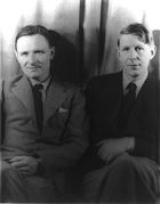
Christopher William Bradshaw Isherwood (August 26, 1904 – January 4, 1986) was an Anglo-American novelist.
Life and work Born at Wyberslegh Hall, High Lane, Cheshire (now in Greater Manchester) in the northwest of England, Isherwood spent his childhood in various towns where his father, a Lieutenant-Colonel in the British Army, was stationed. After his father was killed in the First World War, he settled with his mother in London and at Wyberslegh.
Isherwood attended preparatory school St. Edmund's, Surrey, where he first met W. H. Auden.

Discussion
Ask a question about 'Christopher Isherwood'
Start a new discussion about 'Christopher Isherwood'
Answer questions from other users
|
Quotations
I am a camera with its shutter open, quite passive, recording, not thinking.
"Berlin Diary" (1930) from Goodbye to Berlin (1939)
I doubt if one ever accepts a belief until one urgently needs it.
Christopher and His Kind (1976), p. 306
Horror is always aware of its cause; terror never is. That is precisely what makes terror terrifying.
Great English Short Stories selected and introduced by Isherwood (1957) Laurel TM 674623, p. 267
The paternalist is a sentimentalist at heart, and the sentimentalist is always potentially cruel.
"Los Angeles" from Exhumations (1966) Methuen & Co., Ltd, London, p. 160
I'll bet Shakespeare compromised himself a lot; anybody who's in the entertainment industry does to some extent.
Writers at Work: The Paris Review Interviews, 4th series, p. 237, interview with W.I. Scobie (1973)
I must honor those who fight of their own free will, he said to himself. And I must try to imitate their courage by following my path as a pacifist, wherever it takes me.
Christopher and His Kind (1976), p. 336

Encyclopedia
Christopher William Bradshaw Isherwood (August 26, 1904 – January 4, 1986) was an Anglo-American novelist.
Life and work Born at Wyberslegh Hall, High Lane, Cheshire (now in Greater Manchester) in the northwest of England, Isherwood spent his childhood in various towns where his father, a Lieutenant-Colonel in the British Army, was stationed. After his father was killed in the First World War, he settled with his mother in London and at Wyberslegh.
Isherwood attended preparatory school St. Edmund's, Surrey, where he first met W. H. Auden. At Repton School he met his lifelong friend Edward Upward, with whom he wrote the extravagant "Mortmere" stories, only one of which was published during his lifetime (a few others appeared after his death, and others were summarized in his Lions and Shadows). He deliberately failed his tripos and left Corpus Christi College, Cambridge without a degree in 1925. For the next few years he lived with violinist André Mangeot, working as secretary to Mangeot's string quartet and studying medicine; during this time he wrote a book of nonsense poems, People One Ought to Know (published 1982), with illustrations by Mangeot's eleven-year-old son, Sylvain.
In 1925 he was reintroduced to W. H. Auden, and became Auden's literary mentor and partner in an intermittent, casual liaison, as Auden sent his poems to Isherwood for comment and approval. Through Auden, Isherwood met Stephen Spender, with whom he later spent much time in Germany. His first novel, All the Conspirators, appeared in 1928; it is an anti-heroic story, written in a pastiche of many modernist novelists, about a young man who is defeated by his mother. In 1928-29 Isherwood studied medicine at King's College London, but gave it up after six months to join Auden for a few weeks in Berlin.
Rejecting his upper-class background and attracted to males, he remained in Berlin, the capital of the young Weimar Republic, drawn by its deserved reputation for sexual freedom. There, he "fully indulged his taste for pretty youths. He went to Berlin in search of boys and found one called Heinz, who became his first great love."
Isherwood commented on the Berlin sex underground, and his own participation in it, in a note to the American publisher of John Henry Mackay's Der Puppenjunge (The Hustler), "a classic boy-love novel set in the contemporary milieu of boy prostitutes in Berlin." "It gives a picture of the Berlin sexual underworld early in this century," wrote Isherwood, "which I know, from my own experience, to be authentic."
In 1931 he met Jean Ross, the inspiration of his fictional character Sally Bowles; he also met Gerald Hamilton, the inspiration for the fictional Mr. Norris. In September 1931 the poet William Plomer introduced him to E. M. Forster; they became close and Forster served as a mentor to the young writer. Isherwood's second novel, The Memorial (1932), was another of his stories of conflict between mother and son, based closely on his own family history. During one of his returns to London he worked with the director Berthold Viertel on the film Little Friend, an experience that became the basis of his novel Prater Violet (1945). He worked as a private tutor in Berlin and elsewhere while writing the novel Mr Norris Changes Trains (1935) and a series of short stories collected under the title Goodbye to Berlin (1939). These provided the inspiration for the play I Am a Camera, the subsequent musical Cabaret and the film of the same name. A memorial plaque to Isherwood has been erected on the house in Schöneberg, Berlin, where he lived.
During these years he moved around Europe, living in Copenhagen, Sintra and elsewhere, and collaborated on three plays with Auden, The Dog Beneath the Skin (1935), The Ascent of F6 (1936), and On the Frontier (1939). Isherwood wrote a lightly fictionalized autobiographical account of his childhood and youth, Lions and Shadows (1938), using the title of an abandoned novel. Auden and Isherwood travelled to China in 1938 to gather material for their book on the Sino-Japanese War called Journey to a War (1939).
Life in the U.S.
Having visited New York on their way back to the UK, Auden and Isherwood decided to emigrate to the United States in January 1939. (The timing of this move, coming just months before Britain was engulfed in the Second World War, placed them under a cloud in the eyes of the "patriotic" crowd later engaged in the total war against global fascism.) After a few months with Auden in New York, Isherwood settled in Hollywood, California.
He met Gerald Heard, the mystic-historian who founded his own monastery at Trabuco Canyon that was eventually gifted to the Vedanta Society of Southern California. Through Heard, who was the first to discover Swami Prabhavananda and Vedanta, Isherwood joined an extraordinary band of mystic explorers that included Aldous Huxley, Bertrand Russell, Chris Wood (Heard's lifelong friend), John Yale and J. Krishnamurti. He embraced Vedanta, and, together with Swami Prabhavananda, he produced several Hindu scriptural translations, Vedanta essays, the biography Ramakrishna and His Disciples, novels, plays and screenplays, all imbued with the themes and character of Vedanta and the Upanishadic quest.
Through Huxley, Isherwood befriended the Russian composer Igor Stravinsky. A chance encounter in a Los Angeles bookstore with the fantasy writer Ray Bradbury led to a favorable review of The Martian Chronicles, which boosted Bradbury's career and helped to form a friendship between the two.
Isherwood became a naturalized citizen of the United States in 1946; he immediately became liable for military service, but having already done volunteer work in 1941-42, at a Quaker hostel for European refugees in Pennsylvania, he had no difficulty establishing himself as a conscientious objector. He began living with the photographer William (Bill) Caskey. In 1947 the two traveled to South America; Isherwood wrote the prose and Caskey provided the photographs for a 1949 book about their journey, The Condor and the Cows.
On Valentine's Day 1953, at the age of 48, he met teen-aged Don Bachardy among a group of friends on the beach at Santa Monica. Although one can find Bachardy's age at the time variously reported, in the biographical film Chris & Don: A Love Story, Bachardy himself recalls that, "at the time I was, probably, 16." Despite the age difference, this meeting began a partnership that, though interrupted by affairs and separations, continued until the end of Isherwood's life. During the early months of their affair, Isherwood finished (and Bachardy typed) the novel he had been working on for some years, The World in the Evening (1954). Isherwood also taught a creative-writing course at Los Angeles State College (now California State University, Los Angeles) for several years during the 1950s and early '60s.
The more than 30-year age difference between Isherwood and Bachardy raised eyebrows at the time, with Bachardy (as he recalled) "regarded as a sort of child prostitute", but the two became a well-known and well-established couple in Southern Californian society, with many Hollywood friends.
Down There on a Visit, a novel published in 1962, comprises four related stories that overlap the period covered in his Berlin stories. In the opinion of many reviewers, Isherwood's finest achievement was his 1964 novel A Single Man. During 1964 Isherwood collaborated with American writer Terry Southern on the screenplay for the Tony Richardson film adaptation of The Loved One, Evelyn Waugh's caustic satire on the American funeral industry.
Isherwood and Bachardy lived together in Santa Monica for the rest of Isherwood's life. Bachardy became a successful draughtsman with an independent reputation, and his portraits of the dying Isherwood became well-known after Isherwood's death. At the age of 81, Isherwood died in 1986 at Santa Monica, California from prostate cancer. Their lifelong relationship is chronicled in the film Chris & Don: A Love Story.
Work on Vedanta and the West Vedanta and the West was the official publication of the Vedanta Society of Southern California. It offered essays by many of the leading intellectuals of the time and had contributions from Aldous Huxley, Gerald Heard, Alan Watts, J. Krishnamurti, W. Somerset Maugham, and many others.
Isherwood was Managing Editor from 1943 until 1945. Together with Huxley and Heard, he was on the Editorial Advisory Board from 1951 until 1962.
The following are articles published in Vedanta and the West written by Isherwood:
- Vivekananda and Sarah Bernhardt - 1943
- On Translating the Gita - 1944
- Hypothesis and Belief - 1944
- The Gita and War - 1944
- What is Vedanta? - 1944
- Ramakrishna and Vivekananda - 1945
- The Problem of the Religious Novel - 1946
- Religion Without Prayers - 1946
- Foreword to a Man of God - 1950
- An Introduction - 1951
- What Vedanta Means to Me - 1951
- Who Is Ramakrishna? - 1957
- Ramakrishna and the Future - 1958
- The Home of Ramakrishna - 1958
- Ramakrishna: A First Chapter - 1959
- The Birth of Ramakrishna - 1959
- The Boyhood of Ramakrishna - 1959
- How Ramakrishna Came to Dakshineswar - 1959
- Early Days at Dakshineswar - 1959
- The Vision of Kali - 1960
- The Marriage of Ramakrishna - 1960
- The Coming of the Bhariravi - 1960
- Some Visitors to Dakshineswar - 1960
- Tota Puri - 1960
- The Writer and Vedanta - 1961
- Mathur - 1961
- Sarada and Chandra - 1962
- Keshab Sen - 1962
- The Coming of the Disciples - 1962
- Introduction to Vivekananda - 1962
- Naren - 1963
- The Training of Naren - 1963
- An Approach to Vedanta - 1963
- The Young Monks - 1963
- Some Great Devotees - 1963
- The Gospel of Sri Ramakrishna - 1963
- The Last Year - 1964
- The Story Continues - 1964
- Letters of Swami Vivekananda - 1968
- Essentials of Vedanta - 1969
List of works
- All the Conspirators (1928; new edn. 1957 with new foreword)
- The Memorial (1932)
- Mr. Norris Changes Trains (1935; US edn. titled The Last of Mr. Norris)
- The Dog Beneath the Skin (1935, with W. H. Auden)
- The Ascent of F6 (1937, with W. H. Auden)
- Sally Bowles (1937; later included in Goodbye to Berlin)
- On the Frontier (1938, with W. H. Auden)
- Lions and Shadows (1938, autobiography)
- Goodbye to Berlin (1939)
- Journey to a War (1939, with W. H. Auden)
- Prater Violet (1945)
- The Berlin Stories (1945; contains Mr. Norris Changes Trains and Goodbye to Berlin; reissued as The Berlin of Sally Bowles, 1975)
- The Condor and the Cows (1949, South-American travel diary)
- What Vedanta Means to Me (1951, pamphlet)
- The World in the Evening (1954)
- Down There on a Visit (1962)
- An Approach to Vedanta (1963)
- A Single Man (1964)
- Ramakrishna and His Disciples (1965)
- Exhumations (1966; journalism and stories)
- A Meeting by the River (1967)
- Essentials of Vedanta (1969)
- Kathleen and Frank (1971, about his parents)
- Frankenstein: The True Story (1973, with Don Bachardy; based on their 1973 filmscript)
- Christopher and His Kind (1976, autobiography)
- My Guru and His Disciple (1980)
- October (1980, with Don Bachardy)
- The Mortmere Stories (with Edward Upward) (1994)
- Where Joy Resides: An Isherwood Reader (1989; selections ed. by Don Bachardy and James P. White)
- Diaries: 1939-1960, ed. by Katherine Bucknell (1996)
- Jacob's Hands: A Fable (1997) originally co-written with Aldous Huxley
- Lost Years: A Memoir 1945-1951, ed. by Katherine Bucknell (2000)
- Kathleen and Christopher, ed. by Lisa Colletta (2005, letters to his mother)
Translations:
- Charles Baudelaire, Intimate Journals (1930; rev. edn. 1947)
- The Song of God: Bhagavad-Gita (with Swami Prabhavananda, 1944)
- Shankara's Crest-Jewel of Discrimination (with Swami Prabhavananda, 1947)
- How to Know God: The Yoga Aphorisms of Patanjali (with Swami Prabhavananda, 1953)
Further reading
- Christopher Isherwood, The Lost Years 1945-1951 pp. 78
- J. J. Berg & C. Freeman (eds.) Conversations with Christopher Isherwood (2001)
- Brian Finney, Christopher Isherwood: A Critical Biography (1979)
- Jonathan Fryer, Isherwood: A Biography (1977; rev. edn., Eye of the Camera, 1993)
- The Isherwood century: essays on the life and work of Christopher Isherwood, ed. by James J. Berg and Chris Freeman (2000)
- Norman Page, Auden and Isherwood: The Berlin Years (2000)
- Peter Parker, Isherwood: A Life (2004)
External links
|