
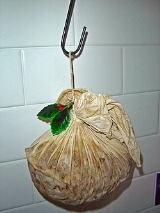
Christmas pudding is a pudding traditionally served on
ChristmasChristmas or Christmas Day is an annual holiday generally celebrated on December 25 by billions of people around the world. It is a Christian feast that commemorates the birth of Jesus Christ, liturgically closing the Advent season and initiating the season of Christmastide, which lasts twelve days...
Day (December 25). It has its origins in medieval
EnglandEngland is a country that is part of the United Kingdom. It shares land borders with Scotland to the north and Wales to the west; the Irish Sea is to the north west, the Celtic Sea to the south west, with the North Sea to the east and the English Channel to the south separating it from continental...
, and is sometimes known as
plum pudding or
plum duff, though this can also refer to other kinds of boiled pudding involving dried fruit.
Basics
Many households have their own recipe for Christmas pudding, some handed down through families for generations. Essentially the recipe brings together what traditionally were expensive or luxurious ingredients - notably the sweet spices that are so important in developing its distinctive rich aroma, and usually made with
suetSuet is raw beef or mutton fat, especially the hard fat found around the loins and kidneys.Suet has a melting point of between 45° and 50°C and congelation between 37° and 40°C....
. It is very dark in appearance - effectively black - as a result of the dark sugars and black
treacleTreacle is any syrup made during the refining of sugar and is defined as "uncrystallized syrup produced in refining sugar". Treacle is used chiefly in cooking as a form of sweetener or condiment....
in most recipes, and its long cooking time. The mixture can be moistened with the juice of citrus fruits,
brandyBrandy is a spirit produced by distilling wine. Brandy generally contains 35%–60% alcohol by volume and is typically taken as an after-dinner drink...
and other alcohol (some recipes call for dark
beerBeer is the world's most widely consumed andprobably oldest alcoholic beverage; it is the third most popular drink overall, after water and tea. It is produced by the brewing and fermentation of sugars, mainly derived from malted cereal grains, most commonly malted barley and malted wheat...
s such as mild, stout or
porterPorter is a dark-coloured style of beer. The history and development of stout and porter are intertwined. The name was first used in the 18th century from its popularity with the street and river porters of London. It is generally brewed with dark malts...
).
Prior to the 19th century, the English Christmas pudding was boiled in a pudding cloth, and often represented as round. The new
Victorian eraThe Victorian era of British history was the period of Queen Victoria's reign from 20 June 1837 until her death on 22 January 1901. It was a long period of peace, prosperity, refined sensibilities and national self-confidence...
fashion involved putting the batter into a basin and then steaming it, followed by unwrapping the pudding, placing it on a platter, and decorating its top with a sprig of
hollyIlex) is a genus of 400 to 600 species of flowering plants in the family Aquifoliaceae, and the only living genus in that family. The species are evergreen and deciduous trees, shrubs, and climbers from tropics to temperate zones world wide....
.
Initial cooking usually involves steaming for many hours (the period can be shortened without loss of quality by using a pressure cooker). To serve, the pudding is reheated by steaming once more, and dressed with warm brandy which is set alight. It can be eaten with
hard sauceHard sauce is a sweet, rich dessert sauce made by creaming or beating butter and sugar with rum , brandy , whiskey, sherry , vanilla or other flavorings...
, brandy butter, rum
butterButter is a dairy product made by churning fresh or fermented cream or milk. It is generally used as a spread and a condiment, as well as in cooking applications, such as baking, sauce making, and pan frying...
,
creamCream is a dairy product that is composed of the higher-butterfat layer skimmed from the top of milk before homogenization. In un-homogenized milk, over time, the lighter fat rises to the top. In the industrial production of cream this process is accelerated by using centrifuges called "separators"...
, lemon cream,
custardCustard is a variety of culinary preparations based on a cooked mixture of milk or cream and egg yolk. Depending on how much egg or thickener is used, custard may vary in consistency from a thin pouring sauce , to a thick pastry cream used to fill éclairs. The most common custards are used as...
, or sweetened
béchamelBéchamel sauce , also known as white sauce, is one of the mother sauces of French cuisine and is used in many recipes of Italian cuisine, for example lasagne. It is used as the base for other sauces . It is traditionally made by whisking scalded milk gradually into a white roux...
, and is sometimes sprinkled with caster sugar (the fall of the sugar on triangular slices resembling the fall of snow on a pitched roof, or snowy mountain tops).
History
The plum
puddingPudding most often refers to a dessert, but it can also be a savory dish.In the United States, pudding characteristically denotes a sweet milk-based dessert similar in consistency to egg-based custards, though it may also refer to other types such as bread and rice pudding.In the United Kingdom and...
's association with Christmas goes back to medieval England with the Roman Catholic Church's decree that the "pudding should be made on the 25th Sunday after Trinity, that it be prepared with 13 ingredients to represent Christ and the 12 apostles, and that every family member stir it in turn from east to west to honour the Magi and their supposed journey in that direction". Recipes for plum puddings appear mainly, if not entirely, in the 17th century and later. Their possible ancestors include savoury puddings such as those in Harleian MS 279, crustades,
malaches whyte, creme boiled (a kind of stirred
custardCustard is a variety of culinary preparations based on a cooked mixture of milk or cream and egg yolk. Depending on how much egg or thickener is used, custard may vary in consistency from a thin pouring sauce , to a thick pastry cream used to fill éclairs. The most common custards are used as...
), and
sippetA sop is a piece of bread or toast that is soaked in liquid food and then eaten. In medieval cuisine, sops were very common. Sops were served with wine, soup or broth, and then picked apart into smaller pieces to soak in the liquid. At elaborate feasts, bread was often pre-cut into finger-sized...
s. Various ingredients and methods of these older recipes appear in early plum puddings.
Features of these recipes were combined or refined in ways that could have yielded plum pudding recipes. For example, combining the stirred custard with sippets makes it into a
foolA fool is an English dessert generally made by mixing puréed fruit, whipped cream, sugar, and possibly a flavouring agent like rose water.- History and etymology:...
, a contemporary of early plum puddings, which is very similar to a pudding. Some early custard tarts, such as the
crustade lumbard in Harleian MS 279, are only unlike plum puddings in that they are held together by a pastry crust and not by crumbs or meal. Malaches whyte, another kind of pastry, has a filling of eggs, bread crumbs, and butter, but no plums. So a fully developed plum pudding recipe could be derived from the above list of possible ancestors by some recombination. This is not to say that there were not other ancestors, only that there need not have been any.
Although it took its final form in Victorian England, the pudding's origins can be traced back to the 1420s, to two sources. It emerged not as a confection or a dessert at all, but as a way of
preserving meatFood preservation is the process of treating and handling food to stop or slow down spoilage and thus allow for longer storage....
at the end of the season. Because of shortages of fodder, all surplus
livestockLivestock refers to one or more domesticated animals raised in an agricultural setting to produce commodities such as food, fiber and labor. The term "livestock" as used in this article does not include poultry or farmed fish; however the inclusion of these, especially poultry, within the meaning...
were slaughtered in the autumn. The meat was then kept in a
pastryPastry is the name given to various kinds of baked products made from ingredients such as flour, sugar, milk, butter, shortening, baking powder and/or eggs. Small cakes, tarts and other sweet baked products are called "pastries."...
case along with dried fruits acting as a preservative. The resultant large "
mince pieA mince pie, also known as minced pie, is a small British sweet pie traditionally served during the Christmas season. Its ingredients are traceable to the 13th century, when returning European crusaders brought with them Middle Eastern recipes containing meats, fruits and spices.The early mince...
s" could then be used to feed hosts of people, particularly at the festive season. The chief ancestor of the modern pudding, however, was the
pottagePottage is a thick soup or stew made by boiling vegetables, grains, and, if available, meat or fish.It was a staple food of all people living in Great Britain from neolithic times on into the Middle Ages...
, a meat and vegetable concoction originating in Roman times. This was prepared in a large cauldron, the ingredients being slow cooked, with dried fruits, sugar and spices added. In the 15th century,
Plum pottage was a sloppy mix of meat, vegetables and fruit served at the beginning of a meal.
In 1714, King George I (sometimes known as the Pudding King) requested that plum pudding be served as part of his royal feast in his first Christmas in England. A recipe for "plum porridge" appeared in
Christmas Entertainments in 1740. As techniques for meat preserving improved in the 18th century, the savoury element of both the mince pie and the plum pottage diminished as the sweet content increased. The mince pie kept its name, though the pottage was increasingly referred to as
plum pudding. Although the latter was always a celebratory dish it was originally eaten at the
Harvest FestivalA Harvest Festival is an annual celebration which occurs around the time of the main harvest of a given region. Given the differences in climate and crops around the world, harvest festivals can be found at various times throughout the world...
, not Christmas. It was not until the 1830s that the cannon-ball of flour, fruits,
suetSuet is raw beef or mutton fat, especially the hard fat found around the loins and kidneys.Suet has a melting point of between 45° and 50°C and congelation between 37° and 40°C....
, sugar and spices, all topped with holly, made a definite appearance, becoming more and more associated with Christmas. In 1747, London food writer
Hannah GlasseHannah Glasse was an English cookery writer of the 18th century. She is best known for her cookbook, The Art of Cookery, first published in 1747...
had given a recipe for Christmas plum porridge, but it appears that
East SussexEast Sussex is a county in South East England. It is bordered by the counties of Kent, Surrey and West Sussex, and to the south by the English Channel.-History:...
cook
Eliza ActonElizabeth "Eliza" Acton was an English poet and cook who produced one of the country's first cookbooks aimed at the domestic reader rather than the professional cook or chef, Modern Cookery for Private Families. In this book she introduced the now-universal practice of listing the ingredients and...
was the first to refer to it as "Christmas Pudding" in her
cookbookA cookbook is a kitchen reference that typically contains a collection of recipes. Modern versions may also include colorful illustrations and advice on purchasing quality ingredients or making substitutions...
.
Wishing and other traditions
Traditionally puddings were made on or immediately after the Sunday "next before
AdventAdvent is a season observed in many Western Christian churches, a time of expectant waiting and preparation for the celebration of the Nativity of Jesus at Christmas. It is the beginning of the Western liturgical year and commences on Advent Sunday, called Levavi...
", i.e. four to five weeks before Christmas. The
collectIn Christian liturgy, a collect is both a liturgical action and a short, general prayer. In the Middle Ages, the prayer was referred to in Latin as collectio, but in the more ancient sources, as oratio. In English, and in this usage, "collect" is pronounced with the stress on the first syllable...
for that Sunday in the
Book of Common PrayerThe Book of Common Prayer is the short title of a number of related prayer books used in the Anglican Communion, as well as by the Continuing Anglican, "Anglican realignment" and other Anglican churches. The original book, published in 1549 , in the reign of Edward VI, was a product of the English...
of the
Church of EnglandThe Church of England is the officially established Christian church in England and the Mother Church of the worldwide Anglican Communion. The church considers itself within the tradition of Western Christianity and dates its formal establishment principally to the mission to England by St...
, as it was used from the 16th century (and still is in traditional churches), reads:
- "Stir up, we beseech thee, O Lord, the wills of thy faithful people; that they, plenteously bringing forth the fruit of good works, may by thee be plenteously rewarded; through Jesus Christ our Lord. Amen"
The day became known as "
Stir-up SundayStir-up Sunday is an informal term in Anglican churches for the last Sunday before the season of Advent.The term comes from the opening words of the collect for the day in the Book of Common Prayer of 1549 and later :In the Book of Common Prayer of 1662 and later, this collect is listed for "The...
". Traditionally everyone in the household, or at least every child, gave the mixture a stir and made a wish while doing so.
It was common practice to include small silver coins in the pudding mixture, which could be kept by the person whose serving included them. The usual choice was a silver threepence or a
sixpenceSixpence may refer to:*Sixpence *Sixpence *Sixpence *Flat cap, also called a sixpence*Sixpence None the Richer, an American pop/rock band...
. The coin was believed to bring wealth in the coming year. Despite knowing that a portion might contain a coin, many a Christmas reveller damaged his or her teeth by biting into one, or indeed swallowed one by mistake. However this practice fell away once real
silverSilver is a metallic chemical element with the chemical symbol Ag and atomic number 47. A soft, white, lustrous transition metal, it has the highest electrical conductivity of any element and the highest thermal conductivity of any metal...
coins were not available, as it was believed that alloy coins would taint the pudding. Additionally, coins pose a
chokingChoking is the mechanical obstruction of the flow of air from the environment into the lungs. Choking prevents breathing, and can be partial or complete, with partial choking allowing some, although inadequate, flow of air into the lungs. Prolonged or complete choking results in asphyxia which...
hazard.
Other tokens are also known to have been included, such as a tiny wishbone (to bring good luck), a silver thimble (for thrift), or an anchor (to symbolise safe harbour).
Once turned out of its basin, decorated with holly, doused in brandy, and flamed (or "fired"), the pudding is traditionally brought to the table ceremoniously, and greeted with a round of applause. In 1843,
Charles DickensCharles John Huffam Dickens was an English novelist, generally considered the greatest of the Victorian period. Dickens enjoyed a wider popularity and fame than had any previous author during his lifetime, and he remains popular, having been responsible for some of English literature's most iconic...
describes the scene in
A Christmas CarolA Christmas Carol is a novella by English author Charles Dickens first published by Chapman & Hall on 17 December 1843. The story tells of sour and stingy Ebenezer Scrooge's ideological, ethical, and emotional transformation after the supernatural visits of Jacob Marley and the Ghosts of...
:
Mrs Cratchit left the room alone -- too nervous to bear witnesses -- to take the pudding up and bring it in... Hallo! A great deal of steam! The pudding was out of the copper. A smell like a washing-day. That was the cloth. A smell like an eating-house and a pastrycook's next door to each other, with a laundress's next door to that. That was the pudding. In half a minute Mrs Cratchit entered -- flushed, but smiling proudly -- with the pudding, like a speckled cannon-ball, so hard and firm, blazing in half of half-a-quartern of ignited brandy, and bedight with Christmas holly stuck into the top.
For the best effect under modern conditions, the lights should be turned out as the pudding is brought in amid its halo of purple brandy flames (this is related to the Christmas tradition of playing "
snap-dragonsSnap-dragon was a parlour game popular from about the 16th to 19th centuries. It was played during the winter, particularly on Christmas Eve. Brandy was heated and placed in a wide shallow bowl; raisins were placed in the brandy which was then set alight...
").
After Christmas
Christmas puddings have very good keeping properties and many families keep one back from Christmas to be eaten at another celebration later in the year, often at
EasterEaster is the central feast in the Christian liturgical year. According to the Canonical gospels, Jesus rose from the dead on the third day after his crucifixion. His resurrection is celebrated on Easter Day or Easter Sunday...
.
Constance SpryConstance Spry was a famous British educator, florist and author in the mid-20th century.- Background :Constance Spry was born Constance Fletcher in Derby in 1886, eldest child and only daughter of George Fletcher and his wife Henrietta Maria Fletcher...
records that it was not uncommon to go so far as to make each year's pudding the
previous Christmas.
See also
- Christmas dinner
Christmas dinner is the primary meal traditionally eaten on Christmas Eve or Christmas Day. In many ways the meal is similar to a standard Sunday dinner. Christmas feasts have traditionally been luxurious and abundant...
- List of Christmas dishes
- Mincemeat
Mincemeat is a mixture of chopped dried fruit, distilled spirits and spices, and sometimes beef suet, beef, or venison. Originally, mincemeat always contained meat. Many modern recipes contain beef suet, though vegetable shortening is sometimes used in its place...
, another common Christmas food incorporating suetSuet is raw beef or mutton fat, especially the hard fat found around the loins and kidneys.Suet has a melting point of between 45° and 50°C and congelation between 37° and 40°C....
- Touch Pieces
A touch piece is a coin or medal attached to attracted superstitious beliefs, such as those with "holes" in them or those with particular designs...
More details of coins being added
External links