


Christine de Pizan

Encyclopedia
Christine de Pizan (1363 – c. 1430) was a Venetian
-born late medieval author who challenged misogyny
and stereotypes prevalent in the male-dominated medieval culture. As a poet, she was well known and highly regarded in her own day; she completed 41 works during her 30 year career (1399–1429), and can be regarded as Europe’s first professional woman writer. She married in 1380, at the age of 15 and was widowed 10 years later. Much of the impetus for her writing came from her need to earn a living for herself and her three children. She spent most of her childhood and all of her adult life based in Paris and then the abbey at Poissy
, and wrote entirely in her adoptive tongue of Middle French
.
Her early courtly poetry is marked by her knowledge of aristocratic custom and fashion of the day, particularly involving women and the practice of chivalry
. Her early and later allegorical and didactic treatises reflect both autobiographical information about her life and views and also her own individualized and protofeminist approach to the scholastic learned tradition of mythology, legend, and history she inherited from clerical scholars and to the genres and courtly or scholastic subjects of contemporary French and Italian poets she admired. Supported and encouraged by important royal French and English patrons, Christine had a influenced fifteenth-century English poetry. Her success stems from a wide range of innovative writing and rhetorical techniques that critically challenged renowned male writers, such as Jean de Meun
who incorporated misogynist beliefs within their literary works.
In recent decades, Christine's work has been returned to prominence by the efforts of scholars such as Charity Cannon Willard, Earl Jeffrey Richards and Simone de Beauvoir
. Certain scholars have argued that she should be seen as an early feminist who efficiently used language to convey that women could play an important role within society. This characterization has been challenged by other critics who claim either that it is an anachronistic use of the word, or that her beliefs were not progressive enough to merit such a designation.
. She was the daughter of Tommaso di Benvenuto da Pizzano (Thomas de Pizan; named for the family's origins in the town of Pizzano, south east of Bologna), a physician, court astrologer, and Councillor of the Republic of Venice
. Following Christine’s birth, Thomas de Pizan accepted an appointment to the court of Charles V of France
, as the king’s astrologer
, alchemist
, and physician
. In this atmosphere, Christine was able to pursue her intellectual interests. She successfully educated herself by immersing herself in languages, in the rediscovered classics and humanism of the early Renaissance, and in Charles V’s royal archive that housed a vast number of manuscripts. Pizan did not assert her intellectual abilities, or establish her authority as a writer until she was widowed at the age of twenty-four.
Christine de Pizan married Etienne du Castel, a royal secretary to the court, at the age of fifteen. She had three children, a daughter (who went to live at the Dominican Abbey in Poissy in 1397 as a companion to the king's daughter, Marie), a son Jean, and another child who died in childhood. Christine’s familial life was threatened in 1390 when her husband, while in Beauvais
on a mission with the king, suddenly died in an epidemic. Following Castel’s death, Christine was left to support her mother, a niece, and her two children. When she tried to collect money from her husband’s estate, she faced complicated lawsuits regarding the recovery of salary due to her husband. In order to support herself and her family, Christine turned to writing. By 1393, she was writing love ballads, which caught the attention of wealthy patrons within the court. These patrons were intrigued by the novelty of a female writer and had her compose texts about their romantic exploits. Christine's output during this period was prolific. Between 1393 and 1412, she composed over three hundred ballads, and many more shorter poems.
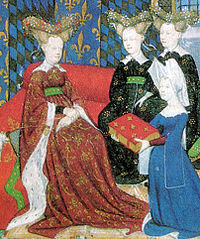 Christine de Pizan’s participation in a literary quarrel, in 1401–1402, allowed her to move beyond the courtly circles, and ultimately to establish her status as a writer concerned with the position of women in society. During these years, she involved herself in a renowned literary debate, the “Querelle du Roman de la Rose”. Christine helped to instigate this debate by beginning to question the literary merits of Jean de Meun’s the Romance of the Rose
. Written in the thirteenth century, the Romance of the Rose satirizes the conventions of courtly love while critically depicting women as nothing more than seducers. Christine specifically objected to the use of vulgar terms in Jean de Meun’s allegorical poem. She argued that these terms denigrated the proper and natural function of sexuality, and that such language was inappropriate for female characters such as Madame Raison
. According to Christine, noble women did not use such language. Her critique primarily stems from her belief that Jean de Meun was purposely slandering women through the debated text.
The debate itself is extensive and at its end, the principal issue was no longer Jean de Meun’s literary capabilities. The principal issue had shifted to the unjust slander of women within literary texts. This dispute helped to establish Christine’s reputation as a female intellectual who could assert herself effectively and defend her claims in the male-dominated literary realm. Christine continued to counter abusive literary treatments of women.
and The Treasure of the City of Ladies, or The Book of the Three Virtues. The first of these shows the importance of women’s past contributions to society, and the second strives to teach women of all estates how to cultivate useful qualities in order to counteract the growth of misogyny (Willard 1984:135).
Christine’s final work was a poem eulogizing Joan of Arc
, the peasant girl who took a very public role in organizing French military resistance to English domination in the early fifteenth century. Written in 1429, The Tale of Joan of Arc celebrates the appearance of a woman military leader who, according to Christine, vindicated and rewarded all women’s efforts to defend their own sex (Willard 1984:205). Besides its literary qualities, this poem is important to historians because it is the only record of Joan of Arc outside the documents of her trial. After completing this particular poem, it seems that Christine, at the age of sixty-five, decided to end her literary career (Willard 1984:207). The exact date of her death is unknown. However, her death did not diminish appreciation for her renowned literary works. Instead, her legacy continued on because of the voice she established as an authoritative rhetorician.
 In the “Querelle du Roman de la Rose,” Christine responded to Jean de Montreuil, who had written her a treatise defending the misogynist sentiments in the Romance of the Rose. She begins by claiming that her opponent was an “expert in rhetoric” as compared to herself “a woman ignorant of subtle understanding and agile sentiment.” In this particular apologetic response, Christine belittles her own style. She is employing a rhetorical strategy by writing against the grain of her meaning, also known as antiphrasis
(Redfern 80). Her ability to employ rhetorical strategies continued when Christine began to compose literary texts following the “Querelle du Roman de la Rose.”
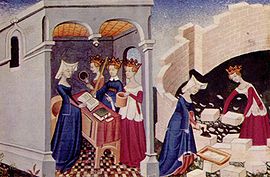
In The Book of the City of Ladies Christine de Pizan created a symbolic city in which women are appreciated and defended. Christine, having no female literary tradition to call upon, constructs three allegorical foremothers: Reason, Justice, and Rectitude. She enters into a dialogue, a movement between question and answer, with these allegorical figures that is from a completely female perspective (Campbell 6). These constructed women lift Christine up from her despair over the misogyny prevalent in her time. Together, they create a forum to speak on issues of consequence to all women. Only female voices, examples and opinions provide evidence within this text. Christine, through Lady Reason in particular, argues that stereotypes of woman can be sustained only if women are prevented from entering the dominant male-oriented conversation (Campbell 7). Overall, Christine hoped to establish truths about women that contradicted the negative stereotypes that she had identified in previous literature. She did this successfully by creating literary foremothers that helped her to formulate a female dialogue that celebrated women and their accomplishments.
In The Treasure of the City of Ladies, Christine highlights the persuasive effect of women’s speech and actions in everyday life. In this particular text, Christine argues that women must recognize and promote their ability to make peace. This ability will allow women to mediate between husband and subjects. She also claims that slanderous speech erodes one’s honor and threatens the sisterly bond among women. Christine then argues that "skill in discourse should be a part of every woman’s moral repertoire" (Redfern 87). Christine understood that a woman’s influence is realized when her speech accords value to chastity, virtue, and restraint. She proved that rhetoric is a powerful tool that women could employ to settle differences and to assert themselves. Overall, she presented a concrete strategy that allowed all women, regardless of their status, to undermine the dominant patriarchal discourse. For the general reader the Treasure is appealing because she gives fascinating glimpses into women's lives in 1400, from the great lady in the castle down to the merchant's wife, the servant, and the peasant. She offers advice to governesses, widows, and even prostitutes.
Christine specifically sought out other women to collaborate in the creation of her work. She makes special mention of a manuscript illuminator we know only as Anastasia
who she described as the most talented of her day.
wrote in 1949 that Épître au Dieu d'Amour was "the first time we see a woman take up her pen in defense of her sex" making Christine de Pizan perhaps the West's first feminist, or protofeminist
as some scholars prefer to say.
Venice
Venice is a city in northern Italy which is renowned for the beauty of its setting, its architecture and its artworks. It is the capital of the Veneto region...
-born late medieval author who challenged misogyny
Misogyny
Misogyny is the hatred or dislike of women or girls. Philogyny, meaning fondness, love or admiration towards women, is the antonym of misogyny. The term misandry is the term for men that is parallel to misogyny...
and stereotypes prevalent in the male-dominated medieval culture. As a poet, she was well known and highly regarded in her own day; she completed 41 works during her 30 year career (1399–1429), and can be regarded as Europe’s first professional woman writer. She married in 1380, at the age of 15 and was widowed 10 years later. Much of the impetus for her writing came from her need to earn a living for herself and her three children. She spent most of her childhood and all of her adult life based in Paris and then the abbey at Poissy
Poissy
Poissy is a commune in the Yvelines department in the Île-de-France in north-central France. It is located in the western suburbs of Paris from the center.In 1561 it was the site of a fruitless Catholic-Huguenot conference, the Colloquy at Poissy...
, and wrote entirely in her adoptive tongue of Middle French
Middle French
Middle French is a historical division of the French language that covers the period from 1340 to 1611. It is a period of transition during which:...
.
Her early courtly poetry is marked by her knowledge of aristocratic custom and fashion of the day, particularly involving women and the practice of chivalry
Chivalry
Chivalry is a term related to the medieval institution of knighthood which has an aristocratic military origin of individual training and service to others. Chivalry was also the term used to refer to a group of mounted men-at-arms as well as to martial valour...
. Her early and later allegorical and didactic treatises reflect both autobiographical information about her life and views and also her own individualized and protofeminist approach to the scholastic learned tradition of mythology, legend, and history she inherited from clerical scholars and to the genres and courtly or scholastic subjects of contemporary French and Italian poets she admired. Supported and encouraged by important royal French and English patrons, Christine had a influenced fifteenth-century English poetry. Her success stems from a wide range of innovative writing and rhetorical techniques that critically challenged renowned male writers, such as Jean de Meun
Jean de Meun
Jean de Meun was a French author best known for his continuation of the Roman de la Rose.-Life:...
who incorporated misogynist beliefs within their literary works.
In recent decades, Christine's work has been returned to prominence by the efforts of scholars such as Charity Cannon Willard, Earl Jeffrey Richards and Simone de Beauvoir
Simone de Beauvoir
Simone-Ernestine-Lucie-Marie Bertrand de Beauvoir, often shortened to Simone de Beauvoir , was a French existentialist philosopher, public intellectual, and social theorist. She wrote novels, essays, biographies, an autobiography in several volumes, and monographs on philosophy, politics, and...
. Certain scholars have argued that she should be seen as an early feminist who efficiently used language to convey that women could play an important role within society. This characterization has been challenged by other critics who claim either that it is an anachronistic use of the word, or that her beliefs were not progressive enough to merit such a designation.
Life
Christine de Pizan was born in 1363 in VeniceRepublic of Venice
The Republic of Venice or Venetian Republic was a state originating from the city of Venice in Northeastern Italy. It existed for over a millennium, from the late 7th century until 1797. It was formally known as the Most Serene Republic of Venice and is often referred to as La Serenissima, in...
. She was the daughter of Tommaso di Benvenuto da Pizzano (Thomas de Pizan; named for the family's origins in the town of Pizzano, south east of Bologna), a physician, court astrologer, and Councillor of the Republic of Venice
Republic of Venice
The Republic of Venice or Venetian Republic was a state originating from the city of Venice in Northeastern Italy. It existed for over a millennium, from the late 7th century until 1797. It was formally known as the Most Serene Republic of Venice and is often referred to as La Serenissima, in...
. Following Christine’s birth, Thomas de Pizan accepted an appointment to the court of Charles V of France
Charles V of France
Charles V , called the Wise, was King of France from 1364 to his death in 1380 and a member of the House of Valois...
, as the king’s astrologer
Astrologer
An astrologer practices one or more forms of astrology. Typically an astrologer draws a horoscope for the time of an event, such as a person's birth, and interprets celestial points and their placements at the time of the event to better understand someone, determine the auspiciousness of an...
, alchemist
Alchemy
Alchemy is an influential philosophical tradition whose early practitioners’ claims to profound powers were known from antiquity. The defining objectives of alchemy are varied; these include the creation of the fabled philosopher's stone possessing powers including the capability of turning base...
, and physician
Physician
A physician is a health care provider who practices the profession of medicine, which is concerned with promoting, maintaining or restoring human health through the study, diagnosis, and treatment of disease, injury and other physical and mental impairments...
. In this atmosphere, Christine was able to pursue her intellectual interests. She successfully educated herself by immersing herself in languages, in the rediscovered classics and humanism of the early Renaissance, and in Charles V’s royal archive that housed a vast number of manuscripts. Pizan did not assert her intellectual abilities, or establish her authority as a writer until she was widowed at the age of twenty-four.
Christine de Pizan married Etienne du Castel, a royal secretary to the court, at the age of fifteen. She had three children, a daughter (who went to live at the Dominican Abbey in Poissy in 1397 as a companion to the king's daughter, Marie), a son Jean, and another child who died in childhood. Christine’s familial life was threatened in 1390 when her husband, while in Beauvais
Beauvais
Beauvais is a city approximately by highway north of central Paris, in the northern French region of Picardie. It currently has a population of over 60,000 inhabitants.- History :...
on a mission with the king, suddenly died in an epidemic. Following Castel’s death, Christine was left to support her mother, a niece, and her two children. When she tried to collect money from her husband’s estate, she faced complicated lawsuits regarding the recovery of salary due to her husband. In order to support herself and her family, Christine turned to writing. By 1393, she was writing love ballads, which caught the attention of wealthy patrons within the court. These patrons were intrigued by the novelty of a female writer and had her compose texts about their romantic exploits. Christine's output during this period was prolific. Between 1393 and 1412, she composed over three hundred ballads, and many more shorter poems.
Roman de la Rose
The Roman de la rose, , is a medieval French poem styled as an allegorical dream vision. It is a notable instance of courtly literature. The work's stated purpose is to both entertain and to teach others about the Art of Love. At various times in the poem, the "Rose" of the title is seen as the...
. Written in the thirteenth century, the Romance of the Rose satirizes the conventions of courtly love while critically depicting women as nothing more than seducers. Christine specifically objected to the use of vulgar terms in Jean de Meun’s allegorical poem. She argued that these terms denigrated the proper and natural function of sexuality, and that such language was inappropriate for female characters such as Madame Raison
Reason
Reason is a term that refers to the capacity human beings have to make sense of things, to establish and verify facts, and to change or justify practices, institutions, and beliefs. It is closely associated with such characteristically human activities as philosophy, science, language, ...
. According to Christine, noble women did not use such language. Her critique primarily stems from her belief that Jean de Meun was purposely slandering women through the debated text.
The debate itself is extensive and at its end, the principal issue was no longer Jean de Meun’s literary capabilities. The principal issue had shifted to the unjust slander of women within literary texts. This dispute helped to establish Christine’s reputation as a female intellectual who could assert herself effectively and defend her claims in the male-dominated literary realm. Christine continued to counter abusive literary treatments of women.
Works
By 1405, Christine de Pizan had completed her most successful literary works, The Book of the City of LadiesThe Book of the City of Ladies
thumb|400px|right|Picture from The Book of the City of LadiesThe Book of the City of Ladies , or Le Livre de la Cité des Dames, is perhaps Christine de Pizan's most famous literary work, and it is her second work of lengthy prose. Pizan uses the vernacular French language to compose the book, but...
and The Treasure of the City of Ladies, or The Book of the Three Virtues. The first of these shows the importance of women’s past contributions to society, and the second strives to teach women of all estates how to cultivate useful qualities in order to counteract the growth of misogyny (Willard 1984:135).
Christine’s final work was a poem eulogizing Joan of Arc
Joan of Arc
Saint Joan of Arc, nicknamed "The Maid of Orléans" , is a national heroine of France and a Roman Catholic saint. A peasant girl born in eastern France who claimed divine guidance, she led the French army to several important victories during the Hundred Years' War, which paved the way for the...
, the peasant girl who took a very public role in organizing French military resistance to English domination in the early fifteenth century. Written in 1429, The Tale of Joan of Arc celebrates the appearance of a woman military leader who, according to Christine, vindicated and rewarded all women’s efforts to defend their own sex (Willard 1984:205). Besides its literary qualities, this poem is important to historians because it is the only record of Joan of Arc outside the documents of her trial. After completing this particular poem, it seems that Christine, at the age of sixty-five, decided to end her literary career (Willard 1984:207). The exact date of her death is unknown. However, her death did not diminish appreciation for her renowned literary works. Instead, her legacy continued on because of the voice she established as an authoritative rhetorician.
Antiphrasis
An antiphrasis is a figure of speech in which a word or phrase is used to mean the opposite of its usual sense, especially ironically....
(Redfern 80). Her ability to employ rhetorical strategies continued when Christine began to compose literary texts following the “Querelle du Roman de la Rose.”
In The Book of the City of Ladies Christine de Pizan created a symbolic city in which women are appreciated and defended. Christine, having no female literary tradition to call upon, constructs three allegorical foremothers: Reason, Justice, and Rectitude. She enters into a dialogue, a movement between question and answer, with these allegorical figures that is from a completely female perspective (Campbell 6). These constructed women lift Christine up from her despair over the misogyny prevalent in her time. Together, they create a forum to speak on issues of consequence to all women. Only female voices, examples and opinions provide evidence within this text. Christine, through Lady Reason in particular, argues that stereotypes of woman can be sustained only if women are prevented from entering the dominant male-oriented conversation (Campbell 7). Overall, Christine hoped to establish truths about women that contradicted the negative stereotypes that she had identified in previous literature. She did this successfully by creating literary foremothers that helped her to formulate a female dialogue that celebrated women and their accomplishments.
In The Treasure of the City of Ladies, Christine highlights the persuasive effect of women’s speech and actions in everyday life. In this particular text, Christine argues that women must recognize and promote their ability to make peace. This ability will allow women to mediate between husband and subjects. She also claims that slanderous speech erodes one’s honor and threatens the sisterly bond among women. Christine then argues that "skill in discourse should be a part of every woman’s moral repertoire" (Redfern 87). Christine understood that a woman’s influence is realized when her speech accords value to chastity, virtue, and restraint. She proved that rhetoric is a powerful tool that women could employ to settle differences and to assert themselves. Overall, she presented a concrete strategy that allowed all women, regardless of their status, to undermine the dominant patriarchal discourse. For the general reader the Treasure is appealing because she gives fascinating glimpses into women's lives in 1400, from the great lady in the castle down to the merchant's wife, the servant, and the peasant. She offers advice to governesses, widows, and even prostitutes.
Christine specifically sought out other women to collaborate in the creation of her work. She makes special mention of a manuscript illuminator we know only as Anastasia
Anastasia (artist)
Anastasia was a French illuminator of manuscripts, apparently specializing in the elaborate decorative borders that were increasingly fashionable, and landscape backgrounds...
who she described as the most talented of her day.
Influence
Christine de Pizan contributed to the rhetorical tradition by counteracting the contemporary discourse. Rhetorical scholars have studied her persuasive strategies. It has been concluded that Christine successfully forged a rhetorical identity for herself, and encouraged women to embrace this identity by counteracting misogynist thinking through persuasive dialogue. Simone de BeauvoirSimone de Beauvoir
Simone-Ernestine-Lucie-Marie Bertrand de Beauvoir, often shortened to Simone de Beauvoir , was a French existentialist philosopher, public intellectual, and social theorist. She wrote novels, essays, biographies, an autobiography in several volumes, and monographs on philosophy, politics, and...
wrote in 1949 that Épître au Dieu d'Amour was "the first time we see a woman take up her pen in defense of her sex" making Christine de Pizan perhaps the West's first feminist, or protofeminist
Protofeminist
Protofeminist is a term used to define women in a philosophical tradition that anticipated modern feminist concepts, yet lived in a time when the term "feminist" was unknown,that is, prior to the 20th century...
as some scholars prefer to say.
Selected bibliography
- L'Épistre au Dieu d'amours (1399)
- L'Épistre de Othéa a Hector (1399–1400)
- Dit de la Rose (1402)
- Cent Ballades d'Amant et de Dame, Virelyas, Rondeaux (1402)
- Le Chemin de long estude (1403)
- Livre de la mutation de fortune (1403)
- La Pastoure (1403)
- Le Livre des fais et bonners meurs du sage roy Charles V (1404)
- Le Livre de la cité des dames (1405)
- Le Livre des trois vertus (1405)
- L'Avision de Christine (1405)
- Livre du corps de policie (1407)
- Livre de paix (1413)
- Ditié de Jehanne d'Arc (1429)
Contemporary scholarship
- The standard translation of The Book of the City of Ladies is by Earl Jeffrey Richards, (1982). The first English translation of Christine de Pizan’s The Treasure of the City of Ladies: or The Book of the Three Virtues is Sarah Lawson’s (1985).
- The standard biography about Christine de Pizan is Charity Cannon Willard’s Christine de Pisan: Her Life and Works (1984). Willard’s biography also provides a comprehensive overview of the “Querelle du Roman de la Rose.” Kevin Brownlee also discusses this debate in detail in his article Widowhood, Sexuality and Gender in Christine de Pisan (in The Romanic Review, 1995)
- For a more detailed account of Christine de Pizan’s rhetorical strategies refer to Jenny R. Redfern’s excerpt Christine de Pisan and The Treasure of the City of Ladies: A Medieval Rhetorician and Her Rhetoric (in Reclaiming Rhetorica, ed. Andrea A. Lunsford, 1995).
- M. Bell Mirabella discusses Christine’s ability to refute the patriarchal discourse in her article Feminist Self-Fashioning: Christine de Pisan and The Treasure of the City of Ladies (in The European Journal of Women’s Studies, 1999).
- Karlyn Kohrs Campbell presents an interesting argument about Christine’s ability to create a female-oriented dialogue in her lecture Three Tall Women: Radical Challenges to Criticism, Pedagogy, and Theory (The Carroll C. Arnold Distinguished Lecture, National Communication Association, 2001).
- Refer to The Rhetorical Tradition (ed. Patricia Bizzell and Bruce Herzberg, 2001) and The Norton Anthology of Theory and Criticism (ed. Vincent B. Leitch, 2001) for some commentary on Christine de Pizan’s life, literary works, rhetorical contributions and other relevant sources that one may find useful.
See also
- Isabeau of BavariaIsabeau of BavariaIsabeau of Bavaria was Queen consort of France as spouse of King Charles VI of France, a member of the Valois Dynasty...
- Joan of ArcJoan of ArcSaint Joan of Arc, nicknamed "The Maid of Orléans" , is a national heroine of France and a Roman Catholic saint. A peasant girl born in eastern France who claimed divine guidance, she led the French army to several important victories during the Hundred Years' War, which paved the way for the...
- List of French language poets
- Vernacular literatureVernacular literatureVernacular literature is literature written in the vernacular—the speech of the "common people".In the European tradition, this effectively means literature not written in Latin...
- Women's historyWomen's historyWomen's history is the study of the role that women have played in history, together with the methods needed to study women. It includes the study of the history of the growth of woman's rights throughout recorded history, the examination of individual women of historical significance, and the...
- Antoine VérardAntoine VérardAntoine Vérard was a late 15th and early 16th century French publisher, bookmaker and bookseller.-Life:The colophon of a 1485 edition of the Catholicon abbreviatum, the first French-Latin dictionary, which dates to 1485, indicates that Antoine Vérard was based at the heart of the bookselling and...
Further reading
- Angus J. Kennedy's "Christine de Pizan: A Bibliographical Guide and supplements (London: Grant & Cutler, 1984, 1994, 2004).
External links
- Ditie de Jehanne d'Arc - French w/ English translation
- Comprehensive bibliography of her works, including listings of the manuscripts, editions, translations, and essays. in French at Archives de littérature du Moyen Âge (Arlima)
- '"A Champion of Her Sex", W. MintoWilliam MintoWilliam Minto , Scottish man of letters, was born at Auchintoul, Aberdeenshire.He was educated at the University of Aberdeen, and spent a year at Merton College, Oxford...
in Macmillan's Magazine, Volume LXIII, Nov. 1885 - Apr. 1886, pp. 264–275 - The Song of Joan of Arc poem - English translation w/ original French