


Chips and Technologies

Encyclopedia
Chips and Technologies was the first fabless semiconductor company
, a model developed by its founder Gordon Campbell. Founded by Dado Banatao
.
Its first product was an EGA IBM compatible graphics chip. This was followed by chipset
s for PC motherboards and other computer graphics
chips.
C&T was acquired by Intel in 1997, primarily for its graphics chip business.
 C&T SuperMath J38700DX was a 80387DX compatible FPU
coprocessor
.
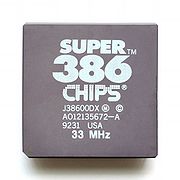
C&T also designed a 386
-compatible microprocessor
known as the Super386 38600DX/38600SX using clean room design
techniques, but this chip never enjoyed as much success as the 386 CPUs produced by Intel, AMD, and Cyrix
. C&T 38605DX had 512 byte cache, but the 144 pin PGA package was incompatible with 386 socket.
, Western Digital
, Cirrus Logic
, Oak Technologies, and others, until it was saturated.
Chips and Technologies provided the Wingine video card, a very high speed framebuffer that sat in a proprietary local bus slot on supported motherboards. Epson and JCIS were two manufacturers who offered motherboards featuring the Wingine local bus slot. The Wingine was popular with users of NEXTSTEP
for Intel processors, as it was one of the highest performing video cards supported by the operating system.
C&T eventually ended up competing in the low end of the video market, the 65555 featured an LVDS transmitter and notably won a design in early Compaq Armada laptops.
Fabless semiconductor company
A fabless semiconductor company specializes in the design and sale of hardware devices and semiconductor chips while outsourcing the fabrication or "fab" of the devices to a specialized manufacturer called a semiconductor foundry...
, a model developed by its founder Gordon Campbell. Founded by Dado Banatao
Dado Banatao
Diosdado Banatao , popularly known by his nickname Dado, is a Filipino entrepreneur and engineer working in the high-tech industry...
.
Its first product was an EGA IBM compatible graphics chip. This was followed by chipset
Chipset
A chipset, PC chipset, or chip set refers to a group of integrated circuits, or chips, that are designed to work together. They are usually marketed as a single product.- Computers :...
s for PC motherboards and other computer graphics
Computer graphics
Computer graphics are graphics created using computers and, more generally, the representation and manipulation of image data by a computer with help from specialized software and hardware....
chips.
C&T was acquired by Intel in 1997, primarily for its graphics chip business.
x86 products
Floating point unit
A floating-point unit is a part of a computer system specially designed to carry out operations on floating point numbers. Typical operations are addition, subtraction, multiplication, division, and square root...
coprocessor
Coprocessor
A coprocessor is a computer processor used to supplement the functions of the primary processor . Operations performed by the coprocessor may be floating point arithmetic, graphics, signal processing, string processing, or encryption. By offloading processor-intensive tasks from the main processor,...
.
C&T also designed a 386
Intel 80386
The Intel 80386, also known as the i386, or just 386, was a 32-bit microprocessor introduced by Intel in 1985. The first versions had 275,000 transistors and were used as the central processing unit of many workstations and high-end personal computers of the time...
-compatible microprocessor
Microprocessor
A microprocessor incorporates the functions of a computer's central processing unit on a single integrated circuit, or at most a few integrated circuits. It is a multipurpose, programmable device that accepts digital data as input, processes it according to instructions stored in its memory, and...
known as the Super386 38600DX/38600SX using clean room design
Clean room design
Clean room design is the method of copying a design by reverse engineering and then recreating it without infringing any of the copyrights and trade secrets associated with the original design. Clean room design is useful as a defense against copyright and trade secret infringement because it...
techniques, but this chip never enjoyed as much success as the 386 CPUs produced by Intel, AMD, and Cyrix
Cyrix
Cyrix Corporation was a microprocessor developer that was founded in 1988 in Richardson, Texas as a specialist supplier of high-performance math coprocessors for 286 and 386 microprocessors. The company was founded by former Texas Instruments staff members and had a long but troubled relationship...
. C&T 38605DX had 512 byte cache, but the 144 pin PGA package was incompatible with 386 socket.
Single chip solutions
- 82C100 - IBM PS/2 Model 30 and Super XT Compatible Chip - Released in 1987, compatible with 8086, 80C86, V30, 8088, 80C88, V20NEC V20The NEC V20 was a processor made by NEC that was a reverse-engineered, pin-compatible version of the Intel 8088 with an instruction set compatible with the Intel 80186...
CPUs. Compatible with all PC/XTPC/XTPC/XT has multiple possible meanings:* "PC/XT" may simply be shorthand for the IBM Personal Computer XT.* "PC/XT" may also be intended to mean "the IBM Personal Computer and/or the IBM Personal Computer XT"....
functional units: 8284, 8288, 8237, 8259, 8254, 8255, DRAMDramDram or DRAM may refer to:As a unit of measure:* Dram , an imperial unit of mass and volume* Armenian dram, a monetary unit* Dirham, a unit of currency in several Arab nationsOther uses:...
control, SRAMStatic random access memoryStatic random-access memory is a type of semiconductor memory where the word static indicates that, unlike dynamic RAM , it does not need to be periodically refreshed, as SRAM uses bistable latching circuitry to store each bit...
control, Keyboard control, Parity Generation and Configuration registers. Additionally features EMS control, dual clock and power management. It supports up to 2.5 MB RAM. - 82C235 - Single Chip AT (SCAT) - Released in 1989, compatible with PC/AT. Supported LIM EMS 4.0, up to 16 MB memory and Shadow RAM.
- 82C836 - Single Chip 386sx AT (SCATsx) - Compatible with PC/AT (bus), supported all the features of SCAT, added support for the i386SX processor and i387SXIntel 80387SXThe Intel 80387SX is the math coprocessor for the Intel 80386SX microprocessor. It was used to perform floating point arithmetic operations directly in hardware. The coprocessor was designed only to work with the SX variant of the i386, rather than the standard 80386...
math coprocessor.
Video chips
Chips and Technologies was the first company (outside of IBM) to deliver a compatible VGA chipset, the 82C451, and VGA cards were introduced the same year as VGA(1987) based on the 82C441 http://groups.google.com/group/comp.sys.ibm.pc.hardware.video/browse_thread/thread/9ce1f240ef936bed/d0cdd054a555025a?hl=en&q=ati+vip+vga+1987#d0cdd054a555025a, opening up the IBM compatible graphics display market. This market was then entered by companies such as Trident MicrosystemsTrident Microsystems
Trident Microsystems is a supplier of display-processors for flat panel displays . At one time, Trident was also a supplier of PC graphics chipsets and sound controllers.- History :...
, Western Digital
Western Digital
Western Digital Corporation is one of the largest computer hard disk drive manufacturers in the world. It has a long history in the electronics industry as an integrated circuit maker and a storage products company. Western Digital was founded on April 23, 1970 by Alvin B...
, Cirrus Logic
Cirrus Logic
Cirrus Logic is a fabless semiconductor supplier specializing in analog, mixed-signal, and audio DSP integrated circuits . They are presently headquartered in Austin, Texas. Their audio processors and audio converters are found in many professional audio and consumer entertainment products,...
, Oak Technologies, and others, until it was saturated.
Chips and Technologies provided the Wingine video card, a very high speed framebuffer that sat in a proprietary local bus slot on supported motherboards. Epson and JCIS were two manufacturers who offered motherboards featuring the Wingine local bus slot. The Wingine was popular with users of NEXTSTEP
NEXTSTEP
NeXTSTEP was the object-oriented, multitasking operating system developed by NeXT Computer to run on its range of proprietary workstation computers, such as the NeXTcube...
for Intel processors, as it was one of the highest performing video cards supported by the operating system.
C&T eventually ended up competing in the low end of the video market, the 65555 featured an LVDS transmitter and notably won a design in early Compaq Armada laptops.