
Home      Discussion      Topics      Dictionary      Almanac
Signup       Login
Chinese White Dolphin

Chinese White Dolphin

Overview
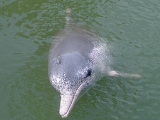
The Chinese white dolphin (Indo-Pacific humpback dolphin, Sousa chinensis chinensis; ) is a humpback dolphin
Humpback dolphin
Humpback dolphins are members of the genus Sousa. These dolphins are characterized by the conspicuous humps and elongated dorsal fins found on the back of adult members of the species...

 species, one of eighty cetacean species. An adult is white or pink and may appear as an albino dolphin to some. Uniquely, the population along the Chinese coast has pink skin. Pink skin is not pigment
Pigment
A pigment is a material that changes the color of reflected or transmitted light as the result of wavelength-selective absorption. This physical process differs from fluorescence, phosphorescence, and other forms of luminescence, in which a material emits light.Many materials selectively absorb...

, but blood vessel
Blood vessel
The blood vessels are the part of the circulatory system that transports blood throughout the body. There are three major types of blood vessels: the arteries, which carry the blood away from the heart; the capillaries, which enable the actual exchange of water and chemicals between the blood and...

s for thermoregulation
Thermoregulation
Thermoregulation is the ability of an organism to keep its body temperature within certain boundaries, even when the surrounding temperature is very different...

. The adult's body length is 200 - 350 centimetres and the infant's body about 1 meter. An adult weighs 150 to 230 kg. A Chinese white dolphin lives 40 years, which can be determined by teeth.
Discussion
Ask a question about 'Chinese White Dolphin'
Start a new discussion about 'Chinese White Dolphin'
Answer questions from other users
Full Discussion Forum
 
Unanswered Questions
Recent Discussions
Encyclopedia
The Chinese white dolphin (Indo-Pacific humpback dolphin, Sousa chinensis chinensis; ) is a humpback dolphin
Humpback dolphin
Humpback dolphins are members of the genus Sousa. These dolphins are characterized by the conspicuous humps and elongated dorsal fins found on the back of adult members of the species...

 species, one of eighty cetacean species. An adult is white or pink and may appear as an albino dolphin to some. Uniquely, the population along the Chinese coast has pink skin. Pink skin is not pigment
Pigment
A pigment is a material that changes the color of reflected or transmitted light as the result of wavelength-selective absorption. This physical process differs from fluorescence, phosphorescence, and other forms of luminescence, in which a material emits light.Many materials selectively absorb...

, but blood vessel
Blood vessel
The blood vessels are the part of the circulatory system that transports blood throughout the body. There are three major types of blood vessels: the arteries, which carry the blood away from the heart; the capillaries, which enable the actual exchange of water and chemicals between the blood and...

s for thermoregulation
Thermoregulation
Thermoregulation is the ability of an organism to keep its body temperature within certain boundaries, even when the surrounding temperature is very different...

. The adult's body length is 200 - 350 centimetres and the infant's body about 1 meter. An adult weighs 150 to 230 kg. A Chinese white dolphin lives 40 years, which can be determined by teeth.

The Indo-Pacific dolphins are in Southeast Asia
Southeast Asia
Southeast Asia, South-East Asia, South East Asia or Southeastern Asia is a subregion of Asia, consisting of the countries that are geographically south of China, east of India, west of New Guinea and north of Australia. The region lies on the intersection of geological plates, with heavy seismic...

, and they breed from South Africa
South Africa
The Republic of South Africa is a country in southern Africa. Located at the southern tip of Africa, it is divided into nine provinces, with of coastline on the Atlantic and Indian oceans...

 to Australia
Australia
Australia , officially the Commonwealth of Australia, is a country in the Southern Hemisphere comprising the mainland of the Australian continent, the island of Tasmania, and numerous smaller islands in the Indian and Pacific Oceans. It is the world's sixth-largest country by total area...

. There are two subspecies, with Sumatra
Sumatra
Sumatra is an island in western Indonesia, westernmost of the Sunda Islands. It is the largest island entirely in Indonesia , and the sixth largest island in the world at 473,481 km2 with a population of 50,365,538...

, one of the Indonesia
Indonesia
Indonesia , officially the Republic of Indonesia , is a country in Southeast Asia and Oceania. Indonesia is an archipelago comprising approximately 13,000 islands. It has 33 provinces with over 238 million people, and is the world's fourth most populous country. Indonesia is a republic, with an...

n islands, as the dividing line between the Chinese and the Western subspecies, Sousa chinensis plumbea. The two subspecies differ in color and dorsal fin size. The subspecies found in Southeast Asia has pinkish white skin and a larger dorsal fin but lacks the fatty hump of South African and Australian relations.

At birth, the dolphins are black. They change to grey, then pinkish with spots when young. Adults are white.

Behavior


Chinese white dolphins swim to the water surface to breathe every twenty to thirty seconds and after that, they will dive into deep water again. A calf dolphin surfaces from the water twice as much as an adult. This is because calves have a smaller lung capacity than an adult dolphin. Adult dolphins can stay underwater for about two to eight minutes but a calf can only stay underwater for one to three minutes. Adult dolphins rarely stay under water for more than four minutes.
They sometimes jump out of water,exposing their whole body. Besides jumping out of water, white dolphins also come up vertically out of the water, exposing the front half of their body. They have a pair of protruding eyes and they can see clearly in both air and water.

Reproductive cycle


Chinese white dolphins are sociable creatures and live in groups of three to four. Female white dolphins become mature at ten years old while the males become mature at thirteen years old. The Chinese white dolphins usually mate from the end of summer to autumn. Infant dolphins are usually born eleven months after the mating. Mature female white dolphins can give birth every three years and the parental care will last until their offspring can find food themselves.

ن

Dolphin watching


Hong Kong Dolphinwatch has been running boat trips to visit the Chinese white dolphins for the past twelve years. The dolphins mainly live in the waters of Lantau North, Southeast Lantau, the Soko Islands
Soko Islands
The Soko Islands are a group of islands in Hong Kong. The group consists of Tai A Chau, Siu A Chau and several smaller nearby islands, in the southwestermost waters of the territory, to the southwest of Lantau Island....

 and Peng Chau
Peng Chau
Peng Chau is a small island located off the north-eastern coast of Lantau Island, Hong Kong, which has an area of 0.99 km².Peng Chau is known for its small island lifestyle, accessibility to fresh seafood, and several temples located around the island...

. The trips run by Hong Kong Dolphinwatch are done primarily with the purpose of raising awareness amongst Hong Kong residents regarding the dolphins, and the operation strictly adheres to the Code of Conduct for Dolphin Watching Activities. Ten percent of the profits of the organization goes into research for Friends of the Earth
Friends of the Earth
Friends of the Earth International is an international network of environmental organizations in 76 countries.FOEI is assisted by a small secretariat which provides support for the network and its agreed major campaigns...

 (HK)'s Water Action Group, which is a charity aimed to raise public awareness of Hong Kong's coastal environment (see Environment of Hong Kong).

There have been some recent reports of dolphin watching practices that have further endangered the Chinese white dolphins. However, these generally are small thin and locally organised one-off tours or private pleasure boats that do not adhere to the Hong Kong Agricultural and Fisheries Department's voluntary Code of Conduct for Dolphin Watching Activities. The basic principles of these codes of conduct are: always observe the dolphins from a distance, and not attempting to physically contact, feed or harm the dolphins. Additionally, boats should maintain a slow and steady speed, not exceeding 10 knots; and the boat should always maintain a parallel movement to the dolphin's course.

Origin of a Cantonese slang expression


The Cantonese has a slang expression "Wu Gei Bak Gei" (often written as 烏忌白忌, lit. "black taboo
Taboo
A taboo is a strong social prohibition relating to any area of human activity or social custom that is sacred and or forbidden based on moral judgment, religious beliefs and or scientific consensus. Breaking the taboo is usually considered objectionable or abhorrent by society...

 white taboo") which means someone being a bad omen or a nuisance etc. The phrase originates from the Cantonese fisher people, because they claim that the dolphins eat the fish in their nets.

However, in proper Chinese, it should be written as 烏鱀白鱀, with the "Gei" originally in olden Chinese, means dolphins. The "Wu" referring to the finless porpoises, which are black, and the "bak", white, referring to Chinese river dolphins. These two species often interrupt and ruin the fishermen's catch. As years passed, because "dolphin" sounds the same as "bad luck", the meaning of the phrase changed.
However, in Cantonese, the "wu" refers to the calves of Chinese white dolphin and "bak" refers to the adults. Note that river dolphins (Baiji) do not exist in Hong Kong.
Nowadays, dolphins are not called "gei" anymore, but 海豚 (Hoi tuen), literally meaning "Sea pig".

Conservation


The Indo-Pacific humpback dolphin is listed on Appendix II of the Convention on the Conservation of Migratory Species of Wild Animals (CMS
Bonn Convention
The Convention on the Conservation of Migratory Species of Wild Animals aims to conserve terrestrial, marine and avian migratory species throughout their range...

). It is listed on Appendix II as it has an unfavourable conservation status or would benefit significantly from international co-operation organised by tailored agreements.

The Indo-Pacific humpback dolphin is also covered by the Memorandum of Understanding for the Conservation of Cetaceans and Their Habitats in the Pacific Islands Region (Pacific Cetaceans MoU).

Timeline of main events


  • 1637: The Chinese white dolphin was first discovered in Hong Kong by the adventurer Peter Mundy
    Peter Mundy
    -Life:He came from Penryn in Cornwall. In 1609 he accompanied his father to Rouen, and was then sent to Gascony to learn French. In May 1611 he went as a cabin-boy in a merchant ship, and gradually rose in life until he became of independent circumstances....

     near the Pearl River
    Pearl River (China)
    The Pearl River or less commonly, the "Guangdong River" or "Canton River" etc., , is an extensive river system in southern China. The name Pearl River is usually used as a catchment term to refer to the watersheds of the Xi Jiang , the Bei Jiang , and the Dong Jiang...

    . The species are attracted to the Pearl River Estuary because of its brackish waters.

  • 1765: Pehr Osbeck
    Pehr Osbeck
    Pehr Osbeck was a Swedish explorer, naturalist and an apostle of Carl Linnaeus.-Naturalist in Canton:He was born in the parish of Hålanda in Västergötland and studied at Uppsala with Carolus Linnaeus...

    gives the first scientific description of the species.

  • Late 1980s: Environmentalists started to pay attention to the Chinese white dolphin population.

  • Early 1990: The Hong Kong public started to become aware of the Chinese white dolphin. This was due to the side effects of the construction of the Chek Lap Kok Airport. It was one of the world's largest single reclamation projects: the reclamation of nine square kilometers of the seabed near Northern Lantau, which was one of the major habitats of the dolphins.

  • Early 1993: Re-evaluation of the environmental effects of the construction of Chek Lap Kok Airport. This alerted eco-activists such as those from the World Wide Fund for Nature in Hong Kong, in turn bringing media attention on the matter. Soon enough, the Hong Kong Government began getting involved by funding projects to research on the Chinese white dolphins

  • Late 1993: The Agriculture, Fisheries and Conservation Department was founded.

  • 1996: Dr. Thomas Jefferson began to conduct research on the Chinese white dolphins in hope of discovering more about them.

  • 1997: The Chinese white dolphin became the official mascot of the 1997 sovereignty changing ceremonies in Hong Kong.

  • 1998: The research results of Dr. Thomas Jefferson was published in "Wildlife Monographs".

  • 1998: The Hong Kong Dolphinwatch was organized and began to run dolphin watching tours for the general public to raise the public's awareness of the species.

  • 2000: The Agriculture, Fisheries and Conservation Department started to conduct long-term observation of the Chinese white dolphins in Hong Kong.

  • 2000: The population of Chinese white dolphins has reached around only 80-140 dolphins in the Pearl River waters.

External links