

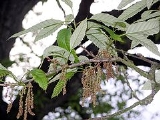
Chinese Cork Oak

Encyclopedia
Quercus variabilis is a species of oak
in the section Quercus sect. Cerris, native to a wide area of eastern Asia
in China
, Japan
, and Korea
.
tree
growing to 25-30 m tall with a rather open crown, and thick corky bark
with deep fissures and marked by sinuous ridges. The leaves
are simple, acuminate, variable in size, 8-20 cm long and 2-8 cm broad, with a serrated margin with each vein ending in a distinctive fine hair-like tooth; they are green above and silvery below with dense short pubescence.
The flower
s are wind-pollinated catkin
s produced in mid spring, maturing about 18 months after pollination; the fruit
is a globose acorn
, 1.5-2 cm diameter, two-thirds enclosed in the acorn cup, which is densely covered in soft 4-8 mm long 'mossy' bristles.
production, though its yield is lower than that of the related cork oak
. It is also occasionally grown as an ornamental tree.
Oak
An oak is a tree or shrub in the genus Quercus , of which about 600 species exist. "Oak" may also appear in the names of species in related genera, notably Lithocarpus...
in the section Quercus sect. Cerris, native to a wide area of eastern Asia
Asia
Asia is the world's largest and most populous continent, located primarily in the eastern and northern hemispheres. It covers 8.7% of the Earth's total surface area and with approximately 3.879 billion people, it hosts 60% of the world's current human population...
in China
China
Chinese civilization may refer to:* China for more general discussion of the country.* Chinese culture* Greater China, the transnational community of ethnic Chinese.* History of China* Sinosphere, the area historically affected by Chinese culture...
, Japan
Japan
Japan is an island nation in East Asia. Located in the Pacific Ocean, it lies to the east of the Sea of Japan, China, North Korea, South Korea and Russia, stretching from the Sea of Okhotsk in the north to the East China Sea and Taiwan in the south...
, and Korea
Korea
Korea ) is an East Asian geographic region that is currently divided into two separate sovereign states — North Korea and South Korea. Located on the Korean Peninsula, Korea is bordered by the People's Republic of China to the northwest, Russia to the northeast, and is separated from Japan to the...
.
Description
It is a medium-sized to large deciduousDeciduous
Deciduous means "falling off at maturity" or "tending to fall off", and is typically used in reference to trees or shrubs that lose their leaves seasonally, and to the shedding of other plant structures such as petals after flowering or fruit when ripe...
tree
Tree
A tree is a perennial woody plant. It is most often defined as a woody plant that has many secondary branches supported clear of the ground on a single main stem or trunk with clear apical dominance. A minimum height specification at maturity is cited by some authors, varying from 3 m to...
growing to 25-30 m tall with a rather open crown, and thick corky bark
Bark
Bark is the outermost layers of stems and roots of woody plants. Plants with bark include trees, woody vines and shrubs. Bark refers to all the tissues outside of the vascular cambium and is a nontechnical term. It overlays the wood and consists of the inner bark and the outer bark. The inner...
with deep fissures and marked by sinuous ridges. The leaves
Leaf
A leaf is an organ of a vascular plant, as defined in botanical terms, and in particular in plant morphology. Foliage is a mass noun that refers to leaves as a feature of plants....
are simple, acuminate, variable in size, 8-20 cm long and 2-8 cm broad, with a serrated margin with each vein ending in a distinctive fine hair-like tooth; they are green above and silvery below with dense short pubescence.
The flower
Flower
A flower, sometimes known as a bloom or blossom, is the reproductive structure found in flowering plants . The biological function of a flower is to effect reproduction, usually by providing a mechanism for the union of sperm with eggs...
s are wind-pollinated catkin
Catkin
A catkin or ament is a slim, cylindrical flower cluster, with inconspicuous or no petals, usually wind-pollinated but sometimes insect pollinated . They contain many, usually unisexual flowers, arranged closely along a central stem which is often drooping...
s produced in mid spring, maturing about 18 months after pollination; the fruit
Fruit
In broad terms, a fruit is a structure of a plant that contains its seeds.The term has different meanings dependent on context. In non-technical usage, such as food preparation, fruit normally means the fleshy seed-associated structures of certain plants that are sweet and edible in the raw state,...
is a globose acorn
Acorn
The acorn, or oak nut, is the nut of the oaks and their close relatives . It usually contains a single seed , enclosed in a tough, leathery shell, and borne in a cup-shaped cupule. Acorns vary from 1–6 cm long and 0.8–4 cm broad...
, 1.5-2 cm diameter, two-thirds enclosed in the acorn cup, which is densely covered in soft 4-8 mm long 'mossy' bristles.
Distribution and habitat
Evergreen and deciduous forests; below 3000 m. Anhui, Fujian, Gansu, Guangdong, Guangxi, Guizhou, Hebei, Henan, Hubei, Hunan, Jiangsu, Jiangxi, Liaoning, Shaanxi, Shandong, Shanxi, Sichuan, Taiwan, Yunnan, Zhejiang Japan, Korea.Uses
It is cultivated in China to a small extent for corkCork (material)
Cork is an impermeable, buoyant material, a prime-subset of bark tissue that is harvested for commercial use primarily from Quercus suber , which is endemic to southwest Europe and northwest Africa...
production, though its yield is lower than that of the related cork oak
Cork Oak
Quercus suber, commonly called the Cork Oak, is a medium-sized, evergreen oak tree in the section Quercus sect. Cerris. It is the primary source of cork for wine bottle stoppers and other uses, such as cork flooring. It is native to southwest Europe and northwest Africa.It grows to up to 20 m,...
. It is also occasionally grown as an ornamental tree.