

.gif)
Chicago school (architecture)

Encyclopedia
Chicago's architecture is famous throughout the world and one style is referred to as the Chicago School. The style is also known as Commercial style. In the history of architecture
, the Chicago School was a school
of architect
s active in Chicago
at the turn of the 20th century. They were among the first to promote the new technologies of steel-frame construction in commercial buildings, and developed a spatial aesthetic which co-evolved with, and then came to influence, parallel developments in European Modernism
. A "Second Chicago School" later emerged in the 1940s and 1970s which pioneered new building technologies and structural system
s such as the tube-frame structure
.
's 1952 book The Chicago School of Architecture. Historians such as H. Allen Brooks
, Winston Weisman and Daniel Bluestone have pointed out that the phrase suggests a unified set of aesthetic or conceptual precepts, when, in fact, Chicago buildings of the era displayed a wide variety of styles and techniques. Contemporary publications used the phrase "Commercial Style" to describe the innovative tall buildings of the era rather than proposing any sort of unified "school".
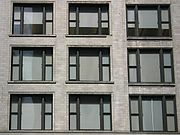 Some of the distinguishing features of the Chicago School are the use of steel-frame buildings with masonry cladding (usually terra cotta
), allowing large plate-glass window areas and limiting the amount of exterior ornamentation. Sometimes elements of neoclassical architecture
are used in Chicago School skyscraper
s. Many Chicago School skyscrapers contain the three parts of a classical column
. The first floor functions as the base, the middle stories, usually with little ornamental detail, act as the shaft of the column, and the last floor or so represent the capital, with more ornamental detail and capped with a cornice.
The "Chicago window" originated in this school. It is a three-part window consisting of a large fixed center panel flanked by two smaller double-hung sash windows. The arrangement of windows on the facade typically creates a grid pattern, with some projecting out from the facade forming bay window
s. The Chicago window combined the functions of light-gathering and natural ventilation; a single central pane was usually fixed, while the two surrounding panes were operable. These windows were often deployed in bays, known as oriel window
s, that projected out over the street.
Architects whose names are associated with the Chicago School include Henry Hobson Richardson
, Dankmar Adler
, Daniel Burnham
, William Holabird
, William LeBaron Jenney, Martin Roche
, John Root, Solon S. Beman, and Louis Sullivan
. Frank Lloyd Wright
started in the firm of Adler and Sullivan but created his own Prairie Style of architecture.
The Home Insurance Building
, which some regarded as the first skyscraper in the world, was built in Chicago in 1885
and was demolished in 1931
. Some of the more famous Chicago School buildings include:

Sullivan Center
Reliance Building
Chicago Building
Brooks Building
Fisher Building
Marquette Building
Wainwright Building
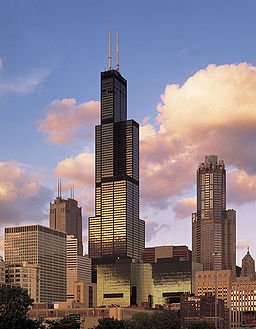 In the 1940s, a "Second Chicago School" emerged from the work of Ludwig Mies van der Rohe
and his efforts of education at the Illinois Institute of Technology
in Chicago. Its first and purest expression was the 860-880 Lake Shore Drive Apartments
(1951) and their technological achievements. This was supported and enlarged in the 1960s due to the ideas of structural engineer Fazlur Khan
. He introduced a new structural system of framed tubes in skyscraper design and construction
. The Bangladesh
i engineer Fazlur Khan defined the framed tube structure
as "a three dimensional space structure composed of three, four, or possibly more frames, braced frames, or shear walls, joined at or near their edges to form a vertical tube-like structural system capable of resisting lateral forces in any direction by cantilevering from the foundation." Closely spaced interconnected exterior columns form the tube. Horizontal loads, for example wind, are supported by the structure as a whole. About half the exterior surface is available for windows. Framed tubes allow fewer interior columns, and so create more usable floor space. Where larger openings like garage doors are required, the tube frame must be interrupted, with transfer girders used to maintain structural integrity.
The first building to apply the tube-frame construction was the DeWitt-Chestnut Apartment Building which Khan designed and was completed in Chicago
by 1963. This laid the foundations for the tube structures of many other later skyscrapers, including his own John Hancock Center
and Willis Tower, and can been seen in the construction of the World Trade Center
, Petronas Towers, Jin Mao Building
, and most other supertall skyscrapers since the 1960s.
Today, there are different styles of architecture all throughout the city, such as the Chicago School, neo-classical, art deco
, modern
, and postmodern
.
Architectural History
Architectural History is the main journal of the Society of Architectural Historians of Great Britain .The journal is published each autumn. The architecture of the British Isles is a major theme of the journal, although it includes more general papers on the history of architecture. Member of...
, the Chicago School was a school
School (discipline)
A school of thought is a collection or group of people who share common characteristics of opinion or outlook of a philosophy, discipline, belief, social movement, cultural movement, or art movement....
of architect
Architect
An architect is a person trained in the planning, design and oversight of the construction of buildings. To practice architecture means to offer or render services in connection with the design and construction of a building, or group of buildings and the space within the site surrounding the...
s active in Chicago
Chicago
Chicago is the largest city in the US state of Illinois. With nearly 2.7 million residents, it is the most populous city in the Midwestern United States and the third most populous in the US, after New York City and Los Angeles...
at the turn of the 20th century. They were among the first to promote the new technologies of steel-frame construction in commercial buildings, and developed a spatial aesthetic which co-evolved with, and then came to influence, parallel developments in European Modernism
Modern architecture
Modern architecture is generally characterized by simplification of form and creation of ornament from the structure and theme of the building. It is a term applied to an overarching movement, with its exact definition and scope varying widely...
. A "Second Chicago School" later emerged in the 1940s and 1970s which pioneered new building technologies and structural system
Structural system
The term structural system or structural frame in structural engineering refers to load-resisting sub-system of a structure. The structural system transfers loads through interconnected structural components or members.-High-rise buildings:...
s such as the tube-frame structure
Tube (structure)
In structural engineering, the tube is the name given to the systems where in order to resist lateral loads a building is designed to act like a three-dimensional hollow tube, cantilevered perpendicular to the ground. The system was introduced by Fazlur Rahman Khan while at Skidmore, Owings and...
.
First Chicago School
While the term "Chicago School" is widely used to describe buildings in the city during the 1880s and 1890s, this term has been disputed by scholars, in particular in reaction to Carl ConditCarl W. Condit
Carl Condit was an American historian of urban and architectural history, a writer, professor, and teacher. He wrote numerous books and articles on the history of American building, especially in Chicago, and founded the History of Science Department at Northwestern University, where he taught for...
's 1952 book The Chicago School of Architecture. Historians such as H. Allen Brooks
H. Allen Brooks
H. Allen Brooks was an architectural historian and longtime professor at the University of Toronto...
, Winston Weisman and Daniel Bluestone have pointed out that the phrase suggests a unified set of aesthetic or conceptual precepts, when, in fact, Chicago buildings of the era displayed a wide variety of styles and techniques. Contemporary publications used the phrase "Commercial Style" to describe the innovative tall buildings of the era rather than proposing any sort of unified "school".
Terra cotta
Terracotta, Terra cotta or Terra-cotta is a clay-based unglazed ceramic, although the term can also be applied to glazed ceramics where the fired body is porous and red in color...
), allowing large plate-glass window areas and limiting the amount of exterior ornamentation. Sometimes elements of neoclassical architecture
Neoclassical architecture
Neoclassical architecture was an architectural style produced by the neoclassical movement that began in the mid-18th century, manifested both in its details as a reaction against the Rococo style of naturalistic ornament, and in its architectural formulas as an outgrowth of some classicizing...
are used in Chicago School skyscraper
Skyscraper
A skyscraper is a tall, continuously habitable building of many stories, often designed for office and commercial use. There is no official definition or height above which a building may be classified as a skyscraper...
s. Many Chicago School skyscrapers contain the three parts of a classical column
Column
A column or pillar in architecture and structural engineering is a vertical structural element that transmits, through compression, the weight of the structure above to other structural elements below. For the purpose of wind or earthquake engineering, columns may be designed to resist lateral forces...
. The first floor functions as the base, the middle stories, usually with little ornamental detail, act as the shaft of the column, and the last floor or so represent the capital, with more ornamental detail and capped with a cornice.
The "Chicago window" originated in this school. It is a three-part window consisting of a large fixed center panel flanked by two smaller double-hung sash windows. The arrangement of windows on the facade typically creates a grid pattern, with some projecting out from the facade forming bay window
Bay window
A bay window is a window space projecting outward from the main walls of a building and forming a bay in a room, either square or polygonal in plan. The angles most commonly used on the inside corners of the bay are 90, 135 and 150 degrees. Bay windows are often associated with Victorian architecture...
s. The Chicago window combined the functions of light-gathering and natural ventilation; a single central pane was usually fixed, while the two surrounding panes were operable. These windows were often deployed in bays, known as oriel window
Oriel window
Oriel windows are a form of bay window commonly found in Gothic architecture, which project from the main wall of the building but do not reach to the ground. Corbels or brackets are often used to support this kind of window. They are seen in combination with the Tudor arch. This type of window was...
s, that projected out over the street.
Architects whose names are associated with the Chicago School include Henry Hobson Richardson
Henry Hobson Richardson
Henry Hobson Richardson was a prominent American architect who designed buildings in Albany, Boston, Buffalo, Chicago, Pittsburgh, and other cities. The style he popularized is named for him: Richardsonian Romanesque...
, Dankmar Adler
Dankmar Adler
Dankmar Adler was a celebrated German-born American architect.-Early years:...
, Daniel Burnham
Daniel Burnham
Daniel Hudson Burnham, FAIA was an American architect and urban planner. He was the Director of Works for the World's Columbian Exposition in Chicago. He took a leading role in the creation of master plans for the development of a number of cities, including Chicago and downtown Washington DC...
, William Holabird
William Holabird
William Holabird was an American architect.Holabird studied at the United States Military Academy at West Point but resigned and moved to Chicago, where he later got married. He worked for William Le Baron Jenney...
, William LeBaron Jenney, Martin Roche
Martin Roche
Martin Roche was an American architect.In partnership with William Holabird, Martin Roche designed buildings following the Chicago School and that were landmarks in the development of early sky scrapers. He worked for William Le Baron Jenney until 1881 when he joined William Holabird at Holabird &...
, John Root, Solon S. Beman, and Louis Sullivan
Louis Sullivan
Louis Henri Sullivan was an American architect, and has been called the "father of skyscrapers" and "father of modernism" He is considered by many as the creator of the modern skyscraper, was an influential architect and critic of the Chicago School, was a mentor to Frank Lloyd Wright, and an...
. Frank Lloyd Wright
Frank Lloyd Wright
Frank Lloyd Wright was an American architect, interior designer, writer and educator, who designed more than 1,000 structures and completed 500 works. Wright believed in designing structures which were in harmony with humanity and its environment, a philosophy he called organic architecture...
started in the firm of Adler and Sullivan but created his own Prairie Style of architecture.
The Home Insurance Building
Home Insurance Building
The Home Insurance Building was built in 1884 in Chicago, Illinois, USA and destroyed in 1931 to make way for the Field Building . It was the first building to use structural steel in its frame, but the majority of its structure was composed of cast and wrought iron...
, which some regarded as the first skyscraper in the world, was built in Chicago in 1885
1885 in architecture
The year 1885 in architecture involved some significant events.-Buildings:* The Home Insurance Building in Chicago, Illinois, designed by William LeBaron Jenney, is completed, often regarded as the world's first skyscraper....
and was demolished in 1931
1931 in architecture
The year 1931 in architecture involved some significant events.-Buildings:* July 1 - Rebuilt Milano Centrale railway station opens in Italy....
. Some of the more famous Chicago School buildings include:
- Auditorium BuildingAuditorium Building, ChicagoThe Auditorium Building in Chicago is one of the best-known designs of Dankmar Adler and Louis Sullivan. Completed in 1889, the building is located on South Michigan Avenue, at the northwest corner of Michigan Avenue and Congress Parkway. It was declared a National Historic Landmark in 1975. It...
Sullivan Center
Carson, Pirie, Scott and Company Building
The Sullivan Center, formerly known as the Carson, Pirie, Scott and Company Building or Carson, Pirie, Scott and Company Store, is a commercial building at 1 South State Street at the corner of East Madison Street in Chicago, Illinois. It was designed by Louis Sullivan for the retail firm...
Reliance Building
Reliance Building
The Reliance Building is a skyscraper located at 32 North State Street in the Loop community area of Chicago, Illinois. The first floor and basement were designed by John Root of the Burnham and Root architectural firm in 1890, with the rest of the building completed by Charles B. Atwood in 1895...
- Gage Group BuildingsGage Group BuildingsThe Gage Group Buildings consist of three buildings located at 18, 24 and 30 S. Michigan Avenue, between Madison Street and Monroe Street, in Chicago, Illinois. They were built from 1890–1899, designed by Holabird & Roche for the three millinery firms - Gage, Keith and Ascher. The building at 18...
Chicago Building
Chicago Building
The Chicago Building or Chicago Savings Bank Building was built in 1904-1905. It is located at 7 W. Madison Street, Chicago, Illinois. It was designed by architectural firm Holabird & Roche, it is an early and highly visible example of the Chicago school of architecture...
Brooks Building
Brooks Building
The Brooks Building in Chicago was built in 1909–1910 in the Chicago School architectural style. An early example steel-framed skyscraper, the structure was commissioned by Peter Brooks and Shepard Brooks and designed by architects Holabird & Roche. The building was designated a Chicago Landmark on...
Fisher Building
Fisher Building (Chicago)
The Fisher Building is 20-story, neo-Gothic landmark building located at 343 South Dearborn Street in the Chicago Loop community area of Chicago. Commissioned by paper magnate Lucius Fisher, the original building was completed in 1896 by D.H. Burnham & Company with an addition latter added in...
- Heyworth BuildingHeyworth BuildingThe Heyworth Building is a Chicago Landmark located at 29 East Madison Street, on the southwest corner of Madison Street and Wabash Avenue in Chicago, Illinois....
- Leiter I BuildingFirst Leiter BuildingThe First Leiter building was a Chicago structure built in 1879 and demolished in 1972.-External references:* Historic American Building Survey Photos and information...
- Leiter II BuildingSecond Leiter BuildingThe Second Leiter Building, also known as Leiter II Building and the Sears Building, is located at the northeast corner of South State Street and East Congress Parkway in Chicago, Illinois....
Marquette Building
Marquette Building (Chicago)
The Marquette Building, completed in 1895, is a Chicago, Illinois landmark that was built by the George A. Fuller Company and designed by architects Holabird & Roche. The building is currently owned by the John D. and Catherine T. MacArthur Foundation...
- Monadnock BuildingMonadnock BuildingThe Monadnock Building , is a skyscraper located at 53 West Jackson Boulevard in the south Loop community area of Chicago, Illinois. The north half of the building was designed by the firm of Burnham & Root and built in 1891...
- Montauk BuildingMontauk BuildingThe Montauk Building - also often referred to as Montauk Block - was a high-rise building in Chicago, Illinois.Designed by John Wellborn Root Sr. and Daniel Burnham, it was built in 1882–1883, and was demolished in 1902...
- Rookery BuildingRookery BuildingThe Rookery Building is a historic landmark located in the Loop community area of Chicago in Cook County, Illinois, United States. Completed by John Wellborn Root and Daniel Burnham of Burnham and Root in 1888, it is considered one of their masterpiece buildings. It once housed the office of the...
Wainwright Building
Wainwright Building
The Wainwright Building is a 10-story red brick office building at 709 Chestnut Street in downtown St. Louis, Missouri. The Wainwright Building is among the first skyscrapers in the world. It was designed by Dankmar Adler and Louis Sullivan in the Palazzo style and built between 1890 and 1891...
Buildings outside Chicago
Buildings outside Chicago include:- Blount BuildingBlount BuildingThe Blount Building is an historic seven-story Chicago school style office building located at 3 West Garden St., SW corner of Palofax St., Pensacola, Escambia County, Florida. It was built by Charles Hill Turner in 1906-1907 for local attorney William Alexander Blount on the site of the...
, 1907, Pensacola, Florida - Manchester CourtsManchester CourtsManchester Courts, earlier known as the MLC Building, was a commercial high-rise building in the Christchurch Central City. Built in 1905–1906 for the New Zealand Express Company, it was at the time the tallest commercial building in Christchurch...
, 1906, Christchurch, New Zealand
Second Chicago School
Ludwig Mies van der Rohe
Ludwig Mies van der Rohe was a German architect. He is commonly referred to and addressed as Mies, his surname....
and his efforts of education at the Illinois Institute of Technology
Illinois Institute of Technology
Illinois Institute of Technology, commonly called Illinois Tech or IIT, is a private Ph.D.-granting university located in Chicago, Illinois, with programs in engineering, science, psychology, architecture, business, communications, industrial technology, information technology, design, and law...
in Chicago. Its first and purest expression was the 860-880 Lake Shore Drive Apartments
860-880 Lake Shore Drive Apartments
860–880 Lake Shore Drive is a twin pair of glass-and-steel apartment towers on N. Lake Shore Drive along Lake Michigan in the Streeterville neighborhood of Chicago, Illinois. Construction began in 1949 and the project was completed in 1951.They were designated as Chicago Landmarks on June 10, 1996....
(1951) and their technological achievements. This was supported and enlarged in the 1960s due to the ideas of structural engineer Fazlur Khan
Fazlur Khan
Fazlur Rahman Khan was a Bangladeshi born architect and structural engineer. He is a central figure behind the "Second Chicago School" of architecture, and is regarded as the "Father of tubular design for high-rises"...
. He introduced a new structural system of framed tubes in skyscraper design and construction
Skyscraper design and construction
The design and construction of skyscrapers involves creating safe, habitable spaces in very tall buildings. The buildings must support their weight, resist wind and earthquakes, and protect occupants from fire. Yet they must also be conveniently accessible, even on the upper floors, and provide...
. The Bangladesh
Bangladesh
Bangladesh , officially the People's Republic of Bangladesh is a sovereign state located in South Asia. It is bordered by India on all sides except for a small border with Burma to the far southeast and by the Bay of Bengal to the south...
i engineer Fazlur Khan defined the framed tube structure
Tube (structure)
In structural engineering, the tube is the name given to the systems where in order to resist lateral loads a building is designed to act like a three-dimensional hollow tube, cantilevered perpendicular to the ground. The system was introduced by Fazlur Rahman Khan while at Skidmore, Owings and...
as "a three dimensional space structure composed of three, four, or possibly more frames, braced frames, or shear walls, joined at or near their edges to form a vertical tube-like structural system capable of resisting lateral forces in any direction by cantilevering from the foundation." Closely spaced interconnected exterior columns form the tube. Horizontal loads, for example wind, are supported by the structure as a whole. About half the exterior surface is available for windows. Framed tubes allow fewer interior columns, and so create more usable floor space. Where larger openings like garage doors are required, the tube frame must be interrupted, with transfer girders used to maintain structural integrity.
The first building to apply the tube-frame construction was the DeWitt-Chestnut Apartment Building which Khan designed and was completed in Chicago
Chicago
Chicago is the largest city in the US state of Illinois. With nearly 2.7 million residents, it is the most populous city in the Midwestern United States and the third most populous in the US, after New York City and Los Angeles...
by 1963. This laid the foundations for the tube structures of many other later skyscrapers, including his own John Hancock Center
John Hancock Center
John Hancock Center at 875 North Michigan Avenue in the Streeterville area of Chicago, Illinois, is a 100-story, 1,127-foot tall skyscraper, constructed under the supervision of Skidmore, Owings and Merrill, with chief designer Bruce Graham and structural engineer Fazlur Khan...
and Willis Tower, and can been seen in the construction of the World Trade Center
Construction of the World Trade Center
The construction of the World Trade Center was conceived as an urban renewal project, spearheaded by David Rockefeller, to help revitalize Lower Manhattan. The project was developed by the Port Authority of New York and New Jersey, which hired architect Minoru Yamasaki who came up with the specific...
, Petronas Towers, Jin Mao Building
Jin Mao Building
The Jin Mao Tower is an 88-story landmark supertall skyscraper in the Lujiazui area of the Pudong district of Shanghai, People's Republic of China. It contains offices and the Shanghai Grand Hyatt hotel. Until 2007 it was the tallest building in the PRC, the fifth tallest in the world by roof...
, and most other supertall skyscrapers since the 1960s.
Today, there are different styles of architecture all throughout the city, such as the Chicago School, neo-classical, art deco
Art Deco
Art deco , or deco, is an eclectic artistic and design style that began in Paris in the 1920s and flourished internationally throughout the 1930s, into the World War II era. The style influenced all areas of design, including architecture and interior design, industrial design, fashion and...
, modern
International style (architecture)
The International style is a major architectural style that emerged in the 1920s and 1930s, the formative decades of Modern architecture. The term originated from the name of a book by Henry-Russell Hitchcock and Philip Johnson, The International Style...
, and postmodern
Postmodernism
Postmodernism is a philosophical movement evolved in reaction to modernism, the tendency in contemporary culture to accept only objective truth and to be inherently suspicious towards a global cultural narrative or meta-narrative. Postmodernist thought is an intentional departure from the...
.