


Chicago blues

Encyclopedia
The Chicago blues is a form of blues
music that developed in Chicago, Illinois, by taking the basic acoustic guitar and harmonica
-based Delta blues
, making the harmonica louder with a microphone and an instrument amplifier
, and adding electrically amplified guitar
, amplified bass guitar
, drums
, piano
and sometimes saxophone
and trumpet
. The music developed in the first half of the twentieth century due to the Great Migration (African American)
when Black workers moved from the South into the industrial cities of the North such as Chicago.
Originally, the Chicago Blues was street-corner based music. But after the music quickly gained popularity, it became a giant commercial enterprise. Soon the new style of music reached out and touched Europe, which led to many famous English rock n' roll bands to get their inspiration from the Chicago Blues.
At first, the Blues clubs in Chicago were filled with black performers, and the music itself was aimed for black audiences. Most of the Blues clubs were on the far south side of Chicago, so white people did not visit them. Later, however, more and more white audiences visited the clubs and listened to the music. This caused clubs to open up on the north side. In addition, more white men started playing the Blues after it became popular.
Chicago Blues has a more extended palette of notes than the standard six-note blues scale
; often, notes from the major scale
and dominant 9th chords
are added, which gives the music a more of a "jazz feel" while remaining in the confines of the blues genre. Chicago blues is also known for its heavy rolling bass. Like Delta Blues, Chicago Blues often uses a harmonica and occasionally saxophones.
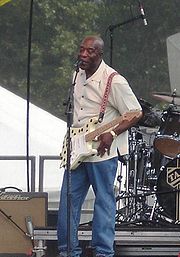
Well-known Chicago blues players include singer/songwriters such as Muddy Waters
, Howlin' Wolf
, Willie Dixon
, and Koko Taylor
; guitar players such as Freddie King
, Luther Allison
, Magic Sam
, Syl Johnson
, Jimmy Rogers
, Buddy Guy
, Robert Lockwood Jr.
, McKinley Mitchell
, Bo Diddley
, Mike Bloomfield
and Elmore James
; harmonica
players such as Big Walter Horton
, Little Walter
, Charlie Musselwhite
, Paul Butterfield
, Junior Wells
and Jimmy Reed
; and keyboardists such as Marty Sammon
.
, who created what is known as the "Bluebird Sound.". Many blues artists recorded for Bluebird, if only briefly, while Arthur Crudup
, Lil Green
and Tommy McClennan
spent virtually their entire career with the label.
and Phil Chess
, was probably the most famous of the Chicago record labels to feature or promote the blues. Musician and critic Cub Koda
even described Chess Records as "America's greatest blues label." It was active from 1950–1969 when the brothers sold the company. Most solo artists also did double duty as session musicians on the records of others.
Checker Records
was a subsidiary of Chess that recorded Chicago blues greats such as Bo Diddley
, J. B. Lenoir
, Robert Lockwood Jr.
and Sonny Boy Williamson II
.
Cobra Records was started on Chicago's West Side in 1956 by Eli Toscano (a record store and television-repair shop owner) and Howard Bedno. When his previous record label, Abco Records, failed to generate much interest, Toscano approached Willie Dixon about working for Cobra. Dissatisfied with his arrangement with Chess Records, Dixon joined Cobra. There he served in many capacities, including talent scout, producer, arranger, songwriter, and bassist, as well as guiding its artistic vision.
moved his Delmar label from St. Louis to Chicago in 1958 and remains active today. They are still known for Jazz and Blues. Artist recorded by the label includes Roscoe Mitchell
, Junior Wells
, Robert Lockwood Jr.
and Sonny Boy Williamson II
.
, a former employee of Delmark, formed Alligator Records in 1971. Alligator Records remains a premier blues label to this day. They have recorded Chicago blues greats such as Koko Taylor
, Buddy Guy
, Otis Rush
, Hound Dog Taylor
and Eddy "The Chief" Clearwater
.
, an established R&B performer who had had a number of hits for King Records and who would have his biggest hits for Hi Records in the 1970s. Johnson’s hits at Twinight included "Come on Sock it to Me" (1967), "Sorry ‘Bout Dat", "Different Strokes", "Is It Because I'm Black" (1969), and "Concrete Reservation".
Testament records
Blues
Blues is the name given to both a musical form and a music genre that originated in African-American communities of primarily the "Deep South" of the United States at the end of the 19th century from spirituals, work songs, field hollers, shouts and chants, and rhymed simple narrative ballads...
music that developed in Chicago, Illinois, by taking the basic acoustic guitar and harmonica
Harmonica
The harmonica, also called harp, French harp, blues harp, and mouth organ, is a free reed wind instrument used primarily in blues and American folk music, jazz, country, and rock and roll. It is played by blowing air into it or drawing air out by placing lips over individual holes or multiple holes...
-based Delta blues
Delta blues
The Delta blues is one of the earliest styles of blues music. It originated in the Mississippi Delta, a region of the United States that stretches from Memphis, Tennessee in the north to Vicksburg, Mississippi in the south, Helena, Arkansas in the west to the Yazoo River on the east. The...
, making the harmonica louder with a microphone and an instrument amplifier
Instrument amplifier
An instrument amplifier is an electronic amplifier that converts the often barely audible or purely electronic signal from musical instruments such as an electric guitar, an electric bass, or an electric keyboard into an electronic signal capable of driving a loudspeaker that can be heard by the...
, and adding electrically amplified guitar
Electric guitar
An electric guitar is a guitar that uses the principle of direct electromagnetic induction to convert vibrations of its metal strings into electric audio signals. The signal generated by an electric guitar is too weak to drive a loudspeaker, so it is amplified before sending it to a loudspeaker...
, amplified bass guitar
Bass guitar
The bass guitar is a stringed instrument played primarily with the fingers or thumb , or by using a pick....
, drums
Drum kit
A drum kit is a collection of drums, cymbals and often other percussion instruments, such as cowbells, wood blocks, triangles, chimes, or tambourines, arranged for convenient playing by a single person ....
, piano
Piano
The piano is a musical instrument played by means of a keyboard. It is one of the most popular instruments in the world. Widely used in classical and jazz music for solo performances, ensemble use, chamber music and accompaniment, the piano is also very popular as an aid to composing and rehearsal...
and sometimes saxophone
Saxophone
The saxophone is a conical-bore transposing musical instrument that is a member of the woodwind family. Saxophones are usually made of brass and played with a single-reed mouthpiece similar to that of the clarinet. The saxophone was invented by the Belgian instrument maker Adolphe Sax in 1846...
and trumpet
Trumpet
The trumpet is the musical instrument with the highest register in the brass family. Trumpets are among the oldest musical instruments, dating back to at least 1500 BCE. They are played by blowing air through closed lips, producing a "buzzing" sound which starts a standing wave vibration in the air...
. The music developed in the first half of the twentieth century due to the Great Migration (African American)
Great Migration (African American)
The Great Migration was the movement of 6 million blacks out of the Southern United States to the Northeast, Midwest, and West from 1910 to 1970. Some historians differentiate between a Great Migration , numbering about 1.6 million migrants, and a Second Great Migration , in which 5 million or more...
when Black workers moved from the South into the industrial cities of the North such as Chicago.
Originally, the Chicago Blues was street-corner based music. But after the music quickly gained popularity, it became a giant commercial enterprise. Soon the new style of music reached out and touched Europe, which led to many famous English rock n' roll bands to get their inspiration from the Chicago Blues.
At first, the Blues clubs in Chicago were filled with black performers, and the music itself was aimed for black audiences. Most of the Blues clubs were on the far south side of Chicago, so white people did not visit them. Later, however, more and more white audiences visited the clubs and listened to the music. This caused clubs to open up on the north side. In addition, more white men started playing the Blues after it became popular.
Chicago Blues has a more extended palette of notes than the standard six-note blues scale
Hexatonic scale
In music and music theory, a hexatonic scale is a scale with six pitches or notes per octave. Famous examples include the whole tone scale, C D E F G A C; the augmented scale, C D E G A B C; the Prometheus scale, C D E F A B C; and what some jazz theorists call the "blues scale", C E F F G B...
; often, notes from the major scale
Major scale
In music theory, the major scale or Ionian scale is one of the diatonic scales. It is made up of seven distinct notes, plus an eighth which duplicates the first an octave higher. In solfege these notes correspond to the syllables "Do, Re, Mi, Fa, Sol, La, Ti/Si, ", the "Do" in the parenthesis at...
and dominant 9th chords
Ninth
In music, a ninth is a compound interval consisting of an octave plus a second.Like the second, the interval of a ninth is classified as a dissonance in common practice tonality. Since a ninth is a larger than a second, its sonority level is considered less dense.-Major ninth:A major ninth is a...
are added, which gives the music a more of a "jazz feel" while remaining in the confines of the blues genre. Chicago blues is also known for its heavy rolling bass. Like Delta Blues, Chicago Blues often uses a harmonica and occasionally saxophones.
Notable musicians
Well-known Chicago blues players include singer/songwriters such as Muddy Waters
Muddy Waters
McKinley Morganfield , known as Muddy Waters, was an American blues musician, generally considered the "father of modern Chicago blues"...
, Howlin' Wolf
Howlin' Wolf
Chester Arthur Burnett , known as Howlin' Wolf, was an influential American blues singer, guitarist and harmonica player....
, Willie Dixon
Willie Dixon
William James "Willie" Dixon was an American blues musician, vocalist, songwriter, arranger and record producer. A Grammy Award winner who was proficient on both the Upright bass and the guitar, as well as his own singing voice, Dixon is arguably best known as one of the most prolific songwriters...
, and Koko Taylor
Koko Taylor
Koko Taylor sometimes spelled KoKo Taylor was an American Chicago blues musician, popularly known as the "Queen of the Blues." She was known primarily for her rough, powerful vocals and traditional blues stylings....
; guitar players such as Freddie King
Freddie King
Freddie King , thought to have been born as Frederick Christian, originally recording as Freddy King, and nicknamed "the Texas Cannonball", was an influential African-American blues guitarist and singer. He is often mentioned as one of "the Three Kings" of electric blues guitar, along with Albert...
, Luther Allison
Luther Allison
Luther Allison was an American blues guitarist. He was born in Widener, Arkansas and moved with his family, at age twelve, to Chicago in 1951. He taught himself guitar and began listening to blues extensively. Three years later he began hanging outside blues nightclubs with the hopes of being...
, Magic Sam
Magic Sam
Samuel "Magic Sam" Gene Maghett was an American Chicago blues musician. Maghett was born in Grenada, Mississippi, United States, and learned to play the blues from listening to records by Muddy Waters and Little Walter...
, Syl Johnson
Syl Johnson
Syl Johnson is an American blues and soul singer and record producer.-Biography:Born Sylvester Thompson in Holly Springs, Mississippi, United States, Johnson sang and played with blues artists Magic Sam, Billy Boy Arnold, Junior Wells and Howlin' Wolf in the 1950s, before recording with Jimmy Reed...
, Jimmy Rogers
Jimmy Rogers
Jimmy Rogers was an American Chicago blues singer, guitarist and harmonica player, best known for his work as a member of Muddy Waters' band of the 1950s.-Career:...
, Buddy Guy
Buddy Guy
George "Buddy" Guy is an American blues and jazz guitarist and singer. He is a critically acclaimed artist who has established himself as a pioneer of the Chicago blues sound, and has served as an influence to some of the most notable musicians of his generation...
, Robert Lockwood Jr.
Robert Lockwood Jr.
Robert Lockwood, Jr., also known as Robert Junior Lockwood, was an American Delta blues guitarist, who recorded for Chess Records among other Chicago labels in the 1950s and 1960s...
, McKinley Mitchell
McKinley Mitchell
McKinley Mitchell was an American Chicago-based soul-blues and rhythm and blues singer, who started out performing gospel music. He recorded singles for Boxer Records, Chess Records , and a variety of other record labels. Most of his releases are still only available on records...
, Bo Diddley
Bo Diddley
Ellas Otha Bates , known by his stage name Bo Diddley, was an American rhythm and blues vocalist, guitarist, songwriter , and inventor...
, Mike Bloomfield
Mike Bloomfield
Michael Bernard "Mike" Bloomfield was an American musician, guitarist, and composer, born in Chicago, Illinois, who became one of the first popular music superstars of the 1960s to earn his reputation almost entirely on his instrumental prowess, since he rarely sang before 1969–70...
and Elmore James
Elmore James
Elmore James was an American blues guitarist, singer, songwriter and band leader. He was known as "the King of the Slide Guitar" and had a unique guitar style, noted for his use of loud amplification and his stirring voice.-Biography:James was born Elmore Brooks in the old Richland community in...
; harmonica
Harmonica
The harmonica, also called harp, French harp, blues harp, and mouth organ, is a free reed wind instrument used primarily in blues and American folk music, jazz, country, and rock and roll. It is played by blowing air into it or drawing air out by placing lips over individual holes or multiple holes...
players such as Big Walter Horton
Big Walter Horton
Walter Horton, better known as Big Walter Horton or Walter "Shakey" Horton, was an American blues harmonica player. A quiet, unassuming and essentially shy man, Horton is remembered as one of the premier harmonica players in the history of blues...
, Little Walter
Little Walter
Little Walter, born Marion Walter Jacobs , was an American blues harmonica player, whose revolutionary approach to his instrument has earned him comparisons to Charlie Parker and Jimi Hendrix, for innovation and impact on succeeding generations...
, Charlie Musselwhite
Charlie Musselwhite
Charlie Musselwhite is an American electric blues harmonica player and bandleader, one of the non-black bluesmen who came to prominence in the early 1960s, along with Mike Bloomfield and Paul Butterfield. Though he has often been identified as a "white bluesman", he claims Native American heritage...
, Paul Butterfield
Paul Butterfield
Paul Butterfield was an American blues vocalist and harmonica player, who founded the Paul Butterfield Blues Band in the early 1960s and performed at the original Woodstock Festival...
, Junior Wells
Junior Wells
Junior Wells , born Amos Wells Blakemore Jr., was an American Chicago blues vocalist, harmonica player, and recording artist...
and Jimmy Reed
Jimmy Reed
Mathis James "Jimmy" Reed was an American blues musician and songwriter, notable for bringing his distinctive style of blues to mainstream audiences. Reed was a major player in the field of electric blues, as opposed to the more acoustic-based sound of many of his contemporaries...
; and keyboardists such as Marty Sammon
Marty Sammon
Marty Sammon is an American blues keyboardist. He is most recognized for his energetic performances, improvisation and mastery of traditional styles...
.
Bluebird Records
Bluebird was an important Chicago Blues label, notably due to the work of A&R/producer Lester MelroseLester Melrose
Lester Melrose was one of the first American producers of blues records.-Career:He was born Lester Franklin Melrose in Sumner, Illinois, United States, the second of six children of Frank and Mollie Melrose who owned a small farm...
, who created what is known as the "Bluebird Sound.". Many blues artists recorded for Bluebird, if only briefly, while Arthur Crudup
Arthur Crudup
Arthur "Big Boy" Crudup was an American Delta blues singer, songwriter and guitarist. He is best known outside blues circles for writing songs such as "That's All Right" , "My Baby Left Me" and "So Glad You're Mine", later covered by Elvis Presley and dozens of other artists.-Career:Arthur Crudup...
, Lil Green
Lil Green
Lil Green was an American blues singer and songwriter.-Life and career:Originally named Lillian Green, she was born in Mississippi; after the early deaths of her parents, she went to Chicago, Illinois, where she began performing in her teens and where she would make all of her recordings.Green was...
and Tommy McClennan
Tommy McClennan
Tommy McClennan was an American Delta blues singer and guitarist.-Life and career:McClennan was born on a farm near Yazoo City, Mississippi, United States, and grew up in the town...
spent virtually their entire career with the label.
Chess Records
Chess Records, run by brothers LeonardLeonard Chess
Leonard Chess was a record company executive and the founder of Chess Records. He was influential in the development of electric blues.- Early life :...
and Phil Chess
Phil Chess
Philip Chess is an American record producer and company executive, the co-founder of Chess Records.He was born Fiszel Czyż in a Jewish community in Częstochowa, Poland. He and his brother Lejzor, sister Malka and mother followed their father to Chicago in 1928...
, was probably the most famous of the Chicago record labels to feature or promote the blues. Musician and critic Cub Koda
Cub Koda
Michael "Cub" Koda was an American rock and roll singer, guitarist, songwriter, disc jockey, music critic, and record compiler. Rolling Stone magazine felt that Koda was best known for writing the song "Smokin' in the Boys' Room", which reached #3 on the 1974 Billboard charts as performed by...
even described Chess Records as "America's greatest blues label." It was active from 1950–1969 when the brothers sold the company. Most solo artists also did double duty as session musicians on the records of others.
Checker Records
Checker Records
Checker Records is an inactive record label that was started in 1952 as a subsidiary to Chess Records in Chicago, Illinois. The label was founded by the Chess brothers, Leonard and Phil, who ran the label until they sold it to General Recorded Tape in 1969, shortly before Leonard's death.The label...
was a subsidiary of Chess that recorded Chicago blues greats such as Bo Diddley
Bo Diddley
Ellas Otha Bates , known by his stage name Bo Diddley, was an American rhythm and blues vocalist, guitarist, songwriter , and inventor...
, J. B. Lenoir
J. B. Lenoir
J. B. Lenoir /ləˈnɔːr/ was an African American blues guitarist and singer-songwriter, active in the 1950s and 1960s Chicago blues scene....
, Robert Lockwood Jr.
Robert Lockwood Jr.
Robert Lockwood, Jr., also known as Robert Junior Lockwood, was an American Delta blues guitarist, who recorded for Chess Records among other Chicago labels in the 1950s and 1960s...
and Sonny Boy Williamson II
Sonny Boy Williamson II
Willie "Sonny Boy" Williamson was an American blues harmonica player, singer and songwriter, from Mississippi. He is acknowledged as one of the most charismatic and influential blues musicians, with considerable prowess on the harmonica and highly creative songwriting skills...
.
Cobra Records
Cobra Records (together with its Artistic subsidiary) was an independent record label that operated from 1956 to 1959. The label was important for launching the recording careers of Chicago blues artists Otis Rush, Magic Sam, and Buddy Guy. It signaled the emergence of a distinctive West Side Sound.Cobra Records was started on Chicago's West Side in 1956 by Eli Toscano (a record store and television-repair shop owner) and Howard Bedno. When his previous record label, Abco Records, failed to generate much interest, Toscano approached Willie Dixon about working for Cobra. Dissatisfied with his arrangement with Chess Records, Dixon joined Cobra. There he served in many capacities, including talent scout, producer, arranger, songwriter, and bassist, as well as guiding its artistic vision.
Delmark
Delmark was formed when Bob KoesterBob Koester
Robert Gregg "Bob" Koester is the American founder and owner of Delmark Records, one of the oldest independent record labels in the United States, and one of jazz's best-known imprints...
moved his Delmar label from St. Louis to Chicago in 1958 and remains active today. They are still known for Jazz and Blues. Artist recorded by the label includes Roscoe Mitchell
Roscoe Mitchell
Roscoe Mitchell is an African American composer, jazz instrumentalist and educator, mostly known for being "a technically superb—if idiosyncratic—saxophonist." He has been called "one of the key figures" in avant-garde jazz who has been "at the forefront of modern music" for the past...
, Junior Wells
Junior Wells
Junior Wells , born Amos Wells Blakemore Jr., was an American Chicago blues vocalist, harmonica player, and recording artist...
, Robert Lockwood Jr.
Robert Lockwood Jr.
Robert Lockwood, Jr., also known as Robert Junior Lockwood, was an American Delta blues guitarist, who recorded for Chess Records among other Chicago labels in the 1950s and 1960s...
and Sonny Boy Williamson II
Sonny Boy Williamson II
Willie "Sonny Boy" Williamson was an American blues harmonica player, singer and songwriter, from Mississippi. He is acknowledged as one of the most charismatic and influential blues musicians, with considerable prowess on the harmonica and highly creative songwriting skills...
.
Alligator Records
Bruce IglauerBruce Iglauer
Bruce Iglauer is the American founder and head of the independent blues record label Alligator Records in Chicago.Iglauer was born in Ann Arbor and grew up in Grand Rapids, Michigan and Cincinnati, Ohio...
, a former employee of Delmark, formed Alligator Records in 1971. Alligator Records remains a premier blues label to this day. They have recorded Chicago blues greats such as Koko Taylor
Koko Taylor
Koko Taylor sometimes spelled KoKo Taylor was an American Chicago blues musician, popularly known as the "Queen of the Blues." She was known primarily for her rough, powerful vocals and traditional blues stylings....
, Buddy Guy
Buddy Guy
George "Buddy" Guy is an American blues and jazz guitarist and singer. He is a critically acclaimed artist who has established himself as a pioneer of the Chicago blues sound, and has served as an influence to some of the most notable musicians of his generation...
, Otis Rush
Otis Rush
Otis Rush is a blues musician, singer and guitarist. His distinctive guitar style features a slow burning sound and long bent notes...
, Hound Dog Taylor
Hound Dog Taylor
Theodore Roosevelt "Hound Dog" Taylor was an American Chicago blues guitarist and singer.-Career:Taylor was born in Natchez, Mississippi in 1915 . He originally played piano, but began playing guitar when he was 20...
and Eddy "The Chief" Clearwater
Eddy Clearwater
Eddy "The Chief" Clearwater is the stage name of Edward Harrington ,) an American Chicago blues musician. Blues Revue said Eddy plays “joyous rave-ups…he testifies with stunning soul fervor and powerful guitar. One of the blues’ finest songwriters.” -Early life:He was born in Macon, Mississippi,...
.
Twinight Records
Twinight Records was a minor American recording label, founded in Chicago in 1967 by Howard Bedno and Peter Wright, who later added E. Rodney Jones as a partner. Specializing in R&B and soul music, for a few months the label was called Twilight Records until it was discovered that another company already owned the Twilight name. Over five years, the label released (or at least recorded) 55 singles and charted seven times. The label’s star was Syl JohnsonSyl Johnson
Syl Johnson is an American blues and soul singer and record producer.-Biography:Born Sylvester Thompson in Holly Springs, Mississippi, United States, Johnson sang and played with blues artists Magic Sam, Billy Boy Arnold, Junior Wells and Howlin' Wolf in the 1950s, before recording with Jimmy Reed...
, an established R&B performer who had had a number of hits for King Records and who would have his biggest hits for Hi Records in the 1970s. Johnson’s hits at Twinight included "Come on Sock it to Me" (1967), "Sorry ‘Bout Dat", "Different Strokes", "Is It Because I'm Black" (1969), and "Concrete Reservation".
Testament records
See also
- Chicago record labelsChicago record labelsThis is a list of notable record labels based in Chicago....
- Chicago Blues FestivalChicago Blues FestivalThe Chicago Blues Festival is an annual event held in June that features three days of performances by top-tier blues musicians, both old favorites and the up-and-coming. It is hosted by the City of Chicago Mayor's Office of Special Events, and always occurs in early June...
- Maxwell StreetMaxwell StreetMaxwell Street is an east-west street in Chicago, Illinois that intersects with Halsted Street just south of Roosevelt Road. It runs at 1330 South in the numbering system running from 500 West to 1126 West. The Maxwell Street neighborhood is considered part of the Near West Side and is one of the...
- Music of ChicagoMusic of ChicagoAs the largest non-coastal United States city, Chicago, Illinois is a major center for music in the midwestern United States, especially in the early 1900s, when the "Great Migration" of poor black workers from the South into the industrial cities brought traditional jazz and blues music to...
External links
- WDCB Radio- streaming blues from College of DuPage, Illinois
- France Jean Baptiste
- Chicago blues example and lesson
- Windy City Blues Internet Radio Station Featuring The Best In Chicago Blues Plus Other Blues Greats
- Blues Festival