
All Topics  
Chevrotain

 
Chevrotain

   Email Print
   Bookmark   Link


Chevrotain


"Kancil" redirects here. For the car, see Perodua Kancil
Perodua Kancil

The Perodua Kancil is a city car manufactured by Malaysian automobile manufacturer Perodua since 1994. The Kancil is named after the mousedeer native to Malaysia....
Not to be confused with Kanchil (Lesser Mouse Deer)
Not to be confused with deer mouse (Peromyscus)


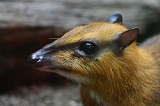
The nine species of chevrotain, also known as mouse deer, make up the family
Family (biology)

In biological classification, family is a taxonomic rank. Exact details of formal nomenclature depend on the Nomenclature Codes which applies....
 Tragulidae. Chevrotains are small, secretive creatures, now found only in the tropical forests of Africa
Africa

Africa is the world's second-largest and second most-populous continent, after Asia. At about 30.2 million km? including adjacent islands, it covers 6% of the Earth's total surface area and 20.4% of the total land area....
, India
India

India, officially the Republic of India , is a country in South Asia. It is the List of countries and outlying territories by total area country by geographical area, the List of countries by population country, and the most populous liberal democracy in the world....
, Sri Lanka
Sri Lanka

Sri Lanka, officially the Democratic Socialist Republic of Sri Lanka is an island country in South Asia, located about off the southern coast of India....
, and South-east Asia.


Discussion
Ask a question about 'Chevrotain'
Start a new discussion about 'Chevrotain'
Answer questions from other users
Full Discussion Forum


Encyclopedia


"Kancil" redirects here. For the car, see Perodua Kancil
Perodua Kancil

The Perodua Kancil is a city car manufactured by Malaysian automobile manufacturer Perodua since 1994. The Kancil is named after the mousedeer native to Malaysia....
Not to be confused with Kanchil (Lesser Mouse Deer)
Not to be confused with deer mouse (Peromyscus)


The nine species of chevrotain, also known as mouse deer, make up the family
Family (biology)

In biological classification, family is a taxonomic rank. Exact details of formal nomenclature depend on the Nomenclature Codes which applies....
 Tragulidae. Chevrotains are small, secretive creatures, now found only in the tropical forests of Africa
Africa

Africa is the world's second-largest and second most-populous continent, after Asia. At about 30.2 million km? including adjacent islands, it covers 6% of the Earth's total surface area and 20.4% of the total land area....
, India
India

India, officially the Republic of India , is a country in South Asia. It is the List of countries and outlying territories by total area country by geographical area, the List of countries by population country, and the most populous liberal democracy in the world....
, Sri Lanka
Sri Lanka

Sri Lanka, officially the Democratic Socialist Republic of Sri Lanka is an island country in South Asia, located about off the southern coast of India....
, and South-east Asia. They are the only living members of the infraorder Tragulina.

In Malay folklore, the mouse deer plays the same role as the wily fox
Fox

A fox is an animal belonging to any one of about 27 species of small to medium-sized Canidae, characterized by possessing a long, narrow snout, and a bushy tail, or brush....
 of European fables. The Malaysian-made Perodua Kancil
Perodua Kancil

The Perodua Kancil is a city car manufactured by Malaysian automobile manufacturer Perodua since 1994. The Kancil is named after the mousedeer native to Malaysia....
 car is named after the chevrotain, as it is a very small vehicle. The Telugu
Telugu language

Telugu or Telegu is one of the four classical languages of India. It is a South-Central Dravidian languages mostly spoken in the Indian state of Andhra Pradesh, where it is the official language....
 name for the animal is "Jarini Pandi", which literally means "a deer and a mouse". The word 'chevrotain' itself is French
French language

French is a Romance language spoken around the world by around 80 million people as first language, by 190 million as second language, and by about another 200 million people as an acquired tongue, with significant speakers in 54 countries....
, and can be translated as 'little goat'.

Biology

The family was widespread and successful from the Oligocene
Oligocene

The Oligocene is a geologic epoch of the Paleogene Geologic Timescale and extends from about 33.9 million to 23 million years before the present....
 (34 million years ago) to the Miocene
Miocene

The Miocene is a Geologic time scale of the Neogene period and extends from about 23.03 to 5.33 million years before the present. As with other older geologic periods, the rock beds that define the start and end are well identified but the exact dates of the start and end of the period are uncertain....
 (about 5 million years ago), but has remained almost unchanged over that time and remains as an example of primitive ruminant
Ruminant

Physiologically, a ruminant is a mammal of the order Artiodactyla that digests plant-based food by initially softening it within the animal's first stomach, known as the rumen, then regurgitating the semi-digested mass, now known as cud, and chewing it again....
 form. Chevrotains have a four-chambered stomach to ferment tough plant foods, but the third chamber
Omasum

The omasum, also known as the bible, the fardel, the manyplies and the psalterium, is the third compartment of the stomach in ruminants....
 is poorly developed. Like other ruminants, they lack upper incisors, and give birth to only a single young, rather than having pig
Pig

Pigs, also called hogs or swine, are a genus of even-toed ungulates within the Family Suidae. The name pig, hog, or swine most commonly refers to the Domestic pig in everyday parlance, but technically encompasses several distinct species, including the Wild Boar....
-like litters. The dental formula
Dentition

Dentition is the tooth development of teeth and their arrangement in the mouth.All mammals except the monotremes, the xenarthrans, the pangolins, and the cetaceans have up to four distinct types of teeth, with a maximum number for each....
 of chevrotains is the same as that of some smaller deer:

In other respects, however, the chevrotains have primitive features, closer to non-ruminants such as pigs. They do not have horns or antlers, but both sexes possess enlarged upper canine
Canine tooth

In mammalian oral anatomy, the canine teeth, also called cuspids, dogteeth, fangs, or eye teeth, are relatively long, pointed tooth....
s . The male's are prominent and sharp, projecting either side of the lower jaw. Chevrotains have short, thin legs which leave them lacking in agility but also helps to maintain a smaller profile which aids in running through the dense foliage of their environment. Other pig-like features include the presence of four toes on each foot, the absence of facial scent glands, premolar
Premolar

The premolar teeth or bicuspids are transitional teeth located between the Canine_tooth and Molar_ teeth. In humans, there are two premolars per quadrant, making eight premolars total in the mouth....
s with sharp crowns, and the form of their sexual behaviour and copulation.

The largest member of the family is the Water Chevrotain of Africa, at about 80 cm in length and roughly 10 kilograms. It is regarded as the most pig-like and primitive of the four. The remaining three all prefer rocky forest habitats. The Lesser Mouse Deer of South-east Asia is the smallest of all ungulate
Ungulate

Ungulates are several groups of mammals, most of which use the tips of their toes, usually hoofed, to sustain their whole body weight while moving....
s, at a mature size as little as around 45 cm (18 inches) and 2 kg (4.4 lb).

Chevrotains are solitary animals, and usually interact only to mate. The young are weaned
Weaning

Weaning is the process of gradually introducing a mammal infant, either human or animal, to what will be its adult diet and withdrawing the supply of its mother's milk....
 at three months of age, and reach sexual maturity at between five and ten months, depending on species. Parental care is relatively limited. Although they lack the types of scent glands found in most other ruminants, they do possess a chin gland for marking each other as mates or antagonists, and, in the case of the water chevrotain, anal and preputial glands for marking territory. Their territories are relatively small, on the order of 13-24 hectares, but neighbors generally ignore each other, rather than competing aggressively.

All four species depend for their survival on the retention of their fast-dwindling forest habitat and restriction of the bush meat trade.

Classification

  • SUBORDER RUMINANTIA
    Ruminantia

    The biological suborder Ruminantia includes many of the well-known large grazing or browsing mammals: among them cattle, capra s, sheep, deer, and antelope....
    • Family Tragulidae
      • Genus Hyemoschus
        • Water Chevrotain, Hyemoschus aquaticus
      • Genus Moschiola
        Moschiola

        Moschiola is a genus of even-toed ungulate in the Tragulidae family.It contains the following species:*Indian Spotted Chevrotain *Sri Lankan Spotted Chevrotain ...
        • Indian Spotted Chevrotain
          Indian Spotted Chevrotain

          The Indian Spotted Chevrotain is a species of even-toed ungulate in the Tragulidae family found in India and possibly Nepal. It has a body length of 23 in , with a tail length of 1 in ; it weighs around 7 lb ....
          ,
          Moschiola indica
        • Sri Lanka Spotted Chevrotain, Moschiola memmina
        • Yellow-striped Chevrotain, Moschiola kathygre
      • Genus Tragulus
        Tragulus

        'Tragulus' is a genus of even-toed ungulate in the Tragulidae family.It contains the following species:* Java Mouse-deer * Lesser Mouse-deer ''...
        • Java Mouse-deer
          Java Mouse-deer

          The Java Mouse-deer is a species of even-toed ungulate in the Tragulidae family. At full grown it is about the size of a rabbit. It is found in Brunei, Cambodia, China, Indonesia, Laos, Malaysia, Myanmar, Singapore, and Thailand....
          ,
          Tragulus javanicus
        • Lesser Mouse-deer
          Lesser Mouse-deer

          The Lesser Mouse-deer or Kanchil is a species of even-toed ungulate in the Tragulidae family. It is found in Indochina, Burma , Brunei, Cambodia, China , Indonesia , Laos, Malaysia , Singapore, Thailand, and Vietnam....
           or Kanchil,
          Tragulus kanchil
        • Greater Mouse-deer
          Greater Mouse-deer

          The Greater Mouse-deer or Napu is a species of even-toed ungulate in the Tragulidae family. Its common name are Greater Mouse-deer or Greater Malay Chevrotain....
          ,
          Tragulus napu
        • Philippine Mouse-deer
          Philippine Mouse-deer

          The Philippine Mouse-deer , also known as the Balabac Mouse Deer or Pilandok , is a small, nocturnal ruminant, which is endemism to Balabac and nearby smaller islands south-west of Palawan in the Philippines....
          ,
          Tragulus nigricans
        • Vietnam Mouse-deer
          Vietnam Mouse-deer

          The Vietnam Mouse-deer , also known as the Silver-backed chevrotain, is a species of even-toed ungulate in the Tragulidae family. As of 2004 it was unclear if any Vietnam Mouse-deer survived....
          ,
          Tragulus versicolor
        • Williamson's Mouse-deer, Tragulus williamsoni
    • Family Moschidae: musk deer
    • Family Cervidae: deer
    • Family Giraffidae
      Giraffidae

      The giraffids are ruminant artiodactyl mammals that share a common ancestor with deer and bovids. The biological family Giraffidae, once a diverse group spread throughout Eurasia and Africa, contains only two living members, the giraffe and the okapi....
      : Giraffe and Okapi
    • Family Antilocapridae: Pronghorn
    • Family Bovidae: cattle, goats, sheep, and antelope


Ancient Chevrotains

  • Dorcatherium
  • Dorcabune
  • Siamotragulus
  • Yunnanotherium


The
Hypertragulidae were closely related to the Tragulidae:

  • Hypertragulus
    Hypertragulus

    Hypertragulus is an extinct genus of Chevrotain, or "Mouse deer", belonging to the family Hypertragulidae. The genus was first described in 1873 by Edward Drinker Cope....


Gallery