

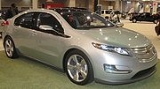
Chevrolet Volt

Encyclopedia
The Chevrolet Volt is a plug-in hybrid electric vehicle
manufactured by General Motors
. The Volt has been on sale in the U.S. market since mid-December 2010, and is the most fuel-efficient
compact car
sold in the United States, as rated by the United States Environmental Protection Agency
(EPA).
According to General Motors the Volt can travel 25 to 50 mi (40.2 to 80.5 km) on its lithium-ion battery alone. The EPA official all-electric range
is 35 miles (56.3 km), and the total range is 379 miles (609.9 km). The EPA rated 2011 model year
Volt's combined city/highway fuel economy
at 93 mpgU.S. (39.5 km/L) equivalent (MPG-e)
in all-electric mode, and at 37 mpgU.S. (15.7 km/L) in gasoline-only mode, for an overall combined gasoline-electric fuel economy rating of 60 mpgU.S. (25.5 km/L) equivalent. The 2012 model year Volt received a revised EPA rating, increasing the combined city/highway fuel economy in all-electric mode to 94 MPG-e. The Volt operates as a pure battery electric vehicle
until its plug-in battery capacity is depleted; at which point its gasoline engine powers an electric generator to extend the vehicle's range. The Volt's regenerative braking also contributes to the on-board electricity generation. In order to improve performance, the internal combustion engine
may at times be engaged mechanically to assist both electric motors to propel the Volt.
The suggested retail price
for the 2011 Chevrolet Volt in the U.S. starts at before the U.S. federal tax credit and additional incentives are available in some locations. The 2012 Volt base price will be less than the 2011 model, as features have been removed from the base configuration. The 2011 Volt is being sold only in selected U.S. markets and nationwide availability of the 2012 model year is expected by November 2011. Deliveries of the 2012 Volt began in Canada in September 2011, and the suggested retail price starts at before any available rebates. The initial Canadian launch is also limited to selected markets and availability in the rest of Canada is expected before the end of 2012. In China the Volt's price starts at (around ) and initial sales will be limited to eight cities. In the Eurozone
the Volt platform will be sold as the Opel
/Vauxhall
Ampera, and is expected to be sold for about including VAT
before any government incentives. In the United Kingdom the Vauxhall Ampera is expected to be priced at . Exports to Europe and China are scheduled for late 2011.
Among other awards and recognition, the Chevrolet Volt won the 2009 Green Car Vision Award
, 2011 Motor Trend Car of the Year
, 2011 Green Car of the Year
, 2011 North American Car of the Year
, and 2011 World Green Car
. Despite the awards earned and the positive reception from many automotive
critics, there has been some controversy and concerns in the media. These include the extent of the federal government participation in the Volt development during General Motors' 2009 government-led bankruptcy; concerns about the Volt's relatively high sales price; and complaints about price markups due to the Volt's initial limited supply.
equipped with a "range extending" gasoline powered internal combustion engine (ICE)
as a genset
and therefore dubbed the Volt an "Extended Range Electric Vehicle" or E-REV. In a January 2011 interview, the Chevy Volt's Global Chief Engineer, Pamela Fletcher, referred to the Volt as "an electric car with extended range."
According to SAE's definition the Volt is a hybrid vehicle, due to the combination of an internal combustion engine and electric motors, and its configuration can be referred to as a plug-in hybrid. The Volt operates as a purely electric vehicle
for the first 25 to 50 mi (40.2 to 80.5 km), after which it functions primarily as a series hybrid, as the internal combustion engine acts primarily as a generator to power the electric traction motor
. When the initial pure EV battery capacity drops below a pre-established threshold from full charge and while the Volt is operating in series hybrid mode, the Volt's control system will select the most optimally efficient drive mode to improve performance and boost high-speed efficiency. At certain loads and speeds, 30 mile per hour, the internal combustion engine may at times be engaged mechanically via a clutch
to an output split planetary gearset and assist the traction motor to propel the Volt. Therefore, the Volt can operate as an all-electric vehicle, a series hybrid or a parallel hybrid depending on the battery's state of charge
(SOC) and operating conditions. The Volt has an automotive drive system
different from any existing car, but as a series hybrid or when in gasoline mode, the Volt operates similarly to conventional diesel-electric railroad locomotives, which use the combustion engine only to produce electricity to drive the electric traction motors, except for the times when the Volt needs to improve performance.
was unveiled at the January 2007 North American International Auto Show
, becoming the first-ever series plug-in hybrid concept car shown by a major manufacturer. The Volt concept vehicle had four doors with a rear liftgate
and seating for four passengers. This was a significant change in design when compared to the General Motors EV1
of the 1990s, which only seated two to reduce weight and to make the necessary room for the lead-acid battery
pack. The top speed was also increased on the Volt, from the electronically limited 80 miles per hour (128.7 km/h) to 100 miles per hour (160.9 km/h). The battery pack size was reduced, from about 300 l (10.6 cu ft) in volume in the EV1, to just 100 l (3.5 cu ft) in the Volt.
Then General Motors' Vice Chairman Robert Lutz has told publicly that the two-seat sports car being developed by Tesla Motors
, the Roadster
, and the rapid advancement of lithium-ion battery technology inspired him to push the carmaker to develop the Volt after the 2006 Detroit Auto Show. Lutz's initial idea was to develop an all-electric car, but Jon Lauckner, General Motors Vice President for Global Vehicle Development, convinced him that to avoid an expensive battery, range anxiety
concerns, and lack of public charging infrastructure
, they could use a smaller battery pack with a small gasoline engine driving a generator acting as a backup to extend the range, but without a mechanical connection between the gasoline engine and the drive wheels, so it would be a pure electrically driven vehicle without many of the limitations General Motors learned from the EV1 experience.
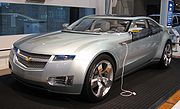 Most of the Volt initial design parameters defined for the development of the concept car, then referred as the "iCar" in homage to the iPod
, were kept throughout the process up to the final production version. A key design parameter was a target of 40 miles (64.4 km) for the all-electric range
, selected to keep the battery size small and lower costs, and mainly because research showed that in the U.S. 78 percent of daily commuters
travel 40 miles or less. This target range would allow most travel to be accomplished electrically driven and the assumption was made that charging will take place at home overnight. This requirement translated using a lithium-ion battery pack with an energy storage capacity of 16 kWh considering that the battery would be used until the state of charge
(SOC) of the battery reached 30%. This limit to the SOC was necessary in order to maintain operational performance under a wide range of environments, and to minimize the battery degradation to allow at least a ten year life span. The initial target range for the gasoline engine/generator was set between 250 to 300 mi (402.3 to 482.8 ) and the vehicle had to be family size for four or five passengers.
Another key design decision was to develop the concept car based on a new family of common powertrain
components for electric propulsion, which initially was called the E-Flex Systems, “E” stands for electric drive and “Flex” for the different sources of electricity, but later was renamed Voltec drive system. The E-Flex or Voltec platform is an attempt to standardize many components of possible future electrically propelled vehicles, and to allow multiple interchangeable electricity-generating systems. The E-Flex platform has the potential to adapt the vehicles to pure battery electric
, to fuel cell-powered
or to several other sources of energy to create electricity on board, such as engine-generator
sets (genset) fueled by gasoline
, diesel, biodiesel
, ethanol fuel
(E100), or flex-fuel (E85
). Regenerative braking would also contribute to the on-board electricity generation. On October 2006 the E-flex platform was selected for the new propulsion architecture and the name Volt was chosen by General Motors.
The Volt concept car became the first application of the E-Flex (Voltec) drive system with a combination of an electric motor
, the same used in the Chevrolet Equinox Fuel Cell, a 16 kW·h (57.6 MJ) lithium-ion battery pack with 136 kW
of peak power, and a genset consisting of a small 1.0 L, 3-cylinder turbocharged
flex-fuel capable engine linked to a 53 kW generator. General Motors called this genset an electric vehicle (EV) range extender. The vehicle was propelled by an electric motor with a peak output of 120 kW delivering 236 lb-ft (320 N-m) of motoring torque
. The concept car featured several advanced materials from GE Automotive Plastics which allowed to reduce the vehicle weight up to 50 percent.
The Volt concept featured a 12 US gal (45.4 l) fuel capacity providing the vehicle a total driving range of around 640 mi (1,030 km), which considered a gasoline fuel efficiency of about 50 mpgU.S. (21.3 km/L) and a 40 mi (64.4 km) all-electric range
. According to General Motors estimates, a daily drive of 60 mi (96.6 km), combined with an overnight recharge to support the first 40 all-electric miles, would yield an effective gasoline fuel economy of 150 mpgU.S. (63.8 km/L). General Motors also emphasized that the Volt would further reduce dependence on imported oil if E85 ethanol was used instead of gasoline to power the on-board generator engine. Robert Lutz added that if the driver used E85, "the fuel economy figure became 525 miles per (equivalent) petroleum gallon", as only 15% of gasoline is used in this blend. General Motors also noted that actual production of the Volt depended on further battery development, because the required rechargeable batteries needed to make the Volt a viable vehicle did not exist in the market and had yet to be developed. The concept car was actually powered by two 12-volt conventional car batteries, just enough power to allow the vehicle to move at low speeds in the stand.
headquarters in Detroit. The production model differed greatly in design from the original concept car. The carmaker cited necessary aerodynamic changes needed to extend the Volt's initial full-charge range by reducing the concept cars's drag coefficient
(Cd). Another reason was to use of General Motors' new Delta II platform to keep costs reasonable. The global compact vehicle architecture chosen is shared by the planned 2010 Chevrolet Cruze
and the 2012 Saab 9-3
. Another significant difference with the concept car is the seating, as the production Volt seats four rather than five passengers. This change was due the higher-than-usual central tunnel that runs from the front console to the rear seat. This tunnel houses the car's T-shaped battery pack.
General Motors found that due to its angular shape, the Volt's concept car had a high drag coefficient of 0.43, "roughly the same aerodynamic efficiency as a Chevrolet Silverado pickup", which would put a burden on the electric range, and as a result General Motors' designers and engineers spent more than 1,000 hours in the wind tunnel reworking the exterior shape of the Volt. According to General Motors engineers, the Volt's drag coefficient is the carmaker's second best only to the GM EV1 (Cd=0.19 ). General Motors initially claimed that the production model's drag coefficient
would be lower than the Toyota Prius
(Cd=0.25), but the production vehicle has a drag coefficient of 0.29.
After the concept was put into the pipeline for production, General Motors began looking for a partner to develop the Volt's lithium-ion battery pack. The carmaker evaluated about twenty-five different battery cell chemistries and constructions from around two dozen lithium-ion battery makers around the world. Due to their more promising cell technologies, two companies were selected in June 2007, Compact Power (CPI), which uses a lithium manganese oxide (LiMn2O4) cell made by its parent company, LG Chemical; and Continental Automotive Systems
, which uses lithium iron phosphate
based cylindrical cells
made by A123Systems
. By the end of October 2007 CPI (LG Chem) delivered their finished battery pack prototype
s, and A123 delivered theirs by January 2008. General Motors testing process was conducted at the laboratory the carmaker had created for the GM EV1 program, and would lead to chose one of the suppliers. The battery packs included monitoring systems designed to keep the batteries cool and operating at optimum capacity despite a wide range of ambient temperatures. In order to make sure the battery pack would last ten years and 150000 miles (241,401 km) expected for the battery warranty, the Volt team decided to use only half of the 16 kW·h capacity to reduce the rate of capacity degradation, limiting the state of charge
(SOC) up to 80% of capacity and never depleting the battery below 30%. General Motors also was expecting the battery could withstand 5,000 full discharges without losing more than 10% of its charge capacity.
In April 2008 General Motors started extensive battery testing. In two years the carmaker put the battery packs to the equivalent of 150,000 real-world miles (240,000 km) and ten years of use. The durability of the battery pack was tested for a broad range of extreme ambient conditions including a shaker table
to simulate potholes and a thermal chamber, to simulate temperatures varying from 116 °F (46.7 °C), typical of the Southwest
deserts, to -40 F typical of the Alaska
tundra
. In April 2008 the lithium-ion battery pack was placed in Chevrolet Malibu
s fitted with the Volt powertrain
to be used as test mules for further real-world testing. In October 2008 General Motors chose CPI (LG Chemical) to provide the battery systems for the first production version of the Volt. In July 2008 General Motors confirmed that a non-turbocharged, 1.4 liter 4-cylinder engine would be used as the range extender, and that the intention was to build it in Flint, Michigan
.
In April 2009, General Motors allowed journalists to test the Volt powertrain
in the body of Chevrolet Cruze
sedans used as test mules which lacked the range-extending generator. The driving tests were conducted at GM Technical Center in Warren, Michigan
. Several of the journalists noted that the Volt mule's drive in electric mode is quiet and smooth, without any of the typical noises in commercially available hybrids when accelerating or decelerating. In November 2009, a journalist described the 'feel' of driving the car as it transitioned from electric to generator mode as "the engine’s initial engagement is inaudible and seamless"
The first pre-production test car
based on the final Volt design was built in June 2009, in Warren, Michigan
, and by October 2009, 80 Volts had been built and were tested under various conditions. On March 31, 2010, the first factory-built Volt was produced at the Detroit Hamtramck Assembly Plant
in order to test the production line
and for quality control purposes, both of the tooling and the pre-production vehicles produced before regular production began.
Official introduction
General Motors held a ceremony at its Detroit/Hamtramck Assembly
plant on November 30, 2010, to introduce the first Chevrolet Volt off the assembly line. The first Volt built for retail sale was earmarked for display at General Motors' Heritage Center museum in Sterling Heights, Michigan
. The second unit was offered at a public auction, with an opening bid of and it was won by Rick Hendrick
who paid . The proceeds went to fund math and sciences education in Detroit through the Detroit Public Schools Foundation. Sales and deliveries began in mid December 2010 and the first retail vehicle was delivered to a customer in Denville, New Jersey
on December 15, 2010.
by plugging the car into a 120-240 VAC residential electrical outlet using the provided SAE J1772
-compliant charging cord. No external charging station is required. The Volt is propelled by an electric motor
with a peak output of 111 kW delivering 273 lb-ft (368 N-m) of torque. After the Volt battery has dropped to a predetermined threshold from full charge, a small naturally aspirated 1.4-liter 4-cylinder
internal combustion engine
(Opel's Family 0
) with approximately 80 horsepower
, burns premium gasoline to power a 55 kW generator
to extend the Volt's range. Additionally, under certain conditions, when performance needs to be improved the gasoline engine can also engage the powertrain mechanically to assist propulsion directly, resulting in a slight efficiency boost. The vehicle also has a regenerative braking system. The electrical power from the generator is sent primarily to the electric motor, with the excess going to the batteries, depending on the state of charge
(SOC) of the battery pack and the power demanded at the wheels.
The Volt requires premium gasoline because the higher octane rating
fuel allows the 10.5:1 compression ratio
engine to maximize its fuel efficiency by 5 to 10% as compared to regular gasoline. For users who drive mostly in electric mode and to avoid maintenance problems caused by storing the same gasoline in the tank for months, the 2011 Volt has a sealed and pressurized fuel tank to avoid evaporation, and as a result, the fuel filler has to be depressurized before opening the tank. Also the engine management system monitors the time between engine running and it is programmed to prompt the driver to run past the 40 miles (64.4 km) all-electric range
before recharging in order to consume some gasoline. If the driver does not run on gasoline, the system will automatically run the maintenance mode which starts the engine to consume some of the aging fuel and circulate the fluids within the engine. A configuration with an E85
flex-fuel capable engine is under development and is expected to be available in 2013.
The Voltec drivetrain platform permits the Volt to operate as a pure battery electric vehicle
until its plug-in battery capacity has been depleted at a predetermined level, at which time it commences to operate as a series hybrid design since mechanical power drives the generator, which in turn either charges the battery pack or provides power to the electric motors. While in this series mode at higher speeds and loads, (typically above 30 miles per hour (13.4 m/s) and/or under hard acceleration
) the gasoline engine can engage mechanically to the output from the transmission and assist both electric motors to drive the wheels, hence the Volt can also operate as a power-split or series-parallel hybrid when additional power is required. After its all-electric range has been depleted, at speeds in between 30 to 70 mph (13.4 to 31.3 ), the Volt is programmed to select the most efficient drive mode of the two, a design feature that allows the Volt to improve performance and boost high-speed efficiency by 10 to 15 percent.
The 2011 Volt has three drive modes, normal, sport and mountain. The mountain mode, which is expected to be required only under unusual power demand conditions, increases minimum battery state of charge
(SOC) to around 45%, helping the Volt to maintain performance on steep and long grades. The driver will hear more engine noise when operation in mountain mode due to the higher rate of power generation required to maintain this mode. The sport mode causes the engine to rev higher and the response to the "throttle" pedal is quicker.
The battery pack stores 16 kW·h of energy but it is controlled or buffered via the energy management system to use only 10.4 kW·h of this capacity to maximize the life of the pack. For this reason the battery pack never fully charges or depletes, as the software only allows the battery to operate within a state of charge
(SOC) window of 65%, after which the engine kicks in and maintains the charge near the lower level. The minimum SOC varies depending on operating conditions. When more power is required, such as mountain mode, the lower limit of the SOC will raise to 45% to ensure there is enough power available.
Despite containing near identical energy (+/- 0.5kWh), the Volt's battery pack is over 70% lighter than the EV1's original 1310 lb (594.2 kg), 16.5 kW·h AC Delco lead-acid battery
pack, mainly because the Volt uses higher specific energy
Li-ion batteries. Li-Ion batteries are expected to become less expensive as economies of scale take effect.
Because batteries are sensitive to temperature changes, the Volt has a thermal management system to monitor and maintain the battery pack temperature for optimum performance and durability. The Volt's battery pack provides reliable operation, when plugged in, at temperatures as low as -13 F and as high as 122 °F (50 °C). Because the Volt features a battery pack that can be warmed or cooled, in cold weather the battery is preheated during charging to provide full power capability; in hot weather the battery can be cooled during charging. The Volt’s thermal management system can also be powered during driving either by the battery or engine.
The Volt's battery is guaranteed by General Motors for eight years or 100000 miles (160,934 km), and will cover all 161 battery components. As all rechargeable batteries degrade over time, General Motors estimates the Volt battery will degrade by 10 to 30% after 8 to 10 years. The Volt’s battery management system runs more than 500 diagnostics at 10 times per second, allowing to keep track of the Volt’s battery pack in real-time, 85% of which ensure the battery pack is operating safely and 15% monitor battery performance and life.
The Volt uses a new plug specification, SAE J1772-2009
, that is being proposed as a standard for electric cars.
A full charge takes approximately ten to twelve hours from a standard North American 120V
, 15 A
household outlet and about three hours from a standard 240 VAC outlet. The Volt comes with a 20 ft (6.1 m) 120V charging cord. If plugged in, recharging can be controlled remotely through a smartphone application.
road tests, the Volt's 0 to 60 mph
acceleration time is 9.2 seconds running on electric-only mode, and 9.0 seconds with the gasoline engine assisting propulsion. Motor Trend
reports the Volt's quarter mile (402 m) time is 16.9 sec @ 84.3 mph (37.7 m/s), while Edmunds reports a quarter mile (402 m) time of 16.8 sec @ 81.5 mph (36.4 m/s) in electric-only operation, and 16.6 sec @ 85.5 mph (38.2 m/s) with the gasoline engine assisting. Motor Trend reports a 60 mile per hour braking distance of 112 ft (34.1 m) and Edmunds.com of 124 ft (37.8 m).
According to General Motors the Volt's all-electric range
with fully charged batteries varies from 25 to 50 mi (40.2 to 80.5 ) depending on terrain, driving technique, temperature. The Environmental Protection Agency
(EPA) official all-electric range is 35 miles (56.3 km) with an energy consumption of 36 kWh per 100 miles (810 kJ/km). This range is based on the agency's five-cycle tests using varying driving conditions and climate controls. The total range with a full tank of gasoline and a fully charged battery is 379 miles (609.9 km) according to EPA tests.
The Volt's fuel tank capacity is 9.3 gallons (35.2 l) and once the car runs out of fuel, the gasoline-powered generator shuts down, and the Volt taps into the battery for extra power. The reserve battery power is designed to provide an extra 3 mile of range once the gasoline tank is depleted. When the reserve battery power is low, the Volt safely slows to a stop.
Europe
The Opel Ampera official all-electric range under the EU-approved UN ECE R101 standard for plug-in hybrids is 83 km (51.6 mi). Opel prefers to state that the Ampera's EV ranges is 40 to 80 km (24.9 to 49.7 ).
The U.S. Environmental Protection Agency
(EPA) officially rated the 2011 model year Volt's combined city/highway fuel economy
in all-electric mode at 93 miles per gallon gasoline equivalent
(MPG-e) (2.5 L gasoline equivalent/100 km; 112 mpg-imp gasoline equivalent). This rating considers a conversion factor of 33.7 kW-hr of electricity being the energy equivalent of a gallon of gasoline. The EPA rating in gasoline-only mode is 37 mpgU.S. (15.7 km/L). The overall combined city/highway gasoline-electricity fuel economy rating is 60 mpgU.S. (25.5 km/L) equivalent
(MPG-e), making the Volt the most fuel-efficient compact car
sold in the United States since its introduction in December 2010. For the 2012 model year, EPA revised the Volt's fuel economy ratings, increasing the combined city/highway rating in all-electric mode from 93 MPG-e to 94 MPG-e, and the highway rating was increased from 90 MPG-e to 93 MPG-e.
The EPA also included in the Volt's fuel economy label a table showing fuel economy and electricity consumed for five different scenarios: 30, 45, 60 and 75 miles (120.7 km) driven between a full charge, and a never charge scenario. This information was included in order to make the consumers aware of the variability of the fuel economy outcome depending on miles driven between charges. Under the gasoline-only scenario (never charge), the 37 mpgU.S. (15.7 km/L) figure results from 35 mpgU.S. (14.9 km/L) city driving and 40 mpgU.S. (17 km/L) on the highway.
In April 2011 General Motors reported, based on data collected through its OnStar
telematics
system since Volt deliveries began in December 2010, that Volt owners drive in average 800 miles (1,287.5 km) before they need to fill up the gasoline tank. The analysis also found that the average period between fill-ups is 30 days. In November 2011 General Motors reported that with more than 10 million cumulative miles driven by Volt owners, their data shows that around two-thirds of miles driven were in electric mode.
Europe
The Opel Ampera official equivalent fuel consumption under the EU-approved UN ECE R101 standard for plug-in hybrids is 1.2 L/100 km (83 km/l). However, a leading Opel engineer prefers saying 169 Wh/km while battery-powered, and then 20km/l petrol-powered. The ECE R101 standard weights charge-depleting
mode as 76% and gasoline-only driving as 24%.
EPA rating for the Volt's tailpipe emissions
is 84 grams of carbon dioxide
per mile, (52.5 CO2 g/km), which puts the Volt ahead of the Toyota Prius
in terms of low greenhouse emissions as measured at the tailpipe. CO2 emissions are produced by the internal combustion engine in extended-range mode, and only after the Volt's primary battery charge has been depleted. In the other air pollutants
category, the Volt rates six out of ten, with ten being best.
The California Air Resources Board
(CARB) classified the Volt as Ultra Low Emission Vehicle
(ULEV), as CARB tests do not account for the Volt electric range
. With all tests conducted under conditions where the engine is running the CARB rated the Volt's carbon monoxide
(CO) emissions at 1.3 g/mile (0.81 g/km), missing the limit for SULEV classification by 0.3 g/mile (0.19 g/km).
Europe
The Ampera's official EU-approved UN ECE R101 carbon dioxide emission rating is 27g/km.
with traction control
; StabiliTrak electronic stability control
system with brake assist; tire-pressure monitoring system; and 8 total airbag
s: dual-stage frontal, side-impact and knee for driver and front passenger, and roof-rail side-impact for front and rear outboard seating positions, with a passenger sensing system. There is also available an optional emergency assistance system.
The 2011 Chevrolet Volt was named "Top Safety Pick" by the Insurance Institute for Highway Safety
. The Volt received the top ratings of "Good" for front, side, and rear impact crash test
s, and also on rollover
protection. All injury measurements except one were rated good, indicating a low risk of significant injuries in crashes according to the scale of severity employed in the IIHS’s testing. The Volt's lower rating of "Acceptable" was for torso injuries.
The Volt received a five-star overall crash safety rating from the National Highway Traffic Safety Administration
(NHTSA), the highest-possible score. This rating was obtained with NHTSA's New Car Assessment Program which is used for 2011 model year
vehicles.
Accident and rescue handling
In August 2010, General Motors began a training program for first responders when performing rescue duties involving the Chevrolet Volt. The program began at the 2010 Fire-Rescue International in Chicago, using a pre-production Volt for a live extrication exercise. Chicago firefighters demonstrated the sequence of tasks required to safely disable the vehicle’s powertrain and its 12 volt electrical system, which controls its high-voltage components, and then proceed to extricate injured occupants. As of January 2011, additional training workshops had taken place in Detroit, Los Angeles, San Francisco, Austin, Texas
, Washington, D.C. and New York City, corresponding to the Volt's initial launch markets. An Emergency Response Guide for the 2011 Volt was made available at its Service Technical College for use by emergency responders. The guide also describes methods of disabling the high voltage system and identifies cut zone information.
GM recommends that a Volt battery fire be fought with water rather that dry chemicals, and rates the Volt battery as having no explosion or electrocution hazard as the result of a collision. The high-voltage system is designed to shut down automatically in the event of an airbag deployment, and to detect a loss of communication from an airbag control module. During the Volt development the lithium-ion battery pack was subjected to a wide range of tests, including overcharge, discharge, vibration, excess heat and cold, short circuit, humidity, fire, crush, water immersion, salt water immersion, and nail penetration.
Warning sounds
Due to significant noise reduction typical of hybrids and plug-ins vehicles
traveling in all-electric mode at low speeds, General Motors equipped the Volt with an electronic warning sound system
for optional use when the car is operating at low speeds to alert the blind and other pedestrians to the car's presence. General Motors system is called Pedestrian-Friendly Alert System and is manually activated by the driver. Based on the U.S. Pedestrian Safety Enhancement Act of 2010, signed into law in January 2011, the U.S. Department of Transportation is performing studies to establish a U.S. vehicle safety standard that would set requirements for the alert sound, and the ruling is expected to be finalized before mid 2012.
Fire incidents
In June 2011 a Volt that had been subjected by the National Highway Traffic Safety Administration (NHTSA) to a 20 mph (8.9 m/s) side pole impact crash test followed by a post-impact rollover, caught fire three weeks later in the test center parking lot, burning nearby vehicles. The battery was found to be the source of the fire. After the fire, both Chevrolet and the NHTSA independently replicated the crash test and a subsequent vehicle rotation procedure to test for any fluid leakage, but in their first attempt they could not reproduce the conditions under which the battery pack ignited. The NHTSA said it had "concluded that the crash test damaged the Volt’s lithium-ion battery and that the damage led to a vehicle fire that took several weeks to develop." In further testing of the Volt's batteries carried out by NHTSA in November 2011, two of the three tests resulted in thermal events. One battery pack was rotated 180 degrees within hours after it was impacted and began to smoke and emit sparks after rotation. In the other case, the battery pack that was crashed-tested one week earlier and that had been monitored since the test caught fire. Therefore the NHTSA opened a formal safety defect investigation on November 25, 2011, to examine the potential risks involved from intrusion damage to the battery pack in the Chevrolet Volt. As a result of this investigation, GM announced that it would offer any Volt owner who has concerns another GM car while the federal investigation is taking place. In December 2011, the company said they were prepared to recall all the vehicles and repair them upon determination of the cause of the fires, and also announced they would buy back the car if the owner was too afraid of the potential for a fire.. In December 2011 Dan Akerson said that it may be necessary to redesign the battery as a result of the fires
The NHTSA also said it was working with all automakers to develop postcrash procedures to keep occupants of electric vehicles and emergency personnel who respond to crash scenes safe. Additionally, NHTSA advised to be aware that fires may occur a considerable amount of time after a crash. General Motors said the first fire would have been avoided if GM's protocols for deactivating the battery after the crash had been followed. These protocols had been used by GM since July 2011 but were not shared with the NHTSA until November 2011.. In another statement the carmaker stated that they “are working with other vehicle manufacturers, first responders, tow truck operators, and salvage associations with the goal of implementing industrywide protocols.”
During 2011 two other Volts were involved in garage fires, one in Barkhamsted, Connecticut
, in April 2011, and another in Mooresville, North Carolina
, in November 2011. In the Barkhamsted case, the fire marshal's report concluded the Volt that was parked in the garage had nothing to do with the cause of the fire. In the Mooresville case, a Volt was charging in the garage at the time of the fire but the fire marshal preliminary determination was that “the source of the ignition seems to be from outside the area of the vehicles.”
The Volt features OnStar Mobile
application for owners to access vehicle information without being in or near the car. This smartphone
application features the ability to check fuel efficiency as well as the vehicle's current electric range. It also helps monitor the charging, giving owners key information about the current charge level and the amount of time it will take until it is fully charged. The application also is able to control features such as locking/unlocking doors, and acts as a remote starter
. A five year OnStar service is bundled into the Volt's base price.
2011 model year
The 2011 Chevrolet Volt comes standard with cruise control
; remote vehicle start-up system; 17-inch 5-spoke forged painted aluminum wheels; Bluetooth
wireless
technology for select phones; audio and navigation system
with a center console capacitive touch panel and DVD and MP3 playback, with voice recognition; OnStar
with five years of service; BOSE
premium speaker system, with six speakers and sub-woofer; 30 GB
hard drive for audio data storage; USB ports; three auxiliary, 12-volt, power outlets; power door locks
and windows; power adjustable mirrors; premium cloth seating; programmable time of day charge control; and a 110-volt charge cord.
Available options include three different colors of premium paint; 17-inch 5-spoke forged polished-aluminum wheels; door trim premium with layered graphics; rearview camera system, rear camera and parking assist package
, and ultrasonic parking assist, front and rear; leather-wrapped steering wheel; and heated leather front seats with selectable automatic activation.
2012 model year
General Motors announced that the 2012 Volt standard features will include a passive remote keyless access
with passive locking allowing the car to automatically lock and unlock with the key fob in close proximity of vehicle; OnStar turn-by-turn navigation for three years, and available in-dash navigation system; and Chevrolet MyLink including Bluetooth streaming audio for music and select phones. The 2012 Volt will be available in two additional interior accents: white and spiced red; and two new exterior colors: summit white and blue topaz metallic.
The 2012 Volt will have a total of seven option packages while the 2011 model had only three. Among other options the 2012 model includes leather seats, a backup camera, navigation system, and premium paint. Also 17-inch sport alloy wheel
s with black inserts will be available later.
plant following the conclusion of the 2007 UAW-GM
contract talks
. For initial production the gasoline engine is being imported from the Opel
engine plant in Aspern
, Austria
. In November 2010, General Motors began investing million at its engine operations plant in Flint, Michigan
to support increased production of the Ecotec
1.4-liter engine that is used in the Chevrolet Cruze
, the upcoming 2012 Chevrolet Sonic, and the variant used in the Chevrolet Volt. The Flint plant was expected to start production of 400 engines a day in early 2011, ramp up daily production to 800 engines in late 2011, and to increase its capacity to 1,200 a day by late 2012. In May 2011, General Motors decided to invest an additional at the Flint plant to further increase 1.4-liter engine production capacity.
In 2010, General Motors planned an initial production for calendar year 2011 of 10,000 Volts and 45,000 units for 2012, up from the 30,000 units initially announced. In May 2011, the carmaker again raised its production targets. By mid June production was halted for about one month at the Detroit/Hamtramck Assembly plant to complete some upgrades, including the installation of new tooling, equipment and overhead conveyor systems throughout the facility. These upgrades allowed to triple the rate of Volt production and prepared the plant for 2012 Volt and Ampera production. As a result, Volt and Ampera production capacity will increase to 16,000 units in 2011, including 3,500 units for exports and 2,500 demonstration units destined to U.S. dealerships, and the rest for U.S. sales. In November 2011 GM's sales chief announced that they would not sell 10000 vehciles in 2011.In 2012, global production capacity is expected to be 60,000 vehicles with an estimated 45,000 units to be delivered in the United States. Out of the 2012 production, General Motors will produce 10,000 Amperas available for sale in Europe, 6,000 destined for Opel and 4,000 for Vauxhall in the UK. In addition, 2,000 Volts will be made available for the region.
The Volt's battery cells are produced by LG Chem
in South Korea
and subsequently shipped to the US, where the battery packs are assembled at a purpose-built facility in Brownstown Township, Michigan
owned and operated by General Motors. Compact Power, the North American subsidiary of LG Chem, is building a battery plant in Holland, Michigan
to manufacture the advanced battery cells for the Volt and other carmakers, with capacity to produce enough cells for 50,000 to 200,000 battery packs per year. The million Holland plant was funded by 50% U.S. Department of Energy matching stimulus funds
and is planned to open by mid 2012.
The 2011 Chevrolet Volt was officially launched on November 30, 2010 at a ceremony at the Hamtramck plant, where the first production unit for retail sale came off the assembly line. The first retail vehicle was delivered to a customer in Denville, New Jersey
on December 15, 2010.
, California
, and Austin, Texas
. As of May 2011, the Volt had been launched also in Connecticut
, Maryland
, Michigan
, New Jersey
, and Virginia
. Deliveries in Delaware
, Florida
, Georgia
, Hawaii
, North Carolina
, Oregon
, Pennsylvania
, South Carolina
, and Washington are expected for the third quarter of 2011. In June 2011, Chevrolet
dealers nationwide began taking orders for the 2012 Volt, and deliveries in all 50 states are expected by November 2011.
The suggested retail price
(MSRP) for the 2011 Chevrolet Volt in the U.S. starts at which excludes destination freight charge, tax, title, license, dealer fees and optional equipment and before any savings due to factory incentives, tax deductions, or other available subsidies for qualifying buyers. The MSRP for the 2012 Volt will start at including a destination freight charge and excludes tax, title and license fees, or other available government subsidies. The base price is less than the 2011 model year
, and General Motors explained that this price reduction is possible because of a "wider range of options and configurations that come with the expansion of Volt production for sale nationally."
Due to the capacity of the Volt's battery pack it qualifies for the maximum federal tax credit as specified in the Emergency Economic Stabilization Act of 2008
. The federal tax credit phases out over a one year period after the manufacturer has sold at least 200,000 vehicles in the U.S. Several states also have additional incentives or rebates available for plug-in electric vehicle
s for qualifying buyers. The 2011 Volt price including all available regular production and premium options is , including destination charges and before tax credits or any subsidies. For the 2012 model year the price of the Volt with all available options is before tax credits or any subsidies available.
The 2011 Chevrolet Volt is also available through leasing
with a monthly payment of for 36 months, with due at lease signing, and with an option to buy at the end of the lease. Although the Volt's retail price is higher than its main competitor, the 2011 Nissan Leaf
, the lease rate for the Volt is almost the same as its competitor, except that the Leaf has a lower initial payment. General Motors explained that "the apparent disparity between the Volt's sticker and lease prices is a reflection of the company's calculation that the vehicle will maintain a very high residual value after three years—significantly higher than that of the LEAF."
The price for the home charging units
is plus installation costs. The Voltec home-charging unit is a 240-volt (Level II) charger, and, according to General Motors, can replenish the Volt's batteries in about four hours. Consumer Reports
has advised buyers to budget up to , as many older homes may need a substantial electrical upgrade because the U.S National Electrical Code requires that the charger have its own dedicated 220-volt, 30-amp circuit. Early buyers can benefit from the federal tax credit available for charging equipment.
The 2011 Volt was not submitted for application to the California Air Resources Board
's (CARB) Clean Vehicle Rebate Project rebate and therefore was not required to meet the 10-year 150000 miles (241,401 km) battery warranty requirement for enhanced advanced technology partial zero-emissions vehicle
s (enhAT-PZEV). The Volt team explained that for the launch General Motors decided to go with a common national package which includes an 8-year 100000 miles (160,934 km) battery warranty. For this reason owners of the 2011 Volt did not qualified for California's rebate's and free access to use carpool lanes even when traveling solo. A third package, scheduled for 2013, is under development with an E85
flex-fuel engine. General Motors engineering team commented that "introducing two or three packages of an entirely new technology set and platform at the same time wasn't an option."
In November 2011 General Motors announced that beginning in early 2012, all models sold in California will feature a new low emissions package that will allow the 2012 Chevrolet Volt to qualify as an enhanced, advanced technology –partial zero emissions vehicle (enhAT-PZEV) and have access to California’s high-occupancy vehicle lane
s (HOV). The new standard California version of the Volt features a modified engine and exhaust components. The catalytic converter
was modified to add a secondary air-injection pump that "streams ambient air into the exhaust stream to increase its ability to remove pollutants." Owners of a 2012 Volt with the low emissions package will be eligible to apply for one of 40,000 available HOV lane stickers issued to vehicles that qualify as a California AT-PZEV. The permits are handed out on a first-apply, first-served basis. Additionally, the new low emissions package makes the 2012 Volt eligible for owners to receive up to in state rebates through the state’s Clean Vehicle Rebate Project (CVRP). This incentive is in addition to the federal government’s tax credit.
Monthly U.S. sales
Since deliveries began in December 2010, General Motors has sold 5,329 Volts through October 2011. As of October 2011 GM has also produced and delivered an additional 2,300 Volts dedicated as demonstration vehicles for customer test drives at Chevrolet dealerships. Due to a one-month halt in production that took place between June and July 2011 to upgrade the Detroit/Hamtramck Assembly plant, supplied was limited during this period. After the plant retooling, the production rate reached 150 units per day four days a week by August 2011. By early November 2011, General Motors authorized its Chevrolet dealears to sell their Volt demos which together with 1,800 units in transit to dealers make up an inventory of 4,100 vehicles available for sales.
The following table present monthy sales since the Volt's deliveries began in December 2010. Demonstration vehicles allocated to dealerships are not included in retail sales reports while they are used for test drives.
Resale value
In May 2011 Kelley Blue Book
(KBB) projected the 2011 Chevrolet Volt resale value at just over after 36 months, the length of a typical lease, which represents 42% of the car's suggested retail price
(MSRP). KBB explains that even though the residual value seems low, the projection considers that the first 200,000 Volts sold will qualify for a federal tax credit, which effectively reduces the MSRP to , making the represent 51% of its original value after the tax credit. In comparison, KBB notes, the 2011 Toyota Prius has a projected residual of 46% after 36 months. KBB's estimate assumed gasoline price will be around per gallon in 2014.
Consumer Reports
commented that their own analysis show that many Chevrolets lose about half of their purchase price after three years of ownership, and if the Volt depreciates the same, seems a reasonable estimate. However, Consumer Reports have noted that fuel-efficient hybrids and diesel models often depreciate far less than most vehicles, which might increase the Volt's resale value after three years above the estimate. Additionally, if gasoline prices continue to rise or if the tax credits expire, the demand for used Chevrolet Volts could quickly increase, raising their market value. On the other hand, if the next-generation Volt’s battery has twice the capacity and cost less, as General Motors has claimed, the first generation Volts will be obsolete when the new ones come out in 2015. Considering these assumptions, Consumer Reports considers that "at this point we believe it’s still unclear how the Volt will fare."
According to Kelly Blue Book the 2012 Volt is expected to retain 42% of its original value after 3 years and 27% after 5 years. Based on this figures, in November 2011 KBB awarded the Volt with the 2012 Best Resale Value Awards in the plug-in electric car category. KBB explains that the residual value for the Volt is lower than the market 35.5% average due to the federal tax credit, which lowers the transction price and pushes down the residual value.
, Quebec City
, Toronto
, Oshawa
, Ottawa-Gatineau, Vancouver
and Victoria
. Availability in the rest of the country is expected before the end of 2012. General Motors began taking orders in May 2011.
The suggested retail price (MSRP) for the 2012 Chevrolet Volt starts at ( in June 2011) which excludes any charges, fees, and optional equipment. This price is before any available subsidies or incentives for qualifying buyers. In the Canadian market, the Volt will be offered in one standard trim level with two option packages, a Premium Trim Package and a Rear Camera and Park Assist Package. The Volt is being endorsed by the Ontario
government and the province will provide a ( in June 2011) tax credit for buyers. The province also will purchase 500 Volts for the Ontario public service
fleet. The Quebec
government will also offer rebates of up to beginning on January 1, 2012. Commencing on December 1, 2011, the Government of British Columbia has announced their new LiveSmart BC program in which the Chevrolet Volt qualifies for a incentive/rebate as well as towards charging equipment.
/Vauxhall
Ampera, the European version of the same car. Opel is developing the battery control modules for the Ampera at the Opel Alternative Propulsion Center Europe in Mainz-Kastel, Germany
. The production version of the Ampera was unveiled at the 2011 Geneva Motor Show.
The main differences between the Volt and the Ampera are in their styling. The Ampera has a distinctive front and rear fascia
, with a large cut-out in the rear bumper. The Opel Ampera features more stylized alloy wheels as standard, and the side skirts are body-colored rather than black plastic. In the inside there are only minor differences and both versions share the same exact powertrain and battery pack. A key operational difference is that the Ampera will have four drive modes, one more than the Volt. The additional option is "City Mode", which adapts battery management to the needs of commuter travel
. City mode or "battery hold" engages the range-extender immediately, allowing to save the energy currently stored in the battery, and when switched off, the range-extender stops and the Ampera is then able to use the energy saved in the battery for pure electric driving, for example for traveling urban areas or restricted zones, such as the European low emission zone
s or to allow the Ampera to qualify for an exemption of the London congestion charge
.
The Opel Ampera will benefit from several subsidies and tax breaks available for plug-in electric vehicle
s in several European countries. According to Opel, as of June 2011 around 5,000 customers across Europe have reserved an Ampera, with 3,000 reservations from corporate customers. The Ampera would be available for sale in Europe in late 2011, and will be assembled at the Detroit/Hamtramck Assembly plant, Michigan. For 2012 General Motors plans to manufacture 10,000 Amperas for sale in Europe, 6,000 destined for Opel and 4,000 for Vauxhall in the UK, plus an additional 2,000 Volts will be made available for the region. The carmaker will target the Ampera for business fleet market and local government agencies, where Opel has a strong customer base, while the Volt will be aimed at retail customers.
at ( in February 2011) including VAT
, but prices by country may vary due to the trim levels that will be offered in each market.
General Motors announced that the imported Volt's price starts at (around ) and initial sales will be limited to eight Chinese cities: Beijing
, Shanghai
, Hangzhou
, Suzhou
, Wuxi
, Guangzhou
, Shenzhen
and Foshan
.
At the Sydney Motor Show
in October 2008, Holden
stated that the Volt would be available in Australia
by 2012.
However the Holden website indicates that "There is no release date for this vehicle in Australia. Holden's performance tuning division, Holden Special Vehicles
, is also considering creating a performance version of the Volt to be sold in the Australian market. Opel
has also stated that it is considering selling the Ampera in Australia alongside the Volt when the brand is launched in 2012.
In November 2011 the first Holden Volt arrived in Australia for a series of evaluation journeys. Holden has announced that the Volt has undergone numerous modifications to better suit it to Australian roads, although the test vehicles are left-hand drive.
Brazil
General Motors do Brasil
announced that it will import from five to ten Volts to Brazil during the first semester of 2011 as part of a demonstration and also to lobby the federal government to enact financial incentives for green cars
. If successful, General Motors would adapt the Volt to operate on ethanol fuel
, as most new Brazilian cars are flex-fuel
.
Japan
In December 2010, General Motors announced plans to introduce the Volt in limited numbers into Japan in 2011 for technology and market test purposes. Exports for retail sales will depend on the results of this trial.
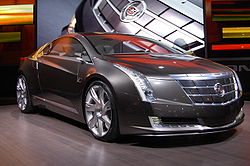 Cadillac Converj
The Cadillac Converj
is a plug-in hybrid concept car
manufactured by Cadillac
, a division of General Motors, and first unveiled at the 2009 North American International Auto Show
. The Converj incorporates the propulsion system from the Chevy Volt, including the battery pack and the Voltec powertrain with the 111 kW
electric motor, and the four-cylinder engine-generator. The Converj concept has an all-electric range
of 40 miles (64.4 km) and a top speed of 100 mph (44.7 m/s). In August 2011, General Motors announced that the Converj concept will go into production as the Cadillac ELR.
Volt MPV5
At the 2010 Auto China
show General Motors unveiled the Chevrolet Volt MPV5 Concept. The Volt MPV5 is a plug-in crossover hybrid and has a top speed of 100 mi/h and an electric range
of 32 miles (51.5 km). The MPV5 integrates design elements from the Volt, with a body style very similar to the Chevrolet Orlando
and four inches larger than its predecessor, Chevrolet HHR
.
was concerned about how the United States Environmental Protection Agency
(EPA) would test the Volt to determine its official fuel economy
rating. The controversy centered on whether, by including a gasoline engine, the Volt should be classified as a hybrid
rather than an electric car
as claimed by General Motors. If tested with the same EPA tests used by other hybrids, the Volt's EPA fuel economy rating would be around 48 mpgU.S. (20.4 km/L) due to the current EPA test for hybrids disallowing vehicles from boosting their mpg rating using stored battery power. General Motors stated that the Volt is an entirely new type of vehicle which the EPA's current fuel economy tests were not suited to rate and that a new test should be devised for this emerging class of hybrid-electrics. General Motors also advocated for a more simplified mpg calculation method to take into account the range of a plug-in hybrid while running solely on electricity. Because the Volt can travel 40 miles (64.4 km) on batteries alone, GM argued that most drivers with a daily commute of less than that distance would drive only in electric mode, so long as they recharged their vehicle at work or at home overnight.
The EPA official rating issued in November 2010 included separate fuel economy ratings for all-electric mode and gasoline-only mode, with an overall combined city/highway gasoline-electricity fuel economy rating of 60 mpgU.S. (25.5 km/L) equivalent
(MPG-e). To address the variability of the fuel economy outcome depending on miles driven between charges, EPA also included in the Volt's fuel economy label a table showing fuel economy and electricity consumed for five different scenarios driven between a full charge, and a never-charge scenario. According to this table the Volt's fuel economy goes up to 168 mpgU.S. (71.4 km/L) equivalent (MPG-e) if driven 45 miles (72.4 km) between full charges. Also, in recognition of the multiple operating modes that a plug-in hybrid can be built with (all-electric, blended, and gasoline-only), for the new fuel economy and environment label that will be mandatory in the U.S. beginning in model year
2013, EPA and the National Highway Traffic Safety Administration
(NHTSA) issued two separate fuel economy labels for plug-in hybrids. One label is for extended-range electric vehicles, like the Chevy Volt, with two modes: all-electric and gasoline-only; and a second label for blended mode that includes a combination of all-electric, gasoline and electric operation, and gasoline only, like a conventional hybrid vehicle
.
rating for the Volt of 230 mpgU.S. (97.8 km/L) of gasoline plus 25 kW·h/100 mi (560 kJ/km) of electricity using the EPA's proposed method for evaluating plug-in hybrids. The U.S. Environmental Protection Agency (EPA) issued a statement clarifying that the "EPA has not tested a Chevy Volt and therefore cannot confirm the fuel economy values claimed by GM." On July 2010, General Motors recognized that their estimate was based on a formula that never got official approval, and they were awaiting EPA's decision on how the equivalent fuel economy of plug-in hybrids will be estimated.
The official EPA rating was issued in November 2010 EPA and became the agency's first fuel economy label for a plug-in hybrids. The EPA rated the 2011 Volt combined fuel economy at 93 miles per gallon gasoline equivalent
(MPG-e) in all-electric mode, and 37 mpgU.S. (15.7 km/L) in gasoline-only mode, for an overall combined fuel economy rating of 60 mpgU.S. (25.5 km/L) equivalent (MPG-e). The label also shows the combined city-highway fuel economy in all-electric mode expressed in traditional energy consumption units, rating the Volt at 36 KWh per 100 miles (160.9 km).
said that "GM is at least one generation behind Toyota on advanced, “green” powertrain development. In an attempt to leapfrog Toyota, GM has devoted significant resources to the Chevy Volt." and that "while the Chevy Volt holds promise, it is currently projected to be much more expensive than its gasoline-fueled peers and will likely need substantial reductions in manufacturing cost
in order to become commercially viable." In an April 2009 interview with the president of General Motors' North American operations, Troy Clark stated he was uncertain if the next generation systems following the Volt would be profitable.
A 2009 Carnegie Mellon University
study found that a PHEV-40 will be less cost effective than a HEV
or a PHEV-7 in all of the scenarios considered, due to the cost and weight of the battery. Jon Lauckner, a Vice President at General Motors, responded that the study did not consider the inconvenience of a 7 miles (11.3 km) electric range
and that the study's cost estimate of per kWh for the Volt's battery pack was "many hundreds of dollars per kilowatt hour higher" than what it costs to make today."
After the Volt's sales price was announced in July 2010, a Washington Post editorial expressed its concern because as "for the near future, electric cars will be far too expensive for anyone but upper-income Americans. The only way to sell them, even to the well-off, will be with a large federal subsidy. The newspaper explained that the average new car sold for in 2008, while the plug-in Volt, by contrast, will cost , less the -per-car federal tax credit, and that includes other subsidies derived from the advanced vehicle technology grant program part of the economic stimulus plan. The Washington Post concludes that "common sense suggests the likeliest purchasers will be upscale consumers who already own gasoline-powered cars for heavy-duty driving, live in a single-family home with an electric outlet in the garage – and can afford a green experiment."
In an OpEd published in the New York Times, Edward Niedermeyer, editor of the website
The Truth About Cars
, criticized General Motors
because the Volt costs before relevant tax breaks despite billions of dollars of government loans and grants for the Volt’s development and production. "And instead of the sleek coupe of 2007, it looks suspiciously similar to a Toyota Prius. It also requires premium gasoline, seats only four people (the battery runs down the center of the car, preventing a rear bench) and has less head and leg room than the Chevrolet Cruze, which is more or less the non-electric version of the Volt." He also complained that to make the Volt more affordable, General Motors decided to offer a -a-month lease for 36 months, but limited to only 12000 miles (19,312.1 km) per year, or about 33 miles (53.1 km) per day. If an owner wants to keep below the lease mileage limit and he charges his Volt every evening, which is good for 40 miles (64.4 km) of battery power, this Volt owner would rarely use its expensive range-extending gasoline engine. "No wonder the Volt’s main competition, the Nissan Leaf, forgoes the additional combustion engine — and ends up costing $8,000 less as a result."
General Motors CEO Edward Whitacre Jr. rejected as "ridiculous" criticism that the Volt's price is too expensive. He said that "I wish we had thousands more (Volts) but we don't. I think it's a very fair price. It's the only car that will go coast to coast on electricity without plugging it in, and nobody else can come close." A G.M. spokesman also commented they are not worried about the critics of the price and commented that the leasing price is very affordable, nearly on par with Nissan's electric Leaf
.
Despite the federal government being the major GM shareholder due to the 2009 government-led bankruptcy
of the automaker, during a press briefing at the White House
an administration official clarified that the federal government did not have any input on the controversial pricing of the 2011 Chevrolet Volt. The Treasury
official said that "We do not tell General Motors what to charge for its cars... we don't tell them what to charge for the Volt. We're not going to tell them what to charge for the Chevrolet Cruze."
There have been also complaints regarding price markups due to the initial limited availability. The New York Times reported in August 2010 that several dealers were charging between to above General Motors's recommended price. At least in one case a mark up in California was reported by Edmunds.com
. Even though the carmaker cannot dictate vehicle pricing to its dealers, a G.M. spokesman said that the company had requested the dealers to keep prices in line with the company’s suggested retail price.
In May 2011 the National Legal and Policy Center
denounced that some Chevrolet dealers were selling Volts to other dealers and claiming the federal tax credit for themselves. Then the dealers who bought the Volts sell them as used cars with low mileage to private buyers, who no longer qualify for the credit. General Motors acknowledged that 10 dealer-to-dealer Volt sales had taken place among Chevrolet dealers, but the carmaker said they do not encourage such practice.
at 84 grams of carbon dioxide
per mile (52.5 CO2 g/km). These are the greenhouse emissions at the point of operation. Charging the Volt's batteries still results in some greenhouse gas
emissions from electricity generation
at the local power station
. However, under most conditions CO2 output is less than other low emission vehicle
s and in the best case emissions are nearly zero. General Motors claims that the Volt saves 4.4 metric tons in CO2 emissions annually compared to a typical U.S. car.
UK based Auto Express
magazine claims in a non-scientific study
to have calculated that the generation of electricity for charging the batteries in the Volt resulted in emissions equivalent to 124.2 g/km (199 g/mi) of CO2 for electric-only trips (those not involving the use of any on board fuel), based on government figures for the average CO2 emissions from power stations. According to Auto Express, this is more CO2 than the BMW 118d
produces. Using CO2 emissions data for the United States, the Auto Express estimate can be shown to imply Volt's plug-to-wheel efficiency of approximately 340 Wh/mile (212 Wh/km) – somewhat high for electric vehicles (Tesla Roadster
is EPA rated at 280 Wh/mile (175 Wh/km) plug-to wheel), but within the realm of possibility.
U.S. organizations
International organizations
European organizations
competition among the journalists attending the official press launch event over a 43.2 mi (69.5 km) distance. The winner achieved over 50 mi (80.5 km) of electric range while most participants managed just over 46 mi (74 km).
The Detroit News
reported an all-electric range of 32 miles (51.5 km) driving in a "very un-eco-friendly manner" and a total fuel consumption of 0.9 gal for the 75 miles (120.7 km) trip. USA Today
reported an EV range of 40 miles (64.4 km) driving more than an hour of stop-and-go through Detroit suburbs and the rolling Michigan countryside. Detroit Free Press
reported an all-electric range of 46.2 miles (74.4 km) driving normally and using the air conditioning. The following table summarizes the results reported by other specialized media, and some other more extended tests that took place later.
Plug-in hybrid electric vehicle
A plug-in hybrid electric vehicle , plug-in hybrid vehicle , or plug-in hybrid is a hybrid vehicle which utilizes rechargeable batteries, or another energy storage device, that can be restored to full charge by connecting a plug to an external electric power source...
manufactured by General Motors
General Motors
General Motors Company , commonly known as GM, formerly incorporated as General Motors Corporation, is an American multinational automotive corporation headquartered in Detroit, Michigan and the world's second-largest automaker in 2010...
. The Volt has been on sale in the U.S. market since mid-December 2010, and is the most fuel-efficient
Fuel economy in automobiles
Fuel usage in automobiles refers to the fuel efficiency relationship between distance traveled by an automobile and the amount of fuel consumed....
compact car
Compact car
A compact car , or small family car , is a classification of cars which are larger than a supermini but smaller than or equal to a mid-size car...
sold in the United States, as rated by the United States Environmental Protection Agency
United States Environmental Protection Agency
The U.S. Environmental Protection Agency is an agency of the federal government of the United States charged with protecting human health and the environment, by writing and enforcing regulations based on laws passed by Congress...
(EPA).
According to General Motors the Volt can travel 25 to 50 mi (40.2 to 80.5 km) on its lithium-ion battery alone. The EPA official all-electric range
All-electric range
All-electric range is the driving range of a vehicle using only power from its electric battery pack to traverse a given driving cycle. In the case of a battery electric vehicle, it means the total range per charge. For a plug-in hybrid , it means the range of the vehicle in charge-depleting mode...
is 35 miles (56.3 km), and the total range is 379 miles (609.9 km). The EPA rated 2011 model year
Model year
The model year of a product is a number used worldwide, but with a high level of prominence in North America, to describe approximately when a product was produced, and indicates the coinciding base specification of that product....
Volt's combined city/highway fuel economy
Fuel economy in automobiles
Fuel usage in automobiles refers to the fuel efficiency relationship between distance traveled by an automobile and the amount of fuel consumed....
at 93 mpgU.S. (39.5 km/L) equivalent (MPG-e)
Miles per gallon gasoline equivalent
Miles per gallon gasoline equivalent is a measure of the average distance traveled per unit of energy consumed. MPGe is used by the U.S...
in all-electric mode, and at 37 mpgU.S. (15.7 km/L) in gasoline-only mode, for an overall combined gasoline-electric fuel economy rating of 60 mpgU.S. (25.5 km/L) equivalent. The 2012 model year Volt received a revised EPA rating, increasing the combined city/highway fuel economy in all-electric mode to 94 MPG-e. The Volt operates as a pure battery electric vehicle
Battery electric vehicle
A battery electric vehicle, or BEV, is a type of electric vehicle that uses chemical energy stored in rechargeable battery packs. BEVs use electric motors and motor controllers instead of, or in addition to, internal combustion engines for propulsion.A battery-only electric vehicle or...
until its plug-in battery capacity is depleted; at which point its gasoline engine powers an electric generator to extend the vehicle's range. The Volt's regenerative braking also contributes to the on-board electricity generation. In order to improve performance, the internal combustion engine
Internal combustion engine
The internal combustion engine is an engine in which the combustion of a fuel occurs with an oxidizer in a combustion chamber. In an internal combustion engine, the expansion of the high-temperature and high -pressure gases produced by combustion apply direct force to some component of the engine...
may at times be engaged mechanically to assist both electric motors to propel the Volt.
The suggested retail price
Suggested retail price
The manufacturer's suggested retail price , list price or recommended retail price of a product is the price which the manufacturer recommends that the retailer sell the product. The intention was to help to standardise prices among locations...
for the 2011 Chevrolet Volt in the U.S. starts at before the U.S. federal tax credit and additional incentives are available in some locations. The 2012 Volt base price will be less than the 2011 model, as features have been removed from the base configuration. The 2011 Volt is being sold only in selected U.S. markets and nationwide availability of the 2012 model year is expected by November 2011. Deliveries of the 2012 Volt began in Canada in September 2011, and the suggested retail price starts at before any available rebates. The initial Canadian launch is also limited to selected markets and availability in the rest of Canada is expected before the end of 2012. In China the Volt's price starts at (around ) and initial sales will be limited to eight cities. In the Eurozone
Eurozone
The eurozone , officially called the euro area, is an economic and monetary union of seventeen European Union member states that have adopted the euro as their common currency and sole legal tender...
the Volt platform will be sold as the Opel
Opel
Adam Opel AG, generally shortened to Opel, is a German automobile company founded by Adam Opel in 1862. Opel has been building automobiles since 1899, and became an Aktiengesellschaft in 1929...
/Vauxhall
Vauxhall Motors
Vauxhall Motors is a British automotive company owned by General Motors and headquartered in Luton. It was founded in 1857 as a pump and marine engine manufacturer, began manufacturing cars in 1903 and was acquired by GM in 1925. It has been the second-largest selling car brand in the UK for...
Ampera, and is expected to be sold for about including VAT
Vat
Vat or VAT may refer to:* A type of container such as a barrel, storage tank, or tub, often constructed of welded sheet stainless steel, and used for holding, storing, and processing liquids such as milk, wine, and beer...
before any government incentives. In the United Kingdom the Vauxhall Ampera is expected to be priced at . Exports to Europe and China are scheduled for late 2011.
Among other awards and recognition, the Chevrolet Volt won the 2009 Green Car Vision Award
Green Car Vision Award
The Green Car Vision Award is an annual award granted by the Green Car Journal. In contrast with its Green Car of the Year award, which only considers production vehicles that make the most significant environmental advancements, the Green Car Vision Award considers pre-production vehicles with...
, 2011 Motor Trend Car of the Year
Motor Trend Car of the Year
The Motor Trend Car of the Year is an award given by Motor Trend magazine, an American monthly that is published since 1949.- Background :...
, 2011 Green Car of the Year
Green Car of the Year
The Green Car of the Year is an award from the Green Car Journal.The winner is selected by an 11-member panel comprising automotive and environmental experts...
, 2011 North American Car of the Year
North American Car of the Year
The North American Car of the Year is an automobile award voted annually in January at the North American International Auto Show in Detroit. The jury consists of no more than 50 automotive journalists.-Example:-Pre-1994:-1994-1999:-2000-2009:...
, and 2011 World Green Car
World Car of the Year
The World Car of the Year is an automobile award selected by a jury of 48 international automotive journalists from 22 countries. Cars considered must be sold in at least five countries on at least two continents prior to January 1 of the year of the award...
. Despite the awards earned and the positive reception from many automotive
Automotive industry
The automotive industry designs, develops, manufactures, markets, and sells motor vehicles, and is one of the world's most important economic sectors by revenue....
critics, there has been some controversy and concerns in the media. These include the extent of the federal government participation in the Volt development during General Motors' 2009 government-led bankruptcy; concerns about the Volt's relatively high sales price; and complaints about price markups due to the Volt's initial limited supply.
Terminology
The Society of Automotive Engineers' (SAE) definition of a hybrid vehicle states that the vehicle shall have "two or more energy storage systems both of which must provide propulsion power, either together or independently." General Motors has avoided the use of the term "hybrid" when describing its Voltec designs, even after the carmaker revealed that in some cases the combustion engine provided some assist at high speeds or to improve performance. Instead General Motors describes the Volt as an electric vehicleElectric vehicle
An electric vehicle , also referred to as an electric drive vehicle, uses one or more electric motors or traction motors for propulsion...
equipped with a "range extending" gasoline powered internal combustion engine (ICE)
Internal combustion engine
The internal combustion engine is an engine in which the combustion of a fuel occurs with an oxidizer in a combustion chamber. In an internal combustion engine, the expansion of the high-temperature and high -pressure gases produced by combustion apply direct force to some component of the engine...
as a genset
Engine-generator
An engine-generator is the combination of an electrical generator and an engine mounted together to form a single piece of equipment. This combination is also called an engine-generator set or a gen-set...
and therefore dubbed the Volt an "Extended Range Electric Vehicle" or E-REV. In a January 2011 interview, the Chevy Volt's Global Chief Engineer, Pamela Fletcher, referred to the Volt as "an electric car with extended range."
According to SAE's definition the Volt is a hybrid vehicle, due to the combination of an internal combustion engine and electric motors, and its configuration can be referred to as a plug-in hybrid. The Volt operates as a purely electric vehicle
Electric vehicle
An electric vehicle , also referred to as an electric drive vehicle, uses one or more electric motors or traction motors for propulsion...
for the first 25 to 50 mi (40.2 to 80.5 km), after which it functions primarily as a series hybrid, as the internal combustion engine acts primarily as a generator to power the electric traction motor
Traction motor
Traction motor refers to an electric motor providing the primary rotational torque of a machine, usually for conversion into linear motion ....
. When the initial pure EV battery capacity drops below a pre-established threshold from full charge and while the Volt is operating in series hybrid mode, the Volt's control system will select the most optimally efficient drive mode to improve performance and boost high-speed efficiency. At certain loads and speeds, 30 mile per hour, the internal combustion engine may at times be engaged mechanically via a clutch
Clutch
A clutch is a mechanical device which provides for the transmission of power from one component to another...
to an output split planetary gearset and assist the traction motor to propel the Volt. Therefore, the Volt can operate as an all-electric vehicle, a series hybrid or a parallel hybrid depending on the battery's state of charge
State of charge
State of charge is the equivalent of a fuel gauge for the battery pack in a battery electric vehicle , hybrid vehicle , or plug-in hybrid electric vehicle...
(SOC) and operating conditions. The Volt has an automotive drive system
Powertrain
In a motor vehicle, the term powertrain or powerplant refers to the group of components that generate power and deliver it to the road surface, water, or air. This includes the engine, transmission, drive shafts, differentials, and the final drive...
different from any existing car, but as a series hybrid or when in gasoline mode, the Volt operates similarly to conventional diesel-electric railroad locomotives, which use the combustion engine only to produce electricity to drive the electric traction motors, except for the times when the Volt needs to improve performance.
Concept vehicle
The Chevrolet Volt concept carConcept car
A concept vehicle or show vehicle is a car made to showcase new styling and or new technology. They are often shown at motor shows to gauge customer reaction to new and radical designs which may or may not have a chance of being produced....
was unveiled at the January 2007 North American International Auto Show
North American International Auto Show
The North American International Auto Show is an annual auto show held in Detroit, Michigan at Cobo Center, usually in January. It is among the largest auto shows in North America.-History:...
, becoming the first-ever series plug-in hybrid concept car shown by a major manufacturer. The Volt concept vehicle had four doors with a rear liftgate
Liftgate
A liftgate, also called a hatch, hatchback or liftback, is a closure at the rear of a vehicle that can be mechanically raised during loading and unloading of cargo...
and seating for four passengers. This was a significant change in design when compared to the General Motors EV1
General Motors EV1
The General Motors EV1 was an electric car produced and leased by the General Motors Corporation from 1996 to 1999. It was the first mass-produced and purpose-designed electric vehicle of the modern era from a major automaker, and the first GM car designed to be an electric vehicle from the...
of the 1990s, which only seated two to reduce weight and to make the necessary room for the lead-acid battery
Lead-acid battery
Lead–acid batteries, invented in 1859 by French physicist Gaston Planté, are the oldest type of rechargeable battery. Despite having a very low energy-to-weight ratio and a low energy-to-volume ratio, their ability to supply high surge currents means that the cells maintain a relatively large...
pack. The top speed was also increased on the Volt, from the electronically limited 80 miles per hour (128.7 km/h) to 100 miles per hour (160.9 km/h). The battery pack size was reduced, from about 300 l (10.6 cu ft) in volume in the EV1, to just 100 l (3.5 cu ft) in the Volt.
Then General Motors' Vice Chairman Robert Lutz has told publicly that the two-seat sports car being developed by Tesla Motors
Tesla Motors
Tesla Motors, Inc. is a Silicon Valley-based company that designs, manufactures and sells electric cars and electric vehicle powertrain components. It was the only automaker building and selling a zero-emission sports car, the Tesla Roadster, in serial production...
, the Roadster
Tesla Roadster
The Tesla Roadster is a battery electric vehicle sports car produced by the electric car firm Tesla Motors in California. The Roadster was the first highway-capable all-electric vehicle in serial production available in the United States. Since 2008 Tesla has sold 2,024 Roadsters in 30 countries...
, and the rapid advancement of lithium-ion battery technology inspired him to push the carmaker to develop the Volt after the 2006 Detroit Auto Show. Lutz's initial idea was to develop an all-electric car, but Jon Lauckner, General Motors Vice President for Global Vehicle Development, convinced him that to avoid an expensive battery, range anxiety
Range anxiety
Range anxiety is the fear that a vehicle has insufficient range to reach its destination and would thus strand the vehicle's occupants.The term, which is primarily used in reference to electric vehicles, is considered to be one of the major barriers to large scale adoption of electric vehicles...
concerns, and lack of public charging infrastructure
Charging station
An electric vehicle charging station, also called EV charging station, electric recharging point, charging point and EVSE , is an element in an infrastructure that supplies electric energy for the recharging of electric vehicles, plug-in hybrid electric-gasoline vehicles) or semi-static and mobile...
, they could use a smaller battery pack with a small gasoline engine driving a generator acting as a backup to extend the range, but without a mechanical connection between the gasoline engine and the drive wheels, so it would be a pure electrically driven vehicle without many of the limitations General Motors learned from the EV1 experience.
IPod
iPod is a line of portable media players created and marketed by Apple Inc. The product line-up currently consists of the hard drive-based iPod Classic, the touchscreen iPod Touch, the compact iPod Nano, and the ultra-compact iPod Shuffle...
, were kept throughout the process up to the final production version. A key design parameter was a target of 40 miles (64.4 km) for the all-electric range
All-electric range
All-electric range is the driving range of a vehicle using only power from its electric battery pack to traverse a given driving cycle. In the case of a battery electric vehicle, it means the total range per charge. For a plug-in hybrid , it means the range of the vehicle in charge-depleting mode...
, selected to keep the battery size small and lower costs, and mainly because research showed that in the U.S. 78 percent of daily commuters
Commuting
Commuting is regular travel between one's place of residence and place of work or full time study. It sometimes refers to any regular or often repeated traveling between locations when not work related.- History :...
travel 40 miles or less. This target range would allow most travel to be accomplished electrically driven and the assumption was made that charging will take place at home overnight. This requirement translated using a lithium-ion battery pack with an energy storage capacity of 16 kWh considering that the battery would be used until the state of charge
State of charge
State of charge is the equivalent of a fuel gauge for the battery pack in a battery electric vehicle , hybrid vehicle , or plug-in hybrid electric vehicle...
(SOC) of the battery reached 30%. This limit to the SOC was necessary in order to maintain operational performance under a wide range of environments, and to minimize the battery degradation to allow at least a ten year life span. The initial target range for the gasoline engine/generator was set between 250 to 300 mi (402.3 to 482.8 ) and the vehicle had to be family size for four or five passengers.
Another key design decision was to develop the concept car based on a new family of common powertrain
Powertrain
In a motor vehicle, the term powertrain or powerplant refers to the group of components that generate power and deliver it to the road surface, water, or air. This includes the engine, transmission, drive shafts, differentials, and the final drive...
components for electric propulsion, which initially was called the E-Flex Systems, “E” stands for electric drive and “Flex” for the different sources of electricity, but later was renamed Voltec drive system. The E-Flex or Voltec platform is an attempt to standardize many components of possible future electrically propelled vehicles, and to allow multiple interchangeable electricity-generating systems. The E-Flex platform has the potential to adapt the vehicles to pure battery electric
Battery electric vehicle
A battery electric vehicle, or BEV, is a type of electric vehicle that uses chemical energy stored in rechargeable battery packs. BEVs use electric motors and motor controllers instead of, or in addition to, internal combustion engines for propulsion.A battery-only electric vehicle or...
, to fuel cell-powered
Fuel cell vehicle
A Fuel cell vehicle or Fuel Cell Electric Vehicle is a type of hydrogen vehicle which uses a fuel cell to produce electricity, powering its on-board electric motor...
or to several other sources of energy to create electricity on board, such as engine-generator
Engine-generator
An engine-generator is the combination of an electrical generator and an engine mounted together to form a single piece of equipment. This combination is also called an engine-generator set or a gen-set...
sets (genset) fueled by gasoline
Gasoline
Gasoline , or petrol , is a toxic, translucent, petroleum-derived liquid that is primarily used as a fuel in internal combustion engines. It consists mostly of organic compounds obtained by the fractional distillation of petroleum, enhanced with a variety of additives. Some gasolines also contain...
, diesel, biodiesel
Biodiesel
Biodiesel refers to a vegetable oil- or animal fat-based diesel fuel consisting of long-chain alkyl esters. Biodiesel is typically made by chemically reacting lipids with an alcohol....
, ethanol fuel
Ethanol fuel
Ethanol fuel is ethanol , the same type of alcohol found in alcoholic beverages. It is most often used as a motor fuel, mainly as a biofuel additive for gasoline. World ethanol production for transport fuel tripled between 2000 and 2007 from 17 billion to more than 52 billion litres...
(E100), or flex-fuel (E85
E85
E85 is an abbreviation for an ethanol fuel blend of up to 85% denatured ethanol fuel and gasoline or other hydrocarbon by volume. E85 is commonly used by flex-fuel vehicles in the US, Canada, and Europe. Some of the benefits of E85 over conventional gasoline powered vehicles include the potential...
). Regenerative braking would also contribute to the on-board electricity generation. On October 2006 the E-flex platform was selected for the new propulsion architecture and the name Volt was chosen by General Motors.
The Volt concept car became the first application of the E-Flex (Voltec) drive system with a combination of an electric motor
Electric motor
An electric motor converts electrical energy into mechanical energy.Most electric motors operate through the interaction of magnetic fields and current-carrying conductors to generate force...
, the same used in the Chevrolet Equinox Fuel Cell, a 16 kW·h (57.6 MJ) lithium-ion battery pack with 136 kW
Kw
kw or KW may refer to:* Kuwait, ISO 3166-1 country code** .kw, the country code top level domain for Kuwait* Kilowatt* Self-ionization of water Kw* Cornish language's ISO 639 code* Kitchener–Waterloo, Ontario, Canada...
of peak power, and a genset consisting of a small 1.0 L, 3-cylinder turbocharged
Turbocharger
A turbocharger, or turbo , from the Greek "τύρβη" is a centrifugal compressor powered by a turbine that is driven by an engine's exhaust gases. Its benefit lies with the compressor increasing the mass of air entering the engine , thereby resulting in greater performance...
flex-fuel capable engine linked to a 53 kW generator. General Motors called this genset an electric vehicle (EV) range extender. The vehicle was propelled by an electric motor with a peak output of 120 kW delivering 236 lb-ft (320 N-m) of motoring torque
Torque
Torque, moment or moment of force , is the tendency of a force to rotate an object about an axis, fulcrum, or pivot. Just as a force is a push or a pull, a torque can be thought of as a twist....
. The concept car featured several advanced materials from GE Automotive Plastics which allowed to reduce the vehicle weight up to 50 percent.
The Volt concept featured a 12 US gal (45.4 l) fuel capacity providing the vehicle a total driving range of around 640 mi (1,030 km), which considered a gasoline fuel efficiency of about 50 mpgU.S. (21.3 km/L) and a 40 mi (64.4 km) all-electric range
All-electric range
All-electric range is the driving range of a vehicle using only power from its electric battery pack to traverse a given driving cycle. In the case of a battery electric vehicle, it means the total range per charge. For a plug-in hybrid , it means the range of the vehicle in charge-depleting mode...
. According to General Motors estimates, a daily drive of 60 mi (96.6 km), combined with an overnight recharge to support the first 40 all-electric miles, would yield an effective gasoline fuel economy of 150 mpgU.S. (63.8 km/L). General Motors also emphasized that the Volt would further reduce dependence on imported oil if E85 ethanol was used instead of gasoline to power the on-board generator engine. Robert Lutz added that if the driver used E85, "the fuel economy figure became 525 miles per (equivalent) petroleum gallon", as only 15% of gasoline is used in this blend. General Motors also noted that actual production of the Volt depended on further battery development, because the required rechargeable batteries needed to make the Volt a viable vehicle did not exist in the market and had yet to be developed. The concept car was actually powered by two 12-volt conventional car batteries, just enough power to allow the vehicle to move at low speeds in the stand.
Production model
The production design model officially unveiled on September 16, 2008, as part of General Motors centennial celebration at the WintergardenRenaissance Center
Renaissance Center is a group of seven interconnected skyscrapers in Downtown Detroit, Michigan, United States. Located on the International Riverfront, the Renaissance Center complex is owned by General Motors as its world headquarters...
headquarters in Detroit. The production model differed greatly in design from the original concept car. The carmaker cited necessary aerodynamic changes needed to extend the Volt's initial full-charge range by reducing the concept cars's drag coefficient
Drag coefficient
In fluid dynamics, the drag coefficient is a dimensionless quantity that is used to quantify the drag or resistance of an object in a fluid environment such as air or water. It is used in the drag equation, where a lower drag coefficient indicates the object will have less aerodynamic or...
(Cd). Another reason was to use of General Motors' new Delta II platform to keep costs reasonable. The global compact vehicle architecture chosen is shared by the planned 2010 Chevrolet Cruze
Chevrolet Cruze
The Chevrolet Cruze is a General Motors automobile, spanning two unrelated models. The original iteration, a subcompact crossover SUV, was manufactured by Suzuki in Japan between 2001 and 2008 under joint venture with GM...
and the 2012 Saab 9-3
Saab 9-3
The first generation 9-3, a substantially improved 'new-generation' Saab 900 was launched in 1998 for the 1999 model year. Saab claimed that 1,100 changes were made, including a revised suspension in an attempt to tighten up the handling characteristics of its predecessor, the Saab 900...
. Another significant difference with the concept car is the seating, as the production Volt seats four rather than five passengers. This change was due the higher-than-usual central tunnel that runs from the front console to the rear seat. This tunnel houses the car's T-shaped battery pack.
General Motors found that due to its angular shape, the Volt's concept car had a high drag coefficient of 0.43, "roughly the same aerodynamic efficiency as a Chevrolet Silverado pickup", which would put a burden on the electric range, and as a result General Motors' designers and engineers spent more than 1,000 hours in the wind tunnel reworking the exterior shape of the Volt. According to General Motors engineers, the Volt's drag coefficient is the carmaker's second best only to the GM EV1 (Cd=0.19 ). General Motors initially claimed that the production model's drag coefficient
Drag coefficient
In fluid dynamics, the drag coefficient is a dimensionless quantity that is used to quantify the drag or resistance of an object in a fluid environment such as air or water. It is used in the drag equation, where a lower drag coefficient indicates the object will have less aerodynamic or...
would be lower than the Toyota Prius
Toyota Prius
The Toyota Prius is a full hybrid electric mid-size hatchback, formerly a compact sedan developed and manufactured by the Toyota Motor Corporation...
(Cd=0.25), but the production vehicle has a drag coefficient of 0.29.
After the concept was put into the pipeline for production, General Motors began looking for a partner to develop the Volt's lithium-ion battery pack. The carmaker evaluated about twenty-five different battery cell chemistries and constructions from around two dozen lithium-ion battery makers around the world. Due to their more promising cell technologies, two companies were selected in June 2007, Compact Power (CPI), which uses a lithium manganese oxide (LiMn2O4) cell made by its parent company, LG Chemical; and Continental Automotive Systems
Continental Automotive Systems
Continental Automotive Systems , founded in 1906 by Alfred Teves, a division of Continental AG, is a leading brake and electronics supplier to the automotive industry, delivering systems, components, electronics, lithium-ion batteries and engineering services for vehicle safety, comfort and...
, which uses lithium iron phosphate
Lithium iron phosphate battery
The lithium iron phosphate battery, also called LFP battery, is a type of rechargeable battery, specifically a lithium-ion battery, which uses LiFePO4 as a cathode material.-History:...
based cylindrical cells
Commodity cell
Cells are individual cylindrical or rectangular energy storage devices inside a battery.Commodity cells are the kind of cells used in laptops and cell phones, as the energy storage element in its batteries...
made by A123Systems
A123Systems
A123 Systems develops and manufactures advanced lithium-ion batteries and battery systems for the transportation, electric grid and commercial markets. The company has about 2,500 employees globally and is headquartered in Waltham, Massachusetts. Founded in 2001 by Dr. Yet-Ming Chiang, Dr...
. By the end of October 2007 CPI (LG Chem) delivered their finished battery pack prototype
Prototype
A prototype is an early sample or model built to test a concept or process or to act as a thing to be replicated or learned from.The word prototype derives from the Greek πρωτότυπον , "primitive form", neutral of πρωτότυπος , "original, primitive", from πρῶτος , "first" and τύπος ,...
s, and A123 delivered theirs by January 2008. General Motors testing process was conducted at the laboratory the carmaker had created for the GM EV1 program, and would lead to chose one of the suppliers. The battery packs included monitoring systems designed to keep the batteries cool and operating at optimum capacity despite a wide range of ambient temperatures. In order to make sure the battery pack would last ten years and 150000 miles (241,401 km) expected for the battery warranty, the Volt team decided to use only half of the 16 kW·h capacity to reduce the rate of capacity degradation, limiting the state of charge
State of charge
State of charge is the equivalent of a fuel gauge for the battery pack in a battery electric vehicle , hybrid vehicle , or plug-in hybrid electric vehicle...
(SOC) up to 80% of capacity and never depleting the battery below 30%. General Motors also was expecting the battery could withstand 5,000 full discharges without losing more than 10% of its charge capacity.
In April 2008 General Motors started extensive battery testing. In two years the carmaker put the battery packs to the equivalent of 150,000 real-world miles (240,000 km) and ten years of use. The durability of the battery pack was tested for a broad range of extreme ambient conditions including a shaker table
Multi-axis shaker table
A multi-axis shaker table or MAST is an automotive test system specifically designed for the high-frequency testing of vehicle components. These test systems consist of hexapod platform with a low resonance table on top. The test system can be used to simulate any kind of vibration in all six...
to simulate potholes and a thermal chamber, to simulate temperatures varying from 116 °F (46.7 °C), typical of the Southwest
Southwestern United States
The Southwestern United States is a region defined in different ways by different sources. Broad definitions include nearly a quarter of the United States, including Arizona, California, Colorado, Nevada, New Mexico, Oklahoma, Texas and Utah...
deserts, to -40 F typical of the Alaska
Alaska
Alaska is the largest state in the United States by area. It is situated in the northwest extremity of the North American continent, with Canada to the east, the Arctic Ocean to the north, and the Pacific Ocean to the west and south, with Russia further west across the Bering Strait...
tundra
Tundra
In physical geography, tundra is a biome where the tree growth is hindered by low temperatures and short growing seasons. The term tundra comes through Russian тундра from the Kildin Sami word tūndâr "uplands," "treeless mountain tract." There are three types of tundra: Arctic tundra, alpine...
. In April 2008 the lithium-ion battery pack was placed in Chevrolet Malibu
Chevrolet Malibu
Malibus and all other Chevelles were completely restyled for 1968 with semi-fastback rooflines on two-door hardtops and wheelbases split to on two-door models and 118 for four-door sedans and station wagons. Engine offerings included a new V8 rated at that replaced the V8 that had served as the...
s fitted with the Volt powertrain
Powertrain
In a motor vehicle, the term powertrain or powerplant refers to the group of components that generate power and deliver it to the road surface, water, or air. This includes the engine, transmission, drive shafts, differentials, and the final drive...
to be used as test mules for further real-world testing. In October 2008 General Motors chose CPI (LG Chemical) to provide the battery systems for the first production version of the Volt. In July 2008 General Motors confirmed that a non-turbocharged, 1.4 liter 4-cylinder engine would be used as the range extender, and that the intention was to build it in Flint, Michigan
Flint, Michigan
Flint is a city in the U.S. state of Michigan and is located along the Flint River, northwest of Detroit. The U.S. Census Bureau reports the 2010 population to be placed at 102,434, making Flint the seventh largest city in Michigan. It is the county seat of Genesee County which lies in the...
.
In April 2009, General Motors allowed journalists to test the Volt powertrain
Powertrain
In a motor vehicle, the term powertrain or powerplant refers to the group of components that generate power and deliver it to the road surface, water, or air. This includes the engine, transmission, drive shafts, differentials, and the final drive...
in the body of Chevrolet Cruze
Chevrolet Cruze
The Chevrolet Cruze is a General Motors automobile, spanning two unrelated models. The original iteration, a subcompact crossover SUV, was manufactured by Suzuki in Japan between 2001 and 2008 under joint venture with GM...
sedans used as test mules which lacked the range-extending generator. The driving tests were conducted at GM Technical Center in Warren, Michigan
Warren, Michigan
Warren is a city in Macomb County in the U.S. state of Michigan. The 2010 census places the city's population at 134,056, making Warren the largest city in Macomb County, the third largest city in Michigan, and Metro Detroit's largest suburb....
. Several of the journalists noted that the Volt mule's drive in electric mode is quiet and smooth, without any of the typical noises in commercially available hybrids when accelerating or decelerating. In November 2009, a journalist described the 'feel' of driving the car as it transitioned from electric to generator mode as "the engine’s initial engagement is inaudible and seamless"
The first pre-production test car
Pre-production car
Pre-production cars are vehicles that allow the automaker to find problems before a new model goes on sale to the public. Pre-production cars come after prototypes, or development mules which themselves are preceded by concept cars...
based on the final Volt design was built in June 2009, in Warren, Michigan
Warren, Michigan
Warren is a city in Macomb County in the U.S. state of Michigan. The 2010 census places the city's population at 134,056, making Warren the largest city in Macomb County, the third largest city in Michigan, and Metro Detroit's largest suburb....
, and by October 2009, 80 Volts had been built and were tested under various conditions. On March 31, 2010, the first factory-built Volt was produced at the Detroit Hamtramck Assembly Plant
Detroit/Hamtramck Assembly
Detroit/Hamtramck Assembly is a General Motors automobile factory straddling the border between Detroit and Hamtramck, Michigan. It is located about three miles from corporate headquarters and has been used for production of Chevrolet, Buick, Oldsmobile, and Cadillac products.-History:The site...
in order to test the production line
Production line
A production line is a set of sequential operations established in a factory whereby materials are put through a refining process to produce an end-product that is suitable for onward consumption; or components are assembled to make a finished article....
and for quality control purposes, both of the tooling and the pre-production vehicles produced before regular production began.
Official introduction
General Motors held a ceremony at its Detroit/Hamtramck Assembly
Detroit/Hamtramck Assembly
Detroit/Hamtramck Assembly is a General Motors automobile factory straddling the border between Detroit and Hamtramck, Michigan. It is located about three miles from corporate headquarters and has been used for production of Chevrolet, Buick, Oldsmobile, and Cadillac products.-History:The site...
plant on November 30, 2010, to introduce the first Chevrolet Volt off the assembly line. The first Volt built for retail sale was earmarked for display at General Motors' Heritage Center museum in Sterling Heights, Michigan
Sterling Heights, Michigan
Sterling Heights is a city in Macomb County of the U.S. state of Michigan, and one of Detroit's core suburbs. As of the 2010 census, the city had a total population of 129,699...
. The second unit was offered at a public auction, with an opening bid of and it was won by Rick Hendrick
Rick Hendrick
Joseph Riddick Hendrick III , better known as Rick Hendrick, is the current owner of the American NASCAR team, Hendrick Motorsports and founder of the Hendrick Automotive Group and Hendrick Marrow Program. He attended Park View High School in South Hill, Virginia, and began his career in auto...
who paid . The proceeds went to fund math and sciences education in Detroit through the Detroit Public Schools Foundation. Sales and deliveries began in mid December 2010 and the first retail vehicle was delivered to a customer in Denville, New Jersey
Denville, New Jersey
Denville is a township in Morris County, New Jersey, United States. As of the 2010 United States Census, the township population was 16,635. Denville is known as the "Hub of Morris County" for its location along major transportation routes at the center of the county...
on December 15, 2010.
Drivetrain
The 2011 Chevrolet Volt has a 16 kW·h / 45 A·h (10.4 kW·h usable) lithium-ion battery pack that can be chargedState of charge
State of charge is the equivalent of a fuel gauge for the battery pack in a battery electric vehicle , hybrid vehicle , or plug-in hybrid electric vehicle...
by plugging the car into a 120-240 VAC residential electrical outlet using the provided SAE J1772
SAE J1772
SAE J1772 is a North American standard for electrical connectors for electric vehicles maintained by the Society of Automotive Engineers and has the formal title "SAE Surface Vehicle Recommended Practice J1772, SAE Electric VehicleConductive Charge Coupler”...
-compliant charging cord. No external charging station is required. The Volt is propelled by an electric motor
Electric motor
An electric motor converts electrical energy into mechanical energy.Most electric motors operate through the interaction of magnetic fields and current-carrying conductors to generate force...
with a peak output of 111 kW delivering 273 lb-ft (368 N-m) of torque. After the Volt battery has dropped to a predetermined threshold from full charge, a small naturally aspirated 1.4-liter 4-cylinder
Straight-4
The inline-four engine or straight-four engine is an internal combustion engine with all four cylinders mounted in a straight line, or plane along the crankcase. The single bank of cylinders may be oriented in either a vertical or an inclined plane with all the pistons driving a common crankshaft....
internal combustion engine
Internal combustion engine
The internal combustion engine is an engine in which the combustion of a fuel occurs with an oxidizer in a combustion chamber. In an internal combustion engine, the expansion of the high-temperature and high -pressure gases produced by combustion apply direct force to some component of the engine...
(Opel's Family 0
GM Family 0 engine
The Family 0 is a family of inline piston engines that was developed by GM Powertrain Torino, a subsidiary of Opel, as a low-displacement engine for use on entry-level subcompact cars from Opel/Vauxhall....
) with approximately 80 horsepower
Horsepower
Horsepower is the name of several units of measurement of power. The most common definitions equal between 735.5 and 750 watts.Horsepower was originally defined to compare the output of steam engines with the power of draft horses in continuous operation. The unit was widely adopted to measure the...
, burns premium gasoline to power a 55 kW generator
Electrical generator
In electricity generation, an electric generator is a device that converts mechanical energy to electrical energy. A generator forces electric charge to flow through an external electrical circuit. It is analogous to a water pump, which causes water to flow...
to extend the Volt's range. Additionally, under certain conditions, when performance needs to be improved the gasoline engine can also engage the powertrain mechanically to assist propulsion directly, resulting in a slight efficiency boost. The vehicle also has a regenerative braking system. The electrical power from the generator is sent primarily to the electric motor, with the excess going to the batteries, depending on the state of charge
State of charge
State of charge is the equivalent of a fuel gauge for the battery pack in a battery electric vehicle , hybrid vehicle , or plug-in hybrid electric vehicle...
(SOC) of the battery pack and the power demanded at the wheels.
The Volt requires premium gasoline because the higher octane rating
Octane rating
Octane rating or octane number is a standard measure of the anti-knock properties of a motor or aviation fuel. The higher the octane number, the more compression the fuel can withstand before detonating...
fuel allows the 10.5:1 compression ratio
Compression ratio
The 'compression ratio' of an internal-combustion engine or external combustion engine is a value that represents the ratio of the volume of its combustion chamber from its largest capacity to its smallest capacity...
engine to maximize its fuel efficiency by 5 to 10% as compared to regular gasoline. For users who drive mostly in electric mode and to avoid maintenance problems caused by storing the same gasoline in the tank for months, the 2011 Volt has a sealed and pressurized fuel tank to avoid evaporation, and as a result, the fuel filler has to be depressurized before opening the tank. Also the engine management system monitors the time between engine running and it is programmed to prompt the driver to run past the 40 miles (64.4 km) all-electric range
All-electric range
All-electric range is the driving range of a vehicle using only power from its electric battery pack to traverse a given driving cycle. In the case of a battery electric vehicle, it means the total range per charge. For a plug-in hybrid , it means the range of the vehicle in charge-depleting mode...
before recharging in order to consume some gasoline. If the driver does not run on gasoline, the system will automatically run the maintenance mode which starts the engine to consume some of the aging fuel and circulate the fluids within the engine. A configuration with an E85
E85
E85 is an abbreviation for an ethanol fuel blend of up to 85% denatured ethanol fuel and gasoline or other hydrocarbon by volume. E85 is commonly used by flex-fuel vehicles in the US, Canada, and Europe. Some of the benefits of E85 over conventional gasoline powered vehicles include the potential...
flex-fuel capable engine is under development and is expected to be available in 2013.
The Voltec drivetrain platform permits the Volt to operate as a pure battery electric vehicle
Battery electric vehicle
A battery electric vehicle, or BEV, is a type of electric vehicle that uses chemical energy stored in rechargeable battery packs. BEVs use electric motors and motor controllers instead of, or in addition to, internal combustion engines for propulsion.A battery-only electric vehicle or...
until its plug-in battery capacity has been depleted at a predetermined level, at which time it commences to operate as a series hybrid design since mechanical power drives the generator, which in turn either charges the battery pack or provides power to the electric motors. While in this series mode at higher speeds and loads, (typically above 30 miles per hour (13.4 m/s) and/or under hard acceleration
Acceleration
In physics, acceleration is the rate of change of velocity with time. In one dimension, acceleration is the rate at which something speeds up or slows down. However, since velocity is a vector, acceleration describes the rate of change of both the magnitude and the direction of velocity. ...
) the gasoline engine can engage mechanically to the output from the transmission and assist both electric motors to drive the wheels, hence the Volt can also operate as a power-split or series-parallel hybrid when additional power is required. After its all-electric range has been depleted, at speeds in between 30 to 70 mph (13.4 to 31.3 ), the Volt is programmed to select the most efficient drive mode of the two, a design feature that allows the Volt to improve performance and boost high-speed efficiency by 10 to 15 percent.
The 2011 Volt has three drive modes, normal, sport and mountain. The mountain mode, which is expected to be required only under unusual power demand conditions, increases minimum battery state of charge
State of charge
State of charge is the equivalent of a fuel gauge for the battery pack in a battery electric vehicle , hybrid vehicle , or plug-in hybrid electric vehicle...
(SOC) to around 45%, helping the Volt to maintain performance on steep and long grades. The driver will hear more engine noise when operation in mountain mode due to the higher rate of power generation required to maintain this mode. The sport mode causes the engine to rev higher and the response to the "throttle" pedal is quicker.
Battery
The Volt's lithium-ion battery (Li-ion) battery pack weighs 435 lb (197.3 kg) and consists of 288 individual cells arranged into nine modules. Plastic frames hold pairs of lithium-ion cells that sandwich an aluminum cooling fin. The design and construction of that aluminum plate was critical to ensuring an even temperature distribution with no hot or cool spots across the flat, rectangular cell. The battery pack has its own cooling circuit that is similar to, but independent from, the engine cooling system.The battery pack stores 16 kW·h of energy but it is controlled or buffered via the energy management system to use only 10.4 kW·h of this capacity to maximize the life of the pack. For this reason the battery pack never fully charges or depletes, as the software only allows the battery to operate within a state of charge
State of charge
State of charge is the equivalent of a fuel gauge for the battery pack in a battery electric vehicle , hybrid vehicle , or plug-in hybrid electric vehicle...
(SOC) window of 65%, after which the engine kicks in and maintains the charge near the lower level. The minimum SOC varies depending on operating conditions. When more power is required, such as mountain mode, the lower limit of the SOC will raise to 45% to ensure there is enough power available.
Despite containing near identical energy (+/- 0.5kWh), the Volt's battery pack is over 70% lighter than the EV1's original 1310 lb (594.2 kg), 16.5 kW·h AC Delco lead-acid battery
Lead-acid battery
Lead–acid batteries, invented in 1859 by French physicist Gaston Planté, are the oldest type of rechargeable battery. Despite having a very low energy-to-weight ratio and a low energy-to-volume ratio, their ability to supply high surge currents means that the cells maintain a relatively large...
pack, mainly because the Volt uses higher specific energy
Specific energy
Specific energy is defined as the energy per unit mass. Common metric units are J/kg. It is an intensive property. Contrast this with energy, which is an extensive property. There are two main types of specific energy: potential energy and specific kinetic energy. Others are the gray and sievert,...
Li-ion batteries. Li-Ion batteries are expected to become less expensive as economies of scale take effect.
Because batteries are sensitive to temperature changes, the Volt has a thermal management system to monitor and maintain the battery pack temperature for optimum performance and durability. The Volt's battery pack provides reliable operation, when plugged in, at temperatures as low as -13 F and as high as 122 °F (50 °C). Because the Volt features a battery pack that can be warmed or cooled, in cold weather the battery is preheated during charging to provide full power capability; in hot weather the battery can be cooled during charging. The Volt’s thermal management system can also be powered during driving either by the battery or engine.
The Volt's battery is guaranteed by General Motors for eight years or 100000 miles (160,934 km), and will cover all 161 battery components. As all rechargeable batteries degrade over time, General Motors estimates the Volt battery will degrade by 10 to 30% after 8 to 10 years. The Volt’s battery management system runs more than 500 diagnostics at 10 times per second, allowing to keep track of the Volt’s battery pack in real-time, 85% of which ensure the battery pack is operating safely and 15% monitor battery performance and life.
The Volt uses a new plug specification, SAE J1772-2009
SAE J1772
SAE J1772 is a North American standard for electrical connectors for electric vehicles maintained by the Society of Automotive Engineers and has the formal title "SAE Surface Vehicle Recommended Practice J1772, SAE Electric VehicleConductive Charge Coupler”...
, that is being proposed as a standard for electric cars.
A full charge takes approximately ten to twelve hours from a standard North American 120V
Volt
The volt is the SI derived unit for electric potential, electric potential difference, and electromotive force. The volt is named in honor of the Italian physicist Alessandro Volta , who invented the voltaic pile, possibly the first chemical battery.- Definition :A single volt is defined as the...
, 15 A
Ampere
The ampere , often shortened to amp, is the SI unit of electric current and is one of the seven SI base units. It is named after André-Marie Ampère , French mathematician and physicist, considered the father of electrodynamics...
household outlet and about three hours from a standard 240 VAC outlet. The Volt comes with a 20 ft (6.1 m) 120V charging cord. If plugged in, recharging can be controlled remotely through a smartphone application.
Performance
The Volt has a top speed of 100 mph (44.7 m/s). According to Edmunds.comEdmunds.com
Edmunds.com is a provider of automotive information via Web sites, books, and other media. The company is headquartered in Santa Monica, California and maintains an office outside of Detroit, Michigan...
road tests, the Volt's 0 to 60 mph
0 to 60 mph
The time it takes to accelerate from 0 to 60 mph is a commonly used performance measure for automotive acceleration in the United States and the United Kingdom. In the rest of the world 0 to 100 km/h is used...
acceleration time is 9.2 seconds running on electric-only mode, and 9.0 seconds with the gasoline engine assisting propulsion. Motor Trend
Motor Trend
Motor Trend is an American automobile magazine. It first appeared in September 1949, issued by Petersen Publishing Company in Los Angeles, and bearing the tag line "The Magazine for a Motoring World". Petersen Publishing was sold to British publisher EMAP in 1998, who sold the former Petersen...
reports the Volt's quarter mile (402 m) time is 16.9 sec @ 84.3 mph (37.7 m/s), while Edmunds reports a quarter mile (402 m) time of 16.8 sec @ 81.5 mph (36.4 m/s) in electric-only operation, and 16.6 sec @ 85.5 mph (38.2 m/s) with the gasoline engine assisting. Motor Trend reports a 60 mile per hour braking distance of 112 ft (34.1 m) and Edmunds.com of 124 ft (37.8 m).
Range
United StatesAccording to General Motors the Volt's all-electric range
All-electric range
All-electric range is the driving range of a vehicle using only power from its electric battery pack to traverse a given driving cycle. In the case of a battery electric vehicle, it means the total range per charge. For a plug-in hybrid , it means the range of the vehicle in charge-depleting mode...
with fully charged batteries varies from 25 to 50 mi (40.2 to 80.5 ) depending on terrain, driving technique, temperature. The Environmental Protection Agency
United States Environmental Protection Agency
The U.S. Environmental Protection Agency is an agency of the federal government of the United States charged with protecting human health and the environment, by writing and enforcing regulations based on laws passed by Congress...
(EPA) official all-electric range is 35 miles (56.3 km) with an energy consumption of 36 kWh per 100 miles (810 kJ/km). This range is based on the agency's five-cycle tests using varying driving conditions and climate controls. The total range with a full tank of gasoline and a fully charged battery is 379 miles (609.9 km) according to EPA tests.
The Volt's fuel tank capacity is 9.3 gallons (35.2 l) and once the car runs out of fuel, the gasoline-powered generator shuts down, and the Volt taps into the battery for extra power. The reserve battery power is designed to provide an extra 3 mile of range once the gasoline tank is depleted. When the reserve battery power is low, the Volt safely slows to a stop.
Europe
The Opel Ampera official all-electric range under the EU-approved UN ECE R101 standard for plug-in hybrids is 83 km (51.6 mi). Opel prefers to state that the Ampera's EV ranges is 40 to 80 km (24.9 to 49.7 ).
Fuel economy
United StatesThe U.S. Environmental Protection Agency
United States Environmental Protection Agency
The U.S. Environmental Protection Agency is an agency of the federal government of the United States charged with protecting human health and the environment, by writing and enforcing regulations based on laws passed by Congress...
(EPA) officially rated the 2011 model year Volt's combined city/highway fuel economy
Fuel economy in automobiles
Fuel usage in automobiles refers to the fuel efficiency relationship between distance traveled by an automobile and the amount of fuel consumed....
in all-electric mode at 93 miles per gallon gasoline equivalent
Miles per gallon gasoline equivalent
Miles per gallon gasoline equivalent is a measure of the average distance traveled per unit of energy consumed. MPGe is used by the U.S...
(MPG-e) (2.5 L gasoline equivalent/100 km; 112 mpg-imp gasoline equivalent). This rating considers a conversion factor of 33.7 kW-hr of electricity being the energy equivalent of a gallon of gasoline. The EPA rating in gasoline-only mode is 37 mpgU.S. (15.7 km/L). The overall combined city/highway gasoline-electricity fuel economy rating is 60 mpgU.S. (25.5 km/L) equivalent
Miles per gallon gasoline equivalent
Miles per gallon gasoline equivalent is a measure of the average distance traveled per unit of energy consumed. MPGe is used by the U.S...
(MPG-e), making the Volt the most fuel-efficient compact car
Compact car
A compact car , or small family car , is a classification of cars which are larger than a supermini but smaller than or equal to a mid-size car...
sold in the United States since its introduction in December 2010. For the 2012 model year, EPA revised the Volt's fuel economy ratings, increasing the combined city/highway rating in all-electric mode from 93 MPG-e to 94 MPG-e, and the highway rating was increased from 90 MPG-e to 93 MPG-e.
The EPA also included in the Volt's fuel economy label a table showing fuel economy and electricity consumed for five different scenarios: 30, 45, 60 and 75 miles (120.7 km) driven between a full charge, and a never charge scenario. This information was included in order to make the consumers aware of the variability of the fuel economy outcome depending on miles driven between charges. Under the gasoline-only scenario (never charge), the 37 mpgU.S. (15.7 km/L) figure results from 35 mpgU.S. (14.9 km/L) city driving and 40 mpgU.S. (17 km/L) on the highway.
In April 2011 General Motors reported, based on data collected through its OnStar
OnStar
OnStar Corporation is a subsidiary of General Motors that provides subscription-based communications, in-vehicle security, hands free calling, turn-by-turn navigation, and remote diagnostics systems throughout the United States, Canada and China. A similar service is known as ChevyStar in Latin...
telematics
Telematics
Telematics typically is any integrated use of telecommunications and informatics, also known as ICT...
system since Volt deliveries began in December 2010, that Volt owners drive in average 800 miles (1,287.5 km) before they need to fill up the gasoline tank. The analysis also found that the average period between fill-ups is 30 days. In November 2011 General Motors reported that with more than 10 million cumulative miles driven by Volt owners, their data shows that around two-thirds of miles driven were in electric mode.
Europe
The Opel Ampera official equivalent fuel consumption under the EU-approved UN ECE R101 standard for plug-in hybrids is 1.2 L/100 km (83 km/l). However, a leading Opel engineer prefers saying 169 Wh/km while battery-powered, and then 20km/l petrol-powered. The ECE R101 standard weights charge-depleting
Charge-depleting
Charge-depleting or EV mode refers to a mode of vehicle operation that is dependent on energy from the battery pack. Battery electric vehicles operate solely in this mode...
mode as 76% and gasoline-only driving as 24%.
Tailpipe emissions
United StatesEPA rating for the Volt's tailpipe emissions
Motor vehicle emissions
Motor vehicle emissions are composed of the by-products that comes out of the exhaust systems or other emissions such as gasoline evaporation...
is 84 grams of carbon dioxide
Carbon dioxide
Carbon dioxide is a naturally occurring chemical compound composed of two oxygen atoms covalently bonded to a single carbon atom...
per mile, (52.5 CO2 g/km), which puts the Volt ahead of the Toyota Prius
Toyota Prius
The Toyota Prius is a full hybrid electric mid-size hatchback, formerly a compact sedan developed and manufactured by the Toyota Motor Corporation...
in terms of low greenhouse emissions as measured at the tailpipe. CO2 emissions are produced by the internal combustion engine in extended-range mode, and only after the Volt's primary battery charge has been depleted. In the other air pollutants
Air pollution
Air pollution is the introduction of chemicals, particulate matter, or biological materials that cause harm or discomfort to humans or other living organisms, or cause damage to the natural environment or built environment, into the atmosphere....
category, the Volt rates six out of ten, with ten being best.
The California Air Resources Board
California Air Resources Board
The California Air Resources Board, also known as CARB or ARB, is the "clean air agency" in the government of California. Established in 1967 in the Mulford-Carrell Act, combining the Bureau of Air Sanitation and the Motor Vehicle Pollution Control Board, CARB is a department within the...
(CARB) classified the Volt as Ultra Low Emission Vehicle
Ultra Low Emission Vehicle
An ultra-low-emission vehicle is a motor vehicle that emits extremely low levels of motor vehicle emissions compared to other vehicles...
(ULEV), as CARB tests do not account for the Volt electric range
All-electric range
All-electric range is the driving range of a vehicle using only power from its electric battery pack to traverse a given driving cycle. In the case of a battery electric vehicle, it means the total range per charge. For a plug-in hybrid , it means the range of the vehicle in charge-depleting mode...
. With all tests conducted under conditions where the engine is running the CARB rated the Volt's carbon monoxide
Carbon monoxide
Carbon monoxide , also called carbonous oxide, is a colorless, odorless, and tasteless gas that is slightly lighter than air. It is highly toxic to humans and animals in higher quantities, although it is also produced in normal animal metabolism in low quantities, and is thought to have some normal...
(CO) emissions at 1.3 g/mile (0.81 g/km), missing the limit for SULEV classification by 0.3 g/mile (0.19 g/km).
Europe
The Ampera's official EU-approved UN ECE R101 carbon dioxide emission rating is 27g/km.
Safety
The 2011 Chevrolet Volt standard features include 4-wheel anti-lock brakesAnti-lock braking system
An anti-lock braking system is a safety system that allows the wheels on a motor vehicle to continue interacting tractively with the road surface as directed by driver steering inputs while braking, preventing the wheels from locking up and therefore avoiding skidding.An ABS generally offers...
with traction control
Traction control
A traction control system , also known as anti-slip regulation , is typically a secondary function of the anti-lock braking system on production motor vehicles, designed to prevent loss of traction of driven road wheels...
; StabiliTrak electronic stability control
Electronic stability control
Electronic stability control is a computerized technology that may potentially improve the safety of a vehicle's stability by detecting and minimizing skids. When ESC detects loss of steering control, it automatically applies the brakes to help "steer" the vehicle where the driver intends to go...
system with brake assist; tire-pressure monitoring system; and 8 total airbag
Airbag
An Airbag is a vehicle safety device. It is an occupant restraint consisting of a flexible envelope designed to inflate rapidly during an automobile collision, to prevent occupants from striking interior objects such as the steering wheel or a window...
s: dual-stage frontal, side-impact and knee for driver and front passenger, and roof-rail side-impact for front and rear outboard seating positions, with a passenger sensing system. There is also available an optional emergency assistance system.
The 2011 Chevrolet Volt was named "Top Safety Pick" by the Insurance Institute for Highway Safety
Insurance Institute for Highway Safety
The Insurance Institute for Highway Safety is a U.S. non-profit organization funded by auto insurers, established in 1959 and headquartered in Arlington, Virginia. It works to reduce the number of motor vehicle crashes, and the rate of injuries and amount of property damage in the crashes that...
. The Volt received the top ratings of "Good" for front, side, and rear impact crash test
Crash test
A crash test is a form of destructive testing usually performed in order to ensure safe design standards in crashworthiness and crash compatibility for various modes of transportation or related systems and components.- Types :...
s, and also on rollover
Rollover
A rollover is a type of vehicle accident in which a vehicle tips over onto its side or roof. The most common cause of a rollover is traveling too fast while turning.- Dynamics :Vehicles can roll over in several ways...
protection. All injury measurements except one were rated good, indicating a low risk of significant injuries in crashes according to the scale of severity employed in the IIHS’s testing. The Volt's lower rating of "Acceptable" was for torso injuries.
The Volt received a five-star overall crash safety rating from the National Highway Traffic Safety Administration
National Highway Traffic Safety Administration
The National Highway Traffic Safety Administration is an agency of the Executive Branch of the U.S. government, part of the Department of Transportation...
(NHTSA), the highest-possible score. This rating was obtained with NHTSA's New Car Assessment Program which is used for 2011 model year
Model year
The model year of a product is a number used worldwide, but with a high level of prominence in North America, to describe approximately when a product was produced, and indicates the coinciding base specification of that product....
vehicles.
Accident and rescue handling
In August 2010, General Motors began a training program for first responders when performing rescue duties involving the Chevrolet Volt. The program began at the 2010 Fire-Rescue International in Chicago, using a pre-production Volt for a live extrication exercise. Chicago firefighters demonstrated the sequence of tasks required to safely disable the vehicle’s powertrain and its 12 volt electrical system, which controls its high-voltage components, and then proceed to extricate injured occupants. As of January 2011, additional training workshops had taken place in Detroit, Los Angeles, San Francisco, Austin, Texas
Austin, Texas
Austin is the capital city of the U.S. state of :Texas and the seat of Travis County. Located in Central Texas on the eastern edge of the American Southwest, it is the fourth-largest city in Texas and the 14th most populous city in the United States. It was the third-fastest-growing large city in...
, Washington, D.C. and New York City, corresponding to the Volt's initial launch markets. An Emergency Response Guide for the 2011 Volt was made available at its Service Technical College for use by emergency responders. The guide also describes methods of disabling the high voltage system and identifies cut zone information.
GM recommends that a Volt battery fire be fought with water rather that dry chemicals, and rates the Volt battery as having no explosion or electrocution hazard as the result of a collision. The high-voltage system is designed to shut down automatically in the event of an airbag deployment, and to detect a loss of communication from an airbag control module. During the Volt development the lithium-ion battery pack was subjected to a wide range of tests, including overcharge, discharge, vibration, excess heat and cold, short circuit, humidity, fire, crush, water immersion, salt water immersion, and nail penetration.
Warning sounds
Due to significant noise reduction typical of hybrids and plug-ins vehicles
Plug-in electric vehicle
A plug-in electric vehicle is any motor vehicle that can be recharged from any external source of electricity, such as wall sockets, and the electricity stored in the rechargeable battery packs drives or contributes to drive the wheels...
traveling in all-electric mode at low speeds, General Motors equipped the Volt with an electronic warning sound system
Electric vehicle warning sounds
Electric vehicle warning sounds are a series of sounds designed to alert pedestrians to the presence of electric drive vehicles such as hybrid electric vehicles , plug-in hybrid electric vehicles , and all-electric vehicles travelling at low speeds...
for optional use when the car is operating at low speeds to alert the blind and other pedestrians to the car's presence. General Motors system is called Pedestrian-Friendly Alert System and is manually activated by the driver. Based on the U.S. Pedestrian Safety Enhancement Act of 2010, signed into law in January 2011, the U.S. Department of Transportation is performing studies to establish a U.S. vehicle safety standard that would set requirements for the alert sound, and the ruling is expected to be finalized before mid 2012.
Fire incidents
In June 2011 a Volt that had been subjected by the National Highway Traffic Safety Administration (NHTSA) to a 20 mph (8.9 m/s) side pole impact crash test followed by a post-impact rollover, caught fire three weeks later in the test center parking lot, burning nearby vehicles. The battery was found to be the source of the fire. After the fire, both Chevrolet and the NHTSA independently replicated the crash test and a subsequent vehicle rotation procedure to test for any fluid leakage, but in their first attempt they could not reproduce the conditions under which the battery pack ignited. The NHTSA said it had "concluded that the crash test damaged the Volt’s lithium-ion battery and that the damage led to a vehicle fire that took several weeks to develop." In further testing of the Volt's batteries carried out by NHTSA in November 2011, two of the three tests resulted in thermal events. One battery pack was rotated 180 degrees within hours after it was impacted and began to smoke and emit sparks after rotation. In the other case, the battery pack that was crashed-tested one week earlier and that had been monitored since the test caught fire. Therefore the NHTSA opened a formal safety defect investigation on November 25, 2011, to examine the potential risks involved from intrusion damage to the battery pack in the Chevrolet Volt. As a result of this investigation, GM announced that it would offer any Volt owner who has concerns another GM car while the federal investigation is taking place. In December 2011, the company said they were prepared to recall all the vehicles and repair them upon determination of the cause of the fires, and also announced they would buy back the car if the owner was too afraid of the potential for a fire.. In December 2011 Dan Akerson said that it may be necessary to redesign the battery as a result of the fires
The NHTSA also said it was working with all automakers to develop postcrash procedures to keep occupants of electric vehicles and emergency personnel who respond to crash scenes safe. Additionally, NHTSA advised to be aware that fires may occur a considerable amount of time after a crash. General Motors said the first fire would have been avoided if GM's protocols for deactivating the battery after the crash had been followed. These protocols had been used by GM since July 2011 but were not shared with the NHTSA until November 2011.. In another statement the carmaker stated that they “are working with other vehicle manufacturers, first responders, tow truck operators, and salvage associations with the goal of implementing industrywide protocols.”
During 2011 two other Volts were involved in garage fires, one in Barkhamsted, Connecticut
Barkhamsted, Connecticut
Barkhamsted is a town in Litchfield County in Connecticut and contains six villages, West Hill, Mallory, Center Hill, Washington Hill, Pleasant Valley and Riverton. The population was 3,494 at the 2000 census...
, in April 2011, and another in Mooresville, North Carolina
Mooresville, North Carolina
Mooresville is a large suburban town in southern Iredell County, North Carolina, USA. It is in the Metrolina metro area. The population was 32,133 at the 2010 United States Census...
, in November 2011. In the Barkhamsted case, the fire marshal's report concluded the Volt that was parked in the garage had nothing to do with the cause of the fire. In the Mooresville case, a Volt was charging in the garage at the time of the fire but the fire marshal preliminary determination was that “the source of the ignition seems to be from outside the area of the vehicles.”
Other features
ConnectivityThe Volt features OnStar Mobile
OnStar
OnStar Corporation is a subsidiary of General Motors that provides subscription-based communications, in-vehicle security, hands free calling, turn-by-turn navigation, and remote diagnostics systems throughout the United States, Canada and China. A similar service is known as ChevyStar in Latin...
application for owners to access vehicle information without being in or near the car. This smartphone
Smartphone
A smartphone is a high-end mobile phone built on a mobile computing platform, with more advanced computing ability and connectivity than a contemporary feature phone. The first smartphones were devices that mainly combined the functions of a personal digital assistant and a mobile phone or camera...
application features the ability to check fuel efficiency as well as the vehicle's current electric range. It also helps monitor the charging, giving owners key information about the current charge level and the amount of time it will take until it is fully charged. The application also is able to control features such as locking/unlocking doors, and acts as a remote starter
Remote starter
A remote starter is a radio controlled device, which is installed in a vehicle by the factory or an aftermarket installer to preheat or cool the vehicle before the owner gets into it. Once activated, by pushing a button on your keychain remote, it starts the vehicle automatically for a...
. A five year OnStar service is bundled into the Volt's base price.
2011 model year
The 2011 Chevrolet Volt comes standard with cruise control
Cruise control
Cruise control is a system that automatically controls the speed of a motor vehicle. The system takes over the throttle of the car to maintain a steady speed as set by the driver.-History:...
; remote vehicle start-up system; 17-inch 5-spoke forged painted aluminum wheels; Bluetooth
Bluetooth
Bluetooth is a proprietary open wireless technology standard for exchanging data over short distances from fixed and mobile devices, creating personal area networks with high levels of security...
wireless
Wireless
Wireless telecommunications is the transfer of information between two or more points that are not physically connected. Distances can be short, such as a few meters for television remote control, or as far as thousands or even millions of kilometers for deep-space radio communications...
technology for select phones; audio and navigation system
Automotive navigation system
An automotive navigation system is a satellite navigation system designed for use in automobiles. It typically uses a GPS navigation device to acquire position data to locate the user on a road in the unit's map database. Using the road database, the unit can give directions to other locations...
with a center console capacitive touch panel and DVD and MP3 playback, with voice recognition; OnStar
OnStar
OnStar Corporation is a subsidiary of General Motors that provides subscription-based communications, in-vehicle security, hands free calling, turn-by-turn navigation, and remote diagnostics systems throughout the United States, Canada and China. A similar service is known as ChevyStar in Latin...
with five years of service; BOSE
Bose
Bose may refer to:* Amar Gopal Bose, the chairman and founder of Bose Corporation* Baise City, or Bose, a prefecture-level city in Guangxi Zhuang Autonomous Region, China* Bose Corporation, an audio company* Bose , a lunar crater...
premium speaker system, with six speakers and sub-woofer; 30 GB
Gigabyte
The gigabyte is a multiple of the unit byte for digital information storage. The prefix giga means 109 in the International System of Units , therefore 1 gigabyte is...
hard drive for audio data storage; USB ports; three auxiliary, 12-volt, power outlets; power door locks
Power door locks
Power door locks allow the driver or front passenger to simultaneously lock or unlock all the doors of an automobile or truck, by pressing a button or flipping a switch....
and windows; power adjustable mirrors; premium cloth seating; programmable time of day charge control; and a 110-volt charge cord.
Available options include three different colors of premium paint; 17-inch 5-spoke forged polished-aluminum wheels; door trim premium with layered graphics; rearview camera system, rear camera and parking assist package
Parking sensors
Parking sensors are proximity sensors for road vehicles which can alert the driver to unseen obstacles during parking manoeuvres.Parking sensors generally fall into two categories.1. Electromagnetic parking sensors...
, and ultrasonic parking assist, front and rear; leather-wrapped steering wheel; and heated leather front seats with selectable automatic activation.
2012 model year
General Motors announced that the 2012 Volt standard features will include a passive remote keyless access
Remote keyless system
A remote keyless system is a system designed to permit or deny access to premises or automobiles. While the "remote" system is portable and has locking capabilities, the exact phrase "keyless entry" is solely reserved for the numeric dials or keypads that are located on or near the driver side door...
with passive locking allowing the car to automatically lock and unlock with the key fob in close proximity of vehicle; OnStar turn-by-turn navigation for three years, and available in-dash navigation system; and Chevrolet MyLink including Bluetooth streaming audio for music and select phones. The 2012 Volt will be available in two additional interior accents: white and spiced red; and two new exterior colors: summit white and blue topaz metallic.
The 2012 Volt will have a total of seven option packages while the 2011 model had only three. Among other options the 2012 model includes leather seats, a backup camera, navigation system, and premium paint. Also 17-inch sport alloy wheel
Alloy wheel
Alloy wheels are automobile wheels which are made from an alloy of aluminium or magnesium. They are typically lighter for the same strength...
s with black inserts will be available later.
Production and sales
North America
Assembly of the Volt was assigned to Detroit/Hamtramck AssemblyDetroit/Hamtramck Assembly
Detroit/Hamtramck Assembly is a General Motors automobile factory straddling the border between Detroit and Hamtramck, Michigan. It is located about three miles from corporate headquarters and has been used for production of Chevrolet, Buick, Oldsmobile, and Cadillac products.-History:The site...
plant following the conclusion of the 2007 UAW-GM
United Auto Workers
The International Union, United Automobile, Aerospace and Agricultural Implement Workers of America, better known as the United Auto Workers , is a labor union which represents workers in the United States and Puerto Rico, and formerly in Canada. Founded as part of the Congress of Industrial...
contract talks
2007 General Motors strike
The 2007 General Motors strike was a strike from September 24 to 26, 2007, by the United Auto Workers against General Motors.On September 24, 2007 at approximately 11:00 a.m. EDT, the roughly 73,000 General Motors workers represented by the United Auto Workers union went on strike against the company...
. For initial production the gasoline engine is being imported from the Opel
Opel
Adam Opel AG, generally shortened to Opel, is a German automobile company founded by Adam Opel in 1862. Opel has been building automobiles since 1899, and became an Aktiengesellschaft in 1929...
engine plant in Aspern
Aspern
Aspern is part of Donaustadt, the 22nd district of Vienna.In 1904, the formerly independent village was incorporated into Vienna as part of the 21st district, Floridsdorf. Only in 1946 did it become part of the newly created 22nd district, Donaustadt. The area is known because of the Battle of...
, Austria
Austria
Austria , officially the Republic of Austria , is a landlocked country of roughly 8.4 million people in Central Europe. It is bordered by the Czech Republic and Germany to the north, Slovakia and Hungary to the east, Slovenia and Italy to the south, and Switzerland and Liechtenstein to the...
. In November 2010, General Motors began investing million at its engine operations plant in Flint, Michigan
Flint, Michigan
Flint is a city in the U.S. state of Michigan and is located along the Flint River, northwest of Detroit. The U.S. Census Bureau reports the 2010 population to be placed at 102,434, making Flint the seventh largest city in Michigan. It is the county seat of Genesee County which lies in the...
to support increased production of the Ecotec
Ecotec
Ecotec is a General Motors trademark that refers to a series of emissions technologies that were implemented throughout a range of GM engines...
1.4-liter engine that is used in the Chevrolet Cruze
Chevrolet Cruze
The Chevrolet Cruze is a General Motors automobile, spanning two unrelated models. The original iteration, a subcompact crossover SUV, was manufactured by Suzuki in Japan between 2001 and 2008 under joint venture with GM...
, the upcoming 2012 Chevrolet Sonic, and the variant used in the Chevrolet Volt. The Flint plant was expected to start production of 400 engines a day in early 2011, ramp up daily production to 800 engines in late 2011, and to increase its capacity to 1,200 a day by late 2012. In May 2011, General Motors decided to invest an additional at the Flint plant to further increase 1.4-liter engine production capacity.
In 2010, General Motors planned an initial production for calendar year 2011 of 10,000 Volts and 45,000 units for 2012, up from the 30,000 units initially announced. In May 2011, the carmaker again raised its production targets. By mid June production was halted for about one month at the Detroit/Hamtramck Assembly plant to complete some upgrades, including the installation of new tooling, equipment and overhead conveyor systems throughout the facility. These upgrades allowed to triple the rate of Volt production and prepared the plant for 2012 Volt and Ampera production. As a result, Volt and Ampera production capacity will increase to 16,000 units in 2011, including 3,500 units for exports and 2,500 demonstration units destined to U.S. dealerships, and the rest for U.S. sales. In November 2011 GM's sales chief announced that they would not sell 10000 vehciles in 2011.In 2012, global production capacity is expected to be 60,000 vehicles with an estimated 45,000 units to be delivered in the United States. Out of the 2012 production, General Motors will produce 10,000 Amperas available for sale in Europe, 6,000 destined for Opel and 4,000 for Vauxhall in the UK. In addition, 2,000 Volts will be made available for the region.
The Volt's battery cells are produced by LG Chem
LG Chem
LG Chem Ltd. , often referred to as LG Chemical and also known as Lucky GoldStar Chemical, is the largest Korean chemical company and is headquartered in Seoul, South Korea...
in South Korea
South Korea
The Republic of Korea , , is a sovereign state in East Asia, located on the southern portion of the Korean Peninsula. It is neighbored by the People's Republic of China to the west, Japan to the east, North Korea to the north, and the East China Sea and Republic of China to the south...
and subsequently shipped to the US, where the battery packs are assembled at a purpose-built facility in Brownstown Township, Michigan
Brownstown Township, Michigan
Brownstown Charter Township is a charter township of Wayne County in the U.S. state of Michigan. The population was 30,627 at the 2010 census. It is part of the collection of communities known as Downriver. Brownstown's three separate segments are due to the incorporation of the cities of Flat...
owned and operated by General Motors. Compact Power, the North American subsidiary of LG Chem, is building a battery plant in Holland, Michigan
Holland, Michigan
Holland is a city in the western region of the Lower Peninsula of the U.S. state of Michigan. It is situated near the eastern shore of Lake Michigan on Lake Macatawa, which is fed by the Macatawa River ....
to manufacture the advanced battery cells for the Volt and other carmakers, with capacity to produce enough cells for 50,000 to 200,000 battery packs per year. The million Holland plant was funded by 50% U.S. Department of Energy matching stimulus funds
American Recovery and Reinvestment Act of 2009
The American Recovery and Reinvestment Act of 2009, abbreviated ARRA and commonly referred to as the Stimulus or The Recovery Act, is an economic stimulus package enacted by the 111th United States Congress in February 2009 and signed into law on February 17, 2009, by President Barack Obama.To...
and is planned to open by mid 2012.
The 2011 Chevrolet Volt was officially launched on November 30, 2010 at a ceremony at the Hamtramck plant, where the first production unit for retail sale came off the assembly line. The first retail vehicle was delivered to a customer in Denville, New Jersey
Denville, New Jersey
Denville is a township in Morris County, New Jersey, United States. As of the 2010 United States Census, the township population was 16,635. Denville is known as the "Hub of Morris County" for its location along major transportation routes at the center of the county...
on December 15, 2010.
United States
The 2011 Chevrolet Volt is being sold only in selected markets due to limited initial production, as General Motors original target for 2011 was only 10,000 units. The first cars were delivered in Washington D.C., the New York City metropolitan regionNew York metropolitan area
The New York metropolitan area, also known as Greater New York, or the Tri-State area, is the region that composes of New York City and the surrounding region...
, California
California
California is a state located on the West Coast of the United States. It is by far the most populous U.S. state, and the third-largest by land area...
, and Austin, Texas
Austin, Texas
Austin is the capital city of the U.S. state of :Texas and the seat of Travis County. Located in Central Texas on the eastern edge of the American Southwest, it is the fourth-largest city in Texas and the 14th most populous city in the United States. It was the third-fastest-growing large city in...
. As of May 2011, the Volt had been launched also in Connecticut
Connecticut
Connecticut is a state in the New England region of the northeastern United States. It is bordered by Rhode Island to the east, Massachusetts to the north, and the state of New York to the west and the south .Connecticut is named for the Connecticut River, the major U.S. river that approximately...
, Maryland
Maryland
Maryland is a U.S. state located in the Mid Atlantic region of the United States, bordering Virginia, West Virginia, and the District of Columbia to its south and west; Pennsylvania to its north; and Delaware to its east...
, Michigan
Michigan
Michigan is a U.S. state located in the Great Lakes Region of the United States of America. The name Michigan is the French form of the Ojibwa word mishigamaa, meaning "large water" or "large lake"....
, New Jersey
New Jersey
New Jersey is a state in the Northeastern and Middle Atlantic regions of the United States. , its population was 8,791,894. It is bordered on the north and east by the state of New York, on the southeast and south by the Atlantic Ocean, on the west by Pennsylvania and on the southwest by Delaware...
, and Virginia
Virginia
The Commonwealth of Virginia , is a U.S. state on the Atlantic Coast of the Southern United States. Virginia is nicknamed the "Old Dominion" and sometimes the "Mother of Presidents" after the eight U.S. presidents born there...
. Deliveries in Delaware
Delaware
Delaware is a U.S. state located on the Atlantic Coast in the Mid-Atlantic region of the United States. It is bordered to the south and west by Maryland, and to the north by Pennsylvania...
, Florida
Florida
Florida is a state in the southeastern United States, located on the nation's Atlantic and Gulf coasts. It is bordered to the west by the Gulf of Mexico, to the north by Alabama and Georgia and to the east by the Atlantic Ocean. With a population of 18,801,310 as measured by the 2010 census, it...
, Georgia
Georgia (U.S. state)
Georgia is a state located in the southeastern United States. It was established in 1732, the last of the original Thirteen Colonies. The state is named after King George II of Great Britain. Georgia was the fourth state to ratify the United States Constitution, on January 2, 1788...
, Hawaii
Hawaii
Hawaii is the newest of the 50 U.S. states , and is the only U.S. state made up entirely of islands. It is the northernmost island group in Polynesia, occupying most of an archipelago in the central Pacific Ocean, southwest of the continental United States, southeast of Japan, and northeast of...
, North Carolina
North Carolina
North Carolina is a state located in the southeastern United States. The state borders South Carolina and Georgia to the south, Tennessee to the west and Virginia to the north. North Carolina contains 100 counties. Its capital is Raleigh, and its largest city is Charlotte...
, Oregon
Oregon
Oregon is a state in the Pacific Northwest region of the United States. It is located on the Pacific coast, with Washington to the north, California to the south, Nevada on the southeast and Idaho to the east. The Columbia and Snake rivers delineate much of Oregon's northern and eastern...
, Pennsylvania
Pennsylvania
The Commonwealth of Pennsylvania is a U.S. state that is located in the Northeastern and Mid-Atlantic regions of the United States. The state borders Delaware and Maryland to the south, West Virginia to the southwest, Ohio to the west, New York and Ontario, Canada, to the north, and New Jersey to...
, South Carolina
South Carolina
South Carolina is a state in the Deep South of the United States that borders Georgia to the south, North Carolina to the north, and the Atlantic Ocean to the east. Originally part of the Province of Carolina, the Province of South Carolina was one of the 13 colonies that declared independence...
, and Washington are expected for the third quarter of 2011. In June 2011, Chevrolet
Chevrolet
Chevrolet , also known as Chevy , is a brand of vehicle produced by General Motors Company . Founded by Louis Chevrolet and ousted GM founder William C. Durant on November 3, 1911, General Motors acquired Chevrolet in 1918...
dealers nationwide began taking orders for the 2012 Volt, and deliveries in all 50 states are expected by November 2011.
The suggested retail price
Suggested retail price
The manufacturer's suggested retail price , list price or recommended retail price of a product is the price which the manufacturer recommends that the retailer sell the product. The intention was to help to standardise prices among locations...
(MSRP) for the 2011 Chevrolet Volt in the U.S. starts at which excludes destination freight charge, tax, title, license, dealer fees and optional equipment and before any savings due to factory incentives, tax deductions, or other available subsidies for qualifying buyers. The MSRP for the 2012 Volt will start at including a destination freight charge and excludes tax, title and license fees, or other available government subsidies. The base price is less than the 2011 model year
Model year
The model year of a product is a number used worldwide, but with a high level of prominence in North America, to describe approximately when a product was produced, and indicates the coinciding base specification of that product....
, and General Motors explained that this price reduction is possible because of a "wider range of options and configurations that come with the expansion of Volt production for sale nationally."
Due to the capacity of the Volt's battery pack it qualifies for the maximum federal tax credit as specified in the Emergency Economic Stabilization Act of 2008
Emergency Economic Stabilization Act of 2008
The Emergency Economic Stabilization Act of 2008 The Emergency Economic Stabilization Act of 2008 The Emergency Economic Stabilization Act of 2008 (Division A of , commonly referred to as a bailout of the U.S. financial system, is a law enacted in response to the subprime mortgage crisis...
. The federal tax credit phases out over a one year period after the manufacturer has sold at least 200,000 vehicles in the U.S. Several states also have additional incentives or rebates available for plug-in electric vehicle
Plug-in electric vehicle
A plug-in electric vehicle is any motor vehicle that can be recharged from any external source of electricity, such as wall sockets, and the electricity stored in the rechargeable battery packs drives or contributes to drive the wheels...
s for qualifying buyers. The 2011 Volt price including all available regular production and premium options is , including destination charges and before tax credits or any subsidies. For the 2012 model year the price of the Volt with all available options is before tax credits or any subsidies available.
The 2011 Chevrolet Volt is also available through leasing
Vehicle leasing
Vehicle leasing is the leasing a motor vehicle for a fixed period of time. It is commonly offered by dealers as an alternative to vehicle purchase but is widely used by businesses as a highly cost-effective method of acquiring vehicles for business, without the usually needed cash outlay...
with a monthly payment of for 36 months, with due at lease signing, and with an option to buy at the end of the lease. Although the Volt's retail price is higher than its main competitor, the 2011 Nissan Leaf
Nissan Leaf
Nissan introduced its first battery electric vehicle, the Nissan Altra at the Los Angeles International Auto Show on 29 December 1997. The Altra EV was produced between 1998 and 2002, only about 200 vehicles were ever produced, and it was mainly used as a fleet vehicle for companies such as...
, the lease rate for the Volt is almost the same as its competitor, except that the Leaf has a lower initial payment. General Motors explained that "the apparent disparity between the Volt's sticker and lease prices is a reflection of the company's calculation that the vehicle will maintain a very high residual value after three years—significantly higher than that of the LEAF."
The price for the home charging units
Charging station
An electric vehicle charging station, also called EV charging station, electric recharging point, charging point and EVSE , is an element in an infrastructure that supplies electric energy for the recharging of electric vehicles, plug-in hybrid electric-gasoline vehicles) or semi-static and mobile...
is plus installation costs. The Voltec home-charging unit is a 240-volt (Level II) charger, and, according to General Motors, can replenish the Volt's batteries in about four hours. Consumer Reports
Consumer Reports
Consumer Reports is an American magazine published monthly by Consumers Union since 1936. It publishes reviews and comparisons of consumer products and services based on reporting and results from its in-house testing laboratory. It also publishes cleaning and general buying guides...
has advised buyers to budget up to , as many older homes may need a substantial electrical upgrade because the U.S National Electrical Code requires that the charger have its own dedicated 220-volt, 30-amp circuit. Early buyers can benefit from the federal tax credit available for charging equipment.
The 2011 Volt was not submitted for application to the California Air Resources Board
California Air Resources Board
The California Air Resources Board, also known as CARB or ARB, is the "clean air agency" in the government of California. Established in 1967 in the Mulford-Carrell Act, combining the Bureau of Air Sanitation and the Motor Vehicle Pollution Control Board, CARB is a department within the...
's (CARB) Clean Vehicle Rebate Project rebate and therefore was not required to meet the 10-year 150000 miles (241,401 km) battery warranty requirement for enhanced advanced technology partial zero-emissions vehicle
Partial zero-emissions vehicle
A Partial Zero Emissions Vehicle is a vehicle that has zero evaporative emissions from its fuel system, has a 15-year warranty on its emission-control components, and meets SULEV tailpipe-emission standards....
s (enhAT-PZEV). The Volt team explained that for the launch General Motors decided to go with a common national package which includes an 8-year 100000 miles (160,934 km) battery warranty. For this reason owners of the 2011 Volt did not qualified for California's rebate's and free access to use carpool lanes even when traveling solo. A third package, scheduled for 2013, is under development with an E85
E85
E85 is an abbreviation for an ethanol fuel blend of up to 85% denatured ethanol fuel and gasoline or other hydrocarbon by volume. E85 is commonly used by flex-fuel vehicles in the US, Canada, and Europe. Some of the benefits of E85 over conventional gasoline powered vehicles include the potential...
flex-fuel engine. General Motors engineering team commented that "introducing two or three packages of an entirely new technology set and platform at the same time wasn't an option."
In November 2011 General Motors announced that beginning in early 2012, all models sold in California will feature a new low emissions package that will allow the 2012 Chevrolet Volt to qualify as an enhanced, advanced technology –partial zero emissions vehicle (enhAT-PZEV) and have access to California’s high-occupancy vehicle lane
High-occupancy vehicle lane
In transportation engineering and transportation planning, a high-occupancy vehicle lane is a lane reserved for vehicles with a driver and one or more passengers...
s (HOV). The new standard California version of the Volt features a modified engine and exhaust components. The catalytic converter
Catalytic converter
A catalytic converter is a device used to convert toxic exhaust emissions from an internal combustion engine into non-toxic substances. Inside a catalytic converter, a catalyst stimulates a chemical reaction in which noxious byproducts of combustion are converted to less toxic substances by dint...
was modified to add a secondary air-injection pump that "streams ambient air into the exhaust stream to increase its ability to remove pollutants." Owners of a 2012 Volt with the low emissions package will be eligible to apply for one of 40,000 available HOV lane stickers issued to vehicles that qualify as a California AT-PZEV. The permits are handed out on a first-apply, first-served basis. Additionally, the new low emissions package makes the 2012 Volt eligible for owners to receive up to in state rebates through the state’s Clean Vehicle Rebate Project (CVRP). This incentive is in addition to the federal government’s tax credit.
Monthly U.S. sales
Since deliveries began in December 2010, General Motors has sold 5,329 Volts through October 2011. As of October 2011 GM has also produced and delivered an additional 2,300 Volts dedicated as demonstration vehicles for customer test drives at Chevrolet dealerships. Due to a one-month halt in production that took place between June and July 2011 to upgrade the Detroit/Hamtramck Assembly plant, supplied was limited during this period. After the plant retooling, the production rate reached 150 units per day four days a week by August 2011. By early November 2011, General Motors authorized its Chevrolet dealears to sell their Volt demos which together with 1,800 units in transit to dealers make up an inventory of 4,100 vehicles available for sales.
The following table present monthy sales since the Volt's deliveries began in December 2010. Demonstration vehicles allocated to dealerships are not included in retail sales reports while they are used for test drives.
| Chevrolet Volt monthly U.S. sales (2010–2011) | |||||||||||||
| 2011 | |||||||||||||
| Jan | Feb | Mar | Apr | May | Jun | Jul | Aug | Sep | Oct | Nov | Dec | CYTD | |
|---|---|---|---|---|---|---|---|---|---|---|---|---|---|
| 321 | 281 | 608 | 493 | 481 | 561 | 125 | 302 | 723 | 1,108 | 1,139 | 6,142 | ||
| 2010 | |||||||||||||
| Jan | Feb | Mar | Apr | May | Jun | Jul | Aug | Sep | Oct | Nov | Dec | Total | |
| 326 | 326 | ||||||||||||
Resale value
In May 2011 Kelley Blue Book
Kelley Blue Book
Kelley Blue Book, headquartered in Irvine, California, is the United States' largest automotive vehicle valuation company. The company's website is a source for new and used vehicle pricing and information...
(KBB) projected the 2011 Chevrolet Volt resale value at just over after 36 months, the length of a typical lease, which represents 42% of the car's suggested retail price
Suggested retail price
The manufacturer's suggested retail price , list price or recommended retail price of a product is the price which the manufacturer recommends that the retailer sell the product. The intention was to help to standardise prices among locations...
(MSRP). KBB explains that even though the residual value seems low, the projection considers that the first 200,000 Volts sold will qualify for a federal tax credit, which effectively reduces the MSRP to , making the represent 51% of its original value after the tax credit. In comparison, KBB notes, the 2011 Toyota Prius has a projected residual of 46% after 36 months. KBB's estimate assumed gasoline price will be around per gallon in 2014.
Consumer Reports
Consumer Reports
Consumer Reports is an American magazine published monthly by Consumers Union since 1936. It publishes reviews and comparisons of consumer products and services based on reporting and results from its in-house testing laboratory. It also publishes cleaning and general buying guides...
commented that their own analysis show that many Chevrolets lose about half of their purchase price after three years of ownership, and if the Volt depreciates the same, seems a reasonable estimate. However, Consumer Reports have noted that fuel-efficient hybrids and diesel models often depreciate far less than most vehicles, which might increase the Volt's resale value after three years above the estimate. Additionally, if gasoline prices continue to rise or if the tax credits expire, the demand for used Chevrolet Volts could quickly increase, raising their market value. On the other hand, if the next-generation Volt’s battery has twice the capacity and cost less, as General Motors has claimed, the first generation Volts will be obsolete when the new ones come out in 2015. Considering these assumptions, Consumer Reports considers that "at this point we believe it’s still unclear how the Volt will fare."
According to Kelly Blue Book the 2012 Volt is expected to retain 42% of its original value after 3 years and 27% after 5 years. Based on this figures, in November 2011 KBB awarded the Volt with the 2012 Best Resale Value Awards in the plug-in electric car category. KBB explains that the residual value for the Volt is lower than the market 35.5% average due to the federal tax credit, which lowers the transction price and pushes down the residual value.
Canada
Volt deliveries in Canada began in September 2011, and the initial launch markets for retail customers include MontrealMontreal
Montreal is a city in Canada. It is the largest city in the province of Quebec, the second-largest city in Canada and the seventh largest in North America...
, Quebec City
Quebec City
Quebec , also Québec, Quebec City or Québec City is the capital of the Canadian province of Quebec and is located within the Capitale-Nationale region. It is the second most populous city in Quebec after Montreal, which is about to the southwest...
, Toronto
Toronto
Toronto is the provincial capital of Ontario and the largest city in Canada. It is located in Southern Ontario on the northwestern shore of Lake Ontario. A relatively modern city, Toronto's history dates back to the late-18th century, when its land was first purchased by the British monarchy from...
, Oshawa
Oshawa
Oshawa is a city in Ontario, Canada, on the Lake Ontario shoreline. It lies in Southern Ontario approximately 60 kilometres east of downtown Toronto. It is commonly viewed as the eastern anchor of both the Greater Toronto Area and the Golden Horseshoe. It is now commonly referred to as the most...
, Ottawa-Gatineau, Vancouver
Vancouver
Vancouver is a coastal seaport city on the mainland of British Columbia, Canada. It is the hub of Greater Vancouver, which, with over 2.3 million residents, is the third most populous metropolitan area in the country,...
and Victoria
Victoria, British Columbia
Victoria is the capital city of British Columbia, Canada and is located on the southern tip of Vancouver Island off Canada's Pacific coast. The city has a population of about 78,000 within the metropolitan area of Greater Victoria, which has a population of 360,063, the 15th most populous Canadian...
. Availability in the rest of the country is expected before the end of 2012. General Motors began taking orders in May 2011.
The suggested retail price (MSRP) for the 2012 Chevrolet Volt starts at ( in June 2011) which excludes any charges, fees, and optional equipment. This price is before any available subsidies or incentives for qualifying buyers. In the Canadian market, the Volt will be offered in one standard trim level with two option packages, a Premium Trim Package and a Rear Camera and Park Assist Package. The Volt is being endorsed by the Ontario
Ontario
Ontario is a province of Canada, located in east-central Canada. It is Canada's most populous province and second largest in total area. It is home to the nation's most populous city, Toronto, and the nation's capital, Ottawa....
government and the province will provide a ( in June 2011) tax credit for buyers. The province also will purchase 500 Volts for the Ontario public service
Government of Ontario
The Government of Ontario refers to the provincial government of the province of Ontario, Canada. Its powers and structure are set out in the Constitution Act, 1867....
fleet. The Quebec
Quebec
Quebec or is a province in east-central Canada. It is the only Canadian province with a predominantly French-speaking population and the only one whose sole official language is French at the provincial level....
government will also offer rebates of up to beginning on January 1, 2012. Commencing on December 1, 2011, the Government of British Columbia has announced their new LiveSmart BC program in which the Chevrolet Volt qualifies for a incentive/rebate as well as towards charging equipment.
Europe
The European version of the Volt, the Opel Ampera, was unveiled at the Geneva Auto Show in March 2009 and also was exhibited at the 2009 Frankfurt Auto Show. General Motors will offer in the European market the choice of the Volt or the OpelOpel
Adam Opel AG, generally shortened to Opel, is a German automobile company founded by Adam Opel in 1862. Opel has been building automobiles since 1899, and became an Aktiengesellschaft in 1929...
/Vauxhall
Vauxhall Motors
Vauxhall Motors is a British automotive company owned by General Motors and headquartered in Luton. It was founded in 1857 as a pump and marine engine manufacturer, began manufacturing cars in 1903 and was acquired by GM in 1925. It has been the second-largest selling car brand in the UK for...
Ampera, the European version of the same car. Opel is developing the battery control modules for the Ampera at the Opel Alternative Propulsion Center Europe in Mainz-Kastel, Germany
Germany
Germany , officially the Federal Republic of Germany , is a federal parliamentary republic in Europe. The country consists of 16 states while the capital and largest city is Berlin. Germany covers an area of 357,021 km2 and has a largely temperate seasonal climate...
. The production version of the Ampera was unveiled at the 2011 Geneva Motor Show.
The main differences between the Volt and the Ampera are in their styling. The Ampera has a distinctive front and rear fascia
Fascia (car)
Confusingly, fascia is used for several different things in the automotive world. Many of these meanings are related to the appearance of the car....
, with a large cut-out in the rear bumper. The Opel Ampera features more stylized alloy wheels as standard, and the side skirts are body-colored rather than black plastic. In the inside there are only minor differences and both versions share the same exact powertrain and battery pack. A key operational difference is that the Ampera will have four drive modes, one more than the Volt. The additional option is "City Mode", which adapts battery management to the needs of commuter travel
Commuting
Commuting is regular travel between one's place of residence and place of work or full time study. It sometimes refers to any regular or often repeated traveling between locations when not work related.- History :...
. City mode or "battery hold" engages the range-extender immediately, allowing to save the energy currently stored in the battery, and when switched off, the range-extender stops and the Ampera is then able to use the energy saved in the battery for pure electric driving, for example for traveling urban areas or restricted zones, such as the European low emission zone
Low Emission Zone
A Low-Emission Zone is a geographically defined area which seeks to restrict or deter access by specific polluting vehicles or only allow low emitting vehicles, such as regular or plug-in hybrids, or zero-emission vehicles, such as all-electric vehicles, with the aim of improving the air...
s or to allow the Ampera to qualify for an exemption of the London congestion charge
London congestion charge
The London congestion charge is a fee charged for some categories of motor vehicle to travel at certain times within the Congestion Charge Zone , a traffic area in London. The charge aims to reduce congestion, and raise investment funds for London's transport system...
.
The Opel Ampera will benefit from several subsidies and tax breaks available for plug-in electric vehicle
Plug-in electric vehicle
A plug-in electric vehicle is any motor vehicle that can be recharged from any external source of electricity, such as wall sockets, and the electricity stored in the rechargeable battery packs drives or contributes to drive the wheels...
s in several European countries. According to Opel, as of June 2011 around 5,000 customers across Europe have reserved an Ampera, with 3,000 reservations from corporate customers. The Ampera would be available for sale in Europe in late 2011, and will be assembled at the Detroit/Hamtramck Assembly plant, Michigan. For 2012 General Motors plans to manufacture 10,000 Amperas for sale in Europe, 6,000 destined for Opel and 4,000 for Vauxhall in the UK, plus an additional 2,000 Volts will be made available for the region. The carmaker will target the Ampera for business fleet market and local government agencies, where Opel has a strong customer base, while the Volt will be aimed at retail customers.
Eurozone
In February 2011 Opel announced that the Ampera will be offered for a uniform price throughout the EurozoneEurozone
The eurozone , officially called the euro area, is an economic and monetary union of seventeen European Union member states that have adopted the euro as their common currency and sole legal tender...
at ( in February 2011) including VAT
Vat
Vat or VAT may refer to:* A type of container such as a barrel, storage tank, or tub, often constructed of welded sheet stainless steel, and used for holding, storing, and processing liquids such as milk, wine, and beer...
, but prices by country may vary due to the trim levels that will be offered in each market.
United Kingdom
A right-hand drive version for the UK is planned for the second quarter of 2012, and pricing starts at ( in July 2011) before discounting the Plug-in Car Grant. The Chevrolet Volt will also be available in the UK at a cost of ( in July 2010) before the government grant. All Volts in the UK will come standard with leather interior.China
In September 2010, General Motors unveiled the Chevrolet Volt to the Chinese press and potential consumers under its Chinese name of 沃蓝达 (Wo Lan Da) and delivered the first two Volts for use as part of Expo 2010 Shanghai China's transportation fleet. The Volt is scheduled to go on sale in China by late 2011. However, according to General Motors, the Chinese government is refusing the Chevrolet Volt to qualify to up to in government subsidies unless GM agrees to transfer intellectual property to a joint venture with a Chinese automaker for at least one of the Volt’s three core technologies: electric motors, complex electronic controls, and power storage devices, whether batteries or a fuel cell. General Motors is negotiating with the Chinese government to let the Volt qualify for the subsidies without the technology transfer. As of November 2011 the subsidies are available only for electric cars made by Chinese automakers.General Motors announced that the imported Volt's price starts at (around ) and initial sales will be limited to eight Chinese cities: Beijing
Beijing
Beijing , also known as Peking , is the capital of the People's Republic of China and one of the most populous cities in the world, with a population of 19,612,368 as of 2010. The city is the country's political, cultural, and educational center, and home to the headquarters for most of China's...
, Shanghai
Shanghai
Shanghai is the largest city by population in China and the largest city proper in the world. It is one of the four province-level municipalities in the People's Republic of China, with a total population of over 23 million as of 2010...
, Hangzhou
Hangzhou
Hangzhou , formerly transliterated as Hangchow, is the capital and largest city of Zhejiang Province in Eastern China. Governed as a sub-provincial city, and as of 2010, its entire administrative division or prefecture had a registered population of 8.7 million people...
, Suzhou
Suzhou
Suzhou , previously transliterated as Su-chou, Suchow, and Soochow, is a major city located in the southeast of Jiangsu Province in Eastern China, located adjacent to Shanghai Municipality. The city is situated on the lower reaches of the Yangtze River and on the shores of Taihu Lake and is a part...
, Wuxi
Wuxi
Wuxi is an old city in Jiangsu province, People's Republic of China. Split in half by Lake Tai, Wuxi borders Changzhou to the west and Suzhou to the east. The northern half looks across to Taizhou across the Yangtze River, while the southern half also borders the province of Zhejiang to the south...
, Guangzhou
Guangzhou
Guangzhou , known historically as Canton or Kwangchow, is the capital and largest city of the Guangdong province in the People's Republic of China. Located in southern China on the Pearl River, about north-northwest of Hong Kong, Guangzhou is a key national transportation hub and trading port...
, Shenzhen
Shenzhen
Shenzhen is a major city in the south of Southern China's Guangdong Province, situated immediately north of Hong Kong. The area became China's first—and one of the most successful—Special Economic Zones...
and Foshan
Foshan
Foshan is a city in central Guangdong province in southern China. The prefectural area under the city's jurisdiction over an area of about 3,840 km² and a population of 5.4 million of which 1.1 million reside in the city proper ....
.
Other markets
AustraliaAt the Sydney Motor Show
Australian International Motor Show
The Australian International Motor Show is an annual auto show held in Australia, alternating between the cities of Sydney and Melbourne. Prior to the Sydney event in 2010, both cities previously hosted separate annual exhibitions...
in October 2008, Holden
Holden
GM Holden Ltd is an automaker that operates in Australia, based in Port Melbourne, Victoria. The company was founded in 1856 as a saddlery manufacturer. In 1908 it moved into the automotive field, before becoming a subsidiary of the U.S.-based General Motors in 1931...
stated that the Volt would be available in Australia
Australia
Australia , officially the Commonwealth of Australia, is a country in the Southern Hemisphere comprising the mainland of the Australian continent, the island of Tasmania, and numerous smaller islands in the Indian and Pacific Oceans. It is the world's sixth-largest country by total area...
by 2012.
However the Holden website indicates that "There is no release date for this vehicle in Australia. Holden's performance tuning division, Holden Special Vehicles
Holden Special Vehicles
Holden Special Vehicles is the officially designated performance vehicle partner of Australian automobile manufacturer Holden. Established in 1987 and based in Clayton, Victoria, the company modifies Holden models such as the Commodore, Caprice and Ute and markets them under the HSV brandname.-...
, is also considering creating a performance version of the Volt to be sold in the Australian market. Opel
Opel
Adam Opel AG, generally shortened to Opel, is a German automobile company founded by Adam Opel in 1862. Opel has been building automobiles since 1899, and became an Aktiengesellschaft in 1929...
has also stated that it is considering selling the Ampera in Australia alongside the Volt when the brand is launched in 2012.
In November 2011 the first Holden Volt arrived in Australia for a series of evaluation journeys. Holden has announced that the Volt has undergone numerous modifications to better suit it to Australian roads, although the test vehicles are left-hand drive.
Brazil
General Motors do Brasil
General Motors do Brasil
General Motors do Brazil is the largest subsidiary of the General Motors in South America and the second largest operation outside the United States. In 2005 it completed 80 years of operation in Brazil...
announced that it will import from five to ten Volts to Brazil during the first semester of 2011 as part of a demonstration and also to lobby the federal government to enact financial incentives for green cars
Green vehicle
A green vehicle or environmentally friendly vehicle is a road motor vehicle that produces less harmful impacts to the environment than comparable conventional internal combustion engine vehicles running on gasoline or diesel, or one that uses alternative fuels...
. If successful, General Motors would adapt the Volt to operate on ethanol fuel
Ethanol fuel
Ethanol fuel is ethanol , the same type of alcohol found in alcoholic beverages. It is most often used as a motor fuel, mainly as a biofuel additive for gasoline. World ethanol production for transport fuel tripled between 2000 and 2007 from 17 billion to more than 52 billion litres...
, as most new Brazilian cars are flex-fuel
Flexible-fuel vehicles in Brazil
The fleet of flexible-fuel vehicles in Brazil is the largest in the world, and since their inception in 2003, a total of 14.3 million cars, motorcycles, and light trucks have been produced through June 2011, of which, one million are flexible-fuel motorcycles...
.
Japan
In December 2010, General Motors announced plans to introduce the Volt in limited numbers into Japan in 2011 for technology and market test purposes. Exports for retail sales will depend on the results of this trial.
Related concept cars
The Cadillac Converj
Cadillac Converj
The Cadillac Converj is a plug-in hybrid concept car developed by General Motors, to be mass produced as the Cadillac ELR. It was first shown at the 2009 North American International Auto Show in Detroit and made its West Coast debut at the 2009 Orange County Auto Show.Incorporating the propulsion...
is a plug-in hybrid concept car
Concept car
A concept vehicle or show vehicle is a car made to showcase new styling and or new technology. They are often shown at motor shows to gauge customer reaction to new and radical designs which may or may not have a chance of being produced....
manufactured by Cadillac
Cadillac
Cadillac is an American luxury vehicle marque owned by General Motors . Cadillac vehicles are sold in over 50 countries and territories, but mostly in North America. Cadillac is currently the second oldest American automobile manufacturer behind fellow GM marque Buick and is among the oldest...
, a division of General Motors, and first unveiled at the 2009 North American International Auto Show
North American International Auto Show
The North American International Auto Show is an annual auto show held in Detroit, Michigan at Cobo Center, usually in January. It is among the largest auto shows in North America.-History:...
. The Converj incorporates the propulsion system from the Chevy Volt, including the battery pack and the Voltec powertrain with the 111 kW
Kw
kw or KW may refer to:* Kuwait, ISO 3166-1 country code** .kw, the country code top level domain for Kuwait* Kilowatt* Self-ionization of water Kw* Cornish language's ISO 639 code* Kitchener–Waterloo, Ontario, Canada...
electric motor, and the four-cylinder engine-generator. The Converj concept has an all-electric range
All-electric range
All-electric range is the driving range of a vehicle using only power from its electric battery pack to traverse a given driving cycle. In the case of a battery electric vehicle, it means the total range per charge. For a plug-in hybrid , it means the range of the vehicle in charge-depleting mode...
of 40 miles (64.4 km) and a top speed of 100 mph (44.7 m/s). In August 2011, General Motors announced that the Converj concept will go into production as the Cadillac ELR.
Volt MPV5
At the 2010 Auto China
Auto China
Beijing International Automotive Exhibition or Auto China is an auto show held biennially in Beijing, China since 1990. It has now become one of three top auto shows in the world along with Frankfurt and Detroit...
show General Motors unveiled the Chevrolet Volt MPV5 Concept. The Volt MPV5 is a plug-in crossover hybrid and has a top speed of 100 mi/h and an electric range
All-electric range
All-electric range is the driving range of a vehicle using only power from its electric battery pack to traverse a given driving cycle. In the case of a battery electric vehicle, it means the total range per charge. For a plug-in hybrid , it means the range of the vehicle in charge-depleting mode...
of 32 miles (51.5 km). The MPV5 integrates design elements from the Volt, with a body style very similar to the Chevrolet Orlando
Chevrolet Orlando
The Chevrolet Orlando is a five-door, seven-seat compact MPV manufactured by GM Korea under the Chevrolet division for world-wide markets-First generation :It was introduced as a concept vehicle at the 2008 Paris Motor Show...
and four inches larger than its predecessor, Chevrolet HHR
Chevrolet HHR
The Chevrolet HHR was a retro-styled station wagon launched by the Chevrolet division of American automaker General Motors at the 2005 Los Angeles Auto Show as a 2006 model — and designed by Bryan Nesbitt. Smaller than the Equinox, the HHR shared the GM Delta platform with the Chevrolet...
.
EPA fuel economy testing
In 2008, General MotorsGeneral Motors
General Motors Company , commonly known as GM, formerly incorporated as General Motors Corporation, is an American multinational automotive corporation headquartered in Detroit, Michigan and the world's second-largest automaker in 2010...
was concerned about how the United States Environmental Protection Agency
United States Environmental Protection Agency
The U.S. Environmental Protection Agency is an agency of the federal government of the United States charged with protecting human health and the environment, by writing and enforcing regulations based on laws passed by Congress...
(EPA) would test the Volt to determine its official fuel economy
Fuel economy in automobiles
Fuel usage in automobiles refers to the fuel efficiency relationship between distance traveled by an automobile and the amount of fuel consumed....
rating. The controversy centered on whether, by including a gasoline engine, the Volt should be classified as a hybrid
Hybrid electric vehicle
A hybrid electric vehicle is a type of hybrid vehicle and electric vehicle which combines a conventional internal combustion engine propulsion system with an electric propulsion system. The presence of the electric powertrain is intended to achieve either better fuel economy than a conventional...
rather than an electric car
Electric car
An electric car is an automobile which is propelled by electric motor, using electrical energy stored in batteries or another energy storage device. Electric cars were popular in the late-19th century and early 20th century, until advances in internal combustion engine technology and mass...
as claimed by General Motors. If tested with the same EPA tests used by other hybrids, the Volt's EPA fuel economy rating would be around 48 mpgU.S. (20.4 km/L) due to the current EPA test for hybrids disallowing vehicles from boosting their mpg rating using stored battery power. General Motors stated that the Volt is an entirely new type of vehicle which the EPA's current fuel economy tests were not suited to rate and that a new test should be devised for this emerging class of hybrid-electrics. General Motors also advocated for a more simplified mpg calculation method to take into account the range of a plug-in hybrid while running solely on electricity. Because the Volt can travel 40 miles (64.4 km) on batteries alone, GM argued that most drivers with a daily commute of less than that distance would drive only in electric mode, so long as they recharged their vehicle at work or at home overnight.
The EPA official rating issued in November 2010 included separate fuel economy ratings for all-electric mode and gasoline-only mode, with an overall combined city/highway gasoline-electricity fuel economy rating of 60 mpgU.S. (25.5 km/L) equivalent
Miles per gallon gasoline equivalent
Miles per gallon gasoline equivalent is a measure of the average distance traveled per unit of energy consumed. MPGe is used by the U.S...
(MPG-e). To address the variability of the fuel economy outcome depending on miles driven between charges, EPA also included in the Volt's fuel economy label a table showing fuel economy and electricity consumed for five different scenarios driven between a full charge, and a never-charge scenario. According to this table the Volt's fuel economy goes up to 168 mpgU.S. (71.4 km/L) equivalent (MPG-e) if driven 45 miles (72.4 km) between full charges. Also, in recognition of the multiple operating modes that a plug-in hybrid can be built with (all-electric, blended, and gasoline-only), for the new fuel economy and environment label that will be mandatory in the U.S. beginning in model year
Model year
The model year of a product is a number used worldwide, but with a high level of prominence in North America, to describe approximately when a product was produced, and indicates the coinciding base specification of that product....
2013, EPA and the National Highway Traffic Safety Administration
National Highway Traffic Safety Administration
The National Highway Traffic Safety Administration is an agency of the Executive Branch of the U.S. government, part of the Department of Transportation...
(NHTSA) issued two separate fuel economy labels for plug-in hybrids. One label is for extended-range electric vehicles, like the Chevy Volt, with two modes: all-electric and gasoline-only; and a second label for blended mode that includes a combination of all-electric, gasoline and electric operation, and gasoline only, like a conventional hybrid vehicle
Hybrid electric vehicle
A hybrid electric vehicle is a type of hybrid vehicle and electric vehicle which combines a conventional internal combustion engine propulsion system with an electric propulsion system. The presence of the electric powertrain is intended to achieve either better fuel economy than a conventional...
.
EPA fuel economy rating
On August 2009, General Motors released its estimated city fuel economyFuel economy in automobiles
Fuel usage in automobiles refers to the fuel efficiency relationship between distance traveled by an automobile and the amount of fuel consumed....
rating for the Volt of 230 mpgU.S. (97.8 km/L) of gasoline plus 25 kW·h/100 mi (560 kJ/km) of electricity using the EPA's proposed method for evaluating plug-in hybrids. The U.S. Environmental Protection Agency (EPA) issued a statement clarifying that the "EPA has not tested a Chevy Volt and therefore cannot confirm the fuel economy values claimed by GM." On July 2010, General Motors recognized that their estimate was based on a formula that never got official approval, and they were awaiting EPA's decision on how the equivalent fuel economy of plug-in hybrids will be estimated.
The official EPA rating was issued in November 2010 EPA and became the agency's first fuel economy label for a plug-in hybrids. The EPA rated the 2011 Volt combined fuel economy at 93 miles per gallon gasoline equivalent
Miles per gallon gasoline equivalent
Miles per gallon gasoline equivalent is a measure of the average distance traveled per unit of energy consumed. MPGe is used by the U.S...
(MPG-e) in all-electric mode, and 37 mpgU.S. (15.7 km/L) in gasoline-only mode, for an overall combined fuel economy rating of 60 mpgU.S. (25.5 km/L) equivalent (MPG-e). The label also shows the combined city-highway fuel economy in all-electric mode expressed in traditional energy consumption units, rating the Volt at 36 KWh per 100 miles (160.9 km).
Production cost and sales price
In 2009, the Presidential Task Force on the Auto IndustryPresidential Task Force on the Auto Industry
The Presidential Task Force on the Auto Industry is an ad hoc group of United States cabinet-level and other officials that was formed to deal with the financial bail out of automakers Chrysler Corporation and General Motors....
said that "GM is at least one generation behind Toyota on advanced, “green” powertrain development. In an attempt to leapfrog Toyota, GM has devoted significant resources to the Chevy Volt." and that "while the Chevy Volt holds promise, it is currently projected to be much more expensive than its gasoline-fueled peers and will likely need substantial reductions in manufacturing cost
Manufacturing cost
Manufacturing cost is the sum of costs of all resources consumed in the process of making a product. The manufacturing cost is classified into three categories: direct materials cost, direct labor cost and manufacturing overhead.- Direct materials cost :...
in order to become commercially viable." In an April 2009 interview with the president of General Motors' North American operations, Troy Clark stated he was uncertain if the next generation systems following the Volt would be profitable.
A 2009 Carnegie Mellon University
Carnegie Mellon University
Carnegie Mellon University is a private research university in Pittsburgh, Pennsylvania, United States....
study found that a PHEV-40 will be less cost effective than a HEV
Hybrid electric vehicle
A hybrid electric vehicle is a type of hybrid vehicle and electric vehicle which combines a conventional internal combustion engine propulsion system with an electric propulsion system. The presence of the electric powertrain is intended to achieve either better fuel economy than a conventional...
or a PHEV-7 in all of the scenarios considered, due to the cost and weight of the battery. Jon Lauckner, a Vice President at General Motors, responded that the study did not consider the inconvenience of a 7 miles (11.3 km) electric range
All-electric range
All-electric range is the driving range of a vehicle using only power from its electric battery pack to traverse a given driving cycle. In the case of a battery electric vehicle, it means the total range per charge. For a plug-in hybrid , it means the range of the vehicle in charge-depleting mode...
and that the study's cost estimate of per kWh for the Volt's battery pack was "many hundreds of dollars per kilowatt hour higher" than what it costs to make today."
After the Volt's sales price was announced in July 2010, a Washington Post editorial expressed its concern because as "for the near future, electric cars will be far too expensive for anyone but upper-income Americans. The only way to sell them, even to the well-off, will be with a large federal subsidy. The newspaper explained that the average new car sold for in 2008, while the plug-in Volt, by contrast, will cost , less the -per-car federal tax credit, and that includes other subsidies derived from the advanced vehicle technology grant program part of the economic stimulus plan. The Washington Post concludes that "common sense suggests the likeliest purchasers will be upscale consumers who already own gasoline-powered cars for heavy-duty driving, live in a single-family home with an electric outlet in the garage – and can afford a green experiment."
In an OpEd published in the New York Times, Edward Niedermeyer, editor of the website
Website
A website, also written as Web site, web site, or simply site, is a collection of related web pages containing images, videos or other digital assets. A website is hosted on at least one web server, accessible via a network such as the Internet or a private local area network through an Internet...
The Truth About Cars
The Truth About Cars
The Truth About Cars is a website covering automobiles, automotive products and the auto industry. Its features include the GM and Ford “Death Watch” and Chrysler "Suicide Watch" series. The site began publishing in 2002, and features a mix of automotive reviews, editorials and news...
, criticized General Motors
General Motors
General Motors Company , commonly known as GM, formerly incorporated as General Motors Corporation, is an American multinational automotive corporation headquartered in Detroit, Michigan and the world's second-largest automaker in 2010...
because the Volt costs before relevant tax breaks despite billions of dollars of government loans and grants for the Volt’s development and production. "And instead of the sleek coupe of 2007, it looks suspiciously similar to a Toyota Prius. It also requires premium gasoline, seats only four people (the battery runs down the center of the car, preventing a rear bench) and has less head and leg room than the Chevrolet Cruze, which is more or less the non-electric version of the Volt." He also complained that to make the Volt more affordable, General Motors decided to offer a -a-month lease for 36 months, but limited to only 12000 miles (19,312.1 km) per year, or about 33 miles (53.1 km) per day. If an owner wants to keep below the lease mileage limit and he charges his Volt every evening, which is good for 40 miles (64.4 km) of battery power, this Volt owner would rarely use its expensive range-extending gasoline engine. "No wonder the Volt’s main competition, the Nissan Leaf, forgoes the additional combustion engine — and ends up costing $8,000 less as a result."
General Motors CEO Edward Whitacre Jr. rejected as "ridiculous" criticism that the Volt's price is too expensive. He said that "I wish we had thousands more (Volts) but we don't. I think it's a very fair price. It's the only car that will go coast to coast on electricity without plugging it in, and nobody else can come close." A G.M. spokesman also commented they are not worried about the critics of the price and commented that the leasing price is very affordable, nearly on par with Nissan's electric Leaf
Nissan Leaf
Nissan introduced its first battery electric vehicle, the Nissan Altra at the Los Angeles International Auto Show on 29 December 1997. The Altra EV was produced between 1998 and 2002, only about 200 vehicles were ever produced, and it was mainly used as a fleet vehicle for companies such as...
.
Despite the federal government being the major GM shareholder due to the 2009 government-led bankruptcy
Bankruptcy
Bankruptcy is a legal status of an insolvent person or an organisation, that is, one that cannot repay the debts owed to creditors. In most jurisdictions bankruptcy is imposed by a court order, often initiated by the debtor....
of the automaker, during a press briefing at the White House
White House
The White House is the official residence and principal workplace of the president of the United States. Located at 1600 Pennsylvania Avenue NW in Washington, D.C., the house was designed by Irish-born James Hoban, and built between 1792 and 1800 of white-painted Aquia sandstone in the Neoclassical...
an administration official clarified that the federal government did not have any input on the controversial pricing of the 2011 Chevrolet Volt. The Treasury
United States Department of the Treasury
The Department of the Treasury is an executive department and the treasury of the United States federal government. It was established by an Act of Congress in 1789 to manage government revenue...
official said that "We do not tell General Motors what to charge for its cars... we don't tell them what to charge for the Volt. We're not going to tell them what to charge for the Chevrolet Cruze."
There have been also complaints regarding price markups due to the initial limited availability. The New York Times reported in August 2010 that several dealers were charging between to above General Motors's recommended price. At least in one case a mark up in California was reported by Edmunds.com
Edmunds.com
Edmunds.com is a provider of automotive information via Web sites, books, and other media. The company is headquartered in Santa Monica, California and maintains an office outside of Detroit, Michigan...
. Even though the carmaker cannot dictate vehicle pricing to its dealers, a G.M. spokesman said that the company had requested the dealers to keep prices in line with the company’s suggested retail price.
In May 2011 the National Legal and Policy Center
National Legal and Policy Center
The National Legal and Policy Center is a right-leaning 501 non-profit group that monitors and reports on the ethics of public officials, supporters of liberal causes, and labor unions in the United States. Among the NLPC's more high-profile targets have been Reverend Al Sharpton, Reverend Jesse...
denounced that some Chevrolet dealers were selling Volts to other dealers and claiming the federal tax credit for themselves. Then the dealers who bought the Volts sell them as used cars with low mileage to private buyers, who no longer qualify for the credit. General Motors acknowledged that 10 dealer-to-dealer Volt sales had taken place among Chevrolet dealers, but the carmaker said they do not encourage such practice.
Battery charging emissions
The EPA rated the Volt's tailpipe emissionsMotor vehicle emissions
Motor vehicle emissions are composed of the by-products that comes out of the exhaust systems or other emissions such as gasoline evaporation...
at 84 grams of carbon dioxide
Carbon dioxide
Carbon dioxide is a naturally occurring chemical compound composed of two oxygen atoms covalently bonded to a single carbon atom...
per mile (52.5 CO2 g/km). These are the greenhouse emissions at the point of operation. Charging the Volt's batteries still results in some greenhouse gas
Greenhouse gas
A greenhouse gas is a gas in an atmosphere that absorbs and emits radiation within the thermal infrared range. This process is the fundamental cause of the greenhouse effect. The primary greenhouse gases in the Earth's atmosphere are water vapor, carbon dioxide, methane, nitrous oxide, and ozone...
emissions from electricity generation
Electricity generation
Electricity generation is the process of generating electric energy from other forms of energy.The fundamental principles of electricity generation were discovered during the 1820s and early 1830s by the British scientist Michael Faraday...
at the local power station
Power station
A power station is an industrial facility for the generation of electric energy....
. However, under most conditions CO2 output is less than other low emission vehicle
Low emission vehicle
A low-emission vehicle is a motor vehicle that emits relatively low levels of motor vehicle emissions. The term may be used in a general sense, but in some countries it is defined in air quality statues....
s and in the best case emissions are nearly zero. General Motors claims that the Volt saves 4.4 metric tons in CO2 emissions annually compared to a typical U.S. car.
UK based Auto Express
Auto Express
Auto Express is a weekly motoring magazine sold in the United Kingdom published by Dennis Publishing. The Editor-in-Chief is Steve Fowler.Launched in September 1988, its 1000th issue was published on 20 February 2008. It's only weekly competitor in Britain is the long established Autocar...
magazine claims in a non-scientific study
Scientific method
Scientific method refers to a body of techniques for investigating phenomena, acquiring new knowledge, or correcting and integrating previous knowledge. To be termed scientific, a method of inquiry must be based on gathering empirical and measurable evidence subject to specific principles of...
to have calculated that the generation of electricity for charging the batteries in the Volt resulted in emissions equivalent to 124.2 g/km (199 g/mi) of CO2 for electric-only trips (those not involving the use of any on board fuel), based on government figures for the average CO2 emissions from power stations. According to Auto Express, this is more CO2 than the BMW 118d
BMW 1 Series
The BMW 1 Series is an entry level sports car produced by the German automaker BMW since 2004. The 1 Series is unusual in its class as it features rear-wheel drive, 50:50 weight balance, a longitudinally-mounted engine and an advanced aluminum multilink suspension...
produces. Using CO2 emissions data for the United States, the Auto Express estimate can be shown to imply Volt's plug-to-wheel efficiency of approximately 340 Wh/mile (212 Wh/km) – somewhat high for electric vehicles (Tesla Roadster
Tesla Roadster
The Tesla Roadster is a battery electric vehicle sports car produced by the electric car firm Tesla Motors in California. The Roadster was the first highway-capable all-electric vehicle in serial production available in the United States. Since 2008 Tesla has sold 2,024 Roadsters in 30 countries...
is EPA rated at 280 Wh/mile (175 Wh/km) plug-to wheel), but within the realm of possibility.
Awards and recognition
The Volt has received awards from multiple organizations:U.S. organizations
- 2009 Green Car Vision AwardGreen Car Vision AwardThe Green Car Vision Award is an annual award granted by the Green Car Journal. In contrast with its Green Car of the Year award, which only considers production vehicles that make the most significant environmental advancements, the Green Car Vision Award considers pre-production vehicles with...
by the Green Car JournalGreen Car JournalGreen Car Journal is a quarterly publication created in 1992 that focuses on green vehicles and environmentally friendly energy and technologies...
at the Washington Auto ShowWashington Auto ShowThe Washington Auto Show is an annual local auto show held in Washington, D.C. at the Walter E. Washington Convention Center between late January and early February. The event has evolved to emphasize and showcase the latest innovations in sustainable automotive technologies...
for "a bold and far-reaching approach that promises to bring an exceptionally fuel efficient model to consumers at reasonable cost."
- 2011 Car and Driver Ten Best CarsCar and Driver Ten BestCar and Driver magazine annually nominates a list of what it considers the Ten Best cars and Five Best trucks.All production vehicles for sale in that calendar year are considered with these restrictions:# The vehicle must be on sale by January...
. For the first time ever Car and DriverCar and DriverCar and Driver is an American automotive enthusiast magazine. Its total circulation is 1.31 million. It is owned by Hearst Magazines, who purchased prior owner Hachette Filipacchi Media U.S. in 2011...
magazine included an electrically powered car among its 10 best.
- 2011 Motor Trend Car of the YearMotor Trend Car of the YearThe Motor Trend Car of the Year is an award given by Motor Trend magazine, an American monthly that is published since 1949.- Background :...
. The magazine commented that "In the 61-year history of the Car of the Year award, there have been few contenders as hyped – or as controversial – as the Chevrolet Volt."
- 2011 Green Car of the YearGreen Car of the YearThe Green Car of the Year is an award from the Green Car Journal.The winner is selected by an 11-member panel comprising automotive and environmental experts...
by Green Car JournalGreen Car JournalGreen Car Journal is a quarterly publication created in 1992 that focuses on green vehicles and environmentally friendly energy and technologies...
. The magazine editors explained that "This award welcomes a new genre of mass-production electric vehicles to the consumer market, with the Volt as the first-ever electric vehicle to take top prize."
- 2011 Automobile of the Year by Automobile MagazineAutomobile MagazineAutomobile magazine is an automobile magazine in the United States and is owned by Source Interlink. It was founded by a group of former employees of Car and Driver magazine, led by that publications’s former editor, David E. Davis, and originally published by News Corporation...
. The editors commented that the Volt "...is genuinely an all-new car, in the most simplistic sense as well as in the greater notion that the Volt is unlike any vehicle we have ever driven."
- 2011 North American Car of the YearNorth American Car of the YearThe North American Car of the Year is an automobile award voted annually in January at the North American International Auto Show in Detroit. The jury consists of no more than 50 automotive journalists.-Example:-Pre-1994:-1994-1999:-2000-2009:...
announced at the 2011 North American International Auto ShowNorth American International Auto ShowThe North American International Auto Show is an annual auto show held in Detroit, Michigan at Cobo Center, usually in January. It is among the largest auto shows in North America.-History:...
. Forty-nine American and Canadian automobile writers chose the Volt. The nominees were judged based on "innovation, design, safety, handling, driver satisfaction and value".
- Listed among the 2011 Greenest Vehicles of the Year by the American Council for an Energy-Efficient EconomyAmerican Council for an Energy-Efficient EconomyThe American Council for an Energy-Efficient Economy, or ACEEE, is a nonprofit, 501 organization. Founded in 1980, ACEEE's mission is to advance energy efficiency as a fast, cheap, and effective means of meeting energy challenges...
.
- 2011 Edison Award - Gold in the Transportation Category, Personal Transportation Segment.
- 2012 Best Resale Value Award in the category of electric cars by Kelley Blue BookKelley Blue BookKelley Blue Book, headquartered in Irvine, California, is the United States' largest automotive vehicle valuation company. The company's website is a source for new and used vehicle pricing and information...
.
International organizations
- 2009 Festival Automobile International selected the Chevrolet Volt for the 2009 Grand Prize for Environment.
- 2011 World Green CarWorld Car of the YearThe World Car of the Year is an automobile award selected by a jury of 48 international automotive journalists from 22 countries. Cars considered must be sold in at least five countries on at least two continents prior to January 1 of the year of the award...
announced at the 2011 New York Auto Show.
European organizations
- 2012 Car of the Year in DenmarkDenmarkDenmark is a Scandinavian country in Northern Europe. The countries of Denmark and Greenland, as well as the Faroe Islands, constitute the Kingdom of Denmark . It is the southernmost of the Nordic countries, southwest of Sweden and south of Norway, and bordered to the south by Germany. Denmark...
. In October 2011, 18 Danish motor journalists chose the Opel Ampera as "Car of the Year 2012" by a wide margin, despite being more expensive than the family cars the award usually goes to.
Reviews and test drives
On October 10, 2010, General Motors made the Volt available for 150 journalists and analysts to test drive the plug-in on open highways around Detroit. General Motors organized a hypermilingHypermiling
Hypermiling is the act of driving using techniques that maximize fuel economy. Those who practice these techniques are referred to as "hypermilers."...
competition among the journalists attending the official press launch event over a 43.2 mi (69.5 km) distance. The winner achieved over 50 mi (80.5 km) of electric range while most participants managed just over 46 mi (74 km).
The Detroit News
The Detroit News
The Detroit News is one of the two major newspapers in the U.S. city of Detroit, Michigan. The paper began in 1873, when it rented space in the rival Free Press's building. The News absorbed the Detroit Tribune on February 1, 1919, the Detroit Journal on July 21, 1922, and on November 7, 1960,...
reported an all-electric range of 32 miles (51.5 km) driving in a "very un-eco-friendly manner" and a total fuel consumption of 0.9 gal for the 75 miles (120.7 km) trip. USA Today
USA Today
USA Today is a national American daily newspaper published by the Gannett Company. It was founded by Al Neuharth. The newspaper vies with The Wall Street Journal for the position of having the widest circulation of any newspaper in the United States, something it previously held since 2003...
reported an EV range of 40 miles (64.4 km) driving more than an hour of stop-and-go through Detroit suburbs and the rolling Michigan countryside. Detroit Free Press
Detroit Free Press
The Detroit Free Press is the largest daily newspaper in Detroit, Michigan, USA. The Sunday edition is entitled the Sunday Free Press. It is sometimes informally referred to as the "Freep"...
reported an all-electric range of 46.2 miles (74.4 km) driving normally and using the air conditioning. The following table summarizes the results reported by other specialized media, and some other more extended tests that took place later.
| Summary of the Volt's all-electric range All-electric range All-electric range is the driving range of a vehicle using only power from its electric battery pack to traverse a given driving cycle. In the case of a battery electric vehicle, it means the total range per charge. For a plug-in hybrid , it means the range of the vehicle in charge-depleting mode... and fuel economy Fuel economy in automobiles Fuel usage in automobiles refers to the fuel efficiency relationship between distance traveled by an automobile and the amount of fuel consumed.... results published by the specialized press and industry analysts |
||||||||
|---|---|---|---|---|---|---|---|---|
| Reviewer | Driving condition |
All-electric range |
Fuel economy Gasoline only (Charge-sustaining mode) |
Fuel economy EV mode (Charge-depleting mode Charge-depleting Charge-depleting or EV mode refers to a mode of vehicle operation that is dependent on energy from the battery pack. Battery electric vehicles operate solely in this mode... ) |
Comments | |||
| miles | km | mpg-US | L/100 km | mpg-e Miles per gallon gasoline equivalent Miles per gallon gasoline equivalent is a measure of the average distance traveled per unit of energy consumed. MPGe is used by the U.S... |
L/100 km-e | |||
| EPA ratings | Repeatable, EPA five-cycle tests designed to simulate varying driving conditions and climate controls | 35 | 56.3 | 37 miles per US gallon | 93 miles per US gallon | All ratings combined city and highway Overall combined gasoline-electric fuel economy rating of 60 mpgU.S. (25.5 km/L) equivalent (mpg-e) Miles per gallon gasoline equivalent Miles per gallon gasoline equivalent is a measure of the average distance traveled per unit of energy consumed. MPGe is used by the U.S... |
||
| Popular Mechanics Popular Mechanics Popular Mechanics is an American magazine first published January 11, 1902 by H. H. Windsor, and has been owned since 1958 by the Hearst Corporation... |
Two-lane roads under "lead-foot" style driving, A/C off | 31 | 49.9 | n.a. | n.a | |||
| City streets under normal style driving, A/C on | 35 | 56.3 | 31.7 miles per US gallon | n.a. | ||||
| Highway only, cruising at 78 mph | 33 | 53.1 | 36 miles per US gallon | n.a | Over 600 miles (965.6 km) | |||
| Consumer Reports Consumer Reports Consumer Reports is an American magazine published monthly by Consumers Union since 1936. It publishes reviews and comparisons of consumer products and services based on reporting and results from its in-house testing laboratory. It also publishes cleaning and general buying guides... |
Short test: normal daily commute, climate control in Auto mode | 33 | 53.1 | 30 miles per US gallon | 89 miles per US gallon | Outdoor temperatures averaged about 50 °F (10 °C) | ||
| Extended test: normal daily commute, cold winter time | 25 | 40.2 | 30 miles per US gallon | n.a. | Outdoor temperatures averaged about 20 to 30 °F (-6.7 to -1.1 C). Almost1000 miles (1,609.3 km). Average combined 53 miles per US gallon | |||
| Motor Trend Motor Trend Motor Trend is an American automobile magazine. It first appeared in September 1949, issued by Petersen Publishing Company in Los Angeles, and bearing the tag line "The Magazine for a Motoring World". Petersen Publishing was sold to British publisher EMAP in 1998, who sold the former Petersen... |
Normal everyday driving | n.a | n.a | 126.7 miles per US gallon | Over 299 miles (481.2 km) | |||
| City, hard-core mountain roads and freeway, A/C on | 36.3 | 58.4 | n.a | 74.6 miles per US gallon (31.7 km/L) | Over 122 miles (196.3 km) | |||
| Extended test on cold winter time (February-mid April) |
22-30 | 35-48 | n.a | 75.3 miles per US gallon | Over 3090 miles (4,972.9 km), 2,259 city/831 highway. Combined gasoline/electricity average fuel economy of 49.26 miles per US gallon equivalent Miles per gallon gasoline equivalent Miles per gallon gasoline equivalent is a measure of the average distance traveled per unit of energy consumed. MPGe is used by the U.S... . Average cost /mi (/km). Maximum EV range: 39.4 miles (63.4 km) at 50 °F (10 °C). |
|||
| Edmunds.com Edmunds.com Edmunds.com is a provider of automotive information via Web sites, books, and other media. The company is headquartered in Santa Monica, California and maintains an office outside of Detroit, Michigan... |
"Light-footedly" in typical traffic driving | 47 | 75.6 | n.a | n.a | |||
| Normal driving three persons on board | 42 | 67.6 | n.a | n.a | ||||
| Car and Driver Car and Driver Car and Driver is an American automotive enthusiast magazine. Its total circulation is 1.31 million. It is owned by Hearst Magazines, who purchased prior owner Hachette Filipacchi Media U.S. in 2011... |
Highway commuting with the 80 mph flow of traffic | 26 | 41.8 | Average 35 |
Average 6.7 |
Average 74 |
Average 3.2 |
Energy-equivalent efficiency (mpgge Miles per gallon gasoline equivalent Miles per gallon gasoline equivalent is a measure of the average distance traveled per unit of energy consumed. MPGe is used by the U.S... ) over152 miles (244.6 km) |
| Fast driving back-road loop | 31 | 49.9 | ||||||
| Autoblog Autoblog Autoblog is a neologism and misnomer used to describe a particular type of website which uses software designed to automatically add content in a blog format. The owner of an autoblog is generally referred to as an autoblogger. Engaging in this practice is called autoblogging.Autoblogging does... |
Hypermiling Hypermiling Hypermiling is the act of driving using techniques that maximize fuel economy. Those who practice these techniques are referred to as "hypermilers."... without disrupting traffic |
47.5 | 76.4 | 36 miles per US gallon | n.a. | Battery-level meter still showed 10 miles (16.1 km) of range remaining | ||
| Green Car Reports | Hypermiling Hypermiling Hypermiling is the act of driving using techniques that maximize fuel economy. Those who practice these techniques are referred to as "hypermilers."... in road with speed limits under 45 mph |
43 | 69.2 | n.a. | n.a. | Battery-level meter still showed 3 miles (4.8 km) of range remaining | ||
| Normal driving, no freeway | n.a. | 40.3 miles per US gallon | 73.9 miles per US gallon | Over 160 miles, 73 miles (117.5 km) on electricity and 86.8 miles (139.7 km) on gasoline. | ||||
| Los Angeles Times Los Angeles Times The Los Angeles Times is a daily newspaper published in Los Angeles, California, since 1881. It was the second-largest metropolitan newspaper in circulation in the United States in 2008 and the fourth most widely distributed newspaper in the country.... |
Highway driving, freeway speed | n.a. | n.a. | 90.3 miles per US gallon | Over 72.5 miles, 40.8 in electric mode and 31.7 on gasoline | |||
| Highway driving, freeway speed | n.a. | 39 miles per US gallon | n.a. | Over 400 miles (643.7 km) from Los Angeles Los Ángeles Los Ángeles is the capital of the province of Biobío, in the commune of the same name, in Region VIII , in the center-south of Chile. It is located between the Laja and Biobío rivers. The population is 123,445 inhabitants... to Oakland |
||||
| MSNBC MSNBC MSNBC is a cable news channel based in the United States available in the US, Germany , South Africa, the Middle East and Canada... |
Highway driving, freeway speed | 32.9 | 52.9 | 40 miles per US gallon | 80 miles per US gallon | Over 873 miles (1,405 km) from Seattle to San Francisco | ||
See also
- Chevrolet Spark EVChevrolet Spark EVThe Chevrolet Spark EV is a prototype city electric car developed by the Chevrolet division of General Motors and first shown to the public at the 2011 Los Angeles Auto Show. The Spark EV is scheduled to be sold in select U.S. and global markets beginning in 2013 in low volumes...
- GM Voltec platform
- Electric carElectric carAn electric car is an automobile which is propelled by electric motor, using electrical energy stored in batteries or another energy storage device. Electric cars were popular in the late-19th century and early 20th century, until advances in internal combustion engine technology and mass...
- EV Project
- General Motors EV1General Motors EV1The General Motors EV1 was an electric car produced and leased by the General Motors Corporation from 1996 to 1999. It was the first mass-produced and purpose-designed electric vehicle of the modern era from a major automaker, and the first GM car designed to be an electric vehicle from the...
– all-electric car from the 1990s - General Motors XP-883General Motors XP-883The XP-883 was an experimental plug-in hybrid car demonstrated by General Motors in 1969. Primarily intended as a commuter vehicle, the very small car had a fiberglass body with a design resembling the then-future Chevrolet Vega or Ford Pinto...
– plug-in hybrid vehicle from 1969 - General Motors Hy-wireGeneral Motors Hy-wireThe Hy-wire is a concept car from General Motors originally introduced in January 2002. The car runs on hydrogen fuel cells and uses a drive-by-wire system, meaning that the car is controlled electronically...
– hydrogen powered - General Motors SequelGeneral Motors SequelThe Sequel is a purpose-built hydrogen fuel cell-powered concept car and sport utility vehicle from General Motors, employing the latest generation of HydroGen3 technology developed by Opel. The Sequel uses a "skateboard chassis" in which all relevant drivetrain and 700 bar hydrogen storage...
– hydrogen powered - Genset trailerGenset trailerA genset trailer is a range extending device for use with battery electric vehicles consisting of an internal combustion engine and an electrical generator . They run on traditional fuels such as gasoline or diesel and are sized to provide the continuous power requirements for the vehicle they are...
- Government incentives for plug-in electric vehiclesGovernment incentives for plug-in electric vehiclesGovernment incentives for plug-in electric vehicles have been established by several national and local governments around the world as a financial incentive for consumers to purchase a plug-in electric vehicle....
- List of modern production plug-in electric vehicles
- Magna InternationalMagna InternationalMagna International Inc. , is an automotive supplier headquartered in Aurora, Ontario, Canada. It is Canada's largest automobile parts manufacturer, and one of the country's largest companies. It owns the Magna Steyr automobile production company of Austria....
- Opel FlextremeOpel FlextremeThe Opel Flextreme is a diesel plug-in hybrid concept car created by Opel.It is based on the same GM E-Flex series hybrid platform used in the Chevy Volt, but using a diesel rather than gasoline engine. It can travel on its lithium-ion battery before a small diesel engine starts charging the battery...
– Diesel plug-in hybrid by Opel