
All Topics  
Chess problem


   Email Print
   Bookmark   Link


Chess problem


A chess problem, also called a chess composition, is a puzzle
Chess puzzle

A chess puzzle is a puzzle in which knowledge of the pieces and rules of chess is used to solve logically a chess-related problem. The longstanding popularity of chess has paved the way for a rich tradition of such chess-related puzzles and composed problems, which assume a familiarity with the pieces and rules of chess, but can set differen...
 set by somebody using chess pieces on a chess
Chess

Chess is a recreational and competitive game played between two Player . Sometimes called Western chess or international chess to distinguish it from History of chess and other chess variants, the current form of the game emerged in Southern Europe during the second half of the 15th century after evolving from similar, much older...
 board, that presents the solver with a particular task to be achieved. For instance, a position might be given with the instruction that white is to move first, and checkmate black in two moves against any possible defense. A person who creates such problems is known as a composer
Chess composer

A chess composer is a person who creates Endgame study or chess problems. He usually specializes in a particular genre, e.g. endgame studies, twomovers, threemovers, moremovers, helpmates, selfmates, fairy chesss....
. There is a good deal of specialized jargon used in connection with chess problems; see chess problem terminology
Chess problem terminology

This is a list of terms used in chess problems. For a list of unorthodox pieces used in chess problems, see fairy chess piece. For a list of terms used in chess is general, see chess terminology....
 for a list.

The term "chess problem" is not sharply defined: there is no clear demarcation between chess compositions on the one hand and puzzles or tactical exercises on the other.


Discussion
Ask a question about 'Chess problem'
Start a new discussion about 'Chess problem'
Answer questions from other users
Full Discussion Forum


Encyclopedia


A chess problem, also called a chess composition, is a puzzle
Chess puzzle

A chess puzzle is a puzzle in which knowledge of the pieces and rules of chess is used to solve logically a chess-related problem. The longstanding popularity of chess has paved the way for a rich tradition of such chess-related puzzles and composed problems, which assume a familiarity with the pieces and rules of chess, but can set differen...
 set by somebody using chess pieces on a chess
Chess

Chess is a recreational and competitive game played between two Player . Sometimes called Western chess or international chess to distinguish it from History of chess and other chess variants, the current form of the game emerged in Southern Europe during the second half of the 15th century after evolving from similar, much older...
 board, that presents the solver with a particular task to be achieved. For instance, a position might be given with the instruction that white is to move first, and checkmate black in two moves against any possible defense. A person who creates such problems is known as a composer
Chess composer

A chess composer is a person who creates Endgame study or chess problems. He usually specializes in a particular genre, e.g. endgame studies, twomovers, threemovers, moremovers, helpmates, selfmates, fairy chesss....
. There is a good deal of specialized jargon used in connection with chess problems; see chess problem terminology
Chess problem terminology

This is a list of terms used in chess problems. For a list of unorthodox pieces used in chess problems, see fairy chess piece. For a list of terms used in chess is general, see chess terminology....
 for a list.

The term "chess problem" is not sharply defined: there is no clear demarcation between chess compositions on the one hand and puzzles or tactical exercises on the other. In practice, however, the distinction is very clear. There are common characteristics shared by compositions in the problem section of chess magazines, in specialist chess problem magazines, and in collections of chess problems in book form. Not every chess problem has every one of these features, but most have many:

  1. The position is composed - that is, it has not been taken from an actual game, but has been invented for the specific purpose of providing a problem. Although a constraint on orthodox chess problems is that the original position be reachable via a series of legal moves from the starting position, most problem positions would not arise in over-the-board play.
  2. There is a specific stipulation, that is, a goal to be achieved; for example, to checkmate black within a specified number of moves.
  3. There is a theme (or combination of themes) that the problem has been composed to illustrate: chess problems typically instantiate particular ideas.
  4. The problem exhibits economy in its construction: no greater force is employed than that required to render the problem sound (that is, to guarantee that the problem's intended solution is indeed a solution and that it is the problem's only solution).
  5. The problem has aesthetic value. Problems are experienced not only as puzzles but as objects of beauty. This is closely related to the fact that problems are organized to exhibit clear ideas in as economical a manner as possible.


Problems can be contrasted with tactical puzzles often found in chess columns or magazines in which the task is to find the best move or sequence of moves (usually leading to mate or gain of material) from a given position. Such puzzles are often taken from actual games, or at least have positions which look as if they could have arisen during a game, and are used for instructional purposes. Most such puzzles fail to exhibit the above features.

Types of problem


There are various different types of chess problems:

  • Directmates: white to move first and checkmate black within a specified number of moves against any defence. These are often referred to as "mate in n", where n is the number of moves within which mate must be delivered. In composing and solving competitions, directmates are further broken down into three classes:
    • Two-movers: white to move and checkmate black in two moves against any defence.
    • Three-movers: white to move and checkmate black in no more than three moves against any defence.
    • More-movers: white to move and checkmate black in n moves against any defence, where n is some particular number greater than three.
  • Helpmate
    Helpmate

    A helpmate is a kind of chess problem in which both sides cooperate in order to achieve the goal of mating black. In a helpmate in n moves, black moves first, then white, each side moving n times, to culminate in white's nth move mating black....
    s: black to move first cooperates with white to get black's own king mated in a specified number of moves.
  • Selfmate
    Selfmate

    A selfmate is a chess problem in which white, moving first, must force black to deliver checkmate within a specified number of moves against his will....
    s: white moves first and forces black (in a specified number of moves) to checkmate white.
  • Reflexmate
    Reflexmate

    A reflexmate is a chess problem in which white, moving first, must force black to deliver checkmate within a specified number of moves against his will....
    s: a form of selfmate with the added stipulation that each side must give mate if it is able to do so. (When this stipulation applies only to black, it is a semi-reflexmate.)
  • Seriesmover
    Seriesmover

    A seriesmover is a chess problem in which one side makes a series of legal moves without reply at the end of which the other side makes a single move, giving checkmate or yielding stalemate, depending on the precise stipulation....
    s: one side makes a series of moves without reply to achieve a stipulated aim. Check may not be given except on the last move. A seriesmover may take various forms:
    • Seriesmate: a directmate with white playing a series of moves without reply to checkmate black.
    • Serieshelpmate: a helpmate in which black plays a series of moves without reply after which white plays one move to checkmate black.
    • Seriesselfmate: a selfmate in which white plays a series of moves leading to a position in which black is forced to give mate.
    • Seriesreflexmate: a reflexmate in which white plays a series of moves leading to a position in which black can, and therefore must, give mate.


Except for the directmates, the above are also considered forms of fairy chess
Fairy chess

Fairy chess comprises chess problems that differ from classical chess problems in that they are not direct mates. The term was introduced before the First World War....
 insofar as they involve unorthodox rules.

  • Studies
    Endgame study

    An endgame study, or just study, is a composed chess position ? that is, one that has been made up rather than one from an actual game ? presented as a sort of puzzle, in which the aim of the solver is to find a way for one side to win or draw, as stipulated, against any moves the other side plays....
    : an orthodox problem in which the stipulation is that white to play must win or draw. Almost all studies are endgame positions. Studies are composed chess problems, but because their stipulation is open-ended (the win or draw does not have to be achieved within any particular number of moves) they are usually thought of as distinct from problems and as a form of composition that is closer to the puzzles of interest to over-the-board players. Indeed, composed studies have often extended our knowledge of endgame theory. But again, there is no clear dividing line between the two kinds of positions.


In all the above types of problem, castling
Castling

Castling is a special move in the game of chess involving the king and either of the original rook of the same color. Castling consists of moving the king two squares towards a rook, then moving the rook onto the square over which the king crossed....
 is assumed to be allowed unless it can be proved by retrograde analysis
Retrograde analysis

Retrograde analysis is a technique employed by chess problem solvers to determine which moves were played leading up to a given position. While this technique is rarely needed for solving ordinary chess problems, there is a whole sub-genre of chess problems in which it is an important part; such problems are known as retros....
 (see below) that the rook in question or king must have previously moved. En passant
En passant

'En passant' is a move in the board game of chess. En passant is a special capture made immediately after a player moves a pawn two squares forward from its starting position, and an opposing pawn could have captured it as if it had only moved one square forward....
 captures, on the other hand, are assumed not to be legal, unless it can be proved that the pawn in question must have moved two squares on the previous move.

There are several other types of chess problem which do not fall into any of the above categories. Some of these are really coded mathematical problems, expressed using the geometry and pieces of the chessboard. A famous such problem is the knight's tour
Knight's tour

The Knight's Tour is a mathematical problem involving a Knight on a chessboard. The knight is placed on the empty board and, moving according to the rules of chess, must visit each square exactly once....
, in which one is to determine the path of a knight that visits each square of the board exactly once. Another is the eight queens problem, in which eight queens are to be placed on the board so that none is attacking any of the others.

Of far greater relation to standard chess problems, however, are the following, which have a rich history and have been revisited many times, with magazines, books and prizes dedicated to them:

  • Retrograde analysis problems: such problems, often also called retros, typically present the solver with a diagram position and a question. In order to answer the question, the solver must work out the history of the position, that is, must work backwards from the given position to the previous move or moves that have been played. A problem employing retrograde analysis may, for example, present a position and ask questions like "What was white's last move?", "Has the bishop on c1 moved?", "Is the black knight promoted?", "Can White castle?", etc. (Some retrograde analysis may also have to be employed in more conventional problems (directmates and so on) to determine, for example, whether an en passant pawn capture or castling is possible.) The most important subset of retro problems are:
    • Shortest proof game
      Shortest proof game

      A shortest proof game is a type of retrograde analysis chess problems. The solver must construct a game , starting from the initial chess position, which ends with a given position after a specified number of moves....
      s: the solver is given a position and must construct a game, starting from the normal game array, which ends in that position. The two sides cooperate to reach the position, but all moves must be legal. Usually the number of moves required to reach the position is given, though sometimes the task is simply to reach the given position in the smallest number of moves.
  • Construction tasks: no diagram is given in construction tasks; instead, the aim is to construct a game or position with certain features. For example, Sam Loyd
    Sam Loyd

    Samuel Loyd , born in Philadelphia and raised in New York, was an United States chess player, chess composer, puzzle author, and recreational mathematics....
     devised the problem: "Construct a game which ends with black delivering discovered checkmate on move four" (published in Le Sphinx, 1866; the solution is 1.f3 e5 2.Kf2 h5 3.Kg3 h4+ 4.Kg4 d5#); while all white moves are unique (see Beauty in chess problems below), the black ones aren't. A unique problem is: "Construct a game with black b-pawn checkmating on move four" (from Shortest construction tasks map in External links section; the unique solution is 1.d4 c6 2.Kd2 Qa5+ 3.Kd3 Qa3+ 4.Kc4 b5#). Some construction tasks ask for a maximum or minimum number of effects to be arranged, for example a game with the maximum possible number of consecutive discovered checks, or a position in which all sixteen pieces control the minimum number of squares. A special class are games uniquely determined by their last move like "3. ... Rxe5+" or "4. ... b5#" from above (from Moves that determine all the previous moves in External links section).


Beauty in chess problems


The role of aesthetic evaluation in the appreciation of chess problems is very significant, and indeed most composers and solvers consider such compositions to be an art form. Vladimir Nabokov
Vladimir Nabokov

Vladimir Vladimirovich Nabokov was a Multilingualism Russian-American novelist and short story writer.Nabokov wrote his first nine novels in Russian language, then rose to international prominence as a master English prose stylist....
 wrote about the "originality, invention, conciseness, harmony, complexity, and splendid insincerity" of creating chess problems and spent considerable time doing so. There are no official standards by which to distinguish a beautiful problem from a poor one, and such judgments can vary from individual to individual as well as from generation to generation. Such variation is to be expected when it comes to aesthetic appraisal. Nevertheless, modern taste generally recognizes the following elements to be important in the aesthetic evaluation of a problem:

  • The problem position must be legal. That is to say, the diagram must be reachable by legal moves beginning with the initial game array. It is not considered a defect if the diagram can only be reached via a game containing what over-the-board players would consider gross blunders.
  • The first move of the problem's solution (the key move or key) must be unique. A problem which has two keys is said to be cooked and is judged to be unsound or defective. (Exceptions are problems which are composed to have more than one solution which are thematically related to one another in some way; this type of problem is particularly common in helpmates.)
  • Ideally, in directmates, there should be a unique white move after each black move. A choice of white moves (other than the key) is a dual. Duals are often tolerated if the problem is strong in other regards and if the duals occur in lines of play that are subsidiary to the main theme.
  • The solution should illustrate a theme or themes, rather than emerging from disjointed calculation. Many of the more common themes have been given names by problemists (see chess problem terminology
    Chess problem terminology

    This is a list of terms used in chess problems. For a list of unorthodox pieces used in chess problems, see fairy chess piece. For a list of terms used in chess is general, see chess terminology....
     for a list).
  • The key move of the solution should not be obvious. Obvious moves such as checks, captures, and (in directmates) moves which restrict the movement of the black king make for bad keys. Keys which deprive the black king of some squares to which it could initially move (flight squares), but at the same time make available an equal or greater number of flight squares are acceptable. Key moves which prevent the enemy from playing a checking move are also undesirable, particularly in cases where there is no mate provided after the checking move. In general, the weaker (in terms of ordinary over-the-board play) the key move is the less obvious it will be, and hence the more highly prized it will be.


  • There should be no promoted
    Promotion (chess)

    Promotion is a chess term describing the transformation of a Pawn that reaches its eighth rank into the player's choice of a Queen , Knight , Rook , or Bishop of the same List of chess terms#Color ....
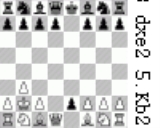
     pawns in the initial position. For example, if White has three knights, one of them must clearly have been promoted; the same is true of two light-square bishops. There are more subtle cases: if f1 is empty, a white bishop stands on b5 and there are white pawns on e2 and g2, then the bishop must be a promoted pawn (there is no way the original bishop could have got past those unmoved pawns). A piece such as this, which does not leave a player with pieces additional to those at the start of a game, but which nonetheless must have been promoted, is called obtrusive. The presence of obtrusive units constitutes a smaller flaw than the presence of more obviously promoted units. See, for example, the diagram at right.
  • The problem should be economical. There are several facets to this desideratum. For one thing, every piece on the board should serve a purpose, either to enable the actual solution, or to exclude alternative solutions. Extra units should not be added to create "red herrings" (this is called dressing the board), except in rare cases where this is part of the theme. If the theme can be shown with fewer total units, it should be. For another, the problem should not employ more moves than is needed to exhibit the particular theme(s) at its heart; if the theme can be shown in fewer moves, it should be.


Example problem


To the right is a directmate problem composed by T. Taverner in 1881.

The key move is Rh1. This is difficult to find because it makes no threat – instead, it puts black in zugzwang
Zugzwang

Zugzwang is a term originally used in chess which also applies to various other games. The concept finds its formal definition in combinatorial game theory....
, a situation in which every move leads to a disadvantage, yet the player must move. Each of black's nineteen legal replies allows an immediate mate. For example, if black defends with 1...Bxh7, the d5 square is no longer guarded, and white mates with 2.Nd5#. Or if black plays 1...Re5, black blocks that escape square for its king allowing 2.Qg4#. Yet if black could only pass (i.e., make no move at all), white would have no way to mate on its second move.

The thematic approach to solving is to notice then that in the original position, black is already almost in zugzwang. If black were compelled to play first, only Re3 and Bg5 would not allow immediate mate. However, each of those two moves blocks a flight square for the black king, and once white has removed its rook from h2 white can put some other piece on that square to deliver mate: 1...Re3 2. Bh2# and 1...Bg5 2.Qh2#.

The arrangement of the black rooks and bishops, with a pair of adjacent rooks flanked by a pair of bishops, is known to problemists as Organ Pipe
Pipe organ

The pipe organ is a keyboard musical instrument that produces sound by venting mechanically compressed air through resonant Organ pipe. Each pipe produces sound at one fixed pitch, so they are provided in sets or "ranks" with one pipe or more per note, each rank having a common timbre and loudness throughout....
s. This arrangement is designed to illustrate the effect of mutual black interferences: for example, consider what happens after the key if black plays 1...Bf7. White now mates with 2.Qf5#, a move which is only possible because the bishop black moved has got in the way of the rook's guard of f5 - this is known as a self-interference. Similarly, if black tries 1...Rf7, this interferes with the bishop's guard of d5, allowing white to mate with Nd5#. Mutual interferences like this, between two pieces on one square, are known as Grimshaw
Grimshaw (chess)

A Grimshaw is a device found in chess problems in which two black pieces arriving on a particular square mutually interfere with each other. It is named after the 19th century problem composer Walter Grimshaw....
 interferences. The theme this problem exhibits is precisely such Grimshaw interferences.


Abbreviations


For reasons of space and internationality, various abbreviations are often used in chess problem journals to indicate a problem's stipulation (whether it is a mate in two, helpmate in four, or whatever). The most common are:

  • "#" abbreviates checkmate;
  • "=" abbreviates stalemate (occasionally "p", standing for "pat", the French for stalemate, is used instead);
  • "h" abbreviates helpmate;
  • "s" abbreviates selfmate;
  • "r" abbreviates reflexmate;
  • "ser-" abbreviates series.


These are combined with a number to indicate how many moves the goal must be achieved in. "#3", therefore, indicates a mate in three, while "ser-h=14" indicates a serieshelpstalemate in 14 (i.e., black makes 14 moves in a row such that white can subsequently make one move to deliver stalemate).

In studies, the symbols "+" and "=" are used to indicate "White to play and win" and "White to play and draw" respectively.

Tournaments


Various tournaments (or tourneys) exist for both the composition and solving of chess problems.

Composition tournaments


Composition tourneys may be formal or informal. In formal tourneys, the competing problems are not published before they are judged, while in informal tourneys they are. Informal tourneys are often run by problem magazines and other publications with a regular problem section; it is common for every problem to have been published in a particular magazine within a particular year to be eligible for an informal award. Formal tourneys are often held to commemorate a particular event or person. The World Chess Composing Tournament (WCCT) is a formal tourney for national teams organised by the Permanent Commission of the FIDE for Chess Compositions
Permanent Commission of the FIDE for Chess Compositions

Permanent Commission of the FIDE for Chess Compositions is the highest body governing the official activities in the chess composition, mandated by FIDE....
 (PCCC).

In both formal and informal tourneys, entries will normally be limited to a particular genre of problem (for example, mate in twos, moremovers, helpmates) and may or may not have additional restrictions (for example, problems in patrol chess
Patrol chess

Patrol chess is a chess variant in which captures can be made and checks given only if the capturing or checking piece is guarded by a friendly unit....
, problems showing the Lacny
Lacny

The Lacny or Lacny cycle is a chess problem theme named after Ludovit Lacny, the first person to demonstrate the idea in 1949.It is an example of lines of play being cyclically related: in one phase of play, the Black defences a, b and c are answered by the White mates A, B and C respectively; in another phase, those same defences a,...
 theme, problems using fewer than nine units). Honours are usually awarded in three grades: these are, in descending order of merit, prizes, honourable mentions, and commendations. As many problems as the judge sees fit may be placed in each grade, and the problems within each grade may or may not be ranked (so an award may include a 1st Honourable Mention, a 2nd Honourable Mention, and a 3rd Honourable Mention, or just three unranked Honourable Mentions).

After an award is published, there is a period (typically around three months) in which individuals may claim honoured problems are anticipated (that is, that an identical problem, or nearly so, had been published at an earlier date) or unsound (i.e., that a problem has cooks or no solution). If such claims are upheld, the award may be adjusted accordingly. At the end of this period, the award becomes final. It is normal to indicate any honour a problem has received when it is republished.

Solving tournaments


Solving tournaments also fall into two main types. In tourneys conducted by correspondence, the participants send their entries by post or e-mail. These are often run on similar terms to informal composition tourneys; indeed, the same problems which are entries in the informal composition tourney are often also set in the solving tourney. It is impossible to eliminate the use of computers in such tournaments, though some problems, such as those with particularly long solutions, will not be well-suited to solution by computer.

Other solving tourneys are held with all participants present at a particular time and place. They have only a limited amount of time to solve the problems, and the use of any solving aid other than a chess set is prohibited. The most notable tournament of this type is the World Chess Solving Championship
World Chess Solving Championship

The World Chess Solving Championship is an annual competition in the solving of chess problems organised by FIDE via the Permanent Commission of the FIDE for Chess Compositions ....
, organised by the PCCC.

In both types of tourney, each problem is worth a specified number of points, often with bonus points for finding cooks or correctly claiming no solution. Incomplete solutions are awarded an appropriate proportion of the points available. The solver amassing the most points is the winner.

Titles


Just as in over-the-board play, the titles International Grandmaster
International Grandmaster

The title Grandmaster is awarded to extremely strong chess masters by the world chess organization FIDE. Apart from "World Chess Championship", Grandmaster is the highest title a chess player can attain....
, International Master
International Master

The title International Master is awarded to outstanding chess players by the world chess organization F?d?ration Internationale des ?checs. The title is open to both men and women....
 and FIDE Master
FIDE Master

FIDE Master is a title awarded by the world chess governing body, F?d?ration Internationale des ?checs . Introduced in 1978, FM ranks below the titles of International Master and International Grandmaster, but ahead of Candidate Master....
 are awarded by FIDE via the Permanent Commission of the FIDE for Chess Compositions
Permanent Commission of the FIDE for Chess Compositions

Permanent Commission of the FIDE for Chess Compositions is the highest body governing the official activities in the chess composition, mandated by FIDE....
 (PCCC) for especially distinguished problem and study composers and solvers (unlike over-the-board chess, however, there are no women-only equivalents to these titles in problem chess).

For composition, the International Master title was established in 1959, with André Chéron
André Chéron

Andr? Ch?ron was a French chess player, chess endgame chess theory, and a Chess composer of endgame study. He lived in Switzerland for many years....
, Arnolodo Ellerman, Alexander Gerbstmann, Jan Hartong, and Cyril Kipping being the first honorary recipients. In subsequent years, qualification for the IM title, as well as for the GM title (first awarded in 1972 to Genrikh Kasparyan, Lev Loshinsky, Comins Mansfield
Comins Mansfield

Comins Mansfield was a chess problem chess composer. He gained title Grandmaster of the FIDE for Chess Compositions in 1972 and 94,33 points in FIDE Album....
, and Eeltje Visserman) and the FM title (first awarded 1990) has been determined on the basis of the number of problems or studies a composer had selected for publication in the FIDE Album
FIDE Album

The FIDE Albums are publications of world chess governing body, FIDE, via the Permanent Commission of the FIDE for Chess Compositions , containing the best chess problems and endgame study of a certain period ....
s. These albums are collections of the best problems and studies composed in a particular three-year period, as selected by FIDE-appointed judges. Each problem published in an album is worth 1 point; each study is worth 1?; joint compositions are worth the same divided by the number of composers. For the FIDE Master title, a composer must accumulate 12 points; for the International Master title, 25 points are needed; and for the Grandmaster title, a composer must have 70 points.

For solvers, the GM and IM titles were both first awarded in 1982; the FM title followed in 1997. GM and IM titles can only be gained by participating in the official World Chess Solving Championship (WCSC): to become a GM, a solver must score at least 90 percent of the winner's points and on each occasion finish in at least tenth place three times within ten successive WCSCs. For the IM title they must score at least 80 percent of the winner's points and each time finish in at least fifteenth place twice within five successive WCSCs; alternatively, winning a single WCSC or scoring as many points as the winner in a single WCSC will earn the IM title. For the FM title, the solver must score at least 75 percent of the winners points and each time finish within the top 40 percent of participants in any two PCCC-approved solving competitions.

The title International Judge of Chess Compositions
International Judge of Chess Compositions

International Judge of Chess Compositions is a title award by FIDE via the Permanent Commission of the FIDE for Chess Compositions to individuals who have judged several chess problem or study tournaments and who are considered capable of judging such awards at the highest level....
 is given to individuals considered capable of judging composing tourneys at the highest level.

Computers and chess problems


Solution to problem by Heathcote

1.Rcc7! with the threat 2.Nc3. There are eight defences by the black knight on d4, each met by a different white mate: 1...Nxb3 2.Qd3#; 1...Nb5 2.Rc5#; 1...Nc6 2.Rcd7#; 1...Ne6 2.Red7#; 1...Nf5 2.Re5#; 1...Nf3 2.Qe4#; 1...Ne2 2.Qxh5#; and 1...Nc2 2.b4#. When a black knight moves to the maximum number of eight squares like this, it is known as a knight wheel.

Further reading

  • Addison, Stephen (1989), Book of Extraordinary Chess Problems, Crowood. ISBN 1-85223-240-4. An encyclopedia of unorthodox and 'chess lateral thinking' problems.
  • Stephen L. Carter
    Stephen L. Carter

    Stephen L. Carter born October 26 1954 is an United States law professor, legal- and social-policy writer, columnist, and novelist. He is the William Nelson Cromwell Professor of Law at Yale Law School, where he has taught since 1982....
    , The Emperor of Ocean Park. Chess and Chess Problems in fiction.
  • Frolkin, Andrei and Wilts, Gerd (1991), Shortest Proof Games. A collection of 170 proof games (published in Germany, but written in English).
  • Howard, Kenneth S. (1961), How To Solve Chess Problems, Dover Publications. ISBN 0-486-20748-X. A preliminary section of 30 pages is a useful introduction for novice solvers; there follow 112 problems with discussion.
  • Lipton, Michael, Matthews, R. C. O. and Rice, John (1963), Chess Problems: Introduction to an Art, Faber.
  • Morse, Jeremy
    Jeremy Morse

    Sir Christopher Jeremy Morse , known as Sir Jeremy Morse, was Chancellor of the University of Bristol between 1989 and 2003 before being succeeded by the Brenda Hale, Baroness Hale of Richmond and was chairman of Lloyds Bank....
     (1995; revised edition, 2001), Chess Problems: Tasks and Records, Faber and Faber. ISBN 0-571-15363-1. Concentrates on maximum tasks and records.
  • Nunn, John
    John Nunn

    John Denis Martin Nunn is one of England's strongest chess players, and once belonged to the world's top ten. He was twice world champion in chess problem solving....
     (1985), Solving in Style, Gambit Publications. ISBN 1-901983-66-8. Problems seen from the point of view of the solver.
  • Rice, John (1996), Chess Wizardry: The New ABC of Chess Problems, Batsford / International Chess Enterprises. ISBN 1-879479-33-8. A general overview of chess problems, including an extensive A-Z of themes and terms, and 460 problems. Widely regarded as the best single-volume work in English on the subject.


External links


Official sites

  • , (in English and Dutch)
  • , (in German)


External links

  • , (in English and French)
  • (in English and German)
  • Cornell University Library Historical Monographs Collection.