


Cheshire Cat

Encyclopedia
The Cheshire Cat is a fictional cat popularised by Lewis Carroll
's depiction of it in Alice's Adventures in Wonderland
. Known for his distinctive mischievous grin, the Cheshire Cat has had a notable impact on popular culture.
's pseudonymous Peter Pindar's Pair of Lyric Epistles in 1792: "Lo, like a Cheshire cat our court will grin." Earlier than that, A classical dictionary of the vulgar tongue by Francis Grose (The Second Edition, Corrected and Enlarged, London 1788) contains the following entry: "CHESHIRE CAT. He grins like a Cheshire cat; said of any one who shows his teeth and gums in laughing.".
, hence the cats grin because of all the milk and cream that is available. This is the explanation most favoured by the people of Cheshire.
says grinning like a Cheshire cat is "an old simile
, popularised by Lewis Carroll". According to Brewer's dictionary, "The phrase has never been satisfactorily accounted for, but it has been said that cheese was formerly sold in Cheshire moulded like a cat that looked as though it was grinning". The cheese was cut from the tail end, so that the last part eaten was the head of the smiling cat.
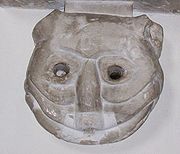
tower in Grappenhall
, a village adjacent to his birthplace — in Warrington
, Cheshire.
Others have attributed it to a gargoyle found on a pillar in St. Nicolas Church, Cranleigh
, where Carroll used to travel frequently when he lived in Guildford (though this is doubtful as he moved to Guildford some three years after Alice's Adventures in Wonderland had been published) and a carving in a church in the village of Croft-on-Tees
, in the north east of England, where his father had been rector
.
St. Christopher's church in Pott Shrigley, Cheshire, is believed to have been visited by Carroll and has a stone sculpture most closely resembling the pictorial cat in the book.
's house in her kitchen, and then later outside on the branches of a tree, where it appears and disappears at will, engaging Alice in amusing but sometimes vexing conversation. The cat sometimes raises philosophical points that annoy or baffle Alice
. It does, however, appear to cheer her up when it turns up suddenly at the Queen of Hearts
' croquet
field, and when sentenced to death baffles everyone by having made its head appear without its body, sparking a massive argument between the executioner and the King
and Queen of Hearts about whether something that does not have a body can indeed be beheaded
.
At one point, the cat disappears gradually until nothing is left but its grin, prompting Alice to remark that she has often seen a cat without a grin but never a grin without a cat.
The county of Cheshire contained a number of mills and the occupation of hatter was common. This leads the reader to surmise that both the Cheshire Cat and the Mad Hatter originated in the author's familiarity with Cheshire.
Lewis Carroll
Charles Lutwidge Dodgson , better known by the pseudonym Lewis Carroll , was an English author, mathematician, logician, Anglican deacon and photographer. His most famous writings are Alice's Adventures in Wonderland and its sequel Through the Looking-Glass, as well as the poems "The Hunting of the...
's depiction of it in Alice's Adventures in Wonderland
Alice's Adventures in Wonderland
Alice's Adventures in Wonderland is an 1865 novel written by English author Charles Lutwidge Dodgson under the pseudonym Lewis Carroll. It tells of a girl named Alice who falls down a rabbit hole into a fantasy world populated by peculiar, anthropomorphic creatures...
. Known for his distinctive mischievous grin, the Cheshire Cat has had a notable impact on popular culture.
Origins
The phrase appears in print in John WolcotJohn Wolcot
John Wolcot , satirist, born in Dodbrooke, near Kingsbridge in Devon, was educated by an uncle, and studied medicine. In 1767 he went as physician to Sir William Trelawny, Governor of Jamaica, and whom he induced to present him to a Church in the island then vacant, and was ordained in 1769...
's pseudonymous Peter Pindar's Pair of Lyric Epistles in 1792: "Lo, like a Cheshire cat our court will grin." Earlier than that, A classical dictionary of the vulgar tongue by Francis Grose (The Second Edition, Corrected and Enlarged, London 1788) contains the following entry: "CHESHIRE CAT. He grins like a Cheshire cat; said of any one who shows his teeth and gums in laughing.".
Dairy farming
A possible origin of the phrase "Grinning like a Cheshire Cat" is from the large number of dairy farms in CheshireCheshire
Cheshire is a ceremonial county in North West England. Cheshire's county town is the city of Chester, although its largest town is Warrington. Other major towns include Widnes, Congleton, Crewe, Ellesmere Port, Runcorn, Macclesfield, Winsford, Northwich, and Wilmslow...
, hence the cats grin because of all the milk and cream that is available. This is the explanation most favoured by the people of Cheshire.
Cheese moulds
Brewer's Dictionary of Phrase and FableBrewer's Dictionary of Phrase and Fable
Brewer's Dictionary of Phrase and Fable, sometimes referred to simply as Brewer's, is a reference work containing definitions and explanations of many famous phrases, allusions and figures, whether historical or mythical.-History:...
says grinning like a Cheshire cat is "an old simile
Simile
A simile is a figure of speech that directly compares two different things, usually by employing the words "like", "as". Even though both similes and metaphors are forms of comparison, similes indirectly compare the two ideas and allow them to remain distinct in spite of their similarities, whereas...
, popularised by Lewis Carroll". According to Brewer's dictionary, "The phrase has never been satisfactorily accounted for, but it has been said that cheese was formerly sold in Cheshire moulded like a cat that looked as though it was grinning". The cheese was cut from the tail end, so that the last part eaten was the head of the smiling cat.
Church carvings
There are many reports that Carroll found inspiration for the name and expression of the Cheshire Cat in the 16th century sandstone carving of a grinning cat, on the west face of St. Wilfrid's ChurchSt Wilfrid's Church, Grappenhall
St Wilfrid's Church, Grappenhall, is in Church Lane, Grappenhall, a village near Warrington, Cheshire, England. It has been designated by English Heritage as a Grade I listed building...
tower in Grappenhall
Grappenhall
Grappenhall is a suburban village in Warrington, Cheshire, England. It is situated along the Bridgewater Canal, and forms one of the principal settlements of Grappenhall and Thelwall civil parish...
, a village adjacent to his birthplace — in Warrington
Warrington
Warrington is a town, borough and unitary authority area of Cheshire, England. It stands on the banks of the River Mersey, which is tidal to the west of the weir at Howley. It lies 16 miles east of Liverpool, 19 miles west of Manchester and 8 miles south of St Helens...
, Cheshire.
Others have attributed it to a gargoyle found on a pillar in St. Nicolas Church, Cranleigh
Cranleigh
Cranleigh is a large village, self-proclaimed the largest in England, and is situated 8 miles south east of Godalming in Surrey. It lies to the east of the A281 which links Guildford with Horsham; neighbouring villages include: Ewhurst, Alfold and Hascombe....
, where Carroll used to travel frequently when he lived in Guildford (though this is doubtful as he moved to Guildford some three years after Alice's Adventures in Wonderland had been published) and a carving in a church in the village of Croft-on-Tees
Croft-on-Tees
Croft-on-Tees is a village and civil parish in the Richmondshire district of North Yorkshire, England. South of Darlington, it stands on the opposite side of the River Tees from Hurworth-on-Tees and is situated on the A167. The bridge over the Tees between Croft and Hurworth marks the boundary...
, in the north east of England, where his father had been rector
Rector
The word rector has a number of different meanings; it is widely used to refer to an academic, religious or political administrator...
.
St. Christopher's church in Pott Shrigley, Cheshire, is believed to have been visited by Carroll and has a stone sculpture most closely resembling the pictorial cat in the book.
Alice's Adventures in Wonderland
Alice first encounters it at the DuchessDuchess (Alice's Adventures in Wonderland)
The Duchess is a character in Lewis Carroll's Alice's Adventures in Wonderland, published in 1865. Carroll does not describe her physically in much detail, although her hideous appearance is strongly established in the popular imagination thanks to John Tenniel's illustrations and from context it...
's house in her kitchen, and then later outside on the branches of a tree, where it appears and disappears at will, engaging Alice in amusing but sometimes vexing conversation. The cat sometimes raises philosophical points that annoy or baffle Alice
Alice (Alice's Adventures in Wonderland)
Alice is a fictional character in the literary classic, Alice's Adventures in Wonderland and its sequel, Through the Looking-Glass, And What Alice Found There. She is a young girl from Victorian-era Britain.-Development:...
. It does, however, appear to cheer her up when it turns up suddenly at the Queen of Hearts
Queen of Hearts (Alice's Adventures in Wonderland)
The Queen of Hearts is a character from the book Alice's Adventures in Wonderland by the writer and mathematician Lewis Carroll. She is a foul-tempered monarch, that Carroll himself pictured as "a blind fury", and who is quick to decree death sentences at the slightest offense...
' croquet
Croquet
Croquet is a lawn game, played both as a recreational pastime and as a competitive sport. It involves hitting plastic or wooden balls with a mallet through hoops embedded into the grass playing court.-History:...
field, and when sentenced to death baffles everyone by having made its head appear without its body, sparking a massive argument between the executioner and the King
King of Hearts (Alice's Adventures in Wonderland)
The King of Hearts is a character from the book Alice's Adventures in Wonderland by Lewis Carroll.-Alice's Adventures in Wonderland:He seems to, when compared to the Queen of Hearts, be the moderate part of the Wonderland government...
and Queen of Hearts about whether something that does not have a body can indeed be beheaded
Decapitation
Decapitation is the separation of the head from the body. Beheading typically refers to the act of intentional decapitation, e.g., as a means of murder or execution; it may be accomplished, for example, with an axe, sword, knife, wire, or by other more sophisticated means such as a guillotine...
.
At one point, the cat disappears gradually until nothing is left but its grin, prompting Alice to remark that she has often seen a cat without a grin but never a grin without a cat.
The county of Cheshire contained a number of mills and the occupation of hatter was common. This leads the reader to surmise that both the Cheshire Cat and the Mad Hatter originated in the author's familiarity with Cheshire.
Popular culture
The Cheshire Cat is one of many iconic characters depicted in Alice's Adventures in Wonderland that have become enmeshed in popular culture, appearing in various forms of media, from political cartoons to television. One of its distinguishing features is that from time to time it disappears, the last thing to be seen being its grin.- In the 1951 Disney animated film, Alice in WonderlandAlice in Wonderland (1951 film)Alice in Wonderland is a 1951 American animated feature produced by Walt Disney and based primarily on Lewis Carroll's Alice's Adventures in Wonderland with a few additional elements from Through the Looking-Glass. Thirteenth in the Walt Disney Animated Classics series, the film was released in New...
, the Cheshire Cat is depicted as an intelligent yet mischievous character that sometimes helps Alice and sometimes gets her into trouble, and thus, in some cases, is classified as a "Disney Villain", though he is currently not considered a villain (especially in Mickey's House of VillainsMickey's House of VillainsMickey's House of Villains is a direct-to-video film produced by The Walt Disney Company. It is a film adaptation of the Disney Channel animated television series Disney's House of Mouse, starring Mickey Mouse, Donald Duck, Minnie Mouse, Goofy, Daisy Duck and Disney Villains that have appeared in...
, where he is not part of the group of villains, instead celebrating their defeat at the end). He is voiced by Sterling HollowaySterling HollowaySterling Price Holloway, Jr. was an American character actor who appeared in 150 films and television programs. He was also a voice actor for The Walt Disney Company...
and later by Jim CummingsJim CummingsJames Jonah "Jim" Cummings is an American voice actor who has appeared in almost 100 roles. He has appeared in classic animated movies such as Aladdin and The Lion King, as well as taking on roles in more current films, such as Bee Movie, Princess and the Frog, and Winnie the Pooh.-Personal...
after Holloway's death (making him the third character that Cummings has taken from Holloway, the first being Winnie-the-PoohWinnie-the-PoohWinnie-the-Pooh, also called Pooh Bear, is a fictional anthropomorphic bear created by A. A. Milne. The first collection of stories about the character was the book Winnie-the-Pooh , and this was followed by The House at Pooh Corner...
and the second being KaaKaaKaa is a fictional and exceptionally long Python molurus from the Mowgli stories written by Rudyard Kipling. Kaa is one of Mowgli's mentors and friends. He, Baloo and Bagheera sing for Mowgli "The Outsong" of the jungle. First introduced in the story "Kaa's Hunting" in The Jungle Book, Kaa is a...
). The Disney version of the character can also be spotted during the final scene of the 1988 film Who Framed Roger RabbitWho Framed Roger RabbitWho Framed Roger Rabbit is a 1988 American fantasy-comedy-noir film directed by Robert Zemeckis and released by Touchstone Pictures. The film combines live action and animation, and is based on Gary K. Wolf's novel Who Censored Roger Rabbit?, which depicts a world in which cartoon characters...
. The Cheshire Cat is heard singing the poem JabberwockyJabberwocky"Jabberwocky" is a nonsense verse poem written by Lewis Carroll in his 1872 novel Through the Looking-Glass, and What Alice Found There, a sequel to Alice's Adventures in Wonderland...
before he materialises in front of Alice. This is arguably the most iconic version of the character mostly because of his color scheme. Prior to the release of the Walt DisneyThe Walt Disney CompanyThe Walt Disney Company is the largest media conglomerate in the world in terms of revenue. Founded on October 16, 1923, by Walt and Roy Disney as the Disney Brothers Cartoon Studio, Walt Disney Productions established itself as a leader in the American animation industry before diversifying into...
animated adaptation of the story, scholars observed few specific allusions to this character. Martin GardnerMartin GardnerMartin Gardner was an American mathematics and science writer specializing in recreational mathematics, but with interests encompassing micromagic, stage magic, literature , philosophy, scientific skepticism, and religion...
, author of The Annotated AliceThe Annotated AliceThe Annotated Alice is a work by Martin Gardner incorporating the text of Lewis Carroll's major tales: Alice's Adventures in Wonderland and Through the Looking-Glass as well as the original illustrations by John Tenniel...
, wondered if T. S. EliotT. S. EliotThomas Stearns "T. S." Eliot OM was a playwright, literary critic, and arguably the most important English-language poet of the 20th century. Although he was born an American he moved to the United Kingdom in 1914 and was naturalised as a British subject in 1927 at age 39.The poem that made his...
had the Cheshire Cat in mind when writing Morning at the Window but notes no other significant allusions in the pre-war period.
- The Cheshire Cheese Campaign won a Gold award at the 2009 Cheshire County Show with their entry into the cheeseboard category. The board, called 'The Cheshire Cat' was constructed using White, Coloured & Blue Cheshire cheese, all made at the Joseph Heler dairy in Cheshire.
- Images of and references to the Cheshire Cat cropped up more frequently in the 1960s and 1970s, along with more frequent references to Carroll's works in general. The Cheshire Cat appeared on LSDLSDLysergic acid diethylamide, abbreviated LSD or LSD-25, also known as lysergide and colloquially as acid, is a semisynthetic psychedelic drug of the ergoline family, well known for its psychological effects which can include altered thinking processes, closed and open eye visuals, synaesthesia, an...
blotters as well as in song lyrics and popular fiction. For example, in the Star Trek episode Who Mourns for Adonais?, KirkJames T. KirkJames Tiberius "Jim" Kirk is a character in the Star Trek media franchise. Kirk was first played by William Shatner as the principal lead character in the original Star Trek series. Shatner voiced Kirk in the animated Star Trek series and appeared in the first seven Star Trek movies...
and ChekovPavel ChekovPavel Andreievich Chekov is a Russian Starfleet officer in the Star Trek fictional universe. Walter Koenig portrayed Chekov in the original Star Trek series and first seven Star Trek films; Anton Yelchin portrayed the character in the 2009 film Star Trek.-Origin:Star Trek creator Gene Roddenberry...
argue over the origin of the "vanishing cat" and Chekov amusingly alleges that it came from MinskMinsk- Ecological situation :The ecological situation is monitored by Republican Center of Radioactive and Environmental Control .During 2003–2008 the overall weight of contaminants increased from 186,000 to 247,400 tons. The change of gas as industrial fuel to mazut for financial reasons has worsened...
. while in the second-season finale of Prison BreakPrison BreakPrison Break is an American television serial drama created by Paul Scheuring, that was broadcast on the Fox Broadcasting Company for four seasons, from 2005 until 2009. The series revolves around two brothers; one has been sentenced to death for a crime he did not commit, and the other devises an...
, Theodore "T-Bag" Bagwell describes his smile as the Cheshire Cat when he meets Brad BellickBrad BellickBradley "Brad" Bellick is a fictional character from the American television series, Prison Break. He is portrayed by Wade Williams. As one of the principal characters of Prison Break, he has been featured in all four seasons of the series...
in the jail cell in PanamaPanamaPanama , officially the Republic of Panama , is the southernmost country of Central America. Situated on the isthmus connecting North and South America, it is bordered by Costa Rica to the northwest, Colombia to the southeast, the Caribbean Sea to the north and the Pacific Ocean to the south. The...
.
- An exhibit called The Cheshire Cat at the ExploratoriumExploratoriumThe Exploratorium is a museum in San Francisco with over 475 participatory exhibits, all of them made onsite, that mix science and art. It also aims to promote museums as informal education centers....
in San Francisco, created by Bob Miller in 1978, features a mirrored eyepiece that allows visitors to look at a picture of the Cheshire Cat's face with one eye, while the other eye sees a reflection of a white screen to the side. When the visitor waves a hand in across the white screen, the cat image starts to disappear. If the visitor focuses on the cat's smile while doing this, the smile will remain while the cat disappears. The general phenomenon of a moving stimulus presented to one eye causing a static image to disappear from the other eye is called the Cheshire Cat effect, named after this exhibit. The effect is part of a broader visual phenomenon called binocular rivalryBinocular rivalryBinocular rivalry is a phenomenon of visual perception in which perception alternates between different images presented to each eye.When one image is presented to one eye and a very different image is presented to the other, instead of the two images being seen superimposed, one image is seen for...
.
- Punk rockPunk rockPunk rock is a rock music genre that developed between 1974 and 1976 in the United States, the United Kingdom, and Australia. Rooted in garage rock and other forms of what is now known as protopunk music, punk rock bands eschewed perceived excesses of mainstream 1970s rock...
band Blink-182Blink-182Blink-182 is an American rock band consisting of vocalist and bass guitarist Mark Hoppus, vocalist and guitarist Tom DeLonge, and drummer Travis Barker. They have sold over 27 million albums worldwide since forming in Poway, California in 1992...
's debut studio album is called Cheshire Cat.
- In The Care Bears Adventure in WonderlandThe Care Bears Adventure in WonderlandThe Care Bears Adventure in Wonderland is the third theatrically released film in the Care Bears animated franchise. It was released in the United States and Canada on August 7, 1987 by Cineplex Odeon Films, and is based on Lewis Carroll's Alice stories...
, the Cheshire Cat is depicted as an eccentric fantastical creature who speaks solely in rapRapRap may refer to:*Rapping, performance in which rhyming lyrics are used, with or without musical accompaniment ; while an MC performs spoken verses in time to a beat/ melody**Hip hop subculture**Hip hop music...
.
- The 1975 Ted NugentTed NugentTheodore Anthony "Ted" Nugent is an American guitarist, musician, singer, author, reserve police officer, and activist. From Detroit, Michigan, he originally gained fame as the lead guitarist of The Amboy Dukes, before embarking on a lengthy solo career...
song Free For AllFree-for-All (song)"Free-for-All" is the first song on Ted Nugent second's album Free-for-All and the only track on the entire album that Nugent sang himself.Having been recorded and released on vinyl before the Frank Zappa-condemned censorship motives of Tipper Gore, the LP was neither censored by a retail chain,...
from the album of the same name includes the line: "I see you there with your Cheshire grin/I've got my eyes on you".
- In DC ComicsDC ComicsDC Comics, Inc. is one of the largest and most successful companies operating in the market for American comic books and related media. It is the publishing unit of DC Entertainment a company of Warner Bros. Entertainment, which itself is owned by Time Warner...
, the New GoddessNew GodsThe New Gods are a fictional race appearing in publications by DC Comics, as well as the title for four series of comic books about those characters. They first appeared in New Gods #1 , and were created and designed by Jack Kirby....
Malice Vundabar, niece of the villain Virman VundabarVirman VundabarVirman Vundabar is a fictional extraterrestrial supervillain published by DC Comics. He was created by Jack Kirby and first appeared in Mister Miracle vol. 1 #5 "drawn like Benito Mussolini."-Fictional character biography:...
, resembles Alice and controls a carnivorous creature called Chessure that looks like nothing more than a grinning face. CheshireCheshire (comics)Cheshire is a DC Comics villain that first appeared in New Teen Titans Annual #2 .-Fictional character biography:Born to a French father and a Vietnamese mother, Jade Nguyen had an unhappy childhood and was sold into slavery...
is also the codename of the human assassin Jade Nguyen who has a daughter with the heroic archer Roy "Speedy" Harper. Though the comic version bears no similarity to the Cheshire Cat, the Cheshire from the Teen Titans and Young JusticeYoung Justice (TV series)Young Justice is an American animated television series created by Greg Weisman and Brandon Vietti for Cartoon Network. Despite its title, it is not an adaptation of Todd Dezago and Todd Nauck's Young Justice comic series, but rather an adaptation of the entire DC Universe with a focus on young...
animated series wears a mask of a grinning cat.
- In the Thursday NextThursday NextThursday Next is the main protagonist in a series of comic fantasy, alternate history novels by the British author Jasper Fforde. She was first introduced in Fforde's first published novel, The Eyre Affair, released on July 19, 2001 by Hodder & Stoughton. , the series comprises six books, in two...
series by Jasper FfordeJasper FfordeJasper Fforde is a British novelist. Fforde's first novel, The Eyre Affair, was published in 2001. Fforde is mainly known for his Thursday Next novels, although he has written several books in the loosely connected Nursery Crime series and begun two more independent series: The Last Dragonslayer...
, the Cheshire Cat is an overseer in the Great Library, a library within the "book-world" which contains copies of every book ever written. However, due to "boundary changes", the Cat is renamed the "Unitary Authority of WarringtonWarringtonWarrington is a town, borough and unitary authority area of Cheshire, England. It stands on the banks of the River Mersey, which is tidal to the west of the weir at Howley. It lies 16 miles east of Liverpool, 19 miles west of Manchester and 8 miles south of St Helens...
Cat". Thursday has a conversation with the Cat identical to that between the Cat and Alice, which she later notices. The Cheshire Cat of this series, however, is not only sane but helpful to some extent as an active member of Jurisfiction, the metafictional justice agency for characters within books.
- In the Peanuts comic strip, SnoopySnoopySnoopy is an fictional character in the long-running comic strip Peanuts, by Charles M. Schulz. He is Charlie Brown's pet beagle. Snoopy began his life in the strip as a fairly conventional dog, but eventually evolved into perhaps the strip's most dynamic character—and among the most recognizable...
has shown the ability to perform the Cheshire Cat's signature disappearing act, but has gotten stuck several times. Snoopy did the Cheshire Cat grin in April 1967.
- In the PCPersonal computerA personal computer is any general-purpose computer whose size, capabilities, and original sales price make it useful for individuals, and which is intended to be operated directly by an end-user with no intervening computer operator...
game Jazz Jackrabbit 2, the cat is featured in psychedelicPsychedelicThe term psychedelic is derived from the Greek words ψυχή and δηλοῦν , translating to "soul-manifesting". A psychedelic experience is characterized by the striking perception of aspects of one's mind previously unknown, or by the creative exuberance of the mind liberated from its ostensibly...
levels that resemble characters from Alice in Wonderland. However, he's merely a platform than a guide.
- In the PlayStation 2PlayStation 2The PlayStation 2 is a sixth-generation video game console manufactured by Sony as part of the PlayStation series. Its development was announced in March 1999 and it was first released on March 4, 2000, in Japan...
version of Tom Clancy's Splinter Cell: Double AgentTom Clancy's Splinter Cell: Double AgentTom Clancy's Splinter Cell: Double Agent is an action-adventure stealth game, developed and published by Ubisoft. The series, endorsed by American author Tom Clancy, follows the character Sam Fisher, an agent employed by a black-ops division of the National Security Agency, dubbed Third...
, there are two exclusive levels. In the second level entitled "Bunker", Sam is kidnapped and must escape through gas-filled chambers. In one instance he's asked how he's doing; Sam replies, "Either the stuff is still in my system or I'm being followed by the Cheshire Cat."
- In Kingdom Hearts, the Cheshire Cat offers Sora, Donald and Goofy clues to prove that the Heartless attempted to steal the Queen of Hearts' heart and not Alice, along with the blizzard spell (in the manga, the Cheshire Cat grants Sora the ability to perform all types of magic, not just blizzard); however, he also summons the Trickmaster Heartless to fight the heroes while the Heartless kidnap Alice, making it difficult to determine whether this Cheshire Cat is good or evil. His role in Kingdom Hearts: 358/2 Days is very similar, both helping Roxas and summoning Heartless indirectly, implying that the Cheshire Cat may have some control over the Heartless. The manga reveals that MaleficentMaleficentMaleficent is a fictional character and the main antagonist in Walt Disney's 1959 adaptation of Sleeping Beauty. She is the self-proclaimed "Mistress of All Evil" who, after not being invited to the baby's christening, curses the infant Princess Aurora to "prick her finger on the spindle of a...
offered him a place in her group of villains, but he turned her down.
- In the video games American McGee's AliceAmerican McGee's AliceAmerican McGee's Alice is a third-person action game released for PC on October 6, 2000. The game, developed by Rogue Entertainment and published by Electronic Arts, is set in an alternative universe of Lewis Carroll's Alice's Adventures in Wonderland...
(2000); and the sequel Alice: Madness ReturnsAlice: Madness ReturnsAlice: Madness Returns is a video game for Microsoft Windows, PlayStation 3, and Xbox 360 released on June 14, 2011, in North America, June 16, 2011, in Europe and June 17, 2011, in the United Kingdom. It is the sequel to the 2000 Windows and Mac video game American McGee's Alice...
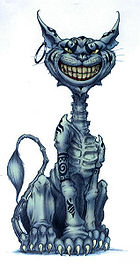
(2011), the Cheshire Cat is portrayed as an enigmatic, yet wise guide for Alice in the corrupted Wonderland. In keeping with the twisted tone of the game, the Cheshire Cat is mangy and emaciated in appearance. His voice was provided by Roger L. JacksonRoger L. JacksonRoger Labon Jackson is an American voice actor. He is best known for voicing the killer Ghostface in the Scream films, leaving him to keep an unknown identity to withhold the mystery of Ghostface...
, who also voiced the Mad HatterMad HatterHatta, the Hatter is a fictional character in Lewis Carroll's Alice's Adventures in Wonderland and the story's sequel, Through the Looking-Glass. He is often referred to as the Mad Hatter, though this term was never used by Carroll...
and The Jabberwock in the game.
- In the 1999 television adaptationAlice in Wonderland (1999 film)Alice in Wonderland is a television film first broadcast in 1999 on NBC and then shown on British television on Channel 4. It is based upon Lewis Carroll's books Alice's Adventures in Wonderland and Through the Looking-Glass....
of the books, the Cheshire Cat is portrayed by Whoopi GoldbergWhoopi GoldbergWhoopi Goldberg is an American comedian, actress, singer-songwriter, political activist, author and talk show host.Goldberg made her film debut in The Color Purple playing Celie, a mistreated black woman in the Deep South. She received a nomination for the Academy Award for Best Actress and won...
, the first time the character is portrayed as a female. She fully acts as an ally and friend to Alice, the latter defending the cat when she is threatened with execution.
- In Frank Beddor's The Looking Glass WarsThe Looking Glass WarsThe Looking Glass Wars is a series of novels by Frank Beddor, inspired by Lewis Carroll's Alice's Adventures in Wonderland and Through the Looking-Glass. The base is that the two books written by Lewis Carroll is a distortion of the 'true story' portrayed in these novels...
, the Cat is Redd's top assassin. The Cat has butcher knife claws and can change from his true form to the form of a small black kitten. He initially has nine lives, but loses all but one by the end of the book.
- In the SyFySyfySyfy , formerly known as the Sci-Fi Channel and SCI FI, is an American cable television channel featuring science fiction, supernatural, fantasy, reality, paranormal, wrestling, and horror programming. Launched on September 24, 1992, it is part of the entertainment conglomerate NBCUniversal, a...
TV miniseries AliceAlice (TV miniseries)Alice is a 2009 television mini-series that was originally broadcast on Canadian cable television channel Showcase and an hour later on American cable television channel Syfy...
, the Cheshire Cat appears in a dream sequence as Alice’s childhood cat, Dinah. It leads Alice to a strange room where she experiences flashbacks to her childhood. Right before Alice enters the room, she looks back and sees the Cheshire Cat flash its trademark smile. However, unlike in the original book, it doesn’t disappear.
- In the LaserdiscLaserdiscLaserDisc was a home video format and the first commercial optical disc storage medium. Initially licensed, sold, and marketed as MCA DiscoVision in North America in 1978, the technology was previously referred to interally as Optical Videodisc System, Reflective Optical Videodisc, Laser Optical...
game Dragon's Lair II, The Cheshire Cat appears only as a head, reciting the Jabberwocky poem while trying to make a meal out of the hero "Dirk the Daring".
- In the online series Harper's Globe, a tie-in with the CBSCBSCBS Broadcasting Inc. is a major US commercial broadcasting television network, which started as a radio network. The name is derived from the initials of the network's former name, Columbia Broadcasting System. The network is sometimes referred to as the "Eye Network" in reference to the shape of...
television murder mystery series Harper's Island, Robin MatthewsRobin MatthewsRobin Matthews is the United Kingdom leader of the European party Libertas, which fought all 72 British seats in the June European Parliament election, 2009. He stood as a candidate for South West England....
works for Harper's Globe, the island's newspaper. As she investigates the past, it's her job to attract local involvement on the Globe's website. One user, the "Cheshire Cat," seemingly leads Robin down a path to gather more information about what lies beneath the surface of the island's people as she tries to find her missing love interest, Brent Cyr.
- In the anime Ouran High School Host ClubOuran High School Host Clubis a manga series by Bisco Hatori, serialized in Hakusensha's LaLa magazine since August 5, 2003. The series follows Haruhi Fujioka, a scholarship student at Ouran High School, and the other members of the popular host club. The romantic comedy focuses on the relationships within and without the...
, the characters Hikaru Hitachiin and Kaoru Hitachiin both play the part of the Cheshire Cat in the episode "Haruhi in Wonderland".
- In the anime and manga Pandora HeartsPandora Heartsis a manga series by Jun Mochizuki. Originally starting serialization in the shōnen magazine GFantasy published by Square Enix in June 2006. Currently fourteen volumes have been released in Japan. The manga series was licensed for an English language release by Broccoli Books but has been dropped;...
, one of the main characters, Alice, had a pet cat that died, but returns 100 years later as a chain in a realm created by one of Alice's memories. He came to call himself the Cheshire Cat, and had a more human-like appearance, or a catboyCatgirlA catgirl is a female character with cat traits, such as cat ears, a cat tail, or other feline characteristics on an otherwise human body. Catgirls are found in various fiction genres, and in particular Japanese anime and manga where they are more commonly referred to as Neko or Nekomimi , in...
look. He is also a key character with vital information in the series.
- In the manga Are You Alice?, the Cheshire Cat is depicted as a man with cat ears and long brown hair (according to official colouring), and is often seen smiling. He is the loyal pet cat of The Dutchess, who is a little girl that took in the cat when it was stray. The cat's main role in the manga unfolds along with the story, but he's seen closely following the boy whom everyone calls 'Alice', throughout the deadly game taking place in 'Wonderland'. He is not seen by The Mad Hatter (though he's still heard), and often just disappears without explanation. However, it seems he was the person who gave Alice his name.
- The Cheshire Cat lends its name to two public house in the county of CheshireCheshireCheshire is a ceremonial county in North West England. Cheshire's county town is the city of Chester, although its largest town is Warrington. Other major towns include Widnes, Congleton, Crewe, Ellesmere Port, Runcorn, Macclesfield, Winsford, Northwich, and Wilmslow...
; one near StockportStockportStockport is a town in Greater Manchester, England. It lies on elevated ground southeast of Manchester city centre, at the point where the rivers Goyt and Tame join and create the River Mersey. Stockport is the largest settlement in the metropolitan borough of the same name...
and another on the A41A41 roadThe A41 is a formerly-major trunk road in England that links London and Birkenhead, although it has now largely been superseded by motorways. It passes through or near various towns and cities including Watford, Hemel Hempstead, Aylesbury, Solihull, Birmingham, West Bromwich, Wolverhampton,...
just south of ChesterChesterChester is a city in Cheshire, England. Lying on the River Dee, close to the border with Wales, it is home to 77,040 inhabitants, and is the largest and most populous settlement of the wider unitary authority area of Cheshire West and Chester, which had a population of 328,100 according to the...
.
- In the AnimaniacsAnimaniacsSteven Spielberg Presents Animaniacs, usually referred to as simply Animaniacs, is an American animated series, distributed by Warner Bros. Television and produced by Amblin Entertainment and Warner Bros. Animation. The cartoon was the second animated series produced by the collaboration of Steven...
episode "Mindy in Wonderland", the Cheshire Cat is female and more closely resembles Rita the cat. She is voiced by Bernadette PetersBernadette PetersBernadette Peters is an American actress, singer and children's book author from Ozone Park, Queens, New York. Over the course of a career that has spanned five decades, she has starred in musical theatre, films and television, as well as performing in solo concerts and recordings...
.
- The Cheshire Cat is alluded to in Terry Pratchett's Wyrd SistersWyrd SistersWyrd Sisters is Terry Pratchett's sixth Discworld novel, published in 1988, and re-introduces Granny Weatherwax of Equal Rites.- Plot :...
: ""Greebo's grin gradually faded, until there was nothing left but the cat. This was nearly as spooky as the other way round."
- The Cheshire Cat appears in Walt Disney's 2010 Alice in WonderlandAlice in Wonderland (2010 film)Alice in Wonderland is a 2010 American computer-animated/live action fantasy adventure film directed by Tim Burton, written by Linda Woolverton, and released by Walt Disney Pictures...
, directed by Tim BurtonTim BurtonTimothy William "Tim" Burton is an American film director, film producer, writer and artist. He is famous for dark, quirky-themed movies such as Beetlejuice, Edward Scissorhands, The Nightmare Before Christmas, Ed Wood, Sleepy Hollow, Corpse Bride and Sweeney Todd: The Demon Barber of Fleet...
. In the movie, Cheshire (as he is referred to by other Wonderland characters) first appears to Alice as she is walking alone in the forest. He helps her by binding the wound she suffered earlier by the BandersnatchBandersnatchA Bandersnatch is a fictional creature from Lewis Carroll's 1872 novel Through the Looking-Glass and 1874 poem "The Hunting of the Snark". Although neither poem describes the appearance of a Bandersnatch in great detail, in "The Hunting of the Snark" it has a long neck and snapping jaws, and both...
and taking her to the Hatter and the March Hare. He is later blamed by the Hatter for betraying him during the Red Queen's attack where the White Queen's throne was usurped. However, as the plot moves along, he redeems himself by changing his form to resemble the Hatter during his execution and then evaporates as the axe is about to make contact, thus fooling everyone as the Hatter's hat floats up to the Queen's seat and Cheshire appears and winks. In the video game adaptation of the movie, Cheshire is a playable character who can not only turn himself invisible, but other objects around him as well. The character was voiced by Stephen FryStephen FryStephen John Fry is an English actor, screenwriter, author, playwright, journalist, poet, comedian, television presenter and film director, and a director of Norwich City Football Club. He first came to attention in the 1981 Cambridge Footlights Revue presentation "The Cellar Tapes", which also...
.
- The Cheshire Cat is included in the manga Alice in the Country of HeartsAlice in the Country of Heartsis a Japanese female-oriented romance adventure visual novel developed by Quin Rose. The game is a re-imagining of Lewis Carroll's classic Alice's Adventures in Wonderland. A manga adaptation illustrated by Soumei Hoshino was serialized in Mag Garden's Monthly Comic Avarus between the October 2007...
. He is known as Boris and works for a man called 'Mary Gowland', the boss of the Amusement Park territory. Boris is a human, though he has functional cat ears and a cat tail. He has a series of piercings on his ears, his tail, and one on his belly button. In this depiction, he is a happy-go-lucky person who has an obsession with guns (Weapons are a big part of the Alice in the Country of Hearts books). He is known only as Boris, and is never mentioned as the Cheshire Cat, though it is obvious that is his role in the story.
- In James A. OwenJames A. OwenJames A. Owen is an American comic book creator, publisher and writer. He is best known for his creator-owned comic book series Starchild and as the author of The Chronicles of the Imaginarium Geographica novel series, that began with Here, There Be Dragons in 2006.-Life and career:Owen...
's book, The Shadow Dragons, the character GrimalkinGrimalkinA grimalkin is an old or evil-looking female cat. The term stems from "grey" plus "malkin", an archaic term for a cat, derived from a hypocoristic form of the female name Maud...
is shown as the inspiration for the Cheshire Cat, and is even once referred to as such by H.G. Wells. - In the FuturamaFuturamaFuturama is an American animated science fiction sitcom created by Matt Groening and developed by Groening and David X. Cohen for the Fox Broadcasting Company. The series follows the adventures of a late 20th-century New York City pizza delivery boy, Philip J...
episode The StingThe Sting (Futurama)"The Sting" is episode twelve in season four of Futurama. It originally aired in North America on June 1, 2003. It is arguably one of the most popular episodes of the series.-Plot:...
in one scene Fry disappears and reappears like the Cheshire cat. Though it may have been a hallucinationHallucinationA hallucination, in the broadest sense of the word, is a perception in the absence of a stimulus. In a stricter sense, hallucinations are defined as perceptions in a conscious and awake state in the absence of external stimuli which have qualities of real perception, in that they are vivid,...
. - The cat is referenced in Matthew Reilly's Hover Car Racer on page 198.
- French singer Nolwenn LeroyNolwenn LeroyNolwenn Leroy, , is a French singer and songwriter, discovered by the French television reality show Star Academy. She is best known for her two Number One singles "Cassé" and "Nolwenn Ohwo!"....
produced the album Le Cheshire Cat et moi in 2009