

Cheraman Perumal

Encyclopedia
The end of the Chera dynasty
Rama Varman Kulashekhara ascended the throne during a period of severe crisis. Kulothunga Chola IKulothunga Chola I
Kō Rājakēsarivarman Abaya Kulōthunga Chōla was one of the greatest kings of the Chola Empire. He was one of the sovereigns who bore the title Kulottunga, literally meaning the exalter of his race.-Early life:...
had occupied Nanjanad and south Kerala and was proceeding towards Kollam
Kollam
Kollam , often anglicized as ', is a city in the Indian state of Kerala. The city lies on the banks of Ashtamudi Lake on the Arabian sea coast and is situated about north of the state capital, Thiruvananthapuram...
, the capital of the Venad
Venad
Venad Swarupam was one of the three prominent late medieval Hindu feudal kingdoms on Malabar Coast, south India, along with Kingdom of Calicut and Kingdom of Cannanore. In the early 14th century, Venad ruler Ravi Varma Kulasekhara had established a short-lived supremacy over southern India...
kings in 1096 AD. Rama Varma resolved to beat back the Cholas and rallied all his patriotic forces. A large body of Chera army transformed into suicide squads (Chavers) later known as "Nairs". The capital city of Mahodayapuram (present Kodungallur
Kodungallur
Kodungallur is a municipality in Thrissur District, in the state of Kerala, India on the Malabar Coast. Kodungallur is located about 29 km northwest of Kochi city and 38 km Southwest of Thrissur, on National Highway 17 . Muziris the ancient seaport at the mouth of the Periyar River was...
) and surrounding places were devastated in the long war and the king, without even a palace of his own, is known to have stayed at alternative frugal accommodations.
Towards the end of the war he shifted the capital from Mahodayapuram to Kollam and led a large army to stem the Cholas in the south. Kulothinga was defeated and withdrew towards Kottar. The Cholapuram
Cholapuram
Cholapuram is a panchayat town in Thanjavur district in the state of Tamil Nadu, India.-Geography:Cholapuram is located at . It has an average elevation of 123 metres .-Demographics:...
records (1100 AD) that codified the achievements of Kulothunga Chola refer to this. The Cholas could not regain their influence beyond Nanjanad after this defeat. The death of Rama Varman Kulashekhara marked the end of the Kulashekhara kingdom of Mahodayapuram. Venad attained the status of an independent kingdom, of which Rama Varman Kulashekhara is regarded as the founder.
Cheraman legend
The later life of the last Cheraman is shrouded in mystery. Following his disappearance the chieftains of empire partitioned the land and proclaimed their independence in early 12th century. These fiefdoms would later emerge as the kingdoms of KolathunaduKolathunadu
Kolathunādu was one of the three most powerful feudal kingdoms on the Malabar Coast during the arrival Portuguese Armadas to India along with Zamorin's Calicut and Venad. Kolathunād had its capital at Ezhimala and was ruled by Kolathiri royal family and roughly comprised the whole northern...
, Kozhikode
Kozhikode
Kozhikode During Classical antiquity and the Middle Ages, Kozhikkode was dubbed the "City of Spices" for its role as the major trading point of eastern spices. Kozhikode was once the capital of an independent kingdom of the same name and later of the erstwhile Malabar District...
and Kochi
Kochi
-Places:* Kochi, a city in the state of Kerala, India, formerly known as Cochin* Kingdom of Cochin, a former feudal city-state on Malabar Coast, India** Fort Kochi, one of the three main urban components which constitute the present day city of Kochi, Kerala, India...
.
A legend tells of the mysterious disappearance and conversion to Islam of the last Cheraman Perumal which, however, is neither corroborated by any contemporary record nor was mentioned by any of the several Arab and European travellers who visited Kerala including Suleiman, Al Biruni, Benjamin of Tudela
Benjamin of Tudela
Benjamin of Tudela was a medieval Jewish traveler who visited Europe, Asia, and Africa in the 12th century. His vivid descriptions of western Asia preceded those of Marco Polo by a hundred years...
, Al Kazwini, Marco Polo
Marco Polo
Marco Polo was a Venetian merchant traveler from the Venetian Republic whose travels are recorded in Il Milione, a book which did much to introduce Europeans to Central Asia and China. He learned about trading whilst his father and uncle, Niccolò and Maffeo, travelled through Asia and apparently...
, Friar Odoric, Friar Jordanus
Jordanus
Jordanus or Jordan Catalani was a French Dominican missionary and explorer in Asia known for his Mirabilia describing the marvels of the East.-Travels:He was perhaps born at Sévérac-le-Château in Aveyron, north-east of Toulouse...
, Ibn Batuta, Abdur Razzak, Nicolo Conti etc. But it was after the Portuguese' arrival that middle eastern travellers like Sheikh Zainuddin spoke of the legend;
On a moon-lit night the king while walking on the rooftop of his palace along with the queen saw the moon suddenly splitting into two halves. Later he came to know through the Arab traders that a prophet called Muhammad had wrought a miracle on that fateful night, and sundered the moon before a crowd of dazed spectators. Impressed by this new messenger of God in Arabia, the king set out for the holy land after dividing his kingdom and assigning various territories to local chieftains to ensure smooth governance. In Arabia he met the Prophet and embraced Islam in the presence of Abu Bakr Siddique, who later became the first caliph. Cheraman, who took a Muslim name, Tajuddin, died on his way back to India and was buried on the shore of the Arabian Sea at SalalahSalalahSalalah , is the capital and seat of the governor or Wali of the southern Omani province of Dhofar. The population of Salalah was 197,169 in 2009....
in the Sultanate of OmanOmanOman , officially called the Sultanate of Oman , is an Arab state in southwest Asia on the southeast coast of the Arabian Peninsula. It is bordered by the United Arab Emirates to the northwest, Saudi Arabia to the west, and Yemen to the southwest. The coast is formed by the Arabian Sea on the...
. It is said that he had earlier written letters to the local rulers of Malabar and sent it through his ministers along with Malik bin Dinar, a companion of the Prophet. In the letters he had asked them to "receive the bearers of the letters and treat them well and help them to construct mosques at KodungallurKodungallurKodungallur is a municipality in Thrissur District, in the state of Kerala, India on the Malabar Coast. Kodungallur is located about 29 km northwest of Kochi city and 38 km Southwest of Thrissur, on National Highway 17 . Muziris the ancient seaport at the mouth of the Periyar River was...
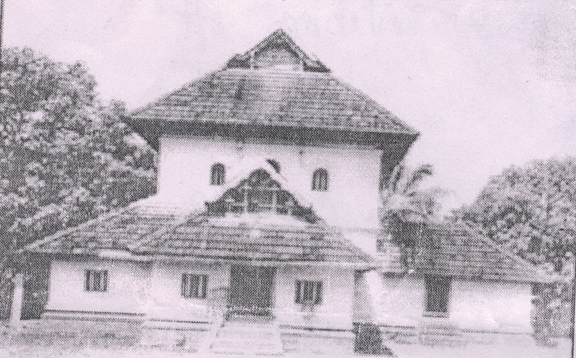
and elsewhere". The rulers of Kerala honoured the letters and permitted Malik Bin Dinar and his fellow Arab traders to build mosques in Kerala. The mosque built in the early 7th century at Kodungallur, known as Cheraman Malik Masjid, still exists with its original structure and is said to be the oldest mosque in the sub-continent. It is named after both Cheraman Perumal and Malik bin Dinar.
Another mosque built during this period was the Malik Dinar MosqueMalik Dinar MosqueMalik Dinar Mosque is a historical mosque in Kasargod district of Kerala state, south India. Over the years, Kasargod acquired the considerable importance as a centre of Islam on the west coast. It is the site of one of the mosques believed to have been founded by Malik Ibn Dinar...
.
William Logan accepted the story as authentic but changed the date of conversion from 345 AD to 825 AD. The Perumal, however, could not have met Muhammad (570–632 AD) either in 825 AD or in 345 AD. The mosque at Kodungallur, purportedly built on the instruction of the last Perumal in 629 AD exhibits the style of middle Chola architecture and a team of historians who studied its foundation safely placed it in the 12th century. The mosque at Madayi, one of ten believed to have built at the instruction of the last Perumal, had a plaque attributing its foundation to Hegira 518 i.e., 1124 AD.
Some have argued that it is not Rama Varma Kulashekhara but Bhaskara Ravi Varma who is the protagonist of this legend. However, the life of Bhaskara Ravi Varma is well documented and there is no report of his having left his empire. Another school of thought believes that he converted to Buddhism or Jainism and there is yet another version according to which Perumal converted to Christianity, went on a pilgrimage to Mylapore
Mylapore
Mylapore is a cultural hub and neighborhood in the southern part of the city of Chennai, the capital of Tamil Nadu, India. Earlier, Mylapore used to be called Vedapuri....
, died there and is buried beside the tomb of St. Thomas
Thomas the Apostle
Thomas the Apostle, also called Doubting Thomas or Didymus was one of the Twelve Apostles of Jesus. He is best known for questioning Jesus' resurrection when first told of it, then proclaiming "My Lord and my God" on seeing Jesus in . He was perhaps the only Apostle who went outside the Roman...
, the Apostle. Prof. A. Sreedhara Menon concluded that the legend of Rama Varama Kulashekhara's conversion originated as a figment of imagination or as a case of mistaken identity and continued to be reproduced without critical examination.
Sources
- Roman Karur, Dr. Nagaswamy R.,(1995), Brahadish Publications, Chennai
http://tamilartsacademy.com/books/roman%20karur/cover.html
- Tamil Coins, Dr. Nagaswamy R.,(1981), State Department of Archaeology, Tamil Nadu http://tamilartsacademy.com/books/coins/chapter01.xml
- History of Mosque and tradition on Bahrain Tribune
- India's President makes a visit to the mosque
- The Land of the Permauls. Cochin, Its Past and Its Present 1863. Chapter 2. Page 44, The Last "Permaul." Dr. Francis Day.
- Interview with Raja Valiyathampuram of Kodungallur in Central Kerala http://www.iosworld.org/interview_cheramul.htm
Sources
- Roman Karur, Dr. Nagaswamy R., (1995), Brahadish Publications, Chennai
- Tamilartsacademy.com, Tamil Coins, Dr. Nagaswamy R., (1981), State Department of Archaeology, Tamil Nadu.
- History of Mosque and tradition on Bahrain Tribune
- India's President makes a visit to the mosque, Hindu.com
- The Land of the Permauls. Cochin, Its Past and Its Present 1863. Chapter 2. Page 44, The Last "Permaul." Dr. Francis Day.
- IOSworld.org, Interview with Raja Valiyathampuram of Kodungallur in Central Kerala.