

Chelydridae

Encyclopedia
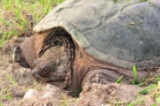
Chelydridae is a family
of turtles which has seven extinct and two extant genera
. The extant genera are Chelydra
the snapping turtles, and its larger relative Macrochelys, of which the Alligator Snapping Turtle
(Macrochelys temminckii) is the only species. Both are endemic
to the Western Hemisphere
. The extinct genera are Acherontemys
, Chelydrops
, Chelydropsis
, Emarginachelys
, Macrocephalochelys
, Planiplastron
, and Protochelydra
.
history, with extinct
species reported from North America
, all over Asia and Europe
, far outside its present range. The earliest described chelydrid is Emarginachelys cretacea, known from well preserved fossils from the Maastrichtian
stage of the Late Cretaceous
of Montana
. Another well preserved fossil chelydrid is the Late Paleocene
Protochelydra zangerli from North Dakota
. The carapace
of Protochelydra is higher domed than that of the recent Chelydra, a trait conjectured to be associated with the coexistence of large, chelonivorous (i.e., turtle-eating) crocodilia
ns. Another genus, Chelydropsis, contains several well known Eurasia
n chelydrid species
that existed from the Oligocene
to the Pliocene
.
The monotypic Asia
n genus
Platysternon
has at times been included in this group.
Family (biology)
In biological classification, family is* a taxonomic rank. Other well-known ranks are life, domain, kingdom, phylum, class, order, genus, and species, with family fitting between order and genus. As for the other well-known ranks, there is the option of an immediately lower rank, indicated by the...
of turtles which has seven extinct and two extant genera
Genera
Genera is a commercial operating system and development environment for Lisp machines developed by Symbolics. It is essentially a fork of an earlier operating system originating on the MIT AI Lab's Lisp machines which Symbolics had used in common with LMI and Texas Instruments...
. The extant genera are Chelydra
Chelydra
Chelydra is one of the two extant genera of the Chelydridae family of turtles, the other being Macrochelys.-Species:The genus Chelydra has three species.* Chelydra acutirostris Peters, 1962 – South American snapping turtle...
the snapping turtles, and its larger relative Macrochelys, of which the Alligator Snapping Turtle
Alligator Snapping Turtle
The alligator snapping turtle is one of the largest freshwater turtles in the world. It is not closely related to, but is often associated with the common snapping turtle. They are the sole living member of the genus Macrochelys--while common snappers are in the genus Chelydra...
(Macrochelys temminckii) is the only species. Both are endemic
Endemic (ecology)
Endemism is the ecological state of being unique to a defined geographic location, such as an island, nation or other defined zone, or habitat type; organisms that are indigenous to a place are not endemic to it if they are also found elsewhere. For example, all species of lemur are endemic to the...
to the Western Hemisphere
Western Hemisphere
The Western Hemisphere or western hemisphere is mainly used as a geographical term for the half of the Earth that lies west of the Prime Meridian and east of the Antimeridian , the other half being called the Eastern Hemisphere.In this sense, the western hemisphere consists of the western portions...
. The extinct genera are Acherontemys
Acherontemys
Acherontemys is an extinct genus from Miocene of United States. It was assigned to Chelydridae by Robert L. Carroll ; and to Emydidae by Hutchison .-References:...
, Chelydrops
Chelydrops
Chelydrops is an extinct genus of Chelydridae from Miocene of North America. Only one species is described, Chelydrops stricta.-Reference:* Carroll, R. L. Vertebrate Paleontology and Evolution. W. H Freeman Company, 1988....
, Chelydropsis
Chelydropsis
Chelydropsis is an extinct genus of snapping turtle that lived from the Oligocene to the Pliocene in Asia and Europe.- Sources :*The Osteology of the Reptiles by Alfred Sherwood Romer...
, Emarginachelys
Emarginachelys
Emarginachelys cretacea is the earliest described chelydrid, known from well preserved fossils from the Maastrichtian stage of the Late Cretaceous of Montana....
, Macrocephalochelys
Macrocephalochelys
Macrocephalochelys is an extinct genus of turtles belonging in the family Chelydridae. It was first described from a partial skull from the Pliocene found in the Ukraine by Piboplichko and Taraschchuk in 1960. It was assigned to the family Chelydridae by R. L. Carroll in 1988 although it was...
, Planiplastron
Planiplastron
Planiplastron is an extinct genus of snapping turtle. It was first described by Chkhikvadze in 1971. It was assigned to the family Chelydridae by R. L. Carroll in 1988....
, and Protochelydra
Protochelydra
Protochelydra is an extinct genus of Chelydridae....
.
Fossil history
The Chelydridae have a long fossilFossil
Fossils are the preserved remains or traces of animals , plants, and other organisms from the remote past...
history, with extinct
Extinction
In biology and ecology, extinction is the end of an organism or of a group of organisms , normally a species. The moment of extinction is generally considered to be the death of the last individual of the species, although the capacity to breed and recover may have been lost before this point...
species reported from North America
North America
North America is a continent wholly within the Northern Hemisphere and almost wholly within the Western Hemisphere. It is also considered a northern subcontinent of the Americas...
, all over Asia and Europe
Europe
Europe is, by convention, one of the world's seven continents. Comprising the westernmost peninsula of Eurasia, Europe is generally 'divided' from Asia to its east by the watershed divides of the Ural and Caucasus Mountains, the Ural River, the Caspian and Black Seas, and the waterways connecting...
, far outside its present range. The earliest described chelydrid is Emarginachelys cretacea, known from well preserved fossils from the Maastrichtian
Maastrichtian
The Maastrichtian is, in the ICS' geologic timescale, the latest age or upper stage of the Late Cretaceous epoch or Upper Cretaceous series, the Cretaceous period or system, and of the Mesozoic era or erathem. It spanned from 70.6 ± 0.6 Ma to 65.5 ± 0.3 Ma...
stage of the Late Cretaceous
Cretaceous
The Cretaceous , derived from the Latin "creta" , usually abbreviated K for its German translation Kreide , is a geologic period and system from circa to million years ago. In the geologic timescale, the Cretaceous follows the Jurassic period and is followed by the Paleogene period of the...
of Montana
Montana
Montana is a state in the Western United States. The western third of Montana contains numerous mountain ranges. Smaller, "island ranges" are found in the central third of the state, for a total of 77 named ranges of the Rocky Mountains. This geographical fact is reflected in the state's name,...
. Another well preserved fossil chelydrid is the Late Paleocene
Paleocene
The Paleocene or Palaeocene, the "early recent", is a geologic epoch that lasted from about . It is the first epoch of the Palaeogene Period in the modern Cenozoic Era...
Protochelydra zangerli from North Dakota
North Dakota
North Dakota is a state located in the Midwestern region of the United States of America, along the Canadian border. The state is bordered by Canada to the north, Minnesota to the east, South Dakota to the south and Montana to the west. North Dakota is the 19th-largest state by area in the U.S....
. The carapace
Carapace
A carapace is a dorsal section of the exoskeleton or shell in a number of animal groups, including arthropods such as crustaceans and arachnids, as well as vertebrates such as turtles and tortoises. In turtles and tortoises, the underside is called the plastron.-Crustaceans:In crustaceans, the...
of Protochelydra is higher domed than that of the recent Chelydra, a trait conjectured to be associated with the coexistence of large, chelonivorous (i.e., turtle-eating) crocodilia
Crocodilia
Crocodilia is an order of large reptiles that appeared about 84 million years ago in the late Cretaceous Period . They are the closest living relatives of birds, as the two groups are the only known survivors of the Archosauria...
ns. Another genus, Chelydropsis, contains several well known Eurasia
Eurasia
Eurasia is a continent or supercontinent comprising the traditional continents of Europe and Asia ; covering about 52,990,000 km2 or about 10.6% of the Earth's surface located primarily in the eastern and northern hemispheres...
n chelydrid species
Species
In biology, a species is one of the basic units of biological classification and a taxonomic rank. A species is often defined as a group of organisms capable of interbreeding and producing fertile offspring. While in many cases this definition is adequate, more precise or differing measures are...
that existed from the Oligocene
Oligocene
The Oligocene is a geologic epoch of the Paleogene Period and extends from about 34 million to 23 million years before the present . As with other older geologic periods, the rock beds that define the period are well identified but the exact dates of the start and end of the period are slightly...
to the Pliocene
Pliocene
The Pliocene Epoch is the period in the geologic timescale that extends from 5.332 million to 2.588 million years before present. It is the second and youngest epoch of the Neogene Period in the Cenozoic Era. The Pliocene follows the Miocene Epoch and is followed by the Pleistocene Epoch...
.
Classification of known genera
- Family Chelydridae
- Genus †ExtinctionIn biology and ecology, extinction is the end of an organism or of a group of organisms , normally a species. The moment of extinction is generally considered to be the death of the last individual of the species, although the capacity to breed and recover may have been lost before this point...
AcherontemysAcherontemysAcherontemys is an extinct genus from Miocene of United States. It was assigned to Chelydridae by Robert L. Carroll ; and to Emydidae by Hutchison .-References:... - Genus ChelydraChelydraChelydra is one of the two extant genera of the Chelydridae family of turtles, the other being Macrochelys.-Species:The genus Chelydra has three species.* Chelydra acutirostris Peters, 1962 – South American snapping turtle...
– common snapping turtles - Genus †ChelydropsChelydropsChelydrops is an extinct genus of Chelydridae from Miocene of North America. Only one species is described, Chelydrops stricta.-Reference:* Carroll, R. L. Vertebrate Paleontology and Evolution. W. H Freeman Company, 1988....
- Genus †ChelydropsisChelydropsisChelydropsis is an extinct genus of snapping turtle that lived from the Oligocene to the Pliocene in Asia and Europe.- Sources :*The Osteology of the Reptiles by Alfred Sherwood Romer...
- Genus †EmarginachelysEmarginachelysEmarginachelys cretacea is the earliest described chelydrid, known from well preserved fossils from the Maastrichtian stage of the Late Cretaceous of Montana....
- Genus †MacrocephalochelysMacrocephalochelysMacrocephalochelys is an extinct genus of turtles belonging in the family Chelydridae. It was first described from a partial skull from the Pliocene found in the Ukraine by Piboplichko and Taraschchuk in 1960. It was assigned to the family Chelydridae by R. L. Carroll in 1988 although it was...
- Genus Macrochelys – Alligator Snapping Turtle
- Genus †PlaniplastronPlaniplastronPlaniplastron is an extinct genus of snapping turtle. It was first described by Chkhikvadze in 1971. It was assigned to the family Chelydridae by R. L. Carroll in 1988....
- Genus †ProtochelydraProtochelydraProtochelydra is an extinct genus of Chelydridae....
- Genus †
Past classification
The Chelydrinae subfamily is no longer used.The monotypic Asia
Asia
Asia is the world's largest and most populous continent, located primarily in the eastern and northern hemispheres. It covers 8.7% of the Earth's total surface area and with approximately 3.879 billion people, it hosts 60% of the world's current human population...
n genus
Genus
In biology, a genus is a low-level taxonomic rank used in the biological classification of living and fossil organisms, which is an example of definition by genus and differentia...
Platysternon
Big-headed Turtle
The big-headed turtle is a species of turtle in the family Platysternidae.-Background:Previously considered a distinct family placed on occasion in "Kinosternoidea", it was later moved to the Emydidae. With the Geoemydidae being split off from these, it seems wisest to reinstate, at least for the...
has at times been included in this group.