
Home      Discussion      Topics      Dictionary      Almanac
Signup       Login
Chebyshev filter

Chebyshev filter

Overview
Chebyshev filters are analog or digital
Digital
A digital system is a data technology that uses discrete values. By contrast, non-digital systems use a continuous range of values to represent information...

 filters
Filter (signal processing)
In signal processing, a filter is a device or process that removes from a signal some unwanted component or feature. Filtering is a class of signal processing, the defining feature of filters being the complete or partial suppression of some aspect of the signal...

 having a steeper roll-off
Roll-off
Roll-off is a term commonly used to describe the steepness of a transmission function with frequency, particularly in electrical network analysis, and most especially in connection with filter circuits in the transition between a passband and a stopband...

 and more passband
Passband
A passband is the range of frequencies or wavelengths that can pass through a filter without being attenuated.A bandpass filtered signal , is known as a bandpass signal, as opposed to a baseband signal....

 ripple (type I) or stopband
Stopband
A stopband is a band of frequencies, between specified limits, through which a circuit, such as a filter or telephone circuit, does not allow signals to pass, or the attenuation is above the required stopband attenuation level...

 ripple (type II) than Butterworth filter
Butterworth filter
The Butterworth filter is a type of signal processing filter designed to have as flat a frequency response as possible in the passband so that it is also termed a maximally flat magnitude filter...

s. Chebyshev filters have the property that they minimize the error between the idealized and the actual filter characteristic over the range of the filter, but with ripples in the passband.
Discussion
Ask a question about 'Chebyshev filter'
Start a new discussion about 'Chebyshev filter'
Answer questions from other users
Full Discussion Forum
 
Unanswered Questions
Encyclopedia
Chebyshev filters are analog or digital
Digital
A digital system is a data technology that uses discrete values. By contrast, non-digital systems use a continuous range of values to represent information...

 filters
Filter (signal processing)
In signal processing, a filter is a device or process that removes from a signal some unwanted component or feature. Filtering is a class of signal processing, the defining feature of filters being the complete or partial suppression of some aspect of the signal...

 having a steeper roll-off
Roll-off
Roll-off is a term commonly used to describe the steepness of a transmission function with frequency, particularly in electrical network analysis, and most especially in connection with filter circuits in the transition between a passband and a stopband...

 and more passband
Passband
A passband is the range of frequencies or wavelengths that can pass through a filter without being attenuated.A bandpass filtered signal , is known as a bandpass signal, as opposed to a baseband signal....

 ripple (type I) or stopband
Stopband
A stopband is a band of frequencies, between specified limits, through which a circuit, such as a filter or telephone circuit, does not allow signals to pass, or the attenuation is above the required stopband attenuation level...

 ripple (type II) than Butterworth filter
Butterworth filter
The Butterworth filter is a type of signal processing filter designed to have as flat a frequency response as possible in the passband so that it is also termed a maximally flat magnitude filter...

s. Chebyshev filters have the property that they minimize the error between the idealized and the actual filter characteristic over the range of the filter, but with ripples in the passband.
This type of filter is named in honor of Pafnuty Chebyshev
Pafnuty Chebyshev
Pafnuty Lvovich Chebyshev was a Russian mathematician. His name can be alternatively transliterated as Chebychev, Chebysheff, Chebyshov, Tschebyshev, Tchebycheff, or Tschebyscheff .-Early years:One of nine children, Chebyshev was born in the village of Okatovo in the district of Borovsk,...

 because its mathematical characteristics are derived from Chebyshev polynomials
Chebyshev polynomials
In mathematics the Chebyshev polynomials, named after Pafnuty Chebyshev, are a sequence of orthogonal polynomials which are related to de Moivre's formula and which can be defined recursively. One usually distinguishes between Chebyshev polynomials of the first kind which are denoted Tn and...

.

Because of the passband ripple inherent in Chebyshev filters, the ones that have a smoother response in the passband but a more irregular response in the stopband are preferred for some applications.

Type I Chebyshev filters


These are the most common Chebyshev filters. The gain (or amplitude
Amplitude
Amplitude is the magnitude of change in the oscillating variable with each oscillation within an oscillating system. For example, sound waves in air are oscillations in atmospheric pressure and their amplitudes are proportional to the change in pressure during one oscillation...

) response as a function of angular frequency of the nth-order low-pass filter is


where is the ripple factor, is the cutoff frequency
Cutoff frequency
In physics and electrical engineering, a cutoff frequency, corner frequency, or break frequency is a boundary in a system's frequency response at which energy flowing through the system begins to be reduced rather than passing through.Typically in electronic systems such as filters and...

 and is a Chebyshev polynomial of the th order.

The passband exhibits equiripple behavior, with the ripple determined by the ripple factor . In the passband, the Chebyshev polynomial alternates between 0 and 1 so the filter gain will alternate between maxima at G = 1 and minima at . At the cutoff frequency the gain again has the value but continues to drop into the stop band as the frequency increases. This behavior is shown in the diagram on the right. The common practice of defining the cutoff frequency at −3 dB
Decibel
The decibel is a logarithmic unit that indicates the ratio of a physical quantity relative to a specified or implied reference level. A ratio in decibels is ten times the logarithm to base 10 of the ratio of two power quantities...

 is usually not applied to Chebyshev filters; instead the cutoff is taken as the point at which the gain falls to the value of the ripple for the final time.

The order of a Chebyshev filter is equal to the number of reactive components (for example, inductor
Inductor
An inductor is a passive two-terminal electrical component used to store energy in a magnetic field. An inductor's ability to store magnetic energy is measured by its inductance, in units of henries...

s) needed to realize the filter using analog electronics.

The ripple is often given in dB
Decibel
The decibel is a logarithmic unit that indicates the ratio of a physical quantity relative to a specified or implied reference level. A ratio in decibels is ten times the logarithm to base 10 of the ratio of two power quantities...

:
Ripple in dB =


so that a ripple amplitude of 3 dB results from

An even steeper roll-off
Roll-off
Roll-off is a term commonly used to describe the steepness of a transmission function with frequency, particularly in electrical network analysis, and most especially in connection with filter circuits in the transition between a passband and a stopband...

 can be obtained if we allow for ripple in the stop band, by allowing zeroes on the -axis in the complex plane. This will however result in less suppression in the stop band. The result is called an elliptic filter
Elliptic filter
An elliptic filter is a signal processing filter with equalized ripple behavior in both the passband and the stopband...

, also known as Cauer filter.


Poles and zeroes


For simplicity, assume that the cutoff frequency is equal to unity. The poles of the gain of the Chebyshev filter will be the zeroes of the denominator of the gain. Using the complex frequency s:


Defining and using the trigonometric definition of the Chebyshev polynomials yields:


Solving for


where the multiple values of the arc cosine function are made explicit using the integer index m. The poles of the Chebyshev gain function are then:


Using the properties of the trigonometric and hyperbolic functions, this may be written in explicitly complex form:


where m = 1, 2,..., n  and


This may be viewed as an equation parametric in and it demonstrates that the poles lie on an ellipse in s-space centered at s = 0 with a real semi-axis of length and an imaginary semi-axis of length of

The transfer function


The above expression yields the poles of the gain G. For each complex pole, there is another which is the complex conjugate, and for each conjugate pair there are two more that are the negatives of the pair. The transfer function
Transfer function
A transfer function is a mathematical representation, in terms of spatial or temporal frequency, of the relation between the input and output of a linear time-invariant system. With optical imaging devices, for example, it is the Fourier transform of the point spread function i.e...

 must be stable, so that its poles will be those of the gain that have negative real parts and therefore lie in the left half plane of complex frequency space. The transfer function is then given by


where are only those poles with a negative sign in front of the real term in the above equation for the poles.

The group delay


The group delay
Group delay
Group delay is a measure of the time delay of the amplitude envelopes of the various sinusoidal components of a signal through a device under test, and is a function of frequency for each component...

 is defined as the derivative of the phase with respect to angular frequency and is a measure of the distortion in the signal introduced by phase differences for different frequencies.


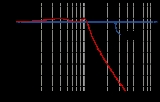
The gain and the group delay for a fifth-order type I Chebyshev filter with ε=0.5 are plotted in the graph on the left. It can be seen that there are ripples in the gain and the group delay in the passband but not in the stopband.


Type II Chebyshev filters


Also known as inverse Chebyshev, this type is less common because it does not roll off as fast as type I, and requires more components. It has no ripple in the passband, but does have equiripple in the stopband. The gain is:


In the stopband, the Chebyshev polynomial will oscillate between 0 and 1 so that the gain will oscillate between zero and


and the smallest frequency at which this maximum is attained will be the cutoff frequency . The parameter ε is thus related to the stopband
Stopband
A stopband is a band of frequencies, between specified limits, through which a circuit, such as a filter or telephone circuit, does not allow signals to pass, or the attenuation is above the required stopband attenuation level...

 attenuation
Attenuation
In physics, attenuation is the gradual loss in intensity of any kind of flux through a medium. For instance, sunlight is attenuated by dark glasses, X-rays are attenuated by lead, and light and sound are attenuated by water.In electrical engineering and telecommunications, attenuation affects the...

 γ in decibel
Decibel
The decibel is a logarithmic unit that indicates the ratio of a physical quantity relative to a specified or implied reference level. A ratio in decibels is ten times the logarithm to base 10 of the ratio of two power quantities...

s by:


For a stopband attenuation of 5dB, ε = 0.6801; for an attenuation of 10dB, ε = 0.3333. The frequency fC = ωC/2π is the cutoff frequency. The 3dB frequency fH is related to fC by:

Poles and zeroes


Again, assuming that the cutoff frequency is equal to unity, the poles of the gain of the Chebyshev filter will be the zeroes of the denominator of the gain:


The poles of gain of the type II Chebyshev filter will be the inverse of the poles of the type I filter:


where m = 1, 2, ..., n . The zeroes of the type II Chebyshev filter will be the zeroes of the numerator of the gain:


The zeroes of the type II Chebyshev filter will thus be the inverse of the zeroes of the Chebyshev polynomial.


for m = 1, 2, ..., n

The transfer function


The transfer function will be given by the poles in the left half plane of the gain function, and will have the same zeroes but these zeroes will be single rather than double zeroes.

The group delay


The gain and the group delay for a fifth-order type II Chebyshev filter with ε=0.1 are plotted in the graph on the left. It can be seen that there are ripples in the gain in the stop band but not in the pass band.


Cauer topology


A passive LC Chebyshev low-pass filter
Low-pass filter
A low-pass filter is an electronic filter that passes low-frequency signals but attenuates signals with frequencies higher than the cutoff frequency. The actual amount of attenuation for each frequency varies from filter to filter. It is sometimes called a high-cut filter, or treble cut filter...

 may be realized using a Cauer topology. Inductor or capacitor values of a nth-order Chebyshev filter may be calculated from the following equations:


G1, Gk are the capacitor or inductor element values.
fH, the 3 dB frequency is calculated with:

The coefficients A, Y, β, Ak, and Bk may be calculated from the following equations:


where RdB is the passband ripple in decibels.


The calculated Gk values may then be converted into shunt
Shunt (electrical)
In electronics, a shunt is a device which allows electric current to pass around another point in the circuit. The term is also widely used in photovoltaics to describe an unwanted short circuit between the front and back surface contacts of a solar cell, usually caused by wafer damage.-Defective...

 capacitors and top inductors as shown on the right, or they may be converted into top capacitors and shunt inductors.
  • For example, C1 shunt = G1, L2 top = G2, ...

  • or L1 shunt = G1, C1 top = G2, ...


The resulting circuit is a normalized low-pass filter. Using frequency transformations and impedance scaling, the normalized low-pass filter may be transformed into high-pass
High-pass filter
A high-pass filter is a device that passes high frequencies and attenuates frequencies lower than its cutoff frequency. A high-pass filter is usually modeled as a linear time-invariant system...

, band-pass
Band-pass filter
A band-pass filter is a device that passes frequencies within a certain range and rejects frequencies outside that range.Optical band-pass filters are of common usage....

, and band-stop
Band-stop filter
In signal processing, a band-stop filter or band-rejection filter is a filter that passes most frequencies unaltered, but attenuates those in a specific range to very low levels. It is the opposite of a band-pass filter...

 filters of any desired cutoff frequency
Cutoff frequency
In physics and electrical engineering, a cutoff frequency, corner frequency, or break frequency is a boundary in a system's frequency response at which energy flowing through the system begins to be reduced rather than passing through.Typically in electronic systems such as filters and...

 or bandwidth.

Digital


As with most analog filters, the Chebyshev may be converted to a digital (discrete-time) recursive
Recursive filter
In signal processing, a recursive filter is a type of filter which re-uses one or more of its outputs as an input. This feedback typically results in an unending impulse response , characterised by either exponentially growing, decaying, or sinusoidal signal output components.However, a recursive...

 form via the bilinear transform
Bilinear transform
The bilinear transform is used in digital signal processing and discrete-time control theory to transform continuous-time system representations to discrete-time and vice versa....

. However, as digital filter
Digital filter
In electronics, computer science and mathematics, a digital filter is a system that performs mathematical operations on a sampled, discrete-time signal to reduce or enhance certain aspects of that signal. This is in contrast to the other major type of electronic filter, the analog filter, which is...

s have a finite bandwidth, the response shape of the transformed Chebyshev will be warped. Alternatively, the Matched Z-transform method
Matched Z-transform method
The matched Z-transform method, also called the pole–zero mapping or pole–zero matching method, is a technique for converting a continuous-time filter design to a discrete-time filter design....

 may be used, which does not warp the response.

Comparison with other linear filters


Here is an image showing the Chebyshev filters next to other common kind of filters obtained with the same number of coefficients (all filters are fifth order):

As is clear from the image, Chebyshev filters are sharper than the Butterworth filter
Butterworth filter
The Butterworth filter is a type of signal processing filter designed to have as flat a frequency response as possible in the passband so that it is also termed a maximally flat magnitude filter...

; they are not as sharp as the elliptic one
Elliptic filter
An elliptic filter is a signal processing filter with equalized ripple behavior in both the passband and the stopband...

, but they show fewer ripples over the bandwidth.

See also

Filter design
Filter design
Filter design is the process of designing a filter , often a linear shift-invariant filter, that satisfies a set of requirements, some of which are contradictory...

  • Bessel filter
    Bessel filter
    In electronics and signal processing, a Bessel filter is a type of linear filter with a maximally flat group delay . Bessel filters are often used in audio crossover systems...

  • Butterworth filter
    Butterworth filter
    The Butterworth filter is a type of signal processing filter designed to have as flat a frequency response as possible in the passband so that it is also termed a maximally flat magnitude filter...

  • Comb filter
    Comb filter
    In signal processing, a comb filter adds a delayed version of a signal to itself, causing constructive and destructive interference. The frequency response of a comb filter consists of a series of regularly spaced spikes, giving the appearance of a comb....

  • Elliptic filter
    Elliptic filter
    An elliptic filter is a signal processing filter with equalized ripple behavior in both the passband and the stopband...


Mathematics
Mathematics
Mathematics is the study of quantity, space, structure, and change. Mathematicians seek out patterns and formulate new conjectures. Mathematicians resolve the truth or falsity of conjectures by mathematical proofs, which are arguments sufficient to convince other mathematicians of their validity...

  • Chebyshev nodes
    Chebyshev nodes
    In numerical analysis, Chebyshev nodes are the roots of the Chebyshev polynomial of the first kind. They are often used as nodes in polynomial interpolation because the resulting interpolation polynomial minimizes the Runge's phenomenon.-Definition:...

  • Chebyshev polynomial