


Charlottetown Conference

Encyclopedia
Charlottetown
Charlottetown is a Canadian city. It is both the largest city on and the provincial capital of Prince Edward Island, and the county seat of Queens County. Named after Queen Charlotte, the wife of George III, Charlottetown was first incorporated as a town in 1855 and designated as a city in 1885...
, Prince Edward Island
Prince Edward Island
Prince Edward Island is a Canadian province consisting of an island of the same name, as well as other islands. The maritime province is the smallest in the nation in both land area and population...
for representatives from the colonies of British North America
British North America
British North America is a historical term. It consisted of the colonies and territories of the British Empire in continental North America after the end of the American Revolutionary War and the recognition of American independence in 1783.At the start of the Revolutionary War in 1775 the British...
to discuss Canadian Confederation
Canadian Confederation
Canadian Confederation was the process by which the federal Dominion of Canada was formed on July 1, 1867. On that day, three British colonies were formed into four Canadian provinces...
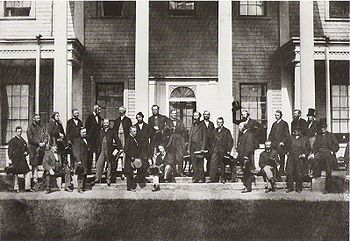
. The conference took place between 1–9 September 1864.
The conference was originally planned as a meeting between representatives from the Maritime colonies only: Nova Scotia
Nova Scotia
Nova Scotia is one of Canada's three Maritime provinces and is the most populous province in Atlantic Canada. The name of the province is Latin for "New Scotland," but "Nova Scotia" is the recognized, English-language name of the province. The provincial capital is Halifax. Nova Scotia is the...
, New Brunswick
New Brunswick
New Brunswick is one of Canada's three Maritime provinces and is the only province in the federation that is constitutionally bilingual . The provincial capital is Fredericton and Saint John is the most populous city. Greater Moncton is the largest Census Metropolitan Area...
, and Prince Edward Island
Prince Edward Island
Prince Edward Island is a Canadian province consisting of an island of the same name, as well as other islands. The maritime province is the smallest in the nation in both land area and population...
. Newfoundland agreed with the movement, but was not notified in time to take part in the proceedings. Britain
United Kingdom
The United Kingdom of Great Britain and Northern IrelandIn the United Kingdom and Dependencies, other languages have been officially recognised as legitimate autochthonous languages under the European Charter for Regional or Minority Languages...
encouraged a Maritime Union
Maritime Union
Maritime Union is a proposed political union of the three Maritime provinces of Canada to form a single new province which would be the fifth-largest in Canada by population...
between these colonies, hoping that they would then become less economically and politically dependent on the Crown, as well as provide for greater economic and military power for the region in light of the ongoing American Civil War
American Civil War
The American Civil War was a civil war fought in the United States of America. In response to the election of Abraham Lincoln as President of the United States, 11 southern slave states declared their secession from the United States and formed the Confederate States of America ; the other 25...
. However another colony, the Province of Canada
Province of Canada
The Province of Canada, United Province of Canada, or the United Canadas was a British colony in North America from 1841 to 1867. Its formation reflected recommendations made by John Lambton, 1st Earl of Durham in the Report on the Affairs of British North America following the Rebellions of...
(modern Ontario
Ontario
Ontario is a province of Canada, located in east-central Canada. It is Canada's most populous province and second largest in total area. It is home to the nation's most populous city, Toronto, and the nation's capital, Ottawa....
and Quebec
Quebec
Quebec or is a province in east-central Canada. It is the only Canadian province with a predominantly French-speaking population and the only one whose sole official language is French at the provincial level....
), heard news of the planned conference and asked that the agenda be expanded to discuss a union that would also include them. Newfoundland also requested to be able to attend the conference in August 1864, but by then it was too late to change the plans.
Coincidentally there was a circus in Charlottetown at the same time, which was much more interesting to the majority of the population. There was no one working at the public wharf at the foot of Great George Street when the Canadian delegates arrived on the steamship SS Victoria, so Prince Edward Island representative William Henry Pope had to handle receptions by himself, including rowing out to greet the new arrivals. The Canadian delegates stayed each night on board the SS Queen Victoria as the circus and the Maritime delegates had taken up most of the accommodations in town.
Conference
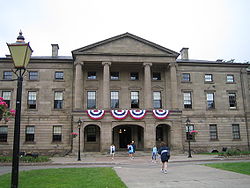
Province House (Prince Edward Island)
Province House is where the Prince Edward Island Legislature, known as the Legislative Assembly of Prince Edward Island, has met since 1847. The building is located at the intersection of Richmond and Great George Streets in Charlottetown; it is Canada's second-oldest seat of government.- History...
, although some social functions were held at Government House
Government House (Prince Edward Island)
Government House of Prince Edward Island, often referred to as Fanningbank, is the official residence of the Lieutenant Governor of Prince Edward Island, as well as that in Charlottetown of the Canadian monarch...
, the home of the colony's Lieutenant Governor
Lieutenant Governor of Prince Edward Island
The Lieutenant Governor of Prince Edward Island is the viceregal representative in Prince Edward Island of the Canadian monarch, Queen Elizabeth II, who operates distinctly within the province but is also shared equally with the ten other jurisdictions of Canada and resides predominantly in her...
.
The conference began on Thursday, September 1 with a banquet for all of the delegates. Parties and banquets were in fact held each night after the day's discussions had ended (except for Sunday, September 4, when they did not meet). The representatives from the Province of Canada dominated the conference, overshadowing the concerns of the Maritimes, and laying out the foundations for the union that benefitted them the most. Four of the first five days (excluding Sunday) were spent outlining the Canadian position; the Maritime representatives did not discuss their own plans until September 6 and September 7. Canadian delegate George Brown
George Brown (Canadian politician)
George Brown was a Scottish-born Canadian journalist, politician and one of the Fathers of Confederation...
spent two days discussing the details of the proposed constitution, which would keep Canada within the British Empire
British Empire
The British Empire comprised the dominions, colonies, protectorates, mandates and other territories ruled or administered by the United Kingdom. It originated with the overseas colonies and trading posts established by England in the late 16th and early 17th centuries. At its height, it was the...
, but would not include any of the problems which had led to the American Civil War
American Civil War
The American Civil War was a civil war fought in the United States of America. In response to the election of Abraham Lincoln as President of the United States, 11 southern slave states declared their secession from the United States and formed the Confederate States of America ; the other 25...
, which was still raging at the time in the United States.
Most of the Maritimes were convinced that a wider union including the Province of Canada would also be beneficial to them; Prince Edward Island was unsure, however, and very much against confederation. They also believed that this union could be achieved within a few years, rather than in an undefined period in the future as they had originally planned. The conference concluded on Wednesday, September 7, but the representatives agreed to meet again the next month in Quebec City
Quebec City
Quebec , also Québec, Quebec City or Québec City is the capital of the Canadian province of Quebec and is located within the Capitale-Nationale region. It is the second most populous city in Quebec after Montreal, which is about to the southwest...
(see Quebec Conference
Quebec Conference, 1864
The Quebec Conference was the second meeting held in 1864 to discuss Canadian Confederation.The 16 delegates from the Province of Canada, Nova Scotia, New Brunswick, and Prince Edward Island had agreed at the close of the Charlottetown Conference to meet again at Quebec City October 1864...
). A ball was also held on September 8, after which, the delegates returned home.
New Brunswick
- Edward Barron ChandlerEdward Barron ChandlerEdward Barron Chandler was a New Brunswick politician and lawyer from a United Empire Loyalist family. He was one of the Fathers of Confederation....
- John Hamilton GrayJohn Hamilton Gray (New Brunswick politician)John Hamilton Gray, QC was a politician in the Province of New Brunswick, Canada, a jurist, and one of the Fathers of Confederation. He should not be confused with John Hamilton Gray, a Prince Edward Island politician in the same era.Gray was born in St. George's, Bermuda...
- Samuel Leonard TilleySamuel Leonard TilleySir Samuel Leonard Tilley, PC, KCMG was a Canadian politician and one of the Fathers of Confederation. Tilley was descended from United Empire Loyalists on both sides of his family...
- William H. Steeves
- John Mercer JohnsonJohn Mercer JohnsonJohn Mercer Johnson was a politician in the Province of New Brunswick, Canada and a Father of Confederation. He represented Northumberland in the Canadian House of Commons from 1867 to 1868 as a Liberal member....
Nova Scotia
- Adams George ArchibaldAdams George ArchibaldSir Adams George Archibald, KCMG, PC was a Canadian lawyer and politician, and a father of Confederation. He was based in Nova Scotia for most of his career, though he also served as 1st Lieutenant Governor of Manitoba from 1870 to 1872.Archibald was born in Truro to a prominent family in Nova...
- Robert B. DickeyRobert B. DickeyRobert Barry Dickey was a participant in conferences leading to the Canadian Confederation of 1867 and is therefore considered to be one of the Fathers of Confederation....
- William Alexander HenryWilliam Alexander HenryWilliam Alexander Henry was a Canadian lawyer, politician, judge and one of the Fathers of Confederation....
- Jonathan McCullyJonathan McCullyJonathan McCully was a participant at the Confederation conferences at Charlottetown, Quebec City, and in London, and is thus considered one of the Fathers of Canadian Confederation. He did much to promote union through newspaper editorials. For his efforts, he received a Senate appointment...
- Charles TupperCharles TupperSir Charles Tupper, 1st Baronet, GCMG, CB, PC was a Canadian father of Confederation: as the Premier of Nova Scotia from 1864 to 1867, he led Nova Scotia into Confederation. He later went on to serve as the sixth Prime Minister of Canada, sworn in to office on May 1, 1896, seven days after...
Prince Edward Island
- George ColesGeorge ColesGeorge Coles was a Canadian politician, being the first Premier of Prince Edward Island, and a Father of Canadian Confederation....
- John Hamilton Gray
- Edward Palmer
- Andrew Archibald MacdonaldAndrew Archibald MacdonaldAndrew Archibald Macdonald, PC , was the fourth Lieutenant Governor of Prince Edward Island from 1 August 1884 to 2 September 1889, was one of the fathers of Canadian Confederation....
- William Henry Pope
- Edward WhelanEdward WhelanEdward Whelan . Edward Whelan was one of Prince Edward Island's delegates to the Québec Conference and one of the Fathers of the Canadian Confederation. Edward Whelan was also a journalist, orator, and advocate for responsible government.-Early years:Edward Whelan was born in 1824 in Ballina,...
Province of Canada
- George BrownGeorge Brown (Canadian politician)George Brown was a Scottish-born Canadian journalist, politician and one of the Fathers of Confederation...
- Alexander CampbellAlexander Campbell (Canadian politician)Sir Alexander Campbell, PC, KCMG, QC was an English-born, Canadian statesman and politician, and a father of Canadian Confederation....
- George-Étienne CartierGeorge-Étienne CartierSir George-Étienne Cartier, 1st Baronet, PC was a French-Canadian statesman and Father of Confederation.The English spelling of the name, George, instead of Georges, the usual French spelling, is explained by his having been named in honour of King George III....
- Alexander Tilloch GaltAlexander Tilloch GaltSir Alexander Tilloch Galt, GCMG, PC was a politician and a father of Canadian Confederation.He was born in Chelsea, England, the son of Scottish novelist and colonizer, John Galt, and Elizabeth Tilloch Galt. He was a cousin of Sir Hugh Allan.Alexander Galt is interred in the Mount Royal Cemetery...
- John A. MacdonaldJohn A. MacdonaldSir John Alexander Macdonald, GCB, KCMG, PC, PC , QC was the first Prime Minister of Canada. The dominant figure of Canadian Confederation, his political career spanned almost half a century...
- Hector-Louis LangevinHector-Louis LangevinSir Hector-Louis Langevin, PC, KCMG, CB, QC was a Canadian lawyer, politician and one of the Fathers of Confederation....
- William McDougallWilliam McDougall (politician)Sir William McDougall PC CB was a Canadian lawyer, politician and one of the Fathers of Confederation.Born near York, Upper Canada...
- Thomas D'Arcy McGee
External links
- Charlottetown Conference of 1864
- Canadian Confederation, a virtual museum exhibition at Library and Archives Canada