

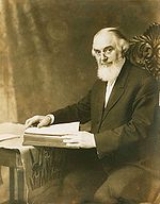
Charles Taze Russell

Encyclopedia
Charles Taze Russell or Pastor Russell, was a prominent early 20th century Christian restorationist minister from Pittsburgh
, Pennsylvania
, USA
, and founder of what is now known as the Bible Student movement
, from which Jehovah's Witnesses
and numerous independent Bible Student groups emerged after his death.
Beginning in July, 1879 he began publishing a monthly religious journal, Zion's Watch Tower and Herald of Christ's Presence. The journal is now published by Jehovah's Witnesses on a semi-monthly basis under the name, The Watchtower Announcing Jehovah's Kingdom
. In 1881 he co-founded Zion's Watch Tower Tract Society
and in 1884 the corporation was officially registered, with Russell as president. Russell wrote many articles, books, tracts, pamphlets and sermons, totaling approximately 50,000 printed pages. From 1886 to 1904, he published a six-volume Bible study series originally entitled Millennial Dawn, later renamed Studies in the Scriptures
, nearly 20 million copies of which were printed and distributed around the world in several languages during his lifetime. (A seventh volume was commissioned by his successor as society president, Joseph Rutherford
, and published in 1917.) The Watch Tower Society officially states that it ceased publication of Russell's writings in 1927, though his books continue to be published by several independent groups.
Russell was a charismatic figure, but claimed no special revelation or vision for his teachings and no special authority on his own behalf. He stated that he did not seek to found a new denomination, but instead intended merely to gather together those who were seeking the truth of God's Word "during this harvest time". He wrote that the "clear unfolding of truth" within his teachings was due to "the simple fact that God's due time has come; and if I did not speak, and no other agent could be found, the very stones would cry out." He viewed himself—and all other Christians anointed with the Holy Spirit—as "God's mouthpiece" and an ambassador of Christ. Later in his career he accepted without protest that many Bible Students viewed him as the "faithful and wise servant
" of Matthew 24:45, and was described by the Watch Tower after his death as having been made "ruler of all the Lord's goods".
After Russell's death, a crisis arose surrounding Rutherford's leadership of the society, culminating in a movement-wide schism. As many as three-quarters of the approximately 50,000 Bible Students who had been associating in 1917 had left by 1931, resulting in the formation of several groups that retained variations on the name Bible Students
. Those who maintained fellowship with the Watch Tower Society adopted the name Jehovah's witnesses in 1931, while those who severed ties with the Society formed their own groups including the Pastoral Bible Institute
in 1918, the Laymen's Home Missionary Movement in 1919, and the Dawn Bible Students Association
in 1929.
-Irish
parents, immigrant Joseph Lytel (icon) Russell (d. December 17, 1897) and Ann Eliza Birney (d. January 25, 1861), on February 16, 1852 in Allegheny, Pennsylvania, USA. Charles was apparently the second of five children, and was one of only two to survive into adulthood.
The Russells lived in Philadelphia, as well as Allegheny
, before moving to Pittsburgh, where they became members of the Presbyterian Church. In his early teens, Charles' father made him partner of his Pittsburgh haberdasher
y store. By age twelve, Russell was writing business contracts for customers and given charge of some of his father's other clothing stores. At age thirteen, Charles left the Presbyterian Church to join the Congregational Church
. In his youth he was known to chalk Bible verses on fence boards and city sidewalks to draw attention to the punishment of hell awaiting the unfaithful in an attempt to convert unbelievers.
At age sixteen, a discussion with a childhood friend on faults perceived in Christianity
(such as contradictions in creed
s, along with medieval traditions) led Charles to question his faith. He then began to investigate other religious views and philosophies, including Islam
, Confucianism
, Buddhism
, Taoism
, Hinduism
, but concluded that they did not provide the answers he was seeking. In 1870, at age eighteen, he attended a presentation by Adventist
minister Jonas Wendell
. During his presentation Wendell outlined his belief that 1873 or 1874 would be the date for Christ's second coming
. He later stated that although he did not entirely agree with the arguments presented by Wendell the presentation itself was sufficient to inspire within him a renewed zeal and reestablish his belief that the Bible the word of God.
under the claim of mental cruelty. She was granted a divorce from bed and board, with alimony, in 1908. Maria Russell died at the age of 88 in St. Petersburg
, Florida
on March 12, 1938 from complications related to Hodgkin's disease.
Adventist
ministers George Storrs
and George Stetson
, themselves frequent attendees, came to the conclusion that many of the primary doctrines of the established churches, including the trinity, hellfire and inherent immortality of the soul, were not substantiated by the scriptures.
Around January 1876 Russell received a copy of Nelson Barbour's Herald of the Morning in the mail. Russell telegraphed Barbour to set up a meeting. The first response was a visit by Barbour and John Henry Paton in Allegheny in March 1876 at Russell's expense to hear their arguments, and compare the conclusions that each side had made in their studies. Russell sponsored a speech by Barbour in St. George's Hall, Philadelphia in August 1876 and attended other lectures by Barbour.
Among the teachings Barbour introduced to Russell was the view that Christians who had died would be raised in April, 1878. Russell, who had previously rejected prophetic chronology, was moved to devote his life to what he was convinced were now the last two years before the invisible, spiritual return of Christ. He sold his five clothing stores for approximately $300,000 (current value $). With Russell's encouragement and financial backing, Barbour wrote an outline of their views in Three Worlds; or Plan of Redemption, published in 1877. A text Russell had previously written, entitled The Object and Manner of our Lord's Return, was published concurrently through the offices of the Herald of the Morning. Russell was eager to lead a Christian revival and called two separate meetings of Christian leaders in Pittsburgh. Russell's ideas, particularly stressing the imminence of the rapture
and the second advent of Christ, were rejected both times.
:
Confused by what was perceived to be an error in calculation, Russell re-examined the doctrine to see if he could determine whether it had biblical origins or was simply Christian tradition. His conclusion that it was tradition led him to begin teaching, through the pages of the Herald, what he believed to have discovered on the subject. Barbour, embarrassed by the failure of their expectations, rejected Russell's explanation and a debate ensued in successive issues of the journal from early 1878 to mid-1879. In a matter of months, Barbour's embarrassment led to a recanting of some of the views he and Russell had previously shared, including any reliance upon prophetic chronology. Their disagreements turned into a debate over Christ's ransom, resulting in a split between the two. Russell removed his financial support and started his own journal, Zion's Watch Tower and Herald of Christ's Presence, with the first issue published in July 1879. Barbour formed The Church of the Strangers that same year, continuing to publish Herald of the Morning.
, with William Henry Conley
as president and Russell as secretary-treasurer, for the purpose of disseminating tracts, papers, doctrinal treatises and Bibles. All materials were printed and bound by Russell's privately owned Tower Publishing Company for an agreed price, then distributed by "colporteurs" (persons who travel to sell or publicize Bibles, religious tracts, etc.). The Society was officially chartered in 1884, with Russell as President, and in 1886 its name was changed to Watch Tower Bible and Tract Society.
In 1908, Russell transferred the headquarters of the Watch Tower Society to its current location in Brooklyn, New York.
, the Virginia
s, Ohio
, and elsewhere, who annually re-elected him "Pastor", and commonly referred to him as "Pastor Russell". Congregations that eventually formed in other nations also followed this tradition.
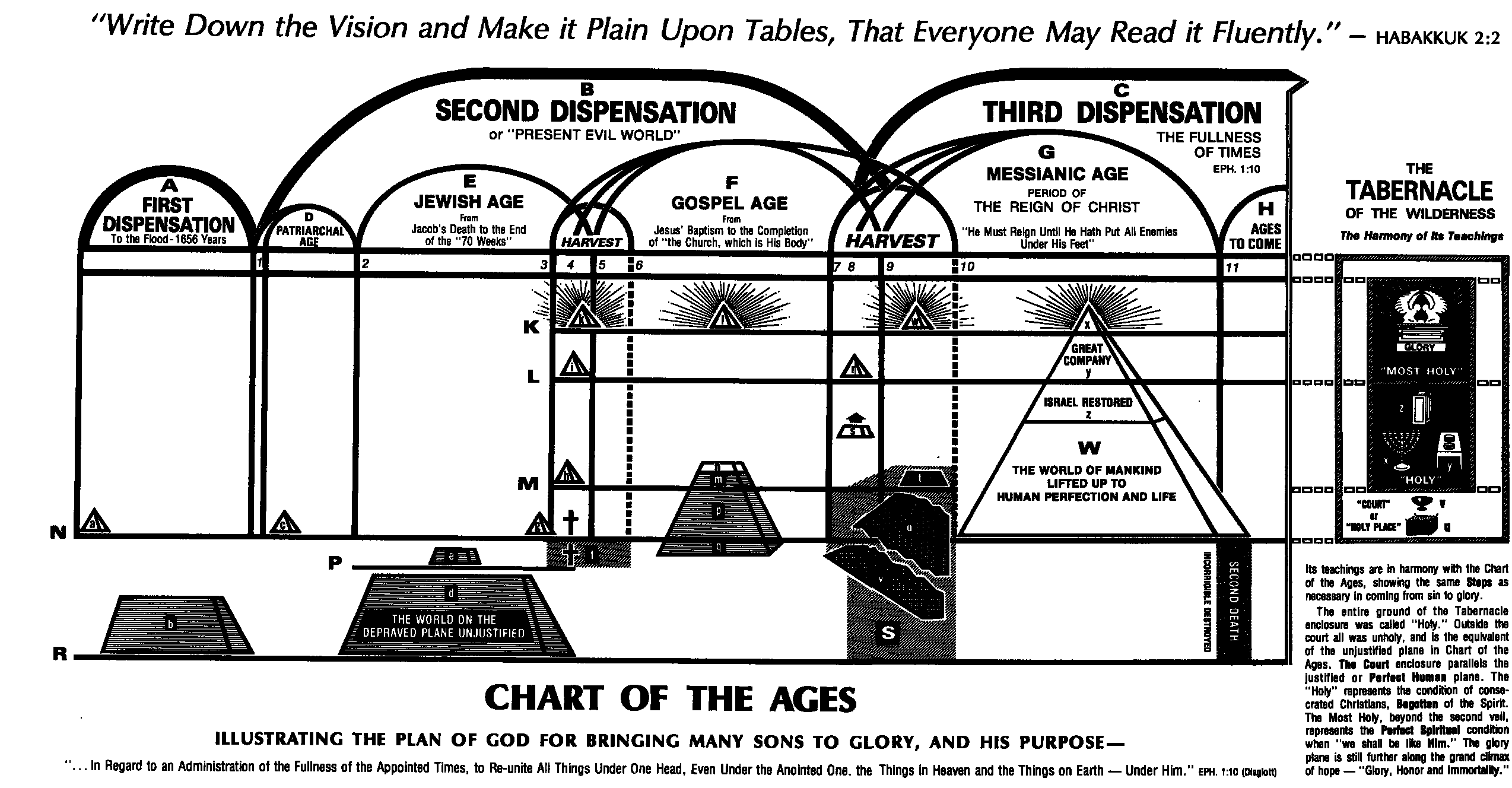
In 1881, he published his first prominent work entitled Food for Thinking Christians. The 162-page "pamphlet" was published using donated funds amounting to approximately $40,000 (current value $). It had a vast circulation of nearly 1.5 million copies over a period of four months distributed throughout the United States, Canada and Great Britain by various channels. During the same year he published Tabernacle and its Teachings which was quickly expanded and reissued as Tabernacle Shadows of the "Better Sacrifices" outlining his interpretation of the various animal sacrifices and Tabernacle ceremonies instituted by Moses
. The distribution of these works and other tracts by the Watch Tower Society during 1881 was claimed to have exceeded by eight times that of the American Tract Society
for the year 1880.
In 1903, newspapers began publishing his written sermons. These newspaper sermons were syndicated worldwide in as many as 4,000 newspapers, eventually reaching an estimated readership of some 15 million in the United States and Canada.
In 1910 the secular journal Overland Monthly
calculated that by 1909 Russell's writings had become the most distributed privately produced English-language works in the United States, and that the entire corpus of his works were the third most circulated on earth exceeded only by the Bible and the Chinese Almanac. In 1912 The Continent, a Presbyterian journal, stated that in North America his writings had achieved a greater circulation "than the combined circulation of the writings of all the priests and preachers in North America."
Russell, however, had many critics and was often labeled a heretic
.
to clarify that they were not novels. Russell published six volumes in the series:
The delayed publication of the seventh volume became a source of great anticipation and mystery among Bible Students. Following Russell's death in 1916, a seventh volume entitled The Finished Mystery was published in 1917, which was advertised as his "posthumous work". This seventh volume was a detailed interpretation of the Book of Revelation
, but also included interpretations of Ezekiel
and the Song of Solomon
. Immediate controversy surrounded both its publication and content, and it soon became known that much of the contents were written and compiled by two of Russell's associates, Clayton J. Woodworth and George H. Fisher, and edited by Joseph Rutherford
, by then the new president of the Watch Tower Society.
, an innovative eight-hour religious film in four parts, incorporating sound, moving film, and color slides. It was the first major screenplay to synchronize sound with moving film. Production began as early as 1912, and the Drama was introduced in 1914 by the Watch Tower Bible and Tract Society of Pennsylvania. A book by the same name was also published. The project's expenses put the organization under some financial pressures; the full cost was estimated at about US$300,000 (current value $).
s, in the concept of a Great Apostasy
that began in the first century AD. He also agreed with many other contemporary Protestants in belief in the imminent Second Coming
of Christ, and Armageddon
. Some of the areas in which his Scriptural interpretations differed from those of Catholics, and many Protestants, include the following:
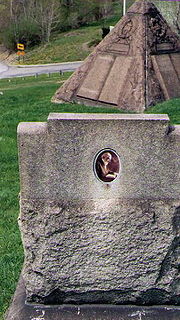
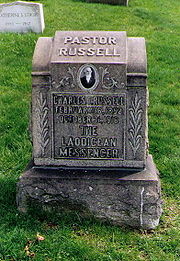 Russell's health had become increasingly poor in the last three years leading up to his death. During his final ministerial tour of the western and southwestern United States he became increasingly ill with cystitis, but ignored advice to abandon the tour. He suffered severe chills during his last week, and at times had to be held in position in bed to prevent suffocation. He was forced to deliver some of his Bible discourses sitting in a chair, and on a few occasions his voice was so weak as to be barely audible. Russell, aged 64 died on October 31, 1916, near Pampa, Texas
, while returning to Brooklyn by train. An associate of Russell's stated that at age 64 his body was more worn out than that of his father who died at age 89. He was buried in Rosemont United Cemetery, Pittsburgh. The gravesite (vide coordinates above) is marked by a headstone, nearby stands a 7 feet (2.1 m) pyramid memorial erected by the Watch Tower Bible and Tract Society in 1921.
was elected president of the Watch Tower Bible and Tract Society, despite disputes over the election process. Further disputes arose over interpretation of sections of Russell's will dealing with the future contents of Zion's Watch Tower magazine, as well as who, if anyone, had authority to print new literature. By the end of the 1920s, nearly three quarters of the Bible Student congregations had rejected Rutherford's on-going changes in organizational structure, doctrinal interpretations, and congregational practices, some of which began to appear in material printed by the Watch Tower Society as early as 1917. Many Bible Students were disaffected by Rutherford's rejection of Russell's views regarding his role in the restoration of the "truth" and support of the Great Pyramid
as having been built under God's direction.
Those remaining supportive of Rutherford adopted the new name "Jehovah's Witnesses
" in 1931, and changed the keyword of their magazine from "Watch Tower" to "The Watchtower". Many of the most prominent Bible Students who had ceased association with the changing Watch Tower Society attempted a regathering of disaffected Bible Students in October 1929 by holding the First Annual Bible Students Reunion Convention in the old Pittsburgh "Bible House" long used by Russell.. These conventions were held yearly, but the process of regathering took nearly twenty years.
in Pittsburgh by associates Otto van Zech, Elmer Bryan, J.B. Adamson, S.G. Rogers, Paul Koetitz, and others. It accused Russell of being a dictatorial leader, a shrewd businessman who appeared eager to collect funds from the selling of the Millennial Dawn books, that he had cheated one of them out of financial gains, and that he issued thousands of Millennial Dawn books under a female pseudonym. A booklet entitled A Conspiracy Exposed and Harvest Siftings was written by Russell and issued as an extra to the April 1894 Zion's Watch Tower magazine in order to preempt attempts to have their views circulated to a wider audience of Bible Students. Russell printed copies of letters he had received from these former associates in order to show that their claims were false, and that those involved 'were guided by Satan in an attempt to subvert his work' as a "minister of the gospel".
During the trial Mrs. Russell's attorney alleged that in 1894 Mr. Russell had engaged in "improper intimacy" with Rose Ball, by then a 25-year old woman whom the Russells had previously cared for as a foster daughter after claiming to be an orphan. Mrs. Russell alleged that Ball had told her Mr. Russell claimed to be an amorous "jellyfish floating around" to different women until someone responded to his advances. Mr. Russell denied the accusations and stated that he had never used such terminology to describe himself. When the judge asked Mrs. Russell if she was accusing her husband of adultery, she replied, "No".
The Washington Post and the Mission Friend of Chicago reprinted the "jellyfish" story while also accusing Russell of immoral conduct. Russell sued the papers for libel; the jury decided in his favor, awarding him one dollar. Following an appeal, Russell received a cash settlement of $15,000 (current value $) plus court costs, and an agreement that the two papers publish his weekly syndicated sermons as well as a retraction defending his character.
Rose Ball Henninges died November 22, 1950 at the age of 81 in Melbourne Victoria Australia having for several years been an author for The People's Paper and remained associated with the Bible Students in Australia until her death.
. Many critics insisted that Russell had deceived and defrauded many by selling the supposedly advanced strain of wheat for $60 per bushel, far above the average cost of wheat at the time. Throughout 1912 and 1913, the Eagle continued to report on Russell's alleged fraud. Russell sued the Eagle for libel, but lost. A government expert investigated the "Miracle Wheat" and said it "was low in the Government tests". Prior to entering the court, the Eagle declared that "at the trial it will show that "Pastor" Russell's religious cult is nothing more than a money-making scheme." Russell defended himself publicly, and in writing, claiming that the wheat was donated to the Watch Tower Society, and although sold for $1 per pound, Mr. Stoner routinely sold it for a $1.25 per pound. Russell claimed to have no financial connection to the wheat, and that no one claimed a refund despite such an offer for up to a year later for any who were dissatisfied with their purchase. According to official records, gross receipts from the fundraiser totaled "about $1800" (current value $), of which "Russell himself did not get a penny" and "The Society itself made no claim for the wheat on its own knowledge and the money received went as a donation into Christian missionary work."
, Ontario
, published and widely distributed a four-page leaflet entitled, Some facts about the Self-Styled "Pastor" Charles T. Russell (of Millennial Dawn Fame), alleging that Russell was involved in questionable business practices, had defrauded his estranged wife, and denounced his qualifications, legitimacy and moral example as a Pastor. Russell in turn sued Ross for defamatory libel on December 2, 1912. After several delays the case came before Police Court Magistrate G. F. Jelfs on March 17, 1913. During cross-examination Russell stated that he had attended public school for only seven years having left when he was about fourteen years of age after which he received instruction through private tutors.. He responded that he was versed in Latin terms "to an extent" but did not know Hebrew or Greek, that he had never been ordained by any bishop or minister, and had never attended a theological seminary or any schools of higher learning. The Hamilton and Toronto Ontario newspapers reported the claims made by Ross and provided a brief outline of the court proceedings, but made no reference to misconduct on the part of Russell, and criticized Ross for having fled Ontario when summoned and not being present during any of the court proceedings. On April 1, 1913 the High Court of Ontario returned a verdict of "No Bill" ruling that Russell was not entitled to damages because the libel was not likely to result in any violence within Canada. Following the libel case Ross published an expanded edition of 48-pages entitled Some Facts and More Facts about the Self-Styled "Pastor" Charles T. Russell (of Millennial Dawn Fame). In this work Ross claimed that during the proceedings on March 17, 1913 Russell had repeatedly lied under oath by affirming that he was ordained but then denying the same when cross-examined, by affirming that he knew the Greek language, but when shown by Counselor Staunton an extract from the New Testament in Greek by Westcott & Hort
he was unable to recognize it, and that he had not been divorced from his wife, but retracted the statement under cross-examination. In response to Ross's accusations, Russell stated through various printed and public sources that he had never claimed knowledge of the Greek language, merely the alphabet and that early Christians were also criticized by the religious authorities for being unlearned and ignorant. He believed that his ordination was "of God" according to the biblical pattern, not requiring any denominational approval or theological training indicating that his annual election as "Pastor" by over 500 congregations worldwide constituted him as properly ordained. Russell contended that Ross and others were attacking him because they were unable to answer his theological arguments preferring instead to resort to slander and character assassination.
. Some have claimed that various symbols Russell employed in his published literature are Masonic in nature, and that such associations implied he engaged in occult activity. In later editions of the Studies in the Scriptures
series a winged solar disk was stamped on the front cover, a symbol that is also associated with Freemasonry. However, Russell's use of the winged solar-disk
originated from his understanding of Malachi 4:2, which denotes a sun with wings, as a symbol that Christ's millennial Kingdom had begun to emerge. Some critics also claim that the pyramid near Russell's gravesite is Masonic, because of its shape and its use of the Cross and Crown
symbol, although this remains disputed. Despite these claims, the Grand Lodge officially stated that Russell was not a Freemason, and the symbols used are not exclusive to Masonry but pre-date the fraternity. The Encyclopedia of Occultism and Parapsychology notes that Russell's supporters, along with other Christian churches have "shown a marked aversion to Spiritualism and other occult phenomena. Very early in the group’s history Russell attacked Spiritualism (which he called Spiritism)".
In June 1913, during his transcontinental speaking tour, Russell gave a discourse in a Masonic hall in San Francisco, where he stated: "Although I have never been a Mason ... Something I do seems to be the same as Masons do, I don't know what it is; but they often give me all kinds of grips
and I give them back, then I tell them I don't know anything about it except just a few grips that have come to me naturally". Throughout his ministry he stated that he believed Christian identity is incompatible with Freemasonry, and that Freemasonry, Knights of Pythias, Theosophy, and other such groups are "grievous evils" and "unclean". A Freemasonry website states: "Russell was not a Freemason. Neither the symbols found in the Watchtower nor the cross and crown symbol are exclusively Masonic."
Pittsburgh, Pennsylvania
Pittsburgh is the second-largest city in the US Commonwealth of Pennsylvania and the county seat of Allegheny County. Regionally, it anchors the largest urban area of Appalachia and the Ohio River Valley, and nationally, it is the 22nd-largest urban area in the United States...
, Pennsylvania
Pennsylvania
The Commonwealth of Pennsylvania is a U.S. state that is located in the Northeastern and Mid-Atlantic regions of the United States. The state borders Delaware and Maryland to the south, West Virginia to the southwest, Ohio to the west, New York and Ontario, Canada, to the north, and New Jersey to...
, USA
United States
The United States of America is a federal constitutional republic comprising fifty states and a federal district...
, and founder of what is now known as the Bible Student movement
Bible Student movement
The Bible Student movement is the name adopted by a Millennialist Restorationist Christian movement that emerged from the teachings and ministry of Charles Taze Russell, also known as Pastor Russell...
, from which Jehovah's Witnesses
Jehovah's Witnesses
Jehovah's Witnesses is a millenarian restorationist Christian denomination with nontrinitarian beliefs distinct from mainstream Christianity. The religion reports worldwide membership of over 7 million adherents involved in evangelism, convention attendance of over 12 million, and annual...
and numerous independent Bible Student groups emerged after his death.
Beginning in July, 1879 he began publishing a monthly religious journal, Zion's Watch Tower and Herald of Christ's Presence. The journal is now published by Jehovah's Witnesses on a semi-monthly basis under the name, The Watchtower Announcing Jehovah's Kingdom
The Watchtower
The Watchtower Announcing Jehovah's Kingdom is an illustrated religious magazine, published semi-monthly in 194 languages by Jehovah's Witnesses via the Watch Tower Bible and Tract Society of Pennsylvania and printed in various branch offices around the world...
. In 1881 he co-founded Zion's Watch Tower Tract Society
Watch Tower Bible and Tract Society of Pennsylvania
The Watch Tower Bible and Tract Society of Pennsylvania is a non-stock, not-for-profit organization headquartered in the New York City borough of Brooklyn, United States. It is the main legal entity used worldwide by Jehovah's Witnesses to direct, administer and develop doctrines for the religion...
and in 1884 the corporation was officially registered, with Russell as president. Russell wrote many articles, books, tracts, pamphlets and sermons, totaling approximately 50,000 printed pages. From 1886 to 1904, he published a six-volume Bible study series originally entitled Millennial Dawn, later renamed Studies in the Scriptures
Studies in the Scriptures
Studies in the Scriptures is a series of publications, intended as a Bible study aid, containing seven volumes of great importance to the history of the Bible Students, and the early history of the Jehovah's Witnesses.-Origin and author:...
, nearly 20 million copies of which were printed and distributed around the world in several languages during his lifetime. (A seventh volume was commissioned by his successor as society president, Joseph Rutherford
Joseph Franklin Rutherford
Joseph Franklin Rutherford , also known as "Judge" Rutherford, was the second president of the incorporated Watch Tower Bible and Tract Society, and played a primary role in the organization and doctrinal development of Jehovah's Witnesses, which emerged from the Bible Student movement established...
, and published in 1917.) The Watch Tower Society officially states that it ceased publication of Russell's writings in 1927, though his books continue to be published by several independent groups.
Russell was a charismatic figure, but claimed no special revelation or vision for his teachings and no special authority on his own behalf. He stated that he did not seek to found a new denomination, but instead intended merely to gather together those who were seeking the truth of God's Word "during this harvest time". He wrote that the "clear unfolding of truth" within his teachings was due to "the simple fact that God's due time has come; and if I did not speak, and no other agent could be found, the very stones would cry out." He viewed himself—and all other Christians anointed with the Holy Spirit—as "God's mouthpiece" and an ambassador of Christ. Later in his career he accepted without protest that many Bible Students viewed him as the "faithful and wise servant
Faithful and Discreet Slave
The faithful and discreet slave is the term used by Jehovah's Witnesses to describe the collective body of "anointed" Christians alive on earth who expect to ascend to heaven at death. Approximately 11,000 Jehovah's Witnesses profess to be members of this "remnant" of the 144,000...
" of Matthew 24:45, and was described by the Watch Tower after his death as having been made "ruler of all the Lord's goods".
After Russell's death, a crisis arose surrounding Rutherford's leadership of the society, culminating in a movement-wide schism. As many as three-quarters of the approximately 50,000 Bible Students who had been associating in 1917 had left by 1931, resulting in the formation of several groups that retained variations on the name Bible Students
Bible Students
Bible Students refers to followers of the Bible Student movement and a number of related religious communities:* Dawn Bible Students Association* Free Bible Students* Jehovah's Witnesses* Laymen's Home Missionary Movement...
. Those who maintained fellowship with the Watch Tower Society adopted the name Jehovah's witnesses in 1931, while those who severed ties with the Society formed their own groups including the Pastoral Bible Institute
Pastoral Bible Institute
The Pastoral Bible Institute was founded by a small group who were part of the Bible Student movement, a Christian denomination following Millerite Adventist notions guided by principles expounded by Pastor Charles Taze Russell...
in 1918, the Laymen's Home Missionary Movement in 1919, and the Dawn Bible Students Association
Dawn Bible Students Association
The Dawn Bible Students Association is a legal entity used by a branch of the Bible Student Movement.It was founded with the intention of becoming a publishing house to begin printing and distributing the first six volumes of the Studies in the Scriptures series that were written by Charles Taze...
in 1929.
Early life
Charles Taze Russell was born to ScottishScottish people
The Scottish people , or Scots, are a nation and ethnic group native to Scotland. Historically they emerged from an amalgamation of the Picts and Gaels, incorporating neighbouring Britons to the south as well as invading Germanic peoples such as the Anglo-Saxons and the Norse.In modern use,...
-Irish
Irish people
The Irish people are an ethnic group who originate in Ireland, an island in northwestern Europe. Ireland has been populated for around 9,000 years , with the Irish people's earliest ancestors recorded having legends of being descended from groups such as the Nemedians, Fomorians, Fir Bolg, Tuatha...
parents, immigrant Joseph Lytel (icon) Russell (d. December 17, 1897) and Ann Eliza Birney (d. January 25, 1861), on February 16, 1852 in Allegheny, Pennsylvania, USA. Charles was apparently the second of five children, and was one of only two to survive into adulthood.
The Russells lived in Philadelphia, as well as Allegheny
Allegheny, Pennsylvania
Allegheny City was a Pennsylvania municipality located on the north side of the junction of the Allegheny and Ohio rivers, across from downtown Pittsburgh. It was annexed by Pittsburgh in 1907...
, before moving to Pittsburgh, where they became members of the Presbyterian Church. In his early teens, Charles' father made him partner of his Pittsburgh haberdasher
Haberdasher
A haberdasher is a person who sells small articles for sewing, such as buttons, ribbons, zips, and other notions. In American English, haberdasher is another term for a men's outfitter. A haberdasher's shop or the items sold therein are called haberdashery.-Origin and use:The word appears in...
y store. By age twelve, Russell was writing business contracts for customers and given charge of some of his father's other clothing stores. At age thirteen, Charles left the Presbyterian Church to join the Congregational Church
Congregational church
Congregational churches are Protestant Christian churches practicing Congregationalist church governance, in which each congregation independently and autonomously runs its own affairs....
. In his youth he was known to chalk Bible verses on fence boards and city sidewalks to draw attention to the punishment of hell awaiting the unfaithful in an attempt to convert unbelievers.
At age sixteen, a discussion with a childhood friend on faults perceived in Christianity
Christianity
Christianity is a monotheistic religion based on the life and teachings of Jesus as presented in canonical gospels and other New Testament writings...
(such as contradictions in creed
Creed
A creed is a statement of belief—usually a statement of faith that describes the beliefs shared by a religious community—and is often recited as part of a religious service. When the statement of faith is longer and polemical, as well as didactic, it is not called a creed but a Confession of faith...
s, along with medieval traditions) led Charles to question his faith. He then began to investigate other religious views and philosophies, including Islam
Islam
Islam . The most common are and . : Arabic pronunciation varies regionally. The first vowel ranges from ~~. The second vowel ranges from ~~~...
, Confucianism
Confucianism
Confucianism is a Chinese ethical and philosophical system developed from the teachings of the Chinese philosopher Confucius . Confucianism originated as an "ethical-sociopolitical teaching" during the Spring and Autumn Period, but later developed metaphysical and cosmological elements in the Han...
, Buddhism
Buddhism
Buddhism is a religion and philosophy encompassing a variety of traditions, beliefs and practices, largely based on teachings attributed to Siddhartha Gautama, commonly known as the Buddha . The Buddha lived and taught in the northeastern Indian subcontinent some time between the 6th and 4th...
, Taoism
Taoism
Taoism refers to a philosophical or religious tradition in which the basic concept is to establish harmony with the Tao , which is the mechanism of everything that exists...
, Hinduism
Hinduism
Hinduism is the predominant and indigenous religious tradition of the Indian Subcontinent. Hinduism is known to its followers as , amongst many other expressions...
, but concluded that they did not provide the answers he was seeking. In 1870, at age eighteen, he attended a presentation by Adventist
Adventist
Adventism is a Christian movement which began in the 19th century, in the context of the Second Great Awakening revival in the United States. The name refers to belief in the imminent Second Coming of Jesus Christ. It was started by William Miller, whose followers became known as Millerites...
minister Jonas Wendell
Jonas Wendell
'Elder Jonas Wendell of Edenboro, Pennsylvania, was a zealous Adventist preacher following in the spirit of William Miller. Following the "Great Disappointment" Wendell experienced periods of weak faith, as did many Adventists...
. During his presentation Wendell outlined his belief that 1873 or 1874 would be the date for Christ's second coming
Second Coming
In Christian doctrine, the Second Coming of Christ, the Second Advent, or the Parousia, is the anticipated return of Jesus Christ from Heaven, where he sits at the Right Hand of God, to Earth. This prophecy is found in the canonical gospels and in most Christian and Islamic eschatologies...
. He later stated that although he did not entirely agree with the arguments presented by Wendell the presentation itself was sufficient to inspire within him a renewed zeal and reestablish his belief that the Bible the word of God.
Marriage
On March 13, 1879, Russell married Maria Frances Ackley (m; 1850–1938) after a few months' acquaintance. The couple separated in 1897. Russell blamed the marriage breakup on disagreements over Maria's insistence for a greater editorial role in Zion's Watch Tower magazine, though a later court judgment noted that he had labelled the marriage "a mistake" three years before the dispute over her editorial ambitions had arisen. Maria Russell filed a suit for legal separation in the Court of Common Pleas at Pittsburgh, Pennsylvania in June 1903 and three years later filed for divorceDivorce
Divorce is the final termination of a marital union, canceling the legal duties and responsibilities of marriage and dissolving the bonds of matrimony between the parties...
under the claim of mental cruelty. She was granted a divorce from bed and board, with alimony, in 1908. Maria Russell died at the age of 88 in St. Petersburg
St. Petersburg, Florida
St. Petersburg is a city in Pinellas County, Florida, United States. It is known as a vacation destination for both American and foreign tourists. As of 2008, the population estimate by the U.S. Census Bureau is 245,314, making St...
, Florida
Florida
Florida is a state in the southeastern United States, located on the nation's Atlantic and Gulf coasts. It is bordered to the west by the Gulf of Mexico, to the north by Alabama and Georgia and to the east by the Atlantic Ocean. With a population of 18,801,310 as measured by the 2010 census, it...
on March 12, 1938 from complications related to Hodgkin's disease.
Beginnings
About 1870, Russell and his father established a group with a number of acquaintances to undertake an analytical study of the Bible and the origins of Christian doctrine, creed, and tradition. The group, strongly influenced by the writings of MilleriteMillerites
The Millerites were the followers of the teachings of William Miller who, in 1833, first shared publicly his belief in the coming Second Advent of Jesus Christ in roughly the year 1843.-Origins:...
Adventist
Adventist
Adventism is a Christian movement which began in the 19th century, in the context of the Second Great Awakening revival in the United States. The name refers to belief in the imminent Second Coming of Jesus Christ. It was started by William Miller, whose followers became known as Millerites...
ministers George Storrs
George Storrs
George Storrs was a Christian teacher and writer in the United States.- Biography :George Storrs was born in Lebanon, New Hampshire on December 13, 1796, son to Colonel Constant Storrs and the former Lucinda Howe...
and George Stetson
George Stetson
George Stetson was a Christian pastor.- Biography :The first Stetsons from England arrived in the United States in 1634. George Stetson associated with Henry Grew and George Storrs in his early ministry, and even later with Jonas Wendell and Charles Taze Russell. He was not only a minister, but...
, themselves frequent attendees, came to the conclusion that many of the primary doctrines of the established churches, including the trinity, hellfire and inherent immortality of the soul, were not substantiated by the scriptures.
Around January 1876 Russell received a copy of Nelson Barbour's Herald of the Morning in the mail. Russell telegraphed Barbour to set up a meeting. The first response was a visit by Barbour and John Henry Paton in Allegheny in March 1876 at Russell's expense to hear their arguments, and compare the conclusions that each side had made in their studies. Russell sponsored a speech by Barbour in St. George's Hall, Philadelphia in August 1876 and attended other lectures by Barbour.
Among the teachings Barbour introduced to Russell was the view that Christians who had died would be raised in April, 1878. Russell, who had previously rejected prophetic chronology, was moved to devote his life to what he was convinced were now the last two years before the invisible, spiritual return of Christ. He sold his five clothing stores for approximately $300,000 (current value $). With Russell's encouragement and financial backing, Barbour wrote an outline of their views in Three Worlds; or Plan of Redemption, published in 1877. A text Russell had previously written, entitled The Object and Manner of our Lord's Return, was published concurrently through the offices of the Herald of the Morning. Russell was eager to lead a Christian revival and called two separate meetings of Christian leaders in Pittsburgh. Russell's ideas, particularly stressing the imminence of the rapture
Rapture
The rapture is a reference to the "being caught up" referred to in 1 Thessalonians 4:17, when the "dead in Christ" and "we who are alive and remain" will be caught up in the clouds to meet "the Lord"....
and the second advent of Christ, were rejected both times.
Split with Barbour
When 1878 arrived, failure of the expected rapture of the saints brought great disappointment for Barbour and Russell, and their associates and readers. According to one of Russell's associates, A.H. MacmillanAlexander Hugh Macmillan
Alexander Hugh Macmillan , also referred to as A. H. Macmillan, was an important member of the Bible Students, and later, of Jehovah’s Witnesses. He became a board member of the Watch Tower Bible and Tract Society in 1918...
:
Confused by what was perceived to be an error in calculation, Russell re-examined the doctrine to see if he could determine whether it had biblical origins or was simply Christian tradition. His conclusion that it was tradition led him to begin teaching, through the pages of the Herald, what he believed to have discovered on the subject. Barbour, embarrassed by the failure of their expectations, rejected Russell's explanation and a debate ensued in successive issues of the journal from early 1878 to mid-1879. In a matter of months, Barbour's embarrassment led to a recanting of some of the views he and Russell had previously shared, including any reliance upon prophetic chronology. Their disagreements turned into a debate over Christ's ransom, resulting in a split between the two. Russell removed his financial support and started his own journal, Zion's Watch Tower and Herald of Christ's Presence, with the first issue published in July 1879. Barbour formed The Church of the Strangers that same year, continuing to publish Herald of the Morning.
Watch Tower Society
In 1881, he founded Zion's Watch Tower Tract SocietyWatch Tower Bible and Tract Society of Pennsylvania
The Watch Tower Bible and Tract Society of Pennsylvania is a non-stock, not-for-profit organization headquartered in the New York City borough of Brooklyn, United States. It is the main legal entity used worldwide by Jehovah's Witnesses to direct, administer and develop doctrines for the religion...
, with William Henry Conley
William Henry Conley
William Henry Conley , was a Pittsburgh philanthropist and industrialist. He was married to Sarah Shaffer . Together, they provided organizational and financial support to religious institutions in the United States. William Conley was trained by his uncle in the printing business for ten years...
as president and Russell as secretary-treasurer, for the purpose of disseminating tracts, papers, doctrinal treatises and Bibles. All materials were printed and bound by Russell's privately owned Tower Publishing Company for an agreed price, then distributed by "colporteurs" (persons who travel to sell or publicize Bibles, religious tracts, etc.). The Society was officially chartered in 1884, with Russell as President, and in 1886 its name was changed to Watch Tower Bible and Tract Society.
In 1908, Russell transferred the headquarters of the Watch Tower Society to its current location in Brooklyn, New York.
Publications
With the formation of the Watch Tower Society, Russell's ministry intensified. His Bible study group had grown to hundreds of local members, with followers throughout New EnglandNew England
New England is a region in the northeastern corner of the United States consisting of the six states of Maine, New Hampshire, Vermont, Massachusetts, Rhode Island, and Connecticut...
, the Virginia
Virginia
The Commonwealth of Virginia , is a U.S. state on the Atlantic Coast of the Southern United States. Virginia is nicknamed the "Old Dominion" and sometimes the "Mother of Presidents" after the eight U.S. presidents born there...
s, Ohio
Ohio
Ohio is a Midwestern state in the United States. The 34th largest state by area in the U.S.,it is the 7th‑most populous with over 11.5 million residents, containing several major American cities and seven metropolitan areas with populations of 500,000 or more.The state's capital is Columbus...
, and elsewhere, who annually re-elected him "Pastor", and commonly referred to him as "Pastor Russell". Congregations that eventually formed in other nations also followed this tradition.
In 1881, he published his first prominent work entitled Food for Thinking Christians. The 162-page "pamphlet" was published using donated funds amounting to approximately $40,000 (current value $). It had a vast circulation of nearly 1.5 million copies over a period of four months distributed throughout the United States, Canada and Great Britain by various channels. During the same year he published Tabernacle and its Teachings which was quickly expanded and reissued as Tabernacle Shadows of the "Better Sacrifices" outlining his interpretation of the various animal sacrifices and Tabernacle ceremonies instituted by Moses
Moses
Moses was, according to the Hebrew Bible and Qur'an, a religious leader, lawgiver and prophet, to whom the authorship of the Torah is traditionally attributed...
. The distribution of these works and other tracts by the Watch Tower Society during 1881 was claimed to have exceeded by eight times that of the American Tract Society
American Tract Society
The American Tract Society is a nonprofit, nonsectarian but evangelical organization founded on May 11, 1825 in New York City for the purpose of publishing and disseminating Christian literature. ATS traces its lineage back through the New York Tract Society and the New England Tract Society to...
for the year 1880.
In 1903, newspapers began publishing his written sermons. These newspaper sermons were syndicated worldwide in as many as 4,000 newspapers, eventually reaching an estimated readership of some 15 million in the United States and Canada.
In 1910 the secular journal Overland Monthly
Overland Monthly
Overland Monthly was a monthly magazine based in California, United States, and published in the 19th and 20th century.The magazine's first issue was in July 1868, and continued until the late 1875. The original publishers, in 1880, started The Californian, which became The Californian and Overland...
calculated that by 1909 Russell's writings had become the most distributed privately produced English-language works in the United States, and that the entire corpus of his works were the third most circulated on earth exceeded only by the Bible and the Chinese Almanac. In 1912 The Continent, a Presbyterian journal, stated that in North America his writings had achieved a greater circulation "than the combined circulation of the writings of all the priests and preachers in North America."
Russell, however, had many critics and was often labeled a heretic
Heresy
Heresy is a controversial or novel change to a system of beliefs, especially a religion, that conflicts with established dogma. It is distinct from apostasy, which is the formal denunciation of one's religion, principles or cause, and blasphemy, which is irreverence toward religion...
.
Studies in the Scriptures
Russell devoted nearly a tenth of his fortune, along with contributed funds, in publishing and distributing Food for Thinking Christians in 1881. In the same year followed The Tabernacle and its Teachings and Tabernacle Shadows of the Better Sacrifices. In 1886, after reportedly not making back most of the money spent publishing these three titles, he began publication of what was intended to be a seven-volume series. The volumes were collectively called Millennial Dawn, later renamed Studies in the ScripturesStudies in the Scriptures
Studies in the Scriptures is a series of publications, intended as a Bible study aid, containing seven volumes of great importance to the history of the Bible Students, and the early history of the Jehovah's Witnesses.-Origin and author:...
to clarify that they were not novels. Russell published six volumes in the series:
- The Plan of the Ages – later renamed The Divine Plan of the Ages (1886)
- The Time is at Hand (1889)
- Thy Kingdom Come (1891)
- The Day of Vengeance – later renamed The Battle of Armageddon (1897)
- The At-one-ment Between God and Men (1899)
- The New Creation (1904)
The delayed publication of the seventh volume became a source of great anticipation and mystery among Bible Students. Following Russell's death in 1916, a seventh volume entitled The Finished Mystery was published in 1917, which was advertised as his "posthumous work". This seventh volume was a detailed interpretation of the Book of Revelation
Book of Revelation
The Book of Revelation is the final book of the New Testament. The title came into usage from the first word of the book in Koine Greek: apokalupsis, meaning "unveiling" or "revelation"...
, but also included interpretations of Ezekiel
Book of Ezekiel
The Book of Ezekiel is the third of the Latter Prophets in the Hebrew Bible, following the books of Isaiah and Jeremiah and preceding the Book of the Twelve....
and the Song of Solomon
Song of songs
Song of Songs, also known as the Song of Solomon, is a book of the Hebrew Bible or Old Testament. It may also refer to:In music:* Song of songs , the debut album by David and the Giants* A generic term for medleysPlays...
. Immediate controversy surrounded both its publication and content, and it soon became known that much of the contents were written and compiled by two of Russell's associates, Clayton J. Woodworth and George H. Fisher, and edited by Joseph Rutherford
Joseph Franklin Rutherford
Joseph Franklin Rutherford , also known as "Judge" Rutherford, was the second president of the incorporated Watch Tower Bible and Tract Society, and played a primary role in the organization and doctrinal development of Jehovah's Witnesses, which emerged from the Bible Student movement established...
, by then the new president of the Watch Tower Society.
Photo Drama of Creation
Russell directed the production of a worldwide roadshow presentation entitled The Photo-Drama of CreationThe Photo-Drama of Creation
The Photo-Drama of Creation, or Creation-Drama, was a four-part Christian film produced by the Watch Tower Bible and Tract Society of Pennsylvania under the direction of Charles Taze Russell, the founder of the Bible Student movement.The film presented Russell's beliefs about God's plan from the...
, an innovative eight-hour religious film in four parts, incorporating sound, moving film, and color slides. It was the first major screenplay to synchronize sound with moving film. Production began as early as 1912, and the Drama was introduced in 1914 by the Watch Tower Bible and Tract Society of Pennsylvania. A book by the same name was also published. The project's expenses put the organization under some financial pressures; the full cost was estimated at about US$300,000 (current value $).
Theology and teachings
Following his analytical examination of the Bible, Russell and other Bible Students came to believe that Christian creeds and traditions were harmful errors, believing they had restored Christianity to the purity held in the first century. Such views and conclusions were viewed as heresy by many Church leaders and scholars in his day. Russell agreed with other Protestants on the primacy of the Bible, and justification by faith alone, but thought that errors had been introduced in interpretation. Russell agreed with many 19th century Protestants, including MilleriteMillerite
Millerite is a nickel sulfide mineral, NiS. It is brassy in colour and has an acicular habit, often forming radiating masses and furry aggregates...
s, in the concept of a Great Apostasy
Great Apostasy
The Great Apostasy is a term used by some religious groups to describe a general fallen state of traditional Christianity, especially the Papacy, because it allowed the traditional Roman mysteries and deities of solar monism such as Mithras and Sol Invictus and idol worship back into the church,...
that began in the first century AD. He also agreed with many other contemporary Protestants in belief in the imminent Second Coming
Second Coming
In Christian doctrine, the Second Coming of Christ, the Second Advent, or the Parousia, is the anticipated return of Jesus Christ from Heaven, where he sits at the Right Hand of God, to Earth. This prophecy is found in the canonical gospels and in most Christian and Islamic eschatologies...
of Christ, and Armageddon
Armageddon
Armageddon is, according to the Bible, the site of a battle during the end times, variously interpreted as either a literal or symbolic location...
. Some of the areas in which his Scriptural interpretations differed from those of Catholics, and many Protestants, include the following:
- HellHellIn many religious traditions, a hell is a place of suffering and punishment in the afterlife. Religions with a linear divine history often depict hells as endless. Religions with a cyclic history often depict a hell as an intermediary period between incarnations...
. He maintained that there was a heavenly resurrection of 144,000 righteous, as well as a "great multitude", but believed that the remainder of mankind slept in death, awaiting an earthly resurrection. - The TrinityTrinityThe Christian doctrine of the Trinity defines God as three divine persons : the Father, the Son , and the Holy Spirit. The three persons are distinct yet coexist in unity, and are co-equal, co-eternal and consubstantial . Put another way, the three persons of the Trinity are of one being...
. Russell believed in the divinity of Christ, but differed from orthodoxy by teaching Jesus had received that divinity as a gift from the Father, after dying on the cross. He also taught that the Holy Spirit is not a person, but the manifestation of God's power. - Christ's Second ComingSecond ComingIn Christian doctrine, the Second Coming of Christ, the Second Advent, or the Parousia, is the anticipated return of Jesus Christ from Heaven, where he sits at the Right Hand of God, to Earth. This prophecy is found in the canonical gospels and in most Christian and Islamic eschatologies...
. Russell believed that Christ had returned invisibly in 1874, and that he had been ruling from the heavensParousiaParousia is an ancient Greek word meaning presence, arrival, or official visit.-Classical usage:# Physical presence, arrival – The main use is the physical presence of a person, which where that person is not already present refers to the prospect of the physical arrival of that person, especially...
since that date. He predicted that a period known as the "Gentile Times" would end in 1914, and that Christ would take power of Earth's affairs at that time. He interpreted the outbreak of World War IWorld War IWorld War I , which was predominantly called the World War or the Great War from its occurrence until 1939, and the First World War or World War I thereafter, was a major war centred in Europe that began on 28 July 1914 and lasted until 11 November 1918...
as the beginning of ArmageddonArmageddonArmageddon is, according to the Bible, the site of a battle during the end times, variously interpreted as either a literal or symbolic location...
, which he viewed to be both a gradual deterioration of civilized society, and a climactic multi-national attack on a restored Israel accompanied by worldwide anarchy. - PyramidologyPyramidologyPyramidology is a term used, sometimes disparagingly, to refer to various pseudoscientific speculations regarding pyramids, most often the Giza Necropolis and the Great Pyramid of Giza in Egypt...
. Following views first taught by Christian writers such as John Taylor, Charles Piazzi SmythCharles Piazzi SmythCharles Piazzi Smyth , was Astronomer Royal for Scotland from 1846 to 1888, well-known for many innovations in astronomy and his pyramidological and metrological studies of the Great Pyramid of Giza....
and Joseph SeissJoseph SeissJoseph Augustus Seiss was an American theologian and Lutheran minister known for his religion writings on pyramidology and dispensationalism.-Life:...
, he believed the Great Pyramid of Giza was built by the HebrewsHebrewsHebrews is an ethnonym used in the Hebrew Bible...
(associated to the HyksosHyksosThe Hyksos were an Asiatic people who took over the eastern Nile Delta during the twelfth dynasty, initiating the Second Intermediate Period of ancient Egypt....
) under God’s direction, but to be understood only in our day. He adopted and used Seiss's phrase referring to it as "the Bible in stone". He believed that certain biblical texts, including Isaiah 19:19–20 and others, prophesied a future understanding of the Great Pyramid and adopted the view that the various ascending and descending passages represented the fall of man, the provision of the Mosaic LawTorahTorah- A scroll containing the first five books of the BibleThe Torah , is name given by Jews to the first five books of the bible—Genesis , Exodus , Leviticus , Numbers and Deuteronomy Torah- A scroll containing the first five books of the BibleThe Torah , is name given by Jews to the first five...
, the death of Christ, the exultation of the saints in heaven, etc. Calculations were made using the pattern of an inch per year. Dates such as 1874, 1914, and 1948 were purported to have been found through the study of this monument. - Christian ZionismChristian ZionismChristian Zionism is a belief among some Christians that the return of the Jews to the Holy Land, and the establishment of the State of Israel in 1948, is in accordance with Biblical prophecy. It overlaps with, but is distinct from, the nineteenth century movement for the Restoration of the Jews...
. Expanding upon an idea suggested by Nelson Barbour, Russell taught as early as 1879 that God's favor had been restored to JewsJewsThe Jews , also known as the Jewish people, are a nation and ethnoreligious group originating in the Israelites or Hebrews of the Ancient Near East. The Jewish ethnicity, nationality, and religion are strongly interrelated, as Judaism is the traditional faith of the Jewish nation...
as the result of a prophetic "double" which had ended in 1878 (favor from JacobJacobJacob "heel" or "leg-puller"), also later known as Israel , as described in the Hebrew Bible, the Talmud, the New Testament and the Qur'an was the third patriarch of the Hebrew people with whom God made a covenant, and ancestor of the tribes of Israel, which were named after his descendants.In the...
to Jesus, then disfavor from Jesus until 1878). In 1910, he conducted a meeting at the New York HippodromeNew York HippodromeThe Hippodrome Theatre, also called the New York Hippodrome, was a theatre in New York City from 1905 to 1939, located on Sixth Avenue between 43rd and 44th Streets in the Theater District of Midtown Manhattan. It was called the world's largest theatre by its builders and had a seating capacity of...
Theatre, with thousands of Jews attending. Jews and Christians alike were shocked by his teaching that Jews should not convert to Christianity. Russell believed that the land of PalestinePalestinePalestine is a conventional name, among others, used to describe the geographic region between the Mediterranean Sea and the Jordan River, and various adjoining lands....
belonged exclusively to the Jewish race, that God was now calling them back to their land, and that they would be the center of earthly leadership under God's Kingdom. Early in Russell's ministry, he speculated that the Jews would possibly flock to Palestine and form their own nation by the year 1910. Shortly before his death, he utilized the Jewish press to stress that 1914 prophetically marked the time when Gentile nations no longer had earthly authority with the result that all Jews were, from that time onward, permitted and guided by God to gather to Palestine and boldly reclaim the land for themselves. - Climate changeClimate changeClimate change is a significant and lasting change in the statistical distribution of weather patterns over periods ranging from decades to millions of years. It may be a change in average weather conditions or the distribution of events around that average...
. In writings as early as 1883 (and through to the end of his life) Russell repeatedly expressed the view that the world's climate would gradually but significantly change as a prelude to the re-establishment of Eden-like conditions. These changes, he said, would include the gradual melting of the Greenland ice sheet, the Arctic and Antarctic polar ice caps, and the general warming of the earth.
Death
40°30′35.27"N 80°0′56.65"WPampa, Texas
Pampa is a city in Gray County, Texas, United States. The population was 17,887 at the 2000 census. It is the county seat of Gray County.Pampa is the principal city of the Pampa Micropolitan Statistical Area, which includes all of Gray and Roberts counties....
, while returning to Brooklyn by train. An associate of Russell's stated that at age 64 his body was more worn out than that of his father who died at age 89. He was buried in Rosemont United Cemetery, Pittsburgh. The gravesite (vide coordinates above) is marked by a headstone, nearby stands a 7 feet (2.1 m) pyramid memorial erected by the Watch Tower Bible and Tract Society in 1921.
Legacy
In January 1917, Joseph Franklin RutherfordJoseph Franklin Rutherford
Joseph Franklin Rutherford , also known as "Judge" Rutherford, was the second president of the incorporated Watch Tower Bible and Tract Society, and played a primary role in the organization and doctrinal development of Jehovah's Witnesses, which emerged from the Bible Student movement established...
was elected president of the Watch Tower Bible and Tract Society, despite disputes over the election process. Further disputes arose over interpretation of sections of Russell's will dealing with the future contents of Zion's Watch Tower magazine, as well as who, if anyone, had authority to print new literature. By the end of the 1920s, nearly three quarters of the Bible Student congregations had rejected Rutherford's on-going changes in organizational structure, doctrinal interpretations, and congregational practices, some of which began to appear in material printed by the Watch Tower Society as early as 1917. Many Bible Students were disaffected by Rutherford's rejection of Russell's views regarding his role in the restoration of the "truth" and support of the Great Pyramid
Great Pyramid of Giza
The Great Pyramid of Giza is the oldest and largest of the three pyramids in the Giza Necropolis bordering what is now El Giza, Egypt. It is the oldest of the Seven Wonders of the Ancient World, and the only one to remain largely intact...
as having been built under God's direction.
Those remaining supportive of Rutherford adopted the new name "Jehovah's Witnesses
Jehovah's Witnesses
Jehovah's Witnesses is a millenarian restorationist Christian denomination with nontrinitarian beliefs distinct from mainstream Christianity. The religion reports worldwide membership of over 7 million adherents involved in evangelism, convention attendance of over 12 million, and annual...
" in 1931, and changed the keyword of their magazine from "Watch Tower" to "The Watchtower". Many of the most prominent Bible Students who had ceased association with the changing Watch Tower Society attempted a regathering of disaffected Bible Students in October 1929 by holding the First Annual Bible Students Reunion Convention in the old Pittsburgh "Bible House" long used by Russell.. These conventions were held yearly, but the process of regathering took nearly twenty years.
Leadership Style
As early as 1892, Russell's views and management style were strongly criticized by certain individuals associated with his ministry. In 1893 a paper was written and circulated to Bible StudentsBible Students
Bible Students refers to followers of the Bible Student movement and a number of related religious communities:* Dawn Bible Students Association* Free Bible Students* Jehovah's Witnesses* Laymen's Home Missionary Movement...
in Pittsburgh by associates Otto van Zech, Elmer Bryan, J.B. Adamson, S.G. Rogers, Paul Koetitz, and others. It accused Russell of being a dictatorial leader, a shrewd businessman who appeared eager to collect funds from the selling of the Millennial Dawn books, that he had cheated one of them out of financial gains, and that he issued thousands of Millennial Dawn books under a female pseudonym. A booklet entitled A Conspiracy Exposed and Harvest Siftings was written by Russell and issued as an extra to the April 1894 Zion's Watch Tower magazine in order to preempt attempts to have their views circulated to a wider audience of Bible Students. Russell printed copies of letters he had received from these former associates in order to show that their claims were false, and that those involved 'were guided by Satan in an attempt to subvert his work' as a "minister of the gospel".
Allegation of Immoral Conduct
In 1897 Russell's wife, Maria, left him after a disagreement over the management of Zion's Watch Tower magazine. She believed that, as his wife, she should have equal control over its administration and equal privilege in writing articles, preaching, and traveling abroad as his representative. In 1903 she filed for legal separation on the grounds of mental cruelty, because of what she considered to be forced celibacy and frequent cold, indifferent treatment. The separation was granted in 1906, with Russell charged to pay alimony.During the trial Mrs. Russell's attorney alleged that in 1894 Mr. Russell had engaged in "improper intimacy" with Rose Ball, by then a 25-year old woman whom the Russells had previously cared for as a foster daughter after claiming to be an orphan. Mrs. Russell alleged that Ball had told her Mr. Russell claimed to be an amorous "jellyfish floating around" to different women until someone responded to his advances. Mr. Russell denied the accusations and stated that he had never used such terminology to describe himself. When the judge asked Mrs. Russell if she was accusing her husband of adultery, she replied, "No".
The Washington Post and the Mission Friend of Chicago reprinted the "jellyfish" story while also accusing Russell of immoral conduct. Russell sued the papers for libel; the jury decided in his favor, awarding him one dollar. Following an appeal, Russell received a cash settlement of $15,000 (current value $) plus court costs, and an agreement that the two papers publish his weekly syndicated sermons as well as a retraction defending his character.
Rose Ball Henninges died November 22, 1950 at the age of 81 in Melbourne Victoria Australia having for several years been an author for The People's Paper and remained associated with the Bible Students in Australia until her death.
'Miracle Wheat'
On March 22, 1911, The Brooklyn Daily Eagle published articles accusing Russell of gaining profit from a strain of wheat named "Miracle Wheat" by its alleged discoverer, K.B. Stoner of Fincastle, VirginiaFincastle, Virginia
Fincastle is a town in Botetourt County, Virginia, United States. The population was 353 at the 2010 census. It is the county seat of Botetourt County.Fincastle is part of the Roanoke Metropolitan Statistical Area.-History:...
. Many critics insisted that Russell had deceived and defrauded many by selling the supposedly advanced strain of wheat for $60 per bushel, far above the average cost of wheat at the time. Throughout 1912 and 1913, the Eagle continued to report on Russell's alleged fraud. Russell sued the Eagle for libel, but lost. A government expert investigated the "Miracle Wheat" and said it "was low in the Government tests". Prior to entering the court, the Eagle declared that "at the trial it will show that "Pastor" Russell's religious cult is nothing more than a money-making scheme." Russell defended himself publicly, and in writing, claiming that the wheat was donated to the Watch Tower Society, and although sold for $1 per pound, Mr. Stoner routinely sold it for a $1.25 per pound. Russell claimed to have no financial connection to the wheat, and that no one claimed a refund despite such an offer for up to a year later for any who were dissatisfied with their purchase. According to official records, gross receipts from the fundraiser totaled "about $1800" (current value $), of which "Russell himself did not get a penny" and "The Society itself made no claim for the wheat on its own knowledge and the money received went as a donation into Christian missionary work."
Qualifications
In June 1912 Rev. J. J. Ross (1871-1935), Pastor of the James Street Baptist Church in HamiltonHamilton, Ontario
Hamilton is a port city in the Canadian province of Ontario. Conceived by George Hamilton when he purchased the Durand farm shortly after the War of 1812, Hamilton has become the centre of a densely populated and industrialized region at the west end of Lake Ontario known as the Golden Horseshoe...
, Ontario
Ontario
Ontario is a province of Canada, located in east-central Canada. It is Canada's most populous province and second largest in total area. It is home to the nation's most populous city, Toronto, and the nation's capital, Ottawa....
, published and widely distributed a four-page leaflet entitled, Some facts about the Self-Styled "Pastor" Charles T. Russell (of Millennial Dawn Fame), alleging that Russell was involved in questionable business practices, had defrauded his estranged wife, and denounced his qualifications, legitimacy and moral example as a Pastor. Russell in turn sued Ross for defamatory libel on December 2, 1912. After several delays the case came before Police Court Magistrate G. F. Jelfs on March 17, 1913. During cross-examination Russell stated that he had attended public school for only seven years having left when he was about fourteen years of age after which he received instruction through private tutors.. He responded that he was versed in Latin terms "to an extent" but did not know Hebrew or Greek, that he had never been ordained by any bishop or minister, and had never attended a theological seminary or any schools of higher learning. The Hamilton and Toronto Ontario newspapers reported the claims made by Ross and provided a brief outline of the court proceedings, but made no reference to misconduct on the part of Russell, and criticized Ross for having fled Ontario when summoned and not being present during any of the court proceedings. On April 1, 1913 the High Court of Ontario returned a verdict of "No Bill" ruling that Russell was not entitled to damages because the libel was not likely to result in any violence within Canada. Following the libel case Ross published an expanded edition of 48-pages entitled Some Facts and More Facts about the Self-Styled "Pastor" Charles T. Russell (of Millennial Dawn Fame). In this work Ross claimed that during the proceedings on March 17, 1913 Russell had repeatedly lied under oath by affirming that he was ordained but then denying the same when cross-examined, by affirming that he knew the Greek language, but when shown by Counselor Staunton an extract from the New Testament in Greek by Westcott & Hort
Fenton John Anthony Hort
Fenton John Anthony Hort was an Irish theologian and editor, with Brooke Westcott of a critical edition of The New Testament in the Original Greek.-Life:...
he was unable to recognize it, and that he had not been divorced from his wife, but retracted the statement under cross-examination. In response to Ross's accusations, Russell stated through various printed and public sources that he had never claimed knowledge of the Greek language, merely the alphabet and that early Christians were also criticized by the religious authorities for being unlearned and ignorant. He believed that his ordination was "of God" according to the biblical pattern, not requiring any denominational approval or theological training indicating that his annual election as "Pastor" by over 500 congregations worldwide constituted him as properly ordained. Russell contended that Ross and others were attacking him because they were unable to answer his theological arguments preferring instead to resort to slander and character assassination.
Alleged connections with Freemasonry
Several decades after his death, it was alleged that Russell had links with FreemasonryFreemasonry
Freemasonry is a fraternal organisation that arose from obscure origins in the late 16th to early 17th century. Freemasonry now exists in various forms all over the world, with a membership estimated at around six million, including approximately 150,000 under the jurisdictions of the Grand Lodge...
. Some have claimed that various symbols Russell employed in his published literature are Masonic in nature, and that such associations implied he engaged in occult activity. In later editions of the Studies in the Scriptures
Studies in the Scriptures
Studies in the Scriptures is a series of publications, intended as a Bible study aid, containing seven volumes of great importance to the history of the Bible Students, and the early history of the Jehovah's Witnesses.-Origin and author:...
series a winged solar disk was stamped on the front cover, a symbol that is also associated with Freemasonry. However, Russell's use of the winged solar-disk
Winged sun
The winged sun is a symbol associated with divinity, royalty and power in the Ancient Near East . The symbol has also been found in the records of ancient cultures residing in various regions of South America as well as Australia.- Ancient Egyptian use :In Ancient Egypt, the symbol is attested...
originated from his understanding of Malachi 4:2, which denotes a sun with wings, as a symbol that Christ's millennial Kingdom had begun to emerge. Some critics also claim that the pyramid near Russell's gravesite is Masonic, because of its shape and its use of the Cross and Crown
Cross and Crown
The Cross and Crown is a traditional Christian symbol , appearing in many churches , that has also been used in heraldry...
symbol, although this remains disputed. Despite these claims, the Grand Lodge officially stated that Russell was not a Freemason, and the symbols used are not exclusive to Masonry but pre-date the fraternity. The Encyclopedia of Occultism and Parapsychology notes that Russell's supporters, along with other Christian churches have "shown a marked aversion to Spiritualism and other occult phenomena. Very early in the group’s history Russell attacked Spiritualism (which he called Spiritism)".
In June 1913, during his transcontinental speaking tour, Russell gave a discourse in a Masonic hall in San Francisco, where he stated: "Although I have never been a Mason ... Something I do seems to be the same as Masons do, I don't know what it is; but they often give me all kinds of grips
Secret handshake
A secret handshake is a distinct form of handshake or greeting which conveys membership in or loyalty to a club, clique or subculture. The typical secret handshake involves placing one's fingers or thumbs in a particular position, one that will be recognized by fellow members while seeming to be a...
and I give them back, then I tell them I don't know anything about it except just a few grips that have come to me naturally". Throughout his ministry he stated that he believed Christian identity is incompatible with Freemasonry, and that Freemasonry, Knights of Pythias, Theosophy, and other such groups are "grievous evils" and "unclean". A Freemasonry website states: "Russell was not a Freemason. Neither the symbols found in the Watchtower nor the cross and crown symbol are exclusively Masonic."
External links
- Watchtower.org Official website of Jehovah's Witnesses
- Pastor-Russell.com Pastor Russell website
- Jehovah's Witnesses in the Divine Purpose (1959), Watchtower Bible and Tract Society.
- The Bible Student Movement in the Days of C.T. Russell, James Parkinson, (1975)
- 1975 Yearbook of Jehovah's Witnesses (1974), Watchtower Bible and Tract Society.
- Jehovah's Witnesses in the Divine Purpose (1959), Watchtower Bible and Tract Society.
- Jehovah's Witnesses—Proclaimers of God's Kingdom (1993), Watchtower Bible and Tract Society.
- The Golden Age, A Journal of Fact Hope and Courage, Vol. 12, No. 308, p. 655–657, (1931) published by the "Watchtower Bible & Tract Society", Brooklyn NY
- The Golden Age, A Journal of Fact Hope and Courage, Vol. 13, No. 315, p. 21–27, (1931) published by the "Watchtower Bible & Tract Society", Brooklyn, NY
- Faith on the March, A.H. Macmillan, (1957)
- Biography of Charles Taze Russell from Zion's Watch Tower obituary issue, December 1, 1916
- Harvest Gatherings and Siftings Zion's Watch Tower, June 1, 1916, p. 170.
- International Bible Students Souvenir Convention Report for 1916, "Pastor Russell Passes Through the Gates of Glory", Chicago, 1917
- International Bible Students Souvenir Convention Report for 1907, "Praise and Testimony Meeting", Chicago, 1908
- Laodicean Messenger (1923) Chicago: The Bible Students Book Store; Memoirs of the Life of Charles Taze Russell.
- Message to Herald of the Morning subscribers 1879 Pittsburgh, Pa; Zion's Watch Tower and Herald of Christ's Presence, July 1, 1879, Supplement
- The Messenger of Laodicea, Watch Tower Bible and Tract Society, 1919
- Pyramid at Russell's Grave
- North Side: People: Charles Taze Russell – information page at the Carnegie Library of Pittsburgh’s website.
- CT Russell Database – Database of Russell's writings
- C. T. Russell, audience, 1913: Period between the death of apostles and now (Real Player required)
- C. T. Russell, audience, 1913: Suppression by Religious Inquisitions (Real Player required)
- Russell's Last Will & Testament
- Studies in the Scriptures Online
- Studies in the Scriptures from Biblestudents.com
- St. Paul Enterprise Nov 7, 14, 21 and 28, 1916 articles "Regarding the Death and Burial of, and Memorial Services for, Pastor Russell"
- Chapter II. Organizational Beginnings: (1873–1912) Charles Taze Russell from Barbara G. Harrison's Visions of Glory: A History and a Memory of Jehovah’s Witnesses, New York, 1978 Simon & Shuster. See also chapters IV and VI.
- Where Else But Pittsburgh! George Swetnam, Davis & Warde, Inc., 1958
- Works of Charles Taze Russell and their effect upon Religion in America 1974 Bob Chastain, Master's Thesis