
| |
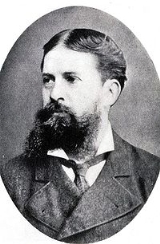
Charles Sanders Peirce (pronounced purse) (September 10, 1839 – April 19, 1914) was an American logician, mathematician, philosopher, and scientist, born in Cambridge, Massachusetts. Peirce was educated as a chemist and employed as a scientist for 30 years. It is largely his contributions to logic, mathematics, philosophy, and semiotics (and his founding of pragmatism) that is appreciated today. In 1934, the philosopher Paul Weiss called Peirce "the most original and versatile of American philosophers and America's greatest logician".
Although an innovator in fields such as mathematics, research methodology, the philosophy of science, epistemology, and metaphysics, Peirce considered himself a logician first and foremost.

Discussion
Ask a question about 'Charles Peirce'
Start a new discussion about 'Charles Peirce'
Answer questions from other users
|
Quotations
All the evolution we know of proceeds from the vague to the definite.
Vol. VI, par. 191
Do not block the way of inquiry.
Vol. I, par. 135
Every man is fully satisfied that there is such a thing as truth, or he would not ask any question.
Vol. V, par. 211
Let us not pretend to doubt in philosophy what we do not doubt in our hearts.
Vol. V, par. 265
Mere imagination would indeed be mere trifling; only no imagination is mere.
Vol. VI, par. 286
The idea does not belong to the soul; it is the soul that belongs to the idea.
Vol. I, par. 216

Encyclopedia
Charles Sanders Peirce (pronounced purse) (September 10, 1839 – April 19, 1914) was an American logician, mathematician, philosopher, and scientist, born in Cambridge, Massachusetts. Peirce was educated as a chemist and employed as a scientist for 30 years. It is largely his contributions to logic, mathematics, philosophy, and semiotics (and his founding of pragmatism) that is appreciated today. In 1934, the philosopher Paul Weiss called Peirce "the most original and versatile of American philosophers and America's greatest logician".
Although an innovator in fields such as mathematics, research methodology, the philosophy of science, epistemology, and metaphysics, Peirce considered himself a logician first and foremost. While he made major contributions to formal logic, "logic" for him encompassed much of what is now called the philosophy of science and epistemology. He, in turn, saw logic as a branch of semiotics, of which he is a founder. As early as 1886 he saw that logical operations could be carried out by electrical switching circuits, an idea used decades later to produce digital computers.
Life
Charles Sanders Peirce was the son of Sarah Hunt Mills and Benjamin Peirce, a professor of astronomy and mathematics at Harvard University, perhaps the first serious research mathematician in America. At 12 years of age, Charles read an older brother's copy of Richard Whately's Elements of Logic, then the leading English language text on the subject. Thus began his lifelong fascination with logic and reasoning. He went on to obtain the BA and MA from Harvard, and in 1863 the Lawrence Scientific School awarded him its first M.Sc. in chemistry. This last degree was awarded summa cum laude; otherwise his academic record was undistinguished. At Harvard, he began lifelong friendships with Francis Ellingwood Abbot, Chauncey Wright, and William James. One of his Harvard instructors, Charles William Eliot, formed an unfavorable opinion of Peirce. This opinion proved fateful, because Eliot, while President of Harvard 1869–1909 — a period encompassing nearly all of Peirce's working life — repeatedly vetoed having Harvard employ Peirce in any capacity.
Peirce suffered all his life from what was then known as "facial neuralgia," a very painful nervous/facial condition. The Brent biography says that when in the throes of its pain "he was, at first, almost stupefied, and then aloof, cold, depressed, extremely suspicious, impatient of the slightest crossing, and subject to violent outbursts of temper." His condition would today be diagnosed as trigeminal neuralgia. Its consequences may have led to the social isolation which made the later years of his life so tragic.
United States Coast Survey
Between 1859 and 1891, Peirce was intermittently employed in various scientific capacities by the United States Coast Survey, where he enjoyed the protection of his highly influential father until the latter's death in 1880. This employment exempted Peirce from having to take part in the Civil War. It would have been very awkward for him to do so, as the Boston Brahmin Peirces sympathized with the Confederacy. At the Survey, he worked mainly in geodesy and in gravimetry, refining the use of pendulums to determine small local variations in the strength of the earth's gravity. The Survey sent him to Europe five times, the first in 1871, as part of a group dispatched to observe a solar eclipse. While in Europe, he sought out Augustus De Morgan, William Stanley Jevons, and William Kingdon Clifford, British mathematicians and logicians whose turn of mind resembled his own. From 1869 to 1872, he was employed as an Assistant in Harvard's astronomical observatory, doing important work on determining the brightness of stars and the shape of the Milky Way. (On Peirce the astronomer, see Lenzen's chapter in Moore and Robin, 1964.) In 1876 he was elected a member of the National Academy of Sciences. In 1878, he was the first to define the meter as so many wavelengths of light of a certain frequency, the definition employed until 1983 (Taylor 2001: 5).
During the 1880s, Peirce's indifference to bureaucratic detail waxed while the quality and timeliness of his Survey work waned. Peirce took years to write reports that he should have completed in mere months. Meanwhile, he wrote hundreds of logic, philosophy, and science entries for the Century Dictionary. In 1885, an investigation by the Allison Commission exonerated Peirce, but led to the dismissal of Superintendent Julius Hilgard and several other Coast Survey employees for misuse of public funds. In 1891, Peirce resigned from the Coast Survey, at the request of Superintendent Thomas Corwin Mendenhall. He never again held regular employment.
Johns Hopkins University
In 1879, Peirce was appointed Lecturer in logic at the new Johns Hopkins University. That university was strong in a number of areas that interested him, such as philosophy (Royce and Dewey did their PhDs at Hopkins), psychology (taught by G. Stanley Hall and studied by Joseph Jastrow, who coauthored a landmark empirical study with Peirce), and mathematics (taught by J. J. Sylvester, who came to admire Peirce's work on mathematics and logic). This nontenured position proved to be the only academic appointment Peirce ever held.
Brent documents something Peirce never suspected, namely that his efforts to obtain academic employment, grants, and scientific respectability were repeatedly frustrated by the covert opposition of a major American scientist of the day, Simon Newcomb. Peirce's ability to find academic employment may also have been frustrated by a difficult personality. Brent conjectures about various psychological and other difficulties.
Peirce's personal life also handicapped him. His first wife, Harriet Melusina Fay, left him in 1875. He soon took up with a woman whose maiden name and nationality remain uncertain to this day (the best guess is that her name was Juliette Froissy and that she was French), but his divorce from Harriet became final only in 1883, after which he married Juliette. That year, Newcomb pointed out to a Johns Hopkins trustee that Peirce, while a Hopkins employee, had lived and traveled with a woman to whom he was not married. The ensuing scandal led to his dismissal. Just why Peirce's later applications for academic employment at Clark University, University of Wisconsin-Madison, University of Michigan, Cornell University, Stanford University, and the University of Chicago were all unsuccessful can no longer be determined. Presumably, his having lived with Juliette for years while still legally married to Harriet led him to be deemed morally unfit for academic employment anywhere in the USA. Peirce had no children by either marriage.
Poverty
In 1887 Peirce spent part of his inheritance from his parents to buy of rural land near Milford, Pennsylvania, land which never yielded an economic return. There he built a large house which he named "Arisbe" where he spent the rest of his life, writing prolifically, much of it unpublished to this day. His living beyond his means soon led to grave financial and legal difficulties. Peirce spent much of his last two decades unable to afford heat in winter, and subsisting on old bread kindly donated by the local baker. Unable to afford new stationery, he wrote on the verso side of old manuscripts. An outstanding warrant for assault and unpaid debts led to his being a fugitive in New York City for a while. Several people, including his brother James Mills Peirce and his neighbors, relatives of Gifford Pinchot, settled his debts and paid his property taxes and mortgage.
Peirce did some scientific and engineering consulting and wrote a good deal for meager pay, mainly dictionary and encyclopedia entries, and reviews for The Nation (with whose editor, Wendell Phillips Garrison he became friendly). He did translations for the Smithsonian Institution, at its director Samuel Langley's instigation. Peirce also did substantial mathematical calculations for Langley's research on powered flight. Hoping to make money, Peirce tried inventing. He began but did not complete a number of books. In 1888, President Grover Cleveland appointed him to the Assay Commission. From 1890 onwards, he had a friend and admirer in Judge Francis C. Russell of Chicago, who introduced Peirce to Paul Carus and Edward Hegeler, the editor and the owner, respectively, of the pioneering American philosophy journal The Monist, which eventually published 14 or so articles by Peirce. He applied to the newly formed Carnegie Institution for a grant to write a book summarizing his life's work. The application was doomed; his nemesis Newcomb served on the Institution's executive committee, and its President had been the President of Johns Hopkins at the time of Peirce's dismissal.
The one who did the most to help Peirce in these desperate times was his old friend William James, who dedicated his Will to Believe to Peirce, and who arranged for Peirce to be paid to give four series of lectures at or near Harvard. Most important, each year from 1898 until his death in 1910, James would write to his friends in the Boston intelligentsia, asking that they make a financial contribution to help support Peirce. Peirce reciprocated by designating James's eldest son as his heir should Juliette predecease him.
Peirce died destitute in Milford, Pennsylvania, twenty years before his widow.
Reception
Bertrand Russell opined, "Beyond doubt [...] he was one of the most original minds of the later nineteenth century, and certainly the greatest American thinker ever." (Yet his Principia Mathematica does not mention Peirce.) A. N. Whitehead, while reading some of Peirce's unpublished manuscripts soon after arriving at Harvard in 1924, was struck by how Peirce had anticipated his own "process" thinking. (On Peirce and process metaphysics, see the chapter by Lowe in Moore and Robin, 1964.) Karl Popper viewed Peirce as "one of the greatest philosophers of all times". Nevertheless, Peirce's accomplishments were not immediately recognized. His imposing contemporaries William James and Josiah Royce admired him, and Cassius Jackson Keyser at Columbia and C. K. Ogden wrote about Peirce with respect, but to no immediate effect.
The first scholar to give Peirce his considered professional attention was Royce's student Morris Raphael Cohen, the editor of a 1923 anthology of Peirce's writings titled Chance, Love, and Logic and the author of the first bibliography of Peirce's scattered writings. John Dewey had had Peirce as an instructor at Johns Hopkins, and from 1916 onwards, Dewey's writings repeatedly mention Peirce with deference. His 1938 Logic: The Theory of Inquiry is Peircean through and through. The publication of the first six volumes of the Collected Papers (1931–35), the most important event to date in Peirce studies and one Cohen made possible by raising the needed funds, did not lead to an immediate outpouring of secondary studies. The editors of those volumes, Charles Hartshorne and Paul Weiss, did not become Peirce specialists. Early landmarks of the secondary literature include the monographs by Buchler (1939), Feibleman (1946), and Goudge (1950), the 1941 Ph.D. thesis by Arthur W. Burks (who went on to edit volumes 7 and 8 of the Collected Papers), and the edited volume Wiener and Young (1952). The Charles S. Peirce Society was founded in 1946. Its Transactions, an academic journal specializing in Peirce, pragmatism, and American philosophy, has appeared since 1965.
In 1949, while doing unrelated archival work, the historian of mathematics Carolyn Eisele (1902–2000) chanced on an autograph letter by Peirce. Thus began her 40 years of research on Peirce the mathematician and scientist, culminating in Eisele (1976, 1979, 1985). Beginning around 1960, the philosopher and historian of ideas Max Fisch (1900–1995) emerged as an authority on Peirce; Fisch (1986) reprints many of the relevant articles, including a wide-ranging survey (Fisch 1986: 422-48) of the impact of Peirce's thought through 1983.
Peirce has come to enjoy a significant international following. There are university research centers devoted to Peirce studies and pragmatism in Brazil, Finland, Germany, France and Spain. His writings have been translated into several languages, including German, French, Finnish, Spanish, and Swedish. Since 1950, there have been French, Italian, Spanish and British Peirceans of note. For many years, the North American philosophy department most devoted to Peirce was the University of Toronto's, thanks in good part to the leadership of Thomas Goudge and David Savan. In recent years, American Peirce scholars have clustered at Indiana University - Purdue University Indianapolis, the home of the Peirce Edition Project, and the Pennsylvania State University.
Robert Burch has commented on Peirce's current influence as follows:
Currently, considerable interest is being taken in Peirce's ideas from outside the arena of academic philosophy. The interest comes from industry, business, technology, and the military; and it has resulted in the existence of a number of agencies, institutes, and laboratories in which ongoing research into and development of Peircean concepts is being undertaken. (Burch 2001/2005.)
Works
Peirce's reputation rests largely on a number of academic papers published in American scholarly and scientific journals. These papers, along with a selection of Peirce's previously unpublished work and a smattering of his correspondence, fill the eight volumes of the Collected Papers of Charles Sanders Peirce, published between 1931 and 1958. An important recent sampler of Peirce's philosophical writings is the two volume The Essential Peirce (Houser and Kloesel (eds.) 1992, Peirce Edition Project (eds.) 1998).
The only full-length book that Peirce authored and saw published in his lifetime was Photometric Researches (1878), a 181-page monograph on the applications of spectrographic methods to astronomy. Also published in book form was Peirce's 62-page Description of a Notation for the Logic of Relatives, Resulting from an Amplification of the Conceptions of Boole's Calculus of Logic (1870) which was an extraction from Memoirs of the American Academy of Arts and Sciences 9 (1870), pp. 317–378. While at Johns Hopkins, he edited Studies in Logic (published 1883), containing chapters by himself and his graduate students. An abridged 23-page version of Peirce's syllabus for his 1903 Lowell Institute lectures was published as a pamphlet in 1903. He was a frequent book reviewer and contributor to The Nation, work reprinted in Ketner and Cook (1975–87). He wrote articles appearing in The Monist, Popular Science Monthly, the Journal of Speculative Philosophy, and elsewhere. He also gave various series of lectures over the years, for which see Lectures by Peirce.
Hardwick (2001) published Peirce's entire correspondence with Victoria, Lady Welby. Peirce's other published correspondence is largely limited to the 14 letters included in volume 8 of the Collected Papers, and the 20-odd pre-1890 items included in the Writings.
Harvard University acquired the papers found in Peirce's study soon after his death, but did not microfilm them until 1964. Only after Richard Robin (1967) catalogued this Nachlass did it become clear that Peirce had left approximately 1650 unpublished manuscripts, totaling over 100,000 pages. Eisele (1976, 1985) published some of this work, but most of it remains unpublished. For more on the vicissitudes of Peirce's papers, see (Houser 1989).
The limited coverage, and defective editing and organization, of the Collected Papers led Max Fisch and others in the 1970s to found the Peirce Edition Project, whose mission is to prepare a more complete critical chronological edition, known as the Writings. Only 6 out of a planned 31 volumes have appeared to date, but they cover the period from 1859–1890, when Peirce carried out much of his best-known work.
List of major articles and lectures
See Bibliography for extensive list of his works, along with links to many of them readable online.
- On a New List of Categories (presented 1867) (see Theory of categories below)
- Questions Concerning Certain Faculties Claimed for Man (1868)
- Some Consequences of Four Incapacities (1868)
- Grounds of Validity of the Laws of Logic: Further Consequences of Four Incapacities (1869)
- The Harvard lectures on British logicians (1869-1870)
- Description of a Notation for the Logic of Relatives (1870)
- Illustrations of the Logic of Science (1877–1878) (see Pragmatism below)
- The Fixation of Belief (1877)
- How to Make Our Ideas Clear (1878)
- The Doctrine of Chances (1878)
- The Probability of Induction (1878)
- The Order of Nature (1878)
- Deduction, Induction, and Hypothesis (1878)
- On the Algebra of Logic (1880)
- Note B: The Logic of Relatives (1883)
- On Small Differences in Sensation (with Joseph Jastrow, 1884)
- On the Algebra of Logic: A Contribution to the Philosophy of Notation (presented 1884)
- A Guess at the Riddle (1887-88 MS)
- Trichotomic (1888 MS)
- The Monist Metaphysical Series (1891–1893)
- The Architecture of Theories (1891)
- The Doctrine of Necessity Examined (1892)
- The Law of Mind (1892)
- Man's Glassy Essence (1892)
- Evolutionary Love (1893)
- Immortality in the Light of Synechism (1893 MS)
- The Logic of Relatives (1894)
- The lectures on "Reasoning and the Logic of Things" in Cambridge, MA (1898)
- F.R.L. [First Rule of Logic] (1899 MS) (see Presuppositions of logic below)
- Application of C. S. Peirce to the Executive Committee of the Carnegie Institution (1902)
- The Simplest Mathematics (1902 MS)
- The Harvard lectures on pragmatism (1903)
- The Lowell lectures and syllabus on topics of logic (1903)
- Kaina Stoicheia [New Elements] (1904 MS)
- What Pragmatism Is (1905)
- Issues of Pragmaticism (1905)
- Prolegomena To an Apology For Pragmaticism (1906)
- A Neglected Argument for the Reality of God (1908)
Mathematics
Mathematics of logic
It may be added that algebra was formerly called Cossic, in English, or the Rule of Cos; and the first algebra published in England was called "The Whetstone of Wit", because the author supposed that the word cos was the Latin word so spelled, which means a whetstone. But in fact, cos was derived from the Italian, cosa, thing, the thing you want to find, the unknown quantity whose value is sought. It is the Latin caussa, a thing aimed at, a cause. ("Elements of Mathematics", MS 165 (c. 1895), NEM 2, 50.)
Peirce made a number of striking discoveries in foundational mathematics, nearly all of which came to be appreciated only long after his death. He:
- Discovered in 1880 how what is now called Boolean algebra could be expressed by means of a single binary operation, either NAND or its dual, NOR. (See also De Morgan's Laws). This discovery anticipated Sheffer by 33 years.
- In Peirce (1885), set out what can be read as the first (primitive) axiomatic set theory, anticipating Zermelo by about two decades.
- Discovered, independently of Dedekind, an important formal definition of an infinite set, namely, as a set that can be put into a one-to-one correspondence with one of its proper subsets.
In 1918, the logician C. I. Lewis wrote, "The contributions of C.S. Peirce to symbolic logic are more numerous and varied than those of any other writer — at least in the nineteenth century." Beginning with his first paper on the "Logic of Relatives" (1870), Peirce extended the theory of relations that Augustus De Morgan had just recently awakened from its Cinderella slumbers. Much of the actual mathematics of relations now taken for granted was "borrowed" from Peirce, not always with all due credit (Anellis 1995). Beginning in 1940, Alfred Tarski and his students rediscovered aspects of Peirce's larger vision of relational logic, developing the perspective of relational algebra. These theoretical resources gradually worked their way into applications, in large part instigated by the work of Edgar F. Codd, who happened to be a doctoral student of the Peirce editor and scholar Arthur W. Burks, on the relational model or the relational paradigm for implementing and using databases.
In the four-volume work The New Elements of Mathematics by Charles S. Peirce (1976), mathematician and Peirce scholar Carolyn Eisele published a large number of Peirce's previously unpublished manuscripts on mathematical subjects, including the drafts for an introductory textbook, allusively titled The New Elements of Mathematics, that presented mathematics from a decidedly novel, if not revolutionary, standpoint.
In 1902 Peirce applied to the newly established Carnegie Institution for aid "in accomplishing certain scientific work", presenting an "explanation of what work is proposed" plus an "appendix containing a fuller statement". These parts of the letter, along with excerpts from earlier drafts, can be found in NEM 4 (Eisele 1976). The appendix is organized as a "List of Proposed Memoirs on Logic", and No. 12 among the 36 proposals is titled "On the Definition of Logic", the earlier draft of which is quoted in full below.
On Peirce and his contemporaries Ernst Schröder and Gottlob Frege, Hilary Putnam (1982) wrote that he found through research that, though Frege had priority by four years, it was Peirce and his student Oscar Howard Mitchell who effectively discovered the quantifier for the mathematical world. The main evidence for Putnam's claims is "On the Algebra of Logic: A Contribution to the Philosophy of Notation" (1885), published in the premier American mathematical journal of the day. Peano and Ernst Schröder, among others, cited this article and used or adapted Peirce's notations, which are a typographical variant of those currently used. Peirce apparently was ignorant of Frege's work, despite their rival achievements in logic, philosophy of language, and the foundations of mathematics.
Peirce's other major discoveries in formal logic include:
- Distinguishing (Peirce, 1885) between first-order and second-order quantification.
- Seeing that Boolean calculations could be carried out by means of electrical switches, anticipating Claude Shannon by more than 50 years.
A philosophy of logic, grounded in his categories and semiotic, can be extracted from Peirce's writings. This philosophy, as well as Peirce's logical work more generally, is exposited and defended in ; the Introduction in Houser et al (1997); and Dipert's chapter in Misak (2004). Jean Van Heijenoort (Van Heijenoort 1967), Jaakko Hintikka in his chapter in Brunning and Forster (1997), and Geraldine Brady (Brady 2000) divide those who study formal (and natural) languages into two camps: the model-theorists / semanticists, and the proof theorists / universalists. Hintikka and Brady view Peirce as a pioneer model theorist. On how the young Bertrand Russell, especially his Principles of Mathematics and Principia Mathematica, did not do Peirce justice, see Anellis (1995).
Peirce's work on formal logic had admirers other than Ernst Schröder:
- The Polish school of logic and foundational mathematics, including Alfred Tarski;
- Arthur Prior, whose Formal Logic and chapter in Moore and Robin (1964) praised and studied Peirce's logical work.
Logical graphs
Logic of information
.... The information of a term is the measure of its superfluous comprehension. That is to say that the proper office of the comprehension is to determine the extension of the term. For instance, you and I are men because we possess those attributes — having two legs, being rational, &tc. — which make up the comprehension of man. Every addition to the comprehension of a term lessens its extension up to a certain point, after that further additions increase the information instead. (C.S. Peirce, "The Logic of Science, or, Induction and Hypothesis" (1866), W 1, 467.)
Probability theory
Peirce held that science achieves statistical probabilities, not certainties, and that chance, a veering from law, is very real. In probability theory itself he held with the frequency interpretation (objective ratios of cases) rather than probability as a measure of confidence or belief, and he assigned probability to an argument’s conclusion rather than to a proposition, event, etc., as such.
Other areas of mathematics
Peirce produced a quincuncial projection of a sphere which kept angles true and resulted in less distortion of area than did other projections.
Continuity, or synechism, is important, even crucial, in Peirce's philosophy. He worked long on the mathematics of continua and noted both that, in an 1882 paper, he anticipated Dedekind and that, unknowingly at the time, he was largely anticipated by Cantor; he held for many years that the real numbers constituted a pseudocontinuum and that a true continuum of instants was not a "multitude" (as he called it) or Cantorian aleph, that it had, within any lapse of time, room enough for any multitude howsoever great, and that it was the real subject matter of that which we now call topology. In 1908 he gave up on that particular conception of continua.
Philosophy
It is not sufficiently recognized that Peirce’s career was that of a scientist, not a philosopher; and that during his lifetime he was known and valued chiefly as a scientist, only secondarily as a logician, and scarcely at all as a philosopher. Even his work in philosophy and logic will not be understood until this fact becomes a standing premise of Peircian studies. (Max Fisch, in (Moore and Robin 1964, 486).
Peirce was a working scientist for 30 years, and arguably was a professional philosopher only during the five years he lectured at Johns Hopkins. He learned philosophy mainly by reading, each day, a few pages of Kant's Critique of Pure Reason, in the original German, while a Harvard undergraduate. His writings bear on a wide array of disciplines, including astronomy, metrology, geodesy, mathematics, logic, philosophy, the history and philosophy of science, linguistics, economics, and psychology. This work has become the subject of renewed interest and approval, resulting in a revival inspired not only by his anticipations of recent scientific developments but also by his demonstration of how philosophy can be applied effectively to human problems.
Peirce's writings repeatedly refer to a system of three categories, named Firstness, Secondness, and Thirdness, devised early in his career in reaction to his reading of Aristotle, Kant, and Hegel. He later initiated the philosophical tendency known as pragmatism, a variant of which his life-long friend William James made popular. Peirce believed that any truth is provisional, and that the truth of any proposition cannot be certain but only probable. The name he gave to this state of affairs was "fallibilism". This fallibilism and pragmatism may be seen as playing roles in his work similar to those of skepticism and positivism, respectively, in the work of others. He divided philosophy into three areas, (1) Phenomenology (which he also called Phaneroscopy or Categorics), (2) Normative sciences (esthetics, ethics, and logic), and (3) Metaphysics; his views on them are discussed in order below.
Theory of categories On May 14, 1867, the 27-year-old Peirce presented a paper entitled "" to the American Academy of Arts and Sciences, which published it the following year. The paper outlined a theory of predication, involving three universal categories that Peirce would apply throughout philosophy and elsewhere for the rest of his life. Most students of Peirce will readily agree about their prevalence throughout his philosophical work. Peirce scholars generally regard the "New List" as foundational or breaking the ground for Peirce's "architectonic", his blueprint for a pragmatic philosophy. In the categories one will discern, concentrated, the pattern which one finds formed by the three grades of clearness in "" (1878 foundational paper for pragmatism), and in numerous other trichotomies in his work.
"On a New List of Categories" is cast as a Kantian deduction; it is short but dense and difficult to summarize. The following table is compiled from that and later works.
*Note: An interpretant is the product of an interpretive process, or the content of an interpretation.
Esthetics and ethics
Peirce did not write extensively in esthetics and ethics, but held that, together with logic in the broad sense, those studies constituted the normative sciences. He defined esthetics as the study of good and bad; and characterized the good as "the admirable". He held that, as the study of good and bad, esthetics is the study of the ends governing all conduct and comes ahead of other normative studies.
Peirce reserved the spelling "aesthetics" for the study of artistic beauty.
Philosophy: Logic, or semiotic
Logic as philosophical
For Peirce, logic, as such, is a division of philosophy; is a normative science, after ethics and esthetics; and is "the art of devising methods of research". Peirce called (with no sense of deprecation) "mathematics of logic" much of the kind of thing which, in current research and applications, is called simply "logic". He was productive in both areas, which were deeply connected in his work and thought.
Presuppositions of logic
In his "F.R.L." [First Rule of Logic] (1899), he states that the first, and "in one sense, this sole", rule of reason is that, in order to learn, one needs to desire to learn and desire it without resting satisfied with that which one is inclined to think. So, logic's first rule is that reason's prerequisite is, to wonder. From that, he draws out a corollary:
- ...there follows one corollary which itself deserves to be inscribed upon every wall of the city of philosophy:
Do not block the way of inquiry.
Peirce adds, that method and economy are best in research but no outright sin inheres in trying any theory in the sense that the investigation via its trial adoption can proceed unimpeded and undiscouraged, and that "the one unpardonable offence" is a philosophical barricade against truth's advance, an offense to which "metaphysicians in all ages have shown themselves the most addicted". Peirce in many writings holds that logic precedes metaphysics (ontological, religious, and physical).
In "F.R.L.", Peirce proceeds to list four common barriers to inquiry: (1) Assertion of absolute certainty; (2) maintaining that something is absolutely unknowable; (3) maintaining that something is absolutely inexplicable because absolutely basic or ultimate; (4) holding that perfect exactitude is possible, especially such as to quite preclude unusual and anomalous phenomena. To refuse absolute certainty is the heart of fallibilism, which Peirce unfolds into refusals to set up any of the listed barriers. Peirce elsewhere argues (1897) that logic's presupposition of fallibilism leads at length to the view that chance and continuity are very real (tychism and synechism).
One might have thought that, as a whole, the topic belongs within theory of inquiry ("Methodeutic" or "Philosophical or Speculative Rhetoric"), his third department of logic; but the First Rule of Logic pertains to the mind's presuppositions in undertaking reason and logic, presuppositions, for instance, that there are truth and real things independent of what you or I think of them. He describes such ideas as, collectively, hopes which, in particular cases, one is unable seriously to doubt.
Logic as formal semiotic
Peirce's semiotic is philosophical logic studied in terms of signs and sign processes. Peirce conceives of, defines, and discusses things like assertions and interpretations in terms of philosophical logic rather than basically in terms of psychology or social studies. In a formal vein, Peirce says:
On the Definition of Logic. Logic is formal semiotic. A sign is something, A, which brings something, B, its interpretant sign, determined or created by it, into the same sort of correspondence (or a lower implied sort) with something, C, its object, as that in which itself stands to C. This definition no more involves any reference to human thought than does the definition of a line as the place within which a particle lies during a lapse of time. It is from this definition that I deduce the principles of logic by mathematical reasoning, and by mathematical reasoning that, I aver, will support criticism of Weierstrassian severity, and that is perfectly evident. The word "formal" in the definition is also defined. (Peirce, "Carnegie Application", NEM 4, 54).
Peirce himself referred to his general study of signs as semiotic or semeiotic. Both terms are current in both singular and plural forms. Peirce began writing on semiotic in the 1860s, around the time that he devised his system of three categories, and from the beginning it was based on the concept of a triadic sign relation. His 1907 definition of semiosis is "action, or influence, which is, or involves, a cooperation of three subjects, such as a sign, its object, and its interpretant, this tri-relative influence not being in any way resolvable into actions between pairs". His semiotic is based on understanding of that triadic relation.
Dynamics of inquiry
Every mind which passes from doubt to belief must have ideas which follow after one another in time. Every mind which reasons must have ideas which not only follow after others but are caused by them. Every mind which is capable of logical criticism of its inferences, must be aware of this determination of its ideas by previous ideas. (Peirce, "On Time and Thought", W 3, 68–69.)
Throughout the 1860s, the young but rapidly maturing Peirce was busy establishing a conceptual base camp and a technical supply line for a lifetime's intellectual adventures. In the long view, among best titles for the story, it all seems to have something to do with the dynamics of inquiry. This broad subject area has a part given by nature and a part ruled by nurture. On first approach, one can see a question of articulation and a question of explanation:
- What is needed to articulate the workings of the active form of representation that is known as conscious experience?
- What is needed to account for the workings of the reflective discipline of inquiry that is known as science?
The pursuit of these questions finds them entangled together and finally incomprehensible apart from each other, but for exposition's sake it is convenient to organize a study of Peirce's assault on the summa by following first the trails of thought that led him to develop a theory of signs ('semiotic'), and tracking next the ways of thinking that led him to develop within it a theory of inquiry, one that would be up to the task of saying 'how science works'.
Opportune points of departure for exploring the dynamics of representation, such as led to Peirce's theories of inference and information, inquiry and signs, are those that he took for his own springboards. Perhaps the most significant influences radiate from points on parallel lines of inquiry in Aristotle's work, points where the intellectual forerunner focused on many of the same issues and even came to strikingly similar conclusions, at least about the best ways to begin. To keep on course to a more solid basis for understanding Peirce, it serves to consider the following loci in Aristotle:
In addition to the three elements of inference, that Peirce would assay to be irreducible, Aristotle analyzed several types of compound inference, most importantly the type known as 'reasoning by analogy' or 'reasoning from example', employing for the latter description the Greek word 'paradeigma', from which we get our word 'paradigm'.
Inquiry is a form of reasoning process; it institutes a specially conducted way, manner, style, or turn of thinking. Philosophers of the school that is commonly called 'pragmatic' hold with Peirce that "all thought is in signs", where 'sign' is the word for the broadest conceivable variety of indices, semblances, signals, symbols, formulas, texts, and so on up the line, that might be imagined. Even intellectual concepts and mental ideas are held to be a special class of signs, corresponding to internal states of the thinking agent that both issue in and result from the interpretation of external signs.
The subsumption of inquiry within reasoning in general and the inclusion of thinking within the class of sign processes let us approach the subject of inquiry from two different perspectives:
- The syllogistic approach treats inquiry as a species of logical process, and is limited to those of its aspects that can be related to the most basic laws of inference.
- The sign-theoretic approach views inquiry as a genus of semiosis, an activity taking place within the more general setting of sign relations and sign processes.
The distinction between signs denoting and objects denoted is critical to the discussion of Peirce's theory of signs.
Signs
Sign relation In order to understand what a sign is we need to understand what a sign relation is, for signhood is a way of being in relation, not a way of being in itself. In order to understand what a sign relation is we need to understand what a triadic relation is, for the role of a sign is constituted as one among three, where roles in general are distinct even when the things that fill them are not. In order to understand what a triadic relation is we need to understand what a relation is, and here there are traditionally two ways of understanding what a relation is, both of which are necessary if not sufficient to complete understanding, namely, the way of extension and the way of intension. To these traditional approximations, Peirce adds a third way, the way of information, including change of information, in order to integrate the other two approaches into a unified whole. For discussion of Peirce's approach to comprehension, denotation, correspondence, semiotic determination, and other important sign relations, see the main article on sign relation.
Semiotic elements
Also see Sign relations for discussion of sign, object, and interpretant in terms of denotation, comprehension, correspondence, determination, and so forth.
Peirce held there are exactly three basic elements in semiosis (sign action):
- A sign (or representamen) represents, in the broadest possible sense of "represents". It is something interpretable as saying something about something. It is not necessarily symbolic, linguistic, or artificial.
- An object (or semiotic object) is a subject matter of a sign and an interpretant. It can be anything discussable or thinkable, a thing, event, relationship, quality, law, argument, etc., and can even be fictional, for instance Hamlet. All of those are special or partial objects. The object most accurately is the universe of discourse to which the partial or special object belongs. For instance, a perturbation of Pluto's orbit is a sign about Pluto but ultimately not only about Pluto.
- An interpretant (or interpretant sign) is the sign's more or less clarified meaning or ramification, a kind of form or idea of the difference which the sign's being true or undeceptive would make. (Peirce's sign theory concerns meaning in the broadest sense, including logical implication, not just the meanings of words as properly clarified by a dictionary.) The interpretant is a sign (a) of the object and (b) of the interpretant's "predecessor" (the interpreted sign) as being a sign of the same object. The interpretant is an interpretation in the sense of a product of an interpretive process or a content in which an interpretive relation culminates, though this product or content may itself be an act, a state of agitation, a conduct, etc. Such is what is meant in saying that the sign stands for the object to the interpretant.
Some of the understanding needed by the mind depends on familiarity with the object. In order to know what a given sign denotes, the mind needs some experience of that sign's object collaterally to that sign or sign system, and in that context Peirce speaks of collateral experience, collateral observation, collateral acquaintance, all in much the same terms.
The object determines (not in the deterministic sense, but in a sense of "specializes," bestimmt) the sign to determine another sign -- the interpretant -- to be related to the object as the sign is related to the object, hence the interpretant, fulfilling its function as sign of the object, determines a further interpretant sign. The process is logically structured to perpetuate itself.
For further discussion of sign, object, and interpretant, see Sign relations and the main article Semiotic elements and classes of signs (Peirce).
Classes of signs Among Peirce's many sign typologies, three stand out, interlocked. They depend respectively on (I) the sign itself, (II) the sign's relation to its denoted object, and (III) the sign's relation to its object and to its interpretant. Additionally, each of the three typologies is a three-way division, a trichotomy, via Peirce's three phenomenological categories. One typology classifies the sign by the sign's own category. A second classifies the sign by the category of the sign's way of denoting its object. The third classifies the sign by the category which the sign's interpretant attributes to the sign's way of denoting the object.
I. Qualisign, sinsign, legisign (also called tone, token, type, and also called potisign, actisign, famisign): This typology emphasizes the sign itself in terms of the phenomenological category which it embodies -- the qualisign is a quality, a possibility, a "First"; the sinsign is a reaction or resistance, a singular object, an actual event or fact, a "Second"; and the legisign is a habit, a rule, a representational relation, a "Third".
II. Icon, index, symbol: This typology, the best known one, emphasizes the different ways in which the sign refers to its object -- the icon (also called semblance or likeness) by a quality of its own, the index by real connection to its object, and the symbol by a habit or rule for its interpretant.
III. Rheme, dicisign, argument (also called sumisign, dicisign, suadisign, also seme, pheme, delome, and regarded as very broadened versions of the traditional term, proposition, argument): This typology emphasizes that which the interpretant represents to be the sign's way of referring to its object -- the rheme, for example a term, is a sign interpreted to represent its object in respect of quality; the dicisign, for example a proposition, is a sign interpreted to represent its object in respect of fact; and the argument is a sign interpreted to represent its object in respect of habit or law. This is the culminating typology of the three, where the sign is understood as a structural element of inference.
Every sign falls under one class or another within (I) and within (II) and within (III). Thus each of the three typologies is a three-valued parameter for every sign. The three parameters are not independent of each other; many co-classifications aren't found, for reasons pertaining to the lack of either habit-taking or singular reaction in a quality, and the lack of habit-taking in a singular reaction. The result is not 27 but instead ten classes of signs fully specified at this level of analysis.
Modes of inference
Borrowing a brace of concepts from Aristotle, Peirce examined three basic modes of reasoning that play roles in inquiry, processes currently known as abductive, deductive, and inductive inference. Peirce also called abduction "retroduction" and "hypothesis", characterizing it as inference to the best explanation. Peirce sometimes expounded the modes of inference by transformations of the classical Barbara (AAA) syllogism, for example in "Deduction, Induction, and Hypothesis" (1878, see CP 2:623). He called the Major Premiss the "Rule", the Minor Premiss the "Case", and that which in deduction is the conclusion the "Result":
Deduction.
Rule: All the beans from this bag are white.
Case: These beans are from this bag.
Result: These beans are white.
Induction.
Case: These beans are [randomly selected] from this bag.
Result: These beans are white.
Rule: All the beans from this bag are white.
Abduction (or Hypothesis).
Rule: All the beans from this bag are white.
Result: These beans [oddly] are white.
Case: These beans are from this bag.
Not quite satisfied, Peirce eventually arrived at this logical form (in "Pragmatism and Abduction", 1903, see CP 5.189) for abductive inference:
The surprising fact, C, is observed;
But if A were true, C would be a matter of course,
Hence, there is reason to suspect that A is true.
Note that the logical form does not also cover induction, since induction does not depend on surprise and does not introduce a new idea in its conclusion. Induction seeks facts to test a hypothesis; abduction seeks a hypothesis to account for facts.
In his methodeutic or theory of inquiry (see below), Peirce discusses the three modes as combining to play distinct and essential roles in inquiry and science, with abduction generating a possible hypothesis to account for a surprising phenomenon, deduction clarifying the relevant necessary predictive consequences of the hypothesis, and induction actually testing the sum of the predictions against the sum of the data.
Pragmatism Peirce's recipe for pragmatic thinking, called both pragmatism and pragmaticism, is recapitulated in several versions of the so-called pragmatic maxim. Here is one of his more emphatic reiterations of it:
Consider what effects that might conceivably have practical bearings you conceive the objects of your conception to have. Then, your conception of those effects is the whole of your conception of the object.
William James, among others, regarded two of Peirce's papers, "" (1877) and "How to Make Our Ideas Clear" (1878) as pragmatism's origin. Peirce conceived pragmatism as a method for clarifying the meaning of difficult ideas through application of the pragmatic maxim. He differed from William James and the early John Dewey, in some of their tangential enthusiasms, in being decidedly more rationalistic and realistic, in several senses of those terms, throughout the preponderance of his own philosophical moods.
Peirce's pragmatism is a method of sorting out conceptual confusions by equating the meaning of any concept with the conceivable operational or practical consequences of whatever it is which the concept portrays. This pragmatism bears no resemblance to "vulgar" pragmatism, which misleadingly connotes a ruthless and Machiavellian search for mercenary or political advantage. Rather, Peirce's pragmatic maxim is the heart of his pragmatism as a method of experimentational mental reflection arriving at conceptions in terms of conceivable confirmatory and disconfirmatory circumstances -- a method hospitable to the generation of explanatory hypotheses, and conducive to the employment and improvement of verification to test the truth of putative knowledge. As such a method, pragmatism leads beyond the usual duo of foundational alternatives, namely:
His approach is distinct from foundationalism, empiricist or otherwise, as well as from coherentism, by the following three dimensions:
- Active process of theory generation, with no prior assurance of truth;
- Subsequent application of the contingent theory, aimed toward developing its logical and practical consequences;
- Evaluation of the provisional theory's utility for the anticipation of future experience, and that in dual senses of the word: prediction and control. Peirce's identification of these three dimensions serves to flesh out an approach to inquiry far more solid than the standard image of simple inductive generalization as describing a pattern observed in phenomena. Peirce's pragmatism was the first time the scientific method was proposed as an epistemology for philosophical questions.
A theory that proves itself more successful than its rivals in predicting and controlling our world is said to be nearer the truth. This is an operational notion of truth employed by scientists. Peirce held, that the scientific method is the best for theoretical questions but not always better than tradition, instinct, etc., for time-sensitive practical questions, but will in the long run produce the most secure results on which action can ultimately be based.
In "How to Make Our Ideas Clear", Peirce discusses three grades of clearness of conception:
- 1. Clearness of the familiar conception.
- 2. Clearness as of a definition's parts, the clearness in virtue of which logicians call a concept or definition "distinct".
- 3. Clearness in virtue of clearness of conceivable consequences of the object as conceived of. Here he introduced that which he later called the Pragmatic Maxim.
By way of example of how to clarify conceptions, he addresses truth and the real as questions of the presuppositions of reasoning in general. In clearness's second grade, he defines truth as a sign's correspondence to its object, and the real as the object of such correspondence, such that truth and the real are independent of that which you or I or any definite community of researchers think. Then in clearness's third grade (the pragmatic grade), he defines the truth as that which would be reached, sooner or later but still inevitably, by research adequately prolonged, such that the real does depend on that final opinion -- a dependence to which he appeals in theoretical arguments elsewhere, for instance for the long-term validity of the rule of induction. Peirce argues that even to argue against the independence and discoverability of truth and the real is to presuppose that there is, about that very question under argument, a truth with just such independence and discoverability. For more on Peirce's theory of truth, see the Peirce section in Pragmatic Theory of Truth.
Peirce's pragmatism, as method and theory of definitions and the clearness of ideas, is a department within his theory of inquiry, which he variously called "Methodeutic" and "Philosophical or Speculative Rhetoric". He applied his pragmatism as a method throughout his work. For further discussion see the main articles Pragmaticism and Pragmatic maxim.
Theory of inquiry In The Fixation of Belief (1877), Peirce outlined four methods of inquiry and settling belief: (1) the method of tenacity (sticking with that which one is inclined to think), (2) the method of authority, (3) the method of congruity or the a priori or the dilettante or "what is agreeable to reason" (which leads to argumentation which gets finally nowhere), and (4) the method of science. Peirce held that, in practical affairs, slow and stumbling ratiocination is often dangerously inferior to instinct, sentiment, and tradition, and that the scientific method is best suited to theoretical research, which in turn should not be bound to the other methods and practical ends; yet what recommends scientific method above others finally is that it is deliberately designed to arrive, eventually, at the most secure beliefs, upon which the most successful actions can eventually be based.
Peirce extracted the pragmatic model or theory of inquiry from its raw materials in classical logic and refined it in parallel with the early development of symbolic logic to address problems about the nature of scientific reasoning.
Abduction, deduction, and induction do not make complete sense in isolation from each other but comprise a cycle understandable as a whole insofar as they collaborate toward the end of inquiry. In the pragmatic way of thinking in terms of conceivable consequences, every thing has a purpose, and a thing's purpose is the first thing that we should try to note about it. Inquiry's purpose is to reduce doubt and lead to a state of belief, which a person in that state will usually call 'knowledge' or 'certainty'. The three kinds of inference function systematically to reduce the uncertainties and difficulties that occasioned the inquiry, and thus, to the extent that inquiry succeeds, lead to an increase in the knowledge or skills, in other words an augmentation in the competence or performance of the agent or community engaged in the inquiry.
For instance, abduction's purpose is to generate guesses that deduction can explicate and that induction can evaluate. This places mild but meaningful constraints of plausibility, practical testability, and so on, on the production of hypotheses, since it is not just any wild guess at explanation that submits itself to reason and bows out when defeated in a match with reality, and the logic of abduction gets involved with the economy of research. Likewise, each of the other types of inference realizes its purpose only in accord with its proper role in the whole cycle of inquiry. No matter how much it may be necessary to study these processes in abstraction from each other, the integrity of inquiry places strong limitations on the effective modularity of its principal components.
The ensuing question, 'What sort of constraint, exactly, does pragmatic thinking of the end of inquiry place on our guesses?', is generally recognized as the problem of 'giving a rule to abduction'. Peirce's overall answer was the pragmatic maxim. In 1903 Peirce called the question of pragmatism "the question of the logic of abduction".
Peirce characterized the scientific method as follows:
1. Abduction (or retroduction). Generation of explanatory hypothesis. From abduction, Peirce distinguishes induction as inferring, on the basis of tests, the proportion of truth in the hypothesis. Every inquiry, whether into ideas, brute facts, or norms and laws, arises in the effort to resolve the wonder of surprising observations in the given realm or realms. All explanatory content of theories is reached by way of abduction, the most insecure among modes of inference. Induction as a process is far too slow for that job, so economy of research demands abduction, whose modicum of success depends on one's being somehow attuned to nature, by dispositions learned and, some of them, likely inborn. Abduction has general inductive justification in that it works often enough and that nothing else works, at least not quickly enough when science is already properly rather slow, the work of indefinitely many generations. Given that abduction relies on inborn or developed instinct attuned to nature and is driven by the need to economize the inquiry process, its explanatory hypotheses should be optimally simple in the sense of "natural" (for which Peirce cites Galileo and which Peirce distinguishes from "logically simple"). Given that abduction is insecure guesswork, it should have consequences with conceivable practical bearing leading at least to mental tests, and, in science, lending themselves to scientific testing.
2. Deduction. Analysis of hypothesis and deduction of its consequences in order to test the hypothesis. Two stages:
- i. Explication. Logical analysis of the hypothesis in order to render it as distinct as possible.
- ii. Demonstration (or deductive argumentation). Deduction of hypothesis's consequence. Corollarial or, if needed, Theorematic.
3. Induction. The long-run validity of the rule of induction is deducible from the principle (presuppositional to reasoning in general) that the real "is only the object of the final opinion to which sufficient investigation would lead". In other words, if there were something to which an inductive process involving ongoing tests or observations would never lead, then that thing would not be real. Three stages:
- i. Classification. Classing objects of experience under general ideas.
- ii. Probation (or direct Inductive Argumentation): Crude (the enumeration of instances) or Gradual (new estimate of proportion of truth in the hypothesis after each test). Gradual Induction is Qualitative or Quantitative; if Quantitative, then dependent on measurements, or on statistics, or on countings.
- iii. Sentential Induction. "...which, by Inductive reasonings, appraises the different Probations singly, then their combinations, then makes self-appraisal of these very appraisals themselves, and passes final judgment on the whole result".
Philosophy: Metaphysics
In ontology, Peirce declared himself Scholastic Realist about generals early on. Eventually he embraced Scholastic Realism about modalities (possibility, necessity, etc.) as well, holding that the modalities are real and not mere functions of one's ignorance.
Peirce believed in God, and characterized such belief as founded in an instinct explorable in musing over the worlds of ideas, brute facts, and evolving norms -- and it is a belief in God not as an actual or existent being (in Peirce's sense of those words), but all the same as a real being. In "A Neglected Argument for the Reality of God" (1908), Peirce sketches, for God's reality, an argument to a hypothesis of God as the Necessary Being, a hypothesis which he describes in terms of how it would tend to develop and become compelling in musement and inquiry by a normal person who is led, by the hypothesis, to consider as being purposed the features of the worlds of ideas, brute facts, and evolving norms, such that the thought of such purposefulness will "stand or fall with the hypothesis"; meanwhile, according to Peirce, the hypothesis, in supposing an "infinitely incomprehensible" being, starts off at odds with its own nature as a purportively true conception, and so, no matter how much the hypothesis grows, it both (A) inevitably regards itself as partly true, partly vague, and as continuing to define itself without limit, and (B) inevitably has God appearing likewise vague but growing, though God as the Necessary Being is not vague or growing; but the hypothesis will hold it to be more false to say the opposite, that God is purposeless.
In physical metaphysics, Peirce held the view, which he called objective idealism, that "that matter is effete mind, inveterate habits becoming physical laws". Peirce asserted the reality of (1) chance (his tychist view), (2) mechanical necessity (anancist view), and (3) that which he called the law of love (agapist view). They embody his categories Firstness, Secondness, and Thirdness, respectively. He held that fortuitous variation (which he also called "sporting"), mechanical necessity, and creative love are the three modes of evolution (modes called "tychasm", "anancasm", and "agapasm") of the universe and its parts. His found his conception of agapasm embodied in Lamarckian evolution; the overall idea in any case is that of evolution tending toward an end or goal, and it could also be the evolution of a mind or a society; it is the kind of evolution which manifests workings of mind in some general sense. He said that overall he was a synechist, holding with reality of continuity.
Science of review
Peirce outlined two fields, "Cenoscopy" and "Science of Review", both of which could be called "philosophy" and both of which included philosophy about science. Peirce distinguished First Philosophy as "Cenoscopy," placed it after mathematics and before special sciences (physical, chemical, biological, psychological, social) among the Sciences of Discovery, and included, within it, the general study of inquiry and scientific method. Cenoscopic philosophy concerns positive phenomena in general, does not rely on findings from special sciences, and is the kind discussed earlier in this article. Peirce distinguished Ultimate Philosophy as "Science of Review" or "Synthetic Philosophy", placed it between Science of Discovery and Practical Science, and characterized it as "...arranging the results of discovery, beginning with digests, and going on to endeavor to form a philosophy of science". His examples of Science of Review included Humboldt's Cosmos, Comte's Philosophie positive, and Spencer's Synthetic Philosophy.
Peirce placed, within Science of Review, the work and theory of classifying the sciences (including mathematics and philosophy). His classifications, on which he worked for many years, draw on argument and wide knowledge, and are of interest both as a map for navigating his philosophy and as an accomplished polymath's survey of research in his time.
Abbreviations
- CP n.m = Collected Papers of Charles Sanders Peirce, vol. n, paragraph m.
- EP n, m = The Essential Peirce: Selected Philosophical Writings, vol. n, page m.
- NEM n, m = The New Elements of Mathematics by Charles S. Peirce, vol. n, page m.
- W n, m = Writings of Charles S. Peirce: A Chronological Edition, vol. n, page m.
For more information on editions, see References below, and also Charles Sanders Peirce bibliography#Standard editions.
Bibliography A large bibliography of works by Peirce and works about Peirce may be found at the above location, with many links to online texts by or about Peirce.
See also
Abstraction
Contemporaries
* Peirce's student, published with Peirce in Studies in Logic (1883)
Information, inquiry, logic, semiotics
Mathematics
Philosophy
External links
- , Joseph Ransdell (ed.).
- , 95 online works by Peirce as of 2/17/09, with commentary.
- . 421 online papers by 196 authors as of 1/31/09.
-
- . Quarterly journal of Peirce studies since spring 1965. of all issues.
-
- , MacTutor History of Mathematics, O'Connor & Robertson
- , University of Helsinki, Bergman & Paavola (eds.). 24 papers by ten authors as of 1/31/09.
- . João Queiroz and Ricardo Gudwin (eds.), Brazil, in English. 84 authors listed, 51 papers online, more papers listed, as of 1/31/09.
- , Jaime Nubiola (ed.), University of Navarra, Spain. Multilingual site, including many papers, bibliography.
- : Autobiography of Charles S. Peirce, Kenneth Laine Ketner
-
- , Uwe Wirth and Alexander Roesler (eds.). Uses frames. Click on link at bottom of its home page for English.
- , Fieser & Dowden (eds.)
- , Albert Atkin
- , Albert Atkin
- , Albert Atkin
- , Ralph Lichtensteiger
- , Indiana University-Purdue University Indianapolis. Producers of the Writings of Charles S. Peirce, A Chronological Edition (ongoing) and The Essential Peirce vol. 2.
- , Nathan Houser
- , Nathan Houser
- . Working on Peirce's contributions to the Century Dictionary.
- , Fritjof Dau, Germany
- , John R. Shook (ed.)
- , including 76 definitions of the sign by Peirce.
- , Edward N. Zalta (ed.)
- , Robert Burch
- , Eric Hammer
An of this article, by Jaime Nubiola, was posted at Nupedia.
|