

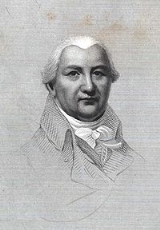
Charles Hutton

Encyclopedia
Charles Hutton was an English
mathematician
.
Hutton was born at Newcastle-on-Tyne. He was educated in a school at Jesmond
, kept by Mr Ivison, a clergyman of the Church of England
. There is reason to believe, on the evidence of two pay-bills, that for a short time in 1755 and 1756 Hutton worked in the colliery at Old Long Benton
; at any rate, on Ivison's promotion to a living, Hutton succeeded to the Jesmond school, whence, in consequence of increasing pupils, he removed to Stotes Hall. While he taught during the day at Stotes Hall, he studied mathematics in the evening at a school in Newcastle. In 1760 he married, and began tuition on a larger scale in Newcastle, where he had among his pupils John Scott
, afterwards Lord Eldon and Lord High Chancellor of England.
In 1764 he published his first work, The Schoolmasters Guide, or a Complete System of Practical Arithmetic, which in 1770 was followed by his Treatise on Mensuration both in Theory and Practice. In 1772 appeared a tract on The Principles of Bridges, which was suggested by the destruction of Newcastle bridge by a high flood on 17 November 1771. In 1773 he was appointed professor of mathematics at the Royal Military Academy, Woolwich
, and in the following year he was elected fellow of the Royal Society of London and reported on Nevil Maskelyne
's determination of the mean density and mass of the earth from measurements taken in 1774–1776 at Schiehallion
in Perthshire
. This account appeared in the Philosophical Transactions for 1778, was afterwards reprinted in the second volume of his Tracts on Mathematical and Philosophical Subjects, and procured for Hutton the degree of LL.D. from the University of Edinburgh
. He was elected a Fellow of the Royal Society in July ,1774 and their foreign secretary in 1779, but his resignation in 1783 was brought about by the president Sir Joseph Banks
, whose behaviour to the mathematical section of the society was somewhat high-handed.
After his Tables of the Products and Powers of Numbers, 1781, and his Mathematical Tables, 1785, he issued, for the use of the Royal Military Academy, in 1787 Elements of Conic Sections, and in 1798 his Course of Mathematics. His Mathematical and Philosophical Dictionary, a valuable contribution to scientific biography, was published in 1795 (second edition, 1815), and the four volumes of Recreations in Mathematics and Natural Philosophy, mostly a translation from the French, in 1803. One of the most laborious of his works was the abridgment, in conjunction with G. Shaw and R. Pearson, of the Philosophical Transactions. This undertaking, the mathematical and scientific parts of which fell to Hutton's share, was completed in 1809, and filled eighteen volumes quarto. His name first appears in the Ladies Diary (a poetical and mathematical almanac which was begun in 1704, and lasted until 1871) in 1764; ten years later, he was appointed editor of the almanac, a post which he retained until 1817. Previously he had begun a small periodical, Miscellane Mathematica, which extended only to thirteen numbers; subsequently he published in five volumes The Diarian Miscellany which contained large extracts from the Diary. He resigned his professorship in 1807.
England
England is a country that is part of the United Kingdom. It shares land borders with Scotland to the north and Wales to the west; the Irish Sea is to the north west, the Celtic Sea to the south west, with the North Sea to the east and the English Channel to the south separating it from continental...
mathematician
Mathematician
A mathematician is a person whose primary area of study is the field of mathematics. Mathematicians are concerned with quantity, structure, space, and change....
.
Hutton was born at Newcastle-on-Tyne. He was educated in a school at Jesmond
Jesmond
Jesmond is a residential suburb and is split into two electoral wards just north of the centre of Newcastle upon Tyne, England. The population is about 12,000. It is adjacent to, and to the east of, the Town Moor, providing pedestrian and cycle paths to Spital Tongues and the city's two Universities...
, kept by Mr Ivison, a clergyman of the Church of England
Church of England
The Church of England is the officially established Christian church in England and the Mother Church of the worldwide Anglican Communion. The church considers itself within the tradition of Western Christianity and dates its formal establishment principally to the mission to England by St...
. There is reason to believe, on the evidence of two pay-bills, that for a short time in 1755 and 1756 Hutton worked in the colliery at Old Long Benton
Longbenton
Longbenton is a district of North Tyneside, England. It is largely occupied by an extensive estate originally built as municipal housing by Newcastle City Council in the 1950s and 1960s. It is served by the Tyne and Wear Metro stations Longbenton Metro station and Four Lane Ends Metro Station...
; at any rate, on Ivison's promotion to a living, Hutton succeeded to the Jesmond school, whence, in consequence of increasing pupils, he removed to Stotes Hall. While he taught during the day at Stotes Hall, he studied mathematics in the evening at a school in Newcastle. In 1760 he married, and began tuition on a larger scale in Newcastle, where he had among his pupils John Scott
John Scott, 1st Earl of Eldon
John Scott, 1st Earl of Eldon PC KC FRS FSA was a British barrister and politician. He served as Lord Chancellor of Great Britain between 1801 and 1806 and again between 1807 and 1827.- Background and education :...
, afterwards Lord Eldon and Lord High Chancellor of England.
In 1764 he published his first work, The Schoolmasters Guide, or a Complete System of Practical Arithmetic, which in 1770 was followed by his Treatise on Mensuration both in Theory and Practice. In 1772 appeared a tract on The Principles of Bridges, which was suggested by the destruction of Newcastle bridge by a high flood on 17 November 1771. In 1773 he was appointed professor of mathematics at the Royal Military Academy, Woolwich
Woolwich
Woolwich is a district in south London, England, located in the London Borough of Greenwich. The area is identified in the London Plan as one of 35 major centres in Greater London.Woolwich formed part of Kent until 1889 when the County of London was created...
, and in the following year he was elected fellow of the Royal Society of London and reported on Nevil Maskelyne
Nevil Maskelyne
The Reverend Dr Nevil Maskelyne FRS was the fifth English Astronomer Royal. He held the office from 1765 to 1811.-Biography:...
's determination of the mean density and mass of the earth from measurements taken in 1774–1776 at Schiehallion
Schiehallion
Schiehallion is a prominent mountain in Perth and Kinross, Scotland. Schiehallion has a rich botanical life, interesting archaeology, and a unique place in scientific history for an 18th-century experiment in 'weighing the world'...
in Perthshire
Perthshire
Perthshire, officially the County of Perth , is a registration county in central Scotland. It extends from Strathmore in the east, to the Pass of Drumochter in the north, Rannoch Moor and Ben Lui in the west, and Aberfoyle in the south...
. This account appeared in the Philosophical Transactions for 1778, was afterwards reprinted in the second volume of his Tracts on Mathematical and Philosophical Subjects, and procured for Hutton the degree of LL.D. from the University of Edinburgh
University of Edinburgh
The University of Edinburgh, founded in 1583, is a public research university located in Edinburgh, the capital of Scotland, and a UNESCO World Heritage Site. The university is deeply embedded in the fabric of the city, with many of the buildings in the historic Old Town belonging to the university...
. He was elected a Fellow of the Royal Society in July ,1774 and their foreign secretary in 1779, but his resignation in 1783 was brought about by the president Sir Joseph Banks
Joseph Banks
Sir Joseph Banks, 1st Baronet, GCB, PRS was an English naturalist, botanist and patron of the natural sciences. He took part in Captain James Cook's first great voyage . Banks is credited with the introduction to the Western world of eucalyptus, acacia, mimosa and the genus named after him,...
, whose behaviour to the mathematical section of the society was somewhat high-handed.
After his Tables of the Products and Powers of Numbers, 1781, and his Mathematical Tables, 1785, he issued, for the use of the Royal Military Academy, in 1787 Elements of Conic Sections, and in 1798 his Course of Mathematics. His Mathematical and Philosophical Dictionary, a valuable contribution to scientific biography, was published in 1795 (second edition, 1815), and the four volumes of Recreations in Mathematics and Natural Philosophy, mostly a translation from the French, in 1803. One of the most laborious of his works was the abridgment, in conjunction with G. Shaw and R. Pearson, of the Philosophical Transactions. This undertaking, the mathematical and scientific parts of which fell to Hutton's share, was completed in 1809, and filled eighteen volumes quarto. His name first appears in the Ladies Diary (a poetical and mathematical almanac which was begun in 1704, and lasted until 1871) in 1764; ten years later, he was appointed editor of the almanac, a post which he retained until 1817. Previously he had begun a small periodical, Miscellane Mathematica, which extended only to thirteen numbers; subsequently he published in five volumes The Diarian Miscellany which contained large extracts from the Diary. He resigned his professorship in 1807.
Works
- Charles Hutton's Mathematical and Philosophical Dictionary
- Charles Hutton Tracts on Mathematical and Philosophical Subjects (F. & C. Rivington, London, 1812)
- Charles Hutton A Course of Mathematics For the Use of Academies... (volume 1) (Campbell & sons, New York, 1825)
- Charles Hutton A Course of Mathematics For the Use of Academies... (volume 2) (Dean, New York, 1831)
- Charles Hutton A Treatise on Mensuration both in Theory and in practice (Newcastle Upon Tyne, 1770)
- Charles Hutton Mathematical tables (F. & C. Rivington, London, 1811)