

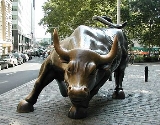
Charging Bull

Encyclopedia
Charging Bull, which is sometimes referred to as the Wall Street Bull or the Bowling Green Bull, is a 3200 kilograms (7,054.8 lb) bronze sculpture
by Arturo Di Modica
that stands in Bowling Green Park
near Wall Street
in Manhattan
, New York City
. Standing 11 feet (3.4 m) tall and measuring 16 feet (4.9 m) long, the oversize sculpture depicts a bull
, the symbol of aggressive financial optimism and prosperity, leaning back on its haunches and with its head lowered as if ready to charge. The sculpture is both a popular tourist destination which draws thousands of people a day, as well as "one of the most iconic images of New York" and a "Wall Street icon" symbolizing "Wall Street" and the Financial District.
In Outdoor Monuments of Manhattan: A Historical Guide, Dianne Durante describes the sculpture:
The bronze color and hard, metallic texture of the sculpture's surface emphasises the brute force of the creature. The work was designed and placed so that viewers could walk around it, which also suggests the creature's own movement is unrestricted — a point reinforced by the twisting posture of the bull's body, according to Durante.
"That bull is one of an edition of five", Di Modica told the New York Daily News
in 1998. "I'm hoping the other four will be going to cities all over the world, whenever somebody buys them." In 2010, a similar Charging Bull sculpted by Di Modica which looks "younger" and "stronger" was installed in Shanghai
.
as a symbol of the "strength and power of the American people." The sculpture was the artist's idea, not the city's. In an act of "guerrilla art", he trucked it to Lower Manhattan
and on December 15, 1989, installed it beneath a 60-foot Christmas tree in the middle of Broad Street in front of the New York Stock Exchange
as a Christmas gift to the people of New York. That day, crowds came to look at the bull, with hundreds stopping to admire and analyze the gift as Di Modica handed out copies of a flier about his artwork.
The police seized the sculpture and placed it into an impound lot. The ensuing public outcry led the New York City Department of Parks and Recreation
to install it two blocks south of the Exchange in the plaza at Bowling Green. It faces up Broadway
.
and other companies for illegally benefiting from his copyright, by selling replicas of the bull and using it in advertising campaigns. In 2009, Di Modica sued Random House
for using a photo of the bull on the cover of a book discussing the collapse of financial services firm Lehman Brothers
.
Since New York City does not own the sculpture, it has a technically temporary permit allowing it to stand on city property, but the temporary permission has lasted since 1989, when city officials said the new location would not be permanent. Art on loan is usually limited to a year's display. Although the city does not buy art, it accepts donations. A writer in the New York Daily News wrote in 1998 that the statue's placement was "beginning to look a mite permanent". According to an article in Art Monthly, Di Modica, "the authorities, and New York public, view it as a permanent feature of Lower Manhattan."
." In 1993, Arthur J. Piccolo, chairman of the Bowling Green Association, made the same point with the same comparison. Henry J. Stern, the city parks commissioner when the statue first appeared in the Financial District, said in 1993: "People are crazy about the bull. It captured their imagination."
The statue's popularity with tourists has a very international appeal. One 2007 newspaper report noted a "ceaseless stream" of visitors from India, the United Kingdom, South Africa, Venezuela and China, as well as the United States. Children enjoy climbing on the bull, which sits "famously" at street level on the cobblestones at the far northern tip of the small park. One popular tourist guidebook assumes that a visitor will want to get his or her picture taken with the statue ("after you pose with the bull [...]"). A popular Bollywood movie, Kal Ho Naa Ho
features the bull in a musical number, increasing its familiarity with Indians. One visitor told a newspaper reporter it was a reason for his visit.
In addition to having their pictures taken at the front end of the bull, many tourists pose at the back of the bull, near the large testicles "for snapshots under an unmistakable symbol of its virility." According to a Washington Post article in 2002, "People on The Street say you've got to rub the nose, horns and testicles of the bull for good luck, tour guide Wayne McLeod would tell the group on the Baltimore bus, who would giddily oblige." According to a 2004 New York Times article, "Passers-by have rubbed — to a bright gleam — its nose, horns and a part of its anatomy that, as Mr. Benepe put it gingerly, 'separates the bull from the steer.'"
A 2007 newspaper account agreed that a "peculiar ritual" of handling the "shining orbs" of the statue's scrotum seems to have developed into a tradition. One visitor, from Mississippi, told the Tribeca Trib she did it "for good luck", and because "there’s a kind of primal response when you see something like that. You just have to engage it." The enthusiastic reaction to the sculpture continues into the darker hours. "I’ve seen people do some crazy things to that bull," said a souvenir vendor, "At night sometimes, when people have been drinking, I’ve seen them do stuff to that bull that you couldn’t print in a newspaper."
(1997), Hitch
(2005), Inside Man
(2006), The Other Guys
(2010), The Sorcerer's Apprentice
(2010), and Arthur
(2011), as well as the TV series My Life as Liz
. A dancer poses in arabesque
atop the sculpture in the 2011 Adbusters
appeal to "Occupy Wall Street
".
Bronze sculpture
Bronze is the most popular metal for cast metal sculptures; a cast bronze sculpture is often called simply a "bronze".Common bronze alloys have the unusual and desirable property of expanding slightly just before they set, thus filling the finest details of a mold. Then, as the bronze cools, it...
by Arturo Di Modica
Arturo Di Modica
Arturo Di Modica is an Italian-American artist, born in Vittoria, Sicily, best known for his sculpture Charging Bull , which he installed without permission in front of the New York Stock Exchange in December 1989. The work cost US$360,000 of the artist's own money...
that stands in Bowling Green Park
Bowling Green (New York City)
Bowling Green is a small public park in Lower Manhattan at the foot of Broadway next to the site of the original Dutch fort of New Amsterdam. Built in 1733, originally including a bowling green, it is the oldest public park in New York City and is surrounded by its original 18th century fence. At...
near Wall Street
Wall Street
Wall Street refers to the financial district of New York City, named after and centered on the eight-block-long street running from Broadway to South Street on the East River in Lower Manhattan. Over time, the term has become a metonym for the financial markets of the United States as a whole, or...
in Manhattan
Manhattan
Manhattan is the oldest and the most densely populated of the five boroughs of New York City. Located primarily on the island of Manhattan at the mouth of the Hudson River, the boundaries of the borough are identical to those of New York County, an original county of the state of New York...
, New York City
New York City
New York is the most populous city in the United States and the center of the New York Metropolitan Area, one of the most populous metropolitan areas in the world. New York exerts a significant impact upon global commerce, finance, media, art, fashion, research, technology, education, and...
. Standing 11 feet (3.4 m) tall and measuring 16 feet (4.9 m) long, the oversize sculpture depicts a bull
Bull
Bull usually refers to an uncastrated adult male bovine.Bull may also refer to:-Entertainment:* Bull , an original show on the TNT Network* "Bull" , an episode of television series CSI: Crime Scene Investigation...
, the symbol of aggressive financial optimism and prosperity, leaning back on its haunches and with its head lowered as if ready to charge. The sculpture is both a popular tourist destination which draws thousands of people a day, as well as "one of the most iconic images of New York" and a "Wall Street icon" symbolizing "Wall Street" and the Financial District.
In Outdoor Monuments of Manhattan: A Historical Guide, Dianne Durante describes the sculpture:
The Bulls head is lowered, its nostrils flare, and its wickedly long, sharp horns are ready to gore; it's an angry, dangerous beast. The muscular body twists to one side, and the tail is curved like a lash: the Bull is also energetic and in motion.
The bronze color and hard, metallic texture of the sculpture's surface emphasises the brute force of the creature. The work was designed and placed so that viewers could walk around it, which also suggests the creature's own movement is unrestricted — a point reinforced by the twisting posture of the bull's body, according to Durante.
Charging Bull, then, shows an aggressive or even belligerent force on the move, but unpredictably. [...] [I]t's not far-fetched to say the theme is the energy, strength, and unpredictability of the stock market."
"That bull is one of an edition of five", Di Modica told the New York Daily News
New York Daily News
The Daily News of New York City is the fourth most widely circulated daily newspaper in the United States with a daily circulation of 605,677, as of November 1, 2011....
in 1998. "I'm hoping the other four will be going to cities all over the world, whenever somebody buys them." In 2010, a similar Charging Bull sculpted by Di Modica which looks "younger" and "stronger" was installed in Shanghai
Shanghai
Shanghai is the largest city by population in China and the largest city proper in the world. It is one of the four province-level municipalities in the People's Republic of China, with a total population of over 23 million as of 2010...
.
Construction and installation
Di Modica spent some US$ 360,000 to create, cast, and install the sculpture following the 1987 stock market crashBlack Monday (1987)
In finance, Black Monday refers to Monday October 19, 1987, when stock markets around the world crashed, shedding a huge value in a very short time. The crash began in Hong Kong and spread west to Europe, hitting the United States after other markets had already declined by a significant margin...
as a symbol of the "strength and power of the American people." The sculpture was the artist's idea, not the city's. In an act of "guerrilla art", he trucked it to Lower Manhattan
Lower Manhattan
Lower Manhattan is the southernmost part of the island of Manhattan, the main island and center of business and government of the City of New York...
and on December 15, 1989, installed it beneath a 60-foot Christmas tree in the middle of Broad Street in front of the New York Stock Exchange
New York Stock Exchange
The New York Stock Exchange is a stock exchange located at 11 Wall Street in Lower Manhattan, New York City, USA. It is by far the world's largest stock exchange by market capitalization of its listed companies at 13.39 trillion as of Dec 2010...
as a Christmas gift to the people of New York. That day, crowds came to look at the bull, with hundreds stopping to admire and analyze the gift as Di Modica handed out copies of a flier about his artwork.
The police seized the sculpture and placed it into an impound lot. The ensuing public outcry led the New York City Department of Parks and Recreation
New York City Department of Parks and Recreation
The City of New York Department of Parks & Recreation is the department of government of the City of New York responsible for maintaining the city's parks system, preserving and maintaining the ecological diversity of the city's natural areas, and furnishing recreational opportunities for city's...
to install it two blocks south of the Exchange in the plaza at Bowling Green. It faces up Broadway
Broadway (New York City)
Broadway is a prominent avenue in New York City, United States, which runs through the full length of the borough of Manhattan and continues northward through the Bronx borough before terminating in Westchester County, New York. It is the oldest north–south main thoroughfare in the city, dating to...
.
Ownership
In 2004, Di Modica announced that the bull sculpture was for sale, on condition the buyer does not move it from its present location. Di Modica continues to own the copyright to the statue. In 2006, Di Modica sued Wal-MartWal-Mart
Wal-Mart Stores, Inc. , branded as Walmart since 2008 and Wal-Mart before then, is an American public multinational corporation that runs chains of large discount department stores and warehouse stores. The company is the world's 18th largest public corporation, according to the Forbes Global 2000...
and other companies for illegally benefiting from his copyright, by selling replicas of the bull and using it in advertising campaigns. In 2009, Di Modica sued Random House
Random House
Random House, Inc. is the largest general-interest trade book publisher in the world. It has been owned since 1998 by the German private media corporation Bertelsmann and has become the umbrella brand for Bertelsmann book publishing. Random House also has a movie production arm, Random House Films,...
for using a photo of the bull on the cover of a book discussing the collapse of financial services firm Lehman Brothers
Lehman Brothers
Lehman Brothers Holdings Inc. was a global financial services firm. Before declaring bankruptcy in 2008, Lehman was the fourth largest investment bank in the USA , doing business in investment banking, equity and fixed-income sales and trading Lehman Brothers Holdings Inc. (former NYSE ticker...
.
Since New York City does not own the sculpture, it has a technically temporary permit allowing it to stand on city property, but the temporary permission has lasted since 1989, when city officials said the new location would not be permanent. Art on loan is usually limited to a year's display. Although the city does not buy art, it accepts donations. A writer in the New York Daily News wrote in 1998 that the statue's placement was "beginning to look a mite permanent". According to an article in Art Monthly, Di Modica, "the authorities, and New York public, view it as a permanent feature of Lower Manhattan."
As a tourist attraction
As soon as the sculpture was set up at Bowling Green, it became "an instant hit". One of the city's most photographed artworks, it has become a tourist destination in the Financial District. "[I]ts popularity is beyond doubt", a New York Times article said of the artwork. "Visitors constantly pose for pictures around it." Adrian Benepe, the New York City parks commissioner, said in 2004, "It's become one of the most visited, most photographed and perhaps most loved and recognized statues in the city of New York. I would say it's right up there with the Statue of LibertyStatue of Liberty
The Statue of Liberty is a colossal neoclassical sculpture on Liberty Island in New York Harbor, designed by Frédéric Bartholdi and dedicated on October 28, 1886...
." In 1993, Arthur J. Piccolo, chairman of the Bowling Green Association, made the same point with the same comparison. Henry J. Stern, the city parks commissioner when the statue first appeared in the Financial District, said in 1993: "People are crazy about the bull. It captured their imagination."
The statue's popularity with tourists has a very international appeal. One 2007 newspaper report noted a "ceaseless stream" of visitors from India, the United Kingdom, South Africa, Venezuela and China, as well as the United States. Children enjoy climbing on the bull, which sits "famously" at street level on the cobblestones at the far northern tip of the small park. One popular tourist guidebook assumes that a visitor will want to get his or her picture taken with the statue ("after you pose with the bull [...]"). A popular Bollywood movie, Kal Ho Naa Ho
Kal Ho Naa Ho
Kal Ho Naa Ho is a 2003 Hindi film set in New York City. It stars Shahrukh Khan, Preity Zinta, Saif Ali Khan and Jaya Bachchan. The film was directed by first-timer Nikhil Advani, it was produced by Yash Johar and co-written by Karan Johar, better known as the director of the hit films Kuch Kuch...
features the bull in a musical number, increasing its familiarity with Indians. One visitor told a newspaper reporter it was a reason for his visit.
In addition to having their pictures taken at the front end of the bull, many tourists pose at the back of the bull, near the large testicles "for snapshots under an unmistakable symbol of its virility." According to a Washington Post article in 2002, "People on The Street say you've got to rub the nose, horns and testicles of the bull for good luck, tour guide Wayne McLeod would tell the group on the Baltimore bus, who would giddily oblige." According to a 2004 New York Times article, "Passers-by have rubbed — to a bright gleam — its nose, horns and a part of its anatomy that, as Mr. Benepe put it gingerly, 'separates the bull from the steer.'"
A 2007 newspaper account agreed that a "peculiar ritual" of handling the "shining orbs" of the statue's scrotum seems to have developed into a tradition. One visitor, from Mississippi, told the Tribeca Trib she did it "for good luck", and because "there’s a kind of primal response when you see something like that. You just have to engage it." The enthusiastic reaction to the sculpture continues into the darker hours. "I’ve seen people do some crazy things to that bull," said a souvenir vendor, "At night sometimes, when people have been drinking, I’ve seen them do stuff to that bull that you couldn’t print in a newspaper."
In popular culture
The sculpture is featured in the films For Richer or PoorerFor Richer or Poorer
For Richer or Poorer is a 1997 comedy film starring Tim Allen and Kirstie Alley. It is rated PG-13 for some sexual innuendo and one use of strong language.-Plot :...
(1997), Hitch
Hitch (film)
Hitch is a 2005 romantic comedy film directed by Andy Tennant and starring Will Smith. The film, which was written by Kevin Bisch, co-stars Eva Mendes, Kevin James, and Amber Valletta. Smith plays a professional matchmaker who makes a living teaching men how to woo women...
(2005), Inside Man
Inside Man
Inside Man is a 2006 crime-drama film directed by Spike Lee. It stars Denzel Washington, Clive Owen, Willem Dafoe and Jodie Foster. The film's screenplay was written by Russell Gewirtz and produced by Brian Grazer...
(2006), The Other Guys
The Other Guys
The Other Guys is a 2010 American action comedy film directed and co-written by Adam McKay, starring Will Ferrell and Mark Wahlberg, and featuring Dwayne Johnson, Samuel L. Jackson, Michael Keaton, Eva Mendes, Steve Coogan, and Ray Stevenson...
(2010), The Sorcerer's Apprentice
The Sorcerer's Apprentice (2010 film)
The Sorcerer's Apprentice is a 2010 fantasy adventure film produced by Jerry Bruckheimer, directed by Jon Turteltaub, and distributed by Walt Disney Pictures, the team behind the National Treasure franchise...
(2010), and Arthur
Arthur (2011 film)
Arthur is a 2011 comedy film written by Peter Baynham and directed by Jason Winer. It is a remake of the 1981 film written and directed by Steve Gordon...
(2011), as well as the TV series My Life as Liz
My Life as Liz
My Life as Liz is a mockumentary style American television series that centers on the life of Liz Lee, a misfit high-school senior living in small town Texas...
. A dancer poses in arabesque
Arabesque (ballet position)
In classical ballet, the term arabesque In classical ballet, the term arabesque In classical ballet, the term arabesque (aa-rah-besk; literally, "in Arabic fashion". Specifically, "arabesque" references an architectural design term that describes and is a spiral...
atop the sculpture in the 2011 Adbusters
AdBusters
The Adbusters Media Foundation is a Canadian-based not-for-profit, anti-consumerist, pro-environment organization founded in 1989 by Kalle Lasn and Bill Schmalz in Vancouver, British Columbia...
appeal to "Occupy Wall Street
Occupy Wall Street
Occupy Wall Street is an ongoing series of demonstrations initiated by the Canadian activist group Adbusters which began September 17, 2011 in Zuccotti Park, located in New York City's Wall Street financial district...
".
See also
- 26 Broadway26 Broadway26 Broadway is a 31-story, 159 m, 520 ft New York City Designated Landmark at the southern tip of Manhattan at Bowling Green...
, the building across the street from the statue, to the east - Bund BullBund BullThe Shanghai Bull, the Bund Financial Bull or the Bund Bull are monikers associated with a derivative of Arturo Di Modica's Charging Bull installed in late April 2010 and unveiled on The Bund in Shanghai on May 15, 2010. The work of art is said to have the same height, length and weight as the...
- Cows on Parade
- Golden calfGolden calfAccording to the Hebrew Bible, the golden calf was an idol made by Aaron to satisfy the Israelites during Moses' absence, when he went up to Mount Sinai...
- Market sentimentMarket sentimentMarket sentiment is the general prevailing attitude of investors as to anticipated price development in a market. This attitude is the accumulation of a variety of fundamental and technical factors, including price history, economic reports, seasonal factors, and national and world events.For...
- Sports Museum of AmericaSports Museum of AmericaThe Sports Museum of America was the United States' first national sports museum dedicated to the history and cultural significance of sports in America. It opened on May 7, 2008 and closed February 20, 2009.-History:...
at 26 Broadway, across the street
External links
- RoadsideAmerica.com article citing many examples of statues that visitors rub
- " A New York Story: How the Charging Bull Chose Wall Street" By Tiziano Thomas Dossena, Bridge Puglia USA, June 2011