

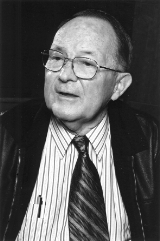
Chalmers Johnson

Encyclopedia
Chalmers Ashby Johnson was an American author
and professor emeritus of the University of California, San Diego
. He served in the Korean War
, was a consultant for the CIA from 1967–1973, and chaired the Center for Chinese Studies at the University of California, Berkeley
from 1967 to 1972. He was also president and co-founder of the Japan Policy Research Institute
(now based at the University of San Francisco
), an organization promoting public education about Japan
and Asia
. He wrote numerous books including, most recently, three examinations of the consequences of American Empire: Blowback, The Sorrows of Empire, and Nemesis: The Last Days of the American Republic.
. He earned a B.A.
degree in Economics
in 1953 and an M.A.
and a Ph.D.
in political science
in 1957 and 1961 respectively. Both of his advanced degrees were from the University of California, Berkeley
. Johnson met his wife Sheila, a 19 year-old junior at Berkeley, in 1956, and they were married in Reno, Nevada
in May, 1957.
During the Korean War
, Johnson served as a naval officer in Japan. He was the communications officer on a ship (the LST 883
) "tasked with ferrying Chinese prisoners of war from South Korea
back to North Korea
n ports." He taught political science at the University of California from 1962 until he retired from teaching in 1992. He was best known early in his career for his scholarship on the subjects of China
and Japan
.
Johnson set the agenda for ten or fifteen years in social science scholarship on China with his book on peasant nationalism. His book MITI and the Japanese Miracle, on the Japanese Ministry of International Trade and Industry
was the preëminent study of the country's development and created the subfield of what could be called the political economy of development. He coined the term "developmental state
". As a public intellectual, he first led the "Japan revisionists" who critiqued American neoliberal economics
with Japan as a model; their arguments faded from view as the Japanese economy stagnated in the mid-90s and beyond. During this period, Johnson acted as a consultant for the Office of National Estimates
, part of the CIA
, contributing to analysis of China and Maoism
.
Johnson was elected a Fellow of the American Academy of Arts and Sciences
in 1976. He served as Director of the Center for Chinese Studies (1967–72) and Chair of the Political Science Department at Berkeley, and held a number of important academic posts in area studies. He was a strong believer in the importance of language
and historical training for doing serious research. Late in his career he became well known as a critic of "rational choice" approaches, particularly in the study of Japanese politics and political economy.
Johnson is perhaps today best known as a sharp critic of American imperialism. His book Blowback (2000) won a prize in 2001 from the Before Columbus Foundation
, and was re-issued in an updated version in 2004. Sorrows of Empire, published in 2004, updated the evidence and argument from Blowback for the post-9/11 environment, and Nemesis concludes the trilogy. Johnson was featured as an expert talking head in the Eugene Jarecki
-directed film Why We Fight
, which won the 2005 Grand Jury Prize at the Sundance Film Festival
. In the past, Johnson has also written for the Los Angeles Times, the London Review of Books, Harper’s Magazine, and The Nation
, since World War II
the US
has developed a vast system of hundreds of military base
s around the world where it has strategic interests. A long-time Cold Warrior
, he applauded the dissolution of the Soviet Union
: "I was a cold warrior. There's no doubt about that. I believed the Soviet Union was a genuine menace. I still think so." But at the same time he experienced a political awakening after the dissolution of the Soviet Union
, noting that instead of demobilizing its armed forces, the US accelerated its reliance on military solutions to problems both economic and political. The result of this militarism (as distinct from actual domestic defense) is more terrorism
against the US and its allies, the loss of core democratic
values at home, and an eventual disaster for the American economy. Of four books he wrote on this topic, the first three are referred to as The Blowback Trilogy:
Chalmers Johnson summarized the intent of Blowback in the final chapter of Nemesis.
Chalmers Johnson summarizes the intent of The Sorrows of Empire in the final chapter of Nemesis.
Chalmers Johnson summarizes the intent of the book Nemesis.
Johnson outlines how the United States can reverse American hegemony.
Author
An author is broadly defined as "the person who originates or gives existence to anything" and that authorship determines responsibility for what is created. Narrowly defined, an author is the originator of any written work.-Legal significance:...
and professor emeritus of the University of California, San Diego
University of California, San Diego
The University of California, San Diego, commonly known as UCSD or UC San Diego, is a public research university located in the La Jolla neighborhood of San Diego, California, United States...
. He served in the Korean War
Korean War
The Korean War was a conventional war between South Korea, supported by the United Nations, and North Korea, supported by the People's Republic of China , with military material aid from the Soviet Union...
, was a consultant for the CIA from 1967–1973, and chaired the Center for Chinese Studies at the University of California, Berkeley
University of California, Berkeley
The University of California, Berkeley , is a teaching and research university established in 1868 and located in Berkeley, California, USA...
from 1967 to 1972. He was also president and co-founder of the Japan Policy Research Institute
Japan Policy Research Institute
The Japan Policy Research Institute is a non-profit organization organized under section 501 of the U.S. Internal Revenue Code that was founded in 1994 by Chalmers Johnson and Steven C...
(now based at the University of San Francisco
University of San Francisco
The University of San Francisco , is a private, Jesuit/Catholic university located in San Francisco, California. Founded in 1855, USF was established as the first university in San Francisco. It is the second oldest institution for higher learning in California and the tenth-oldest university of...
), an organization promoting public education about Japan
Japan
Japan is an island nation in East Asia. Located in the Pacific Ocean, it lies to the east of the Sea of Japan, China, North Korea, South Korea and Russia, stretching from the Sea of Okhotsk in the north to the East China Sea and Taiwan in the south...
and Asia
Asia
Asia is the world's largest and most populous continent, located primarily in the eastern and northern hemispheres. It covers 8.7% of the Earth's total surface area and with approximately 3.879 billion people, it hosts 60% of the world's current human population...
. He wrote numerous books including, most recently, three examinations of the consequences of American Empire: Blowback, The Sorrows of Empire, and Nemesis: The Last Days of the American Republic.
Biography
Johnson was born in 1931 in Phoenix, ArizonaPhoenix, Arizona
Phoenix is the capital, and largest city, of the U.S. state of Arizona, as well as the sixth most populated city in the United States. Phoenix is home to 1,445,632 people according to the official 2010 U.S. Census Bureau data...
. He earned a B.A.
Bachelor of Arts
A Bachelor of Arts , from the Latin artium baccalaureus, is a bachelor's degree awarded for an undergraduate course or program in either the liberal arts, the sciences, or both...
degree in Economics
Economics
Economics is the social science that analyzes the production, distribution, and consumption of goods and services. The term economics comes from the Ancient Greek from + , hence "rules of the house"...
in 1953 and an M.A.
Master's degree
A master's is an academic degree granted to individuals who have undergone study demonstrating a mastery or high-order overview of a specific field of study or area of professional practice...
and a Ph.D.
Doctor of Philosophy
Doctor of Philosophy, abbreviated as Ph.D., PhD, D.Phil., or DPhil , in English-speaking countries, is a postgraduate academic degree awarded by universities...
in political science
Political science
Political Science is a social science discipline concerned with the study of the state, government and politics. Aristotle defined it as the study of the state. It deals extensively with the theory and practice of politics, and the analysis of political systems and political behavior...
in 1957 and 1961 respectively. Both of his advanced degrees were from the University of California, Berkeley
University of California, Berkeley
The University of California, Berkeley , is a teaching and research university established in 1868 and located in Berkeley, California, USA...
. Johnson met his wife Sheila, a 19 year-old junior at Berkeley, in 1956, and they were married in Reno, Nevada
Reno, Nevada
Reno is the county seat of Washoe County, Nevada, United States. The city has a population of about 220,500 and is the most populous Nevada city outside of the Las Vegas metropolitan area...
in May, 1957.
During the Korean War
Korean War
The Korean War was a conventional war between South Korea, supported by the United Nations, and North Korea, supported by the People's Republic of China , with military material aid from the Soviet Union...
, Johnson served as a naval officer in Japan. He was the communications officer on a ship (the LST 883
USS La Moure County (LST-883)
USS La Moure County was an built for the United States Navy during World War II. Named after La Moure County, North Dakota, she was the first of two U.S. Naval vessels to bear the name....
) "tasked with ferrying Chinese prisoners of war from South Korea
South Korea
The Republic of Korea , , is a sovereign state in East Asia, located on the southern portion of the Korean Peninsula. It is neighbored by the People's Republic of China to the west, Japan to the east, North Korea to the north, and the East China Sea and Republic of China to the south...
back to North Korea
North Korea
The Democratic People’s Republic of Korea , , is a country in East Asia, occupying the northern half of the Korean Peninsula. Its capital and largest city is Pyongyang. The Korean Demilitarized Zone serves as the buffer zone between North Korea and South Korea...
n ports." He taught political science at the University of California from 1962 until he retired from teaching in 1992. He was best known early in his career for his scholarship on the subjects of China
China
Chinese civilization may refer to:* China for more general discussion of the country.* Chinese culture* Greater China, the transnational community of ethnic Chinese.* History of China* Sinosphere, the area historically affected by Chinese culture...
and Japan
Japan
Japan is an island nation in East Asia. Located in the Pacific Ocean, it lies to the east of the Sea of Japan, China, North Korea, South Korea and Russia, stretching from the Sea of Okhotsk in the north to the East China Sea and Taiwan in the south...
.
Johnson set the agenda for ten or fifteen years in social science scholarship on China with his book on peasant nationalism. His book MITI and the Japanese Miracle, on the Japanese Ministry of International Trade and Industry
Ministry of International Trade and Industry
The Ministry of International Trade and Industry was one of the most powerful agencies of the Government of Japan. At the height of its influence, it effectively ran much of Japanese industrial policy, funding research and directing investment...
was the preëminent study of the country's development and created the subfield of what could be called the political economy of development. He coined the term "developmental state
Developmental state
Developmental state, or hard state, is a term used by international political economy scholars to refer to the phenomenon of state-led macroeconomic planning in East Asia in the late twentieth century...
". As a public intellectual, he first led the "Japan revisionists" who critiqued American neoliberal economics
Neoliberalism
Neoliberalism is a market-driven approach to economic and social policy based on neoclassical theories of economics that emphasizes the efficiency of private enterprise, liberalized trade and relatively open markets, and therefore seeks to maximize the role of the private sector in determining the...
with Japan as a model; their arguments faded from view as the Japanese economy stagnated in the mid-90s and beyond. During this period, Johnson acted as a consultant for the Office of National Estimates
National Intelligence Estimate
National Intelligence Estimates are United States federal government documents that are the authoritative assessment of the Director of National Intelligence on intelligence related to a particular national security issue...
, part of the CIA
Central Intelligence Agency
The Central Intelligence Agency is a civilian intelligence agency of the United States government. It is an executive agency and reports directly to the Director of National Intelligence, responsible for providing national security intelligence assessment to senior United States policymakers...
, contributing to analysis of China and Maoism
Maoism
Maoism, also known as the Mao Zedong Thought , is claimed by Maoists as an anti-Revisionist form of Marxist communist theory, derived from the teachings of the Chinese political leader Mao Zedong . Developed during the 1950s and 1960s, it was widely applied as the political and military guiding...
.
Johnson was elected a Fellow of the American Academy of Arts and Sciences
American Academy of Arts and Sciences
The American Academy of Arts and Sciences is an independent policy research center that conducts multidisciplinary studies of complex and emerging problems. The Academy’s elected members are leaders in the academic disciplines, the arts, business, and public affairs.James Bowdoin, John Adams, and...
in 1976. He served as Director of the Center for Chinese Studies (1967–72) and Chair of the Political Science Department at Berkeley, and held a number of important academic posts in area studies. He was a strong believer in the importance of language
Language
Language may refer either to the specifically human capacity for acquiring and using complex systems of communication, or to a specific instance of such a system of complex communication...
and historical training for doing serious research. Late in his career he became well known as a critic of "rational choice" approaches, particularly in the study of Japanese politics and political economy.
Johnson is perhaps today best known as a sharp critic of American imperialism. His book Blowback (2000) won a prize in 2001 from the Before Columbus Foundation
Before Columbus Foundation
The Before Columbus Foundation is a nonprofit organization founded in 1976 by Ishmael Reed, Victor Hernández Cruz, Shawn Wong and Rudolfo Anaya to be "a multi-ethnic organizing dedicated to promoting a pan-cultural view of America," especially through the promotion of multicultural writers.One of...
, and was re-issued in an updated version in 2004. Sorrows of Empire, published in 2004, updated the evidence and argument from Blowback for the post-9/11 environment, and Nemesis concludes the trilogy. Johnson was featured as an expert talking head in the Eugene Jarecki
Eugene Jarecki
Eugene Jarecki is an author and a dramatic and documentary filmmaker based in New York.His works include Why We Fight, which won the 2005 Grand Jury Prize at the Sundance Film Festival, The Trials of Henry Kissinger, Reagan, Freakonomics , Quest of the Carib Canoe, and Season of the...
-directed film Why We Fight
Why We Fight (2005 film)
Why We Fight, directed by Eugene Jarecki, is a 2006 documentary film about the military–industrial complex. The title refers to the World War II-era eponymous propaganda movies commissioned by the U.S...
, which won the 2005 Grand Jury Prize at the Sundance Film Festival
Sundance Film Festival
The Sundance Film Festival is a film festival that takes place annually in Utah, in the United States. It is the largest independent cinema festival in the United States. Held in January in Park City, Salt Lake City, and Ogden, as well as at the Sundance Resort, the festival is a showcase for new...
. In the past, Johnson has also written for the Los Angeles Times, the London Review of Books, Harper’s Magazine, and The Nation
The Blowback series
Johnson believed that the enforcement of American hegemony over the world constitutes a new form of global empire. Whereas traditional empires maintained control over subject peoples via coloniesColony
In politics and history, a colony is a territory under the immediate political control of a state. For colonies in antiquity, city-states would often found their own colonies. Some colonies were historically countries, while others were territories without definite statehood from their inception....
, since World War II
World War II
World War II, or the Second World War , was a global conflict lasting from 1939 to 1945, involving most of the world's nations—including all of the great powers—eventually forming two opposing military alliances: the Allies and the Axis...
the US
United States
The United States of America is a federal constitutional republic comprising fifty states and a federal district...
has developed a vast system of hundreds of military base
Military base
A military base is a facility directly owned and operated by or for the military or one of its branches that shelters military equipment and personnel, and facilitates training and operations. In general, a military base provides accommodations for one or more units, but it may also be used as a...
s around the world where it has strategic interests. A long-time Cold Warrior
Cold warrior
Cold warrior is a phrase used to describe the men and women involved in the shaping and executing of American and Soviet policy during the Cold War....
, he applauded the dissolution of the Soviet Union
Dissolution of the Soviet Union
The dissolution of the Soviet Union was the disintegration of the federal political structures and central government of the Union of Soviet Socialist Republics , resulting in the independence of all fifteen republics of the Soviet Union between March 11, 1990 and December 25, 1991...
: "I was a cold warrior. There's no doubt about that. I believed the Soviet Union was a genuine menace. I still think so." But at the same time he experienced a political awakening after the dissolution of the Soviet Union
Dissolution of the Soviet Union
The dissolution of the Soviet Union was the disintegration of the federal political structures and central government of the Union of Soviet Socialist Republics , resulting in the independence of all fifteen republics of the Soviet Union between March 11, 1990 and December 25, 1991...
, noting that instead of demobilizing its armed forces, the US accelerated its reliance on military solutions to problems both economic and political. The result of this militarism (as distinct from actual domestic defense) is more terrorism
Terrorism
Terrorism is the systematic use of terror, especially as a means of coercion. In the international community, however, terrorism has no universally agreed, legally binding, criminal law definition...
against the US and its allies, the loss of core democratic
Democracy
Democracy is generally defined as a form of government in which all adult citizens have an equal say in the decisions that affect their lives. Ideally, this includes equal participation in the proposal, development and passage of legislation into law...
values at home, and an eventual disaster for the American economy. Of four books he wrote on this topic, the first three are referred to as The Blowback Trilogy:
- Blowback: The Costs and Consequences of American Empire
Chalmers Johnson summarized the intent of Blowback in the final chapter of Nemesis.
- "In Blowback, I set out to explain why we are hated around the world. The concept "blowbackBlowbackBlowback may refer to one of the following:*Blowback *Blowback *Blowback , vacuum effect created in the barrel of a firearm when it is discharged...
" does not just mean retaliation for things our government has done to and in foreign countries. It refers to retaliation for the numerous illegal operations we have carried out abroad that were kept totally secret from the American public. This means that when the retaliation comes -- as it did so spectacularly on September 11, 2001 -- the American public is unable to put the events in context. So they tend to support acts intended to lash out against the perpetrators, thereby most commonly preparing the ground for yet another cycle of blowback. In the first book in this trilogy, I tried to provide some of the historical background for understanding the dilemmas we as a nation confront today, although I focused more on Asia -- the area of my academic training -- than on the Middle EastMiddle EastThe Middle East is a region that encompasses Western Asia and Northern Africa. It is often used as a synonym for Near East, in opposition to Far East...
."
- The Sorrows of Empire: Militarism, Secrecy, and the End of the Republic
Chalmers Johnson summarizes the intent of The Sorrows of Empire in the final chapter of Nemesis.
- "The Sorrows of Empire was written during the American preparations for and launching of the invasions and occupations of AfghanistanAfghanistanAfghanistan , officially the Islamic Republic of Afghanistan, is a landlocked country located in the centre of Asia, forming South Asia, Central Asia and the Middle East. With a population of about 29 million, it has an area of , making it the 42nd most populous and 41st largest nation in the world...
and IraqIraqIraq ; officially the Republic of Iraq is a country in Western Asia spanning most of the northwestern end of the Zagros mountain range, the eastern part of the Syrian Desert and the northern part of the Arabian Desert....
. I began to study our continuous military buildup since World War II and the 737 military bases we currently maintain in other people's countries. This empire of bases is the concrete manifestation of our global hegemonyHegemonyHegemony is an indirect form of imperial dominance in which the hegemon rules sub-ordinate states by the implied means of power rather than direct military force. In Ancient Greece , hegemony denoted the politico–military dominance of a city-state over other city-states...
, and many of the blowback-inducing wars we have conducted had as their true purpose the sustaining and expanding of this network. We do not think of these overseas deployments as a form of empire; in fact, most Americans do not give them any thought at all until something truly shocking, such as the treatment of prisoners at Guantanamo Bay, brings them to our attention. But the people living next door to these bases and dealing with the swaggering soldiers who brawl and sometimes rape their women certainly think of them as imperial enclaves, just as the people of ancient IberiaIberiaThe name Iberia refers to three historical regions of the old world:* Iberian Peninsula, in Southwest Europe, location of modern-day Portugal and Spain** Prehistoric Iberia...
or nineteenth-century IndiaIndiaIndia , officially the Republic of India , is a country in South Asia. It is the seventh-largest country by geographical area, the second-most populous country with over 1.2 billion people, and the most populous democracy in the world...
knew that they were victims of foreign colonization."
- Nemesis: The Last Days of the American Republic
Chalmers Johnson summarizes the intent of the book Nemesis.
- “In Nemesis, I have tried to present historical, political, economic, and philosophical evidence of where our current behavior is likely to lead. Specifically, I believe that to maintain our empire abroad requires resources and commitments that will inevitably undercut our domestic democracy and in the end produce a military dictatorship or its civilian equivalent. The founders of our nation understood this well and tried to create a form of government – a republic – that would prevent this from occurring. But the combination of huge standing armies, almost continuous wars, military KeynesianismMilitary KeynesianismMilitary Keynesianism is the accusation that John Maynard Keynes advocated government economic policy in which the government devotes large amounts of spending to the military in an effort to increase economic growth. In fact, the English economist John Maynard Keynes advocated that government...
, and ruinous military expenses have destroyed our republican structure in favor of an imperial presidency. We are on the cusp of losing our democracy for the sake of keeping our empire. Once a nation is started down that path, the dynamics that apply to all empires come into play – isolation, overstretch, the uniting of forces opposed to imperialism, and bankruptcy. NemesisNemesis (mythology)In Greek mythology, Nemesis , also called Rhamnousia/Rhamnusia at her sanctuary at Rhamnous, north of Marathon, was the spirit of divine retribution against those who succumb to hubris . The Greeks personified vengeful fate as a remorseless goddess: the goddess of revenge...
stalks our life as a free nation.”
- Dismantling the Empire: America's Last Best Hope
Johnson outlines how the United States can reverse American hegemony.
Audio and Video
- Audio interview March 2010 on Media Matters with Bob McChesneyRobert W. McChesneyRobert Waterman McChesney is an American professor at the University of Illinois at Urbana-Champaign. He is the Gutgsell Endowed Professor in the Department of Communication. His work concentrates on the history and political economy of communication, emphasizing the role media play in democratic...
- Video/Audio: Chalmers Johnson on the military-industrial complex October 4–7, 2008 on The Real News with Paul Jay
- Audio: Is America on the brink of destruction through imperial over-reach?
- Audio interview February 2007 on Democracy Now!Democracy Now!Democracy Now! and its staff have received several journalism awards, including the Gracie Award from American Women in Radio & Television; the George Polk Award for its 1998 radio documentary Drilling and Killing: Chevron and Nigeria's Oil Dictatorship, on the Chevron Corporation and the deaths of...
with Amy Goodman - Chalmers Johnson, Evil Empire, A Talk by Chalmers Johnson, DVD, 2006
- Audio interview April 2004 on Behind the News with Doug HenwoodDoug HenwoodDoug Henwood is an American journalist who writes frequently about economic affairs. He publishes a newsletter, Left Business Observer, that analyzes economics and politics from a left-wing perspective, and is a contributing editor at The Nation.- Early years :Henwood was born in Teaneck, New...
- Video Interview: Decline of Empires: The Signs of Decay by Ecological Options Network
External links
- A National Intelligence Estimate on the United States by Chalmers Johnson (from Harper's MagazineHarper's MagazineHarper's Magazine is a monthly magazine of literature, politics, culture, finance, and the arts, with a generally left-wing perspective. It is the second-oldest continuously published monthly magazine in the U.S. . The current editor is Ellen Rosenbush, who replaced Roger Hodge in January 2010...
) - Empire v. Democracy: Why Nemesis Is at Our Door by Chalmers Johnson
- Blowback Chalmers Johnson essay from The NationThe NationThe Nation is the oldest continuously published weekly magazine in the United States. The periodical, devoted to politics and culture, is self-described as "the flagship of the left." Founded on July 6, 1865, It is published by The Nation Company, L.P., at 33 Irving Place, New York City.The Nation...
- Cold Warrior in a Strange Land Tom Engelhardt interviews Chalmers Johnson
- Can We End the American Empire Before It Ends Us? By Chalmers Johnson, Tomdispatch.com. Posted May 17, 2007.
- Three Good Reasons to Liquidate Our Empire by Chalmers Johnson, The Huffington Post
- Chalmers Johnson vs. the Empire, Antiwar.comAntiwar.comAntiwar.com is a website devoted to opposing aggressive war, imperialism, and assaults on freedom associated with both. The editors describe their politics as libertarian. Their stated motiviation is, "to show how the imperialistic tendencies of the American government lead to a loss of civil...