


Chair of Saint Peter

Encyclopedia
Relic
In religion, a relic is a part of the body of a saint or a venerated person, or else another type of ancient religious object, carefully preserved for purposes of veneration or as a tangible memorial...
conserved in St. Peter's Basilica
St. Peter's Basilica
The Papal Basilica of Saint Peter , officially known in Italian as ' and commonly known as Saint Peter's Basilica, is a Late Renaissance church located within the Vatican City. Saint Peter's Basilica has the largest interior of any Christian church in the world...
, enclosed in a gilt
Gilding
The term gilding covers a number of decorative techniques for applying fine gold leaf or powder to solid surfaces such as wood, stone, or metal to give a thin coating of gold. A gilded object is described as "gilt"...
bronze
Bronze
Bronze is a metal alloy consisting primarily of copper, usually with tin as the main additive. It is hard and brittle, and it was particularly significant in antiquity, so much so that the Bronze Age was named after the metal...
casing that was designed by Gian Lorenzo Bernini
Gian Lorenzo Bernini
Gian Lorenzo Bernini was an Italian artist who worked principally in Rome. He was the leading sculptor of his age and also a prominent architect...
and executed 1647-53.
The chair of a bishop is a cathedra
Cathedra
A cathedra or bishop's throne is the chair or throne of a bishop. It is a symbol of the bishop's teaching authority in the Catholic Church and the Orthodox Church, and has in some sense remained such in the Anglican Communion and in Lutheran churches...
. The cathedra in Saint Peter's Basilica was once used by the pope
Pope
The Pope is the Bishop of Rome, a position that makes him the leader of the worldwide Catholic Church . In the Catholic Church, the Pope is regarded as the successor of Saint Peter, the Apostle...
s. It was therefore often thought to have been used by Saint Peter
Saint Peter
Saint Peter or Simon Peter was an early Christian leader, who is featured prominently in the New Testament Gospels and the Acts of the Apostles. The son of John or of Jonah and from the village of Bethsaida in the province of Galilee, his brother Andrew was also an apostle...
himself, but was in fact a gift from Charles the Bald
Charles the Bald
Charles the Bald , Holy Roman Emperor and King of West Francia , was the youngest son of the Emperor Louis the Pious by his second wife Judith.-Struggle against his brothers:He was born on 13 June 823 in Frankfurt, when his elder...
to the Pope in 875.
Like many medieval reliquaries
Reliquary
A reliquary is a container for relics. These may be the physical remains of saints, such as bones, pieces of clothing, or some object associated with saints or other religious figures...
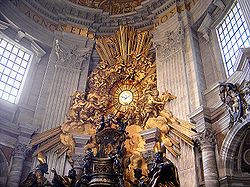
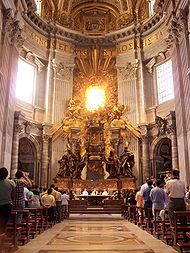
it takes the form of the relic it protects, in this case a chair. Symbolically, the chair Bernini designed had no earthly counterpart in actual contemporary furnishings: it is formed entirely of scrolling members, enclosing a coved panel where the upholstery pattern is rendered as a low relief of Christ
Christ
Christ is the English term for the Greek meaning "the anointed one". It is a translation of the Hebrew , usually transliterated into English as Messiah or Mashiach...
giving the keys to Peter. Large angel
Angel
Angels are mythical beings often depicted as messengers of God in the Hebrew and Christian Bibles along with the Quran. The English word angel is derived from the Greek ἄγγελος, a translation of in the Hebrew Bible ; a similar term, ملائكة , is used in the Qur'an...
ic figures flank an openwork panel beneath a highly realistic bronze seat cushion, vividly empty: the relic is encased within. The cathedra is lofted on splayed scrolling bars that appear to be effortlessly supported by four over-lifesize bronze Doctors of the Church. The cathedra appears to hover over the altar in the basilica's apse, lit by a central tinted window through which light streams, illuminating the gilded glory of sunrays and sculpted clouds that surrounds the window. Like Bernini's Ecstasy of St Theresa
Ecstasy of St Theresa
The Ecstasy of Saint Teresa is the central sculptural group in white marble set in an elevated aedicule in the Cornaro Chapel, Santa Maria della Vittoria, Rome...
, this is a definitive fusion of the Baroque
Baroque
The Baroque is a period and the style that used exaggerated motion and clear, easily interpreted detail to produce drama, tension, exuberance, and grandeur in sculpture, painting, literature, dance, and music...
arts, unifying sculpture and richly polychrome architecture and manipulating effects of light.
Jesus
Jesus
Jesus of Nazareth , commonly referred to as Jesus Christ or simply as Jesus or Christ, is the central figure of Christianity...
' words to Peter in , "You are Peter, and upon this Rock, I will build my Church and the gates of Hell
Hell
In many religious traditions, a hell is a place of suffering and punishment in the afterlife. Religions with a linear divine history often depict hells as endless. Religions with a cyclic history often depict a hell as an intermediary period between incarnations...
shall not prevail against it. To you have I entrusted the keys of the Kingdom of Heaven
Kingdom of God
The Kingdom of God or Kingdom of Heaven is a foundational concept in the Abrahamic religions: Judaism, Christianity and Islam.The term "Kingdom of God" is found in all four canonical gospels and in the Pauline epistles...
and whatever you bind on earth will be bound in heaven, and whatever you loose on earth will be loosed in heaven", are inscribed in Latin in the apse, within which is placed Bernini's monument enclosing the wooden chair, both of which are seen as symbolic of the authority of the Bishop of Rome as Vicar of Christ
Vicar of Christ
Vicar of Christ is a term used in different ways, with different theological connotations throughout history...
and successor of Saint Peter.
Early martyrologies indicate that two liturgical feasts were celebrated in Rome, centuries before the time of Charles the Bald, in honour of earlier chairs associated with Saint Peter, one of which was kept in the baptismal chapel of Saint Peter's Basilica, the other at the catacomb of Priscilla
Catacomb of Priscilla
The Catacomb of Priscilla on the Via Salaria in Rome, Italy, is situated in what was a quarry in Roman times. This quarry was used for Christian burials from the late 2nd century through the 4th century. Some of the walls and ceilings display fine decorations illustrating Biblical scenes...
. The dates of these celebrations were January 18 and February 22. No surviving chair has been identified with either of these chairs. The feasts thus became associated with an abstract understanding of the "Chair of Peter", which by synecdoche
Synecdoche
Synecdoche , meaning "simultaneous understanding") is a figure of speech in which a term is used in one of the following ways:* Part of something is used to refer to the whole thing , or...
signifies the episcopal office
Bishop
A bishop is an ordained or consecrated member of the Christian clergy who is generally entrusted with a position of authority and oversight. Within the Catholic Church, Eastern Orthodox, Oriental Orthodox Churches, in the Assyrian Church of the East, in the Independent Catholic Churches, and in the...
of the Pope
Pope
The Pope is the Bishop of Rome, a position that makes him the leader of the worldwide Catholic Church . In the Catholic Church, the Pope is regarded as the successor of Saint Peter, the Apostle...
as Bishop of Rome, an office considered to have been first held by Saint Peter
Saint Peter
Saint Peter or Simon Peter was an early Christian leader, who is featured prominently in the New Testament Gospels and the Acts of the Apostles. The son of John or of Jonah and from the village of Bethsaida in the province of Galilee, his brother Andrew was also an apostle...
, and thus extended to the diocese, the See of Rome. Though both feasts were originally associated with Saint Peter's stay in Rome, the ninth-century form of the Martyrologium Hieronymianum
Martyrologium Hieronymianum
The Martyrologium Hieronymianum was a medieval list of martyrs, one of the most used and influential of the Middle Ages...
associated the January 18 feast with his stay in Rome, and the February 22 feast with his stay at Antioch
Antioch
Antioch on the Orontes was an ancient city on the eastern side of the Orontes River. It is near the modern city of Antakya, Turkey.Founded near the end of the 4th century BC by Seleucus I Nicator, one of Alexander the Great's generals, Antioch eventually rivaled Alexandria as the chief city of the...
.
The two feasts were included in the Tridentine Calendar
Tridentine Calendar
The Tridentine Calendar is the calendar of saints to be honoured in the course of the liturgical year in the official liturgy of the Roman Rite as reformed by Pope Pius V, implementing a decision of the Council of Trent, which entrusted the task to the Pope....
with the rank of Double, which Pope Clement VIII
Pope Clement VIII
Pope Clement VIII , born Ippolito Aldobrandini, was Pope from 30 January 1592 to 3 March 1605.-Cardinal:...
raised in 1604 to the newly invented rank of Greater Double. In the year 1960 Pope John XXIII
Pope John XXIII
-Papal election:Following the death of Pope Pius XII in 1958, Roncalli was elected Pope, to his great surprise. He had even arrived in the Vatican with a return train ticket to Venice. Many had considered Giovanni Battista Montini, Archbishop of Milan, a possible candidate, but, although archbishop...
removed from the General Roman Calendar eight feast days that were second feasts of a single saint or mystery: one of them was the January 18 feast of the Chair of Peter. The February 22 celebration became a Second-Class Feast. This calendar was incorporated in the 1962 Roman Missal
Roman Missal
The Roman Missal is the liturgical book that contains the texts and rubrics for the celebration of the Mass in the Roman Rite of the Catholic Church.-Situation before the Council of Trent:...
of Pope John XXIII
Pope John XXIII
-Papal election:Following the death of Pope Pius XII in 1958, Roncalli was elected Pope, to his great surprise. He had even arrived in the Vatican with a return train ticket to Venice. Many had considered Giovanni Battista Montini, Archbishop of Milan, a possible candidate, but, although archbishop...
, whose continued use as an extraordinary form of the Roman Rite
Extraordinary form of the Roman Rite
"An extraordinary form of the Roman Rite" is a phrase used in Pope Benedict XVI's motu proprio Summorum Pontificum to describe the liturgy of the 1962 Roman Missal, widely referred to as the "Tridentine Mass"...
is authorized under the conditions indicated in the motu proprio Summorum Pontificum
Summorum Pontificum
Summorum Pontificum is an Apostolic Letter of Pope Benedict XVI, issued "motu proprio" . The document specified the rules, for the Latin Rite of the Catholic Church, for celebrating Mass according to the "Missal promulgated by John XXIII in 1962" , and for administering most of the sacraments in...
In the new classification introduced in 1969 the February 22 celebration appears in the Roman Calendar with the rank of Feast. Those traditionalist Catholic
Traditionalist Catholic
Traditionalist Catholics are Roman Catholics who believe that there should be a restoration of many or all of the liturgical forms, public and private devotions and presentations of Catholic teachings which prevailed in the Catholic Church before the Second Vatican Council...
s who do not accept the changes made by Pope John XXIII continue to celebrate both feast days: "St Peter's Chair at Rome" on January 18 and the "Chair of St Peter at Antioch" on February 22.
External links
- Altar of the Chair of St. Peter
- Catholic Encyclopedia: Chair of St. Peter — article contains photograph of the chair of Charles the Bald
- Encyclopaedia Britannica Online: Gian Lorenzo Bernini