


Central Plains War

Encyclopedia
Central Plains War was a civil war
within the factionalised Kuomintang
(KMT) that broke out in 1930. It was fought between the forces of Chiang Kai-shek
and the coalition of three military commanders who had previously allied with Chiang: Yan Xishan
, Feng Yuxiang
, and Li Zongren
. The war spread wide across Central Plains
, a core region of China
.
In consolidating power for the Kuomintang in the Northern Expedition of 1927–1928, Chiang had forged alliances with the warlord armies of Yan, Feng, and Li. However, relations between Chiang and his warlord allies soon soured, resulting in the war. This war almost bankrupted Chiang's Nationalist Government and cost over 300,000 casualties on both sides. However, Chiang's victory allowed him to further consolidate power as the undisputed leader of most of China.
and Wang Jingwei
, Chiang Kai-shek in contrast was rather a junior official in the Kuomintang
(KMT) . He began to rise to prominence in 1917 in the Guangzhou
government with his militaristic talent. In 1923, Chiang reached the turning point of his life when Chen Jiongming
launched a rebellion against Sun Yat-sen
in Guangzhou. Chiang helped Sun to retreat out of Guangzhou which gained Sun's ultimate trust.
After Sun's death in 1925, the cliques in the Kuomintang began to surface. A power struggle between Chiang and Wang Jingwei split the KMT. However, Chiang was able to use his influence as the commandant of Whampoa Academy to assist on his eventual victory, and Wang was forced to leave the country for a couple years. In 1926, Chiang was chosen as the commander of the National Revolutionary Army
and launched the Northern Expedition. The legitimacy of Chiang's government was thus seemingly decided.
By the end of the expedition, the National Revolutionary Army was organized into four army groups: First was Chiang's Whampoa Clique or Central Army, Second was Feng Yuxiang
's Guominjun
(the largest of the four), Third was Yan Xishan
's Shanxi clique
, and Fourth was Li Zongren
's New Guangxi clique
. In October 1928, Chiang was elected President of the National Government by the KMT central executive committee.
of Manchuria
declared his unification with the Nationalist government
, completing the Northeast Flag Replacement. The objective of the Northern Expedition, unifying China, was proclaimed to be a full success. However, this nominal unification was soon challenged. When the topic of reorganizing the army was brought up at a military conference in 1929, the fact that it would alter the existing territorial influences among the cliques in the party quickly aggravated the relationships between the central government and the regional powers.
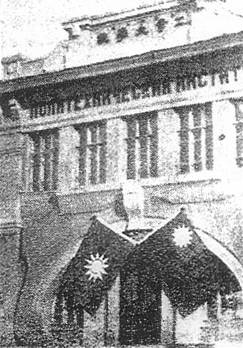 Li Zongren
, Bai Chongxi
and Huang Shaohong of the Guangxi
clique broke off relations with Chiang firstly in March 1929. This effectively started the confrontation. In May, Feng Yuxiang
of the Northwest clashed with Chiang. In November, Li Zongren issued an anti-Chiang declaration, along with Wang Jingwei
, who headed the leftist faction of the Kuomintang and was a rival of the right-wing Chiang. In December, Tang Shengzhi
and Zhang Fakui
announced their support of anti-Chiang coalition. The Nationalist Government in Nanjing
expelled Wang Jingwei from the party in March as a response to the anti-Chiang coalition. The anti-Chiang opposition moved to Beiping to set up a rival KMT government.
In February 1930, Yan Xishan
of the Shanxi clique demanded Chiang's resignation, which Chiang refused. Later that month, Yan was chosen to be commander-in-chief of the coalition while Feng, Li and Zhang Xueliang were chosen to be seconds in command. In April, all of them were sworn in to their positions except Zhang, who was not committed to either side at the time.
in Gansu province against the Guominjun
of Feng Yuxiang.
Ma Zhongying
, a Hui commander led three separate attacks against Feng's forces in Hezhou, and the following year, traveled to Nanjing
and pledged his allegiance to the Kuomintang
, attending the Whampoa Military Academy
and promoted to General.
The Kuomintang
incited anti Yan Xishan
and Feng Yuxiang
sentiments among Chinese Muslims
and Mongols, encouraging for them to topple their rule.
The revolt ended with all the Muslim Generals and Warlords, like Ma Qi
, Ma Lin
, and Ma Bufang
reaffirming their allegiance to the Kuomintang government after defeating the Guominjun.
Army, and deployed the Army from Guangxi into Hunan
province and struck Wuhan
. Feng Yuxiang led the Northwest Army, deploying it from Henan
into Shandong
province to assault Xuzhou
and Wuhan. Yan Xishan led the Shanxi
Army and cooperated with the Northwest Army from Shandong to strike Xuzhou, and planned to march to Nanjing
via railway.
On Chiang's side, Han Fuqu was assigned to defend the southern shore of the Yellow River
to halt the Shanxi Army; The Central Army, commanded by Liu Zhi
, was stationed in Xuzhou for defensive purposes.
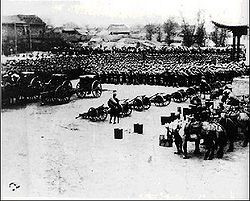 The confrontation erupted in the midst of May. The battlefields in the north were generally in Henan and Shandong; the battlefields in the south were mainly in the area of Yuezhou, Changsha and Hunan
province.
At first, with the assistance of its air force, Chiang's Central Army launched several major offensives. However, the Northwest Army, being top in strength among the coalition, crushed Chen Cheng
and Chiang's forces in Gansu
at the end of May; Chiang was almost captured when inspecting the frontline. But the Northwest Army could not capitalize on the victory as the Shanxi Army was unable to support it in time. This led the Northwest Army to turn to the defensive. Later in Kaifeng
, the Northwest Army repulsed Chiang's attack, and nearly surrounded Chiang's forces. In August, the Shanxi Army and Northwest Army had a major clash with Chiang's forces while attacking Xuzhou. Losses for both sides piled up above 200,000. The Northwest Army ended up not receiving support from Shanxi Army in time, and fell short of success. The Shanxi Army retreated out of Jinan
, and experienced heavy casualties while crossing the Yellow River.
Meanwhile on the southern battlefields, after the Guangxi Army captured Yueyang
, Chiang's forces cut them off from behind. Guangxi Army was eventually forced to withdraw back to Guangxi.
In Shandong, the Shanxi Army captured Jinan
on June 25. After defeating the Guangxi Army in Hunan, the Nanjing
government decided to launch major counter-offensives on Shandong. Landed in Qingdao
, Chiang's forces regained Jinan on August 15. Chiang's army then gathered in Gansu and Shaanxi
province and launched the final offensive against the Northwest Army between the end of August and the beginning of September.
On September 18, Zhang Xueliang declared his support of Chiang Kai-shek. Two days after, Zhang's Northeast Army entered the Shanhai Pass
. As a result, the coalition of Yan and Feng collapsed almost immediately. The Shanxi Army withdrew to the north of the Yellow River while the Northwest Army was totally defeated. On November 4, Yan Xishan and Feng Yuxiang announced their retirement. Yan fled to Dalian
, and Feng's troops were annexed by Zhang. The conflict was now over.
party since the Northern Expedition. Many provinces were affected, and both sides committed over 1,300,000 troops, causing over 300,000 casualties. As a result, the Nanjing
government nearly faced bankruptcy
. The troops that were originally tasked with destroying the Red Army
were pulled away, which prevented Chiang from carrying out his plan to exterminate the Chinese Communist Party.
After the Northeast Army's entrance to Central China, Manchuria
's defense was considerably weakened. It indirectly led to Japan's aggression in the Mukden Incident
. In a wider view, this battle reflects the weakness behind the Nationalist government's unification. The Kuomintang
was unable to resolve the internal dispute between the central government and the regional powers through political methods, and had to resort to military measures. Even though Chiang Kai-shek, who represented the central government, managed to achieve victory in the Central Plains War, the methods he used, including bribery of subordinates of the opposition, were not consistently effective. It did nothing to cement unity among the cliques in the party. The Xi'an Incident
in 1936 and the collapse of the Kuomintang force in the Chinese Civil War
are to an extent due the recurrence of this internal conflict.
Civil war
A civil war is a war between organized groups within the same nation state or republic, or, less commonly, between two countries created from a formerly-united nation state....
within the factionalised Kuomintang
Kuomintang
The Kuomintang of China , sometimes romanized as Guomindang via the Pinyin transcription system or GMD for short, and translated as the Chinese Nationalist Party is a founding and ruling political party of the Republic of China . Its guiding ideology is the Three Principles of the People, espoused...
(KMT) that broke out in 1930. It was fought between the forces of Chiang Kai-shek
Chiang Kai-shek
Chiang Kai-shek was a political and military leader of 20th century China. He is known as Jiǎng Jièshí or Jiǎng Zhōngzhèng in Mandarin....
and the coalition of three military commanders who had previously allied with Chiang: Yan Xishan
Yan Xishan
Yan Xishan, was a Chinese warlord who served in the government of the Republic of China. Yan effectively controlled the province of Shanxi from the 1911 Xinhai Revolution to the 1949 Communist victory in the Chinese Civil War...
, Feng Yuxiang
Feng Yuxiang
Feng Yuxiang was a warlord and leader in Republican China. He was also known as the Christian General for his zeal to convert his troops and the Betrayal General for his penchant to break with the establishment. In 1911, he was an officer in the ranks of Yuan Shikai's Beiyang Army but joined...
, and Li Zongren
Li Zongren
Li Zongren or Li Tsung-jen , courtesy name Delin , was a prominent Guangxi warlord and Kuomintang military commander during the Northern Expedition, Second Sino-Japanese War and Chinese Civil War...
. The war spread wide across Central Plains
Central Plain (China)
Zhongyuan or the Central Plain of China refers to the area on the lower reaches of the Yellow River which formed the cradle of Chinese civilization. It forms part of the North China Plain....
, a core region of China
China
Chinese civilization may refer to:* China for more general discussion of the country.* Chinese culture* Greater China, the transnational community of ethnic Chinese.* History of China* Sinosphere, the area historically affected by Chinese culture...
.
In consolidating power for the Kuomintang in the Northern Expedition of 1927–1928, Chiang had forged alliances with the warlord armies of Yan, Feng, and Li. However, relations between Chiang and his warlord allies soon soured, resulting in the war. This war almost bankrupted Chiang's Nationalist Government and cost over 300,000 casualties on both sides. However, Chiang's victory allowed him to further consolidate power as the undisputed leader of most of China.
Rise of Chiang Kai-shek
Compared to other senior party officials like Hu HanminHu Hanmin
Hu Hanmin was one of the early leaders of Kuomintang , and a very important right-winger in Kuomintang.-Biography:Hu Hanmin was qualified as juren at 21 years of age. He studied in Japan since 1902, and joined Tongmenghui as an editor of 《Minbao》 in 1905. From 1907-1910, he participated in...
and Wang Jingwei
Wang Jingwei
Wang Jingwei , alternate name Wang Zhaoming, was a Chinese politician. He was initially known as a member of the left wing of the Kuomintang , but later became increasingly anti-Communist after his efforts to collaborate with the CCP ended in political failure...
, Chiang Kai-shek in contrast was rather a junior official in the Kuomintang
Kuomintang
The Kuomintang of China , sometimes romanized as Guomindang via the Pinyin transcription system or GMD for short, and translated as the Chinese Nationalist Party is a founding and ruling political party of the Republic of China . Its guiding ideology is the Three Principles of the People, espoused...
(KMT) . He began to rise to prominence in 1917 in the Guangzhou
Guangzhou
Guangzhou , known historically as Canton or Kwangchow, is the capital and largest city of the Guangdong province in the People's Republic of China. Located in southern China on the Pearl River, about north-northwest of Hong Kong, Guangzhou is a key national transportation hub and trading port...
government with his militaristic talent. In 1923, Chiang reached the turning point of his life when Chen Jiongming
Chen Jiongming
Chen Jiongming was a revolutionary figure in the early periods of the Republic of China. Chen Jiongming was born in 1878 at Haifeng, Guangdong, China....
launched a rebellion against Sun Yat-sen
Sun Yat-sen
Sun Yat-sen was a Chinese doctor, revolutionary and political leader. As the foremost pioneer of Nationalist China, Sun is frequently referred to as the "Father of the Nation" , a view agreed upon by both the People's Republic of China and the Republic of China...
in Guangzhou. Chiang helped Sun to retreat out of Guangzhou which gained Sun's ultimate trust.
After Sun's death in 1925, the cliques in the Kuomintang began to surface. A power struggle between Chiang and Wang Jingwei split the KMT. However, Chiang was able to use his influence as the commandant of Whampoa Academy to assist on his eventual victory, and Wang was forced to leave the country for a couple years. In 1926, Chiang was chosen as the commander of the National Revolutionary Army
National Revolutionary Army
The National Revolutionary Army , pre-1928 sometimes shortened to 革命軍 or Revolutionary Army and between 1928-1947 as 國軍 or National Army was the Military Arm of the Kuomintang from 1925 until 1947, as well as the national army of the Republic of China during the KMT's period of party rule...
and launched the Northern Expedition. The legitimacy of Chiang's government was thus seemingly decided.
By the end of the expedition, the National Revolutionary Army was organized into four army groups: First was Chiang's Whampoa Clique or Central Army, Second was Feng Yuxiang
Feng Yuxiang
Feng Yuxiang was a warlord and leader in Republican China. He was also known as the Christian General for his zeal to convert his troops and the Betrayal General for his penchant to break with the establishment. In 1911, he was an officer in the ranks of Yuan Shikai's Beiyang Army but joined...
's Guominjun
Guominjun
The Guominjun , a.k.a Nationalist Army, KMC, or Northwest Army , refers to the military faction founded by Feng Yuxiang, Hu Jingyi and Sun Yue during China's Warlord Era. It was formed when Feng betrayed the Zhili clique during the Second Zhili-Fengtian War with the Fengtian clique in 1924...
(the largest of the four), Third was Yan Xishan
Yan Xishan
Yan Xishan, was a Chinese warlord who served in the government of the Republic of China. Yan effectively controlled the province of Shanxi from the 1911 Xinhai Revolution to the 1949 Communist victory in the Chinese Civil War...
's Shanxi clique
Shanxi clique
The Shanxi clique was one of several military factions that split off from the Beiyang Army during China's warlord era.Though a close associate of Duan Qirui, Shanxi's military governor, Yan Xishan, did not join Duan's Anhui clique. He kept his province neutral from the various civil wars the...
, and Fourth was Li Zongren
Li Zongren
Li Zongren or Li Tsung-jen , courtesy name Delin , was a prominent Guangxi warlord and Kuomintang military commander during the Northern Expedition, Second Sino-Japanese War and Chinese Civil War...
's New Guangxi clique
New Guangxi clique
After the founding of the Republic of China, Guangxi served as the base for one of the most powerful warlord cliques of China: the Old Guangxi clique. Led by Lu Rongting and others, the clique was able to take control of neighbouring Hunan and Guangdong provinces as well...
. In October 1928, Chiang was elected President of the National Government by the KMT central executive committee.
Prelude to the war
In December 1928, Zhang XueliangZhang Xueliang
Zhang Xueliang or Chang Hsüeh-liang , occasionally called Peter Hsueh Liang Chang in English, nicknamed the Young Marshal , was the effective ruler of Manchuria and much of North China after the assassination of his father, Zhang Zuolin, by the Japanese on 4 June 1928...
of Manchuria
Manchuria
Manchuria is a historical name given to a large geographic region in northeast Asia. Depending on the definition of its extent, Manchuria usually falls entirely within the People's Republic of China, or is sometimes divided between China and Russia. The region is commonly referred to as Northeast...
declared his unification with the Nationalist government
Kuomintang
The Kuomintang of China , sometimes romanized as Guomindang via the Pinyin transcription system or GMD for short, and translated as the Chinese Nationalist Party is a founding and ruling political party of the Republic of China . Its guiding ideology is the Three Principles of the People, espoused...
, completing the Northeast Flag Replacement. The objective of the Northern Expedition, unifying China, was proclaimed to be a full success. However, this nominal unification was soon challenged. When the topic of reorganizing the army was brought up at a military conference in 1929, the fact that it would alter the existing territorial influences among the cliques in the party quickly aggravated the relationships between the central government and the regional powers.
Li Zongren
Li Zongren or Li Tsung-jen , courtesy name Delin , was a prominent Guangxi warlord and Kuomintang military commander during the Northern Expedition, Second Sino-Japanese War and Chinese Civil War...
, Bai Chongxi
Bai Chongxi
Bai Chongxi , , also spelled Pai Chung-hsi, was a Chinese general in the National Revolutionary Army of the Republic of China and a prominent Chinese Nationalist Muslim leader. He was of Hui ethnicity and of the Muslim faith...
and Huang Shaohong of the Guangxi
Guangxi
Guangxi, formerly romanized Kwangsi, is a province of southern China along its border with Vietnam. In 1958, it became the Guangxi Zhuang Autonomous Region of the People's Republic of China, a region with special privileges created specifically for the Zhuang people.Guangxi's location, in...
clique broke off relations with Chiang firstly in March 1929. This effectively started the confrontation. In May, Feng Yuxiang
Feng Yuxiang
Feng Yuxiang was a warlord and leader in Republican China. He was also known as the Christian General for his zeal to convert his troops and the Betrayal General for his penchant to break with the establishment. In 1911, he was an officer in the ranks of Yuan Shikai's Beiyang Army but joined...
of the Northwest clashed with Chiang. In November, Li Zongren issued an anti-Chiang declaration, along with Wang Jingwei
Wang Jingwei
Wang Jingwei , alternate name Wang Zhaoming, was a Chinese politician. He was initially known as a member of the left wing of the Kuomintang , but later became increasingly anti-Communist after his efforts to collaborate with the CCP ended in political failure...
, who headed the leftist faction of the Kuomintang and was a rival of the right-wing Chiang. In December, Tang Shengzhi
Tang Shengzhi
Tang Shengzhi was a Chinese warlord during the Warlord Era, a military commander during the Second Sino-Japanese War, and a politician after World War II....
and Zhang Fakui
Zhang Fakui
Zhang Fakui was a Chinese Nationalist general who fought against northern warlords, the Imperial Japanese Army and Chinese Communist forces in his military career. He served as commander-in-chief the 8th Army Group and commander-in-chief of NRA ground force before retire in Hong Kong in...
announced their support of anti-Chiang coalition. The Nationalist Government in Nanjing
Nanjing
' is the capital of Jiangsu province in China and has a prominent place in Chinese history and culture, having been the capital of China on several occasions...
expelled Wang Jingwei from the party in March as a response to the anti-Chiang coalition. The anti-Chiang opposition moved to Beiping to set up a rival KMT government.
In February 1930, Yan Xishan
Yan Xishan
Yan Xishan, was a Chinese warlord who served in the government of the Republic of China. Yan effectively controlled the province of Shanxi from the 1911 Xinhai Revolution to the 1949 Communist victory in the Chinese Civil War...
of the Shanxi clique demanded Chiang's resignation, which Chiang refused. Later that month, Yan was chosen to be commander-in-chief of the coalition while Feng, Li and Zhang Xueliang were chosen to be seconds in command. In April, all of them were sworn in to their positions except Zhang, who was not committed to either side at the time.
Muslim Revolt in Gansu
A revolt led by Ma T'ing-hsiang in the spring of 1928 broke out among the Hui peopleHui people
The Hui people are an ethnic group in China, defined as Chinese speaking people descended from foreign Muslims. They are typically distinguished by their practice of Islam, however some also practice other religions, and many are direct descendants of Silk Road travelers.In modern People's...
in Gansu province against the Guominjun
Guominjun
The Guominjun , a.k.a Nationalist Army, KMC, or Northwest Army , refers to the military faction founded by Feng Yuxiang, Hu Jingyi and Sun Yue during China's Warlord Era. It was formed when Feng betrayed the Zhili clique during the Second Zhili-Fengtian War with the Fengtian clique in 1924...
of Feng Yuxiang.
Ma Zhongying
Ma Zhongying
Ma Zhongying, also Ma Chung-ying was a Tungan Chinese Muslim warlord during the Warlord era of China. Ma Zhongying's birth name was Ma Buying . Zhongying was a warlord of Gansu province in China during the 1930s. He allied himself with the Kuomintang, which gave his soldiers an official...
, a Hui commander led three separate attacks against Feng's forces in Hezhou, and the following year, traveled to Nanjing
Nanjing
' is the capital of Jiangsu province in China and has a prominent place in Chinese history and culture, having been the capital of China on several occasions...
and pledged his allegiance to the Kuomintang
Kuomintang
The Kuomintang of China , sometimes romanized as Guomindang via the Pinyin transcription system or GMD for short, and translated as the Chinese Nationalist Party is a founding and ruling political party of the Republic of China . Its guiding ideology is the Three Principles of the People, espoused...
, attending the Whampoa Military Academy
Whampoa Military Academy
The Nationalist Party of China Army Officer Academy , commonly known as the Whampoa Military Academy , was a military academy in the Republic of China that produced many prestigious commanders who fought in many of China's conflicts in the 20th century, notably the Northern Expedition, the Second...
and promoted to General.
The Kuomintang
Kuomintang
The Kuomintang of China , sometimes romanized as Guomindang via the Pinyin transcription system or GMD for short, and translated as the Chinese Nationalist Party is a founding and ruling political party of the Republic of China . Its guiding ideology is the Three Principles of the People, espoused...
incited anti Yan Xishan
Yan Xishan
Yan Xishan, was a Chinese warlord who served in the government of the Republic of China. Yan effectively controlled the province of Shanxi from the 1911 Xinhai Revolution to the 1949 Communist victory in the Chinese Civil War...
and Feng Yuxiang
Feng Yuxiang
Feng Yuxiang was a warlord and leader in Republican China. He was also known as the Christian General for his zeal to convert his troops and the Betrayal General for his penchant to break with the establishment. In 1911, he was an officer in the ranks of Yuan Shikai's Beiyang Army but joined...
sentiments among Chinese Muslims
Hui people
The Hui people are an ethnic group in China, defined as Chinese speaking people descended from foreign Muslims. They are typically distinguished by their practice of Islam, however some also practice other religions, and many are direct descendants of Silk Road travelers.In modern People's...
and Mongols, encouraging for them to topple their rule.
The revolt ended with all the Muslim Generals and Warlords, like Ma Qi
Ma Qi
Ma Qi was a Chinese Muslim warlord in early 20th century China.-Early life:His grandfather Sa-la Ma , is a Salar. He was born in 1869 in Daohe, now part of Linxia, Gansu, China. His father was Ma Haiyan...
, Ma Lin
Ma Lin
Ma Lin is a fictional character in the Water Margin, one of the Four Great Classical Novels of Chinese literature. He ranks 67th of the 108 Liangshan heroes and 31st of the 72 Earthly Fiends. He is nicknamed "Iron Flute Deity".-Background:...
, and Ma Bufang
Ma Bufang
Ma Bufang was a prominent Muslim Ma clique warlord in China during the Republic of China era, ruling the northwestern province of Qinghai. His rank was Lieutenant-general...
reaffirming their allegiance to the Kuomintang government after defeating the Guominjun.
Preparations
The Anti-Chiang coalition divided their offense into various routes. Li Zongren led the GuangxiGuangxi
Guangxi, formerly romanized Kwangsi, is a province of southern China along its border with Vietnam. In 1958, it became the Guangxi Zhuang Autonomous Region of the People's Republic of China, a region with special privileges created specifically for the Zhuang people.Guangxi's location, in...
Army, and deployed the Army from Guangxi into Hunan
Hunan
' is a province of South-Central China, located to the south of the middle reaches of the Yangtze River and south of Lake Dongting...
province and struck Wuhan
Wuhan
Wuhan is the capital of Hubei province, People's Republic of China, and is the most populous city in Central China. It lies at the east of the Jianghan Plain, and the intersection of the middle reaches of the Yangtze and Han rivers...
. Feng Yuxiang led the Northwest Army, deploying it from Henan
Henan
Henan , is a province of the People's Republic of China, located in the central part of the country. Its one-character abbreviation is "豫" , named after Yuzhou , a Han Dynasty state that included parts of Henan...
into Shandong
Shandong
' is a Province located on the eastern coast of the People's Republic of China. Shandong has played a major role in Chinese history from the beginning of Chinese civilization along the lower reaches of the Yellow River and served as a pivotal cultural and religious site for Taoism, Chinese...
province to assault Xuzhou
Xuzhou
Xuzhou , otherwise known as Pengcheng in ancient times, is a major city in and the fourth largest prefecture-level city of Jiangsu province, People's Republic of China...
and Wuhan. Yan Xishan led the Shanxi
Shanxi
' is a province in Northern China. Its one-character abbreviation is "晋" , after the state of Jin that existed here during the Spring and Autumn Period....
Army and cooperated with the Northwest Army from Shandong to strike Xuzhou, and planned to march to Nanjing
Nanjing
' is the capital of Jiangsu province in China and has a prominent place in Chinese history and culture, having been the capital of China on several occasions...
via railway.
On Chiang's side, Han Fuqu was assigned to defend the southern shore of the Yellow River
Yellow River
The Yellow River or Huang He, formerly known as the Hwang Ho, is the second-longest river in China and the sixth-longest in the world at the estimated length of . Originating in the Bayan Har Mountains in Qinghai Province in western China, it flows through nine provinces of China and empties into...
to halt the Shanxi Army; The Central Army, commanded by Liu Zhi
Liu Chih
Liu Chih was a prominent Kuomintang military and political leader in the Republic of China.-Biography:...
, was stationed in Xuzhou for defensive purposes.
Outbreak
Hunan
' is a province of South-Central China, located to the south of the middle reaches of the Yangtze River and south of Lake Dongting...
province.
At first, with the assistance of its air force, Chiang's Central Army launched several major offensives. However, the Northwest Army, being top in strength among the coalition, crushed Chen Cheng
Chen Cheng
Chen Cheng , was a Chinese political and military leader, and one of the main National Revolutionary Army commanders during the Second Sino-Japanese War and the Chinese Civil War. After moving to Taiwan at the end of the Civil War, he served as the Governor of Taiwan Province, Vice President and...
and Chiang's forces in Gansu
Gansu
' is a province located in the northwest of the People's Republic of China.It lies between the Tibetan and Huangtu plateaus, and borders Mongolia, Inner Mongolia, and Ningxia to the north, Xinjiang and Qinghai to the west, Sichuan to the south, and Shaanxi to the east...
at the end of May; Chiang was almost captured when inspecting the frontline. But the Northwest Army could not capitalize on the victory as the Shanxi Army was unable to support it in time. This led the Northwest Army to turn to the defensive. Later in Kaifeng
Kaifeng
Kaifeng , known previously by several names , is a prefecture-level city in east-central Henan province, Central China. Nearly 5 million people live in the metropolitan area...
, the Northwest Army repulsed Chiang's attack, and nearly surrounded Chiang's forces. In August, the Shanxi Army and Northwest Army had a major clash with Chiang's forces while attacking Xuzhou. Losses for both sides piled up above 200,000. The Northwest Army ended up not receiving support from Shanxi Army in time, and fell short of success. The Shanxi Army retreated out of Jinan
Jinan
Jinan is the capital of Shandong province in Eastern China. The area of present-day Jinan has played an important role in the history of the region from the earliest beginnings of civilisation and has evolved into a major national administrative, economic, and transportation hub...
, and experienced heavy casualties while crossing the Yellow River.
Meanwhile on the southern battlefields, after the Guangxi Army captured Yueyang
Yueyang
Yueyang is a prefecture-level city at the northeastern corner of Hunan province, South Central China, on the southern shores of Dongting Lake.The Yueyang metropolitan area occupies 14,896 km². and the city proper occupies 304 km²...
, Chiang's forces cut them off from behind. Guangxi Army was eventually forced to withdraw back to Guangxi.
In Shandong, the Shanxi Army captured Jinan
Jinan
Jinan is the capital of Shandong province in Eastern China. The area of present-day Jinan has played an important role in the history of the region from the earliest beginnings of civilisation and has evolved into a major national administrative, economic, and transportation hub...
on June 25. After defeating the Guangxi Army in Hunan, the Nanjing
Nanjing
' is the capital of Jiangsu province in China and has a prominent place in Chinese history and culture, having been the capital of China on several occasions...
government decided to launch major counter-offensives on Shandong. Landed in Qingdao
Qingdao
' also known in the West by its postal map spelling Tsingtao, is a major city with a population of over 8.715 million in eastern Shandong province, Eastern China. Its built up area, made of 7 urban districts plus Jimo city, is home to about 4,346,000 inhabitants in 2010.It borders Yantai to the...
, Chiang's forces regained Jinan on August 15. Chiang's army then gathered in Gansu and Shaanxi
Shaanxi
' is a province in the central part of Mainland China, and it includes portions of the Loess Plateau on the middle reaches of the Yellow River in addition to the Qinling Mountains across the southern part of this province...
province and launched the final offensive against the Northwest Army between the end of August and the beginning of September.
On September 18, Zhang Xueliang declared his support of Chiang Kai-shek. Two days after, Zhang's Northeast Army entered the Shanhai Pass
Shanhai Pass
Shanhai Pass , or Shanhaiguan, along with Jiayu Pass and Juyong Pass, is one of the major passes of the Great Wall of China It is located in Shanhaiguan District, Qinhuangdao, Hebei. In 1961, Shanhaiguan became a site of China First Class National Cultural Site.It is a popular tourist destination,...
. As a result, the coalition of Yan and Feng collapsed almost immediately. The Shanxi Army withdrew to the north of the Yellow River while the Northwest Army was totally defeated. On November 4, Yan Xishan and Feng Yuxiang announced their retirement. Yan fled to Dalian
Dalian
Dalian is a major city and seaport in the south of Liaoning province, Northeast China. It faces Shandong to the south, the Yellow Sea to the east and the Bohai Sea to the west and south. Holding sub-provincial administrative status, Dalian is the southernmost city of Northeast China and China's...
, and Feng's troops were annexed by Zhang. The conflict was now over.
Aftermath
The Central Plains War was the biggest civil war conflict inside the KuomintangKuomintang
The Kuomintang of China , sometimes romanized as Guomindang via the Pinyin transcription system or GMD for short, and translated as the Chinese Nationalist Party is a founding and ruling political party of the Republic of China . Its guiding ideology is the Three Principles of the People, espoused...
party since the Northern Expedition. Many provinces were affected, and both sides committed over 1,300,000 troops, causing over 300,000 casualties. As a result, the Nanjing
Nanjing
' is the capital of Jiangsu province in China and has a prominent place in Chinese history and culture, having been the capital of China on several occasions...
government nearly faced bankruptcy
Bankruptcy
Bankruptcy is a legal status of an insolvent person or an organisation, that is, one that cannot repay the debts owed to creditors. In most jurisdictions bankruptcy is imposed by a court order, often initiated by the debtor....
. The troops that were originally tasked with destroying the Red Army
Jiangxi Soviet
The Chinese Soviet Republic , also translated as the Soviet Republic of China or the China Soviet Republic, and often referred to in historical literature as the Jiangxi Soviet , was a state established in November 1931 by the future Communist Party of China leader Mao...
were pulled away, which prevented Chiang from carrying out his plan to exterminate the Chinese Communist Party.
After the Northeast Army's entrance to Central China, Manchuria
Manchuria
Manchuria is a historical name given to a large geographic region in northeast Asia. Depending on the definition of its extent, Manchuria usually falls entirely within the People's Republic of China, or is sometimes divided between China and Russia. The region is commonly referred to as Northeast...
's defense was considerably weakened. It indirectly led to Japan's aggression in the Mukden Incident
Mukden Incident
The Mukden Incident, also known as the Manchurian Incident, was a staged event that was engineered by Japanese military personnel as a pretext for invading the northern part of China known as Manchuria in 1931....
. In a wider view, this battle reflects the weakness behind the Nationalist government's unification. The Kuomintang
Kuomintang
The Kuomintang of China , sometimes romanized as Guomindang via the Pinyin transcription system or GMD for short, and translated as the Chinese Nationalist Party is a founding and ruling political party of the Republic of China . Its guiding ideology is the Three Principles of the People, espoused...
was unable to resolve the internal dispute between the central government and the regional powers through political methods, and had to resort to military measures. Even though Chiang Kai-shek, who represented the central government, managed to achieve victory in the Central Plains War, the methods he used, including bribery of subordinates of the opposition, were not consistently effective. It did nothing to cement unity among the cliques in the party. The Xi'an Incident
Xi'an Incident
The Xi'an Incident of December 1936 is an important episode of Chinese modern history, taking place in the city of Xi'an during the Chinese Civil War between the ruling Kuomintang and the rebel Chinese Communist Party and just before the Second Sino-Japanese War...
in 1936 and the collapse of the Kuomintang force in the Chinese Civil War
Chinese Civil War
The Chinese Civil War was a civil war fought between the Kuomintang , the governing party of the Republic of China, and the Communist Party of China , for the control of China which eventually led to China's division into two Chinas, Republic of China and People's Republic of...
are to an extent due the recurrence of this internal conflict.
See also
- Warlord eraWarlord eraThe Chinese Warlord Era was the period in the history of the Republic of China, from 1916 to 1928, when the country was divided among military cliques, a division that continued until the fall of the Nationalist government in the mainland China regions of Sichuan, Shanxi, Qinghai, Ningxia,...
- National Revolutionary ArmyNational Revolutionary ArmyThe National Revolutionary Army , pre-1928 sometimes shortened to 革命軍 or Revolutionary Army and between 1928-1947 as 國軍 or National Army was the Military Arm of the Kuomintang from 1925 until 1947, as well as the national army of the Republic of China during the KMT's period of party rule...
- History of the Republic of ChinaHistory of the Republic of ChinaThe History of the Republic of China begins after the Qing Dynasty in 1912, when the formation of the Republic of China put an end to over two thousand years of Imperial rule. The Qing Dynasty, also known as the Manchu Dynasty, ruled from 1644 to 1912...
- KuomintangKuomintangThe Kuomintang of China , sometimes romanized as Guomindang via the Pinyin transcription system or GMD for short, and translated as the Chinese Nationalist Party is a founding and ruling political party of the Republic of China . Its guiding ideology is the Three Principles of the People, espoused...