


Censorship by religion

Encyclopedia
Censorship by religion is a form of censorship
where freedom of expression is controlled or limited using religious authority or on the basis of the teachings of the religion
. This form of censorship has a long history and is practiced in many societies and by many religions. Examples include the Edict of Compiègne
, the Index Librorum Prohibitorum
(list of prohibited books) and the condemnation of Salman Rushdie's novel The Satanic Verses
by Iran
ian leader Ayatollah Ruhollah Khomeini.
, heresy
, sacrilege
or impiety
- the censored work being viewed as obscene, challenging a dogma
, or violating a religious taboo
. Defending against these charges is often difficult as some religious traditions permit only the religious authorities (clergy
) to interpret doctrine
and the interpretation is usually dogmatic. For instance, the Catholic Church banned hundreds of books on such grounds and maintained the Index Librorum Prohibitorum
(list of prohibited books), most of which were writings that the Church's Holy Office had deemed dangerous, until the Index's abolishment in 1965.
by Johannes Gutenberg around 1440 changed the nature of book publishing. As of the 16th century, in most European countries both the church and governments attempted to regulate and control printing. Governments established controls over printers across Europe, requiring them to have official licenses to trade and produce books. In 1557 the British Crown aimed to stem the flow of dissent by chartering the Stationers' Company. The right to print was restricted to two universities and to the 21 existing printers in the city of London
. In France, the 1551 Edict of Châteaubriant
included provisions for unpacking and inspecting all books brought into France. The 1557 Edict of Compiègne
applied the death penalty to heretics and resulted in the burning of a noblewoman at the stake.
A first version of the Index Librorum Prohibitorum
("List of Prohibited Books") was promulgated by Pope Paul IV
in 1559, and multiple revisions were made to it over the years.
Some works named in the Index Librorum Prohibitorum are the writings of Desiderius Erasmus
, a Catholic scholar who argued that the Comma Johanneum
was probably forged and De revolutionibus orbium coelestium
, a treatise by Nicolaus Copernicus
arguing for a Heliocentric orbit of the earth, both works that at the time contradicted the Church's official stance on particular issues.
The final (20th) edition appeared in 1948, and it was formally abolished on 14 June 1966 by Pope Paul VI
. However, the moral obligation of the Index was not abolished, according to the Congregation for the Doctrine of the Faith
. Furthermore, the 1983 Code of Canon Law
states that bishops have the duty and right to review material concerning faith or morals before it may be published.
Some examples of Christian bans:
ic theocracies
, such as the fatwa
(religious judgment) against The Satanic Verses
(a novel), ordering that the author be executed for blasphemy
.
Some Islamic societies have religious police, who enforce the application of Islamic Sharia law. Their authority may include the power to arrest unrelated males and females caught socializing, anyone engaged in homosexual behavior or prostitution; to enforce Islamic dress-codes, and store closures during Islamic prayer time.
These religious police enforce Muslim dietary laws, prohibit the consumption or sale of alcoholic beverage
s and pork
, and seize banned consumer products and media regarded as un-Islamic, such as CDs/DVDs of various Western musical groups, television shows and film. In Saudi Arabia
, religious police actively prevent the practice or proselytizing of non-Islamic religions within Saudi Arabia, where they are banned. This included the ban of the film, The Passion of the Christ
.
Examples of Muslim censorship:
in the fifteenth and sixteenth century. Other studies have been written on the censorship of the Czarist government in Russia
in the nineteenth century.
Many of the "official" Christian government censors of Jewish books were Jewish apostates. The main reason for this was due to their knowledge of Hebrew, especially Rabbinic Hebrew.
In Czarist Russia in the nineteenth century, it was decreed that Jewish books could only be published in two cities, Vilnius
and Zhitomir.
(Sanhedrin
10:1) prohibits the reading of extra-biblical books
(ספרים חיצונים). The Talmud
explains this to mean the book of Ben Sirah (Sirach
).
In the early thirteenth century the philosophical book The Guide for the Perplexed by Maimonides
was prohibited to be read until one was older by some French and Spanish Jewish leaders, because of the perceived danger of philosophy. Philosophy was prohibited to be learned until the age of forty. The same restriction was later applied to Kabbalah
, in the fifteenth century.
In the 1720s, the kabbalistic works of Rabbi Moshe Chaim Luzzato were banned by religious leaders. In the 1690s, the book Pri Chadash was banned in Egypt for arguing on earlier authorities.
In the modern era, when government censorship of Jewish books is uncommon, books are mainly self-censored, or banned by Orthodox Jewish religious authorities. Marc Shapiro points out that not all books considered heretical by Orthodox Jews are banned; only those books on which there is a risk that Orthodox Jews may read them are banned.
Some examples:
Censorship
thumb|[[Book burning]] following the [[1973 Chilean coup d'état|1973 coup]] that installed the [[Military government of Chile |Pinochet regime]] in Chile...
where freedom of expression is controlled or limited using religious authority or on the basis of the teachings of the religion
Religion
Religion is a collection of cultural systems, belief systems, and worldviews that establishes symbols that relate humanity to spirituality and, sometimes, to moral values. Many religions have narratives, symbols, traditions and sacred histories that are intended to give meaning to life or to...
. This form of censorship has a long history and is practiced in many societies and by many religions. Examples include the Edict of Compiègne
Edict of Compiègne
The Edict of Compiègne , issued from his Château de Compiègne by Henri II of France, 24 July 1557, applied the death penalty for all convictions of relapsed and obstinate "sacramentarians", for those who went to Geneva or published books there, for iconoclast blasphemers against images, and even...
, the Index Librorum Prohibitorum
Index Librorum Prohibitorum
The Index Librorum Prohibitorum was a list of publications prohibited by the Catholic Church. A first version was promulgated by Pope Paul IV in 1559, and a revised and somewhat relaxed form was authorized at the Council of Trent...
(list of prohibited books) and the condemnation of Salman Rushdie's novel The Satanic Verses
The Satanic Verses
The Satanic Verses is Salman Rushdie's fourth novel, first published in 1988 and inspired in part by the life of Prophet Muhammad. As with his previous books, Rushdie used magical realism and relied on contemporary events and people to create his characters...
by Iran
Iran
Iran , officially the Islamic Republic of Iran , is a country in Southern and Western Asia. The name "Iran" has been in use natively since the Sassanian era and came into use internationally in 1935, before which the country was known to the Western world as Persia...
ian leader Ayatollah Ruhollah Khomeini.
Overview
Religious censorship is defined as the act of suppressing views that are contrary of those of an organized religion. It is usually performed on the grounds of blasphemyBlasphemy
Blasphemy is irreverence towards religious or holy persons or things. Some countries have laws to punish blasphemy, while others have laws to give recourse to those who are offended by blasphemy...
, heresy
Heresy
Heresy is a controversial or novel change to a system of beliefs, especially a religion, that conflicts with established dogma. It is distinct from apostasy, which is the formal denunciation of one's religion, principles or cause, and blasphemy, which is irreverence toward religion...
, sacrilege
Sacrilege
Sacrilege is the violation or injurious treatment of a sacred object. In a less proper sense, any transgression against the virtue of religion would be a sacrilege. It can come in the form of irreverence to sacred persons, places, and things...
or impiety
Impiety
Impiety is classically a lack of proper concern for the obligations owed to public religious observation or cult. Impiety was a main Pagan objection to Christianity, for unlike other initiates into mystery religions, early Christians refused to cast a pinch of incense before the images of the gods,...
- the censored work being viewed as obscene, challenging a dogma
Dogma
Dogma is the established belief or doctrine held by a religion, or a particular group or organization. It is authoritative and not to be disputed, doubted, or diverged from, by the practitioners or believers...
, or violating a religious taboo
Taboo
A taboo is a strong social prohibition relating to any area of human activity or social custom that is sacred and or forbidden based on moral judgment, religious beliefs and or scientific consensus. Breaking the taboo is usually considered objectionable or abhorrent by society...
. Defending against these charges is often difficult as some religious traditions permit only the religious authorities (clergy
Clergy
Clergy is the generic term used to describe the formal religious leadership within a given religion. A clergyman, churchman or cleric is a member of the clergy, especially one who is a priest, preacher, pastor, or other religious professional....
) to interpret doctrine
Doctrine
Doctrine is a codification of beliefs or a body of teachings or instructions, taught principles or positions, as the body of teachings in a branch of knowledge or belief system...
and the interpretation is usually dogmatic. For instance, the Catholic Church banned hundreds of books on such grounds and maintained the Index Librorum Prohibitorum
Index Librorum Prohibitorum
The Index Librorum Prohibitorum was a list of publications prohibited by the Catholic Church. A first version was promulgated by Pope Paul IV in 1559, and a revised and somewhat relaxed form was authorized at the Council of Trent...
(list of prohibited books), most of which were writings that the Church's Holy Office had deemed dangerous, until the Index's abolishment in 1965.
In Christianity
The invention of the printing pressPrinting press
A printing press is a device for applying pressure to an inked surface resting upon a print medium , thereby transferring the ink...
by Johannes Gutenberg around 1440 changed the nature of book publishing. As of the 16th century, in most European countries both the church and governments attempted to regulate and control printing. Governments established controls over printers across Europe, requiring them to have official licenses to trade and produce books. In 1557 the British Crown aimed to stem the flow of dissent by chartering the Stationers' Company. The right to print was restricted to two universities and to the 21 existing printers in the city of London
City of London
The City of London is a small area within Greater London, England. It is the historic core of London around which the modern conurbation grew and has held city status since time immemorial. The City’s boundaries have remained almost unchanged since the Middle Ages, and it is now only a tiny part of...
. In France, the 1551 Edict of Châteaubriant
Edict of Châteaubriant
The Edict of Châteaubriant, issued from the seat of Anne, duc de Montmorency in Brittany, was promulgated by Henri II of France, 27 June 1551. The Edict was one of an increasingly severe series of measures taken by Henry II against Protestants, whom he regarded as heretics...
included provisions for unpacking and inspecting all books brought into France. The 1557 Edict of Compiègne
Edict of Compiègne
The Edict of Compiègne , issued from his Château de Compiègne by Henri II of France, 24 July 1557, applied the death penalty for all convictions of relapsed and obstinate "sacramentarians", for those who went to Geneva or published books there, for iconoclast blasphemers against images, and even...
applied the death penalty to heretics and resulted in the burning of a noblewoman at the stake.
A first version of the Index Librorum Prohibitorum
Index Librorum Prohibitorum
The Index Librorum Prohibitorum was a list of publications prohibited by the Catholic Church. A first version was promulgated by Pope Paul IV in 1559, and a revised and somewhat relaxed form was authorized at the Council of Trent...
("List of Prohibited Books") was promulgated by Pope Paul IV
Pope Paul IV
Pope Paul IV, C.R. , né Giovanni Pietro Carafa, was Pope from 23 May 1555 until his death.-Early life:Giovanni Pietro Carafa was born in Capriglia Irpina, near Avellino, into a prominent noble family of Naples...
in 1559, and multiple revisions were made to it over the years.
Some works named in the Index Librorum Prohibitorum are the writings of Desiderius Erasmus
Desiderius Erasmus
Desiderius Erasmus Roterodamus , known as Erasmus of Rotterdam, was a Dutch Renaissance humanist, Catholic priest, and a theologian....
, a Catholic scholar who argued that the Comma Johanneum
Comma Johanneum
The Comma Johanneum is a comma in the First Epistle of John according to the Latin Vulgate text as transmitted since the Early Middle Ages, based on Vetus Latina minority readings dating to the 7th century...
was probably forged and De revolutionibus orbium coelestium
De revolutionibus orbium coelestium
De revolutionibus orbium coelestium is the seminal work on the heliocentric theory of the Renaissance astronomer Nicolaus Copernicus...
, a treatise by Nicolaus Copernicus
Nicolaus Copernicus
Nicolaus Copernicus was a Renaissance astronomer and the first person to formulate a comprehensive heliocentric cosmology which displaced the Earth from the center of the universe....
arguing for a Heliocentric orbit of the earth, both works that at the time contradicted the Church's official stance on particular issues.
The final (20th) edition appeared in 1948, and it was formally abolished on 14 June 1966 by Pope Paul VI
Pope Paul VI
Paul VI , born Giovanni Battista Enrico Antonio Maria Montini , reigned as Pope of the Catholic Church from 21 June 1963 until his death on 6 August 1978. Succeeding Pope John XXIII, who had convened the Second Vatican Council, he decided to continue it...
. However, the moral obligation of the Index was not abolished, according to the Congregation for the Doctrine of the Faith
Congregation for the Doctrine of the Faith
The Congregation for the Doctrine of the Faith , previously known as the Supreme Sacred Congregation of the Roman and Universal Inquisition , and after 1904 called the Supreme...
. Furthermore, the 1983 Code of Canon Law
1983 Code of Canon Law
The 1983 Code of Canon Law is the codification of canonical legislation for the Latin Rite of the Catholic Church...
states that bishops have the duty and right to review material concerning faith or morals before it may be published.
Some examples of Christian bans:
- The Da Vinci CodeThe Da Vinci CodeThe Da Vinci Code is a 2003 mystery-detective novel written by Dan Brown. It follows symbologist Robert Langdon and Sophie Neveu as they investigate a murder in Paris's Louvre Museum and discover a battle between the Priory of Sion and Opus Dei over the possibility of Jesus having been married to...
was banned in SamoaSamoaSamoa , officially the Independent State of Samoa, formerly known as Western Samoa is a country encompassing the western part of the Samoan Islands in the South Pacific Ocean. It became independent from New Zealand in 1962. The two main islands of Samoa are Upolu and one of the biggest islands in...
.
In Islam
Similar methodology has been carried out under IslamIslam
Islam . The most common are and . : Arabic pronunciation varies regionally. The first vowel ranges from ~~. The second vowel ranges from ~~~...
ic theocracies
Theocracy
Theocracy is a form of organization in which the official policy is to be governed by immediate divine guidance or by officials who are regarded as divinely guided, or simply pursuant to the doctrine of a particular religious sect or religion....
, such as the fatwa
Fatwa
A fatwā in the Islamic faith is a juristic ruling concerning Islamic law issued by an Islamic scholar. In Sunni Islam any fatwā is non-binding, whereas in Shia Islam it could be considered by an individual as binding, depending on his or her relation to the scholar. The person who issues a fatwā...
(religious judgment) against The Satanic Verses
The Satanic Verses
The Satanic Verses is Salman Rushdie's fourth novel, first published in 1988 and inspired in part by the life of Prophet Muhammad. As with his previous books, Rushdie used magical realism and relied on contemporary events and people to create his characters...
(a novel), ordering that the author be executed for blasphemy
Blasphemy
Blasphemy is irreverence towards religious or holy persons or things. Some countries have laws to punish blasphemy, while others have laws to give recourse to those who are offended by blasphemy...
.
Some Islamic societies have religious police, who enforce the application of Islamic Sharia law. Their authority may include the power to arrest unrelated males and females caught socializing, anyone engaged in homosexual behavior or prostitution; to enforce Islamic dress-codes, and store closures during Islamic prayer time.
These religious police enforce Muslim dietary laws, prohibit the consumption or sale of alcoholic beverage
Alcoholic beverage
An alcoholic beverage is a drink containing ethanol, commonly known as alcohol. Alcoholic beverages are divided into three general classes: beers, wines, and spirits. They are legally consumed in most countries, and over 100 countries have laws regulating their production, sale, and consumption...
s and pork
Pork
Pork is the culinary name for meat from the domestic pig , which is eaten in many countries. It is one of the most commonly consumed meats worldwide, with evidence of pig husbandry dating back to 5000 BC....
, and seize banned consumer products and media regarded as un-Islamic, such as CDs/DVDs of various Western musical groups, television shows and film. In Saudi Arabia
Saudi Arabia
The Kingdom of Saudi Arabia , commonly known in British English as Saudi Arabia and in Arabic as as-Sa‘ūdiyyah , is the largest state in Western Asia by land area, constituting the bulk of the Arabian Peninsula, and the second-largest in the Arab World...
, religious police actively prevent the practice or proselytizing of non-Islamic religions within Saudi Arabia, where they are banned. This included the ban of the film, The Passion of the Christ
The Passion of the Christ
The Passion of the Christ is a 2004 American drama film directed by Mel Gibson and starring Jim Caviezel as Jesus. It depicts the Passion of Jesus largely according to the New Testament Gospels of Matthew, Mark, Luke and John...
.
Examples of Muslim censorship:
- Depictions of MuhammadDepictions of MuhammadThe permissibility of depictions of Muhammad, the founder of Islam, has long been a concern in the history of Islam. Oral and written descriptions are readily accepted by all traditions of Islam, but there is disagreement about visual depictions....
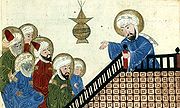
have inspired considerable controversy and censorship in the 2000s, including the image to the right.
In Judaism
Throughout the history of the publishing of Jewish books, various works have been censored or banned. These can be divided into two main categories: Censorship by a non-Jewish government, and self-censorship. Self-censorship could be done either by the author himself, or by the publisher, out of fear from the gentiles or public reaction. Another important distinction that has to be made is between the censorship which existed already on manuscripts, before the printing press was invented, and the more official censorship after the printing press was invented.Gentile Government Censorship
Many studies have been written on censorship and its influence on the publishing of Jewish books. For example, studies have appeared on the censorship of Jewish books when they were first starting to be published, in ItalyItaly
Italy , officially the Italian Republic languages]] under the European Charter for Regional or Minority Languages. In each of these, Italy's official name is as follows:;;;;;;;;), is a unitary parliamentary republic in South-Central Europe. To the north it borders France, Switzerland, Austria and...
in the fifteenth and sixteenth century. Other studies have been written on the censorship of the Czarist government in Russia
Russia
Russia or , officially known as both Russia and the Russian Federation , is a country in northern Eurasia. It is a federal semi-presidential republic, comprising 83 federal subjects...
in the nineteenth century.
Many of the "official" Christian government censors of Jewish books were Jewish apostates. The main reason for this was due to their knowledge of Hebrew, especially Rabbinic Hebrew.
In Czarist Russia in the nineteenth century, it was decreed that Jewish books could only be published in two cities, Vilnius
Vilnius
Vilnius is the capital of Lithuania, and its largest city, with a population of 560,190 as of 2010. It is the seat of the Vilnius city municipality and of the Vilnius district municipality. It is also the capital of Vilnius County...
and Zhitomir.
Censorship by Jewish Religious Authorities
The MishnahMishnah
The Mishnah or Mishna is the first major written redaction of the Jewish oral traditions called the "Oral Torah". It is also the first major work of Rabbinic Judaism. It was redacted c...
(Sanhedrin
Sanhedrin
The Sanhedrin was an assembly of twenty-three judges appointed in every city in the Biblical Land of Israel.The Great Sanhedrin was the supreme court of ancient Israel made of 71 members...
10:1) prohibits the reading of extra-biblical books
Development of the Jewish Bible canon
Rabbinic Judaism recognizes the 24 books of the Masoretic Text, commonly called the Tanakh or Hebrew Bible, as authoritative. Evidence suggests that the process of canonization occurred between 200 BCE and 200 CE. A popular former theory is that the Torah was canonized c. 400 BCE, the Prophets c....
(ספרים חיצונים). The Talmud
Talmud
The Talmud is a central text of mainstream Judaism. It takes the form of a record of rabbinic discussions pertaining to Jewish law, ethics, philosophy, customs and history....
explains this to mean the book of Ben Sirah (Sirach
Sirach
The Book of the All-Virtuous Wisdom of Jesus ben Sira , commonly called the Wisdom of Sirach or simply Sirach, and also known as Ecclesiasticus or Siracides , is a work from the early 2nd century B.C. written by the Jewish scribe Jesus ben Sirach of Jerusalem...
).
In the early thirteenth century the philosophical book The Guide for the Perplexed by Maimonides
Maimonides
Moses ben-Maimon, called Maimonides and also known as Mūsā ibn Maymūn in Arabic, or Rambam , was a preeminent medieval Jewish philosopher and one of the greatest Torah scholars and physicians of the Middle Ages...
was prohibited to be read until one was older by some French and Spanish Jewish leaders, because of the perceived danger of philosophy. Philosophy was prohibited to be learned until the age of forty. The same restriction was later applied to Kabbalah
Kabbalah
Kabbalah/Kabala is a discipline and school of thought concerned with the esoteric aspect of Rabbinic Judaism. It was systematized in 11th-13th century Hachmei Provence and Spain, and again after the Expulsion from Spain, in 16th century Ottoman Palestine...
, in the fifteenth century.
In the 1720s, the kabbalistic works of Rabbi Moshe Chaim Luzzato were banned by religious leaders. In the 1690s, the book Pri Chadash was banned in Egypt for arguing on earlier authorities.
In the modern era, when government censorship of Jewish books is uncommon, books are mainly self-censored, or banned by Orthodox Jewish religious authorities. Marc Shapiro points out that not all books considered heretical by Orthodox Jews are banned; only those books on which there is a risk that Orthodox Jews may read them are banned.
Some examples:
- The ReconstructionistReconstructionist JudaismReconstructionist Judaism is a modern American-based Jewish movement based on the ideas of Mordecai Kaplan . The movement views Judaism as a progressively evolving civilization. It originated as a branch of Conservative Judaism, before it splintered...
SiddurSiddurA siddur is a Jewish prayer book, containing a set order of daily prayers. This article discusses how some of these prayers evolved, and how the siddur, as it is known today has developed...
(1945), revised by Mordecai KaplanMordecai KaplanMordecai Menahem Kaplan , was a rabbi, essayist and Jewish educator and the co-founder of Reconstructionist Judaism along with his son-in-law Ira Eisenstein.-Life and work:...
. - Torah Study: A Survey of Classic Sources on Timely Issues (1990), by Rabbi Leo LeviYehuda (Leo) LeviYehuda Levi was Rector and Professor of Electro-optics at the Jerusalem College of Technology. He is best known as the author of several books on Science and Judaism, and Judaism in contemporary society, as well as on physics.-Biography:...
, was banned by Rabbi Elazar ShachElazar ShachElazar Menachem Man Shach also spelt Eliezer Schach, was a leading Lithuanian-born and educated Haredi rabbi in Bnei Brak, Israel. He also served as one of three co-deans of the Ponevezh yeshiva in Bnei Brak along with Rabbis Shmuel Rozovsky and Dovid Povarsky...
. It was banned because it discussed the value of studying subjects other than TorahTorah studyTorah study is the study by Jewish people of the Torah, Hebrew Bible, Talmud, responsa, rabbinic literature and similar works, all of which are Judaism's religious texts...
. - My Uncle The Netziv (1988), an excerpt of the book Mekor Baruch by Rabbi Baruch EpsteinBaruch EpsteinBaruch Epstein or Baruch ha-Levi Epstein was a Lithuanian rabbi, best known for his Torah Temimah commentary on the Torah...
, was banned by anonymous Rabbis in LakewoodLakewood- Places :In Australia* Lakewood, Western Australia, an abandoned town in Western AustraliaIn Canada:* Lakewood Suburban Centre, Saskatoon, a subdivision in the city of SaskatoonIn the Philippines:* Lakewood, Zamboanga del Sur...
, New JerseyNew JerseyNew Jersey is a state in the Northeastern and Middle Atlantic regions of the United States. , its population was 8,791,894. It is bordered on the north and east by the state of New York, on the southeast and south by the Atlantic Ocean, on the west by Pennsylvania and on the southwest by Delaware...
. It was banned because it was perceived to have said unflattering things about the Netziv. - HaGaon (Hebrew, 2002), a biography of the Vilna GaonVilna GaonElijah ben Shlomo Zalman Kramer, known as the Vilna Gaon or Elijah of Vilna and simply by his Hebrew acronym Gra or Elijah Ben Solomon, , was a Talmudist, halachist, kabbalist, and the foremost leader of non-hasidic Jewry of the past few centuries...
, by Dov Eliach, was banned by Chassidic leaders for its attacks against Chassidus. - The Science of Torah (2001), by Rabbi Natan SlifkinNatan SlifkinNatan Slifkin , also popularly known as the "Zoo Rabbi", is an ordained but non-pulpit serving Orthodox rabbi best known for his interest in zoology, science and for his books on these topics, which are controversial in the Haredi world.-Biography:Natan Slifkin was born and raised in Manchester,...
, was banned by Rabbi Yosef Shalom Elyashiv and others. It was banned because it explained how the theory of evolution can fit with Judaism; evolution is opposed by many authorities. Slifkin's books Mysterious Creatures (2003) and The Camel, the Hare and the Hyrax (2004) were also banned, because they brought down opinions that ChazalChazalChazal or Ḥazal is an acronym for the Hebrew "Ḥakhameinu Zikhronam Liv'rakha",...
could be incorrect in their scientific knowledge. - Making of a GodolMaking of a GodolMaking of a Godol: A Study of Episodes in the Lives of Great Torah Personalities is a two-volume book written and published in 2002, with an improved edition published in 2005, by Rabbi Nathan Kamenetsky , son of Rabbi Yaakov Kamenetsky, about the lives of his father and of various other Jewish...
(2002), by Rabbi Natan Kamenetzky, was banned by Rabbi Yosef Shalom Elyashiv and other Orthodox Jewish authorities. It was banned because of it sometimes portrayed Jewish leaders in unflattering ways. - The Dignity of Difference (2002) by Rabbi Jonathan SacksJonathan SacksJonathan Henry Sacks, Baron Sacks, Kt is the Chief Rabbi of the United Hebrew Congregations of the Commonwealth. His Hebrew name is Yaakov Zvi...
, was banned by Rabbi Elayshiv and others. It was banned because it was perceived to equate Judaism with other religions. - One People, Two Worlds: A Reform rabbi and an Orthodox rabbi explore the issues that divide them(2003) by ReformReform JudaismReform Judaism refers to various beliefs, practices and organizations associated with the Reform Jewish movement in North America, the United Kingdom and elsewhere. In general, it maintains that Judaism and Jewish traditions should be modernized and should be compatible with participation in the...
Rabbi Ammiel HirschAmmiel HirschAmmiel Hirsch is a Reform Jewish rabbi and a bar-certified lawyer in New York. He is the senior rabbi of Stephen Wise Free Synagogue and former Executive Director of the Association of Reform Zionists of America/World Union for Progressive Judaism, North America.-Early life and education:He was...
and OrthodoxOrthodox JudaismOrthodox Judaism , is the approach to Judaism which adheres to the traditional interpretation and application of the laws and ethics of the Torah as legislated in the Talmudic texts by the Sanhedrin and subsequently developed and applied by the later authorities known as the Gaonim, Rishonim, and...
Rabbi Yosef ReinmanYosef ReinmanYaakov Yosef Reinman is an American Orthodox rabbi and writer, historian, and scholar. His monographs and articles have appeared in many Jewish periodicals and his study of Talmudic contractual law is a text used in yeshivas throughout the world...
, was banned by the Moetzes Gedolei HaTorahMoetzes Gedolei HaTorahMoetzes Gedolei HaTorah refers to the supreme rabbinical policy-making council of any of several related Haredi Jewish organizations....
of Agudath Israel of AmericaAgudath Israel of AmericaAgudath Israel of America , is a Haredi Jewish communal organization in the United States loosely affiliated with the international World Agudath Israel.-Functions:...
and the heads of Beth Medrash GovohaBeth Medrash GovohaBeth Medrash Govoha is a Haredi yeshiva located in Lakewood Township, New Jersey. It is commonly known as BMG, or Lakewood Yeshiva....
, LakewoodLakewood- Places :In Australia* Lakewood, Western Australia, an abandoned town in Western AustraliaIn Canada:* Lakewood Suburban Centre, Saskatoon, a subdivision in the city of SaskatoonIn the Philippines:* Lakewood, Zamboanga del Sur...
, New JerseyNew JerseyNew Jersey is a state in the Northeastern and Middle Atlantic regions of the United States. , its population was 8,791,894. It is bordered on the north and east by the state of New York, on the southeast and south by the Atlantic Ocean, on the west by Pennsylvania and on the southwest by Delaware...
.
Other Examples
- Scientific theories
- Biological evolution (Fundamentalist Islam, Fundamentalist ChristianityFundamentalist ChristianityChristian fundamentalism, also known as Fundamentalist Christianity, or Fundamentalism, arose out of British and American Protestantism in the late 19th century and early 20th century among evangelical Christians...
, Hareidi Jews)
- Biological evolution (Fundamentalist Islam, Fundamentalist Christianity
- Literature
- Works by Taslima NasrinTaslima NasrinTaslima Nasrin is a Bengali Bangladeshi ex-doctor turned author who has been living in exile since 1994. From a modest literary profile in the late 1980s, she rose to global fame by the end of the 20th century owing to her feminist views and her criticism of Islam in particular and of religion in...
(Fundamentalist Islam) - The Power and the Glory: The Cult of Manalo was banned by the Philippine sect Iglesia ni CristoIglesia ni CristoIglesia ni Cristo also known as INC, is the largest entirely indigenous Christian religious organization that originated from the Philippines and the largest independent church in Asia. Due to a number of similarities, some Protestant writers describe the INC's doctrines as restorationist in...
from being published in the PhilippinesPhilippinesThe Philippines , officially known as the Republic of the Philippines , is a country in Southeast Asia in the western Pacific Ocean. To its north across the Luzon Strait lies Taiwan. West across the South China Sea sits Vietnam...
.
- Works by Taslima Nasrin
- The ProfitThe ProfitThe Profit is a feature film written and directed by Peter N. Alexander. The film premiered at the Cannes Film Festival in France in 2001. Distribution of the film was prohibited by an American court order which was a result of a lawsuit brought by the Church of Scientology, although the filmmaker...
is a feature film written and directed by Peter N. Alexander in 2001. Little seen, worldwide distribution of the film was prohibited by an American court orderInjunctionAn injunction is an equitable remedy in the form of a court order that requires a party to do or refrain from doing certain acts. A party that fails to comply with an injunction faces criminal or civil penalties and may have to pay damages or accept sanctions...
, the result of a lawsuit by the Church of ScientologyChurch of ScientologyThe Church of Scientology is an organization devoted to the practice and the promotion of the Scientology belief system. The Church of Scientology International is the Church of Scientology's parent organization, and is responsible for the overall ecclesiastical management, dissemination and...
although the filmmaker claims that the film is not about Scientology.
See also
- AniconismAniconismAniconism is the practice or belief in avoiding or shunning images of divine beings, prophets or other respected religious figures, or in different manifestations, any human beings or living creatures. The term aniconic may be used to describe the absence of graphic representations in a particular...
- Freedom of speech versus blasphemyFreedom of speech versus blasphemyTension often exists between political freedom, particularly freedom of speech, and certain examples of art, literature, speech or other acts considered by some to be sacrilegious or blasphemous...
- IconoclasmIconoclasmIconoclasm is the deliberate destruction of religious icons and other symbols or monuments, usually with religious or political motives. It is a frequent component of major political or religious changes...
- Religious intoleranceReligious intoleranceReligious intolerance is intolerance against another's religious beliefs or practices.-Definition:The mere statement on the part of a religion that its own beliefs and practices are correct and any contrary beliefs incorrect does not in itself constitute intolerance...
- TheocracyTheocracyTheocracy is a form of organization in which the official policy is to be governed by immediate divine guidance or by officials who are regarded as divinely guided, or simply pursuant to the doctrine of a particular religious sect or religion....
- Discrimination against atheistsDiscrimination against atheistsDiscrimination against atheists includes the persecution and discrimination faced by atheists and those labeled as atheists in the past and in the current era...
External links
- Articles about censorship by religion in the field of music on Freemuse.org - the world's largest database on music censorship
- Jewish Encyclopedia entry "Censorship of Hebrew Books"