

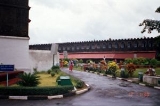
Cellular Jail

Encyclopedia
The Cellular Jail, also known as Kālā Pānī (Hindi
: काला पानी क़ैद ख़ाना, literally 'black water', in the sense of deep sea and hence exile), was a colonial
prison situated in the Andaman and Nicobar Islands, India
. The prison was used by the British
especially to exile
political prisoners to the remote archipelago. Many notable freedom fighters such as Batukeshwar Dutt
and Veer Savarkar, among others, were imprisoned here during the struggle for India's independence
. Today, the complex serves as a national memorial monument.
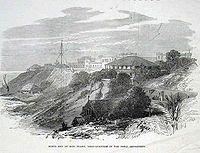 Shortly after the rebellion was crushed, the British sent thousands to the gallows, hung them up from trees, or tied them to cannons and blew them up. Those who survived were exiled for life to the Andamans to sever their connections with their families and their country. 200 mutineers
were transported to the islands under the custody of the jailer David Barry and Major James Pattison Walker
, a military doctor who had been warden of the prison at Agra
. Another 733 from Karachi
arrived in April, 1868. More prisoners arrived from India and Burma as the settlement grew. Anyone who belonged to the Mughal royal family, or who had sent a petition to Bahadur Shah Zafar during the Rebellion was liable to be deported to the islands.
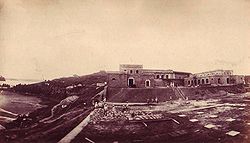 The remote islands were considered to be a suitable place to punish the rebels. Not only were they isolated from the mainland, they could also be used in chain gangs to construct prisons, buildings and harbour facilities. Many died in this enterprise. They served to colonise the island for the British.
By the late 19th century the independence movement had picked up momentum. As a result, the number of prisoners being sent to the Andamans started growing and the need for a high-security prison was felt.
-colored brick building. The bricks used to build the building were brought from Burma, known today as Myanmar
.
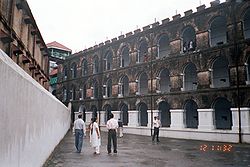 The building had seven wings, at the centre of which a tower served as the intersection and was used by guards to keep watch on the inmates. The wings radiated from the tower in straight lines, much like the spokes of a bicycle wheel. A large bell was kept in the tower to raise the alarm in any eventuality.
Each of the seven wings had three stories upon completion. There were no dormitories and a total of 698 cells. Each cell was 4.5 metres x 2.7 metres or 15x8 feet in size with a ventilator located at a height of three metres. The name, "cellular jail", derived from the solitary cells which prevented any prisoner from communicating with any other. They were all in solitary confinement.
Most prisoners of the Cellular Jail were independence activists. Some famous inmates of the Cellular Jail were Dr. Diwan Singh Kalepani, Maulana Fazl-e-Haq Khairabadi
, Yogendra Shukla
, Batukeshwar Dutt
, Maulana Ahmadullah, Movli Abdul Rahim Sadiqpuri, Babarao Savarkar, Vinayak Damodar Savarkar
, Bhai Parmanand
, V.O.Chidambaram Pillai, Subramaniam Shiva, Sohan Singh, Vaman Rao Joshi and Nand Gopal. Several revolutionaries tried in the Alipore Case (1908) such as Barindra Kumar Ghose, Upendra Nath Banerjee, Birendra Chandra Sen. Jatish Chandra Pal, the surviving companion of Bagha Jatin
, demented under torture here, was transferred to Berhampore Jail in Bengal, before his mysterious death in 1924.
In March 1868, 238 prisoners tried to escape. By April they were all caught. One committed suicide and of the remainder Superintendent Walker ordered 87 to be hanged.
Hunger strikes by the inmates during the early 1930s called attention to the inhumane conditions of their imprisonment. Mahatma Gandhi
and Rabindranath Tagore
intervened. The government decided to repatriate the political prisoners from the Cellular Jail in 1937-38.
invaded the Andaman islands
in 1942 and drove the British out. The Cellular Jail then became home to British prisoners. During this period, Subhash Chandra Bose
also visited the islands.
Two out of the seven wings of the Jail were demolished during the Japanese regime.
In 1945, the British resumed control with the end of World War II
.
The Govind Ballabh Pant Hospital was set up in the premises of the Cellular Jail in 1963. It is now a 500-bed hospital with about 40 doctors serving the local population.
The centenary of the jail's completion was marked on 10 March 2006. Many erstwhile prisoners were felicitated on this occasion by the Government of India
.
Hindi
Standard Hindi, or more precisely Modern Standard Hindi, also known as Manak Hindi , High Hindi, Nagari Hindi, and Literary Hindi, is a standardized and sanskritized register of the Hindustani language derived from the Khariboli dialect of Delhi...
: काला पानी क़ैद ख़ाना, literally 'black water', in the sense of deep sea and hence exile), was a colonial
British Raj
British Raj was the British rule in the Indian subcontinent between 1858 and 1947; The term can also refer to the period of dominion...
prison situated in the Andaman and Nicobar Islands, India
India
India , officially the Republic of India , is a country in South Asia. It is the seventh-largest country by geographical area, the second-most populous country with over 1.2 billion people, and the most populous democracy in the world...
. The prison was used by the British
British Empire
The British Empire comprised the dominions, colonies, protectorates, mandates and other territories ruled or administered by the United Kingdom. It originated with the overseas colonies and trading posts established by England in the late 16th and early 17th centuries. At its height, it was the...
especially to exile
Exile
Exile means to be away from one's home , while either being explicitly refused permission to return and/or being threatened with imprisonment or death upon return...
political prisoners to the remote archipelago. Many notable freedom fighters such as Batukeshwar Dutt
Batukeshwar Dutt
Batukeshwar Dutt was an Indian revolutionary and a freedom fighter in the early 1900s. He is best known for having exploded a few bombs, along with Bhagat Singh, in the Central Legislative Assembly in New Delhi on 8 April 1929...
and Veer Savarkar, among others, were imprisoned here during the struggle for India's independence
Indian independence movement
The term Indian independence movement encompasses a wide area of political organisations, philosophies, and movements which had the common aim of ending first British East India Company rule, and then British imperial authority, in parts of South Asia...
. Today, the complex serves as a national memorial monument.
History
The Cellular Jail is one of the murkiest chapters in the history of the colonial rule in India. Although the prison complex itself was constructed between 1896 and 1906, the British had been using the Andaman islands as a prison since the days in the immediate aftermath of the first war of independence.Indian independence movement
The term Indian independence movement encompasses a wide area of political organisations, philosophies, and movements which had the common aim of ending first British East India Company rule, and then British imperial authority, in parts of South Asia...
were transported to the islands under the custody of the jailer David Barry and Major James Pattison Walker
, a military doctor who had been warden of the prison at Agra
Agra
Agra a.k.a. Akbarabad is a city on the banks of the river Yamuna in the northern state of Uttar Pradesh, India, west of state capital, Lucknow and south from national capital New Delhi. With a population of 1,686,976 , it is one of the most populous cities in Uttar Pradesh and the 19th most...
. Another 733 from Karachi
Karachi
Karachi is the largest city, main seaport and the main financial centre of Pakistan, as well as the capital of the province of Sindh. The city has an estimated population of 13 to 15 million, while the total metropolitan area has a population of over 18 million...
arrived in April, 1868. More prisoners arrived from India and Burma as the settlement grew. Anyone who belonged to the Mughal royal family, or who had sent a petition to Bahadur Shah Zafar during the Rebellion was liable to be deported to the islands.
By the late 19th century the independence movement had picked up momentum. As a result, the number of prisoners being sent to the Andamans started growing and the need for a high-security prison was felt.
Architecture
The construction of the prison started in 1896 and was completed in 1906. The original building was a pucePuce
Puce is a color that is defined as ranging from reddish-brown to purplish-brown, with the latter being the more widely accepted definition found in reputable sources. Puce is a shade of red. The Oxford English Dictionary dates the use of "puce" from 1787...
-colored brick building. The bricks used to build the building were brought from Burma, known today as Myanmar
Myanmar
Burma , officially the Republic of the Union of Myanmar , is a country in Southeast Asia. Burma is bordered by China on the northeast, Laos on the east, Thailand on the southeast, Bangladesh on the west, India on the northwest, the Bay of Bengal to the southwest, and the Andaman Sea on the south....
.
Each of the seven wings had three stories upon completion. There were no dormitories and a total of 698 cells. Each cell was 4.5 metres x 2.7 metres or 15x8 feet in size with a ventilator located at a height of three metres. The name, "cellular jail", derived from the solitary cells which prevented any prisoner from communicating with any other. They were all in solitary confinement.
Inmates
Solitary confinement was implemented as the British government desired to ensure that political prisoners and revolutionaries be isolated from each other. The Andaman island served as the ideal setting for the government to achieve this.Most prisoners of the Cellular Jail were independence activists. Some famous inmates of the Cellular Jail were Dr. Diwan Singh Kalepani, Maulana Fazl-e-Haq Khairabadi
Maulana Fazl-e-Haq Khairabadi
Fazl-e-Haq Khairabadi was one of the main figures of the Indian Rebellion of 1857. He was a philosopher, a poet, a religious scholar, but is most remembered for his role as a freedom fighter. It was he who issued the fatwa in favour of Jihad against the English in 1857.-Life:Khairabadi had been a...
, Yogendra Shukla
Yogendra Shukla
Yogendra Shukla was an Indian nationalist born in Bihar. He served in the Cellular Jail , and he was among the founders of Hindustan Socialist Republican Association...
, Batukeshwar Dutt
Batukeshwar Dutt
Batukeshwar Dutt was an Indian revolutionary and a freedom fighter in the early 1900s. He is best known for having exploded a few bombs, along with Bhagat Singh, in the Central Legislative Assembly in New Delhi on 8 April 1929...
, Maulana Ahmadullah, Movli Abdul Rahim Sadiqpuri, Babarao Savarkar, Vinayak Damodar Savarkar
Vinayak Damodar Savarkar
Vināyak Dāmodar Sāvarkar was an Indian freedom fighter, revolutionary and politician. He was the proponent of liberty as the ultimate ideal. Savarkar was a poet, writer and playwright...
, Bhai Parmanand
Bhai Parmanand
Bhai Parmanand was an Indian nationalist.-Biography:Parmanand was born into a prominent family of the Punjab, descended from the family of the famous Sikh martyr, Bhai Mati Das...
, V.O.Chidambaram Pillai, Subramaniam Shiva, Sohan Singh, Vaman Rao Joshi and Nand Gopal. Several revolutionaries tried in the Alipore Case (1908) such as Barindra Kumar Ghose, Upendra Nath Banerjee, Birendra Chandra Sen. Jatish Chandra Pal, the surviving companion of Bagha Jatin
Bagha Jatin
Bagha Jatin , born Jatindranath Mukherjee was an Bengali revolutionary philosopher against British rule....
, demented under torture here, was transferred to Berhampore Jail in Bengal, before his mysterious death in 1924.
In March 1868, 238 prisoners tried to escape. By April they were all caught. One committed suicide and of the remainder Superintendent Walker ordered 87 to be hanged.
Hunger strikes by the inmates during the early 1930s called attention to the inhumane conditions of their imprisonment. Mahatma Gandhi
Mahatma Gandhi
Mohandas Karamchand Gandhi , pronounced . 2 October 1869 – 30 January 1948) was the pre-eminent political and ideological leader of India during the Indian independence movement...
and Rabindranath Tagore
Rabindranath Tagore
Rabindranath Tagore , sobriquet Gurudev, was a Bengali polymath who reshaped his region's literature and music. Author of Gitanjali and its "profoundly sensitive, fresh and beautiful verse", he became the first non-European Nobel laureate by earning the 1913 Prize in Literature...
intervened. The government decided to repatriate the political prisoners from the Cellular Jail in 1937-38.
Japanese Occupation
The Empire of JapanEmpire of Japan
The Empire of Japan is the name of the state of Japan that existed from the Meiji Restoration on 3 January 1868 to the enactment of the post-World War II Constitution of...
invaded the Andaman islands
Invasion and Occupation of the Andaman Islands during World War II
The Japanese occupation of the Andaman Islands occurred in 1942 during World War II. The Andaman and Nicobar Islands , are a group of islands situated in the Bay of Bengal at about 780 miles from Kolkata, 740 miles from Chennai and 120 miles from Cape Nargis in Burma...
in 1942 and drove the British out. The Cellular Jail then became home to British prisoners. During this period, Subhash Chandra Bose
Subhash Chandra Bose
Subhas Chandra Bose known by name Netaji was an Indian revolutionary who led an Indian national political and military force against Britain and the Western powers during World War II. Bose was one of the most prominent leaders in the Indian independence movement and is a legendary figure in...
also visited the islands.
Two out of the seven wings of the Jail were demolished during the Japanese regime.
In 1945, the British resumed control with the end of World War II
World War II
World War II, or the Second World War , was a global conflict lasting from 1939 to 1945, involving most of the world's nations—including all of the great powers—eventually forming two opposing military alliances: the Allies and the Axis...
.
Post Independence
Another two wings of the jail were demolished after India achieved independence. However, this led to protests from several former prisoners and political leaders who saw it as a way of erasing the tangible evidence of their persecution. The remaining three wings and the central tower were therefore converted into a National Memorial in 1969.The Govind Ballabh Pant Hospital was set up in the premises of the Cellular Jail in 1963. It is now a 500-bed hospital with about 40 doctors serving the local population.
The centenary of the jail's completion was marked on 10 March 2006. Many erstwhile prisoners were felicitated on this occasion by the Government of India
Government of India
The Government of India, officially known as the Union Government, and also known as the Central Government, was established by the Constitution of India, and is the governing authority of the union of 28 states and seven union territories, collectively called the Republic of India...
.
See also
- Charles TegartCharles TegartSir Charles Augustus Tegart KCIE KPM , the second son of Rev. Joseph Poulter Tegart, was a colonial police officer in India and Mandatory Palestine, variously earning praise for his industry and efficiency, and notoriety for his brutality and use of torture.-Early Life:Tegart was the son of a...
, British police commissioner - Communist ConsolidationCommunist ConsolidationCommunist Consolidation was an Indian communist organisation, formed amongst prisoners at the Andaman Cellular Jail. The group was founded on April 26, 1935 by 39 inmates. The group declared its adherence to the Communist Party of India. Its founders belonged to a minority tendency with the...
- Kala PaniKala Pani (1996 film)Kaalapani is a 1996 Indian epic film directed by Priyadarshan, starring Mohanlal, Prabhu Ganesan, Tabu, Nedumudi Venu, Sreenivasan, Tinnu Anand, Annu Kapoor, Alex Draper, Amrish Puri, and Vineeth...
, a 1996 Indian film set in the jail
External links
- http://www.andamancellularjail.org/