
All Topics  
Ceefax

 
Ceefax

   Email Print
   Bookmark   Link


Ceefax


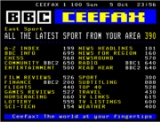
Ceefax (phonetic for "See Facts") is the BBC's teletext
Teletext

Teletext is a television information retrieval service developed in the United Kingdom in the early 1970s. It offers a range of text-based information, typically including national, international and sporting news, weather and TV schedules....
 information service transmitted via the analogue signal, starting in 1974 and running until 2012.

History
The system was announced in October 1972 and following test transmissions in 1973-1974 the Ceefax system went live on the 23 September 1974 with thirty pages of information. Developed by BBC engineers who were working on ways of providing televisual subtitles for the deaf, it was the first teletext system in the world.


Discussion
Ask a question about 'Ceefax'
Start a new discussion about 'Ceefax'
Answer questions from other users
Full Discussion Forum


Encyclopedia


Ceefax (phonetic for "See Facts") is the BBC's teletext
Teletext

Teletext is a television information retrieval service developed in the United Kingdom in the early 1970s. It offers a range of text-based information, typically including national, international and sporting news, weather and TV schedules....
 information service transmitted via the analogue signal, starting in 1974 and running until 2012.

History


The system was announced in October 1972 and following test transmissions in 1973-1974 the Ceefax system went live on the 23 September 1974 with thirty pages of information. Developed by BBC engineers who were working on ways of providing televisual subtitles for the deaf, it was the first teletext system in the world. The then-BBC Director of Engineering James Redmond was a particular enthusiast. Other broadcasters soon took up the idea, including the Independent Broadcasting Authority
Independent Broadcasting Authority

The Independent Broadcasting Authority was the regulatory body in the United Kingdom for Commercial broadcasting television - and radio broadcasts....
 (IBA), who had developed the incompatible ORACLE
ORACLE (teletext)

ORACLE was a commercial teletext service first broadcast on ITV in 1974 and later on Channel 4 in the United Kingdom, finally ending on both channels at 23:59 GMT on 31 December 1992....
 teletext system, at around the same time. After technical negotiations, the two broadcasters in 1976 settled upon a single standard—different from both Ceefax and Oracle—which is still in use for analogue broadcasts as of 2008; and which ultimately developed into World System Teletext
World System Teletext

World System Teletext is the name of the first successful standard for encoding and displaying teletext information, and is used as the standard for teletext throughout Europe today....
. The display format of 24 rows by 40 columns of characters was also adopted for the Prestel
Prestel

Prestel , the brand name for the UK Post Office UK's Viewdata technology, was an interactive videotex system developed during the late 1970s and commercially launched in 1979....
 system.

In March 1980 the BBC channel BBC2, then followed by BBC1, began to transmit experimental teletext pages in-vision, generally for the 30 minutes before programmes began. From May 1983 in-vision pages were filling in the entire length of BBC1 daytime closedowns, whilst on BBC2 from that date they were shown from 9am until the start of programmes as well as filling daytime intervals and closedowns. Also in 1983, after Channel 4 and S4C had launched, pages from 4-Tel, ORACLE and even SBECTEL were transmitted in-vision. ITV finally transmitted ORACLE pages in-vision in 1987 before TV-am began, although the advent of 24-hour broadcasting on ITV meant that ITV's in-vision ORACLE broadcasting was short-lived.

The technology became the standard European teletext system and replaced other standards, including the Antiope
Antiope (teletext)

Antiope was a France teletext standard in the 1980s. Work on it started in 1975.The nice-sounding term allegedly stood for Acquisition Num?rique et T?l?visualisation d?Images Organis?es en Pages d??criture, which could be loosely translated as Digital Acquisition and Remote Visualization of Images Organized into Written Pages....
 system formerly used in France.

In 1983, Ceefax started to broadcast computer programs—known as telesoftware
Telesoftware

Telesoftware was the broadcasting of programs for home computers via Teletext. Pioneered in the United Kingdom during the 1970s and 80s. During that time, software was broadcast at various times on all of the four terrestrial TV channels....
—for the BBC Micro
BBC Micro

The BBC Microcomputer System, or BBC Micro, was a series of microcomputers and associated peripherals designed and built by Acorn Computers for the BBC Computer Literacy Project, operated by the British Broadcasting Corporation....
 (a home computer available in the United Kingdom). The telesoftware broadcasts stopped in 1989. A similar idea was the French C Plus Direct satellite channel which used different, higher speed technology to broadcast PC software.

The basic technology of Ceefax has remained compatible with the 1976 unified rollout; system elaborations since then have been made such that earlier receivers are still able to do a basic decode of pages, but will simply ignore enhanced information rather than showing corrupted data. Early receivers do not see the FastText coloured-button hyperlinking data, so the system ignores it.

As of 2008 the BBC's Ceefax service was still providing information on a wide range of topics covering News, Sport, Weather, TV Listings and Businesses. The pages were kept extremely up-to-date. Before the advent of the Internet, Ceefax pages were often the first location to report a breaking story or headline.

In 2002, the BBC stopped broadcasting Ceefax on the digital satellite Sky Digital
Sky Digital (UK & Ireland)

Sky Digital is the brand name for British Sky Broadcasting's digital satellite television and satellite radio service, transmitted from SES Astra satellites located at Astra 28.2?E and Eutelsat's Eurobird 1 satellite at 28.5?E....
 service, but later brought back a limited service including a TV schedule for BBC One
BBC One

BBC One is the primary television channel of the BBC . It was launched on 2 November 1936 as the BBC Television Service, and was the world's first regular public television service with a high level of ....
 and BBC Two
BBC Two

BBC Two is the second major terrestrial television channel of the BBC, aimed at a wide range of subject matter and interests, and specialising in intelligent yet popular programme genres....
; and subtitles.

Since 2006, the BBC has been promoting the reuse of the Ceefax page numbers on the Freeview and digital satellite BBC Red Button Ceefax-replacement services.

As of 2008 it is expected that Ceefax will not be replaced when the analogue signal is switched off in 2012, instead the BBC is developing IPTV
IPTV

IPTV is a system where a digital television service is delivered using Internet Protocol over a network infrastructure, which may include delivery by a broadband connection....
.

Technology

Ceefax uses the World System Teletext
World System Teletext

World System Teletext is the name of the first successful standard for encoding and displaying teletext information, and is used as the standard for teletext throughout Europe today....
 standard (originally CEPT1
CEPT1

CEPT1 was a standard set in 1981 by the European Conference of Postal and Telecommunications Administrations for the display of Videotex. Otherwise known as "E1"....
). As with other teletext
Teletext

Teletext is a television information retrieval service developed in the United Kingdom in the early 1970s. It offers a range of text-based information, typically including national, international and sporting news, weather and TV schedules....
 systems, text and simple graphics are transmitted in-band with the picture signal, and decoded by controller circuitry.

Pages from Ceefax


Those without access to teletext-equipped sets
Television

Television is a widely used telecommunication mass-media for transmitting and receiving moving , either monochrome or color, usually accompanied by sound....
 can still view limited Ceefax content via the Pages from Ceefax slot on BBC Two
BBC Two

BBC Two is the second major terrestrial television channel of the BBC, aimed at a wide range of subject matter and interests, and specialising in intelligent yet popular programme genres....
. This consists of selected Ceefax pages (typically news
NeWS

NeWS was a windowing system developed by Sun Microsystems in the mid 1980s. Originally known as "SunDew", its primary authors were James Gosling and David S....
) transmitted as an ordinary TV picture. As a result, although Pages from Ceefax can be viewed on any set, there is no interactivity or choice, rather diminishing the purpose of the original concept.

The audio accompaniment for Pages from Ceefax broadcasts typically consists of some form of easy listening
Easy listening

Easy listening music is a style of popular music and radio format that emerged in the mid-20th century, evolving out of Swing music and big band music, and related to Beautiful music and Light music....
 music (between 2000 and 2005 the music was typically sourced from music production libraries such as Funtastik, KPM or BMG Zomba, or sometimes a discontinuous tone. Since 2006, the music is now completely sourced from Funtastik music.

Pages from Ceefax is normally only shown by the BBC in the absence of any other programming. Once a common filler during daytime (where it was occasionally billed as Ceefax in Vision or, in the case of the pre-Breakfast Time 6am slot between 1983 and 1989, as Ceefax AM), it has been marginalised by the move towards a near-continuous service, where in recent years BBC News would be placed in late night/early morning gaps in schedules.

The BBC News channel has a higher preference over Ceefax when BBC One and Two have 'technically' closed down in the early hours of the morning. When scheduled programming on BBC One ends, typically around 4am, they will revert to broadcasts from BBC News. BBC Two also does this, but if both channels have ended scheduled programming, then BBC One has priority over BBC News, while BBC Two will turn to Pages from Ceefax.

For a period between September 2005 and December 2006, there was a weekday gap between 6am and 7am on BBC Two that saw Pages From Ceefax broadcast. During the Christmas period, when The Learning Zone is off air, Ceefax is shown through the night on BBC2. The Learning Zone saw a reduction in its airtime in 2007, so Ceefax is now the filler following the end of programmes on Friday, Saturday and Sunday nights plus every night during the summer school holidays (July - September). The last BBC One network broadcast took place on 9 November 1997, although it is still occasionally shown on BBC One Scotland, normally to fill the gaps between opt-outs and The Sign Zone. The selection of pages broadcast now is significantly smaller than that shown until the late 1990s.

The limited set of rolling pages shown on Pages from Ceefax (referred to as a "newsreel") are also accessible at any time of day via Ceefax page 152 (BBC Two only. BBC One no longer has this page) on any analogue teletext television.

External links