


Cecil John Rhodes

Encyclopedia
Cecil John Rhodes PC
, DCL
(5 July 1853 – 26 March 1902) was an English-born South Africa
n businessman, mining magnate
, and politician. He was the founder of the diamond company De Beers
, which today markets 40% of the world's rough diamonds and at one time marketed 90%. An ardent believer in British colonial imperialism
, he was the founder of the state of Rhodesia
, which was named after him. In 1964, Northern Rhodesia
became the independent state of Zambia
and Southern Rhodesia
was thereafter known as simply as Rhodesia. In 1980, Rhodesia, which had been de-facto independent since 1965, was granted independence by Britain and was renamed Zimbabwe
. South Africa's Rhodes University
is also named after Rhodes. He set up the provisions of the Rhodes Scholarship
, which is funded by his estate.
Historian Richard A. McFarlane views Rhodes "as integral a participant in southern African and British imperial history as George Washington
or Abraham Lincoln
are in their respective eras in United States history... most histories of South Africa covering the last decades of the nineteenth century are contributions to the historiography
of Cecil Rhodes."
, Hertfordshire, England. He was the fifth son of the Reverend Francis William Rhodes and his wife Louisa Peacock Rhodes. His father was a Church of England
vicar
who was proud of never having preached a sermon longer than 10 minutes. His siblings included Francis William Rhodes
, who became an army officer.
A sickly, asthmatic adolescent, Cecil Rhodes was taken out of grammar school and sent to Natal
, South Africa because his family thought the hot climate would improve his health. They expected he would help his older brother Herbert who operated a cotton farm.
According to Basil Williams, Rhodes left grammar school, where he had studied since the age of nine, in 1869 "and continued his studies under his father's eye." However, "His health was weakly and there were even fears that he might be consumptive
, a disease of which several of the family showed symptoms. His father therefore determined to send him abroad to try the effect of a sea voyage and a better climate. Herbert [Cecil's brother] had already set up as a planter in Natal, so to join Herbert in Natal Cecil was despatched on a sailing vessel. The voyage to Durban took him seventy days, and on 1 September 1870 he first set foot on African soil, a tall, lanky, anaemic, fair-haired boy, shy and reserved in bearing." He remained in Natal until October 1871, when he moved to the diamond fields, just opening up.
, in Pietermaritzburg
, Rhodes took an interest in agriculture. He joined his brother Herbert on his cotton farm in the Umkomazi valley in Natal. The land was unsuitable for cotton, and the venture failed. When he first came to Africa, Rhodes lived on money lent by his aunt Sophia.
In October 1871, Rhodes and his brother Herbert left the colony for the diamond fields of Kimberley
. Financed by N M Rothschild & Sons
, over the next 17 years Rhodes succeeded in buying up all the smaller diamond mining operations in the Kimberley area. His monopoly of the world's diamond supply was sealed in 1889 through a strategic partnership with the London-based Diamond Syndicate. They agreed to control world supply to maintain high prices. Rhodes supervised the working of his brother's claim and speculated
on his behalf. Among his associates in the early days were John X. Merriman
and Charles Rudd
, who later became his partner in the De Beers Mining Company
and Niger Oil Company.
During the 1880s Cape vineyards had been devastated by a phylloxera
epidemic. The diseased vineyards were dug up and replanted, and farmers were looking for alternatives to wine. In 1892, Rhodes financed The Pioneer Fruit Growing Company at Nooitgedacht, a venture created by Harry Pickstone, an Englishman who had experience of fruit-growing in California. In 1896 he began to pay more attention to fruit farming and bought farms in Groot Drakenstein, Wellington
and Stellenbosch. A year later, Rhodes bought Rhone and Boschendal
and commissioned Sir Herbert Baker to build him a cottage there. The successful operation soon expanded into Rhodes Fruit Farms
, and formed a cornerstone of the modern-day Cape fruit industry.
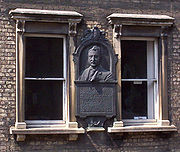 Rhodes attended the Bishop's Stortford
Grammar School
. In 1873, Rhodes left his farm field in the care of his business partner, Rudd, and sailed for England to complete his studies. He was admitted to Oriel College, Oxford, but stayed for only one term in 1873. He returned to South Africa and did not return for his second term at Oxford until 1876. He was greatly influenced by John Ruskin
's inaugural lecture at Oxford, which reinforced his own attachment to the cause of British imperialism
. Among his Oxford associates were James Rochfort Maguire
, later a fellow of All Souls College
and a director of the British South Africa Company
, and Charles Metcalfe
. Due to his university career, Rhodes admired the Oxford "system". Eventually he was inspired to develop his scholarship scheme: "Wherever you turn your eye—except in science—an Oxford man is at the top of the tree".
While attending Oriel College, Rhodes became a Freemason
in the Apollo University Lodge. Although initially he did not approve of the organisation, he continued to be a Freemason until his death in 1902. The failures of the Freemasons, in his mind, later caused him to envisage his own secret society with the goal of bringing the entire world under British rule.
to invest in the more costly claims of what was known as old De Beers (Vooruitzicht). It was named after Johannes Nicolaas de Beer and his brother, Diederik Arnoldus, who occupied the farm. After purchasing the land in 1839 from David Danser, a Koranna chief in the area, Fourie had allowed the de Beers and various other Afrikaner families to cultivate the land. The region extended from the Modder River
via the Vet River up to the Vaal River
.
In 1874 and 1875, the diamond fields were in the grip of depression, but Rhodes and Rudd were among those who stayed to consolidate their interests. They believed that diamonds would be numerous in the hard blue ground
that had been exposed after the softer, yellow layer near the surface had been worked out. During this time, the technical problem of clearing out the water that was flooding the mines became serious. Rhodes and Rudd obtained the contract for pumping water out of the three main mines. It was during this period that Jim B. Taylor
, still a young boy and helping to work his father's claim, first met Rhodes.
On 12 March 1880, Rhodes and Rudd launched the De Beers Mining Company after the amalgamation of a number of individual claims. With £200,000 of capital, the company, of which Rhodes was secretary, owned the largest interest in the mine.
into the Cape Colony
under the Molteno Ministry
in 1877, the area had obtained six seats in the Cape House of Assembly. Rhodes chose the constituency of Barkly West, a rural constituency in which Boer
voters predominated. Barkly West remained faithful to Rhodes even after his support of the Jameson Raid
against the Transvaal
. He continued as its Member until his death.
When Rhodes became a member of the Cape Parliament, the chief goal of the assembly was to help decide the future of Basutoland
. The ministry of Sir Gordon Sprigg was trying to restore order after the 1880 rebellion known as the Gun War
. The Sprigg ministry had precipitated the revolt by applying its policy of disarming Africans to the Basuto. In 1890, Rhodes became Prime Minister of the Cape Colony and implemented laws that would benefit mine and industry owners. He introduced the Glen Grey Act to push black people from their lands and make way for industrial development. He also introduced educational reform to the area.
Rhodes' policies were instrumental in the development of British imperial
policies in South Africa, such as the Hut tax
. He did not, however, have direct political power over the Boer Republic of the Transvaal. He often disagreed with the Transvaal government's policies. He believed he could use his money and his power to overthrow the Boer government and install a British colonial government supporting mine-owners' interests in its place.
In 1895, Rhodes supported an attack on the Transvaal, the infamous Jameson Raid
, which proceeded with the tacit approval of Secretary of State for the Colonies Joseph Chamberlain
. The raid was a catastrophic failure. It forced Cecil Rhodes to resign as Prime Minister of the Cape Colony, sent his oldest brother Col. Frank Rhodes
to jail in Transvaal convicted of high treason
and nearly sentenced to death, and led to the outbreak of both the Second Matabele War
and the Second Boer War
.
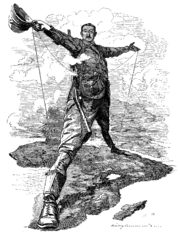 Rhodes used his wealth and that of his business partner Alfred Beit
and other investors to pursue his dream of creating a British Empire
in new territories to the north by obtaining mineral concessions
from the most powerful indigenous
chief
s. Rhodes' competitive advantage over other mineral prospecting companies was his combination of wealth and astute political instincts, also called the 'imperial factor', as he used the British Government. He befriended its local representatives, the British Commissioner
s, and through them organised British protectorate
s over the mineral concession areas via separate but related treaties. In this way he obtained both legality and security for mining operations. He could then win over more investors. Imperial expansion and capital investment went hand in hand.
The imperial factor was a double-edged sword: Rhodes did not want the bureaucrat
s of the Colonial Office
in London to interfere in the Empire in Africa. He wanted British settlers and local politicians and governors to run it. This put him on a collision course with many in Britain, as well as with British missionaries, who favoured what they saw as the more ethical direct rule from London. Rhodes won because he would pay to administer the territories north of South Africa against future mining profits. The Colonial Office did not have the funds to do it. Rhodes promoted his business interests as in the strategic interest of Britain: preventing the Portuguese
, the Germans
or the Boers from moving in to south-central Africa. Rhodes' companies and agents cemented these advantages by obtaining many mining concessions, as exemplified by the Rudd and Lochner Concessions.
, king of the Ndebele of Matabeleland
. In 1888 he tried again. He sent John Moffat
, son of the missionary Robert Moffat
, who was trusted by Lobengula, to persuade the latter to sign a treaty of friendship with Britain, and to look favourably on Rhodes' proposals. His agent Francis Thompson, who had travelled to Bulawayo in the company of Charles Rudd
and Rochfort Maguire, assured Lobengula that no more than ten white men would mine in Matabeleland. This limitation was left out of the document which Lobengula signed, known as the Rudd Concession. Furthermore it stated that the mining companies could do anything necessary to their operations. When Lobengula discovered later the true effects of the concession, he tried to renounce it, but the British Government ignored him.
Armed with the Rudd Concession, in 1889 Rhodes obtained a charter
from the British Government for his British South Africa Company
(BSAC) to rule, police and make new treaties and concessions from the Limpopo River
to the great lakes of Central Africa. He obtained further concessions and treaties north of the Zambezi
, such as those in Barotseland
(the Lochner Concession with King Lewanika
in 1890, which was similar to the Rudd Concession); and in the Lake Mweru
area (Alfred Sharpe
's 1890 Kazembe concession). Rhodes also sent Sharpe to get a concession over mineral-rich Katanga
, but met his match in ruthlessness: when Sharpe was rebuffed by its ruler Msiri, King Leopold II of Belgium
obtained a concession over Msiri's dead body for his Congo Free State
.
Rhodes also wanted Bechuanaland Protectorate (now Botswana
) under the BSAC charter. But three Tswana kings, including Khama III
, travelled to Britain and won over British public opinion for it to remain governed by the British Colonial Office in London. Rhodes commented: "It is humiliating to be utterly beaten by these niggers."
The British Colonial Office
also decided to administer British Central Africa
(Nyasaland, today's Malawi
) owing to the activism of Scots
missionaries trying to end the slave trade. Rhodes paid much of the cost so that the British Central Africa Commissioner Sir Harry Johnston, and his successor Alfred Sharpe, would assist with security for Rhodes in the BSAC's north-eastern territories. Johnston shared Rhodes' expansionist views, but he and his successors were not as pro-settler as Rhodes, and disagreed on dealings with Africans.
which was used to control Matabeleland
and Mashonaland
, in present-day Zimbabwe
. The company had hoped to start a "new Rand
" from the ancient gold mines of the Shona
. Because the gold deposits were on a much smaller scale, many of the white settlers who accompanied the BSAC to Mashonaland became farmers rather than miners. When the Ndebele and the Shona—the two main, but rival peoples—separately rebelled against the coming of the European settlers, the BSAC defeated them in the two Matabele War
s (1893–94; 1896–97). Shortly after learning of the assassination of the Ndebele spiritual leader, Mlimo, by the American scout Frederick Russell Burnham
, Rhodes walked unarmed into the Ndebele stronghold in Matobo Hills. He persuaded the Impi
to lay down their arms, thus ending the Second Matabele War.
By the end of 1894, the territories over which the BSAC had concessions or treaties, collectively called "Zambesia" after the Zambezi River flowing through the middle, comprised an area of 1,143,000 km² between the Limpopo River
and Lake Tanganyika
. In May 1895, its name was officially changed to "Rhodesia", reflecting Rhodes' popularity among settlers who had been using the name informally since 1891. The designation Southern Rhodesia
was officially adopted in 1898 for the part south of the Zambezi, which later became Zimbabwe
; and the designations North-Western
and North-Eastern Rhodesia
were used from 1895 for the territory which later became Northern Rhodesia
, then Zambia
.
Rhodes decreed in his will that he was to be buried in Matobo Hills. After his death in the Cape in 1902, his body was transported by train to Bulawayo
. His burial was attended by Ndebele chiefs, who asked that the firing party should not discharge their rifles as this would disturb the spirits. Then, for the first time, they gave a white man the Matabele royal salute, Bayete. Rhodes was buried alongside Leander Starr Jameson
and 34 British soldiers killed in the Shangani Patrol
.
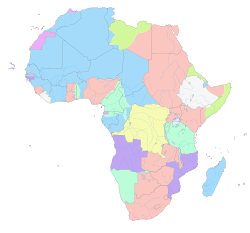
One of Rhodes' dreams (and the dream of many other members of the British Empire
) was for a "red line" on the map from the Cape to Cairo. (On geo-political maps, British dominions were always denoted in red or pink.) Rhodes had been instrumental in securing southern African states for the Empire. He and others felt the best way to "unify the possessions, facilitate governance, enable the military to move quickly to hot spots or conduct war, help settlement, and foster trade" would be to build the "Cape to Cairo Railway".
This enterprise was not without its problems. France had a rival strategy in the late 1890s to link its colonies from west to east across the continent. The Portuguese produced the "Pink Map
", representing their claims to sovereignty in Africa.
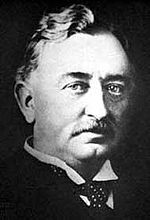 Rhodes wanted to expand the British Empire because he believed that the Anglo-Saxon
race was destined to greatness. In his last will and testament, Rhodes said of the British, "I contend that we are the first race in the world and that the more of the world we inhabit the better it is for the human race." He wanted to make the British Empire a superpower in which all of the British-dominated countries in the empire, including Canada, Australia, New Zealand, and Cape Colony, would be represented in the British Parliament
. Rhodes included American students as eligible for the Rhodes scholarships. He said that he wanted to breed an American elite of philosopher-kings who would have the United States rejoin the British Empire. As Rhodes also respected the Germans
and admired the Kaiser
, he allowed German students to be included in the Rhodes scholarships. He believed that eventually the United Kingdom (including Ireland), the USA and Germany together would dominate the world and ensure peace.
On domestic politics within the United Kingdom, Rhodes was a supporter of the Liberal Party
. Rhodes' only major impact on domestic politics within the United Kingdom was his support of the Irish nationalist party, led by Charles Stewart Parnell
(1846–1891). He contributed a great deal of money to the Irish nationalists, although Rhodes made his support conditional upon an autonomous Ireland's still being represented in the British Parliament. Rhodes was such a strong supporter of Parnell that, after the Liberals and the Irish nationalists disowned him after his was wrongly accused of committing adultery with the wife of another Irish nationalist, and was only cleared after a long court battle, Rhodes continued his support.
Rhodes was more tolerant of the Dutch-speaking whites in the Cape Colony than were the other English-speaking whites in the Cape Colony. He supported teaching Dutch as well as English in public schools in the Cape Colony and lent money to support this cause. While Prime Minister of the Cape Colony, he helped to remove most of the legal disabilities that English-speaking whites had imposed on Dutch-speaking whites. He was a friend of Jan Hofmeyr, leader of the Afrikaner Bond
, and it was largely because of Afrikaner support that he became Prime Minister of the Cape Colony. Rhodes advocated greater self-government for the Cape Colony, in line with his preference for the empire to be controlled by local settlers and politicians rather than by London (see "Rhodes and the imperial factor" above).
Confusingly for the modern reader, self-government of the type Rhodes supported was known as "colonialism". The opposed policy, direct control of a colony from London, was known as "imperialism". This should be kept in mind when reading documents from this time.
The scholar Richard Brown observed: "there is still the simpler but major problem of the extraordinarily thin evidence on which the conclusions about Rhodes are reached. Rhodes himself left few details... Indeed, Rhodes is a singularly difficult subject... since there exists little intimate material – no diaries and few personal letters."
Brown also comments: "On the issue of Rhodes' sexuality... there is, once again, simply not enough reliable evidence to reach firm, irrefutable conclusions. It is inferred, but not proved, that Rhodes was homosexual and it is assumed (but not proved) that his relationships with men were sometimes physical. Neville Pickering is described as Rhodes' lover in spite of the absence of decisive evidence."
Rhodes was close to Pickering; he returned from negotiations for Pickering's 25th birthday in 1882. On that occasion, Rhodes drew up a new will leaving his estate to Pickering. Two years later, Pickering suffered a riding accident. Rhodes nursed him faithfully for six weeks, refusing even to answer telegrams concerning his business interests. Pickering died in Rhodes' arms, and at his funeral Rhodes was said to have wept with fervor.
His successor was Henry Latham Currey
, the son of an old friend, who had become Rhodes's private secretary in 1884. When Currey got engaged in 1894, Rhodes was deeply mortified and their relationship split.
Rhodes also remained close to Leander Starr Jameson
after the two had met in Kimberley, where they shared a bungalow. In 1896 Earl Grey
came to give Rhodes bad news. Rhodes instantly jumped to the conclusion that Jameson, who was ill, had died. On learning that his house had burnt down he commented, "Thank goodness. If Dr. Jim had died, I should never have got over it." Jameson nursed Rhodes during his final illness, was a trustee of his estate and residuary beneficiary of his will, which allowed him to continue living in Rhodes' mansion after his death. Rhodes' secretary, Jourdan, who was present shortly after Rhodes' death said, "Jameson was fighting against his own grief ... No mother could have displayed more tenderness towards the remains of a loved son". Jameson died in England in 1917, but after the war in 1920 his body was transferred to a grave beside that of Rhodes on Malindidzimu Hill or World's View, a granite hill in the Matopo National Park 40 km south of Bulawayo.
by Polish princess Catherine Radziwiłł, born Rzewuska, married into a noble Polish-Lithuanian dynasty called Radziwiłł. Radziwiłł falsely claimed that she was engaged to Rhodes, or that they were having an affair. She asked him to marry her, but Rhodes refused. She got revenge by falsely accusing him of loan fraud. He had to go to trial and testify against her accusation. He died shortly after the trial in 1902. She wrote a biography of Rhodes called Cecil Rhodes: Man and Empire Maker. Her accusations were eventually proved false.
at the onset of the siege
, in a calculated move to raise the political stakes on the government to dedicate resources to the defence of the city. The military felt he was more of a liability than an asset and found him intolerable. In particular, Lieutenant Colonel Kekewich
disliked Rhodes because of Rhodes' inability to cooperate with the military; Rhodes insisted that the military should adopt his plans and ideas instead of following their orders. Despite the differences, Rhodes' company was instrumental in the defence of the city, providing water, refrigeration facilities, constructing fortifications, manufacturing an armoured train
, shells and a one-off gun named Long Cecil
.
Rhodes used his position and influence to lobby the British government to relieve the siege of Kimberley, claiming in the press that the situation in the city was desperate. The military wanted to assemble a large force to take the Boer cities of Bloemfontein
and Pretoria
, but they were compelled to change their plans and send three separate smaller forces to relieve the sieges of Kimberley, Mafeking
and Ladysmith
.
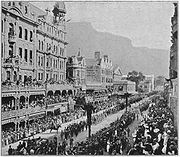 Although Rhodes remained a leading figure in the politics of southern Africa, especially during the Second Boer War
, he was dogged by ill health throughout his relatively short life. He was sent to Natal aged 16 because it was believed the climate might help problems with his heart. On returning to England in 1872 his health again deteriorated with heart and lung problems, to the extent that his doctor believed he would only survive six months. He returned to Kimberley where his health improved. From age 40 his heart condition returned with increasing severity until his death from heart failure in 1902, aged 48, at his seaside cottage in Muizenberg. The Government arranged an epic journey by train from the Cape to Rhodesia, with the funeral train stopping at every station to allow mourners to pay their respects. He was finally laid to rest at World's View, a hilltop located approximately 35 kilometres (21.7 mi) south of Bulawayo
, in what was then Rhodesia
. Today, his grave site is part of Matobo National Park
, Zimbabwe.
In 2004, he was voted 56th in the SABC3 television series Great South Africans.
At his death he was considered one of the wealthiest men in the world. In his first will, of 1877, (before he had accumulated his wealth), Rhodes wanted to create a secret society
that would bring the whole world under British rule. The exact wording from this will is:
Rhodes' final will left a large area of land on the slopes of Table Mountain
to the South African nation. Part of this estate became the upper campus of the University of Cape Town
, another part became the Kirstenbosch National Botanical Garden, while much was spared from development and is now an important conservation area.
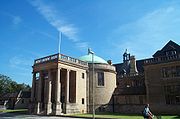 In his last will and testament, he provided for the establishment of the famous Rhodes Scholarship
, the world's first international study programme. The scholarship enabled students from territories under British rule, formerly under British rule, and from Germany, to study at the University of Oxford.
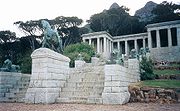 Rhodes Memorial
stands on Rhodes' favourite spot on the slopes of Devil's Peak
, Cape Town
, with a view looking north and east towards the Cape to Cairo
route. Rhodes' house in Cape Town, Groote Schuur
, has recently been inhabited by the President of the R.S.A. Jacob Zuma
.
His birthplace was established as a museum in 1938, now known as Bishops Stortford Museum. The cottage in Muizenberg
where he died is a South African national monument. The cottage today is operated as a museum by the Muizenberg Historical Conservation Society, and is open to the public. A broad display of Rhodes material can be seen, including the original De Beers board room table around which diamonds worth billions of dollars were traded.
Rhodes University College, now Rhodes University
, in Grahamstown
, was established in his name by his trustees and founded by Act of Parliament on 31 May 1904.
The residents of Kimberley elected to build a memorial in Rhodes' honour in their city, which was unveiled in 1907. The 72-ton bronze statue depicts Rhodes on his horse, looking north with map in hand, and dressed as he was when met the Ndebele after their rebellion
.
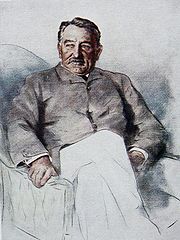
Privy Council of the United Kingdom
Her Majesty's Most Honourable Privy Council, usually known simply as the Privy Council, is a formal body of advisers to the Sovereign in the United Kingdom...
, DCL
Doctor of Civil Law
Doctor of Civil Law is a degree offered by some universities, such as the University of Oxford, instead of the more common Doctor of Laws degrees....
(5 July 1853 – 26 March 1902) was an English-born South Africa
South Africa
The Republic of South Africa is a country in southern Africa. Located at the southern tip of Africa, it is divided into nine provinces, with of coastline on the Atlantic and Indian oceans...
n businessman, mining magnate
Magnate
Magnate, from the Late Latin magnas, a great man, itself from Latin magnus 'great', designates a noble or other man in a high social position, by birth, wealth or other qualities...
, and politician. He was the founder of the diamond company De Beers
De Beers
De Beers is a family of companies that dominate the diamond, diamond mining, diamond trading and industrial diamond manufacturing sectors. De Beers is active in every category of industrial diamond mining: open-pit, underground, large-scale alluvial, coastal and deep sea...
, which today markets 40% of the world's rough diamonds and at one time marketed 90%. An ardent believer in British colonial imperialism
British Empire
The British Empire comprised the dominions, colonies, protectorates, mandates and other territories ruled or administered by the United Kingdom. It originated with the overseas colonies and trading posts established by England in the late 16th and early 17th centuries. At its height, it was the...
, he was the founder of the state of Rhodesia
Rhodesia
Rhodesia , officially the Republic of Rhodesia from 1970, was an unrecognised state located in southern Africa that existed between 1965 and 1979 following its Unilateral Declaration of Independence from the United Kingdom on 11 November 1965...
, which was named after him. In 1964, Northern Rhodesia
Northern Rhodesia
Northern Rhodesia was a territory in south central Africa, formed in 1911. It became independent in 1964 as Zambia.It was initially administered under charter by the British South Africa Company and formed by it in 1911 by amalgamating North-Western Rhodesia and North-Eastern Rhodesia...
became the independent state of Zambia
Zambia
Zambia , officially the Republic of Zambia, is a landlocked country in Southern Africa. The neighbouring countries are the Democratic Republic of the Congo to the north, Tanzania to the north-east, Malawi to the east, Mozambique, Zimbabwe, Botswana and Namibia to the south, and Angola to the west....
and Southern Rhodesia
Southern Rhodesia
Southern Rhodesia was the name of the British colony situated north of the Limpopo River and the Union of South Africa. From its independence in 1965 until its extinction in 1980, it was known as Rhodesia...
was thereafter known as simply as Rhodesia. In 1980, Rhodesia, which had been de-facto independent since 1965, was granted independence by Britain and was renamed Zimbabwe
Zimbabwe
Zimbabwe is a landlocked country located in the southern part of the African continent, between the Zambezi and Limpopo rivers. It is bordered by South Africa to the south, Botswana to the southwest, Zambia and a tip of Namibia to the northwest and Mozambique to the east. Zimbabwe has three...
. South Africa's Rhodes University
Rhodes University
Rhodes University is a public research university located in Grahamstown in the Eastern Cape Province of South Africa, established in 1904. It is the province’s oldest university, and is one of the four universities in the province...
is also named after Rhodes. He set up the provisions of the Rhodes Scholarship
Rhodes Scholarship
The Rhodes Scholarship, named after Cecil Rhodes, is an international postgraduate award for study at the University of Oxford. It was the first large-scale programme of international scholarships, and is widely considered the "world's most prestigious scholarship" by many public sources such as...
, which is funded by his estate.
Historian Richard A. McFarlane views Rhodes "as integral a participant in southern African and British imperial history as George Washington
George Washington
George Washington was the dominant military and political leader of the new United States of America from 1775 to 1799. He led the American victory over Great Britain in the American Revolutionary War as commander-in-chief of the Continental Army from 1775 to 1783, and presided over the writing of...
or Abraham Lincoln
Abraham Lincoln
Abraham Lincoln was the 16th President of the United States, serving from March 1861 until his assassination in April 1865. He successfully led his country through a great constitutional, military and moral crisis – the American Civil War – preserving the Union, while ending slavery, and...
are in their respective eras in United States history... most histories of South Africa covering the last decades of the nineteenth century are contributions to the historiography
Historiography
Historiography refers either to the study of the history and methodology of history as a discipline, or to a body of historical work on a specialized topic...
of Cecil Rhodes."
England
Rhodes was born in 1853 in Bishop's StortfordBishop's Stortford
Bishop's Stortford is a historic market town and civil parish in the district of East Hertfordshire in the county of Hertfordshire in England. It is situated just west of the M11 motorway, on the county boundary with Essex and is the closest large town to London Stansted Airport and part of the...
, Hertfordshire, England. He was the fifth son of the Reverend Francis William Rhodes and his wife Louisa Peacock Rhodes. His father was a Church of England
Church of England
The Church of England is the officially established Christian church in England and the Mother Church of the worldwide Anglican Communion. The church considers itself within the tradition of Western Christianity and dates its formal establishment principally to the mission to England by St...
vicar
Vicar
In the broadest sense, a vicar is a representative, deputy or substitute; anyone acting "in the person of" or agent for a superior . In this sense, the title is comparable to lieutenant...
who was proud of never having preached a sermon longer than 10 minutes. His siblings included Francis William Rhodes
Francis William Rhodes
Colonel Francis William Rhodes, CB, DSO , better known as "Frank", is perhaps the best known member of the Rhodes family after his brother Cecil. Trained as a soldier from his youth, he participated in a considerable amount of conflict in different parts of the world...
, who became an army officer.
A sickly, asthmatic adolescent, Cecil Rhodes was taken out of grammar school and sent to Natal
Colony of Natal
The Colony of Natal was a British colony in south-eastern Africa. It was proclaimed a British colony on May 4, 1843 after the British government had annexed the Boer Republic of Natalia, and on 31 May 1910 combined with three other colonies to form the Union of South Africa, as one of its...
, South Africa because his family thought the hot climate would improve his health. They expected he would help his older brother Herbert who operated a cotton farm.
According to Basil Williams, Rhodes left grammar school, where he had studied since the age of nine, in 1869 "and continued his studies under his father's eye." However, "His health was weakly and there were even fears that he might be consumptive
Tuberculosis
Tuberculosis, MTB, or TB is a common, and in many cases lethal, infectious disease caused by various strains of mycobacteria, usually Mycobacterium tuberculosis. Tuberculosis usually attacks the lungs but can also affect other parts of the body...
, a disease of which several of the family showed symptoms. His father therefore determined to send him abroad to try the effect of a sea voyage and a better climate. Herbert [Cecil's brother] had already set up as a planter in Natal, so to join Herbert in Natal Cecil was despatched on a sailing vessel. The voyage to Durban took him seventy days, and on 1 September 1870 he first set foot on African soil, a tall, lanky, anaemic, fair-haired boy, shy and reserved in bearing." He remained in Natal until October 1871, when he moved to the diamond fields, just opening up.
South Africa
After a brief stay with the Surveyor-General of Natal, Dr. P.C. SutherlandDr. P.C. Sutherland
Dr. Peter Cormack Sutherland Born in Newlands of Forse, near Latheron, Caithness, Scotland. The son of Robert and Elizabeth Sutherland, he was one of three surviving children of a family of 8 due to Smallpox and a drowning accident in Nova Scotia, he became a Geologist, Physician and an Author.In...
, in Pietermaritzburg
Pietermaritzburg
Pietermaritzburg is the capital and second largest city in the province of KwaZulu-Natal, South Africa. It was founded in 1838, and is currently governed by the Msunduzi Local Municipality. Its "purist" Zulu name is umGungundlovu, and this is the name used for the district municipality...
, Rhodes took an interest in agriculture. He joined his brother Herbert on his cotton farm in the Umkomazi valley in Natal. The land was unsuitable for cotton, and the venture failed. When he first came to Africa, Rhodes lived on money lent by his aunt Sophia.
In October 1871, Rhodes and his brother Herbert left the colony for the diamond fields of Kimberley
Kimberley, Northern Cape
Kimberley is a city in South Africa, and the capital of the Northern Cape. It is located near the confluence of the Vaal and Orange Rivers. The town has considerable historical significance due its diamond mining past and siege during the Second Boer War...
. Financed by N M Rothschild & Sons
N M Rothschild & Sons
N M Rothschild & Sons is a private investment banking company, belonging to the Rothschild family...
, over the next 17 years Rhodes succeeded in buying up all the smaller diamond mining operations in the Kimberley area. His monopoly of the world's diamond supply was sealed in 1889 through a strategic partnership with the London-based Diamond Syndicate. They agreed to control world supply to maintain high prices. Rhodes supervised the working of his brother's claim and speculated
Speculation
In finance, speculation is a financial action that does not promise safety of the initial investment along with the return on the principal sum...
on his behalf. Among his associates in the early days were John X. Merriman
John X. Merriman
John Xavier Merriman was the last prime minister of the Cape Colony before the formation of the Union of South Africa in 1910.-Early life:...
and Charles Rudd
Charles Rudd
Charles Dunell Rudd was the main business associate of Cecil John Rhodes.Rudd studied at Harrow School and then entered Trinity College, Cambridge in 1863, where he excelled in playing rackets...
, who later became his partner in the De Beers Mining Company
De Beers
De Beers is a family of companies that dominate the diamond, diamond mining, diamond trading and industrial diamond manufacturing sectors. De Beers is active in every category of industrial diamond mining: open-pit, underground, large-scale alluvial, coastal and deep sea...
and Niger Oil Company.
During the 1880s Cape vineyards had been devastated by a phylloxera
Phylloxera
Grape phylloxera ; originally described in France as Phylloxera vastatrix; equated to the previously described Daktulosphaira vitifoliae, Phylloxera vitifoliae; commonly just called phylloxera is a pest of commercial grapevines worldwide, originally native to eastern North America...
epidemic. The diseased vineyards were dug up and replanted, and farmers were looking for alternatives to wine. In 1892, Rhodes financed The Pioneer Fruit Growing Company at Nooitgedacht, a venture created by Harry Pickstone, an Englishman who had experience of fruit-growing in California. In 1896 he began to pay more attention to fruit farming and bought farms in Groot Drakenstein, Wellington
Wellington, Western Cape
Wellington is a town in the Western Cape Winelands 45 minutes from Cape Town, in South Africa with a population of approximately 58,300. Wellington's economy is centered around agriculture such as wine, table grapes, citrus fruit and a brandy industry. The town is located 75 km north-east of...
and Stellenbosch. A year later, Rhodes bought Rhone and Boschendal
Boschendal
Boschendal is one of the oldest wine estates in South Africa and is located between Franschhoek and Stellenbosch in South Africa's Western Cape.-Huguenot Origins:...
and commissioned Sir Herbert Baker to build him a cottage there. The successful operation soon expanded into Rhodes Fruit Farms
Rhodes Fruit Farms
Rhodes Fruit Farms, founded by Cecil John Rhodes in 1902, exists today as Boschendal The Estate, one of the oldest wine estates in South Africa.-Founding of Rhodes Fruit Farms:...
, and formed a cornerstone of the modern-day Cape fruit industry.
Education
Bishop's Stortford
Bishop's Stortford is a historic market town and civil parish in the district of East Hertfordshire in the county of Hertfordshire in England. It is situated just west of the M11 motorway, on the county boundary with Essex and is the closest large town to London Stansted Airport and part of the...
Grammar School
Grammar school
A grammar school is one of several different types of school in the history of education in the United Kingdom and some other English-speaking countries, originally a school teaching classical languages but more recently an academically-oriented secondary school.The original purpose of mediaeval...
. In 1873, Rhodes left his farm field in the care of his business partner, Rudd, and sailed for England to complete his studies. He was admitted to Oriel College, Oxford, but stayed for only one term in 1873. He returned to South Africa and did not return for his second term at Oxford until 1876. He was greatly influenced by John Ruskin
John Ruskin
John Ruskin was the leading English art critic of the Victorian era, also an art patron, draughtsman, watercolourist, a prominent social thinker and philanthropist. He wrote on subjects ranging from geology to architecture, myth to ornithology, literature to education, and botany to political...
's inaugural lecture at Oxford, which reinforced his own attachment to the cause of British imperialism
Imperialism
Imperialism, as defined by Dictionary of Human Geography, is "the creation and/or maintenance of an unequal economic, cultural, and territorial relationships, usually between states and often in the form of an empire, based on domination and subordination." The imperialism of the last 500 years,...
. Among his Oxford associates were James Rochfort Maguire
James Rochfort Maguire
James Rochfort Maguire , British imperialist and Irish Nationalist politician and MP. in the House of Commons of the United Kingdom of Great Britain and Ireland, as member of the Irish Parliamentary Party represented North Donegal and as a Parnellite Member for West Clare...
, later a fellow of All Souls College
All Souls College, Oxford
The Warden and the College of the Souls of all Faithful People deceased in the University of Oxford or All Souls College is one of the constituent colleges of the University of Oxford in England....
and a director of the British South Africa Company
British South Africa Company
The British South Africa Company was established by Cecil Rhodes through the amalgamation of the Central Search Association and the Exploring Company Ltd., receiving a royal charter in 1889...
, and Charles Metcalfe
Charles Metcalfe, 1st Baron Metcalfe
Charles Theophilus Metcalfe, 1st Baron Metcalfe, Bt, KCB, PC , known as Sir Charles Metcalfe, Bt between 1822 and 1845, was a British colonial administrator...
. Due to his university career, Rhodes admired the Oxford "system". Eventually he was inspired to develop his scholarship scheme: "Wherever you turn your eye—except in science—an Oxford man is at the top of the tree".
While attending Oriel College, Rhodes became a Freemason
Freemasonry
Freemasonry is a fraternal organisation that arose from obscure origins in the late 16th to early 17th century. Freemasonry now exists in various forms all over the world, with a membership estimated at around six million, including approximately 150,000 under the jurisdictions of the Grand Lodge...
in the Apollo University Lodge. Although initially he did not approve of the organisation, he continued to be a Freemason until his death in 1902. The failures of the Freemasons, in his mind, later caused him to envisage his own secret society with the goal of bringing the entire world under British rule.
Diamonds
Whilst at Oxford, Rhodes continued to prosper in Kimberley. Before his departure for Oxford, he and C.D. Rudd had moved from the Kimberley MineBig Hole
The Big Hole, Open Mine or Kimberley Mine is an open-pit and underground mine in Kimberley, South Africa, and claimed to be the largest hole excavated by hand.-History:...
to invest in the more costly claims of what was known as old De Beers (Vooruitzicht). It was named after Johannes Nicolaas de Beer and his brother, Diederik Arnoldus, who occupied the farm. After purchasing the land in 1839 from David Danser, a Koranna chief in the area, Fourie had allowed the de Beers and various other Afrikaner families to cultivate the land. The region extended from the Modder River
Modder River
The Modder River is a river in South Africa that forms part of the border between the Northern Cape and the Free State provinces.Modder River may also refer to:* Modder River, Northern Cape - A small town in the Northern Cape....
via the Vet River up to the Vaal River
Vaal River
The Vaal River is the largest tributary of the Orange River in South Africa. The river has its source in the Drakensberg mountains in Mpumalanga, east of Johannesburg and about 30 km north of Ermelo and only about 240 km from the Indian Ocean. It then flows westwards to its conjunction...
.
In 1874 and 1875, the diamond fields were in the grip of depression, but Rhodes and Rudd were among those who stayed to consolidate their interests. They believed that diamonds would be numerous in the hard blue ground
Kimberlite
Kimberlite is a type of potassic volcanic rock best known for sometimes containing diamonds. It is named after the town of Kimberley in South Africa, where the discovery of an diamond in 1871 spawned a diamond rush, eventually creating the Big Hole....
that had been exposed after the softer, yellow layer near the surface had been worked out. During this time, the technical problem of clearing out the water that was flooding the mines became serious. Rhodes and Rudd obtained the contract for pumping water out of the three main mines. It was during this period that Jim B. Taylor
Jim B. Taylor
James Benjamin Taylor aka Jim B. Taylor , was a South African Randlord and the fifth of 8 children of Isaac Rowland Taylor and Jane Dorothea Hellet...
, still a young boy and helping to work his father's claim, first met Rhodes.
On 12 March 1880, Rhodes and Rudd launched the De Beers Mining Company after the amalgamation of a number of individual claims. With £200,000 of capital, the company, of which Rhodes was secretary, owned the largest interest in the mine.
Politics in South Africa
In 1880, Rhodes prepared to enter public life at the Cape. With the earlier incorporation of Griqualand WestGriqualand West
Griqualand West is an area of central South Africa with an area of 40,000 km² that now forms part of the Northern Cape Province. It was inhabited by the Griqua people - a semi-nomadic, Afrikaans-speaking nation of mixed-race origin, who established several states outside the expanding frontier...
into the Cape Colony
Cape Colony
The Cape Colony, part of modern South Africa, was established by the Dutch East India Company in 1652, with the founding of Cape Town. It was subsequently occupied by the British in 1795 when the Netherlands were occupied by revolutionary France, so that the French revolutionaries could not take...
under the Molteno Ministry
John Charles Molteno
Sir John Charles Molteno KCMG was a soldier, businessman, champion of responsible government and the first Prime Minister of the Cape Colony.-Early life:...
in 1877, the area had obtained six seats in the Cape House of Assembly. Rhodes chose the constituency of Barkly West, a rural constituency in which Boer
Boer
Boer is the Dutch and Afrikaans word for farmer, which came to denote the descendants of the Dutch-speaking settlers of the eastern Cape frontier in Southern Africa during the 18th century, as well as those who left the Cape Colony during the 19th century to settle in the Orange Free State,...
voters predominated. Barkly West remained faithful to Rhodes even after his support of the Jameson Raid
Jameson Raid
The Jameson Raid was a botched raid on Paul Kruger's Transvaal Republic carried out by a British colonial statesman Leander Starr Jameson and his Rhodesian and Bechuanaland policemen over the New Year weekend of 1895–96...
against the Transvaal
South African Republic
The South African Republic , often informally known as the Transvaal Republic, was an independent Boer-ruled country in Southern Africa during the second half of the 19th century. Not to be confused with the present-day Republic of South Africa, it occupied the area later known as the South African...
. He continued as its Member until his death.
When Rhodes became a member of the Cape Parliament, the chief goal of the assembly was to help decide the future of Basutoland
Basutoland
Basutoland or officially the Territory of Basutoland, was a British Crown colony established in 1884 after the Cape Colony's inability to control the territory...
. The ministry of Sir Gordon Sprigg was trying to restore order after the 1880 rebellion known as the Gun War
Gun War
The Gun War also known as the Basuto War was an 1880-1881 conflict in the British territory of Basutoland in Southern Africa, fought between Cape Colony forces and rebellious Basotho chiefs over tribal rights...
. The Sprigg ministry had precipitated the revolt by applying its policy of disarming Africans to the Basuto. In 1890, Rhodes became Prime Minister of the Cape Colony and implemented laws that would benefit mine and industry owners. He introduced the Glen Grey Act to push black people from their lands and make way for industrial development. He also introduced educational reform to the area.
Rhodes' policies were instrumental in the development of British imperial
British Empire
The British Empire comprised the dominions, colonies, protectorates, mandates and other territories ruled or administered by the United Kingdom. It originated with the overseas colonies and trading posts established by England in the late 16th and early 17th centuries. At its height, it was the...
policies in South Africa, such as the Hut tax
Hut tax
The hut tax was a type of taxation introduced by British colonialists in Africa on a per hut or household basis. It was variously payable in money, labour, grain or stock and benefited the colonial authorities in four related ways: it raised money; it supported the currency ; it broadened the cash...
. He did not, however, have direct political power over the Boer Republic of the Transvaal. He often disagreed with the Transvaal government's policies. He believed he could use his money and his power to overthrow the Boer government and install a British colonial government supporting mine-owners' interests in its place.
In 1895, Rhodes supported an attack on the Transvaal, the infamous Jameson Raid
Jameson Raid
The Jameson Raid was a botched raid on Paul Kruger's Transvaal Republic carried out by a British colonial statesman Leander Starr Jameson and his Rhodesian and Bechuanaland policemen over the New Year weekend of 1895–96...
, which proceeded with the tacit approval of Secretary of State for the Colonies Joseph Chamberlain
Joseph Chamberlain
Joseph Chamberlain was an influential British politician and statesman. Unlike most major politicians of the time, he was a self-made businessman and had not attended Oxford or Cambridge University....
. The raid was a catastrophic failure. It forced Cecil Rhodes to resign as Prime Minister of the Cape Colony, sent his oldest brother Col. Frank Rhodes
Francis William Rhodes
Colonel Francis William Rhodes, CB, DSO , better known as "Frank", is perhaps the best known member of the Rhodes family after his brother Cecil. Trained as a soldier from his youth, he participated in a considerable amount of conflict in different parts of the world...
to jail in Transvaal convicted of high treason
High treason
High treason is criminal disloyalty to one's government. Participating in a war against one's native country, attempting to overthrow its government, spying on its military, its diplomats, or its secret services for a hostile and foreign power, or attempting to kill its head of state are perhaps...
and nearly sentenced to death, and led to the outbreak of both the Second Matabele War
Second Matabele War
The Second Matabele War, also known as the Matabeleland Rebellion and in Zimbabwe as the First Chimurenga, was fought in 1896–97 between the British troops and the Ndebele people....
and the Second Boer War
Second Boer War
The Second Boer War was fought from 11 October 1899 until 31 May 1902 between the British Empire and the Afrikaans-speaking Dutch settlers of two independent Boer republics, the South African Republic and the Orange Free State...
.
Rhodes and the imperial factor
Alfred Beit
Alfred Beit was a German, British South African, Jewish gold and diamond magnate, a supporter of British imperialism in Southern Africa and a major donor towards infrastructure development in central and Southern Africa, and to university education and research in several countries.- Life and...
and other investors to pursue his dream of creating a British Empire
British Empire
The British Empire comprised the dominions, colonies, protectorates, mandates and other territories ruled or administered by the United Kingdom. It originated with the overseas colonies and trading posts established by England in the late 16th and early 17th centuries. At its height, it was the...
in new territories to the north by obtaining mineral concessions
Mineral rights
- Mineral estate :Ownership of mineral rights is an estate in real property. Technically it is known as a mineral estate and often referred to as mineral rights...
from the most powerful indigenous
Indigenous peoples of Africa
The indigenous people of Africa are those people of Africa whose way of life, attachment or claims to particular lands, and social and political standing in relation to other more dominant groups have resulted in their substantial marginalisation within modern African states The indigenous people...
chief
Tribal chief
A tribal chief is the leader of a tribal society or chiefdom. Tribal societies with social stratification under a single leader emerged in the Neolithic period out of earlier tribal structures with little stratification, and they remained prevalent throughout the Iron Age.In the case of ...
s. Rhodes' competitive advantage over other mineral prospecting companies was his combination of wealth and astute political instincts, also called the 'imperial factor', as he used the British Government. He befriended its local representatives, the British Commissioner
Commissioner
Commissioner is in principle the title given to a member of a commission or to an individual who has been given a commission ....
s, and through them organised British protectorate
Protectorate
In history, the term protectorate has two different meanings. In its earliest inception, which has been adopted by modern international law, it is an autonomous territory that is protected diplomatically or militarily against third parties by a stronger state or entity...
s over the mineral concession areas via separate but related treaties. In this way he obtained both legality and security for mining operations. He could then win over more investors. Imperial expansion and capital investment went hand in hand.
The imperial factor was a double-edged sword: Rhodes did not want the bureaucrat
Bureaucrat
A bureaucrat is a member of a bureaucracy and can comprise the administration of any organization of any size, though the term usually connotes someone within an institution of a government or corporation...
s of the Colonial Office
Colonial Office
Colonial Office is the government agency which serves to oversee and supervise their colony* Colonial Office - The British Government department* Office of Insular Affairs - the American government agency* Reichskolonialamt - the German Colonial Office...
in London to interfere in the Empire in Africa. He wanted British settlers and local politicians and governors to run it. This put him on a collision course with many in Britain, as well as with British missionaries, who favoured what they saw as the more ethical direct rule from London. Rhodes won because he would pay to administer the territories north of South Africa against future mining profits. The Colonial Office did not have the funds to do it. Rhodes promoted his business interests as in the strategic interest of Britain: preventing the Portuguese
Portugal
Portugal , officially the Portuguese Republic is a country situated in southwestern Europe on the Iberian Peninsula. Portugal is the westernmost country of Europe, and is bordered by the Atlantic Ocean to the West and South and by Spain to the North and East. The Atlantic archipelagos of the...
, the Germans
Germany
Germany , officially the Federal Republic of Germany , is a federal parliamentary republic in Europe. The country consists of 16 states while the capital and largest city is Berlin. Germany covers an area of 357,021 km2 and has a largely temperate seasonal climate...
or the Boers from moving in to south-central Africa. Rhodes' companies and agents cemented these advantages by obtaining many mining concessions, as exemplified by the Rudd and Lochner Concessions.
Treaties, concessions and charters
Rhodes had already tried and failed to get a mining concession from LobengulaLobengula
Lobengula Khumalo was the second and last king of the Ndebele people, usually pronounced Matabele in English. Both names, in the Sindebele language, mean "The men of the long shields", a reference to the Matabele warriors' use of the Zulu shield and spear.- Background :The Matabele were related to...
, king of the Ndebele of Matabeleland
Matabeleland
Modern day Matabeleland is a region in Zimbabwe divided into three provinces: Matabeleland North, Bulawayo and Matabeleland South. These provinces are in the west and south-west of Zimbabwe, between the Limpopo and Zambezi rivers. The region is named after its inhabitants, the Ndebele people...
. In 1888 he tried again. He sent John Moffat
John Smith Moffat
Reverend John Smith Moffat was a British missionary and imperial agent in southern Africa, the son of missionary Robert Moffat and brother-in-law of missionary explorer David Livingstone....
, son of the missionary Robert Moffat
Robert Moffat
Robert Moffat was a Scottish Congregationalist missionary to Africa, and father in law of David Livingstone....
, who was trusted by Lobengula, to persuade the latter to sign a treaty of friendship with Britain, and to look favourably on Rhodes' proposals. His agent Francis Thompson, who had travelled to Bulawayo in the company of Charles Rudd
Charles Rudd
Charles Dunell Rudd was the main business associate of Cecil John Rhodes.Rudd studied at Harrow School and then entered Trinity College, Cambridge in 1863, where he excelled in playing rackets...
and Rochfort Maguire, assured Lobengula that no more than ten white men would mine in Matabeleland. This limitation was left out of the document which Lobengula signed, known as the Rudd Concession. Furthermore it stated that the mining companies could do anything necessary to their operations. When Lobengula discovered later the true effects of the concession, he tried to renounce it, but the British Government ignored him.
Armed with the Rudd Concession, in 1889 Rhodes obtained a charter
Charter
A charter is the grant of authority or rights, stating that the granter formally recognizes the prerogative of the recipient to exercise the rights specified...
from the British Government for his British South Africa Company
British South Africa Company
The British South Africa Company was established by Cecil Rhodes through the amalgamation of the Central Search Association and the Exploring Company Ltd., receiving a royal charter in 1889...
(BSAC) to rule, police and make new treaties and concessions from the Limpopo River
Limpopo River
The Limpopo River rises in central southern Africa, and flows generally eastwards to the Indian Ocean. It is around long, with a drainage basin in size. Its mean annual discharge is 170 m³/s at its mouth...
to the great lakes of Central Africa. He obtained further concessions and treaties north of the Zambezi
Zambezi
The Zambezi is the fourth-longest river in Africa, and the largest flowing into the Indian Ocean from Africa. The area of its basin is , slightly less than half that of the Nile...
, such as those in Barotseland
Barotseland
Barotseland is a region in the western part of Zambia, and is the homeland of the Lozi people or Barotse who were previously known as Luyi or Aluyi. Its heartland is the Barotse Floodplain on the upper Zambezi River, also known as Bulozi or Lyondo, but it includes the surrounding higher ground of...
(the Lochner Concession with King Lewanika
Lewanika
Lewanika was the Lozi Litunga of Barotseland from 1878 to 1916...
in 1890, which was similar to the Rudd Concession); and in the Lake Mweru
Lake Mweru
Lake Mweru is a freshwater lake on the longest arm of Africa's second-longest river, the Congo. Located on the border between Zambia and Democratic Republic of the Congo, it makes up 110 km of the total length of the Congo, lying between its Luapula River and Luvua River segments.Mweru...
area (Alfred Sharpe
Alfred Sharpe
Sir Alfred Sharpe was a professional hunter who became a British colonial administrator and Commissioner of the British Central Africa Protectorate from 1896 until 1910...
's 1890 Kazembe concession). Rhodes also sent Sharpe to get a concession over mineral-rich Katanga
Katanga Province
Katanga Province is one of the provinces of the Democratic Republic of the Congo. Between 1971 and 1997, its official name was Shaba Province. Under the new constitution, the province was to be replaced by four smaller provinces by February 2009; this did not actually take place.Katanga's regional...
, but met his match in ruthlessness: when Sharpe was rebuffed by its ruler Msiri, King Leopold II of Belgium
Leopold II of Belgium
Leopold II was the second king of the Belgians. Born in Brussels the second son of Leopold I and Louise-Marie of Orléans, he succeeded his father to the throne on 17 December 1865 and remained king until his death.Leopold is chiefly remembered as the founder and sole owner of the Congo Free...
obtained a concession over Msiri's dead body for his Congo Free State
Congo Free State
The Congo Free State was a large area in Central Africa which was privately controlled by Leopold II, King of the Belgians. Its origins lay in Leopold's attracting scientific, and humanitarian backing for a non-governmental organization, the Association internationale africaine...
.
Rhodes also wanted Bechuanaland Protectorate (now Botswana
Botswana
Botswana, officially the Republic of Botswana , is a landlocked country located in Southern Africa. The citizens are referred to as "Batswana" . Formerly the British protectorate of Bechuanaland, Botswana adopted its new name after becoming independent within the Commonwealth on 30 September 1966...
) under the BSAC charter. But three Tswana kings, including Khama III
Khama III
Khama III , also known as Khama the Good, was the kgosi of the Bamangwato people of Bechuanaland , who made his country a protectorate of the United Kingdom to ensure its survival against Boer and Ndebele encroachments.-Ancestry and Youth:During the 18th century, Malope, chief of the Bakwena...
, travelled to Britain and won over British public opinion for it to remain governed by the British Colonial Office in London. Rhodes commented: "It is humiliating to be utterly beaten by these niggers."
The British Colonial Office
Colonial Office
Colonial Office is the government agency which serves to oversee and supervise their colony* Colonial Office - The British Government department* Office of Insular Affairs - the American government agency* Reichskolonialamt - the German Colonial Office...
also decided to administer British Central Africa
British Central Africa
The British Central Africa Protectorate existed in the area of present-day Malawi between 1893 and 1907.-History:The Shire Highlands south of Lake Nyasa and the lands west of the lake had been of interest to the British since they were first explored by David Livingstone in the 1850s, and...
(Nyasaland, today's Malawi
Malawi
The Republic of Malawi is a landlocked country in southeast Africa that was formerly known as Nyasaland. It is bordered by Zambia to the northwest, Tanzania to the northeast, and Mozambique on the east, south and west. The country is separated from Tanzania and Mozambique by Lake Malawi. Its size...
) owing to the activism of Scots
Scottish people
The Scottish people , or Scots, are a nation and ethnic group native to Scotland. Historically they emerged from an amalgamation of the Picts and Gaels, incorporating neighbouring Britons to the south as well as invading Germanic peoples such as the Anglo-Saxons and the Norse.In modern use,...
missionaries trying to end the slave trade. Rhodes paid much of the cost so that the British Central Africa Commissioner Sir Harry Johnston, and his successor Alfred Sharpe, would assist with security for Rhodes in the BSAC's north-eastern territories. Johnston shared Rhodes' expansionist views, but he and his successors were not as pro-settler as Rhodes, and disagreed on dealings with Africans.
Rhodesia
The BSAC had its own police force, the British South Africa PoliceBritish South Africa Police
The British South Africa Police was the police force of the British South Africa Company of Cecil Rhodes which became the national police force of Southern Rhodesia and its successor after 1965, Rhodesia...
which was used to control Matabeleland
Matabeleland
Modern day Matabeleland is a region in Zimbabwe divided into three provinces: Matabeleland North, Bulawayo and Matabeleland South. These provinces are in the west and south-west of Zimbabwe, between the Limpopo and Zambezi rivers. The region is named after its inhabitants, the Ndebele people...
and Mashonaland
Mashonaland
Mashonaland is a region in northern Zimbabwe. It is the home of the Shona people.Currently, Mashonaland is divided into three provinces, with a total population of about 3 million:* Mashonaland West* Mashonaland Central* Mashonaland East...
, in present-day Zimbabwe
Zimbabwe
Zimbabwe is a landlocked country located in the southern part of the African continent, between the Zambezi and Limpopo rivers. It is bordered by South Africa to the south, Botswana to the southwest, Zambia and a tip of Namibia to the northwest and Mozambique to the east. Zimbabwe has three...
. The company had hoped to start a "new Rand
Witwatersrand
The Witwatersrand is a low, sedimentary range of hills, at an elevation of 1700–1800 metres above sea-level, which runs in an east-west direction through Gauteng in South Africa. The word in Afrikaans means "the ridge of white waters". Geologically it is complex, but the principal formations...
" from the ancient gold mines of the Shona
Shona people
Shona is the name collectively given to two groups of people in the east and southwest of Zimbabwe, north eastern Botswana and southern Mozambique.-Shona Regional Classification:...
. Because the gold deposits were on a much smaller scale, many of the white settlers who accompanied the BSAC to Mashonaland became farmers rather than miners. When the Ndebele and the Shona—the two main, but rival peoples—separately rebelled against the coming of the European settlers, the BSAC defeated them in the two Matabele War
Matabele War
The Matabele War may refer to one or both of:*The First Matabele War *The Second Matabele War, Matabeleland Rebellion or First Chimurenga of 1896-1897...
s (1893–94; 1896–97). Shortly after learning of the assassination of the Ndebele spiritual leader, Mlimo, by the American scout Frederick Russell Burnham
Frederick Russell Burnham
Frederick Russell Burnham, DSO was an American scout and world traveling adventurer known for his service to the British Army in colonial Africa and for teaching woodcraft to Robert Baden-Powell, thus becoming one of the inspirations for the founding of the international Scouting Movement.Burnham...
, Rhodes walked unarmed into the Ndebele stronghold in Matobo Hills. He persuaded the Impi
Impi
An Impi is an isiZulu word for any armed body of men. However, in English it is often used to refer to a Zulu regiment, which is called an ibutho in Zulu. Its beginnings lie far back in historic tribal warfare customs, where groups of armed men called impis battled...
to lay down their arms, thus ending the Second Matabele War.
By the end of 1894, the territories over which the BSAC had concessions or treaties, collectively called "Zambesia" after the Zambezi River flowing through the middle, comprised an area of 1,143,000 km² between the Limpopo River
Limpopo River
The Limpopo River rises in central southern Africa, and flows generally eastwards to the Indian Ocean. It is around long, with a drainage basin in size. Its mean annual discharge is 170 m³/s at its mouth...
and Lake Tanganyika
Lake Tanganyika
Lake Tanganyika is an African Great Lake. It is estimated to be the second largest freshwater lake in the world by volume, and the second deepest, after Lake Baikal in Siberia; it is also the world's longest freshwater lake...
. In May 1895, its name was officially changed to "Rhodesia", reflecting Rhodes' popularity among settlers who had been using the name informally since 1891. The designation Southern Rhodesia
Southern Rhodesia
Southern Rhodesia was the name of the British colony situated north of the Limpopo River and the Union of South Africa. From its independence in 1965 until its extinction in 1980, it was known as Rhodesia...
was officially adopted in 1898 for the part south of the Zambezi, which later became Zimbabwe
Zimbabwe
Zimbabwe is a landlocked country located in the southern part of the African continent, between the Zambezi and Limpopo rivers. It is bordered by South Africa to the south, Botswana to the southwest, Zambia and a tip of Namibia to the northwest and Mozambique to the east. Zimbabwe has three...
; and the designations North-Western
North-Western Rhodesia
North-Western Rhodesia in south central Africa was formed and administered from 1891 under charter by the British South Africa Company which in 1890 had signed a treaty with King Lewanika of the Barotse, the most powerful traditional ruler in the territory...
and North-Eastern Rhodesia
North-Eastern Rhodesia
North-Eastern Rhodesia in south central Africa was formed by and administered by the British South Africa Company as the other half, with North-Western Rhodesia, of the huge territory lying mainly north of the Zambezi River into which it expanded its charter in 1891...
were used from 1895 for the territory which later became Northern Rhodesia
Northern Rhodesia
Northern Rhodesia was a territory in south central Africa, formed in 1911. It became independent in 1964 as Zambia.It was initially administered under charter by the British South Africa Company and formed by it in 1911 by amalgamating North-Western Rhodesia and North-Eastern Rhodesia...
, then Zambia
Zambia
Zambia , officially the Republic of Zambia, is a landlocked country in Southern Africa. The neighbouring countries are the Democratic Republic of the Congo to the north, Tanzania to the north-east, Malawi to the east, Mozambique, Zimbabwe, Botswana and Namibia to the south, and Angola to the west....
.
Rhodes decreed in his will that he was to be buried in Matobo Hills. After his death in the Cape in 1902, his body was transported by train to Bulawayo
Bulawayo
Bulawayo is the second largest city in Zimbabwe after the capital Harare, with an estimated population in 2010 of 2,000,000. It is located in Matabeleland, 439 km southwest of Harare, and is now treated as a separate provincial area from Matabeleland...
. His burial was attended by Ndebele chiefs, who asked that the firing party should not discharge their rifles as this would disturb the spirits. Then, for the first time, they gave a white man the Matabele royal salute, Bayete. Rhodes was buried alongside Leander Starr Jameson
Leander Starr Jameson
Sir Leander Starr Jameson, 1st Baronet, KCMG, CB, , also known as "Doctor Jim", "The Doctor" or "Lanner", was a British colonial statesman who was best known for his involvement in the Jameson Raid....
and 34 British soldiers killed in the Shangani Patrol
Shangani Patrol
The Shangani Patrol was a group of white Rhodesian pioneer police officers killed in battle on the Shangani River in Matabeleland in 1893. The incident achieved a lasting, prominent place in Rhodesian colonial history.-Setting and Battle:...
.
"Cape to Cairo Red Line"
- Main articles: Cape to Cairo Railway and Cape to Cairo RoadCape to Cairo RoadThe Cape to Cairo Road or 'Pan-African Highway', sometimes called the Great North Road in sub-Saharan Africa, was an imperial dream envisioned by the British Empire that would see a road stretch the length of Africa, from Cape Town to Cairo, similar to the Pan-American Highway...
One of Rhodes' dreams (and the dream of many other members of the British Empire
British Empire
The British Empire comprised the dominions, colonies, protectorates, mandates and other territories ruled or administered by the United Kingdom. It originated with the overseas colonies and trading posts established by England in the late 16th and early 17th centuries. At its height, it was the...
) was for a "red line" on the map from the Cape to Cairo. (On geo-political maps, British dominions were always denoted in red or pink.) Rhodes had been instrumental in securing southern African states for the Empire. He and others felt the best way to "unify the possessions, facilitate governance, enable the military to move quickly to hot spots or conduct war, help settlement, and foster trade" would be to build the "Cape to Cairo Railway".
This enterprise was not without its problems. France had a rival strategy in the late 1890s to link its colonies from west to east across the continent. The Portuguese produced the "Pink Map
Pink Map
The Pink Map was a document representing Portugal's claim of sovereignty over the land between Angola and Mozambique, which today is currently Zambia, Zimbabwe and Malawi.The Pink Map collided with Sir Cecil Rhodes' "Cape to Cairo Red Line"...
", representing their claims to sovereignty in Africa.
Political views
Anglo-Saxon
Anglo-Saxon may refer to:* Anglo-Saxons, a group that invaded Britain** Old English, their language** Anglo-Saxon England, their history, one of various ships* White Anglo-Saxon Protestant, an ethnicity* Anglo-Saxon economy, modern macroeconomic term...
race was destined to greatness. In his last will and testament, Rhodes said of the British, "I contend that we are the first race in the world and that the more of the world we inhabit the better it is for the human race." He wanted to make the British Empire a superpower in which all of the British-dominated countries in the empire, including Canada, Australia, New Zealand, and Cape Colony, would be represented in the British Parliament
Imperial Federation
Imperial Federation was a late-19th early-20th century proposal to create a federated union in place of the existing British Empire.-Motivators:...
. Rhodes included American students as eligible for the Rhodes scholarships. He said that he wanted to breed an American elite of philosopher-kings who would have the United States rejoin the British Empire. As Rhodes also respected the Germans
Germans
The Germans are a Germanic ethnic group native to Central Europe. The English term Germans has referred to the German-speaking population of the Holy Roman Empire since the Late Middle Ages....
and admired the Kaiser
Kaiser
Kaiser is the German title meaning "Emperor", with Kaiserin being the female equivalent, "Empress". Like the Russian Czar it is directly derived from the Latin Emperors' title of Caesar, which in turn is derived from the personal name of a branch of the gens Julia, to which Gaius Julius Caesar,...
, he allowed German students to be included in the Rhodes scholarships. He believed that eventually the United Kingdom (including Ireland), the USA and Germany together would dominate the world and ensure peace.
On domestic politics within the United Kingdom, Rhodes was a supporter of the Liberal Party
Liberal Party (UK)
The Liberal Party was one of the two major political parties of the United Kingdom during the 19th and early 20th centuries. It was a third party of negligible importance throughout the latter half of the 20th Century, before merging with the Social Democratic Party in 1988 to form the present day...
. Rhodes' only major impact on domestic politics within the United Kingdom was his support of the Irish nationalist party, led by Charles Stewart Parnell
Charles Stewart Parnell
Charles Stewart Parnell was an Irish landowner, nationalist political leader, land reform agitator, and the founder and leader of the Irish Parliamentary Party...
(1846–1891). He contributed a great deal of money to the Irish nationalists, although Rhodes made his support conditional upon an autonomous Ireland's still being represented in the British Parliament. Rhodes was such a strong supporter of Parnell that, after the Liberals and the Irish nationalists disowned him after his was wrongly accused of committing adultery with the wife of another Irish nationalist, and was only cleared after a long court battle, Rhodes continued his support.
Rhodes was more tolerant of the Dutch-speaking whites in the Cape Colony than were the other English-speaking whites in the Cape Colony. He supported teaching Dutch as well as English in public schools in the Cape Colony and lent money to support this cause. While Prime Minister of the Cape Colony, he helped to remove most of the legal disabilities that English-speaking whites had imposed on Dutch-speaking whites. He was a friend of Jan Hofmeyr, leader of the Afrikaner Bond
Afrikaner Bond
The Afrikaner Bond was a political party in the Cape Colony. It was formed by the union in 1881 of the Genootskap vir Regte Afrikaners of Rev S.J...
, and it was largely because of Afrikaner support that he became Prime Minister of the Cape Colony. Rhodes advocated greater self-government for the Cape Colony, in line with his preference for the empire to be controlled by local settlers and politicians rather than by London (see "Rhodes and the imperial factor" above).
Confusingly for the modern reader, self-government of the type Rhodes supported was known as "colonialism". The opposed policy, direct control of a colony from London, was known as "imperialism". This should be kept in mind when reading documents from this time.
Sexuality
Rhodes never married, pleading "I have too much work on my hands" and saying that he would not be a dutiful husband. Some writers and academics have suggested that Rhodes may have been homosexual.The scholar Richard Brown observed: "there is still the simpler but major problem of the extraordinarily thin evidence on which the conclusions about Rhodes are reached. Rhodes himself left few details... Indeed, Rhodes is a singularly difficult subject... since there exists little intimate material – no diaries and few personal letters."
Brown also comments: "On the issue of Rhodes' sexuality... there is, once again, simply not enough reliable evidence to reach firm, irrefutable conclusions. It is inferred, but not proved, that Rhodes was homosexual and it is assumed (but not proved) that his relationships with men were sometimes physical. Neville Pickering is described as Rhodes' lover in spite of the absence of decisive evidence."
Rhodes was close to Pickering; he returned from negotiations for Pickering's 25th birthday in 1882. On that occasion, Rhodes drew up a new will leaving his estate to Pickering. Two years later, Pickering suffered a riding accident. Rhodes nursed him faithfully for six weeks, refusing even to answer telegrams concerning his business interests. Pickering died in Rhodes' arms, and at his funeral Rhodes was said to have wept with fervor.
His successor was Henry Latham Currey
Henry Latham Currey
Henry Latham Currey , also known as Harry Currey was a British politician in the Cape Colony.Currey was the son of John Blades Currey and Mary Margaret Christian, daughter of Ewan Christian. He was educated at The King's School, Canterbury and went then to Winchester College.Currey joined the Cape...
, the son of an old friend, who had become Rhodes's private secretary in 1884. When Currey got engaged in 1894, Rhodes was deeply mortified and their relationship split.
Rhodes also remained close to Leander Starr Jameson
Leander Starr Jameson
Sir Leander Starr Jameson, 1st Baronet, KCMG, CB, , also known as "Doctor Jim", "The Doctor" or "Lanner", was a British colonial statesman who was best known for his involvement in the Jameson Raid....
after the two had met in Kimberley, where they shared a bungalow. In 1896 Earl Grey
Albert Grey, 4th Earl Grey
Albert Henry George Grey, 4th Earl Grey was a British nobleman and politician who served as Governor General of Canada, the ninth since Canadian Confederation....
came to give Rhodes bad news. Rhodes instantly jumped to the conclusion that Jameson, who was ill, had died. On learning that his house had burnt down he commented, "Thank goodness. If Dr. Jim had died, I should never have got over it." Jameson nursed Rhodes during his final illness, was a trustee of his estate and residuary beneficiary of his will, which allowed him to continue living in Rhodes' mansion after his death. Rhodes' secretary, Jourdan, who was present shortly after Rhodes' death said, "Jameson was fighting against his own grief ... No mother could have displayed more tenderness towards the remains of a loved son". Jameson died in England in 1917, but after the war in 1920 his body was transferred to a grave beside that of Rhodes on Malindidzimu Hill or World's View, a granite hill in the Matopo National Park 40 km south of Bulawayo.
Princess Radziwiłł
In the last years of his life, Rhodes was stalkedStalking
Stalking is a term commonly used to refer to unwanted and obsessive attention by an individual or group to another person. Stalking behaviors are related to harassment and intimidation and may include following the victim in person and/or monitoring them via the internet...
by Polish princess Catherine Radziwiłł, born Rzewuska, married into a noble Polish-Lithuanian dynasty called Radziwiłł. Radziwiłł falsely claimed that she was engaged to Rhodes, or that they were having an affair. She asked him to marry her, but Rhodes refused. She got revenge by falsely accusing him of loan fraud. He had to go to trial and testify against her accusation. He died shortly after the trial in 1902. She wrote a biography of Rhodes called Cecil Rhodes: Man and Empire Maker. Her accusations were eventually proved false.
Boer Wars
During the Boer Wars Rhodes went to KimberleyKimberley, Northern Cape
Kimberley is a city in South Africa, and the capital of the Northern Cape. It is located near the confluence of the Vaal and Orange Rivers. The town has considerable historical significance due its diamond mining past and siege during the Second Boer War...
at the onset of the siege
Siege of Kimberley
The Siege of Kimberley took place during the Second Boer War at Kimberley, Cape Colony , when Boer forces from the Orange Free State and the Transvaal besieged the diamond mining town. The Boers moved quickly to try to capture the British enclave when war broke out between the British and the two...
, in a calculated move to raise the political stakes on the government to dedicate resources to the defence of the city. The military felt he was more of a liability than an asset and found him intolerable. In particular, Lieutenant Colonel Kekewich
Robert Kekewich
Major General Robert George Kekewich CB was a Victorian era British Army officer.Kekewich was the second son of Trehawke Kekewich, of Peamore House, near Exeter, Devon, and the grandson of Samuel Trehawke Kekewich...
disliked Rhodes because of Rhodes' inability to cooperate with the military; Rhodes insisted that the military should adopt his plans and ideas instead of following their orders. Despite the differences, Rhodes' company was instrumental in the defence of the city, providing water, refrigeration facilities, constructing fortifications, manufacturing an armoured train
Armoured train
An armoured train is a train protected with armour. They are usually equipped with railroad cars armed with artillery and machine guns. They were mostly used during the late 19th and early 20th century, when they offered an innovative way to quickly move large amounts of firepower...
, shells and a one-off gun named Long Cecil
Long Cecil
Long Cecil was a unique one-off gun, designed by George Labram, a United States citizen, and built in the workshops of the De Beers mining company in Kimberley for use by the British during the Siege of Kimberley in the Second Boer War....
.
Rhodes used his position and influence to lobby the British government to relieve the siege of Kimberley, claiming in the press that the situation in the city was desperate. The military wanted to assemble a large force to take the Boer cities of Bloemfontein
Bloemfontein
Bloemfontein is the capital city of the Free State Province of South Africa; and, as the judicial capital of the nation, one of South Africa's three national capitals – the other two being Cape Town, the legislative capital, and Pretoria, the administrative capital.Bloemfontein is popularly and...
and Pretoria
Pretoria
Pretoria is a city located in the northern part of Gauteng Province, South Africa. It is one of the country's three capital cities, serving as the executive and de facto national capital; the others are Cape Town, the legislative capital, and Bloemfontein, the judicial capital.Pretoria is...
, but they were compelled to change their plans and send three separate smaller forces to relieve the sieges of Kimberley, Mafeking
Siege of Mafeking
The Siege of Mafeking was the most famous British action in the Second Boer War. It took place at the town of Mafeking in South Africa over a period of 217 days, from October 1899 to May 1900, and turned Robert Baden-Powell, who went on to found the Scouting Movement, into a national hero...
and Ladysmith
Siege of Ladysmith
The Siege of Ladysmith was a protracted engagement in the Second Boer War, taking place between 30 October 1899 and 28 February 1900 at Ladysmith, Natal.-Background:...
.
Death and legacy
Second Boer War
The Second Boer War was fought from 11 October 1899 until 31 May 1902 between the British Empire and the Afrikaans-speaking Dutch settlers of two independent Boer republics, the South African Republic and the Orange Free State...
, he was dogged by ill health throughout his relatively short life. He was sent to Natal aged 16 because it was believed the climate might help problems with his heart. On returning to England in 1872 his health again deteriorated with heart and lung problems, to the extent that his doctor believed he would only survive six months. He returned to Kimberley where his health improved. From age 40 his heart condition returned with increasing severity until his death from heart failure in 1902, aged 48, at his seaside cottage in Muizenberg. The Government arranged an epic journey by train from the Cape to Rhodesia, with the funeral train stopping at every station to allow mourners to pay their respects. He was finally laid to rest at World's View, a hilltop located approximately 35 kilometres (21.7 mi) south of Bulawayo
Bulawayo
Bulawayo is the second largest city in Zimbabwe after the capital Harare, with an estimated population in 2010 of 2,000,000. It is located in Matabeleland, 439 km southwest of Harare, and is now treated as a separate provincial area from Matabeleland...
, in what was then Rhodesia
Rhodesia
Rhodesia , officially the Republic of Rhodesia from 1970, was an unrecognised state located in southern Africa that existed between 1965 and 1979 following its Unilateral Declaration of Independence from the United Kingdom on 11 November 1965...
. Today, his grave site is part of Matobo National Park
Matobo National Park
The Matobo National Park forms the core of the Matobo or Matopos Hills, an area of granite kopjes and wooded valleys commencing some 35 kilometres south of Bulawayo, southern Zimbabwe...
, Zimbabwe.
In 2004, he was voted 56th in the SABC3 television series Great South Africans.
At his death he was considered one of the wealthiest men in the world. In his first will, of 1877, (before he had accumulated his wealth), Rhodes wanted to create a secret society
Secret society
A secret society is a club or organization whose activities and inner functioning are concealed from non-members. The society may or may not attempt to conceal its existence. The term usually excludes covert groups, such as intelligence agencies or guerrilla insurgencies, which hide their...
that would bring the whole world under British rule. The exact wording from this will is:
Rhodes' final will left a large area of land on the slopes of Table Mountain
Table Mountain
Table Mountain is a flat-topped mountain forming a prominent landmark overlooking the city of Cape Town in South Africa, and is featured in the flag of Cape Town and other local government insignia. It is a significant tourist attraction, with many visitors using the cableway or hiking to the top...
to the South African nation. Part of this estate became the upper campus of the University of Cape Town
University of Cape Town
The University of Cape Town is a public research university located in Cape Town in the Western Cape province of South Africa. UCT was founded in 1829 as the South African College, and is the oldest university in South Africa and the second oldest extant university in Africa.-History:The roots of...
, another part became the Kirstenbosch National Botanical Garden, while much was spared from development and is now an important conservation area.
Rhodes Scholarship
Rhodes Scholarship
The Rhodes Scholarship, named after Cecil Rhodes, is an international postgraduate award for study at the University of Oxford. It was the first large-scale programme of international scholarships, and is widely considered the "world's most prestigious scholarship" by many public sources such as...
, the world's first international study programme. The scholarship enabled students from territories under British rule, formerly under British rule, and from Germany, to study at the University of Oxford.
Memorials
Rhodes Memorial
Rhodes Memorial on Devil's Peak in Cape Town, South Africa, is a memorial to English-born South African politician Cecil John Rhodes designed by Sir Herbert Baker.-Location:...
stands on Rhodes' favourite spot on the slopes of Devil's Peak
Devil's Peak (Cape Town)
Devil's Peak is part of the mountainous backdrop to Cape Town. When looking at Table Mountain from the Victoria & Alfred Waterfront, or when looking at the standard picture postcard view of the mountain, the skyline is from left to right: the spire of Devil's Peak, the flat mesa of Table Mountain,...
, Cape Town
Cape Town
Cape Town is the second-most populous city in South Africa, and the provincial capital and primate city of the Western Cape. As the seat of the National Parliament, it is also the legislative capital of the country. It forms part of the City of Cape Town metropolitan municipality...
, with a view looking north and east towards the Cape to Cairo
Cape To Cairo
Cape to Cairo may refer to:* the Cape to Cairo Railway* the Cape to Cairo Red Line, the 19th century concept of a British-dominated Africa, promoted by Cecil Rhodes* the Cape to Cairo Road...
route. Rhodes' house in Cape Town, Groote Schuur
Groote Schuur
Groote Schuur is an estate in Cape Town, South Africa.Cecil Rhodes took out a lease on the house in 1891. He later bought it in 1893, and had it converted and refurbished by the architect Sir Herbert Baker...
, has recently been inhabited by the President of the R.S.A. Jacob Zuma
Jacob Zuma
Jacob Gedleyihlekisa Zuma is the President of South Africa, elected by parliament following his party's victory in the 2009 general election....
.
His birthplace was established as a museum in 1938, now known as Bishops Stortford Museum. The cottage in Muizenberg
Muizenberg
Muizenberg is a beach-side suburb of Cape Town, South Africa. It is situated where the shore of the Cape Peninsula curves round to the east on the False Bay coast...
where he died is a South African national monument. The cottage today is operated as a museum by the Muizenberg Historical Conservation Society, and is open to the public. A broad display of Rhodes material can be seen, including the original De Beers board room table around which diamonds worth billions of dollars were traded.
Rhodes University College, now Rhodes University
Rhodes University
Rhodes University is a public research university located in Grahamstown in the Eastern Cape Province of South Africa, established in 1904. It is the province’s oldest university, and is one of the four universities in the province...
, in Grahamstown
Grahamstown
Grahamstown is a city in the Eastern Cape Province of the Republic of South Africa and is the seat of the Makana municipality. The population of greater Grahamstown, as of 2003, was 124,758. The population of the surrounding areas, including the actual city was 41,799 of which 77.4% were black,...
, was established in his name by his trustees and founded by Act of Parliament on 31 May 1904.
The residents of Kimberley elected to build a memorial in Rhodes' honour in their city, which was unveiled in 1907. The 72-ton bronze statue depicts Rhodes on his horse, looking north with map in hand, and dressed as he was when met the Ndebele after their rebellion
Second Matabele War
The Second Matabele War, also known as the Matabeleland Rebellion and in Zimbabwe as the First Chimurenga, was fought in 1896–97 between the British troops and the Ndebele people....
.
Quotations
- "To think of these stars that you see overhead at night, these vast worlds which we can never reach. I would annexeAnnexationAnnexation is the de jure incorporation of some territory into another geo-political entity . Usually, it is implied that the territory and population being annexed is the smaller, more peripheral, and weaker of the two merging entities, barring physical size...
the planets if I could; I often think of that. It makes me sad to see them so clear and yet so far."
- “Pure philanthropy is very well in its way but philanthropy plus five percent is a good deal better.”
- "I contend that we are the first race in the world, and that the more of the world we inhabit the better it is for the human race...If there be a God, I think that what he would like me to do is paint as much of the map of Africa British Red as possible..."
- "In order to save the forty million inhabitants of the United Kingdom from a bloody civil war, our colonial statesmen must acquire new lands for settling the surplus population of this country, to provide new markets... The Empire, as I have always said, is a bread and butter question"
- "Remember that you are an Englishman, and have consequently won first prize in the lottery of life."
- "Equal Rights for all Civilized Men South of the Zambesi"
Mis-quotes
- "To be born English is to win first prize in the lottery of life."
- See above.
- “We must find new lands from which we can easily obtain raw materials and at the same time exploit the cheap slave labour that is available from the natives of the colonies. The colonies would also provide a dumping ground for the surplus goods produced in our factories.”
- The wording in this quote disputed and original source is unknown.
Popular culture
- Mark Twain'sMark TwainSamuel Langhorne Clemens , better known by his pen name Mark Twain, was an American author and humorist...
sarcastic summation of Rhodes ("I admire him, I frankly confess it; and when his time comes I shall buy a piece of the rope for a keepsake"), from Chapter LXIX of Following the EquatorFollowing the EquatorFollowing the Equator or More Tramps Abroad is a non-fiction travelogue published by American author Mark Twain in 1897....
, still often appears in collections of famous insults. His account of how "Cecil Rhodes" made his first fortune by discovering, in Australia, in the belly of a shark, a newspaper that gave him advance knowledge of a great rise in wool prices, is completely fictional – Twain dates the event at 1870, when Rhodes was in South Africa – yet is occasionally accepted as true (see a posting on Yahoo Answers at http://answers.yahoo.com/question/index?qid=20080407061220AAi5ap3 (retrieved 22 May 2011)).
- The will of Cecil Rhodes is the central theme in the science fiction book Great Work of TimeGreat Work of TimeGreat Work of Time is a novella by John Crowley. A science fiction story involving time travel, it concerns a secret society created by the will of Cecil Rhodes to preserve and expand the British Empire....
by John CrowleyJohn CrowleyJohn Crowley is an American author of fantasy, science fiction and mainstream fiction. He studied at Indiana University and has a second career as a documentary film writer...
, an alternate history in which the Secret Society stipulated in the will was indeed established. Its members eventually achieve the secret of time travel and use it to restrain World War I and prevent World War II, and to perpetuate the world ascendancy of the British Empire up to the end of the Twentieth Century. The book contains a vivid description of Cecil Rhodes himself, seen through the eyes of a traveller from the future British Empire.
- In the British film Rhodes of AfricaRhodes of AfricaRhodes of Africa is a 1936 British biographical film charting the life of Cecil Rhodes. It was directed by Berthold Viertel and starred Walter Huston, Oskar Homolka, Basil Sydney and Bernard Lee.-Cast:* Walter Huston - Cecil Rhodes...
(1936, directed by Austrian filmmaker Berthold ViertelBerthold ViertelBerthold Viertel , born in Vienna, Austria was a screen writer and film director.-Arrival in America:He was married to screenplay writer and actress Salka Viertel from 30 April 1918 to 20 December 1947. The pair came to Los Angeles in 1928 planning to stay for just three years...
), Rhodes was portrayed by American actor Walter HustonWalter HustonWalter Thomas Huston was a Canadian-born American actor. He was the father of actor and director John Huston and the grandfather of actress Anjelica Huston and actor Danny Huston.-Life and career:...
.
- In 1996, BBC-TV made an eight-part television drama about Rhodes called Rhodes: The Life and Legend of Cecil Rhodes. It was produced by David Drury and written by Antony Thomas. It tells the story of Rhodes' life through a series of flashbacks of conversations between him and Princess Catherine Radziwill and also between her and people who knew him. It also shows the story of how she stalked and eventually ruined him. In the serial, Cecil Rhodes is played by Martin ShawMartin ShawMartin Shaw is an English actor. He is best known for his roles in shows such as The Professionals, The Chief, Judge John Deed and Inspector George Gently.-Theatrical background:...
, the younger Cecil Rhodes is played by his son Joe Shaw, and Princess Radziwill is played by Frances BarberFrances BarberFrances Barber is an Olivier Award-nominated English actress with a long and distinguished stage career. She has also appeared in numerous television productions...
. In the serial Rhodes is portrayed as ruthless and greedy. The serial also suggests that he was homosexual.
- The Wilbur SmithWilbur SmithWilbur Addison Smith is a best-selling novelist. His writings include 16th and 17th century tales about the founding of the southern territories of Africa and the subsequent adventures and international intrigues relevant to these settlements. His books often fall into one of three series...
"Ballantyne" series of novels feature Rhodes. These novels also strongly suggest that he was homosexual.
- In 1901, Rhodes bought Dalham HallDalham HallDalham Hall is a Grade 2 listed country house and estate, located in the village of Dalham, Suffolk, near Newmarket, and west of Bury St Edmunds....
, Suffolk. In 1902 Colonel Francis William RhodesFrancis William RhodesColonel Francis William Rhodes, CB, DSO , better known as "Frank", is perhaps the best known member of the Rhodes family after his brother Cecil. Trained as a soldier from his youth, he participated in a considerable amount of conflict in different parts of the world...
erected the village hall in the village of DalhamDalhamDalham is a small settlement in Suffolk, England. It is west of the town of Bury St Edmunds.-Dalham Hall:In 1901 the estate of Dalham Hall was bought by Cecil Rhodes...
, to commemorate the life of his brother, who had died before taking possession of the estate.
- Rhodes was a peripheral but influential character in the historical novel The CovenantThe Covenant (novel)The Covenant is a historical novel by American author James A. Michener, published in 1980.-Plot summary:The novel is set in South Africa, home to five distinct populations: Bantu , Coloured The Covenant is a historical novel by American author James A. Michener, published in 1980.-Plot summary:The...
by James A. Michener.
- His memorial at Devil's Peak also served as a temple in The Adventures of SinbadThe Adventures of SinbadThe Adventures of Sinbad is a Canadian television series which aired from 1996 to 1998. It follows on the story from the pilot of the same name. It revolves around the series' protagonist, Sinbad. The series is a re-telling of the adventures of Sinbad from The Arabian Nights. Created by Ed Naha, it...
episode The Return of the Ronin.
Controversies
- Rhodes has been portrayed by Dr. C. Magbaily Fyle as a violent and brutal racist who used forced labour tactics as a means of founding De Beers and other portions of his lucrative success.
See also
- British South Africa CompanyBritish South Africa CompanyThe British South Africa Company was established by Cecil Rhodes through the amalgamation of the Central Search Association and the Exploring Company Ltd., receiving a royal charter in 1889...
- British South Africa PoliceBritish South Africa PoliceThe British South Africa Police was the police force of the British South Africa Company of Cecil Rhodes which became the national police force of Southern Rhodesia and its successor after 1965, Rhodesia...
- Origin of 'Rhodesia'
- Pioneer ColumnPioneer ColumnThe Pioneer Column was a force raised by Cecil Rhodes and his British South Africa Company in 1890 and used in his efforts to annex the territory of Mashonaland, later part of Southern Rhodesia ....
- John RuskinJohn RuskinJohn Ruskin was the leading English art critic of the Victorian era, also an art patron, draughtsman, watercolourist, a prominent social thinker and philanthropist. He wrote on subjects ranging from geology to architecture, myth to ornithology, literature to education, and botany to political...
- Frank W. Rhodes
- Rothschild familyRothschild familyThe Rothschild family , known as The House of Rothschild, or more simply as the Rothschilds, is a Jewish-German family that established European banking and finance houses starting in the late 18th century...
- De BeersDe BeersDe Beers is a family of companies that dominate the diamond, diamond mining, diamond trading and industrial diamond manufacturing sectors. De Beers is active in every category of industrial diamond mining: open-pit, underground, large-scale alluvial, coastal and deep sea...
External links
- Cecil John Rhodes
- Banquet in Rhodes' honour held in London 1895
- Cecil John Rhodes at www.sahistory.org.za
- Africa Stage: Monica Dispatch – 30 June 1999 at www.worldtrek.org
- Cecil John Rhodes: historic overview of his Life and times
- Rondebosch.net official site
- Official Boschendal web site
- Official Boschendal The Estate Website