


Cavite

Encyclopedia
Cavite is a province
of the Philippines
located on the southern shores of Manila Bay
in the CALABARZON
region
in Luzon
, just 30 kilometers south of Manila
. Cavite is surrounded by Laguna to the east, Metro Manila
to the northeast, and Batangas
to the south. To the west lies the South China Sea
.
words for "hook," in reference to the small hook-shaped peninsula
jutting into Manila Bay
. The name originally only applied to the peninsula (Cavite La Punta, now Cavite City
) and the adjacent lowland coastal area (Cavite Viejo, now Kawit). Cavite City used to serve as the capital of the province until 1954, and as with many other provinces organized during the Spanish colonial era, the name of the capital was applied to the whole province.
Another theory proposes that the name is a Hispanicized form of kabit, Tagalog
for "joined," "connected," or "attached," referring to the peninsula's topographical relation to the mainland.
, not to be confused with adjacent Metro Manila
, the defined capital district. The urban influence of the metropolis together with easy accessibility, adequate infrastructure and comparatively fresh natural setting makes the picturesque province an ideal refuge.
’s total land area, 2.74 percent of the regional area and 0.48 per cent of the total land area of the Philippines. The municipalities of Maragondon and Silang
have the biggest land areas comprising 165.49 square kilometres (63.9 sq mi) and 156.41 square kilometres (60.4 sq mi) respectively, while the municipality of Noveleta has the smallest land area as indicated by 5.41 square kilometres (2.1 sq mi) or 0.38 percent of the provincial total and area.
Cavite is divided into four physiographical areas, namely: the lowest lowland area, lowland area, the central hilly area and the upland mountainous area.
Forest Lands
Cavite Province lies in the western monsoon forest zone. This location is very beneficial for the formation of tropical rainforests which are characteristically made through natural vegetation. In 2007, the existing for estarea within the province totalled to 8,624.956 hectares. These forest areas were categorized as Protected Landscape under R.A.7586 otherwise known as National Integrated Protected Area System (NIPAS) and the unclassified forest (Non-N I P A S ) . By virtue of Proclamation Number 1594 on 26 October 1976, a total of 4,000 hectares located in Ternate and Maragondon, Cavite was proclaimed as national park, now known as the Mts. Palay-Palay and Mataas na Gulod Protected Landscape. The park lies in the border of Cavite and Batangas and has three peaks, Palay-Palay, Pico de Loro and Mataas na Gulod. Still, there were five (5) unclassified forests found along Tagaytay Ridge, Maragondon, Magallanes, Ternate and Alfonso . With regards to the records of mountains, seven were named such as Pico de Loro, Mt. Palay-Palay, Mt. Buntis, Mt. Mataas na Gulod, Mt. Nagpatong, Mt. Hulog and Mt. Gonzales.
The richness of Cavite’s forest provides the abundance of different forest products. Grass in nature, bamboo, is one of the most available forest products being found in the municipalities of Ternate, Magallanes , Maragondon and General Aguinaldo throughout the year.
Alienable and Disposable Lands
These lands are being used in various ways, either for agriculture , residences, open areas, etc. These actual uses are termed as land-u s e .
Based on the Cavite Provincial Physical Framework Plan 2005-2010, Cavite’s alienable and disposable lands are further classified into production lands and built-up areas. Production lands in Cavite are intended for agriculture, fishery and mining. On the other hand, built-up areas are mainly for residential areas, commercial , industrial and tourism areas.
Production Land-Use
Majority of production land-use is into agriculture. Considering that 50.33% of the total provincial land area is engaged into agriculture, it can be generalized that in spite of rapid urbanization in the province, Cavite remains to have an agricultural economy that makes food security attainable. Some of the major crops being produced in the province are rice, corn, coffee, coconuts, cutflowers and vegetables.
Included in the agricultural land use are livestock farms that range from piggeries, poultries, goat farms and cattle farms. The climatic suitability of Cavite makes the province ideal for integrated farming, having crops and livestock rising in one farm.
Fishery is also another major component of the agricultural sector. Having rich marine resources and long coastlines, the province is home to numerous fishery activities . This industry has provided livelihood to many Caviteños. In some lowland and even upland areas, fishery, in the form of fish ponds are also producing considerable amount of fish products. Some areas in Cavite are also engaged in fish processing and production of fish products like fish sauce.
Mining is the third component of production land-use in the province. As of 2009, there are 15 mining and quarrying areas operating in Cavite. Extraction includes filling materials, gravel and sand.
Built-up Areas
The built-up areas are mainly composed of residential and industrial sites. This also includes commercial and business areas where commerce is transpiring. According to the 2007 Census of Population and Housing by the National Statistics Office, there are 611,450 occupied housing units in Cavite.
Moreover, according to the Housing and Land-Use Regulatory Board, there are around 1,224 housing subdivisions with issued license to sell in the province until 2009 which occupies an area of 9,471 hectares.
Meanwhile, the industrial sector also develops rapidly in the Province. For 2009, operational industrial estates cover around 2,939 hectares. Tourism establishments are also considered built-up areas such as golf courses, leisure farms, resorts and the likes.
The hydrological network of the province is composed of main rivers and tributaries. These rivers and tributaries generally have a flowing direction from the highlands of Tagaytay City going to Manila Bay with stretches from the Municipality of Bacoor up to Ternate.
In the lowland areas covering the towns of Bacoor, Imus, General Trias, Dasmariñas, Naic, Tanza, Ternate, hundreds of artesian wells and deepwells provide water supply for both domestic and irrigation purposes.
Cavite boasts a stretch of about 123 kilometers of shoreline. These can be found along Cavite City, Bacoor, Kawit, Noveleta, Rosario, Tanza, Naic, Maragondon, and Ternate. The richness of Cavite’s coastal resources paved the way for our recognition as major producer of oysters and mussels. The fisherfolks are also active producers of sugpo/bangus. On the western coastlines lie the breathtaking beaches with pale gray sand. Thus, basically, coastal resource of the province contributes to the economic activities related to fishery and tourism.
These rivers are known to have various tributaries passing through the municipalities of the province.
The lowland area of Cavite is generally composed of Guadalupe clay and clay loam. It is characterized as coarse and granular when dry but sticky and plastic when wet. Its substratum is solid volcanic tuff. These types of soils are suited to lowland rice and corn while those in the upland are suited for orchard and pasture. Guadalupe clay adobes are abundant in the southern part of Bacoor and Imus
bordering Dasmariñas
. The soil is hard and compact and difficult to cultivate that makes it generally unsuitable for diverse cropping. It is very sticky when wet and granular when dry. Forage grass is advised for this type of soil. Hydrosol and Obando sand are found along Bacoor Bay. The shoreline of Rosario
, Tanza
, Naic
and Ternate
are lined with Guadalupe sand.
The central area principally consists of Magallanes loam with streaks of Magallanes clay loam of sandy texture. This is recommended for diversified farming such as the cultivation of upland rice, corn, sugarcane, vegetables, coconut, coffee, mangoes and other fruit trees. The steep phase should be forested or planted to rootcrops. The eastern side o f Cavite is consists of Carmona clay loam with streaks of Carmona clay loam steep phase and Carmona sandy clay loam. This type of soil is granular with tuffaceaous material and concretions. It is hard and compact when dry, sticky and plastic when wet. This type of soil is planted to rice with irrigation or sugarcane without irrigation. Fruit trees such as mango, avocado and citrus are also grown in this type of soil. Guingua fine sandy loam is found along the lower part of Malabon and Alang-ilang River at Noveleta.
The type of soils that dominate the upland areas are Tagaytay loam and Tagaytay sandy loam with mountain soil undifferentiated found on the south-eastern side bordering Laguna province. Also on the southern tip are Magallanes clay and Mountain soil undifferentiated with interlacing of Magallanes clay loam steep phase. The Tagaytay loam contains fine sandy materials, moderately friable, and easy to work on when moist. In an undisturbed condition, it bakes and becomes hard when dry. About one-half of this soil type is devoted to upland rice and upland crops. On the other hand, Tagaytay sandy loam is friable and granular with considerable amount of volcanic sand and underlain by adobe clay. Mountain soil undifferentiated is forested with bamboos found in the sea coast. Cavite also has the Patungan sand characterized by pale gray to almost white sand with substratum of marine conglomerates which are found at Sta. Mercedes in Maragondon and in some coastlines of Ternate.
Cavite coastal areas have marl and conglomerate sedimentary rocks and some igneous rocks which are prominent in the high, mountainous regions of western part of the province. Black sands are found in Kawit
while Noveleta has its own salt products. Magallanes
has gravel deposits while reserves of sand and gravel materials are found in Alfonso
, Carmona
, Gen. Emilio Aguinaldo, Naic
, Ternate
, Maragondon and Silang
.
Philippine Atmospheric, Geophysical and Astronomical Services Administration
(PAGASA). Being a Type 1, Cavite has two pronounced seasons – the dry season, which usually begins in November and ends in April, and the rainy season, which starts in May and ends in October. Cavite’s cool periods are from December to February while summer months are from April to May.
Cavite is subdivided into 19 municipalities and 4 cities
:
, and the birthplace of Philippine Independence.
Cavite got its name from a Tagalog word kawit (which means hook) owing to the hook-shaped land on the Old Spanish map. The land was formerly known as "Tangway" where Spanish authorities constructed a fort from which the city of Cavite
rose. Archeological evidence in coastal areas show prehistorical settlements. According to local folklore, the earliest settlers of Cavite came from Sulu or Borneo. In the 17th century, encomiendas or Spanish Royal land grants were given in Cavite and Maragondon. Jesuit priests brought in settlers from Mollucas. These settlers, known as "Mardicas," set
Other settlements grew and by the turn of the century, Cavite towns were already trading with one another. Traditional industries began to thrive as Manila's commerce grew. In 1872, Filipinos launched their revolt against Spain. Three Filipino priests—Jose Burgos, Mariano Gomez and Jacinto Zamora
—were implicated in the Cavite mutiny when 200 Filipinos staged a rebellion within Spanish garrisons. On August 28, 1896, when the revolution against Spain
broke out, Cavite became a bloody theater of war. Led by Emilio Aguinaldo, Caviteños made lightning raids on Spanish headquarters, and soon liberated the entire province. Aguinaldo commanded the Revolution to its successful end: the proclamation of the Republic of the Philippines, on June 12, 1898 in Kawit, the first constitutional republic in Asia, and third established overall, after the Lanfang Republic
in 1777, and the Republic of Formosa
in 1895.
Cavite proudly stands as a place with a glorious past. Its warm and friendly people, whose ancestors came down with a noble cause, manifest industry and patience in various skills and professions, openly receptive to the entry and exchange of culture and technology that are of value to the province.
In 1942, the Japanese Imperial forces
entered Cavite, which was long the site of a major US naval base serving the United States Asiatic Fleet
.
In 1942 to 1945, Filipino soldiers of the 4th, 41st, 42nd, 43rd, 45th and 46th Infantry Division of the Philippine Commonwealth Army was entering the provinces in Cavite with the recognized guerrillas of the Cavite Guerrilla Forces and the Filipino-American Cavite Guerrilla Forces or FACGF under by Colonel Mariano Castañeda of the Philippine Constabulary
from the attack the Japanese troops since the battle for the Filipino recaptures in Cavite. After the conflict insurgencies in Cavite on 1944, local Filipino troops of the Philippine Commonwealth Army units and Caviteňo resistance was over to retreating by the Japanese forces. Before the liberation in Cavite on 1945 by joint U.S. and Filipino soldiers and aiding the Caviteño resistance groups was liberated the clearing province and defeats Japanese.
In January to August 1945, combined Filipino & American troops along with the Caviteño guerrilla fighters liberated in Cavite from the Japanese forces begins the Battle for the Liberation of Cavite at the end of World War II
.
and Negros Occidental
), and the second most densely-populated province in the country. The tremendous increase can be observed in the year 1990 when industrialization was introduced in the province. Investors established their businesses in different industrial estates that magnetized people to migrate to Cavite due to job opportunities the province offers. Another factor attributed to the increase of population is the mushrooming of housing subdivisions. Since Cavite is proximate to Metro Manila
, people working in the metropolitan area choose to live in the province together with their families. Natural increase also contributes to the increase in population. As of January 2011, Cavite is estimated by the Provincial Population Office to have 3.3 million people, giving a density of 2,182 people per square km.
Among the cities and municipalities in Cavite, the city of Dasmariñas
has the biggest population with 556,330 people while the municipality of Gen. Emilio Aguinaldo has registered the smallest population with 17,818 people.
Cavite is a highly urbanized growth center of the country. It is classified as predominantly urban having 90.69 percent of the population are concentrated in the urban areas, while 9.21 percent of the population reside in rural areas.
Since year 2000, urban population increased which can be attributed to in-migration due to expansion of residential areas as well as influx of commercial establishments, services and facilities.
, Chabacano and English
. Chabacano, sometimes spelled as Chavacano, is a creole originally spoken by majority of the Caviteños that lived in Cavite City and Ternate after the arrival of the Spaniards three centuries ago. Around 30000 Caviteños speak Chabacano.
Due to Cavite's proximity to Metro Manila
a large number of people have moved from farther provinces, resulting in a significant usage of Bikol
, Cebuano
and Ilokano
.
account for 4% of the population. Other Christian sects and Muslims comprise the remainder. However, the strong presence of the Christian Churches such as the mainline Evangelical Churches (UNIDA, IEMELIF, Methodist, UCCP, Baptist and Assemblies Of God), Christian Fellowships (Jesus Is Lord, Bread of Life, Christ's Commission Fellowship, Jesus Christ Spreading the Good News), and other Christian Churches such as the United Pentecostal Churches and numerous Oneness groups, have increased the population of the other Christian Churches. This may now account for about 5% of the total Cavite population.
)
Vice-Governor: Recto M. Cantimbuhan (Liberal
)
Board Members:
1st District:
2nd District:
3rd District:
4th District:
5th District:
6th District:
7th District:
Liga ng mga Barangay:
Cavite Councilor League:
SK Federation:
)
2nd District: Jesusa Victoria H. Bautista
(Lakas Kampi
)
3rd District: Erineo S. Maliksi
(Liberal
)
4th District: Elpidio F. Barzaga, Jr. (National Unity
)
5th District: Atty. Roy M. Loyola (Liberal
)
6th District: Antonio A. Ferrer
(National Unity
)
7th District: Jesus Crispin C. Remulla (Nacionalista
)
.jpg) Cavite is a historic, picturesque and scenic province providing a place conducive to both business and leisure. Tagaytay City
Cavite is a historic, picturesque and scenic province providing a place conducive to both business and leisure. Tagaytay City
serves as the main tourist center. Historical attraction and sites are Fort San Felipe and Sangley Point, both in Cavite City
; Corregidor Island
; General Trias; Calero Bridge, Noveleta; Battle of Alapan Marker and Flag in Imus
; Zapote Bridge in Bacoor; Battle of Binakayan Monument in Kawit; Tejeros Convention Site in Rosario
; and Aguinaldo Shrine, the site of the declaration of Philippine Independence in Kawit. Several old churches stand as glorious reminders of how the Catholic faith has blossomed in the Province of Cavite. Existing museums include Geronimo de los Reyes Museum, General Trias; Museo De La Salle, Dasmariñas; Philippine Navy Museum, Cavite City; Baldomero Aguinaldo Museum, Kawit; and Cavite City Library Museum, Cavite City. There are eight (8) world-class golf courses in the province. Natural wonders are mostly found in the upland areas such as Tagaytay Ridge, Macabag Cave in Maragondon, Balite Falls in Amadeo
, Malibiclibic Falls in General Aguinaldo-Magallanes border, Mts. Palay-Palay and Mataas na Gulod National Park in Ternate and Maragondon, Sitio Buhay Unclassified Forest in Magallanes
and flowers, vegetables and coffee farms.
The Aguinaldo Shrine
and Museum in Kawit is where the independence of the Philippines was proclaimed on June 12, 1898 by General Aguinaldo, the Philippines’ first president. This province is today Historical Capital of The Philippines
The Andres Bonifacio House in General Trias is the former home of the country's revolutionary leader The site of his court martial in Maragondon is also preserved.
Other historical sites include the Battle of Alapan and Battle of Julian Bridge Markers, the House of Tirona, and Fort San Felipe.
The main churches of the province are the Imus Cathedral, Silang
, General Trias, Kawit
and Maragondon Catholic Churches. The Shrines of Our Lady of La Salette in Silang
, and St. Anne, Tagaytay, also attract pilgrims.
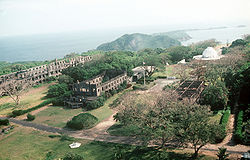 Corregidor
is an island fortress where Filipino and American forces fought against the Japanese invaders in 1942. It has become a tourist attraction with tunnels, cannons and other war structures still well-preserved. The famous line of General Douglas McArthur said is associated with Corregidor: “I shall return!”
There are first class hotels, inns and lodging houses to accommodate both foreign and local tourists. Conference facilities can be found in several convention centers, hotels and resorts in the province. Restaurants and specialty dining places offer mushroom dishes, native delicacies and exotic cuisines. Seafoods, fruits, coffee, organic vegetables, tinapa, handicrafts, ornamental plants also abound in the province.
There are twenty-two (22) accredited tourism establishments and three (3) accredited tour guides. There are also tour packages being arranged with the Department of Tourism. Centuries old traditions and the very rich culture of Cavite have been the source of great pride to Caviteños.
. Many companies, such as Intel (Intel closed its Cavite plant on 2008), have established manufacturing plants in numerous industrial parks in the province.
As of 2003, there are thirty-one (31) industrial estates in the province. A total of 973 investors have poured their investments in the 718 existing industrial establishments. Most of the investors have established partnership with their Filipino counterparts in varying levels of equity participation.
Since the 1990s when the provincial government launched the Second Revolution with industrialization as one of its priority thrusts, Cavite has become a preferred destination of both local and foreign investors. Rapid urbanization has transformed Cavite into an industrial and commercial area in CALABARZON
.
The municipality of Maragondon has the biggest area intended for agriculture, accounts for 14.57% of the total provincial agricultural lands while Cavite City has no longer available land for agriculture related activities and industries. If based on total agricultural lands, we may say that the major players in agriculture in the Province are Maragondon, Silang, Indang, Naic and Alfonso. Of the seven districts in the province, the top three with the widest agricultural area are District VII comprising 43,587.01 hectares or 61.85 percent of the total agricultural areas with 27,115 farmers followed by District VI with 17.40 percent or 12,257.71 hectares having 8,701 farmers and District V comprising 10,248.55 hectares with 10,295 farmers. The municipality of Silang has the most number of farmers. The municipality of Maragondon only ranks 3rd in terms of number of farmers. This can be attributed to highly mechanized operation and vast plantation of rice. The same is true with Gen. Trias and Naic, known as the rice producing municipalities in Cavite. The number of farmers increased by 6.5% that corresponds to around 3,097 farmers. The increase in the number of farmers was due to worldwide recession which led to work displacement of some Caviteños. Silang is dominated by pineapple and coffee plantations as well as with cutflower production.
Among the cities and municipalities, Rosario
has a record of the highest number of these industrial establishments (259), followed by the municipalities of Carmona
with 194 and Dasmariñas City with 123. As observed, more businessmen have been encouraged to establish business outsour ce manufacturi ng jobs in Cavi te knowing that the province offers lower cost of labor and shows higher manpower capability
The number of industrial establishments is stable at 798 in 2009. This is 0.87% l ower than that of
2008 (805). Despite the worldwide economic crisis, Cavite managed to maintain the number
of its industrial locators. Though in some industrial estates, there are companies who shut down their operations, still there are other s that opted to locate in the Province. Despite the
decr ease, the total number of industri al locator s remains higher than i ts value from the year
2002 to 2009. This only shows the confidence that the industri es have to the province of Cavite as one of the most sought location for industrial establishments.
Land use plan of the province defines the location of industrial zones for the strategic provision and optimization of support facilities needed by industries. Cavite has established
a total of 46 economic zones/industrial estates, 27 are operating, 7 are proclaimed and 12
are still in the process of development. In terms of number of economic zones, District V has
the majority of these with 16 industrial zones/estates followed by District VI with 15.
Cavite has twelve (1 2) economic zones with status of development in progress. These are economic zones that are still doing some land development and are not yet fully occupied by locators.
The largest economic zone under development is located in Gen. Trias, the PEC Industrial Park with 177 hectares intended for garments, textiles, semiconductors, food processing and
pharmaceuticals. The total area of economic zones which development is still in progress is 1,095.5 hectares. This would mean a lot of available resources to accommodate the incoming investments and industrial locators in Cavite.
There are three main highways transversing through the province: the Aguinaldo Highway
that runs in a general north-south direction; the Governor's Drive
the runs in a general east-west direction and the A. Soriano Highway
that runs within the coastal towns on the west.
The existing road length computed in terms of road density with respect to population at the standard of 2.4 kilometers per 1,000 population has a deficit of 3,532.71 kilometers.
Cavite's transport infrastructure has not kept in pace with the mushrooming of industrial and commercial activities resulting to quilts of urban sprawl, traffic congestion and increased road accidents. The section of Aguinaldo Highway
(at Bacoor, Imus and Dasmariñas) serving as a major link between the province and the national capital Manila is currently experiencing traffic volume 20% in excess of its designed capacity. Without any drastic improvements in the road network of Cavite, this same section will be saddled with traffic volumes 5 times more than its capacity in 2005 and 11 times more in 2015.
Current entrance and exit routes to and from Cavite are no longer sufficient to decongest traffic along major thoroughfares. The lack of transportation facilities, traffic control systems and insufficient road signages, substandard road structures, prioritization of intersecting streets/alleys against major roads, dangerous electric posts at outer lanes in some areas further aggravate to the worsening transportation situation. Likewise, observed mixed traffic (pedestrian, public transport modes – jeepneys, tricycles, cars) along streets/roads, especially in the business districts add up to the traffic problem.
The national and local government is taking the serious transportation problems lightly which results to stress and dismay of many Cavite residents. Everyday, hordes of employees eager to go for work trooped and lined up for hours along major roads in Bacoor and Imus municipalities. Public transports like buses, jeepneys, and AUs bound to and from the province are always jam-packed like sardine cans. It usually takes a staggering two (2) hours to travel from Imus to Baclaran/Pasay Rotonda (Metro Manila) and vice versa, which is only around 20 kilometers.
But, in 2011, the Cavite Express Way (Cavitex) was opened, which lessened the heavy volume of vehicles passing in Aguinaldo Highway in Bacoor. Residents living near the coasts of Cavite like Cavite City and Noveleta, can now swiftly travel from Metro Manila into their towns and vice versa, using Cavitex and not-needing to pass in the original heavy traffic route (which passes from Aguinaldo Highway and to Tirona Highway). This project lessened the traffic in Aguinaldo Highway in Bacoor, so travel time from Imus to Baclaran/Pasay now only takes one hour of travel.
Line 1 South Extension Project, through southern Metro Manila to the Province of Cavite has been identified as an integral link of the Rail Transit Network by Metro Manila Urban Transportation Integration Study (MMUTIS). It is one of the priority projects of the Department of Public Works and Highways (DPWH) and LRTA
. It is also a flagship project of the Office of the President.
The project aims to expand the existing LRT Line 1 service southward to the cities of Parañaque and Las Piñas and the adjoining municipalities of Bacoor, Imus
and the city of Dasmariñas
, in the Cavite Province. The 27-km route of the light railway system was planned to carry a capacity of 40,000 passengers per direction per hour. The extension will have 48 air-conditioned coaches, 12-four car trains, 10 passenger stations and a satellite depot in Cavite. The first phase of the project will serve approximately 1.9 million commuters based in Pasay, Paranaque, Las Pinas and Bacoor. The second phase of the project will include an 11-kilometer extension to commuters based in Imus and Dasmariñas.
Provinces of the Philippines
The Provinces of the Philippines are the primary political and administrative divisions of the Philippines. There are 80 provinces at present, further subdivided into component cities and municipalities. The National Capital Region, as well as independent cities, are autonomous from any provincial...
of the Philippines
Philippines
The Philippines , officially known as the Republic of the Philippines , is a country in Southeast Asia in the western Pacific Ocean. To its north across the Luzon Strait lies Taiwan. West across the South China Sea sits Vietnam...
located on the southern shores of Manila Bay
Manila Bay
Manila Bay is a natural harbor which serves the Port of Manila , in the Philippines.The bay is considered to be one of the best natural harbors in Southeast Asia and one of the finest in the world...
in the CALABARZON
CALABARZON
CALABARZON is one of the regions of the Philippines. It is also designated as Region IV-A and its regional center is Calamba City in Laguna...
region
Regions of the Philippines
In the Philippines, regions are administrative divisions that serve primarily to organize the provinces of the country for administrative convenience. Currently, the archipelagic republic of the Philippines is divided into 17 regions...
in Luzon
Luzon
Luzon is the largest island in the Philippines. It is located in the northernmost region of the archipelago, and is also the name for one of the three primary island groups in the country centered on the Island of Luzon...
, just 30 kilometers south of Manila
Manila
Manila is the capital of the Philippines. It is one of the sixteen cities forming Metro Manila.Manila is located on the eastern shores of Manila Bay and is bordered by Navotas and Caloocan to the north, Quezon City to the northeast, San Juan and Mandaluyong to the east, Makati on the southeast,...
. Cavite is surrounded by Laguna to the east, Metro Manila
Metro Manila
Metropolitan Manila , the National Capital Region , or simply Metro Manila, is the metropolitan region encompassing the City of Manila and its surrounding areas in the Philippines...
to the northeast, and Batangas
Batangas
Batangas is a first class province of the Philippines located on the southwestern part of Luzon in the CALABARZON region. Its capital is Batangas City and it is bordered by the provinces of Cavite and Laguna to the north and Quezon to the east. Across the Verde Island Passages to the south is the...
to the south. To the west lies the South China Sea
South China Sea
The South China Sea is a marginal sea that is part of the Pacific Ocean, encompassing an area from the Singapore and Malacca Straits to the Strait of Taiwan of around...
.
Etymology
The name "Cavite" comes the Hispanicized form of kawit or it is a corruption of kalawit, TagalogTagalog language
Tagalog is an Austronesian language spoken as a first language by a third of the population of the Philippines and as a second language by most of the rest. It is the first language of the Philippine region IV and of Metro Manila...
words for "hook," in reference to the small hook-shaped peninsula
Cavite City
The City of Cavite is a fourth class city in the province of Cavite, Philippines. The city occupies a hook shaped peninsula jutting out into Manila Bay. Cavite City used to be the capital of the province...
jutting into Manila Bay
Manila Bay
Manila Bay is a natural harbor which serves the Port of Manila , in the Philippines.The bay is considered to be one of the best natural harbors in Southeast Asia and one of the finest in the world...
. The name originally only applied to the peninsula (Cavite La Punta, now Cavite City
Cavite City
The City of Cavite is a fourth class city in the province of Cavite, Philippines. The city occupies a hook shaped peninsula jutting out into Manila Bay. Cavite City used to be the capital of the province...
) and the adjacent lowland coastal area (Cavite Viejo, now Kawit). Cavite City used to serve as the capital of the province until 1954, and as with many other provinces organized during the Spanish colonial era, the name of the capital was applied to the whole province.
Another theory proposes that the name is a Hispanicized form of kabit, Tagalog
Tagalog language
Tagalog is an Austronesian language spoken as a first language by a third of the population of the Philippines and as a second language by most of the rest. It is the first language of the Philippine region IV and of Metro Manila...
for "joined," "connected," or "attached," referring to the peninsula's topographical relation to the mainland.
Geography
Cavite is located within the Greater Manila AreaGreater Manila Area
Greater Manila generally refers to the contiguous urbanization surrounding Metro Manila. Greater Manila spills into the neighboring provinces of Laguna, Cavite, Rizal, Bulacan, Pampanga and Batangas. Greater Manila hugs Laguna de Bay, the largest lake in Luzon...
, not to be confused with adjacent Metro Manila
Metro Manila
Metropolitan Manila , the National Capital Region , or simply Metro Manila, is the metropolitan region encompassing the City of Manila and its surrounding areas in the Philippines...
, the defined capital district. The urban influence of the metropolis together with easy accessibility, adequate infrastructure and comparatively fresh natural setting makes the picturesque province an ideal refuge.
Land area
Cavite occupies land area of 1427.06 square kilometres (551 sq mi) which is approximately 8.72 percent of CALABARZONCALABARZON
CALABARZON is one of the regions of the Philippines. It is also designated as Region IV-A and its regional center is Calamba City in Laguna...
’s total land area, 2.74 percent of the regional area and 0.48 per cent of the total land area of the Philippines. The municipalities of Maragondon and Silang
Silang
Silang may refer to:*Diego Silang*Gabriela Silang*Silang, Cavite...
have the biggest land areas comprising 165.49 square kilometres (63.9 sq mi) and 156.41 square kilometres (60.4 sq mi) respectively, while the municipality of Noveleta has the smallest land area as indicated by 5.41 square kilometres (2.1 sq mi) or 0.38 percent of the provincial total and area.
Islands of Cavite
- Balot Island, located at the mouth of Ternate River
- Caballo IslandCaballo IslandCaballo Island is a bluff, rocky island located at the entrance to Manila Bay in the Philippines. It is about 3/4 mile long with the highest elevation at 381 feet high...
- CorregidorCorregidorCorregidor Island, locally called Isla ng Corregidor, is a lofty island located at the entrance of Manila Bay in southwestern part of Luzon Island in the Philippines. Due to this location, Corregidor was fortified with several coastal artillery and ammunition magazines to defend the entrance of...
- El Fraile Island
- Carabao IslandFort FrankFort Frank was one of the defense forts at the entrance to Manila Bay established by the United States. The entire island was designated as Fort Frank, in honor of Brigadier General Royal T...
- La Monja Island, located west of Corregidor
- Limbones Island, located off Ternate near Batangas border
- Pulo ni Burunggoy (now Island Cove Resort) located in Bacoor BayBacoor BayBacoor Bay is a large inlet of southeastern Manila Bay in the Philippines. It lies along the shoreline of Cavite south of the Cavite Peninsula. It serves as the inner anchorage of Cavite Naval Base. The municipality of Bacoor is on its shore, southeast of the City of Cavite.-References:*Webster's...
- Santa Amalia Island, located NW of Corregidor
Topography and slope
Situated at the entrance of Manila Bay, Cavite is characterized by rolling hinterlands punctuated by hills; shoreland fronting Manila Bay at sea level; and rugged portion at the boundary of Batangas where Dos Picos mountains are located. The province has two principal rivers and two mountains.Cavite is divided into four physiographical areas, namely: the lowest lowland area, lowland area, the central hilly area and the upland mountainous area.
- The lowest lowland area is the coastal plain in particular. These areas have extremely low ground level of EL. 0m to EL. 2m compared to the high tide level of about EL. 0.8m from the Mean Sea Level (MSL). These are the city of Cavite CityCavite CityThe City of Cavite is a fourth class city in the province of Cavite, Philippines. The city occupies a hook shaped peninsula jutting out into Manila Bay. Cavite City used to be the capital of the province...
and the municipalities of Bacoor, KawitKawitKawit can mean the following things:* Kawit, a municipality in the Philippines* Kawit, a queen of Egypt's 11th dynasty...
, Noveleta, RosarioRosarioRosario is the largest city in the province of Santa Fe, Argentina. It is located northwest of Buenos Aires, on the western shore of the Paraná River and has 1,159,004 residents as of the ....
, northern part of CarmonaCarmonaCarmona may be:Places* Carmona, a town in Seville, Spain.* Carmona, Cavite, a municipality in the Philippines* Carmona, Goa* Carmona, Costa Rica, a city in Guanacaste province.* The former name of the Angolan town of Uíge.People...
and eastern part of TernateTernateTernate is an island in the Maluku Islands of eastern Indonesia. It is located off the west coast of the larger island of Halmahera, the center of the powerful former Sultanate of Ternate....
.
- The lowland area consists of the coastal and alluvial plains. These areas have flat ground slope of less than 0.5% and low ground elevation of EL. 2m to EL. 30m. The alluvial plain can be found in the municipality of ImusImus-Places:* Imus, Cavite, a Philippine municipality*Imus Ranch, an American cattle ranch and children's charity-People:* Don Imus, an American television and radio host* Fred Imus, an American radio host and the younger brother of radio talk show host Don Imus...
and southern part of General Trias. Into these municipalities forms the transition area between the coastal plain and the central hilly area. It also covers some areas of Bacoor, KawitKawitKawit can mean the following things:* Kawit, a municipality in the Philippines* Kawit, a queen of Egypt's 11th dynasty...
, Noveleta, RosarioRosarioRosario is the largest city in the province of Santa Fe, Argentina. It is located northwest of Buenos Aires, on the western shore of the Paraná River and has 1,159,004 residents as of the ....
, TanzaTANZATANZA was a pioneering New Zealand record label, from 1949 to 1956. TANZA stands for To Assist New Zealand Artists, and was the first company to record and produce records in New Zealand...
and CarmonaCarmonaCarmona may be:Places* Carmona, a town in Seville, Spain.* Carmona, Cavite, a municipality in the Philippines* Carmona, Goa* Carmona, Costa Rica, a city in Guanacaste province.* The former name of the Angolan town of Uíge.People...
.
- The third topography type is the central hilly area, generally found on the mountain foot slope. It forms the rolling tuffaceous plateau. This topography includes steep hills, ridges and elevated inland valley. The plateau is characterized with ground elevation ranging from 30m to nearly 400m. Its ground slope ranges from 0.5 to 2%. The city of Trece MartiresTrece MártiresTrece Mártires may refer to:*the Thirteen Martyrs of Cavite, Philippine nationalists executed by the Spanish; or*the city of Trece Martires, named after them....
and DasmariñasDasmariñasDasmariñas may refer to:* Dasmariñas City, a city in the province of Cavite, Philippines* Dasmariñas Resettlement Area, a resettlement area located in Dasmariñas City* Dasmariñas Village in Makati City, Philippines...
and the municipalities of General Emilio Aguinaldo, General Mariano Alvarez, Indang, Maragondon, TernateTernateTernate is an island in the Maluku Islands of eastern Indonesia. It is located off the west coast of the larger island of Halmahera, the center of the powerful former Sultanate of Ternate....
, SilangSilangSilang may refer to:*Diego Silang*Gabriela Silang*Silang, Cavite...
and CarmonaCarmonaCarmona may be:Places* Carmona, a town in Seville, Spain.* Carmona, Cavite, a municipality in the Philippines* Carmona, Goa* Carmona, Costa Rica, a city in Guanacaste province.* The former name of the Angolan town of Uíge.People...
have this kind of topography.
- The last topography type is upland mountainous area, found in MagallanesMagallanes-Chile:* Magallanes y la Antártica Chilena Region** Magallanes Province, within this region** Punta Arenas or Magallanes, the main city in the region and province-Philippines:* Magallanes, Agusan del Norte* Magallanes, Cavite* Magallanes, Sorsogon...
, Amadeo, Tagaytay CityTagaytay CityThe City of Tagaytay is a second class city in the province of Cavite, Philippines. Only away from Manila via Aguinaldo Highway, it is one of the country's most popular tourist destinations. Tagaytay City provides a good view of the Taal Volcano...
, MendezMendezMéndez or Mendes is a common surname, originally a patronymic, meaning Son of Mendo or Son of Mem.It may refer to:-General:*Abraham Pereira Mendes , English rabbi and educator...
, AlfonsoAlfonsoAlfonso , Alfons , Afonso , Affonso , Alphonse, Alfonse , Αλφόνσος , Alphonsus , Alphons , Alfonsu in ,...
, southern part of Maragondon and CarmonaCarmonaCarmona may be:Places* Carmona, a town in Seville, Spain.* Carmona, Cavite, a municipality in the Philippines* Carmona, Goa* Carmona, Costa Rica, a city in Guanacaste province.* The former name of the Angolan town of Uíge.People...
. They are situated at a very high elevation above EL. 400m with slopes of more than 2%. The Tagaytay ridge has a peak elevation of 650m.
Land resources and distribution
Cavite’s land resources are categorized into two: forest lands and alienable and disposable lands. Forest lands are being maintained as they play a great role for the ecological balance of the Province aside from the fact that they are home to numerous flora and fauna that needs to be protected and preserved. Correspondingly, the alienable and disposable lands are the built-up areas as well as production areas. These lands are intended for urban, economic and demographic developments.Forest Lands
Cavite Province lies in the western monsoon forest zone. This location is very beneficial for the formation of tropical rainforests which are characteristically made through natural vegetation. In 2007, the existing for estarea within the province totalled to 8,624.956 hectares. These forest areas were categorized as Protected Landscape under R.A.7586 otherwise known as National Integrated Protected Area System (NIPAS) and the unclassified forest (Non-N I P A S ) . By virtue of Proclamation Number 1594 on 26 October 1976, a total of 4,000 hectares located in Ternate and Maragondon, Cavite was proclaimed as national park, now known as the Mts. Palay-Palay and Mataas na Gulod Protected Landscape. The park lies in the border of Cavite and Batangas and has three peaks, Palay-Palay, Pico de Loro and Mataas na Gulod. Still, there were five (5) unclassified forests found along Tagaytay Ridge, Maragondon, Magallanes, Ternate and Alfonso . With regards to the records of mountains, seven were named such as Pico de Loro, Mt. Palay-Palay, Mt. Buntis, Mt. Mataas na Gulod, Mt. Nagpatong, Mt. Hulog and Mt. Gonzales.
The richness of Cavite’s forest provides the abundance of different forest products. Grass in nature, bamboo, is one of the most available forest products being found in the municipalities of Ternate, Magallanes , Maragondon and General Aguinaldo throughout the year.
Alienable and Disposable Lands
These lands are being used in various ways, either for agriculture , residences, open areas, etc. These actual uses are termed as land-u s e .
Based on the Cavite Provincial Physical Framework Plan 2005-2010, Cavite’s alienable and disposable lands are further classified into production lands and built-up areas. Production lands in Cavite are intended for agriculture, fishery and mining. On the other hand, built-up areas are mainly for residential areas, commercial , industrial and tourism areas.
Production Land-Use
Majority of production land-use is into agriculture. Considering that 50.33% of the total provincial land area is engaged into agriculture, it can be generalized that in spite of rapid urbanization in the province, Cavite remains to have an agricultural economy that makes food security attainable. Some of the major crops being produced in the province are rice, corn, coffee, coconuts, cutflowers and vegetables.
Included in the agricultural land use are livestock farms that range from piggeries, poultries, goat farms and cattle farms. The climatic suitability of Cavite makes the province ideal for integrated farming, having crops and livestock rising in one farm.
Fishery is also another major component of the agricultural sector. Having rich marine resources and long coastlines, the province is home to numerous fishery activities . This industry has provided livelihood to many Caviteños. In some lowland and even upland areas, fishery, in the form of fish ponds are also producing considerable amount of fish products. Some areas in Cavite are also engaged in fish processing and production of fish products like fish sauce.
Mining is the third component of production land-use in the province. As of 2009, there are 15 mining and quarrying areas operating in Cavite. Extraction includes filling materials, gravel and sand.
Built-up Areas
The built-up areas are mainly composed of residential and industrial sites. This also includes commercial and business areas where commerce is transpiring. According to the 2007 Census of Population and Housing by the National Statistics Office, there are 611,450 occupied housing units in Cavite.
Moreover, according to the Housing and Land-Use Regulatory Board, there are around 1,224 housing subdivisions with issued license to sell in the province until 2009 which occupies an area of 9,471 hectares.
Meanwhile, the industrial sector also develops rapidly in the Province. For 2009, operational industrial estates cover around 2,939 hectares. Tourism establishments are also considered built-up areas such as golf courses, leisure farms, resorts and the likes.
Water resources
Six major rivers are identified in Cavite. Numerous springs, waterfalls and rivers found in the upland areas of the province are observed to be useful for domestic, tourism, and industrial users. The province is also endowed with waterfalls.The hydrological network of the province is composed of main rivers and tributaries. These rivers and tributaries generally have a flowing direction from the highlands of Tagaytay City going to Manila Bay with stretches from the Municipality of Bacoor up to Ternate.
In the lowland areas covering the towns of Bacoor, Imus, General Trias, Dasmariñas, Naic, Tanza, Ternate, hundreds of artesian wells and deepwells provide water supply for both domestic and irrigation purposes.
Cavite boasts a stretch of about 123 kilometers of shoreline. These can be found along Cavite City, Bacoor, Kawit, Noveleta, Rosario, Tanza, Naic, Maragondon, and Ternate. The richness of Cavite’s coastal resources paved the way for our recognition as major producer of oysters and mussels. The fisherfolks are also active producers of sugpo/bangus. On the western coastlines lie the breathtaking beaches with pale gray sand. Thus, basically, coastal resource of the province contributes to the economic activities related to fishery and tourism.
- Major Rivers
These rivers are known to have various tributaries passing through the municipalities of the province.
- Maragondon River
- Labac River
- Cañas River
- San Juan River
- Bacoor River
- Imus River
- Springs
- Balite Spring (Amadeo)
- Saluysoy Spring (Alfonso)
- Matang Tubig Spring (Tagaytay City)
- Malakas Spring ( General Aguinaldo)
- Ulo Spring (Mendez)
- Waterfalls
- Palsajingin Falls (Indang)
- Balite Falls (Amadeo)
- Malibiclibic Falls (Gen. Aguinaldo)
- Talon-Butas Falls (Gen. Aguinaldo)
- Saluysoy Falls (Alfonso)
- Tala River (Gen. Aguinaldo)
Soil properties
Cavite is composed of several soil types according to soil surveys conducted by the Bureau of Soils and Water Management (BSWM). Classification of soil types in a specific area is a very important consideration in identifying its most fitted land-use. This way, utmost productivity can be achieved.The lowland area of Cavite is generally composed of Guadalupe clay and clay loam. It is characterized as coarse and granular when dry but sticky and plastic when wet. Its substratum is solid volcanic tuff. These types of soils are suited to lowland rice and corn while those in the upland are suited for orchard and pasture. Guadalupe clay adobes are abundant in the southern part of Bacoor and Imus
Imus
-Places:* Imus, Cavite, a Philippine municipality*Imus Ranch, an American cattle ranch and children's charity-People:* Don Imus, an American television and radio host* Fred Imus, an American radio host and the younger brother of radio talk show host Don Imus...
bordering Dasmariñas
Dasmariñas
Dasmariñas may refer to:* Dasmariñas City, a city in the province of Cavite, Philippines* Dasmariñas Resettlement Area, a resettlement area located in Dasmariñas City* Dasmariñas Village in Makati City, Philippines...
. The soil is hard and compact and difficult to cultivate that makes it generally unsuitable for diverse cropping. It is very sticky when wet and granular when dry. Forage grass is advised for this type of soil. Hydrosol and Obando sand are found along Bacoor Bay. The shoreline of Rosario
Rosario
Rosario is the largest city in the province of Santa Fe, Argentina. It is located northwest of Buenos Aires, on the western shore of the Paraná River and has 1,159,004 residents as of the ....
, Tanza
TANZA
TANZA was a pioneering New Zealand record label, from 1949 to 1956. TANZA stands for To Assist New Zealand Artists, and was the first company to record and produce records in New Zealand...
, Naic
NAIC
NAIC is an initialism for* The National Association of Investors Corporation* The National Astronomy and Ionosphere Center* The North American Industry Classification System* The National Association of Insurance Commissioners...
and Ternate
Ternate
Ternate is an island in the Maluku Islands of eastern Indonesia. It is located off the west coast of the larger island of Halmahera, the center of the powerful former Sultanate of Ternate....
are lined with Guadalupe sand.
The central area principally consists of Magallanes loam with streaks of Magallanes clay loam of sandy texture. This is recommended for diversified farming such as the cultivation of upland rice, corn, sugarcane, vegetables, coconut, coffee, mangoes and other fruit trees. The steep phase should be forested or planted to rootcrops. The eastern side o f Cavite is consists of Carmona clay loam with streaks of Carmona clay loam steep phase and Carmona sandy clay loam. This type of soil is granular with tuffaceaous material and concretions. It is hard and compact when dry, sticky and plastic when wet. This type of soil is planted to rice with irrigation or sugarcane without irrigation. Fruit trees such as mango, avocado and citrus are also grown in this type of soil. Guingua fine sandy loam is found along the lower part of Malabon and Alang-ilang River at Noveleta.
The type of soils that dominate the upland areas are Tagaytay loam and Tagaytay sandy loam with mountain soil undifferentiated found on the south-eastern side bordering Laguna province. Also on the southern tip are Magallanes clay and Mountain soil undifferentiated with interlacing of Magallanes clay loam steep phase. The Tagaytay loam contains fine sandy materials, moderately friable, and easy to work on when moist. In an undisturbed condition, it bakes and becomes hard when dry. About one-half of this soil type is devoted to upland rice and upland crops. On the other hand, Tagaytay sandy loam is friable and granular with considerable amount of volcanic sand and underlain by adobe clay. Mountain soil undifferentiated is forested with bamboos found in the sea coast. Cavite also has the Patungan sand characterized by pale gray to almost white sand with substratum of marine conglomerates which are found at Sta. Mercedes in Maragondon and in some coastlines of Ternate.
Mineral resources and reserves
The greater parts of Cavite are composed of volcanic materials, tuff, cinders, basalt, breccias, agglomerate and interbeddings of shales, and sandstones. The dormant and active volcanoes (Taal) are within these volcanic areas and have been the sources of volcanic materials which form the Tagaytay Cuesta. The drainage systems are deeply entrenched in the tuffs, eroding thin interbedded sandstones and conglomerate rocks which are the sources of little reserves of sand and gravel in the larger stream. Adobe stone quarries also flourish in the tuff areas.Cavite coastal areas have marl and conglomerate sedimentary rocks and some igneous rocks which are prominent in the high, mountainous regions of western part of the province. Black sands are found in Kawit
Kawit
Kawit can mean the following things:* Kawit, a municipality in the Philippines* Kawit, a queen of Egypt's 11th dynasty...
while Noveleta has its own salt products. Magallanes
Magallanes
-Chile:* Magallanes y la Antártica Chilena Region** Magallanes Province, within this region** Punta Arenas or Magallanes, the main city in the region and province-Philippines:* Magallanes, Agusan del Norte* Magallanes, Cavite* Magallanes, Sorsogon...
has gravel deposits while reserves of sand and gravel materials are found in Alfonso
Alfonso
Alfonso , Alfons , Afonso , Affonso , Alphonse, Alfonse , Αλφόνσος , Alphonsus , Alphons , Alfonsu in ,...
, Carmona
Carmona
Carmona may be:Places* Carmona, a town in Seville, Spain.* Carmona, Cavite, a municipality in the Philippines* Carmona, Goa* Carmona, Costa Rica, a city in Guanacaste province.* The former name of the Angolan town of Uíge.People...
, Gen. Emilio Aguinaldo, Naic
NAIC
NAIC is an initialism for* The National Association of Investors Corporation* The National Astronomy and Ionosphere Center* The North American Industry Classification System* The National Association of Insurance Commissioners...
, Ternate
Ternate
Ternate is an island in the Maluku Islands of eastern Indonesia. It is located off the west coast of the larger island of Halmahera, the center of the powerful former Sultanate of Ternate....
, Maragondon and Silang
Silang
Silang may refer to:*Diego Silang*Gabriela Silang*Silang, Cavite...
.
Climate
Cavite belongs to Type 1 climate based on the Climate Map of the Philippines by thePhilippine Atmospheric, Geophysical and Astronomical Services Administration
Philippine Atmospheric, Geophysical and Astronomical Services Administration
The Philippine Atmospheric, Geophysical and Astronomical Services Administration is a Philippine national institution dedicated to provide flood and typhoon warnings, public weather forecasts and advisories, meteorological, astronomical, climatological, and other specialized information and...
(PAGASA). Being a Type 1, Cavite has two pronounced seasons – the dry season, which usually begins in November and ends in April, and the rainy season, which starts in May and ends in October. Cavite’s cool periods are from December to February while summer months are from April to May.
Political subdivisions
Cavite is subdivided into 19 municipalities and 4 cities
Cities of the Philippines
A city is a tier of local government in the Philippines. All Philippine cities are chartered cities, whose existence as corporate and administrative entities is governed by their own specific charters in addition to the Local Government Code of 1991, which specifies the administrative structure...
:
| City Cities of the Philippines A city is a tier of local government in the Philippines. All Philippine cities are chartered cities, whose existence as corporate and administrative entities is governed by their own specific charters in addition to the Local Government Code of 1991, which specifies the administrative structure... |
Nickname(s) Nickname A nickname is "a usually familiar or humorous but sometimes pointed or cruel name given to a person or place, as a supposedly appropriate replacement for or addition to the proper name.", or a name similar in origin and pronunciation from the original name.... |
District | No. of Barangays |
Population (2007) |
Area (km²) |
Pop. density (per km²) |
City Mayor |
|---|---|---|---|---|---|---|---|
| Dasmariñas City | -> University City of Cavite -> Industrial Giant of the CALABARZON -> Melting Pot of Cavite |
||||||
| Trece Martires City Trece Martires City The City of Trece Martires is a third-class city in the province of Cavite, Philippines. The city serves as the seat of government of the Cavite, where many of the provincial government offices are located... |
-> The Seat of Provincial Government | ||||||
| Cavite City | -> The Historic and Cultural City of 3 Bays -> International Transport Hub of the Future |
||||||
| Tagaytay City | -> The Country’s 2nd Summer Capital | ||||||
| Municipality Municipalities of the Philippines A municipality is a local government unit in the Philippines. Municipalities are also called towns . They are distinct from cities, which are a different category of local government unit... |
Nickname(s) Nickname A nickname is "a usually familiar or humorous but sometimes pointed or cruel name given to a person or place, as a supposedly appropriate replacement for or addition to the proper name.", or a name similar in origin and pronunciation from the original name.... |
District | No. of Barangays |
Population (2007) |
Area (km²) |
Pop. density (per km²) |
Municipal Mayor |
| Bacoor Bacoor, Cavite The Municipality of Bacoor is a first class urban municipality in the province of Cavite, Philippines. It is a lone district congressional district of Cavite... |
-> Cavite's Gateway To The Metropolis | ||||||
| Imus Imus, Cavite The Municipality of Imus is a first-class municipality in the province of Cavite, Philippines, and it is the officially designated capital of Cavite... |
-> Flag and Christmas Capital of the Philippines -> A Bustling Commercial Center |
||||||
| Silang Silang, Cavite The Municipality of Silang is a first class landlocked municipality in the province of Cavite, Philippines. According to the 2009 census, it has a population of 234,285 people in an area of . Silang is located in the eastern section of Cavite... |
-> Food Bastion of Metro Manila | ||||||
| General Trias | -> A New Frontier for Development in the CALABARZON | ||||||
| Tanza Tanza, Cavite Municipality of Tanza is a 1st class municipality in the province of Cavite, Philippines... |
-> A Prime Tourist Destination | ||||||
| General Mariano Alvarez | -> Mushroom Capital of Cavite -> A Highly Urbanized Commercial-Residential Center |
||||||
| Rosario Rosario, Cavite The Municipality of Rosario is a first class urban municipality in the province of Cavite, Philippines. According to the 2007 census, it has a population of 94,228 people in an area of 38.16 square kilometers, making it the second most densely populated city/municipality in Cavite after General... |
-> An agricultural-commercial-industrial Center | ||||||
| Naic | -> Industrial Terminal & Amusement Center of the Future | ||||||
| Kawit | -> The Birthplace of Philippine Independence | ||||||
| Carmona Carmona, Cavite The Municipality of Carmona is a first class urban municipality in the province of Cavite, Philippines. According to the 2007 census, it has a population of 68,135 people in a land area of 30.92 square kilometres.... |
-> Center for Investment & Sports of Cavite -> Industrial Corridor of Cavite |
||||||
| Indang Indang, Cavite Indang is a 1st class municipality in the province of Cavite, Philippines.Although Indang is a small municipality, it is starting to be developed. Now, fast-food restaurants such as Jollibee, have been opened up .Indang has a public market, or palengke, where goods such as vegetables, seafood,... |
-> Upland Market Center | ||||||
| Alfonso | -> Agro-Industrial Center of the Upland Cavite | ||||||
| Noveleta Noveleta, Cavite The Municipality of Noveleta is an urban municipality in the province of Cavite, Philippines. According to the 2007 census, it has a population of 46,336 people. The current mayor is Engr... |
-> Cradle of Bravior On Rapid Urbanization | ||||||
| Amadeo Amadeo, Cavite The Municipality of Amadeo is a fourth class municipality in the province of Cavite, Philippines. It is nicknamed the "Coffee Capital of the Philippines". According to the 2008 census, it has a population of 43,722 people.Amadeo is best known for their Pahimis Festival, which showcases the town's... |
-> Coffee Capital of the Philippines | ||||||
| Maragondon Maragondon, Cavite The Municipality of Maragondon is a 3rd class municipality in the province of Cavite, Philippines. Maragondon is 54 kilometers away from Manila going southeast. According to the 2007 census, it has a population of 33,604 people... |
-> Historic Town & a Wildlife Sanctuary | ||||||
| Mendez Mendez, Cavite Mendez is a 4th class urban municipality in the province of Cavite, Philippines. According to the 2007 census, it has a population of 26,757 people in an area of 43.27 square kilometers.-History:... |
-> Economic Development on the Rise | ||||||
| Ternate | -> A Major Tourism Growth Center | ||||||
| Magallanes Magallanes, Cavite Magallanes is a 4th class municipality in the province of Cavite, Philippines. According to the 2007 census, it has a population of 18,890 people. The town is named after Ferdinand Magellan.-History:... |
-> An Eco-Tourism Center | ||||||
| General Emilio Aguinaldo | -> A Center for Agro Modernization |
History
Cavite is named as the Historical Capital of the Philippines. It is the cradle of Philippine RevolutionPhilippine Revolution
The Philippine Revolution , called the "Tagalog War" by the Spanish, was an armed military conflict between the people of the Philippines and the Spanish colonial authorities which resulted in the secession of the Philippine Islands from the Spanish Empire.The Philippine Revolution began in August...
, and the birthplace of Philippine Independence.
Cavite got its name from a Tagalog word kawit (which means hook) owing to the hook-shaped land on the Old Spanish map. The land was formerly known as "Tangway" where Spanish authorities constructed a fort from which the city of Cavite
Cavite City
The City of Cavite is a fourth class city in the province of Cavite, Philippines. The city occupies a hook shaped peninsula jutting out into Manila Bay. Cavite City used to be the capital of the province...
rose. Archeological evidence in coastal areas show prehistorical settlements. According to local folklore, the earliest settlers of Cavite came from Sulu or Borneo. In the 17th century, encomiendas or Spanish Royal land grants were given in Cavite and Maragondon. Jesuit priests brought in settlers from Mollucas. These settlers, known as "Mardicas," set
Other settlements grew and by the turn of the century, Cavite towns were already trading with one another. Traditional industries began to thrive as Manila's commerce grew. In 1872, Filipinos launched their revolt against Spain. Three Filipino priests—Jose Burgos, Mariano Gomez and Jacinto Zamora
Gomburza
Gomburza or GOMBURZA is an acronym denoting the surnames of the priests Mariano Gómez, José Apolonio Burgos, and Jacinto Zamora, three Filipino priests who were executed on 17 February 1872 at Bagumbayan in Manila, Philippines by Spanish colonial authorities on charges of subversion arising from...
—were implicated in the Cavite mutiny when 200 Filipinos staged a rebellion within Spanish garrisons. On August 28, 1896, when the revolution against Spain
Spain
Spain , officially the Kingdom of Spain languages]] under the European Charter for Regional or Minority Languages. In each of these, Spain's official name is as follows:;;;;;;), is a country and member state of the European Union located in southwestern Europe on the Iberian Peninsula...
broke out, Cavite became a bloody theater of war. Led by Emilio Aguinaldo, Caviteños made lightning raids on Spanish headquarters, and soon liberated the entire province. Aguinaldo commanded the Revolution to its successful end: the proclamation of the Republic of the Philippines, on June 12, 1898 in Kawit, the first constitutional republic in Asia, and third established overall, after the Lanfang Republic
Lanfang Republic
The Lanfang Republic was a Chinese state in West Kalimantan in Indonesia that was established by a Hakka Chinese named Low Lan Pak in 1777, until it was ended by Dutch occupation in 1884 .The sultans of...
in 1777, and the Republic of Formosa
Republic of Formosa
The Republic of Formosa was a short-lived republic that existed on the island of Taiwan in 1895 between the formal cession of Taiwan by the Qing Dynasty of China to the Empire of Japan by the Treaty of Shimonoseki and its invasion and occupation by Japanese troops...
in 1895.
Cavite proudly stands as a place with a glorious past. Its warm and friendly people, whose ancestors came down with a noble cause, manifest industry and patience in various skills and professions, openly receptive to the entry and exchange of culture and technology that are of value to the province.
In 1942, the Japanese Imperial forces
Imperial Japanese Army
-Foundation:During the Meiji Restoration, the military forces loyal to the Emperor were samurai drawn primarily from the loyalist feudal domains of Satsuma and Chōshū...
entered Cavite, which was long the site of a major US naval base serving the United States Asiatic Fleet
United States Asiatic Fleet
The United States Asiatic Fleet was part of the U.S. Navy. Preceding the World War II era, until 1942, the fleet protected the Philippines.Originally the Asiatic Squadron, it was upgraded to fleet status in 1902. In 1907, the fleet became the First Squadron of the Pacific Fleet. However, on 28...
.
In 1942 to 1945, Filipino soldiers of the 4th, 41st, 42nd, 43rd, 45th and 46th Infantry Division of the Philippine Commonwealth Army was entering the provinces in Cavite with the recognized guerrillas of the Cavite Guerrilla Forces and the Filipino-American Cavite Guerrilla Forces or FACGF under by Colonel Mariano Castañeda of the Philippine Constabulary
Philippine Constabulary
The Philippine Constabulary ' was the oldest of four service commands of the Armed Forces of the Philippines. It was a gendarmerie type para-military police force of the Philippines established in 1901 by the United States-appointed administrative authority replacing the Guardia Civil...
from the attack the Japanese troops since the battle for the Filipino recaptures in Cavite. After the conflict insurgencies in Cavite on 1944, local Filipino troops of the Philippine Commonwealth Army units and Caviteňo resistance was over to retreating by the Japanese forces. Before the liberation in Cavite on 1945 by joint U.S. and Filipino soldiers and aiding the Caviteño resistance groups was liberated the clearing province and defeats Japanese.
In January to August 1945, combined Filipino & American troops along with the Caviteño guerrilla fighters liberated in Cavite from the Japanese forces begins the Battle for the Liberation of Cavite at the end of World War II
World War II
World War II, or the Second World War , was a global conflict lasting from 1939 to 1945, involving most of the world's nations—including all of the great powers—eventually forming two opposing military alliances: the Allies and the Axis...
.
Governors
- Mariano Trias (July 15, 1898 to August 10, 1898)
- Emiliano Riego De Dios (August 10, 1898 to October 7, 1898)
- Ladislao Diwa (October 7, 1898 - 1901)
- Mariano Trias (1901 - 1905)
- Louis J. Van Schaick (1905 - 1907)
- Leonardo R. Osorio (1908 - 1909)
- Tomas Mascardo (1910 - 1912)
- Antero S. Soriano (1912 - 1919)
- Luis O. Ferrer Sr. (1919 - 1921)
- Raymundo C. Jeciel (1922 - 1925)
- Fabian Pugeda (1925 - 1931)
- Pedro F. Espiritu (1931 - 1934)
- Ramon Samonte (1935 - 1940)
- Emilio F. Virata - Acting Governor
- Luis Y. Ferrer Jr. (1940 - 1944)
- Mariano N. Castañeda (1944)
- Dominador M. Camerino (1944 - 1945)
- Mariano N. Castañeda - Acting Governor
- Rafael F. Trias (1945)
- Francisco T. Arca (1945)
- Dominador M. Camerino (1946 - 1954)
- Mariano B. Villanueva - Acting Governor
- Horacio Rodriguez - Acting Governor
- Dominador Mangubat - Acting Governor
- Delfin N. Montano (1956 - 1971)
- Lino D. Bocalan (1972)
- Dominador M. Camerino - Acting Governor
- Juanito R. Remulla (Declared, September 24, 1979)
- Juanito R. Remulla (January 30, 1980 to February 19, 1986)
- Fernando C. Campos (1986 - 1987)
- Juanito R. Remulla (1987 - 1992)
- Juanito R. Remulla (1992 - 1995)
- Epimaco A. Velasco (1995 to January 1998)
- Ramon "Bong" Revilla Jr. (Declared February 1998 to August 30, 1998)
- Ramon "Bong" Revilla Jr. (1998 - 2001)
- Ereneo "Ayong" S. Maliksi (2001 - 2010)
- Juanito Victor C. Remulla Jr. (May 2010 - Present)
Culture and Traditions
Caviteños are very proud of their majestic and interesting cuture and traditions. Aside from the celebrations of town fiestas, the province of Cavite celebrates festivals as forms of thanksgiving for a bountiful harvest and in honor of its patron saints. Some of these festivals are also observed in honor of the historical legacies passed from one generation to another generation. In fact, the province fetes the renowned Kalayaan Festival which is given a great social importance in commemoration of the heroism of its people.Population
Cavite has a total population of 2,856,765 recorded in the 2007 Census, within an area of 1,512.4 km² making it the most populous (if independent cities are excluded from CebuCebu
Cebu is a province in the Philippines, consisting of Cebu Island and 167 surrounding islands. It is located to the east of Negros, to the west of Leyte and Bohol islands...
and Negros Occidental
Negros Occidental
Negros Occidental is a province of the Philippines located in the Western Visayas region. Its capital is Bacolod City and it occupies the northwestern half of Negros Island; Negros Oriental is at the southeastern half...
), and the second most densely-populated province in the country. The tremendous increase can be observed in the year 1990 when industrialization was introduced in the province. Investors established their businesses in different industrial estates that magnetized people to migrate to Cavite due to job opportunities the province offers. Another factor attributed to the increase of population is the mushrooming of housing subdivisions. Since Cavite is proximate to Metro Manila
Metro Manila
Metropolitan Manila , the National Capital Region , or simply Metro Manila, is the metropolitan region encompassing the City of Manila and its surrounding areas in the Philippines...
, people working in the metropolitan area choose to live in the province together with their families. Natural increase also contributes to the increase in population. As of January 2011, Cavite is estimated by the Provincial Population Office to have 3.3 million people, giving a density of 2,182 people per square km.
Among the cities and municipalities in Cavite, the city of Dasmariñas
Dasmariñas
Dasmariñas may refer to:* Dasmariñas City, a city in the province of Cavite, Philippines* Dasmariñas Resettlement Area, a resettlement area located in Dasmariñas City* Dasmariñas Village in Makati City, Philippines...
has the biggest population with 556,330 people while the municipality of Gen. Emilio Aguinaldo has registered the smallest population with 17,818 people.
Cavite is a highly urbanized growth center of the country. It is classified as predominantly urban having 90.69 percent of the population are concentrated in the urban areas, while 9.21 percent of the population reside in rural areas.
Since year 2000, urban population increased which can be attributed to in-migration due to expansion of residential areas as well as influx of commercial establishments, services and facilities.
Languages
The main languages spoken are TagalogTagalog language
Tagalog is an Austronesian language spoken as a first language by a third of the population of the Philippines and as a second language by most of the rest. It is the first language of the Philippine region IV and of Metro Manila...
, Chabacano and English
English language
English is a West Germanic language that arose in the Anglo-Saxon kingdoms of England and spread into what was to become south-east Scotland under the influence of the Anglian medieval kingdom of Northumbria...
. Chabacano, sometimes spelled as Chavacano, is a creole originally spoken by majority of the Caviteños that lived in Cavite City and Ternate after the arrival of the Spaniards three centuries ago. Around 30000 Caviteños speak Chabacano.
Due to Cavite's proximity to Metro Manila
Metro Manila
Metropolitan Manila , the National Capital Region , or simply Metro Manila, is the metropolitan region encompassing the City of Manila and its surrounding areas in the Philippines...
a large number of people have moved from farther provinces, resulting in a significant usage of Bikol
Bikol language
Central Bicolano , is one of the individual languages of the Bikol languages. It belongs to Coastal Bikol. It is spoken in Bicol Region of the Philippines .-Bikol-Naga:...
, Cebuano
Cebuano language
Cebuano, referred to by most of its speakers as Bisaya , is an Austronesian language spoken in the Philippines by about 20 million people mostly in the Central Visayas. It is the most widely spoken of the languages within the so-named Bisayan subgroup and is closely related to other Filipino...
and Ilokano
Ilokano language
Ilokano or Ilocano is the third most-spoken language of the Republic of the Philippines....
.
Religion
In line with national statistics, the majority (70%) of the population are Roman Catholic while adherents of the Aglipayan Church account for 20% and the Iglesia ni CristoIglesia ni Cristo
Iglesia ni Cristo also known as INC, is the largest entirely indigenous Christian religious organization that originated from the Philippines and the largest independent church in Asia. Due to a number of similarities, some Protestant writers describe the INC's doctrines as restorationist in...
account for 4% of the population. Other Christian sects and Muslims comprise the remainder. However, the strong presence of the Christian Churches such as the mainline Evangelical Churches (UNIDA, IEMELIF, Methodist, UCCP, Baptist and Assemblies Of God), Christian Fellowships (Jesus Is Lord, Bread of Life, Christ's Commission Fellowship, Jesus Christ Spreading the Good News), and other Christian Churches such as the United Pentecostal Churches and numerous Oneness groups, have increased the population of the other Christian Churches. This may now account for about 5% of the total Cavite population.
Notable people
- Emilio AguinaldoEmilio AguinaldoEmilio Aguinaldo y Famy was a Filipino general, politician, and independence leader. He played an instrumental role during the Philippines' revolution against Spain, and the subsequent Philippine-American War or War of Philippine Independence that resisted American occupation...
(Kawit, Cavite) – First President of the Philippines - GomburzaGomburzaGomburza or GOMBURZA is an acronym denoting the surnames of the priests Mariano Gómez, José Apolonio Burgos, and Jacinto Zamora, three Filipino priests who were executed on 17 February 1872 at Bagumbayan in Manila, Philippines by Spanish colonial authorities on charges of subversion arising from...
- three FilipinoFilipino peopleThe Filipino people or Filipinos are an Austronesian ethnic group native to the islands of the Philippines. There are about 92 million Filipinos in the Philippines, and about 11 million living outside the Philippines ....
priests who were executed on 17 February 1872 at BagumbayanRizal ParkRizal Park, also known as Luneta Park or colloquially Luneta, is a historical urban park located in the heart of the city of Manila, Philippines, adjacent to the old walled city of Manila, now Intramuros. Since the Spanish Colonial Era, the park has been a favorite spot for unwinding, socializing,...
in ManilaManilaManila is the capital of the Philippines. It is one of the sixteen cities forming Metro Manila.Manila is located on the eastern shores of Manila Bay and is bordered by Navotas and Caloocan to the north, Quezon City to the northeast, San Juan and Mandaluyong to the east, Makati on the southeast,...
, PhilippinesPhilippinesThe Philippines , officially known as the Republic of the Philippines , is a country in Southeast Asia in the western Pacific Ocean. To its north across the Luzon Strait lies Taiwan. West across the South China Sea sits Vietnam...
by Spanish colonial authoritiesNew SpainNew Spain, formally called the Viceroyalty of New Spain , was a viceroyalty of the Spanish colonial empire, comprising primarily territories in what was known then as 'América Septentrional' or North America. Its capital was Mexico City, formerly Tenochtitlan, capital of the Aztec Empire...
on charges of subversion arising from the 1872 Cavite mutiny. - Roman BasaRoman BasaRomán Basa y Esteban was a Filipino patriot who was a leader of the Katipunan, the secret society which sparked the Philippine Revolution against Spanish rule in 1896....
(Cavite City, Cavite) - second president of the Katipunan, shot in Bagumbayan on February 6, 1897 - Ladislao DiwaLadislao DiwaLadislao Diwa y Nocon was a Filipino patriot who was among the founders of the Katipunan that initiated the Philippine Revolution against Spain in 1896.-Early years:...
(Cavite City, Cavite) - Katipunan founder - Julian FelipeJulián FelipeJulián Felipe , was the composer of the music of the Filipino national anthem, now known as Lupang Hinirang.julian felipe...
(Cavite City, Cavite) - composer of Philippine National Anthem - Jose Ramos Ishikawa (Cavite City, Cavite) - propagandist
- Victoriano Luciano (Cavite City, Cavite) - one of the 13 Cavite martyrs
- Olivia Salamanca (Cavite City, Cavite) - one of two pioneer women physicians in the country
- Antonio San Agustin (Cavite City, Cavite) - one of the 13 Cavite martyrs.
- Paulo C. Campos (Dasmarinas, CaviteDasmariñas, CaviteThe City of Dasmariñas is a first class city in the province of Cavite, Philippines. It is located approximately 30 kilometers south of Manila. According to the 2007 census, it has a population of 556,330 people, making it before the most populous municipality in the Philippines before it was...
) - 1988 National Scientist in medical science - Hilario Lara (Imus, CaviteImus, CaviteThe Municipality of Imus is a first-class municipality in the province of Cavite, Philippines, and it is the officially designated capital of Cavite...
) - 1985 National Scientist in public health - Jose R. VelascoJose R. VelascoJose R. Velasco was a Filipino plant physiologist and agricultural chemist noted for his research on soil and plant nutrition and on coconut diseases. In 1998, he was recognized as a National Scientist of the Philippines....
(Imus, CaviteImus, CaviteThe Municipality of Imus is a first-class municipality in the province of Cavite, Philippines, and it is the officially designated capital of Cavite...
) – 1998 National Scientist in biology (plant nutrition) - Lourdes J. CruzLourdes J. CruzLourdes J. Cruz is a biochemist whose research has contributed to the understanding of the biochemistry of toxic peptides from the venom of fish-hunting Conus marine snails. The characterization of over 50 biologically active peptides from the snail's venom had been made possible, in part, by her...
– 2006 National Scientist - Gregoria Montoya (Kawit, Cavite) – Considered as the JOan of Arc of the Philippine Revolution
- Mariano AlvarezMariano ÁlvarezMariano Álvarez was a Filipino revolutionary and politician.-Pre-war life:Álvarez was born in Noveleta, Cavite. He received formal schooling at the San José College in Manila, and obtained a teacher's diploma. He returned to Cavite and worked as a schoolteacher in Naic and Maragondon. He was...
(Noveleta, CaviteNoveleta, CaviteThe Municipality of Noveleta is an urban municipality in the province of Cavite, Philippines. According to the 2007 census, it has a population of 46,336 people. The current mayor is Engr...
) - one of the famous generals of the Philippine Revolution - Candido Tirona (Kawit, Cavite) - first revolutionary capitan general in the Philippines
- Mariano TriasMariano TríasMariano Trías y Closas is considered to be the first de facto Philippine Vice President of that revolutionary government established at the Tejeros Convention - an assembly of Philippine revolutionary leaders that elected officials of the revolutionary movement against the colonial government of...
(General Trias, Cavite) - considered to be the first de facto Philippine Vice President of that revolutionary government established at the Tejeros Convention. - Diego Mojica (General Trias, Cavite) - a native of San Francisco de Malabon (now General Trias) was the original high-ranking leader of the Katipunan chapter in his town. Known as "Katibayan", he was the president of the Sangguniang Balangay of Mapagtiis.
- Banda San Francisco de Malabon (General Trias, Cavite) - known for being the first marching band to play the Philippine National Anthem Lupang HinirangLupang HinirangLupang Hinirang is the national anthem of the Philippines. Its music was composed in 1898 by Julián Felipe, with lyrics in Spanish adapted from the poem Filipinas, written by José Palma in 1899....
. Banda San Francisco de Malabon is now known as Banda Matanda. - Felipe Calderón y Roca (Tanza, CaviteTanza, CaviteMunicipality of Tanza is a 1st class municipality in the province of Cavite, Philippines...
) - National hero; Father of the Malolos Constitution; - Fernando Calderon (Tanza, CaviteTanza, CaviteMunicipality of Tanza is a 1st class municipality in the province of Cavite, Philippines...
) - First Filipino to be the Dean of the College of Medicine and Director of the Philippine General Hospital - Epimaco VelascoEpimaco VelascoEpimaco A. Velasco, popularly known as Epi, is a Filipino politician. DILG Secretary; Governor; NBI Director, first NBI Director who rose from the ranks; worked as a bailiff at the Manila City Hall while studying up law; rose to prominence at the NBI with the killing of Number 1 Most Wanted Man in...
(Tanza, CaviteTanza, CaviteMunicipality of Tanza is a 1st class municipality in the province of Cavite, Philippines...
) - DILG Secretary; Governor; NBI Director, first NBI Director who rose from the ranks; worked as a janitor and later bailiff at the Manila City Hall while studying up law; rose to prominence at the NBI with the killing of Number 1 Most Wanted Man in Cavite, Leonardo Manicio @ "Nardong Putik" in 1971. - Justiniano S. MontanoJustiniano S. MontanoJustiniano Solis Montano, Sr. was a Filipino politician who was elected for one term to the Philippine Senate and for multiple terms as a member of the House of Representatives.-Background:...
(Tanza, CaviteTanza, CaviteMunicipality of Tanza is a 1st class municipality in the province of Cavite, Philippines...
) - Senator; Congressman - Justo Torres (Tanza, CaviteTanza, CaviteMunicipality of Tanza is a 1st class municipality in the province of Cavite, Philippines...
) - Supreme Court Justice - Antero SorianoAntero SorianoAntero S. Soriano was a Philippine senator and Governor of the Province of Cavite from Tanza, Cavite during President Manuel L. Quezon's time.-Family:...
(Tanza, CaviteTanza, CaviteMunicipality of Tanza is a 1st class municipality in the province of Cavite, Philippines...
) - Senator; Governor - Juan de Zuniga Jr. (Tanza, CaviteTanza, CaviteMunicipality of Tanza is a 1st class municipality in the province of Cavite, Philippines...
) - Assistant Governor and Legal Counsel of the Bangko Sentral ng PilipinasBangko Sentral ng PilipinasThe Bangko Sentral ng Pilipinas and commonly abbreviated as BSP is the central bank of the Philippines. It was rechartered on July 3, 1993, pursuant to the provision of the 1987 Philippine Constitution and the New Central Bank Act of 1993... - Emmanuel Velasco (Tanza, CaviteTanza, CaviteMunicipality of Tanza is a 1st class municipality in the province of Cavite, Philippines...
) - Senior State Prosecutor; Chief, Office of the Provincial Prosecutor - Cavite, 3rd son of former Cavite Governor and former NBI Director Epimaco Velasco, former journalist of the Pahayagang Malaya during the Marcos Era, studied Law at the University of Santo Tomas, took up Masters of Laws at UST; Masters in National Security Administration (MNSA) at the National Defense College; and likewise took up post-graduate studies at the FBI Academy, USA and the American University, USA. - Florentino Joya (Tanza, CaviteTanza, CaviteMunicipality of Tanza is a 1st class municipality in the province of Cavite, Philippines...
) - Congressman - Francisco Arca (Tanza, CaviteTanza, CaviteMunicipality of Tanza is a 1st class municipality in the province of Cavite, Philippines...
) - Congressman - Delfin Montano (Tanza, CaviteTanza, CaviteMunicipality of Tanza is a 1st class municipality in the province of Cavite, Philippines...
) - Governor - Lino Bocalan (Tanza, CaviteTanza, CaviteMunicipality of Tanza is a 1st class municipality in the province of Cavite, Philippines...
) - Governor - Hermogenes F. Arayata Jr. (Tanza, CaviteTanza, CaviteMunicipality of Tanza is a 1st class municipality in the province of Cavite, Philippines...
) - GAB Commissioner; Mayor - Mars RaveloMars RaveloMars Ravelo was a Filipino graphic novelist who created the characters Darna, Dyesebel, Captain Barbell, Lastikman, Bondying, Varga, Wanted: Perfect Mother, Hiwaga, Maruja, Mariposa, Roberta, Rita, Buhay Pilipino, Jack and Jill, Flash Bomba, Tiny Tony, and Dragonna among others.-Biography:Mars...
(Tanza, CaviteTanza, CaviteMunicipality of Tanza is a 1st class municipality in the province of Cavite, Philippines...
) - Graphic novelist - Family of Jasmine TriasJasmine TriasJasmine Trias is an American singer-entertainer who was the third place finalist on the third season of American Idol, due in part to tremendous call-in support from California, New York, and her native state of Hawaii. She has released one album to date, Jasmine Trias...
(Tanza, CaviteTanza, CaviteMunicipality of Tanza is a 1st class municipality in the province of Cavite, Philippines...
) - American Idol (3rd runner-up) - Juan CaillesJuan CaillesJuan Cailles was a Filipino commander who served during the Philippine Revolution and Philippine-American War. He later served as a provincial politician.-Early life:...
(Tanza, CaviteTanza, CaviteMunicipality of Tanza is a 1st class municipality in the province of Cavite, Philippines...
) - Filipino revolutionary; educator; Governor of Laguna. - Josefino CenizalJosefino CenizalJosefino Cenizal is a Filipino composer, director and actor from Tanza, Cavite. In 1937, he began to direct music films at Parlatone-Hispano Films, which is where his music career began. - References :...
(Tanza, CaviteTanza, CaviteMunicipality of Tanza is a 1st class municipality in the province of Cavite, Philippines...
) - Composer of the famous Filipino Christmas carol Ang Pasko ay Sumapit , "Hindi Kita Malimot" - Leonel Herrera (Tanza, CaviteTanza, CaviteMunicipality of Tanza is a 1st class municipality in the province of Cavite, Philippines...
) - writer of The Blacksmith's Tale. - Olivia CenizalOlivia CenizalOlivia Cenizal was a Filipino film actress.She was born as Gloria Pagtakhan Maigue in Imus, Cavite into a musical family. She was reportedly encouraged by Cirio H. Santiago to become a film actress. Her film debut was in Palahamak...
(Tanza, CaviteTanza, CaviteMunicipality of Tanza is a 1st class municipality in the province of Cavite, Philippines...
) - Actress - Ranidel de OcampoRanidel de OcampoRanidel Rozal de Ocampo , better known as Ranidel de Ocampo, is a professional basketball player in the Philippine Basketball Association. de Ocampo currently plays for the Talk 'N Text Tropang Texters after he was traded by Air21 Express. He is the younger brother of Yancy de Ocampo...
(Tanza, CaviteTanza, CaviteMunicipality of Tanza is a 1st class municipality in the province of Cavite, Philippines...
) - PBA Player; plays for Talk 'N Text Tropang Texters - Yancy de OcampoYancy de OcampoYancy Rozal de Ocampo is a Filipino professional basketball player who will play for the B-Meg Llamados in the Philippine Basketball Association. At 6'9", he is a good outside shooter and a low post threat. He is also among the PBL's Top 20 Players of All-time...
(Tanza, CaviteTanza, CaviteMunicipality of Tanza is a 1st class municipality in the province of Cavite, Philippines...
) - PBA Player; plays for Talk 'N Text Tropang Texters - Jacqueline Alarca (Tanza, CaviteTanza, CaviteMunicipality of Tanza is a 1st class municipality in the province of Cavite, Philippines...
) - plays for the DLSU Lady Spikers - Shirly Ann Labang (Tanza, CaviteTanza, CaviteMunicipality of Tanza is a 1st class municipality in the province of Cavite, Philippines...
) - Filipina chess international master with an ELO rating of 2610. She competed in the prestigious 2009 Chess World Cup in Khanty-MansiyskKhanty-MansiyskKhanty-Mansiysk experiences a subarctic climate . The climate is extreme, with temperatures as low as -49 C° and as high as 34.5 C°. On average, however, the region is very cold, with an average tempurature of -1.1 C°...
, RussiaRussiaRussia or , officially known as both Russia and the Russian Federation , is a country in northern Eurasia. It is a federal semi-presidential republic, comprising 83 federal subjects...
. - Roselyn Selidio (Tanza, CaviteTanza, CaviteMunicipality of Tanza is a 1st class municipality in the province of Cavite, Philippines...
) - Filipina instructress at ACLC Bacoor, teaches Programming. Also worked at Etelecare Alabang as a Customer Service Representative. Huwarang Filipina 2011 Bayan ng Tanza Kabite. May relasyon ky Julius Ray Logenio at dating pianista ng isang sikat na banda. - IMUSICAPELLA CHAMBER CHOIRImusicapellaImusicapella is a church choir based at the Our Lady of the Pillar Parish in Imus, Cavite, Philippines. The choir sings at the 7PM mass every 2nd Sunday of the month at the Imus Cathedral and at the 7PM mass every 3rd Saturday of the month at the St...
(Imus, CaviteImus, CaviteThe Municipality of Imus is a first-class municipality in the province of Cavite, Philippines, and it is the officially designated capital of Cavite...
) - is a church choir based at the Our Lady of the Pillar Parish in Imus, Cavite. Imusicapella embarked in four international concert tours in 2003, 2005, 2007 and 2011 in countries such as USA, Germany, Austria, Switzerland, Italy, France, Spain, Netherlands, Poland and Czech Republic. They participated in several international choral competitions. - Regino "Inong" Martillano and Emilia "Miyang" Martillano (Carmona, CaviteCarmona, CaviteThe Municipality of Carmona is a first class urban municipality in the province of Cavite, Philippines. According to the 2007 census, it has a population of 68,135 people in a land area of 30.92 square kilometres....
) - a Grandparent have Most Number of Grandchildren in Cavite with 13 children and the Total of 110 Granchildren as year of 2011. - Cherry Anne "Apple" Chiu (Carmona, CaviteCarmona, CaviteThe Municipality of Carmona is a first class urban municipality in the province of Cavite, Philippines. According to the 2007 census, it has a population of 68,135 people in a land area of 30.92 square kilometres....
) - is a singer; one of the Philippine Idol Finalists consisted of 12 aspiring singers who competed for Philippine IdolPhilippine IdolPhilippine Idol was the first franchise of Idol series in the Philippines, the 35th country in the world to air a national Idol franchise and the sixth in Asia. The franchise was first awarded by FremantleMedia, 19 Entertainment and CKX, Inc. to Associated Broadcasting Company in 2006 and then to...
. She was eliminated on November 6. - Susan Enriquez (Carmona, CaviteCarmona, CaviteThe Municipality of Carmona is a first class urban municipality in the province of Cavite, Philippines. According to the 2007 census, it has a population of 68,135 people in a land area of 30.92 square kilometres....
) - is a Filipina broadcast journalist, reporter, host of GMA NetworkGMA NetworkGMA Network is a major commercial television & radio network in the Philippines. GMA Network is owned by GMA Network, Inc. a publicly listed company...
. - Leopoldo SalcedoLeopoldo SalcedoLeopoldo Salcedo was a two-time FAMAS award-winning Filipino film actor who specialized in portraying dramatic heroes. Dubbed as "The Great Profile" , he was said to be among the first kayumanggi or dark-skinned Filipino film stars, in contrast to the lighter-skinned mestizo actors of his...
(Cavite City, Cavite) - is a two-time FAMAS award-winning FilipinoPhilippinesThe Philippines , officially known as the Republic of the Philippines , is a country in Southeast Asia in the western Pacific Ocean. To its north across the Luzon Strait lies Taiwan. West across the South China Sea sits Vietnam...
film actorActorAn actor is a person who acts in a dramatic production and who works in film, television, theatre, or radio in that capacity...
who specialized in portraying dramatic heroes. - Kaye AbadKaye AbadKatherine Grace Cosme Abad , better known as Kaye Abad, is a Filipino-American actress. She is the sister of former child star, Sarah Jane Abad-Contreras, Kaye's sister Sarah Jane now married to a Kamikazee lead singer Jay Contreras.She is a member of ABS-CBN's Star Magic...
(Imus, CaviteImus, CaviteThe Municipality of Imus is a first-class municipality in the province of Cavite, Philippines, and it is the officially designated capital of Cavite...
) - is a Filipina actress. - Christian BautistaChristian BautistaChristian Joseph Morata Bautista , more popularly known by his screen name Christian Bautista, is a Filipino singer, actor, host, and model. He was a finalist of Star In A Million, a Philippine reality show aired on ABS-CBN channel, winning the 4th place in the competition in 2003...
(Imus, CaviteImus, CaviteThe Municipality of Imus is a first-class municipality in the province of Cavite, Philippines, and it is the officially designated capital of Cavite...
) - is a Filipino singer, actor, host, and model. - Panfilo LacsonPanfilo LacsonPanfilo "Ping" Morena Lacson, Sr. is a Filipino politician. He was Director-General of the Philippine National Police from 1999 to 2001 and has been a member of the Philippine Senate since 2001.-Early life and education:...
(Imus, CaviteImus, CaviteThe Municipality of Imus is a first-class municipality in the province of Cavite, Philippines, and it is the officially designated capital of Cavite...
) - is a Filipino politician. - Ayong MaliksiAyong MaliksiErineo Saquilayan Maliksi is a Filipino politician. He is the current congressman from the newly apportioned Third Congressional District of Cavite, also known as the Lone District of Imus. He served as Governor of the Philippines Province of Cavite from 2001 to 2007. He is known as Ayong by his...
(Imus, CaviteImus, CaviteThe Municipality of Imus is a first-class municipality in the province of Cavite, Philippines, and it is the officially designated capital of Cavite...
) - Former Governor - Gilbert RemullaGilbert RemullaGilbert Cesar Remulla is a Filipino newscaster and politician.-Biography:Gilbert is the seventh and youngest child of former Governor Juanito Remulla and Ditas Catibayan Remulla...
(Imus, CaviteImus, CaviteThe Municipality of Imus is a first-class municipality in the province of Cavite, Philippines, and it is the officially designated capital of Cavite...
) - is a Filipino newscaster and politician. - Juanito Remulla (Imus, CaviteImus, CaviteThe Municipality of Imus is a first-class municipality in the province of Cavite, Philippines, and it is the officially designated capital of Cavite...
) - Former Governor and one of the founded of Partido Magdalo. - Ramon Revilla, Sr. (Imus, CaviteImus, CaviteThe Municipality of Imus is a first-class municipality in the province of Cavite, Philippines, and it is the officially designated capital of Cavite...
) - is a Filipino actor and former Senator of the PhilippinesPhilippinesThe Philippines , officially known as the Republic of the Philippines , is a country in Southeast Asia in the western Pacific Ocean. To its north across the Luzon Strait lies Taiwan. West across the South China Sea sits Vietnam...
. - Ramon Revilla, Jr.Ramon Revilla, Jr.Born Jose Acuña Bautista on March 8, 1927 in Imus, Cavite. he assumed the name Ramon Revilla when he entered the movies.In his initial showbiz entry, the young Ramon Revilla was cast only in bit roles which was not enough for him so he left the movies to become head of the Secret Service Unit of...
(Imus, CaviteImus, CaviteThe Municipality of Imus is a first-class municipality in the province of Cavite, Philippines, and it is the officially designated capital of Cavite...
) - is a Filipino actor, politician and senator of the RepublicRepublicA republic is a form of government in which the people, or some significant portion of them, have supreme control over the government and where offices of state are elected or chosen by elected people. In modern times, a common simplified definition of a republic is a government where the head of...
of the PhilippinesPhilippinesThe Philippines , officially known as the Republic of the Philippines , is a country in Southeast Asia in the western Pacific Ocean. To its north across the Luzon Strait lies Taiwan. West across the South China Sea sits Vietnam...
. - Ram RevillaRam RevillaRam Revilla , born Ramgen Jose Magsaysay Bautista, also known as Ramgen Revilla, was a Filipino actor best known for his roles in various Filipino television series including his role as Jeff Gatdula in Tonyong Bayawak.-Personal life:Ram Revilla was born in Imus, Cavite to actor and former...
(Imus, CaviteImus, CaviteThe Municipality of Imus is a first-class municipality in the province of Cavite, Philippines, and it is the officially designated capital of Cavite...
) - is a Filipino actor. - Jolo RevillaJolo RevillaRamon "Jolo" Revilla III is a Filipino actor, who was formerly under with GMA Network. He is notable for playing the role of Ramon Salcedo in 2008 TV series remake of Kaputol ng Isang Awit...
(Bacoor, CaviteBacoor, CaviteThe Municipality of Bacoor is a first class urban municipality in the province of Cavite, Philippines. It is a lone district congressional district of Cavite...
) - is a Filipino actor, politician and senator of the RepublicRepublicA republic is a form of government in which the people, or some significant portion of them, have supreme control over the government and where offices of state are elected or chosen by elected people. In modern times, a common simplified definition of a republic is a government where the head of...
of the PhilippinesPhilippinesThe Philippines , officially known as the Republic of the Philippines , is a country in Southeast Asia in the western Pacific Ocean. To its north across the Luzon Strait lies Taiwan. West across the South China Sea sits Vietnam...
. - Strike RevillaStrike RevillaStrike Bautista Revilla is the incumbent mayor of Bacoor in the province of Cavite...
(Bacoor, CaviteBacoor, CaviteThe Municipality of Bacoor is a first class urban municipality in the province of Cavite, Philippines. It is a lone district congressional district of Cavite...
) - is a politician. - Lani MercadoLani MercadoLani Mercado-Revilla is a member of the Philippine House of Representatives for the 2nd District of Cavite, which comprise of only the municipality of Bacoor. She is also an actress. She is married to actor and Senator Bong Revilla.-Television:-Movies:* Yes Darling: Walang matigas na pulis 2 ......
(Imus, CaviteImus, CaviteThe Municipality of Imus is a first-class municipality in the province of Cavite, Philippines, and it is the officially designated capital of Cavite...
) - is a member of the Philippine House of Representatives for the 2nd District of Cavite, which comprise of only the municipalityMunicipalities of the PhilippinesA municipality is a local government unit in the Philippines. Municipalities are also called towns . They are distinct from cities, which are a different category of local government unit...
of BacoorBacoor, CaviteThe Municipality of Bacoor is a first class urban municipality in the province of Cavite, Philippines. It is a lone district congressional district of Cavite...
. She is also an actress. She is married to actor and Senator Bong RevillaBong RevillaRamon "Bong" Revilla, Jr. , is a Filipino actor, politician and senator of the Republic of the Philippines. In 2009, he legally changed his last name to Bong Revilla....
. - Marian Rivera Marian RiveraMarian Rivera is a Filipina actress and occasional singer-dancer. Her first TV role came in 2005 via TAPE Inc.'s afternoon drama, Kung Mamahalin Mo Lang Ako in the lead that was aired in GMA Network. In 2007 she was cast for the title role in the Philippine remake of MariMar...
(Imus, CaviteImus, CaviteThe Municipality of Imus is a first-class municipality in the province of Cavite, Philippines, and it is the officially designated capital of Cavite...
) - is a Filipina actress and occasional singer-dancer. - Roxanne GuinooRoxanne GuinooRoxanne Guinoo-Yap is a Filipina actress. She is currently under contract with ABS-CBN.-Career:In 2004, Guinoo joined the popular reality search Star Circle Teen Quest via ABS-CBN and made it to the Top 5 finalist or much known as the "Magic Circle of 5", along with co-questors Hero Angeles,...
(Rosario, CaviteRosario, CaviteThe Municipality of Rosario is a first class urban municipality in the province of Cavite, Philippines. According to the 2007 census, it has a population of 94,228 people in an area of 38.16 square kilometers, making it the second most densely populated city/municipality in Cavite after General...
) - is a Filipina actress. - Luis Antonio TagleLuis Antonio TagleTagle was appointed Bishop of the Diocese of Imus on October 22, 2001, and ordained on December 12, 2001.At the first gathering of bishops under Pope Benedict XVI in 2005, the Synod of Bishops, he made one of the seven speeches from the floor, about the inadequacy of the number of priests in the...
(Imus, CaviteImus, CaviteThe Municipality of Imus is a first-class municipality in the province of Cavite, Philippines, and it is the officially designated capital of Cavite...
) - is a FilipinoFilipino peopleThe Filipino people or Filipinos are an Austronesian ethnic group native to the islands of the Philippines. There are about 92 million Filipinos in the Philippines, and about 11 million living outside the Philippines ....
Roman CatholicRoman Catholicism in the PhilippinesThe Roman Catholic Church in the Philippines is part of the worldwide Catholic Church, in full communion with the Pope.With 73.8 million members in 2005, it is the predominant religion, making the Philippines the third largest "Catholic" nation in the world after Brazil and Mexico, as well as one...
ArchbishopArchbishopAn archbishop is a bishop of higher rank, but not of higher sacramental order above that of the three orders of deacon, priest , and bishop...
of the Archdiocese of Manila and de factoDe factoDe facto is a Latin expression that means "concerning fact." In law, it often means "in practice but not necessarily ordained by law" or "in practice or actuality, but not officially established." It is commonly used in contrast to de jure when referring to matters of law, governance, or...
Primate of the Republic of the PhilippinesPhilippinesThe Philippines , officially known as the Republic of the Philippines , is a country in Southeast Asia in the western Pacific Ocean. To its north across the Luzon Strait lies Taiwan. West across the South China Sea sits Vietnam...
. Appointed by Pope Benedict XVIPope Benedict XVIBenedict XVI is the 265th and current Pope, by virtue of his office of Bishop of Rome, the Sovereign of the Vatican City State and the leader of the Catholic Church as well as the other 22 sui iuris Eastern Catholic Churches in full communion with the Holy See... - Cesar VirataCesar VirataCesar Enrique Aguinaldo Virata is a former Prime Minister of the Philippines from 1981-1986 under the Interim Batasang Pambansa and the Regular Batasang Pambansa. One of the Philippines' business leaders and leading technocrats, he served as Finance Minister from 1970 during the Marcos regime and...
(Imus, CaviteImus, CaviteThe Municipality of Imus is a first-class municipality in the province of Cavite, Philippines, and it is the officially designated capital of Cavite...
) - is a former Prime MinisterPrime ministerA prime minister is the most senior minister of cabinet in the executive branch of government in a parliamentary system. In many systems, the prime minister selects and may dismiss other members of the cabinet, and allocates posts to members within the government. In most systems, the prime...
of the PhilippinesPhilippinesThe Philippines , officially known as the Republic of the Philippines , is a country in Southeast Asia in the western Pacific Ocean. To its north across the Luzon Strait lies Taiwan. West across the South China Sea sits Vietnam...
. - Efren Peñaflorida (Cavite City, Cavite) - CNN Hero of the YearCNN HeroesCNN Heroes: An All-Star Tribute is an annual television special created by CNN to honor individuals who make extraordinary contributions to help others. It is hosted by Anderson Cooper...
for 2009. - Marcelito PomoyMarcelito PomoyMarcelito Pomoy is a male singer from Imus, Cavite. He is the grand winner of Pilipinas Got Talent .-Early Life:Marcelito Pomoy, 27, was born on the 22nd of September, 1984 in Bislig, Surigao del Sur, and hails from Imus, Cavite....
(Imus, CaviteImus, CaviteThe Municipality of Imus is a first-class municipality in the province of Cavite, Philippines, and it is the officially designated capital of Cavite...
) - is a male singer, He is the grand winner of Pilipinas Got Talent (season 2)Pilipinas Got Talent (season 2)The second season of Pilipinas Got Talent premiered on ABS-CBN on February 26, 2011. Billy Crawford, Luis Manzano and Nikki Gil take role as the hosts of the show. Once again, the judges include former ABS-CBN executive Freddie Garcia, Kris Aquino, and Ai-Ai de las Alas...
Elected officials
Governor: Juanito Victor C. Remulla, Jr. (NacionalistaNacionalista Party
The Nacionalista Party is the oldest political party in the Philippines today and was responsible for leading the country throughout the majority of the 20th century since its founding in 1907...
)
Vice-Governor: Recto M. Cantimbuhan (Liberal
Liberal Party (Philippines)
The Liberal Party of the Philippines is a liberal party in the Philippines, founded by then senators Senate President Manuel Roxas, Senate President Pro-Tempore Elpidio Quirino, and former 9th Senatorial District Senator Jose Avelino, on November 24, 1945 by a breakaway Liberal group from the...
)
Board Members:
1st District:
- Dino Carlo R. ChuaDino Carlo ChuaDino Carlo Reyes-Chua also known as Dino Reyes-Chua is a Philippine politician in the province of Cavite. He is the youngest Vice-Mayor of Cavite City. He is currently elected as Provincial Board Member representing the 1st Congressional District of Cavite...
- Ryan R. Enriquez
2nd District:
- Edwin E. Malvar
- Rolando S. Remulla
3rd District:
- Larry Boy S. Nato
- Rodrigo P. Arguelles, Sr.
4th District:
- Raul Rex D. Mangubat
- Teofilo B. Lara
5th District:
- Marcos C. Amutan
- Aristides Jose D. Velazco V
6th District:
- Hermogones C. Arayata III
- Albert G. Ambagan, Jr.
7th District:
- Virgilio T. Ambion
- Irene D. Bencito
Liga ng mga Barangay:
- Ramon "Jolo" B. Revilla III
Cavite Councilor League:
- Maurito "Morit" C. Sison
SK Federation:
- Meldon G. de Sagun
House of Representatives
1st District: Joseph Emilio A. Abaya (LiberalLiberal Party (Philippines)
The Liberal Party of the Philippines is a liberal party in the Philippines, founded by then senators Senate President Manuel Roxas, Senate President Pro-Tempore Elpidio Quirino, and former 9th Senatorial District Senator Jose Avelino, on November 24, 1945 by a breakaway Liberal group from the...
)
2nd District: Jesusa Victoria H. Bautista
Lani Mercado
Lani Mercado-Revilla is a member of the Philippine House of Representatives for the 2nd District of Cavite, which comprise of only the municipality of Bacoor. She is also an actress. She is married to actor and Senator Bong Revilla.-Television:-Movies:* Yes Darling: Walang matigas na pulis 2 ......
(Lakas Kampi
Lakas-Kampi-CMD
Lakas Kampi CMD is a center-right political party in the Philippines and the current minority party in the country. Its ideology is heavily influenced by Christian and Islamic democracy...
)
3rd District: Erineo S. Maliksi
Ayong Maliksi
Erineo Saquilayan Maliksi is a Filipino politician. He is the current congressman from the newly apportioned Third Congressional District of Cavite, also known as the Lone District of Imus. He served as Governor of the Philippines Province of Cavite from 2001 to 2007. He is known as Ayong by his...
(Liberal
Liberal Party (Philippines)
The Liberal Party of the Philippines is a liberal party in the Philippines, founded by then senators Senate President Manuel Roxas, Senate President Pro-Tempore Elpidio Quirino, and former 9th Senatorial District Senator Jose Avelino, on November 24, 1945 by a breakaway Liberal group from the...
)
4th District: Elpidio F. Barzaga, Jr. (National Unity
National Unity Party (Philippines)
National Unity Party is a political party in the Philippines. The party was formed by former members of the Lakas Kampi CMD who broke away after internal discontent within the party...
)
5th District: Atty. Roy M. Loyola (Liberal
Liberal Party (Philippines)
The Liberal Party of the Philippines is a liberal party in the Philippines, founded by then senators Senate President Manuel Roxas, Senate President Pro-Tempore Elpidio Quirino, and former 9th Senatorial District Senator Jose Avelino, on November 24, 1945 by a breakaway Liberal group from the...
)
6th District: Antonio A. Ferrer
Antonio Ferrer
Antonio Alandy Ferrer, also known as "Ony" Ferrer, is the current congressman of the newly-created 6th district of the Province of Cavite – consisting of the municipalities of Tanza, General Trias and Amadeo, and the city of Trece Martires – in lieu of Republic Act No. 9727...
(National Unity
National Unity Party (Philippines)
National Unity Party is a political party in the Philippines. The party was formed by former members of the Lakas Kampi CMD who broke away after internal discontent within the party...
)
7th District: Jesus Crispin C. Remulla (Nacionalista
Nacionalista Party
The Nacionalista Party is the oldest political party in the Philippines today and was responsible for leading the country throughout the majority of the 20th century since its founding in 1907...
)
Tourism
Tagaytay City
The City of Tagaytay is a second class city in the province of Cavite, Philippines. Only away from Manila via Aguinaldo Highway, it is one of the country's most popular tourist destinations. Tagaytay City provides a good view of the Taal Volcano...
serves as the main tourist center. Historical attraction and sites are Fort San Felipe and Sangley Point, both in Cavite City
Cavite City
The City of Cavite is a fourth class city in the province of Cavite, Philippines. The city occupies a hook shaped peninsula jutting out into Manila Bay. Cavite City used to be the capital of the province...
; Corregidor Island
Corregidor
Corregidor Island, locally called Isla ng Corregidor, is a lofty island located at the entrance of Manila Bay in southwestern part of Luzon Island in the Philippines. Due to this location, Corregidor was fortified with several coastal artillery and ammunition magazines to defend the entrance of...
; General Trias; Calero Bridge, Noveleta; Battle of Alapan Marker and Flag in Imus
Imus
-Places:* Imus, Cavite, a Philippine municipality*Imus Ranch, an American cattle ranch and children's charity-People:* Don Imus, an American television and radio host* Fred Imus, an American radio host and the younger brother of radio talk show host Don Imus...
; Zapote Bridge in Bacoor; Battle of Binakayan Monument in Kawit; Tejeros Convention Site in Rosario
Rosario
Rosario is the largest city in the province of Santa Fe, Argentina. It is located northwest of Buenos Aires, on the western shore of the Paraná River and has 1,159,004 residents as of the ....
; and Aguinaldo Shrine, the site of the declaration of Philippine Independence in Kawit. Several old churches stand as glorious reminders of how the Catholic faith has blossomed in the Province of Cavite. Existing museums include Geronimo de los Reyes Museum, General Trias; Museo De La Salle, Dasmariñas; Philippine Navy Museum, Cavite City; Baldomero Aguinaldo Museum, Kawit; and Cavite City Library Museum, Cavite City. There are eight (8) world-class golf courses in the province. Natural wonders are mostly found in the upland areas such as Tagaytay Ridge, Macabag Cave in Maragondon, Balite Falls in Amadeo
Amadeo, Cavite
The Municipality of Amadeo is a fourth class municipality in the province of Cavite, Philippines. It is nicknamed the "Coffee Capital of the Philippines". According to the 2008 census, it has a population of 43,722 people.Amadeo is best known for their Pahimis Festival, which showcases the town's...
, Malibiclibic Falls in General Aguinaldo-Magallanes border, Mts. Palay-Palay and Mataas na Gulod National Park in Ternate and Maragondon, Sitio Buhay Unclassified Forest in Magallanes
Magallanes, Cavite
Magallanes is a 4th class municipality in the province of Cavite, Philippines. According to the 2007 census, it has a population of 18,890 people. The town is named after Ferdinand Magellan.-History:...
and flowers, vegetables and coffee farms.
The Aguinaldo Shrine
Aguinaldo Shrine
The Aguinaldo Shrine is the national shrine located in Kawit, Cavite in the Republic of the Philippines, where the independence of the Philippines from Spain was declared on June 12, 1898. To commemorate the event, now known as Araw ng Kalayaan or Independence Day, a national holiday, the...
and Museum in Kawit is where the independence of the Philippines was proclaimed on June 12, 1898 by General Aguinaldo, the Philippines’ first president. This province is today Historical Capital of The Philippines
The Andres Bonifacio House in General Trias is the former home of the country's revolutionary leader The site of his court martial in Maragondon is also preserved.
Other historical sites include the Battle of Alapan and Battle of Julian Bridge Markers, the House of Tirona, and Fort San Felipe.
The main churches of the province are the Imus Cathedral, Silang
Silang
Silang may refer to:*Diego Silang*Gabriela Silang*Silang, Cavite...
, General Trias, Kawit
Kawit
Kawit can mean the following things:* Kawit, a municipality in the Philippines* Kawit, a queen of Egypt's 11th dynasty...
and Maragondon Catholic Churches. The Shrines of Our Lady of La Salette in Silang
Silang
Silang may refer to:*Diego Silang*Gabriela Silang*Silang, Cavite...
, and St. Anne, Tagaytay, also attract pilgrims.
Corregidor
Corregidor Island, locally called Isla ng Corregidor, is a lofty island located at the entrance of Manila Bay in southwestern part of Luzon Island in the Philippines. Due to this location, Corregidor was fortified with several coastal artillery and ammunition magazines to defend the entrance of...
is an island fortress where Filipino and American forces fought against the Japanese invaders in 1942. It has become a tourist attraction with tunnels, cannons and other war structures still well-preserved. The famous line of General Douglas McArthur said is associated with Corregidor: “I shall return!”
There are first class hotels, inns and lodging houses to accommodate both foreign and local tourists. Conference facilities can be found in several convention centers, hotels and resorts in the province. Restaurants and specialty dining places offer mushroom dishes, native delicacies and exotic cuisines. Seafoods, fruits, coffee, organic vegetables, tinapa, handicrafts, ornamental plants also abound in the province.
There are twenty-two (22) accredited tourism establishments and three (3) accredited tour guides. There are also tour packages being arranged with the Department of Tourism. Centuries old traditions and the very rich culture of Cavite have been the source of great pride to Caviteños.
Economy
Cavite is one of the most industrialized and one of the fastest growing provinces in the country due to its close proximity to Metro ManilaMetro Manila
Metropolitan Manila , the National Capital Region , or simply Metro Manila, is the metropolitan region encompassing the City of Manila and its surrounding areas in the Philippines...
. Many companies, such as Intel (Intel closed its Cavite plant on 2008), have established manufacturing plants in numerous industrial parks in the province.
As of 2003, there are thirty-one (31) industrial estates in the province. A total of 973 investors have poured their investments in the 718 existing industrial establishments. Most of the investors have established partnership with their Filipino counterparts in varying levels of equity participation.
Since the 1990s when the provincial government launched the Second Revolution with industrialization as one of its priority thrusts, Cavite has become a preferred destination of both local and foreign investors. Rapid urbanization has transformed Cavite into an industrial and commercial area in CALABARZON
CALABARZON
CALABARZON is one of the regions of the Philippines. It is also designated as Region IV-A and its regional center is Calamba City in Laguna...
.
Agriculture
Cavite is predominantly an agriculture province. Cavite’s economy is largely dependent to agriculture. Despite urbanization and industrialization, still, a significant number of Caviteños are engaged into agribusinesses. Data gathered from Office of the Provincial Agriculturist shows that though the province lies in the industrial belt, the agricultural land is about 49.38 percent or 70,466.53 hectares of the total land area of the Province. This is 1,176.5 hectares bigger than that of the declared agricultural lands in 2008 (69,290.03 hectares).The municipality of Maragondon has the biggest area intended for agriculture, accounts for 14.57% of the total provincial agricultural lands while Cavite City has no longer available land for agriculture related activities and industries. If based on total agricultural lands, we may say that the major players in agriculture in the Province are Maragondon, Silang, Indang, Naic and Alfonso. Of the seven districts in the province, the top three with the widest agricultural area are District VII comprising 43,587.01 hectares or 61.85 percent of the total agricultural areas with 27,115 farmers followed by District VI with 17.40 percent or 12,257.71 hectares having 8,701 farmers and District V comprising 10,248.55 hectares with 10,295 farmers. The municipality of Silang has the most number of farmers. The municipality of Maragondon only ranks 3rd in terms of number of farmers. This can be attributed to highly mechanized operation and vast plantation of rice. The same is true with Gen. Trias and Naic, known as the rice producing municipalities in Cavite. The number of farmers increased by 6.5% that corresponds to around 3,097 farmers. The increase in the number of farmers was due to worldwide recession which led to work displacement of some Caviteños. Silang is dominated by pineapple and coffee plantations as well as with cutflower production.
Industry and commerce
Despite the challenges of the worldwide economic crisis, the province of Cavite was able to maintain the number of industrial locators in the province. The crisis had a minimal effect in terms of number of industrial establishments f rom 805 in 2008 down to 798 in 2009. Majority of these industrial establishments have been operating in District V (266) followed by District I (262) and District IV ranks third with 123.Among the cities and municipalities, Rosario
Rosario
Rosario is the largest city in the province of Santa Fe, Argentina. It is located northwest of Buenos Aires, on the western shore of the Paraná River and has 1,159,004 residents as of the ....
has a record of the highest number of these industrial establishments (259), followed by the municipalities of Carmona
Carmona
Carmona may be:Places* Carmona, a town in Seville, Spain.* Carmona, Cavite, a municipality in the Philippines* Carmona, Goa* Carmona, Costa Rica, a city in Guanacaste province.* The former name of the Angolan town of Uíge.People...
with 194 and Dasmariñas City with 123. As observed, more businessmen have been encouraged to establish business outsour ce manufacturi ng jobs in Cavi te knowing that the province offers lower cost of labor and shows higher manpower capability
The number of industrial establishments is stable at 798 in 2009. This is 0.87% l ower than that of
2008 (805). Despite the worldwide economic crisis, Cavite managed to maintain the number
of its industrial locators. Though in some industrial estates, there are companies who shut down their operations, still there are other s that opted to locate in the Province. Despite the
decr ease, the total number of industri al locator s remains higher than i ts value from the year
2002 to 2009. This only shows the confidence that the industri es have to the province of Cavite as one of the most sought location for industrial establishments.
Land use plan of the province defines the location of industrial zones for the strategic provision and optimization of support facilities needed by industries. Cavite has established
a total of 46 economic zones/industrial estates, 27 are operating, 7 are proclaimed and 12
are still in the process of development. In terms of number of economic zones, District V has
the majority of these with 16 industrial zones/estates followed by District VI with 15.
Cavite has twelve (1 2) economic zones with status of development in progress. These are economic zones that are still doing some land development and are not yet fully occupied by locators.
The largest economic zone under development is located in Gen. Trias, the PEC Industrial Park with 177 hectares intended for garments, textiles, semiconductors, food processing and
pharmaceuticals. The total area of economic zones which development is still in progress is 1,095.5 hectares. This would mean a lot of available resources to accommodate the incoming investments and industrial locators in Cavite.
List of shopping malls in Cavite
- SM City BacoorSM City BacoorSM City Bacoor is a shopping mall owned and developed by SM Prime Holdings. It is the very first SM Supermall in the entire Luzon region and the very first in the Cavite province. It is located in General Emilio Aguinaldo Highway cor. Tirona Highway, Brgy. Habay, Bacoor, Cavite...
- SM City DasmariñasSM City DasmariñasSM City Dasmariñas or simply SM Dasma / SM Pala-pala is a shopping mall owned by SM Prime Holdings. It is the second SM Supermall in the Cavite Province, Philippines. It is located at Governor's Drive, Brgy. Sampaloc 1, Dasmariñas City, Cavite...
(currently undergoing expansion) - SM City RosarioSM City RosarioSM City Rosario is a shopping mall in Cavite Province of the Philippines which is owned by SM Prime Holdings. It is the fourth SM Supermall in the province. It is located at General Trias Drive, Tejeros Convention, Rosario, Cavite...
- SM Center MolinoSM Center MolinoSM Center Molino, formerly known as SM Supercenter Molino, is a shopping mall owned and operated by SM Prime Holdings, the largest mall operator in the Philippines. It is the third SM mall in the province of Cavite and was opened on November 2005....
- SM Marketmall Dasmariñas
- SM Hypermarket Dasmariñas (inside SM Marketmall Dasmariñas)
- SM Hypermarket Imus (formerly Makro Imus)
- Ayala Centerpoint Imus (under construction)
- Robinsons Place Imus
- Robinsons Place DasmariñasRobinsons Place DasmariñasRobinsons Place Dasmariñas is a shopping mall owned and operated by Robinsons Land, the second largest mall operator in the Philippines. It is the 13th mall opened by Robinsons and the 2nd mall in Cavite province...
- Robinsons Summit Ridge Tagaytay
- Robinsons Supermarket General Trias
- Wilcon Builder's Depot - Dasmariñas
- Central Mall Dasmariñas (includes SM Savemore Dasmariñas) (under construction)
- SM Savemore Dasmariñas
- SM Savemore Tagaytay
- SM Savemore Zapote-Bacoor
- Puregold General Mariano Alvarez (GMA)
- Puregold Bacoor
- Puregold Tanza
- Puregold jr. Tagaytay
- Puregold jr. Langkaan Dasmariñas (proposed)
- Waltermart Carmona
- Waltermart Dasmariñas
- Waltermart General Trias
- FRC Supermall Bacoor (includes SM Savemore Zapote-Bacoor)
- FRC Supermall Imus (includes Puregold Imus)
- Lotus Mall Imus (includes Waltermart Supermarket Imus)
- RFC Mall Bacoor
- RFC Mall Zapote Bacoor
- Fun Mall Rosario
- Annies Plaza Tanza
- L Paseo Arcade Trece Martires City
- L Paseo Arcade Indang
- Value Mall by Ayala Malls & Avida Salawag Dasmariñas City (under construction)
- South Supermarket Imus (under construction)
- Ever Supermarket Paliparan-3 Dasmariñas City
Schools
- Adventist International Institute of Advanced StudiesAdventist International Institute of Advanced StudiesThe Adventist International Institute of Advanced Studies is a graduate level educational institution of the Seventh-day Adventist Church. AIIAS is a locally and internationally accredited institution located in Silang, Cavite, Philippines, about 25 miles south of Manila...
- Adventist University of the PhilippinesAdventist University of the PhilippinesAdventist University of the Philippines is private coeducational Christian university located in Putting Kahoy, Silang, Cavite, Philippines. The university is affiliated with the Seventh-day Adventist Church and holds an autonomous status recognized by CHED .-History:The Adventist University of the...
- AMA Computer College
- Bucal National High School
- Cavite State UniversityCavite State UniversityThe Cavite State University , formerly known as Don Severino Agricultural College , is a premier university in the province of Cavite. It was established by the Thomasites as a pioneer intermediate school in 1906...
- Collegio De Amore
- De La Salle University-DasmariñasDe La Salle University-DasmariñasDe La Salle University - Dasmariñas ' is a member institution of De La Salle Philippines located in Dasmariñas City, Cavite. It was established on July 18, 1977 as a private nonsectarian tertiary school named General Emilio Aguinaldo College-Cavite and managed by the Yaman Lahi Foundation...
- De La Salle Health Sciences Institute
- Eulogio "Amang" Rodriguez Institute of Science and Technology (EARIST)
- Emilio Aguinaldo CollegeEmilio Aguinaldo CollegeThe Emilio Aguinaldo College is a private school in Manila, Philippines. It runs under the management of the Marian Clinics Incorporated.-Faculties and Schools:The college offers undergraduate, graduate and professional programs in the following disciplines:...
- Far Eastern UniversityFar Eastern UniversityFar Eastern University in the University Belt area, West Sampaloc, City of Manila, is a nonsectarian, private university in the Philippines. Created by the merger of Far Eastern College and the Institute of Accounts, Business and Finance, FEU became a university in 1934 under the guidance of...
- Imus InstituteImus instituteThe Imus Institute is a co-educational, non-sectarian private school in the town of Imus, in the province of Cavite, Philippines. Founded in 1923, it is the oldest secondary school recognized by the government in the province...
- Imus Unida Christian School (IUCS)
- Imus Computer College (ICC) - Imus Branch
- Imus Computer College (ICC) - Bacoor Branch
- Imus Computer College (ICC) - Dasmarinas Branch
- Imus Computer College (ICC) - Silang Branch
- Imus Computer College (ICC) - Rosario Branch
- Imus Computer College (ICC) - Gen. Mariano Alvarez Branch
- Imus Computer College (ICC) - Carmona Branch
- International School of Hotel and Restaurant Management
- Jesus Good Shepherd SchoolJesus Good Shepherd SchoolJesus Good Shepherd School , founded in 1965, is a private Catholic coeducational institution at Barangay Palico II, Imus, in the province of Cavite, in the Philippines...
- Lyceum of the Philippines UniversityLyceum of the Philippines UniversityThe Lyceum of the Philippines University is an institute of higher education located in Intramuros in the City of Manila. It was founded in 1952 by Dr. José P. Laurel, who became the third and one of the most acclaimed presidents of the Philippines...
- National College of Science and TechnologyNational College of Science and TechnologyThe NCST campus is located along the stretch of Emilio Aguinaldo Highway and near the Congressional Avenue East in the university town of Dasmariñas, Cavite, which makes it accessible to all parts of Cavite province....
- Olivarez CollegeOlivarez CollegeThe Olivarez College is located in Dr. A. Santos Avenue, Sucat Road, Parañaque, Philippines. It is the only school in Parañaque City that is accredited by the Philippine Accrediting Association of Schools, Colleges and Universities and the Philippine Association of Colleges and Universities -...
, Tagaytay - Philippine Christian UniversityPhilippine Christian UniversityThe Philippine Christian University is a private university along Taft Avenue, Manila. It was founded in 1946 through the initiatives of the Laymen of the Evangelical Association of the Philippines. Originally named as Manila Union University, it was renamed as Philippine Christian College...
- Polytechnic University of the PhilippinesPolytechnic University of the PhilippinesThe Polytechnic University of the Philippines commonly known as PUP is a public research university in the Philippines. It was founded on October 19, 1904 as the Manila Business School, offering commerce-related courses...
- Rogationist CollegeRogationist CollegeRogationist College is a private educational institution run by Rogationist priests, a religious order in the Roman Catholic Church. It is located at Silang, Cavite in the Philippines.-Saint Anthony's Boys Village:...
- St. Dominic College of Arts and Sciences
- St. Joseph CollegeSt. Joseph College Cavite CitySt. Joseph College, Cavite City is a Roman Catholic learning institution located in San Roque, Cavite City, Philippines. It was established in 1945 and is run by the Augustinian Recollect Sisters. The first opening of classes was on July 2, 1945. The first school building was then known as St....
- Saint Francis Academy - De La Salle Supervised
- Saint Francis of Assisi College
- Saint Jude CollegeSaint Jude CollegeSt. Jude College is a College of Nursing located in the city of Manila in the Philippines. It was founded in 1968, although a clinic had existed on the site since 1950.-1950s & 1960s:...
- San Sebastian College – Recoletos de Cavite
- Southern Philippines Institute of Science And Technology
- STI CollegeSTI CollegeSystems Technology Institute College is the largest network of for-profit information technology-based colleges in the Philippines. This private college system offers a curriculum including business studies, computer science, education, engineering and health care.STI uses a trimestral calendar as...
- Technological University of the PhilippinesTechnological University of the PhilippinesThe Technological University of the Philippines -History:The Technological University of the Philippines was established upon the enactment of Organic Act No. 74 by the Philippine Commission in 1901. TUP was known then as the Manila Trade School with the primary intention of developing the dignity...
- Trece Martires City College
- University of Perpetual Help SystemUniversity of Perpetual Help SystemThe University of Perpetual Help System is a university system of nine campuses in the Philippines.-History:Established in 1968 by Drs. José and Josefina Tamayo as the Perpetual Help Hospital and School of Nursing , the institution has trained nurses for service in the Philippines and in other...
Transportation
Cavite's total road network comprises roughly 1,973 kilometers. 407.7 kilometers national roads are mostly paved with concrete or asphalt and are relatively in good condition with some portions in need of rehabilitation. Provincial roads made stretch to an approximate total length of 335.1 kilometers. Most of these roads are concrete, some are paved with asphalt and the rest remain gravel roads. Majority of the municipal/city roads are paved with concrete, while barangay roads consist of 46.7% concrete and asphalt roads and 53.3% earth and gravel roads.There are three main highways transversing through the province: the Aguinaldo Highway
Aguinaldo Highway
The Aguinaldo Highway is a 4-lane, highway passing through the busiest towns and cities of Cavite. It is the busiest and most congested of the three major highways located in the province, the others are Governor's Drive and A. Soriano Highway....
that runs in a general north-south direction; the Governor's Drive
Governor's drive
The Governor's Drive is a 2 to 6 lane, network of roads and bridges transversing through the central province of Cavite. It is the widest of the three major highways located in the province, the others are Aguinaldo Highway and A...
the runs in a general east-west direction and the A. Soriano Highway
A. Soriano Highway
The Antero Soriano Highway is a two- to four-lane, highway transversing through the western coast of Cavite. It is one of the three major highways located in the province, the others are Aguinaldo Highway and the Governor's Drive....
that runs within the coastal towns on the west.
The existing road length computed in terms of road density with respect to population at the standard of 2.4 kilometers per 1,000 population has a deficit of 3,532.71 kilometers.
Cavite's transport infrastructure has not kept in pace with the mushrooming of industrial and commercial activities resulting to quilts of urban sprawl, traffic congestion and increased road accidents. The section of Aguinaldo Highway
Aguinaldo Highway
The Aguinaldo Highway is a 4-lane, highway passing through the busiest towns and cities of Cavite. It is the busiest and most congested of the three major highways located in the province, the others are Governor's Drive and A. Soriano Highway....
(at Bacoor, Imus and Dasmariñas) serving as a major link between the province and the national capital Manila is currently experiencing traffic volume 20% in excess of its designed capacity. Without any drastic improvements in the road network of Cavite, this same section will be saddled with traffic volumes 5 times more than its capacity in 2005 and 11 times more in 2015.
Current entrance and exit routes to and from Cavite are no longer sufficient to decongest traffic along major thoroughfares. The lack of transportation facilities, traffic control systems and insufficient road signages, substandard road structures, prioritization of intersecting streets/alleys against major roads, dangerous electric posts at outer lanes in some areas further aggravate to the worsening transportation situation. Likewise, observed mixed traffic (pedestrian, public transport modes – jeepneys, tricycles, cars) along streets/roads, especially in the business districts add up to the traffic problem.
The national and local government is taking the serious transportation problems lightly which results to stress and dismay of many Cavite residents. Everyday, hordes of employees eager to go for work trooped and lined up for hours along major roads in Bacoor and Imus municipalities. Public transports like buses, jeepneys, and AUs bound to and from the province are always jam-packed like sardine cans. It usually takes a staggering two (2) hours to travel from Imus to Baclaran/Pasay Rotonda (Metro Manila) and vice versa, which is only around 20 kilometers.
But, in 2011, the Cavite Express Way (Cavitex) was opened, which lessened the heavy volume of vehicles passing in Aguinaldo Highway in Bacoor. Residents living near the coasts of Cavite like Cavite City and Noveleta, can now swiftly travel from Metro Manila into their towns and vice versa, using Cavitex and not-needing to pass in the original heavy traffic route (which passes from Aguinaldo Highway and to Tirona Highway). This project lessened the traffic in Aguinaldo Highway in Bacoor, so travel time from Imus to Baclaran/Pasay now only takes one hour of travel.
Bus Companies in Cavite
| BUS COMPANY | ROUTE |
|---|---|
| |
Dasmariñas City - Lawton (Regular Aircon) |
| Tagaytay - Lawton (Regular Aircon) | |
| Mendez - Lawton (Regular Aircon) | |
| Cavite City - Lawton (Regular Aircon) | |
| Nasugbu/Lian - Lawton (Regular Aircon) (Formerly Mindanao Express) | |
| Tagaytay City-Mendez Crossing Cavite - Cubao (Philtranco Alibangbang, Araneta Center Bus Terminal) (Regular Aircon) | |
| Balayan Batangas - Cubao (Philtranco Alibangbang, Araneta Center Bus Terminal) (Regular Aircon) | |
| |
|
| Dasmariñas City - Lawton / Ayala (Regular Aircon) | |
| Silang - Lawton / Ayala (Regular Aircon) | |
| Tagaytay - Lawton / Ayala / Mandaluyong-Ortigas (Regular Aircon) | |
| Mendez - Lawton / Ayala / Mandaluyong-Ortigas (Regular Aircon) | |
| Ternate - Lawton via CAVITEX (Regular Aircon) | |
| Mendez Crossing Cavite -Lawton (Regular Aircon) (Formerly Mindanao Express) | |
| |
|
| Lian/Nasugbu Batangas - Pasay/Baclaran (Aircon Super De Luxe, Regular Aircon) | |
| Balayan Batangas - Pasay/Baclaran (Aircon Super De Luxe, Regular Aircon) | |
| |
|
| Dasmariñas City - POEA Ortigas / Malanday / Cubao Farmers / Navotas Terminal (Regular Aircon, Semi-DeLuxe) | |
| Saulog Transit Inc. Saulog Transit Inc. is a bus transportation company in the Philippines servicing routes between Cavite, Metro Manila, and Zambales or Benguet . Its sister company, Dagupan Bus Co., Inc... |
|
| Cavite City - Lawton (Regular Aircon, De Luxe) | |
| Cavite City - Olongapo City, Zambales/San Fernando Pampanga via Coastal Rd, EDSA, NLEX & SCTEX (Regular Aircon, De Luxe) | |
| Cavite City - Baguio via NLEX & National Road (Regular Aircon, De Luxe) | |
| Ternate - Olongapo City, Zambales/San Fernando Pamapanga via Coastal Rd, EDSA, NLEX & SCTEX (Regular Aircon, De Luxe) | |
| Mendez - Olognapo City, Zambales/San Fernando Pampanga via Coastal Rd, EDSA, NLEX & SCTEX (Regular Aircon, De Luxe) | |
| Tagaytay - Olongapo City, Zambales/San Fernando Pampanga via Coastal Rd, EDSA, NLEX & SCTEX (Regular Aircon, De Luxe) | |
| |
|
| Cavite City - Lawton (Regular Aircon) | |
| |
|
| Dasmariñas City/Tagaytay City-Mendez Crossing Cavite - Lawton (Regular Aircon) | |
| Indang/Trece Martirez - Pasay/Baclaran (Ordinary) | |
| |
|
| Maragondon - Lawton (Aircon, Mini-De Luxe) | |
| |
|
| Dasmariñas City - Lawton (Regular Aircon) | |
| Amadeo/Tagaytay City - Lawton (Regular Aircon) | |
| |
|
| Naic - Lawton (Regular Aircon) | |
| |
|
| Ternate - Lawton (Regular Aircon) | |
| |
|
| Maragondon - Lawton (Regular Aircon) | |
| |
|
| General Mariano Alvarez/Carmona - Quiapo/Lawton/Ayala/Alabang (Old bus-type Aircon) | |
| |
|
| Naic/Tanza - Lawton (Regular Aircon, Semi-De Luxe) | |
| |
|
| Dasmariñas City - Lawton/Quiapo (Regular Aircon, Semi-De Luxe) | |
| Dasmariñas City - Ayala, Makati (Regular Aircon, Old Class-City Buses) | |
| |
|
| Alfonso Cavite - Pasay/Baclaran (Regular Aircon & Ordinary) | |
| |
|
| Alfonso Cavite/Tagaytay City/Dasmariñas City - Lawton (Regular Aircon) | |
| Alfonso Cavite - Pasay/Baclaran (Ordinary) | |
| |
|
| Trece Martirez City - Pasay/Baclaran (Regular Aircon) | |
| |
|
| Trece Martirez City - Lawton (Regular Aircon) | |
| Indang/Trece Martirez - Pasay/Baclaran (Ordinary) | |
| |
|
| Indang/Trece Martirez - Pasay/Baclaran (Ordinary) | |
| |
|
| Indang/Trece Martirez - Pasay/Baclaran (Ordinary) | |
| |
|
| Indang/Trece Martirez - Pasay/Baclaran (Ordinary) | |
| |
|
| Calatagan Batangas/Tagaytay City-Mendez Crossing Cavite - Pasay/Baclaran (Aircon & Ordinary) | |
| Indang/Trece Martirez - Pasay/Baclaran (Aircon & Ordinary) | |
| |
|
| Indang/Trece Martrirez City - Pasay/Baclaran (Aircon & Ordinary) | |
| |
|
| Indang/Trece Martirez - Pasay/Baclaran (Aircon & Ordinary) |
LRT Line 1 South Extension Project
The LRTLRT
LRT may stand for:*IATA airport code for Lorient South Brittany Airport, France*Lewis Roberts-Thomson*Lithuanian National Radio and Television *Light rail, a form of urban rail public transportation...
Line 1 South Extension Project, through southern Metro Manila to the Province of Cavite has been identified as an integral link of the Rail Transit Network by Metro Manila Urban Transportation Integration Study (MMUTIS). It is one of the priority projects of the Department of Public Works and Highways (DPWH) and LRTA
Light Rail Transit Authority
The Light Rail Transit Authority is a public transport operator that is in charge of operating and maintaining the Manila Light Rail Transit System. Founded on July 12, 1980, it is also responsible for monitoring the progress of construction of all LRT lines...
. It is also a flagship project of the Office of the President.
The project aims to expand the existing LRT Line 1 service southward to the cities of Parañaque and Las Piñas and the adjoining municipalities of Bacoor, Imus
Imus
-Places:* Imus, Cavite, a Philippine municipality*Imus Ranch, an American cattle ranch and children's charity-People:* Don Imus, an American television and radio host* Fred Imus, an American radio host and the younger brother of radio talk show host Don Imus...
and the city of Dasmariñas
Dasmariñas
Dasmariñas may refer to:* Dasmariñas City, a city in the province of Cavite, Philippines* Dasmariñas Resettlement Area, a resettlement area located in Dasmariñas City* Dasmariñas Village in Makati City, Philippines...
, in the Cavite Province. The 27-km route of the light railway system was planned to carry a capacity of 40,000 passengers per direction per hour. The extension will have 48 air-conditioned coaches, 12-four car trains, 10 passenger stations and a satellite depot in Cavite. The first phase of the project will serve approximately 1.9 million commuters based in Pasay, Paranaque, Las Pinas and Bacoor. The second phase of the project will include an 11-kilometer extension to commuters based in Imus and Dasmariñas.