
All Topics  
Cave lion

 
Cave Lion

   Email Print
   Bookmark   Link


Cave lion


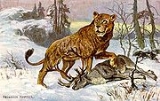
The cave lion (Panthera leo spelaea) also known as the European or Eurasian cave lion, is an extinct subspecies
Subspecies

In biology, subspecies is the taxonomic rank immediately subordinate to a species. A subspecies is a taxonomic group which is less distinct than the Common descent or species from which it originates....
 of lion
Lion

The lion is a member of the family Felidae and one of four big cats in the genus Panthera. With exceptionally large males exceeding 250 kg in weight, it is the second-largest living cat after the tiger....
 known from fossil
Fossil

Fossils are the preserved remains or trace fossil of animals, plants, and other organisms from the remote past. The totality of fossils, both discovered and undiscovered, and their placement in fossiliferous Rock formations and sedimentary rock layers is known as the fossil record....
s and multiple examples of prehistoric art.

species was one of the largest of the panterines. The remains of an adult male, which was found in 1985 near Siegsdorf
Siegsdorf

Siegsdorf is a Municipalities of Germany in the Traunstein in Bavaria, Germany....
 in Germany
Germany

Germany , officially the Federal Republic of Germany , is a country in Central Europe. It is bordered to the north by the North Sea, Denmark, and the Baltic Sea; to the east by Poland and the Czech Republic; to the south by Austria and Switzerland; and to the west by France, Luxembourg, Belgium, and the Netherlands....
, had a shoulder height of around and a body length of without the tail.


Discussion
Ask a question about 'Cave lion'
Start a new discussion about 'Cave lion'
Answer questions from other users
Full Discussion Forum


Recent Posts


Encyclopedia


The cave lion (Panthera leo spelaea) also known as the European or Eurasian cave lion, is an extinct subspecies
Subspecies

In biology, subspecies is the taxonomic rank immediately subordinate to a species. A subspecies is a taxonomic group which is less distinct than the Common descent or species from which it originates....
 of lion
Lion

The lion is a member of the family Felidae and one of four big cats in the genus Panthera. With exceptionally large males exceeding 250 kg in weight, it is the second-largest living cat after the tiger....
 known from fossil
Fossil

Fossils are the preserved remains or trace fossil of animals, plants, and other organisms from the remote past. The totality of fossils, both discovered and undiscovered, and their placement in fossiliferous Rock formations and sedimentary rock layers is known as the fossil record....
s and multiple examples of prehistoric art.

Physical characteristics


This species was one of the largest of the panterines. The remains of an adult male, which was found in 1985 near Siegsdorf
Siegsdorf

Siegsdorf is a Municipalities of Germany in the Traunstein in Bavaria, Germany....
 in Germany
Germany

Germany , officially the Federal Republic of Germany , is a country in Central Europe. It is bordered to the north by the North Sea, Denmark, and the Baltic Sea; to the east by Poland and the Czech Republic; to the south by Austria and Switzerland; and to the west by France, Luxembourg, Belgium, and the Netherlands....
, had a shoulder height of around and a body length of without the tail. This is similar to the size of a very large modern lion. The size of this male has been exceeded by other specimens of this subspecies. Therefore this cat may have been approximately 5-33% larger than modern lions, and maybe even larger than the largest extant cat, the Siberian tiger, Panthera tigris altaica, but it was smaller than the earlier eurasian panterines, Panthera fossilis, and the even larger American lion
American lion

The American lion also known as the North American lion, American cave lion, is an extinct Felidae known from fossils. It was one of the largest subspecies of lion ever to have existed, comparable in size to the Early Middle Pleistocene primitive cave lion, Panthera leo fossilis, and about twenty-five percent larger than...
, Panthera atrox. Their body colour possibly varied from a ochre
Ochre

Ochre or Ocher is a color, usually described as Gold -yellow or light yellow brown....
-tinted grey to dark ochre brown on the upperparts of the body, while the rest of the coat was light brown.

The cave lion is known from Paleolithic
Paleolithic

The Paleolithic or Palaeolithic or "Old Stone" era is a Prehistory era distinguished by the development of the first stone tools, and covers roughly 99% of human history....
 cave paintings, ivory
Ivory

File:Ivory decoration.jpgIvory is formed from dentine and constitutes the bulk of the teeth and tusks of animals such as the elephant, hippopotamus, walrus, mammoth and narwhal....
 carvings, and clay figurine
Figurine

A figurine is a statuette that represents a human, deity, or animal. Figurines may be realistic or iconic, depending on the skill and intention of the creator....
s. These representations indicate that cave lions had rounded, protruding ears, tufted tails, possibly faint tiger-like stripes, and that at least some had a "ruff" or primitive mane around their neck, indicating males. Other archaeological artifact
Artifact (archaeology)

In archaeology, an artifact or artefact is any object made or modified by a human archaeological culture, and often one later recovered by some archaeological endeavor....
s indicate that they were featured in Paleolithic religious rituals
Religion

A religion is an organized approach to human spirituality which usually encompasses a set of myth, symbols, beliefs and practices, often with a supernatural or transcendence quality, that give meaning to the practitioner's experiences of life through reference to a higher power or truth....
.

Environment


The cave lion received its common name from the fact that large quantities of its remains are found in caves , but it is doubtful whether they lived in them. It had a wide habitat tolerance, but probably preferred conifer forests and grasslands , where medium-sized to large herbivores occurred. Fossil footprints of lions, which were found together with those of reindeer
Reindeer

The reindeer , also known as the caribou when wild in North America, is an Arctic and Subarctic-dwelling deer, widespread and numerous across the northern Holarctic....
, demonstrate that these cats once occurred even in subpolar climates.

These active carnivores probably preyed upon the large, herbivorous animals of their time, including horses
Equidae

Equidae is the Taxonomy Family of horses and related animals, including the extant horses, donkeys, and zebras, and many other species known only from fossils....
, deer and bison
Bison

Bison is a taxonomic group containing six species of large even-toed ungulates within the subfamily Bovinae. Only two of these species still exist: the American bison and the European bison, or wisent , each with two subspecies....
. Some paintings of them in caves show several hunting together, which suggests the hunting strategy of contemporary lionesses
Lion

The lion is a member of the family Felidae and one of four big cats in the genus Panthera. With exceptionally large males exceeding 250 kg in weight, it is the second-largest living cat after the tiger....
.

Small prey was usually brought down with a blow of the front paw and then held down with both front feet. The animal was finally killed by a powerful bite of the sharp teeth , at the back of the neck, in the region of the throat and even in the chest. A cave lion usually could not run as fast as its prey, but could pounce on it from behind or run up next to it and bring it down with the paws. In this manner a running animal's balance could very easily be disturbed.

It was most likely the most common predator (after the cave hyena) in plains ecosystems. Its extinction may have been related to the Quaternary extinction event
Quaternary extinction event

The Quaternary epoch saw the extinctions of numerous predominantly larger species, many of which occurred during the transition to the Holocene epoch in what is termed the Holocene extinction event....
, which wiped out most of the megafauna
Megafauna

The term megafauna has two distinct meanings in the biological sciences. The less commonly found meaning is of any animal which can be seen with the unaided eye, in contrast to microfauna....
 prey in those regions. Cave paintings and remains found in the refuse piles of ancient camp sites indicate that they were hunted by early humans, which also may have contributed to their demise.

Classification

The cave lion is considered a species
Species

In biology, a species is one of the basic units of biological classification and a taxonomic rank. A species is often defined as a group of organisms capable of interbreeding and producing fertile offspring....
 in its own right, under the name Panthera spelaea, and at least one authority, based on a comparison of skull
Skull

The skull is a bone structure found in the head of many animals. The skull supports the structures of the face and protects the head against injury....
 shapes, considers the cave lion to be more closely related to the tiger
Tiger

The tiger is a member of the Felidae family; the largest of the four "big cats" in the genus Panthera. Native to much of eastern and southern Asia, the tiger is an apex predator and an Carnivore#Obligate carnivores....
, which would result in the formal name Panthera tigris spelaea. However, recent genetic research shows that it was a close, but separate, relative of the modern lion and leopard.

History and distribution

The cave lion (Panthera spelea) was derived from the earlier Panthera leo fossilis
Panthera leo fossilis

Panthera leo fossilis is an extinct feline of the Early and Middle Pleistocene. It is generally considered to be an early subspecies of the lion ....
, which first appeared in Europe about 700,000 years ago. The cave lion itself lived from 370,000 to 10,000 years ago, during the Pleistocene
Pleistocene

The Pleistocene is the epoch from 1.8 million to 10,000 years Before Present covering the world's recent period of repeated glaciations. The name pleistocene is derived from the Greek and ....
 epoch. Apparently, it became extinct about 10,000 years ago , during the Würm glaciation, although there are some indications it may have existed into historic times in southeastern Europe, as recently as 2,000 years ago in the Balkans
Balkans

The Balkans is the historical name of a geographic subregion of southeastern Europe. The region takes its name from the Balkan Mountains, which run through the centre of Bulgaria into eastern Serbia....
.

Cave lions were widespread in parts of Europe
Europe

Europe is, conventionally, one of the world's seven continents. Comprising the westernmost peninsula of Eurasia, Europe is generally divided from Asia to its east by the water divide of the Ural Mountains, the Ural , the Caspian Sea, and by the Caucasus Mountains to the southeast....
 and Asia
Asia

Asia is the world's largest and most populous continent. It covers 8.6% of the Earth's total surface area and, with over 4 billion people, it contains more than 60% of the world's current human population....
, from Great Britain
Great Britain

Great Britain is an island lying to the northwest of Continental Europe. It is the List of islands by area, and the largest in Europe. With a population of 58.9 million people it is List of islands by population....
, Germany
Germany

Germany , officially the Federal Republic of Germany , is a country in Central Europe. It is bordered to the north by the North Sea, Denmark, and the Baltic Sea; to the east by Poland and the Czech Republic; to the south by Austria and Switzerland; and to the west by France, Luxembourg, Belgium, and the Netherlands....
 and France
France

France , officially the French Republic , is a country whose Metropolitan France is located in Western Europe and that also comprises various Overseas departments and territories of France....
 (Arduini & Teruzzi, 1993) all the way to the Bering Strait
Bering Strait

The Bering Strait is a sea strait between Cape Dezhnev, Chukotka Autonomous Okrug, the easternmost point of the Asian continent and Cape Prince of Wales, Alaska, the westernmost point of the North American continent, with latitude of about 65? 40' north, slightly south of the polar circle....
 and from Siberia
Siberia

Siberia , is the name given to the vast region constituting almost all of North Asia and for the most part currently serving as the massive central and eastern portion of the Russian Federation, having served in the same capacity previously for the Soviet Union from its beginning, and the Russian Empire beginning in the 16th century....
 to Turkistan.

See also


  • Panthera leo fossilis
    Panthera leo fossilis

    Panthera leo fossilis is an extinct feline of the Early and Middle Pleistocene. It is generally considered to be an early subspecies of the lion ....
  • Panthera leo vereshchagini
    Panthera leo vereshchagini

    Panthera leo vereshchagini, also known as the East Siberian or Beringian cave lion, is an extinct prehistoric lion that inhabited Yakutia , Alaska , and the Yukon Territory ....
  • Panthera leo atrox
  • Panthera leo


In popular culture


The Cave Lion is represented as characters and as a revered totemic spirit in the Earth's Children
Earth's Children

Earth's Children is a book series of historical fiction novels written by Jean M. Auel. There are five novels in the series so far and a sixth is being written....
 series of prehistoric fiction, by Jean M. Auel
Jean M. Auel

Jean M. Auel , n?e Jean Marie Untinen is an United States and Finland writer. She is best known for her Earth's Children books, a series of historical fiction novels set in prehistoric Europe that explores interactions of Cro-Magnon people with Neanderthals....
. It appears in the computer game Zoo Tycoon 2: Extinct Animals
Zoo Tycoon 2: Extinct Animals

Zoo Tycoon 2: Extinct Animals is a video game expansion pack for Zoo Tycoon 2 released October 17, 2007. The expansion focuses around extinct animals, mainly dinosaurs or ice age creatures, as well as today's extinct creatures like the dodo or thylacine....
. It was even shown hunting mammoths and Cro Magnons in BBC's Walking with Beasts
Walking with Beasts

Walking with Beasts is a 2001 six-part television documentary film produced by the BBC in the United Kingdom, narrated by Kenneth Branagh. In North America it has been retitled Walking with Prehistoric Beasts, and the original Discovery Channel broadcast was narrated by Stockard Channing....
.

External links


  • , from the Messybeast Cat Resource Archive.
  • , by C. R. Harrington, from Yukon Beringia Interpretative Center.
  • , volume 5, chapter 1, by Hans Krause.
  • , from the Dinosaur Mailing List. (Groiss)