

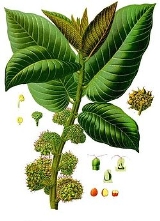
Castilla elastica

Encyclopedia
Castilla elastica, the Panama Rubber Tree, is a tree native to the tropical
areas of Mexico
, Central America
, and northern South America
. It was the principal source of latex
among the Mesoamerica
n peoples in pre-Columbian
times. The latex gathered from Castilla elastica was converted into usable rubber
by mixing the latex sap
with the juice of the morning glory
species Ipomoea alba
which, conveniently, is typically found in the wild as a vine
climbing Castilla elastica. The rubber produced by this method found several uses, including most notably, the manufacture of balls for the Mesoamerican ballgame
.
The Aztec
(Nahuatl
) word for rubber was ulli / olli, from which their word for the ballgame derived (ullamaliztli), and also their name for the ancient people they associated with the origin of the ballgame, the Olmec
s (olmeca: "rubber people"). The Nahuatl word for the tree of Castilla elastica is olicuáhuitl; in Spanish it is known as palo de hule.
common name: caucho,castilloa rubber.
Tropics
The tropics is a region of the Earth surrounding the Equator. It is limited in latitude by the Tropic of Cancer in the northern hemisphere at approximately N and the Tropic of Capricorn in the southern hemisphere at S; these latitudes correspond to the axial tilt of the Earth...
areas of Mexico
Mexico
The United Mexican States , commonly known as Mexico , is a federal constitutional republic in North America. It is bordered on the north by the United States; on the south and west by the Pacific Ocean; on the southeast by Guatemala, Belize, and the Caribbean Sea; and on the east by the Gulf of...
, Central America
Central America
Central America is the central geographic region of the Americas. It is the southernmost, isthmian portion of the North American continent, which connects with South America on the southeast. When considered part of the unified continental model, it is considered a subcontinent...
, and northern South America
South America
South America is a continent situated in the Western Hemisphere, mostly in the Southern Hemisphere, with a relatively small portion in the Northern Hemisphere. The continent is also considered a subcontinent of the Americas. It is bordered on the west by the Pacific Ocean and on the north and east...
. It was the principal source of latex
Latex
Latex is the stable dispersion of polymer microparticles in an aqueous medium. Latexes may be natural or synthetic.Latex as found in nature is a milky fluid found in 10% of all flowering plants . It is a complex emulsion consisting of proteins, alkaloids, starches, sugars, oils, tannins, resins,...
among the Mesoamerica
Mesoamerica
Mesoamerica is a region and culture area in the Americas, extending approximately from central Mexico to Belize, Guatemala, El Salvador, Honduras, Nicaragua, and Costa Rica, within which a number of pre-Columbian societies flourished before the Spanish colonization of the Americas in the 15th and...
n peoples in pre-Columbian
Pre-Columbian
The pre-Columbian era incorporates all period subdivisions in the history and prehistory of the Americas before the appearance of significant European influences on the American continents, spanning the time of the original settlement in the Upper Paleolithic period to European colonization during...
times. The latex gathered from Castilla elastica was converted into usable rubber
Rubber
Natural rubber, also called India rubber or caoutchouc, is an elastomer that was originally derived from latex, a milky colloid produced by some plants. The plants would be ‘tapped’, that is, an incision made into the bark of the tree and the sticky, milk colored latex sap collected and refined...
by mixing the latex sap
Plant sap
Sap is a fluid transported in xylem cells or phloem sieve tube elements of a plant. It transports water and nutrients throughout the plant....
with the juice of the morning glory
Morning glory
Morning glory is a common name for over 1,000 species of flowering plants in the family Convolvulaceae, whose current taxonomy and systematics is in flux...
species Ipomoea alba
Ipomoea alba
Ipomoea alba, sometimes called the moonflower or moon vine, is a species of night-blooming morning-glory, native to tropical and subtropical regions of the New World, from northern Argentina north to Mexico and Florida...
which, conveniently, is typically found in the wild as a vine
Vine
A vine in the narrowest sense is the grapevine , but more generally it can refer to any plant with a growth habit of trailing or scandent, that is to say climbing, stems or runners...
climbing Castilla elastica. The rubber produced by this method found several uses, including most notably, the manufacture of balls for the Mesoamerican ballgame
Mesoamerican ballgame
The Mesoamerican ballgame or Tlatchtli in Náhuatl was a sport with ritual associations played since 1,000 B.C. by the pre-Columbian peoples of Ancient Mexico and Central America...
.
The Aztec
Aztec
The Aztec people were certain ethnic groups of central Mexico, particularly those groups who spoke the Nahuatl language and who dominated large parts of Mesoamerica in the 14th, 15th and 16th centuries, a period referred to as the late post-classic period in Mesoamerican chronology.Aztec is the...
(Nahuatl
Nahuatl
Nahuatl is thought to mean "a good, clear sound" This language name has several spellings, among them náhuatl , Naoatl, Nauatl, Nahuatl, Nawatl. In a back formation from the name of the language, the ethnic group of Nahuatl speakers are called Nahua...
) word for rubber was ulli / olli, from which their word for the ballgame derived (ullamaliztli), and also their name for the ancient people they associated with the origin of the ballgame, the Olmec
Olmec
The Olmec were the first major Pre-Columbian civilization in Mexico. They lived in the tropical lowlands of south-central Mexico, in the modern-day states of Veracruz and Tabasco....
s (olmeca: "rubber people"). The Nahuatl word for the tree of Castilla elastica is olicuáhuitl; in Spanish it is known as palo de hule.
Subspecies
- Castilla elastica ssp. costaricana (Liebm.) C.C.Berg
- Castilla elastica ssp. elastica (Castilloa rubber)
common name: caucho,castilloa rubber.
See also
- GuayuleGuayuleParthenium argentatum, commonly known as the Guayule , is a flowering shrub in the aster family, Asteraceae, that is native to the southwestern United States and northern Mexico. It can be found in the US states of New Mexico and Texas and the Mexican states of Zacatecas, Coahuila, Chihuahua, San...
- another source of latex utilized by the pre-Columbian Mesoamericans - Para rubber treePara rubber treeHevea brasiliensis, the Pará rubber tree, often simply called rubber tree, is a tree belonging to the family Euphorbiaceae, and the most economically important member of the genus Hevea...
- the main source of modern commercial natural latex