

.gif)
Cass Lake (Minnesota)

Encyclopedia
Cass Lake is a glacially
-formed lake
in north central Minnesota
in the United States
. It is approximately 10 mi (16.1 km) long and 7 mi (11.3 km) wide, located in Cass
and Beltrami
counties, within the Chippewa National Forest
and the Leech Lake Indian Reservation
, adjacent to its namesake city of Cass Lake
. In the Ojibwe language
, it is called Gaa-miskwaawaakokaag (where there are many red cedar), and was known to early explorers and traders in French as Lac du Cedre Rouge, and English as Red Cedar Lake. It is the 11th largest lake in Minnesota, and the 8th largest lake lying entirely within the borders of the state.
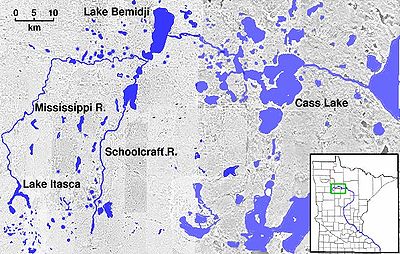
The lake contains five islands, including Star Island, Cedar Island, the two Potato Islands, and a small unnamed island. The Mississippi River
flows through the lake from west to east. A second major stream, the Turtle River
, enters the lake from the north. The lake has a large littoral area, particularly around Cedar Island. Star Island is notable in that it contains 199 acre (0.80532514 km²) Lake Windigo
, thus forming "a lake within an island within a lake". http://www.fs.fed.us/r9/forests/chippewa/recreation/documents/starisland.pdf.
In July, 1820, an expedition led by General Lewis Cass
visited the lake. They were prevented from traveling further upstream by low water, and so designated the lake as the headwaters of the Mississippi because below this point, the river is navigable throughout the ice-free season. In June, 1832, Henry Schoolcraft
, who had been a member of the 1820 expedition, designated the source of the river as being further upstream at Lake Itasca
, the source of the perennial stream. Subsequent to the Cass Expedition of 1820, the lake was renamed Cass Lake in order to distinguish it from Red Cedar Lake (known today as Cedar Lake) in Aitkin County
.
 The lake is popular destination for recreational fishing
, boating
, and swimming. The lake is known for its walleye
, northern pike
, muskellunge
, and yellow perch
fisheries. Tullibee are important forage fish. There are numerous campgrounds and resorts located on its shores. The southern and eastern shores of the lake, as well as all the islands, are protected within the Ten Section Area of the Chippewa National Forest. Norway Beach recreation area is located at the southeast corner of the lake, and contains Norway Beach Lodge, a notable example of Civilian Conservation Corps
-built Finnish-style log architecture. The city of Cass Lake
sits near the southwestern side of the lake. Formerly, the lake played an important role in the lumber industry. Log booms were towed across the lake by steamboat from surrounding lakes and streams to either be sawed into lumber at local mills, or transported elsewhere by railroad.
Historically, Cass Lake was considered to be much larger. Pike Bay is a 4760 acre (19.3 km²) lake lying to the south of Cass Lake; the two lakes are connected by a narrow 0.5 mi (0.80467 km) long channel. Formerly, the two lakes were connected by a 0.6 mi (0.965604 km) wide shallow narrows. Beginning in 1898, construction of a railroad, and later highway and pipeline, across the narrows led to decreased currents through and increased sedimentation in the narrows. The two bodies of water are now generally considered separate lakes, although Pike Bay retains its old name.
The lake level is maintained and stabilized by Knutson Dam, built in 1924 to replace earlier brush and log dams built by lumber companies. Knutson Dam is one of the few dams managed by the U.S. Forest Service.
On the small isthmus between Cass Lake and neighboring Buck Lake lies Camp Chippewa, a boys camp founded in 1935. Another camp, UniStar, lies on a portion of Star Island.
Glacier
A glacier is a large persistent body of ice that forms where the accumulation of snow exceeds its ablation over many years, often centuries. At least 0.1 km² in area and 50 m thick, but often much larger, a glacier slowly deforms and flows due to stresses induced by its weight...
-formed lake
Lake
A lake is a body of relatively still fresh or salt water of considerable size, localized in a basin, that is surrounded by land. Lakes are inland and not part of the ocean and therefore are distinct from lagoons, and are larger and deeper than ponds. Lakes can be contrasted with rivers or streams,...
in north central Minnesota
Minnesota
Minnesota is a U.S. state located in the Midwestern United States. The twelfth largest state of the U.S., it is the twenty-first most populous, with 5.3 million residents. Minnesota was carved out of the eastern half of the Minnesota Territory and admitted to the Union as the thirty-second state...
in the United States
United States
The United States of America is a federal constitutional republic comprising fifty states and a federal district...
. It is approximately 10 mi (16.1 km) long and 7 mi (11.3 km) wide, located in Cass
Cass County, Minnesota
Cass County is a county located in the U.S. state of Minnesota. As of 2010, the population was 28,567. Its county seat is Walker. A portion of the Leech Lake Indian Reservation is in the county.-Geography:...
and Beltrami
Beltrami County, Minnesota
Beltrami County is a county located in the northern part of the U.S. state of Minnesota. As of 2010, the population was 44,442. Its county seat is Bemidji. Portions of the Leech Lake and Red Lake Indian reservations are in the county. The northernmost portion of the Mississippi River flows...
counties, within the Chippewa National Forest
Chippewa National Forest
Chippewa National Forest is a National Forest located in northcentral Minnesota, United States, in the counties of Itasca, Cass, and Beltrami. Forest headquarters are located in Cass Lake, Minnesota. There are local ranger district offices in Blackduck, Deer River, and Walker.-History and...
and the Leech Lake Indian Reservation
Leech Lake Indian Reservation
The Leech Lake Indian Reservation or Gaa-zagaskwaajimekaag in the Ojibwe language, is an Native American reservation located in the north-central Minnesota counties of Cass, Itasca, Beltrami, and Hubbard. It is the land-base for the Leech Lake Band of Ojibwe...
, adjacent to its namesake city of Cass Lake
Cass Lake, Minnesota
As of the census of 2000, there were 860 people, 331 households, and 192 families residing in the city. The population density was 753.2 people per square mile . There were 384 housing units at an average density of 336.3 per square mile . The racial makeup of the city was 30.12% White, 64.42%...
. In the Ojibwe language
Ojibwe language
Ojibwe , also called Anishinaabemowin, is an indigenous language of the Algonquian language family. Ojibwe is characterized by a series of dialects that have local names and frequently local writing systems...
, it is called Gaa-miskwaawaakokaag (where there are many red cedar), and was known to early explorers and traders in French as Lac du Cedre Rouge, and English as Red Cedar Lake. It is the 11th largest lake in Minnesota, and the 8th largest lake lying entirely within the borders of the state.
The lake contains five islands, including Star Island, Cedar Island, the two Potato Islands, and a small unnamed island. The Mississippi River
Mississippi River
The Mississippi River is the largest river system in North America. Flowing entirely in the United States, this river rises in western Minnesota and meanders slowly southwards for to the Mississippi River Delta at the Gulf of Mexico. With its many tributaries, the Mississippi's watershed drains...
flows through the lake from west to east. A second major stream, the Turtle River
Turtle River (Mississippi River)
-References:***USGS Hydrologic Unit Map - State of Minnesota...
, enters the lake from the north. The lake has a large littoral area, particularly around Cedar Island. Star Island is notable in that it contains 199 acre (0.80532514 km²) Lake Windigo
Lake Windigo
Lake Windigo is a small lake on Star Island in northern Minnesota, United States. The lake covers a total of 199 acres and reaches a maximum depth of 15 feet . The littoral zone is 129 acres . Due to its shallow depth and subsequent abundant plant and algae growth, water clarity...
, thus forming "a lake within an island within a lake". http://www.fs.fed.us/r9/forests/chippewa/recreation/documents/starisland.pdf.
In July, 1820, an expedition led by General Lewis Cass
Lewis Cass
Lewis Cass was an American military officer and politician. During his long political career, Cass served as a governor of the Michigan Territory, an American ambassador, a U.S. Senator representing Michigan, and co-founder as well as first Masonic Grand Master of the Grand Lodge of Michigan...
visited the lake. They were prevented from traveling further upstream by low water, and so designated the lake as the headwaters of the Mississippi because below this point, the river is navigable throughout the ice-free season. In June, 1832, Henry Schoolcraft
Henry Schoolcraft
Henry Rowe Schoolcraft was an American geographer, geologist, and ethnologist, noted for his early studies of Native American cultures, as well as for his 1832 discovery of the source of the Mississippi River. He married Jane Johnston, whose parents were Ojibwe and Scots-Irish...
, who had been a member of the 1820 expedition, designated the source of the river as being further upstream at Lake Itasca
Lake Itasca
Lake Itasca is a small glacial lake, approximately in area, in the Headwaters area of north central Minnesota. The lake is located in southeastern Clearwater County within Itasca State Park and it has an average depth of 20–35 feet , and is 1,475 ft above sea level.The Ojibwe name for...
, the source of the perennial stream. Subsequent to the Cass Expedition of 1820, the lake was renamed Cass Lake in order to distinguish it from Red Cedar Lake (known today as Cedar Lake) in Aitkin County
Aitkin County, Minnesota
Aitkin County is a county located in the U.S. state of Minnesota. As of 2010, the population is 16,202. Its county seat is Aitkin. A portion of the Mille Lacs Indian Reservation is in the county.-History:...
.
Fishing
Fishing is the activity of trying to catch wild fish. Fish are normally caught in the wild. Techniques for catching fish include hand gathering, spearing, netting, angling and trapping....
, boating
Boating
Boating is the leisurely activity of travelling by boat, or the recreational use of a boat whether powerboats, sailboats, or man-powered vessels , focused on the travel itself, as well as sports activities, such as fishing or water skiing...
, and swimming. The lake is known for its walleye
Walleye
Walleye is a freshwater perciform fish native to most of Canada and to the northern United States. It is a North American close relative of the European pikeperch...
, northern pike
Northern Pike
The northern pike , is a species of carnivorous fish of the genus Esox...
, muskellunge
Muskellunge
A muskellunge , also known as a muskelunge, muscallonge, milliganong, or maskinonge , is a large, relatively uncommon freshwater fish of North America. Muskellunge are the largest member of the pike family, Esocidae...
, and yellow perch
Yellow perch
The yellow perch is a species of perch found in the United States and Canada, where it is often referred to by the shortform perch. Yellow perch look similar to the European perch, but are paler and more yellowish, with less red in the fins. They have six to eight dark, vertical bars on their sides...
fisheries. Tullibee are important forage fish. There are numerous campgrounds and resorts located on its shores. The southern and eastern shores of the lake, as well as all the islands, are protected within the Ten Section Area of the Chippewa National Forest. Norway Beach recreation area is located at the southeast corner of the lake, and contains Norway Beach Lodge, a notable example of Civilian Conservation Corps
Civilian Conservation Corps
The Civilian Conservation Corps was a public work relief program that operated from 1933 to 1942 in the United States for unemployed, unmarried men from relief families, ages 18–25. A part of the New Deal of President Franklin D...
-built Finnish-style log architecture. The city of Cass Lake
Cass Lake, Minnesota
As of the census of 2000, there were 860 people, 331 households, and 192 families residing in the city. The population density was 753.2 people per square mile . There were 384 housing units at an average density of 336.3 per square mile . The racial makeup of the city was 30.12% White, 64.42%...
sits near the southwestern side of the lake. Formerly, the lake played an important role in the lumber industry. Log booms were towed across the lake by steamboat from surrounding lakes and streams to either be sawed into lumber at local mills, or transported elsewhere by railroad.
Historically, Cass Lake was considered to be much larger. Pike Bay is a 4760 acre (19.3 km²) lake lying to the south of Cass Lake; the two lakes are connected by a narrow 0.5 mi (0.80467 km) long channel. Formerly, the two lakes were connected by a 0.6 mi (0.965604 km) wide shallow narrows. Beginning in 1898, construction of a railroad, and later highway and pipeline, across the narrows led to decreased currents through and increased sedimentation in the narrows. The two bodies of water are now generally considered separate lakes, although Pike Bay retains its old name.
The lake level is maintained and stabilized by Knutson Dam, built in 1924 to replace earlier brush and log dams built by lumber companies. Knutson Dam is one of the few dams managed by the U.S. Forest Service.
On the small isthmus between Cass Lake and neighboring Buck Lake lies Camp Chippewa, a boys camp founded in 1935. Another camp, UniStar, lies on a portion of Star Island.