

.gif)
Casablanca Conference (1943)

Encyclopedia
Casablanca
Casablanca is a city in western Morocco, located on the Atlantic Ocean. It is the capital of the Grand Casablanca region.Casablanca is Morocco's largest city as well as its chief port. It is also the biggest city in the Maghreb. The 2004 census recorded a population of 2,949,805 in the prefecture...
, Morocco
Morocco
Morocco , officially the Kingdom of Morocco , is a country located in North Africa. It has a population of more than 32 million and an area of 710,850 km², and also primarily administers the disputed region of the Western Sahara...
, then a French protectorate
Protectorate
In history, the term protectorate has two different meanings. In its earliest inception, which has been adopted by modern international law, it is an autonomous territory that is protected diplomatically or militarily against third parties by a stronger state or entity...
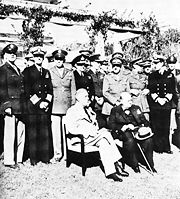
, from January 14 to 24, 1943, to plan the European strategy
European Theatre of World War II
The European Theatre of World War II was a huge area of heavy fighting across Europe from Germany's invasion of Poland on September 1, 1939 until the end of the war with the German unconditional surrender on May 8, 1945...
of the Allies
Allies of World War II
The Allies of World War II were the countries that opposed the Axis powers during the Second World War . Former Axis states contributing to the Allied victory are not considered Allied states...
during World War II
World War II
World War II, or the Second World War , was a global conflict lasting from 1939 to 1945, involving most of the world's nations—including all of the great powers—eventually forming two opposing military alliances: the Allies and the Axis...
. Present were Franklin D. Roosevelt
Franklin D. Roosevelt
Franklin Delano Roosevelt , also known by his initials, FDR, was the 32nd President of the United States and a central figure in world events during the mid-20th century, leading the United States during a time of worldwide economic crisis and world war...
, Winston Churchill
Winston Churchill
Sir Winston Leonard Spencer-Churchill, was a predominantly Conservative British politician and statesman known for his leadership of the United Kingdom during the Second World War. He is widely regarded as one of the greatest wartime leaders of the century and served as Prime Minister twice...
, and many French representatives to file reports for the French.
Soviet
Soviet Union
The Soviet Union , officially the Union of Soviet Socialist Republics , was a constitutionally socialist state that existed in Eurasia between 1922 and 1991....
leader Joseph Stalin
Joseph Stalin
Joseph Vissarionovich Stalin was the Premier of the Soviet Union from 6 May 1941 to 5 March 1953. He was among the Bolshevik revolutionaries who brought about the October Revolution and had held the position of first General Secretary of the Communist Party of the Soviet Union's Central Committee...
had also been invited but declined to attend in light of the ongoing conflict at Stalingrad. General Charles de Gaulle
Charles de Gaulle
Charles André Joseph Marie de Gaulle was a French general and statesman who led the Free French Forces during World War II. He later founded the French Fifth Republic in 1958 and served as its first President from 1959 to 1969....
had initially refused to come but changed his mind when Churchill threatened to recognize Henri Giraud
Henri Giraud
Henri Honoré Giraud was a French general who fought in World War I and World War II. Captured in both wars, he escaped each time....
as head of the Free French Forces
Free French Forces
The Free French Forces were French partisans in World War II who decided to continue fighting against the forces of the Axis powers after the surrender of France and subsequent German occupation and, in the case of Vichy France, collaboration with the Germans.-Definition:In many sources, Free...
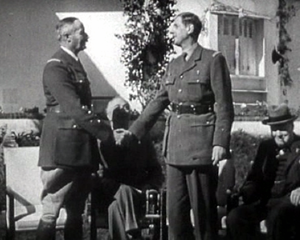
in his place. Giraud was also present at Casablanca, and there was notable tension between the two men during the talks, notably leading Roosevelt to force the two men to shake hands, which they did reluctantly and so quickly that photographers had to ask them to repeat for the shoot. Both men also limited their exchange to offering the other to serve under him.
Casablanca Declaration
Sicily
Sicily is a region of Italy, and is the largest island in the Mediterranean Sea. Along with the surrounding minor islands, it constitutes an autonomous region of Italy, the Regione Autonoma Siciliana Sicily has a rich and unique culture, especially with regard to the arts, music, literature,...
and Italy
Italy
Italy , officially the Italian Republic languages]] under the European Charter for Regional or Minority Languages. In each of these, Italy's official name is as follows:;;;;;;;;), is a unitary parliamentary republic in South-Central Europe. To the north it borders France, Switzerland, Austria and...
, and the recognition of joint leadership of the Free French by de Gaulle
Charles de Gaulle
Charles André Joseph Marie de Gaulle was a French general and statesman who led the Free French Forces during World War II. He later founded the French Fifth Republic in 1958 and served as its first President from 1959 to 1969....
and Giraud
Henri Giraud
Henri Honoré Giraud was a French general who fought in World War I and World War II. Captured in both wars, he escaped each time....
. All the terms were agreed upon. Roosevelt presented the results of the conference to the American people in a radio address on February 12, 1943. Also decided during the Casablanca Conference was that there would be no "cross channel invasion" in 1943. Instead of invading Europe across the English Channel, an invasion into Sicily and then Italy would take place.
Other important decisions
The decision to open a second front in France instead of the Balkans opened the path for the Red ArmyRed Army
The Workers' and Peasants' Red Army started out as the Soviet Union's revolutionary communist combat groups during the Russian Civil War of 1918-1922. It grew into the national army of the Soviet Union. By the 1930s the Red Army was among the largest armies in history.The "Red Army" name refers to...
to eventually advance through Eastern Europe
Eastern Europe
Eastern Europe is the eastern part of Europe. The term has widely disparate geopolitical, geographical, cultural and socioeconomic readings, which makes it highly context-dependent and even volatile, and there are "almost as many definitions of Eastern Europe as there are scholars of the region"...
towards the Central Europe
Central Europe
Central Europe or alternatively Middle Europe is a region of the European continent lying between the variously defined areas of Eastern and Western Europe...
, outrunning the Allied advance, and was one of the first steps in the abandoning of Poland
Poland
Poland , officially the Republic of Poland , is a country in Central Europe bordered by Germany to the west; the Czech Republic and Slovakia to the south; Ukraine, Belarus and Lithuania to the east; and the Baltic Sea and Kaliningrad Oblast, a Russian exclave, to the north...
and the rest of Eastern and Central Europe to the Soviets (the Western betrayal
Western betrayal
Western betrayal, also called Yalta betrayal, refers to a range of critical views concerning the foreign policies of several Western countries between approximately 1919 and 1968 regarding Eastern Europe and Central Europe...
).
During the Conference, Roosevelt also spoke with the French resident general at Rabat, Morocco, about postwar independence and Jewish immigrants in North Africa. Roosevelt proposed that:
"[t]he number of Jews engaged in the practice of the professions (law, medicine, etc.) should be definitely limited to the percentage that the Jewish population in North Africa bears to the whole of the North African population.... [T]his plan would further eliminate the specific and understandable complaints which the Germans bore towards the Jews in Germany, namely, that while they represented a small part of the population, over 50 percent of the lawyers, doctors, schoolteachers, college professors, etc., in Germany were Jews."
This remark was made in response to an early move of the National Socialist Party of Germany (the Nazi Party), which on April 25, 1933 passed the Law against the Overcrowding of German Schools and Institutions of Higher Learning. This stated that "in admissions, care is to be taken that the number of Reich Germans...of non-Aryan descent [i.e. Jews], out of the total attending each school and each faculty, does not exceed the proportion of the non-Aryans [Jews] within the Reich population." The ratio for admissions was set at 1.5%, and a quota of 5% was imposed on Jewish attendance at any single university or school.
The Deutsche Allgemeine Zeitung of April 27, 1933 described the rationale behind the act as follows: "Allowing the presence of too high a percentage of people of foreign origin [Jews] in relation to their percentage of the population could be interpreted as an acceptance of the superiority of other races, something decidedly to be rejected."
See also
- Atlantic CharterAtlantic CharterThe Atlantic Charter was a pivotal policy statement first issued in August 1941 that early in World War II defined the Allied goals for the post-war world. It was drafted by Britain and the United States, and later agreed to by all the Allies...
- Casablanca directiveCasablanca directiveThe Casablanca directive was approved by the Combined Chiefs of Staff of the Western Allies at their 65th meeting on 21 January 1943 and issued to the appropriate the Royal Air Force and United States Army Air Force commanders on 4 February 1943....
the Allied strategic bombing directive issued shortly after the Casablanca Conference. - List of World War II conferences
External links
- Casablanca Conference of 1943
- United States Department of State Foreign Relations of the United States. The Conferences at Washington, 1941–1942, and Casablanca, 1943