


Carved Stone Balls

Encyclopedia

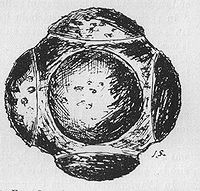
Petrosphere
In archaeology, a petrosphere is the name for any spherical man-made object of any size that is composed of stone. These mainly prehistoric artefacts may have been created and/or selected, but altered in some way to perform their specific function, including carving and painting.Several classes of...
s, usually round and rarely oval. They have from 3 to 160 protruding knobs on the surface. Their size is fairly uniform, they date from the late Neolithic
Neolithic
The Neolithic Age, Era, or Period, or New Stone Age, was a period in the development of human technology, beginning about 9500 BC in some parts of the Middle East, and later in other parts of the world. It is traditionally considered as the last part of the Stone Age...
to possibly the Iron Age
Iron Age
The Iron Age is the archaeological period generally occurring after the Bronze Age, marked by the prevalent use of iron. The early period of the age is characterized by the widespread use of iron or steel. The adoption of such material coincided with other changes in society, including differing...
and are mainly found in Scotland
Scotland
Scotland is a country that is part of the United Kingdom. Occupying the northern third of the island of Great Britain, it shares a border with England to the south and is bounded by the North Sea to the east, the Atlantic Ocean to the north and west, and the North Channel and Irish Sea to the...
. They range from no ornamentation (apart from the knobs) to extensive and highly varied engravings.
Age and distribution
Carved Stone Balls are around 4000 years old, coming from the late NeolithicNeolithic
The Neolithic Age, Era, or Period, or New Stone Age, was a period in the development of human technology, beginning about 9500 BC in some parts of the Middle East, and later in other parts of the world. It is traditionally considered as the last part of the Stone Age...
Bronze Age
Bronze Age
The Bronze Age is a period characterized by the use of copper and its alloy bronze as the chief hard materials in the manufacture of some implements and weapons. Chronologically, it stands between the Stone Age and Iron Age...
.
Nearly all have been found in north-east Scotland, the majority in Aberdeenshire
Aberdeenshire
Aberdeenshire is one of the 32 unitary council areas in Scotland and a lieutenancy area.The present day Aberdeenshire council area does not include the City of Aberdeen, now a separate council area, from which its name derives. Together, the modern council area and the city formed historic...
, the fertile land lying to the east of the Grampian Mountains. A similar distribution to that of Pict
PICT
PICT is a graphics file format introduced on the original Apple Macintosh computer as its standard metafile format. It allows the interchange of graphics , and some limited text support, between Mac applications, and was the native graphics format of QuickDraw.The original version, PICT 1, was...
ish symbols led to the early suggestion that Carved Stone Balls are Pictish artefacts. The core distribution also reflects that of the Recumbent stone circles. As objects they are very easy to transport and a few have been found on Iona
Iona
Iona is a small island in the Inner Hebrides off the western coast of Scotland. It was a centre of Irish monasticism for four centuries and is today renowned for its tranquility and natural beauty. It is a popular tourist destination and a place for retreats...
, Skye
Skye
Skye or the Isle of Skye is the largest and most northerly island in the Inner Hebrides of Scotland. The island's peninsulas radiate out from a mountainous centre dominated by the Cuillin hills...
, Harris
Harris
Harris is the southern and more mountainous part of Lewis and Harris, the largest island in the Outer Hebrides, Scotland. Although not an island itself, Harris is often referred to as the Isle of Harris, which is the former postal county and the current post town for Royal Mail postcodes starting...
, Uist
Uist
Uist or The Uists are the central group of islands in the Outer Hebrides of Scotland.North Uist and South Uist are linked by causeways running via Benbecula and Grimsay, and the entire group is sometimes known as the Uists....
, Lewis
Lewis
Lewis is the northern part of Lewis and Harris, the largest island of the Western Isles or Outer Hebrides of Scotland. The total area of Lewis is ....
, Arran
Isle of Arran
Arran or the Isle of Arran is the largest island in the Firth of Clyde, Scotland, and with an area of is the seventh largest Scottish island. It is in the unitary council area of North Ayrshire and the 2001 census had a resident population of 5,058...
, Hawick
Hawick
Hawick is a town in the Scottish Borders of south east Scotland. It is south-west of Jedburgh and south-southeast of Selkirk. It is one of the farthest towns from the sea in Scotland, in the heart of Teviotdale, and the biggest town in the former county of Roxburghshire. Hawick's architecture is...
, Wigtownshire
Wigtownshire
Wigtownshire or the County of Wigtown is a registration county in the Southern Uplands of south west Scotland. Until 1975, the county was one of the administrative counties used for local government purposes, and is now administered as part of the council area of Dumfries and Galloway...
and fifteen from Orkney. Outside Scotland examples have been found in Ireland
Ireland
Ireland is an island to the northwest of continental Europe. It is the third-largest island in Europe and the twentieth-largest island on Earth...
at Ballymena
Ballymena
Ballymena is a large town in County Antrim, Northern Ireland and the seat of Ballymena Borough Council. Ballymena had a population of 28,717 people in the 2001 Census....
, and in England
England
England is a country that is part of the United Kingdom. It shares land borders with Scotland to the north and Wales to the west; the Irish Sea is to the north west, the Celtic Sea to the south west, with the North Sea to the east and the English Channel to the south separating it from continental...
at Durham
Durham
Durham is a city in north east England. It is within the County Durham local government district, and is the county town of the larger ceremonial county...
, Cumbria
Cumbria
Cumbria , is a non-metropolitan county in North West England. The county and Cumbria County Council, its local authority, came into existence in 1974 after the passage of the Local Government Act 1972. Cumbria's largest settlement and county town is Carlisle. It consists of six districts, and in...
, Lowick
Lowick
Lowick may refer to:*Lowick, Cumbria*Lowick, Northamptonshire*Lowick, Northumberland...
and Bridlington
Bridlington
Bridlington is a seaside resort, minor sea fishing port and civil parish on the Holderness Coast of the North Sea, in the East Riding of Yorkshire, England. It has a static population of over 33,000, which rises considerably during the tourist season...
. The larger (90mm diameter) balls are all from Aberdeenshire, bar one from Newburgh in Fife
Newburgh, Fife
Newburgh is a royal burgh of Fife, Scotland having a population of 2040 . Newburgh has grown little since 1901 when the population was counted at 1904 persons....
.
In the late 1970s a total of 387 had been recorded. Of these, by far the greatest concentration (169) was found in Aberdeenshire. By 1983 the number had risen to 411.
Archaeological context
Many of the balls have not had their discovery site recorded and most are found as a result of agricultural activity. Five were found at Skara BraeSkara Brae
Skara Brae is a large stone-built Neolithic settlement, located on the Bay of Skaill on the west coast of Mainland, Orkney, Scotland. It consists of ten clustered houses, and was occupied from roughly 3180 BCE–2500 BCE...
village and one at the Dunadd
Dunadd
Dunadd, , is an Iron Age and later hillfort near Kilmartin in Argyll and Bute, Scotland and believed to be the capital of the ancient kingdom of Dál Riata.-Description:...
hillfort. The distribution of the balls is similar to that of mace-heads, which were both weapons and prestige objects used in ceremonial situations. The lack of context is likely to distort the interpretation. Random finds are only likely to have been picked up and entered a collection if they were aesthetically appealing. Damaged and plain balls were less likely to find a market than decorated examples so some more decorated examples might be fraudulent.
Materials
Many are said to be made of "greenstoneGreenstone (archaeology)
Greenstone is a common generic term for valuable, green-hued minerals and metamorphosed igneous rocks and stones, that were used in the fashioning of hardstone carvings such as jewelry, statuettes, ritual tools, and various other artefacts in early cultures...
", but this is a general term for all varieties of dark, greenish igneous rocks, including diorites, serpentinite
Serpentinite
Serpentinite is a rock composed of one or more serpentine group minerals. Minerals in this group are formed by serpentinization, a hydration and metamorphic transformation of ultramafic rock from the Earth's mantle...
, and altered basalt
Basalt
Basalt is a common extrusive volcanic rock. It is usually grey to black and fine-grained due to rapid cooling of lava at the surface of a planet. It may be porphyritic containing larger crystals in a fine matrix, or vesicular, or frothy scoria. Unweathered basalt is black or grey...
s. Forty-three are sandstone, including Old Red Sandstone, 26 greenstone and 12 quartzite
Quartzite
Quartzite is a hard metamorphic rock which was originally sandstone. Sandstone is converted into quartzite through heating and pressure usually related to tectonic compression within orogenic belts. Pure quartzite is usually white to gray, though quartzites often occur in various shades of pink...
. Nine were serpentinite
Serpentinite
Serpentinite is a rock composed of one or more serpentine group minerals. Minerals in this group are formed by serpentinization, a hydration and metamorphic transformation of ultramafic rock from the Earth's mantle...
and these had been carved. Some were made of gabbro
Gabbro
Gabbro refers to a large group of dark, coarse-grained, intrusive mafic igneous rocks chemically equivalent to basalt. The rocks are plutonic, formed when molten magma is trapped beneath the Earth's surface and cools into a crystalline mass....
, and a difficult material to carve. Round and oval natural shaped sandstones are sometimes found. Examples made from Hornblende gneiss
Gneiss
Gneiss is a common and widely distributed type of rock formed by high-grade regional metamorphic processes from pre-existing formations that were originally either igneous or sedimentary rocks.-Etymology:...
and granitic gneiss were noted, both very difficult stone to work. Granitic rocks were also used and the famous Towie example may be serpentinised picrite. The highly ornamented examples were mainly made of sandstone or serpentine. A significant number have not as yet been fully inspected or tested to ascertain their composition.
Experimental archaeology
Using authentic manufacturing techniques (pecking and grinding), full replicas have been made by a researcher at the University of Exeter. It was shown that they could be made using prehistoric technology with no recourse to the use of metal tools.Size, shape and knobs
Of the 387 known carved stone balls, 375 are about 70 mm in diameter, but twelve are known with diameters of 90 to 114 mm. Only 7 are oval. They are therefore about the size of tennis balls or oranges.Nearly half have 6 knobs, 3 have 3 knobs, 43 have 4 knobs, 3 have 5 knobs, 18 have 7 knobs, 9 have 8 knobs, 3 have 9 knobs, 52 have between 10 and 55 knobs and finally 14 have between 70 and 160 knobs.
Ornamentation
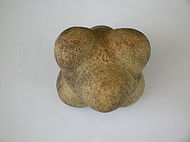
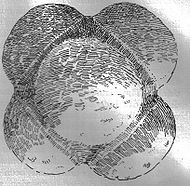
Twenty-six of the six-knobbed balls are decorated. The Orkney examples are unusual, being either all ornamented or otherwise unusual in appearance, such as the lack, bar one example, of the frequently found six-knobbed type. Metal may have been used to work some of the designs.
The Towie ball has some design similarities with the carvings on the Folkton
Folkton
Folkton is a small village and civil parish at the foot of the Yorkshire Wolds and on the edge of the Vale of Pickering on an area known as Folkton Carr in the Scarborough district of North Yorkshire, England....
"drums". These were found in a tumulus
Tumulus
A tumulus is a mound of earth and stones raised over a grave or graves. Tumuli are also known as barrows, burial mounds, Hügelgrab or kurgans, and can be found throughout much of the world. A tumulus composed largely or entirely of stones is usually referred to as a cairn...
in England and are made of chalk with elaborate carvings, amongst which are distinct oculi or eyes. Concentric carved lines on stone balls appear to be stylised oculi. This ball also has a roughly triangular arrangement of three dots in an interspace between the knobs. This appears to be identical to the arrangement of dots found on the Parkhill siver chain terminal ring, found near Aberdeen, a Pictish artefact. It is possible that the dots represent a name, as some of the Pictish symbols at least are thought to represent personal names.
Petrosomatoglyph
A petrosomatoglyph is an image of parts of a human or animal body incised in rock. Many were created by Celtic peoples, such as the Picts, Scots, Irish, Cornish, Cumbrians, Bretons and Welsh. These representations date from the Early Middle Ages; others of uncertain purpose date back to megalithic...
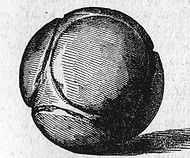
symbolism. Mostly the different knobs have different or sometimes no ornamentation. A 'golf-ball' variety of ornamentation is found on a few balls. The carving does not appear to have any practical purpose in general, however it has been suggested that one type, with very distinct knobs, was used for processing copper ores (see under 'Function'). Some of the bold triangles and criss-cross incisions seem to be more Iron Age in character than Neolithic or Bronze Age.
Function
Bolas
Bolas are a throwing weapon superficially similar to the surujin, made of weights on the ends of interconnected cords, designed to capture animals by entangling their legs...
. Their use as weapons was suggested by many researchers but in recent years this idea has fallen from favour.
One suggestion saw the balls as movable poises on a primitive weighing machine, following the logic of the remarkable uniformity in size shown by a good number of these carefully made objects. However, it has been shown that their weights vary so considerably that mathematically they could not be considered part of a system of weight measurement.
'Sink stones' found in Denmark and Ireland have some slight similarities, these artifacts being used in conjunction with fishing nets.
The possible use of the balls as oracle
Oracle
In Classical Antiquity, an oracle was a person or agency considered to be a source of wise counsel or prophetic predictions or precognition of the future, inspired by the gods. As such it is a form of divination....
s has been suggested. The way in which the ball came to rest could be interpreted as a message from the gods or an answer to a question. The lack of balls found in graves may indicate that they were not considered to belong to individuals.
An alternative or supplementary use could have been as the 'right to speak' where discussions are controlled by the requirement for the speaker to hold the Carved Stone Ball or if not, then keep his or her peace and listen to the views of others. The balls are of a size that fits comfortably in one hand.
Another possible use for the stones would be in the working of hides. Into the 20th Century leatherworkers would polish leather, parchment, and hides, by tying the skins to a frame using a ball at each corner of the hide then rubbing down material being worked with stones. The corners of the hides were wrapped around the balls which allowed the bindings to hold fast without slipping off. In more modern times, the balls were often made from scraps of the material being worked and the leather was cut away from the balls when the polishing was finished. This caused the balls to grow in size until the process had to be started over by replacing the oversized balls with scraps and beginning a new ball.
Ball games
Some theories are given here:Balls were used in traditional or religious games which continue to be played today, such as the Kirkwall Ba game
Kirkwall Ba game
The Kirkwall Ba Game is one of the main annual events held in the town of Kirkwall, in Orkney, Scotland. It is one of a number of Ba Games played in the streets of towns around Scotland; these are examples of traditional football games which are still played in towns in the United Kingdom and...
, which has been played on Christmas Eve and Hogmanay
Hogmanay
Hogmanay is the Scots word for the last day of the year and is synonymous with the celebration of the New Year in the Scottish manner...
every year since the mid 19th century. A hand-made leather ball is thrown up in the air close to St Magnus Cathedral in Kirkwall
Kirkwall
Kirkwall is the biggest town and capital of Orkney, off the coast of northern mainland Scotland. The town is first mentioned in Orkneyinga saga in the year 1046 when it is recorded as the residence of Rögnvald Brusason the Earl of Orkney, who was killed by his uncle Thorfinn the Mighty...
. As many as two hundred men take part and the game can go on for several hours. The object is for the ball to reach the 'goal' of the other team, this being either at the harbour or at the top of the town. The Cornish celtic game of Hurling
Cornish Hurling
Cornish Hurling or Hurling the Silver Ball , is an outdoor team game of Celtic origin played only in Cornwall, United Kingdom. It is played with a small silver ball...
is still played at St.Ives
St Ives, Cornwall
St Ives is a seaside town, civil parish and port in Cornwall, England, United Kingdom. The town lies north of Penzance and west of Camborne on the coast of the Celtic Sea. In former times it was commercially dependent on fishing. The decline in fishing, however, caused a shift in commercial...
and St. Columb Major and it has some similarities to the Orkney Ba' Game.
Balls of plain sandstone with the facets from shaping still clearly visible were found at Traprain Law
Traprain Law
Traprain Law is a hill about 221m in elevation, located east of Haddington in East Lothian, Scotland. It is the site of an oppidum or hill fort, which covered at its maximum extent about 16 ha and must have been a veritable town...
in East Lothian
East Lothian
East Lothian is one of the 32 council areas of Scotland, and a lieutenancy Area. It borders the City of Edinburgh, Scottish Borders and Midlothian. Its administrative centre is Haddington, although its largest town is Musselburgh....
. A significant number have already been found here and are known from other southern Scottish Iron Age
Iron Age
The Iron Age is the archaeological period generally occurring after the Bronze Age, marked by the prevalent use of iron. The early period of the age is characterized by the widespread use of iron or steel. The adoption of such material coincided with other changes in society, including differing...
sites. They may date from the fourth to third centuries BC. These balls are not ornamented and do not have knobs.
Another possibility was their use in the competitive throwing of balls from one place to another, one version being Irish Road Bowling
Irish Road Bowling
Irish road bowling is an ancient sport. It is centered in Ireland - primarily in County Armagh and County Cork. However, it also has players in Boston, Massachusetts; Cambridge, New York, and Bennington, Vermont, vicinity; Traverse City, Michigan; the Bronx, New York; New Zealand; Asheville, North...
, the winner being the one who uses the fewest throws to complete the course. This sport is popular in parts of Ireland
Ireland
Ireland is an island to the northwest of continental Europe. It is the third-largest island in Europe and the twentieth-largest island on Earth...
, the USA and New Zealand
New Zealand
New Zealand is an island country in the south-western Pacific Ocean comprising two main landmasses and numerous smaller islands. The country is situated some east of Australia across the Tasman Sea, and roughly south of the Pacific island nations of New Caledonia, Fiji, and Tonga...
.
Megalith construction aid
A theory on the movement of 'monument stones' has been put forward as a result of an observed correlation between standing stone circles in Aberdeenshire, Scotland and a concentration of carved stone balls, and it is suggested that these petrospherePetrosphere
In archaeology, a petrosphere is the name for any spherical man-made object of any size that is composed of stone. These mainly prehistoric artefacts may have been created and/or selected, but altered in some way to perform their specific function, including carving and painting.Several classes of...
s may have been used to help transport the big stones by functioning like ball bearings.
Many of the late Neolithic stone balls have diameters differing by only a millimetre. The discovery of this led to the suggestion that they might have been meant to be used together. By plotting the find sites on a map it can be demonstrated that often these petrospheres were located in the vicinity of Neolithic recumbent stone circles. Models using small wooden balls placed in a groove in parallel longitudinal pieces of wood 'sleepers' with a carrying board above have shown such megalith transport to be practical in some situations.
Miscellany
Mathematicians are interested in Carved Stone Balls because of their mathematical beautyMathematical beauty
Many mathematicians derive aesthetic pleasure from their work, and from mathematics in general. They express this pleasure by describing mathematics as beautiful. Sometimes mathematicians describe mathematics as an art form or, at a minimum, as a creative activity...
, as they have amongst them all the symmetrical forms of the five Platonic solids.