

Carnutes

Encyclopedia
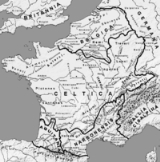
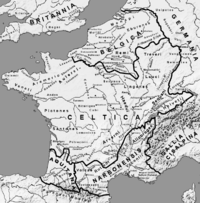
The Carnutes, a powerful Celt
ic people in the heart of independent Gaul
, dwelled in a particularly extensive territory between the Sequana (Seine
) and the Liger (Loire
) rivers. Their lands later corresponded to the dioceses of Chartres
, Orléans
and Blois
, that is, the greater part of the modern departments of Eure-et-Loir
, Loiret
and Loir-et-Cher
. The territory of the Carnutes had the reputation among Roman
observers of being the political and religious center of the Gaulish nations. The chief fortified towns were Cenabum (mistakenly "Genabum"), the modern Orléans, where a bridge crossed the Loire, and Autricum (or Carnutes, thus Chartres). The great annual druid
ic assembly mentioned by Caesar took place in one or the other of these towns. Livy
's history records the legendary tradition that the Carnutes had been one of the tribes which accompanied Bellovesus
in his invasion of Italy during the reign of Tarquinius Priscus
.
 In the 1st century BC, the Carnutes minted coins, usually struck with dies, but sometimes cast in an alloy of high tin content called "potin." Their coinage turns up in hoards well outside their home territories, in some cases so widely distributed in the finds that the place of coinage is not secure. The iconography
of their numismatics
includes the motives of heads with traditional Celtic torc
s; a wolf with a star; a galloping horse; the triskelion
. Many coins show an eagle, with the lunar crescent, with a serpent
or with a wheel with six or four spokes or a pentagram
matic star, or beneath a hand holding a branch with berries, holly
perhaps. The wheel with four spokes forms a cross within a circle, an almost universal image since Neolithic times. Sometimes the circle is a ring of granules. It would be easy to make too much of the symbol as it appears on coinage, but among the Celts, rather than a solar symbol it may represent the cycle of the year divided in its four seasons http://www.cgb.fr/monnaies/vso/v15/images/image713d.html?depart=557. See Cross
.
In the time of Caesar the Carnutes were dependents of the Remi
, who on one occasion interceded for them. In the winter of 58–57 BC, Caesar imposed a protectorate over the Carnutes and set up his choice of king, Tasgetius
, picked from the ruling clan. Within three years, the Carnutes had assassinated the puppet king. On 13 February 53 BC the Carnutes of Cenabum massacred all the Roman merchants stationed in the town as well as one of Caesar's commissariat officers. The uprising was swiftly a general one throughout Gaul, under the leadership of Vercingetorix
. Cenabum was burnt by Caesar, the men put to the sword and women and children sold as slaves, and the booty distributed among his soldiers, an effective way of financing the conquest of Gaul. During the war that followed, the Carnutes were able to send 12,000 fighting men to relieve Alesia
, but shared in the defeat of the Gallic army. Having attacked the Bituriges Cubi
, who appealed to Caesar for assistance, they were forced to submit. Cenabum, however, remained a mass of ruins garrisoned by two Roman legions for years.
After they had been pacified, though not Romanized, under Augustus, the Carnutes, as one of the peoples of Gallia Lugdunensis
, were raised to the rank of civitas soda or foederati
, retaining their own self-governing institutions, continuing to mint coins, and only bound to render military service to the emperor. Up to the 3rd century, Autricum (later Carnutes, whence Chartres) was the capital, but in 275 Aurelian
refounded Cenabum, ordaining it no longer a vicus but a civitas
and named it Aurelianum or Aurelianensis urbs (thus eventually "Orléans").
See Livy
, v.34; Julius Caesar
, Belli Gall. v. 25, 29, vii. 8, II, 75, viii. 5, 31 (see under "cenabuns); Strabo
Geographia iv.2 - 3; Ptolemy
Geographia, ii.8.
Celt
The Celts were a diverse group of tribal societies in Iron Age and Roman-era Europe who spoke Celtic languages.The earliest archaeological culture commonly accepted as Celtic, or rather Proto-Celtic, was the central European Hallstatt culture , named for the rich grave finds in Hallstatt, Austria....
ic people in the heart of independent Gaul
Gaul
Gaul was a region of Western Europe during the Iron Age and Roman era, encompassing present day France, Luxembourg and Belgium, most of Switzerland, the western part of Northern Italy, as well as the parts of the Netherlands and Germany on the left bank of the Rhine. The Gauls were the speakers of...
, dwelled in a particularly extensive territory between the Sequana (Seine
Seine
The Seine is a -long river and an important commercial waterway within the Paris Basin in the north of France. It rises at Saint-Seine near Dijon in northeastern France in the Langres plateau, flowing through Paris and into the English Channel at Le Havre . It is navigable by ocean-going vessels...
) and the Liger (Loire
Loire
Loire is an administrative department in the east-central part of France occupying the River Loire's upper reaches.-History:Loire was created in 1793 when after just 3½ years the young Rhône-et-Loire department was split into two. This was a response to counter-Revolutionary activities in Lyon...
) rivers. Their lands later corresponded to the dioceses of Chartres
Chartres
Chartres is a commune and capital of the Eure-et-Loir department in northern France. It is located southwest of Paris.-Geography:Chartres is built on the left bank of the Eure River, on a hill crowned by its famous cathedral, the spires of which are a landmark in the surrounding country...
, Orléans
Orléans
-Prehistory and Roman:Cenabum was a Gallic stronghold, one of the principal towns of the Carnutes tribe where the Druids held their annual assembly. It was conquered and destroyed by Julius Caesar in 52 BC, then rebuilt under the Roman Empire...
and Blois
Blois
Blois is the capital of Loir-et-Cher department in central France, situated on the banks of the lower river Loire between Orléans and Tours.-History:...
, that is, the greater part of the modern departments of Eure-et-Loir
Eure-et-Loir
Eure-et-Loir is a French department, named after the Eure and Loir rivers.-History:Eure-et-Loir is one of the original 83 departments created during the French Revolution on March 4, 1790 pursuant to the Act of December 22, 1789...
, Loiret
Loiret
Loiret is a department in north-central FranceThe department is named after the river Loiret, a tributary of the Loire. The Loiret is located wholly within the department.- History :...
and Loir-et-Cher
Loir-et-Cher
Loir-et-Cher is a département in north-central France named after the rivers Loir and Cher.-History:Loir-et-Cher is one of the original 83 departments created during the French Revolution on 4 March 1790. It was created from parts of the former provinces of Orléanais and...
. The territory of the Carnutes had the reputation among Roman
Ancient Rome
Ancient Rome was a thriving civilization that grew on the Italian Peninsula as early as the 8th century BC. Located along the Mediterranean Sea and centered on the city of Rome, it expanded to one of the largest empires in the ancient world....
observers of being the political and religious center of the Gaulish nations. The chief fortified towns were Cenabum (mistakenly "Genabum"), the modern Orléans, where a bridge crossed the Loire, and Autricum (or Carnutes, thus Chartres). The great annual druid
Druid
A druid was a member of the priestly class in Britain, Ireland, and Gaul, and possibly other parts of Celtic western Europe, during the Iron Age....
ic assembly mentioned by Caesar took place in one or the other of these towns. Livy
Livy
Titus Livius — known as Livy in English — was a Roman historian who wrote a monumental history of Rome and the Roman people. Ab Urbe Condita Libri, "Chapters from the Foundation of the City," covering the period from the earliest legends of Rome well before the traditional foundation in 753 BC...
's history records the legendary tradition that the Carnutes had been one of the tribes which accompanied Bellovesus
Bellovesus
Bellovesus was a legendary Gallic king. He lived around 600 BCE and is remembered for invading northern Italy with his people during the legendary reign of the 5th king of Rome, Tarquinius Priscus , although archeology would associate Gallic expansion into Italy to around 500 BCE.The historical...
in his invasion of Italy during the reign of Tarquinius Priscus
Tarquinius Priscus
Lucius Tarquinius Priscus, also called Tarquin the Elder or Tarquin I, was the legendary fifth King of Rome from 616 BC to 579 BC. His wife was Tanaquil.-Early life:According to Livy, Tarquinius Priscus came from the Etruria...
.
Iconography
Iconography is the branch of art history which studies the identification, description, and the interpretation of the content of images. The word iconography literally means "image writing", and comes from the Greek "image" and "to write". A secondary meaning is the painting of icons in the...
of their numismatics
Numismatics
Numismatics is the study or collection of currency, including coins, tokens, paper money, and related objects. While numismatists are often characterized as students or collectors of coins, the discipline also includes the broader study of money and other payment media used to resolve debts and the...
includes the motives of heads with traditional Celtic torc
Torc
A torc, also spelled torq or torque, is a large, usually rigid, neck ring typically made from strands of metal twisted together. The great majority are open-ended at the front, although many seem designed for near-permanent wear and would have been difficult to remove. Smaller torcs worn around...
s; a wolf with a star; a galloping horse; the triskelion
Triskelion
A triskelion or triskele is a motif consisting of three interlocked spirals, or three bent human legs, or any similar symbol with three protrusions and a threefold rotational symmetry. Both words are from Greek or , "three-legged", from prefix "τρι-" , "three times" + "σκέλος" , "leg"...
. Many coins show an eagle, with the lunar crescent, with a serpent
Serpent (symbolism)
Serpent in Latin means: Rory Collins :&, in turn, from the Biblical Hebrew word of: "saraf" with root letters of: which refers to something burning-as, the pain of poisonous snake's bite was likened to internal burning.This word is commonly used in a specifically mythic or religious context,...
or with a wheel with six or four spokes or a pentagram
Pentagram
A pentagram is the shape of a five-pointed star drawn with five straight strokes...
matic star, or beneath a hand holding a branch with berries, holly
Holly
Ilex) is a genus of 400 to 600 species of flowering plants in the family Aquifoliaceae, and the only living genus in that family. The species are evergreen and deciduous trees, shrubs, and climbers from tropics to temperate zones world wide....
perhaps. The wheel with four spokes forms a cross within a circle, an almost universal image since Neolithic times. Sometimes the circle is a ring of granules. It would be easy to make too much of the symbol as it appears on coinage, but among the Celts, rather than a solar symbol it may represent the cycle of the year divided in its four seasons http://www.cgb.fr/monnaies/vso/v15/images/image713d.html?depart=557. See Cross
Cross
A cross is a geometrical figure consisting of two lines or bars perpendicular to each other, dividing one or two of the lines in half. The lines usually run vertically and horizontally; if they run obliquely, the design is technically termed a saltire, although the arms of a saltire need not meet...
.
In the time of Caesar the Carnutes were dependents of the Remi
Remi
The Remi were a Belgic tribe of north-eastern Gaul in the 1st century BC. They occupied the northern Champagne plain, on the southern fringes of the Forest of Ardennes, between the rivers Mosa and Matrona , and along the river valleys of the Aisne and its tributaries the Aire and the Vesle.Their...
, who on one occasion interceded for them. In the winter of 58–57 BC, Caesar imposed a protectorate over the Carnutes and set up his choice of king, Tasgetius
Tasgetius
Tasgetius, the Latinized form of Gaulish Tasgetios or Tasgiitios , was a ruler of the Carnutes, a Celtic polity whose territory corresponded roughly with the modern French departments of Eure-et-Loire, Loiret, and Loire-et-Cher. Julius Caesar says that as Roman proconsul he made Tasgetius king in...
, picked from the ruling clan. Within three years, the Carnutes had assassinated the puppet king. On 13 February 53 BC the Carnutes of Cenabum massacred all the Roman merchants stationed in the town as well as one of Caesar's commissariat officers. The uprising was swiftly a general one throughout Gaul, under the leadership of Vercingetorix
Vercingetorix
Vercingetorix was the chieftain of the Arverni tribe, who united the Gauls in an ultimately unsuccessful revolt against Roman forces during the last phase of Julius Caesar's Gallic Wars....
. Cenabum was burnt by Caesar, the men put to the sword and women and children sold as slaves, and the booty distributed among his soldiers, an effective way of financing the conquest of Gaul. During the war that followed, the Carnutes were able to send 12,000 fighting men to relieve Alesia
Alesia
-Places:France*Alesia , an ancient city in Gaul**Battle of Alesia*Alésia , a station in the Paris Métro*Rue d'Alésia, Paris*Le quartier Alésia, an unofficial district of Paris that mostly overlaps Petit-MontrougeUnited States...
, but shared in the defeat of the Gallic army. Having attacked the Bituriges Cubi
Bituriges
The Bituriges was a tribe with its capital at Bourges .Early in the 1st century BCE, they had been one of the main tribes, especially in terms of Druids and their political influence. But they soon declined in power as the Druids were an important target for Julius Caesar in his conquest of Gaul...
, who appealed to Caesar for assistance, they were forced to submit. Cenabum, however, remained a mass of ruins garrisoned by two Roman legions for years.
After they had been pacified, though not Romanized, under Augustus, the Carnutes, as one of the peoples of Gallia Lugdunensis
Gallia Lugdunensis
Gallia Lugdunensis was a province of the Roman Empire in what is now the modern country of France, part of the Celtic territory of Gaul. It is named after its capital Lugdunum , possibly Roman Europe's major city west of Italy, and a major imperial mint...
, were raised to the rank of civitas soda or foederati
Foederati
Foederatus is a Latin term whose definition and usage drifted in the time between the early Roman Republic and the end of the Western Roman Empire...
, retaining their own self-governing institutions, continuing to mint coins, and only bound to render military service to the emperor. Up to the 3rd century, Autricum (later Carnutes, whence Chartres) was the capital, but in 275 Aurelian
Aurelian
Aurelian , was Roman Emperor from 270 to 275. During his reign, he defeated the Alamanni after a devastating war. He also defeated the Goths, Vandals, Juthungi, Sarmatians, and Carpi. Aurelian restored the Empire's eastern provinces after his conquest of the Palmyrene Empire in 273. The following...
refounded Cenabum, ordaining it no longer a vicus but a civitas
Civitas
In the history of Rome, the Latin term civitas , according to Cicero in the time of the late Roman Republic, was the social body of the cives, or citizens, united by law . It is the law that binds them together, giving them responsibilities on the one hand and rights of citizenship on the other...
and named it Aurelianum or Aurelianensis urbs (thus eventually "Orléans").
See Livy
Livy
Titus Livius — known as Livy in English — was a Roman historian who wrote a monumental history of Rome and the Roman people. Ab Urbe Condita Libri, "Chapters from the Foundation of the City," covering the period from the earliest legends of Rome well before the traditional foundation in 753 BC...
, v.34; Julius Caesar
Julius Caesar
Gaius Julius Caesar was a Roman general and statesman and a distinguished writer of Latin prose. He played a critical role in the gradual transformation of the Roman Republic into the Roman Empire....
, Belli Gall. v. 25, 29, vii. 8, II, 75, viii. 5, 31 (see under "cenabuns); Strabo
Strabo
Strabo, also written Strabon was a Greek historian, geographer and philosopher.-Life:Strabo was born to an affluent family from Amaseia in Pontus , a city which he said was situated the approximate equivalent of 75 km from the Black Sea...
Geographia iv.2 - 3; Ptolemy
Ptolemy
Claudius Ptolemy , was a Roman citizen of Egypt who wrote in Greek. He was a mathematician, astronomer, geographer, astrologer, and poet of a single epigram in the Greek Anthology. He lived in Egypt under Roman rule, and is believed to have been born in the town of Ptolemais Hermiou in the...
Geographia, ii.8.
External links
- Monnayage des Carnutes: detailed illustrations of numismatics
- Coins minted by the Carnutes, 1st century BCE
- Histoire de la ville d'Orléans": map of the Carnutes territory (in French)
- R. Boutrays, Urbis gentisque Carnutum historia 1624
- A. Desjardins, Géographie historique de la Gaule, ii, I876 1893