

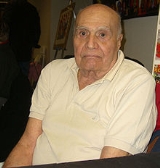
Carmine Infantino

Encyclopedia
Carmine Infantino
Carmine Infantino (born May 24, 1925, in Brooklyn, New York is an American comic book
artist
and editor
who was a major force in the Silver Age of Comic Books
. He was inducted into the Comic Book Hall of Fame in 2000, and was cited in Comics Buyer's Guide
Millennium Poll as the greatest penciller of all time.
, New York City
. His father, Pasquale "Patrick" Infantino, born in New York City, was originally a musician who played saxophone
, clarinet
, and violin
, and had a band with composer Harry Warren
, but in the poverty of the Great Depression
he turned instead to a career as a licensed plumber
. Carmine Infantino's mother, Angela Rosa DellaBadia, emigrated from Calitri
, a hill town northeast of Naples, Italy.
Infantino attended Public Schools 75 and 85 in Brooklyn before going on to the School of Industrial Art (later the High School of Art and Design
) in Manhattan
. During his freshman year of high school, Infantino began working for Harry "A" Chesler, whose studio was one of a handful of comic-book "packagers" who created complete comics for publishers looking to enter the emerging field in the 1930s-1940s Golden Age of Comic Books
. As Infantino recalled:
penciling, Infantino inked
the feature "Jack Frost" in USA Comics #3 (Jan. 1942). He wrote in his autobiography that
Infantino would eventually work for several publishers during the decade, drawing Airboy
and the Heap
for Hillman Periodicals
; working for packager Jack Binder, who supplied Fawcett Comics
; briefly at Holyoke Publishing; then landing at DC Comics
, where he became a regular artist of the Golden Age Flash
, Black Canary
, Green Lantern
and Justice Society of America
.
During the 1950s, Infantino freelanced for Joe Simon
and Jack Kirby
's company, Prize Comics, drawing the series Charlie Chan
, which in particular shows the influence both of Kirby's and Milton Caniff
's art styles. Back at DC, during a lull in the popularity of superhero
es, Infantino drew Westerns
, mysteries
, science fiction
comics. As his style evolved, he began to shed both the Kirbyisms and the gritty shading of Caniff, and develop a clean, linear style.
assigned writer Robert Kanigher
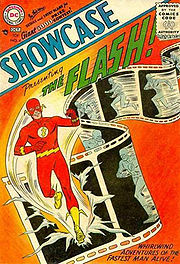
and artist Infantino to the company's first attempt at reviving superheroes: an updated version of the Flash that would appear in issue #4 (Oct. 1956) of the try-out series Showcase
. Infantino designed the now-classic red uniform with yellow detail (reminiscent of the original Fawcett
Captain Marvel
), striving to keep the costume as streamlined as possible, and he drew on his design abilities to create a new visual language to depict the Flash's speed, making the figure a red and yellow blur. The eventual success of the new, science-fiction oriented Flash heralded the wholesale return of superheroes, and the beginning of what fans and historians call the Silver Age of comics.
 Infantino drew the "Flash of Two Worlds
" a landmark story that was published in The Flash
#123 (Sept. 1961). It introduces Earth-Two
, and more generally the concept of the multiverse
, to DC Comics. Infantino continued to work for Schwartz in his other features and titles, most notably "Adam Strange
" in Mystery in Space
, replacing Mike Sekowsky
who did the penciling in Showcase 17-19. In 1964, Schwartz was made responsible for reviving the faded Batman
titles. Writer John Broome
and artist Infantino jettisoned the sillier aspects that had crept into the series (such as Ace the Bathound, and Bat-Mite
) and gave the "New Look" Batman and Robin a more detective-oriented direction and sleeker draftsmanship that proved a hit combination. Other features and characters Infantino drew at DC include "The Space Museum", and Elongated Man
.
After Wilson McCoy
, the artist of The Phantom
comic strip, died, Infantino finished one of his last stories. Infantino was a candidate for taking over the Phantom Sunday strip after McCoy's death, but the job was instead given to Sy Barry
.
with designing covers for the entire DC line. Stan Lee
learned this and approached Infantino with a $22,000 offer to move to Marvel. Publisher Jack Liebowitz
confirmed that DC could not match the offer, but could promote Infantino to the position of art director. Initially reluctant, Infantino accepted what Liebowitz posed as a challenge, and decided to stay with DC. When DC was sold to Kinney National Company
, Infantino was promoted to editorial director. He started by hiring new talent, and promoting artists to editorial positions. He hired Dick Giordano
away from Charlton Comics
, and made artists Joe Orlando
, Joe Kubert
and Mike Sekowsky editors. New talents such as artist Neal Adams
and writer Denny O'Neil
were brought into the company. Several of DC's older characters were revamped by O'Neil including Wonder Woman
; Batman; Green Lantern
and Green Arrow
; and Superman
.
In 1970, Infantino signed on Marvel Comics' star artist and storytelling collaborator, Jack Kirby
, to a DC Comics contract. Beginning with Superman's Pal Jimmy Olsen, Kirby created his Fourth World saga that wove through that existing title and three new series he created. After the "Fourth World" titles were canceled, Kirby created several other series for DC including OMAC, Kamandi
, The Demon, and, together with former partner Joe Simon for one last time, a new incarnation of the Sandman
before returning to freelancing for Marvel in 1975.
Infantino was made DC's publisher in early 1971, during a time of declining circulation for the company's comics, and he attempted a number of changes. In an effort to raise revenue, he raised the cover price of DC's comics from 15 to 25 cents, simultaneously raising the page-count by adding reprints and new backup features. Marvel met the price increase, then dropped back to 20 cents; DC stayed at 25 cents for about a year, a decision that ultimately proved bad for overall sales.
Infantino and writer Len Wein
co-created the "Human Target
" feature in Action Comics
#419 (December 1972). The character was adapted into a short-lived ABC
television series starring Rick Springfield
which debuted in July 1992.
After working with writer Mario Puzo
on the Superman movie, Infantino collaborated with Marvel on the historic company-crossover publication Superman vs. the Amazing Spider-Man
. Yet in January 1976
, before sales on that hit book had been recorded, Warner Communications
replaced Infantino with Jenette Kahn
, a person new to the comics field. Infantino returned to drawing freelance.
 Infantino later drew for a number of titles for Warren Publishing
and Marvel, including the latter's Star Wars
, Spider-Woman
, and Nova
. In 1981, he returned to DC Comics and co-created a revival of the "Dial H for Hero
" feature with writer Marv Wolfman
in a special insert
in Legion of Super-Heroes #272 (February 1981). Infantino returned to The Flash
title with issue #296 (April 1981) and drew the book until its cancellation with issue #350 (October 1985). In 2004, he sued DC for rights to characters he alleges to have created while he was a freelancer
for the company. These include several Flash characters including Wally West
, Iris West
, Captain Cold
, Captain Boomerang
, Mirror Master
, and Gorilla Grodd
, as well as the Elongated Man
and Batgirl
. , Infantino is retired.
Infantino has written or contributed two books about his life and career: The Amazing World of Carmine Infantino (Vanguard Productions, ISBN 1-887591-12-5), and Carmine Infantino: Penciler, Publisher, Provocateur (Tomorrows Publishing, ISBN 1-6054-9025-3)
Infantino is the uncle of Massachusetts
musician Jim Infantino
, of the band Jim's Big Ego
. He contributed the cover art
to the group's album They're Everywhere, which features a song about the Flash called "The Ballad of Barry Allen."
on the popular but apocryphal anecdote
, told by Julius Schwartz
, about Carmine Infantino firing Cardy over not following a cover layout, only to rehire him moments later when Schwartz praised the errant cover art:
Carmine Infantino (born May 24, 1925, in Brooklyn, New York is an American comic book
Comic book
A comic book or comicbook is a magazine made up of comics, narrative artwork in the form of separate panels that represent individual scenes, often accompanied by dialog as well as including...
artist
Artist
An artist is a person engaged in one or more of any of a broad spectrum of activities related to creating art, practicing the arts and/or demonstrating an art. The common usage in both everyday speech and academic discourse is a practitioner in the visual arts only...
and editor
Editing
Editing is the process of selecting and preparing written, visual, audible, and film media used to convey information through the processes of correction, condensation, organization, and other modifications performed with an intention of producing a correct, consistent, accurate, and complete...
who was a major force in the Silver Age of Comic Books
Silver Age of Comic Books
The Silver Age of Comic Books was a period of artistic advancement and commercial success in mainstream American comic books, predominantly those in the superhero genre. Following the Golden Age of Comic Books and an interregnum in the early to mid-1950s, the Silver Age is considered to cover the...
. He was inducted into the Comic Book Hall of Fame in 2000, and was cited in Comics Buyer's Guide
Comics Buyer's Guide
Comics Buyer's Guide , established in 1971, is the longest-running English-language periodical reporting on the American comic book industry...
Millennium Poll as the greatest penciller of all time.
Early life
Carmine Infantino was born via midwife in his family's apartment in BrooklynBrooklyn
Brooklyn is the most populous of New York City's five boroughs, with nearly 2.6 million residents, and the second-largest in area. Since 1896, Brooklyn has had the same boundaries as Kings County, which is now the most populous county in New York State and the second-most densely populated...
, New York City
New York City
New York is the most populous city in the United States and the center of the New York Metropolitan Area, one of the most populous metropolitan areas in the world. New York exerts a significant impact upon global commerce, finance, media, art, fashion, research, technology, education, and...
. His father, Pasquale "Patrick" Infantino, born in New York City, was originally a musician who played saxophone
Saxophone
The saxophone is a conical-bore transposing musical instrument that is a member of the woodwind family. Saxophones are usually made of brass and played with a single-reed mouthpiece similar to that of the clarinet. The saxophone was invented by the Belgian instrument maker Adolphe Sax in 1846...
, clarinet
Clarinet
The clarinet is a musical instrument of woodwind type. The name derives from adding the suffix -et to the Italian word clarino , as the first clarinets had a strident tone similar to that of a trumpet. The instrument has an approximately cylindrical bore, and uses a single reed...
, and violin
Violin
The violin is a string instrument, usually with four strings tuned in perfect fifths. It is the smallest, highest-pitched member of the violin family of string instruments, which includes the viola and cello....
, and had a band with composer Harry Warren
Harry Warren
Harry Warren was an American composer and lyricist. Warren was the first major American songwriter to write primarily for film. He was nominated for the Academy Award for Best Song eleven times and won three Oscars for composing "Lullaby of Broadway", "You'll Never Know" and "On the Atchison,...
, but in the poverty of the Great Depression
Great Depression
The Great Depression was a severe worldwide economic depression in the decade preceding World War II. The timing of the Great Depression varied across nations, but in most countries it started in about 1929 and lasted until the late 1930s or early 1940s...
he turned instead to a career as a licensed plumber
Plumber
A plumber is a tradesperson who specializes in installing and maintaining systems used for potable water, sewage, and drainage in plumbing systems. The term dates from ancient times, and is related to the Latin word for lead, "plumbum." A person engaged in fixing metaphorical "leaks" may also be...
. Carmine Infantino's mother, Angela Rosa DellaBadia, emigrated from Calitri
Calitri
Calitri is a town and comune of 5,292 inhabitants situated in the province of Avellino, Campania, Italy.- Overview :It is situated in Campania but on the borders of the regions of Apulia and Basilicata. It is approximately 530 metres above sea level so even on the hottest day there is generally a...
, a hill town northeast of Naples, Italy.
Infantino attended Public Schools 75 and 85 in Brooklyn before going on to the School of Industrial Art (later the High School of Art and Design
High School of Art and Design
The High School of Art and Design is a Career and Technical Education high school located at 1075 Second Avenue, between 56th and 57th Streets in Manhattan, New York City, New York.It is operated by the New York City Department of Education...
) in Manhattan
Manhattan
Manhattan is the oldest and the most densely populated of the five boroughs of New York City. Located primarily on the island of Manhattan at the mouth of the Hudson River, the boundaries of the borough are identical to those of New York County, an original county of the state of New York...
. During his freshman year of high school, Infantino began working for Harry "A" Chesler, whose studio was one of a handful of comic-book "packagers" who created complete comics for publishers looking to enter the emerging field in the 1930s-1940s Golden Age of Comic Books
Golden Age of Comic Books
The Golden Age of Comic Books was a period in the history of American comic books, generally thought of as lasting from the late 1930s until the late 1940s or early 1950s...
. As Infantino recalled:
Career
With Frank GiacoiaFrank Giacoia
Frank Giacoia was an American comic book artist known primarily as an inker. He sometimes worked under the name Frank Ray, and to a lesser extent Phil Zupa, and the single moniker Espoia .-Early life and career:Frank Giacoia studied at Manhattan's School of...
penciling, Infantino inked
Inker
The inker is one of the two line artists in a traditional comic book or graphic novel. After a pencilled drawing is given to the inker, the inker uses black ink to produce refined outlines over the pencil lines...
the feature "Jack Frost" in USA Comics #3 (Jan. 1942). He wrote in his autobiography that
Infantino would eventually work for several publishers during the decade, drawing Airboy
Airboy
Airboy is a fictional aviator hero of an American comic book series initially published by Hillman Periodicals during the World War II-era time period fans and historians call the Golden Age of comic books. He was created by writers Charles Biro and Dick Wood and artist Al Camy.-Golden Age:Airboy...
and the Heap
The Heap (comics)
The Heap is the name of several fictional comic book muck-monsters, the original of which first appeared in Hillman Periodicals' Air Fighters Comics #3 , during the period fans and historians call the Golden Age of Comic Books...
for Hillman Periodicals
Hillman Periodicals
Hillman Periodicals, Inc. was an American magazine and comic book publishing company founded in 1938 by Alex L. Hillman, a former New York City book publisher...
; working for packager Jack Binder, who supplied Fawcett Comics
Fawcett Comics
Fawcett Comics, a division of Fawcett Publications, was one of several successful comic book publishers during the Golden Age of Comic Books in the 1940s...
; briefly at Holyoke Publishing; then landing at DC Comics
DC Comics
DC Comics, Inc. is one of the largest and most successful companies operating in the market for American comic books and related media. It is the publishing unit of DC Entertainment a company of Warner Bros. Entertainment, which itself is owned by Time Warner...
, where he became a regular artist of the Golden Age Flash
Flash (comics)
The Flash is a name shared by several fictional comic book superheroes from the DC Comics universe. Created by writer Gardner Fox and artist Harry Lampert, the original Flash first appeared in Flash Comics #1 ....
, Black Canary
Black Canary
Black Canary is the name of two fictional characters, DC Comics superheroines created by writer Robert Kanigher and artist Carmine Infantino. The first Black Canary debuted appeared in Flash Comics #86 . The first Black Canary was the alter-ego of Dinah Drake, who took part in Golden Age adventures...
, Green Lantern
Green Lantern
The Green Lantern is the shared primary alias of several fictional characters, superheroes appearing in comic books published by DC Comics. The first Green Lantern was created by writer Bill Finger and artist Martin Nodell in All-American Comics #16 .Each Green Lantern possesses a power ring and...
and Justice Society of America
Justice Society of America
The Justice Society of America, or JSA, is a DC Comics superhero group, the first team of superheroes in comic book history. Conceived by editor Sheldon Mayer and writer Gardner Fox, the JSA first appeared in All Star Comics #3 ....
.
During the 1950s, Infantino freelanced for Joe Simon
Joe Simon
Joseph Henry "Joe" Simon is an American comic book writer, artist, editor, and publisher. Simon created or co-created many important characters in the 1930s-1940s Golden Age of Comic Books and served as the first editor of Timely Comics, the company that would evolve into Marvel Comics.With his...
and Jack Kirby
Jack Kirby
Jack Kirby , born Jacob Kurtzberg, was an American comic book artist, writer and editor regarded by historians and fans as one of the major innovators and most influential creators in the comic book medium....
's company, Prize Comics, drawing the series Charlie Chan
Charlie Chan
Charlie Chan is a fictional Chinese-American detective created by Earl Derr Biggers in 1919. Loosely based on Honolulu detective Chang Apana, Biggers conceived of the benevolent and heroic Chan as an alternative to Yellow Peril stereotypes, such as villains like Fu Manchu...
, which in particular shows the influence both of Kirby's and Milton Caniff
Milton Caniff
Milton Arthur Paul Caniff was an American cartoonist famous for the Terry and the Pirates and Steve Canyon comic strips.-Biography:...
's art styles. Back at DC, during a lull in the popularity of superhero
Superhero
A superhero is a type of stock character, possessing "extraordinary or superhuman powers", dedicated to protecting the public. Since the debut of the prototypical superhero Superman in 1938, stories of superheroes — ranging from brief episodic adventures to continuing years-long sagas —...
es, Infantino drew Westerns
Western comics
Western comics is a comics genre usually depicting the American Old West frontier and typically set during the late nineteenth century...
, mysteries
Mystery fiction
Mystery fiction is a loosely-defined term.1.It is often used as a synonym for detective fiction or crime fiction— in other words a novel or short story in which a detective investigates and solves a crime mystery. Sometimes mystery books are nonfiction...
, science fiction
Science fiction
Science fiction is a genre of fiction dealing with imaginary but more or less plausible content such as future settings, futuristic science and technology, space travel, aliens, and paranormal abilities...
comics. As his style evolved, he began to shed both the Kirbyisms and the gritty shading of Caniff, and develop a clean, linear style.
The Silver Age
In 1956, DC editor Julius SchwartzJulius Schwartz
Julius "Julie" Schwartz was a comic book and pulp magazine editor, and a science fiction agent and prominent fan. He was born in the Bronx, New York...
assigned writer Robert Kanigher
Robert Kanigher
Robert Kanigher was a prolific comic book writer and editor whose career spanned five decades. He was involved with the Wonder Woman franchise for over twenty years, taking over the scripting from creator William Moulton Marston. In addition, Kanigher spent many years in charge of DC Comics' war...
and artist Infantino to the company's first attempt at reviving superheroes: an updated version of the Flash that would appear in issue #4 (Oct. 1956) of the try-out series Showcase
Showcase (comics)
Showcase has been the title of several comic anthology series published by DC Comics. The general theme of these series has been to feature new and minor characters as a way to gauge reader interest in them, without the difficulty and risk of featuring "untested" characters in their own ongoing...
. Infantino designed the now-classic red uniform with yellow detail (reminiscent of the original Fawcett
Fawcett Comics
Fawcett Comics, a division of Fawcett Publications, was one of several successful comic book publishers during the Golden Age of Comic Books in the 1940s...
Captain Marvel
Captain Marvel (DC Comics)
Captain Marvel is a fictional comic book superhero, originally published by Fawcett Comics and later by DC Comics. Created in 1939 by artist C. C. Beck and writer Bill Parker, the character first appeared in Whiz Comics #2...
), striving to keep the costume as streamlined as possible, and he drew on his design abilities to create a new visual language to depict the Flash's speed, making the figure a red and yellow blur. The eventual success of the new, science-fiction oriented Flash heralded the wholesale return of superheroes, and the beginning of what fans and historians call the Silver Age of comics.
Flash of Two Worlds
"Flash of Two Worlds!" is a landmark comic book story that was published in The Flash #123 . It introduces Earth-Two, and more generally the concept of the multiverse, to DC Comics...
" a landmark story that was published in The Flash
The Flash (comic book)
The Flash is an ongoing comic book series featuring the DC Comics superhero of the same name. The character's first incarnation, Jay Garrick, first appeared in Flash Comics #1...
#123 (Sept. 1961). It introduces Earth-Two
Earth-Two
Earth-Two is a fictional universe appearing in American comic book stories published by DC Comics. First appearing in The Flash #123 , Earth-Two was created to explain how Silver-Age versions of characters such as the Flash could appear in stories with their Golden Age counterparts...
, and more generally the concept of the multiverse
Multiverse (DC Comics)
The DC Multiverse is a fictional continuity construct that exists in stories published by comic book company DC Comics. The DC Multiverse consists of numerous worlds, most of them outside DC's main continuity, allowing writers the creative freedom to explore alternative versions of characters and...
, to DC Comics. Infantino continued to work for Schwartz in his other features and titles, most notably "Adam Strange
Adam Strange
Adam Strange is a fictional superhero published by DC Comics. Created by writer Gardner Fox and artist Mike Sekowsky, he first appeared in Showcase #17 .In May 2011, Adam Strange placed 97th on IGN's Top 100 Comic Book Heroes of All Time....
" in Mystery in Space
Mystery in Space
Mystery in Space is the name of two science fiction comic book series published in the United States by DC Comics, then known as National Comics. The first series ran for 110 issues from 1951 - 1966, with a further 7 issues continuing the numbering during a 1980s revival of the title...
, replacing Mike Sekowsky
Mike Sekowsky
Michael Sekowsky was a Jewish American comic book artist best known as the exclusive penciler for DC Comics' Justice League of America during most of the 1960s, and as the regular writer and artist on Wonder Woman during the late 1960s and early 1970s.-Early life and career:Mike Sekowsky began...
who did the penciling in Showcase 17-19. In 1964, Schwartz was made responsible for reviving the faded Batman
Batman
Batman is a fictional character created by the artist Bob Kane and writer Bill Finger. A comic book superhero, Batman first appeared in Detective Comics #27 , and since then has appeared primarily in publications by DC Comics...
titles. Writer John Broome
John Broome (writer)
John Broome , who additionally used the pseudonyms John Osgood and Edgar Ray Meritt, was an American comic book writer for DC Comics.-Early life and career:...
and artist Infantino jettisoned the sillier aspects that had crept into the series (such as Ace the Bathound, and Bat-Mite
Bat-Mite
Bat-Mite is a fictional character appearing in stories published by DC Comics. Bat-Mite is an Imp similar to the Superman villain Mister Mxyzptlk...
) and gave the "New Look" Batman and Robin a more detective-oriented direction and sleeker draftsmanship that proved a hit combination. Other features and characters Infantino drew at DC include "The Space Museum", and Elongated Man
Elongated Man
The Elongated Man is a fictional comic book superhero in the DC universe. He is a reserve member of the Justice League. His first appearance was in The Flash vol. 1, #112...
.
After Wilson McCoy
Wilson McCoy
Wilson McCoy was an American illustrator and painter best known as the second artist on the The Phantom comic strip.Wilson McCoy is well known for his unique, naive style of drawing...
, the artist of The Phantom
The Phantom
The Phantom is an American adventure comic strip created by Lee Falk, also creator of Mandrake the Magician. A popular feature adapted into many media, including television, film and video games, it stars a costumed crimefighter operating from the fictional African country Bengalla.The Phantom is...
comic strip, died, Infantino finished one of his last stories. Infantino was a candidate for taking over the Phantom Sunday strip after McCoy's death, but the job was instead given to Sy Barry
Sy Barry
Seymour "Sy" Barry is an American comic strip artist, best known for his work on The Phantom comic strip, which he drew for three decades.-Career:...
.
DC Comics editorial director
In late 1966/early 1967, Infantino was tasked by Irwin DonenfeldIrwin Donenfeld
Irwin Donenfeld was an American comic book publishing executive for DC Comics. Donenfeld co-owned the firm from 1948 to 1967, holding the positions of Editorial Director and Executive Vice President...
with designing covers for the entire DC line. Stan Lee
Stan Lee
Stan Lee is an American comic book writer, editor, actor, producer, publisher, television personality, and the former president and chairman of Marvel Comics....
learned this and approached Infantino with a $22,000 offer to move to Marvel. Publisher Jack Liebowitz
Jack Liebowitz
Jacob "Jack" S. Liebowitz , was an American accountant and publisher, known primarily as the co-owner with Harry Donenfeld of National Allied Publications .-Early life:...
confirmed that DC could not match the offer, but could promote Infantino to the position of art director. Initially reluctant, Infantino accepted what Liebowitz posed as a challenge, and decided to stay with DC. When DC was sold to Kinney National Company
Kinney National Company
Kinney National Services, Inc. was formed in 1966 when the Kinney Parking Company and the National Cleaning Company merged. The new company was headed by Steve Ross....
, Infantino was promoted to editorial director. He started by hiring new talent, and promoting artists to editorial positions. He hired Dick Giordano
Dick Giordano
Richard Joseph "Dick" Giordano was an American comic book artist and editor best known for introducing Charlton Comics' "Action Heroes" stable of superheroes, and serving as executive editor of then–industry leader DC Comics...
away from Charlton Comics
Charlton Comics
Charlton Comics was an American comic book publishing company that existed from 1946 to 1985, having begun under a different name in 1944. It was based in Derby, Connecticut...
, and made artists Joe Orlando
Joe Orlando
Joseph Orlando was a prolific illustrator, writer, editor and cartoonist during a lengthy career spanning six decades...
, Joe Kubert
Joe Kubert
Joe Kubert is an American comic book artist who went on to found The Kubert School. He is best known for his work on the DC Comics characters Sgt. Rock and Hawkman...
and Mike Sekowsky editors. New talents such as artist Neal Adams
Neal Adams
Neal Adams is an American comic book and commercial artist known for helping to create some of the definitive modern imagery of the DC Comics characters Superman, Batman, and Green Arrow; as the co-founder of the graphic design studio Continuity Associates; and as a creators-rights advocate who...
and writer Denny O'Neil
Dennis O'Neil
Dennis J. "Denny" O'Neil is an American comic book writer and editor, principally for Marvel Comics and DC Comics in the 1970s, 1980s, and 1990s, and Group Editor for the Batman family of books until his retirement....
were brought into the company. Several of DC's older characters were revamped by O'Neil including Wonder Woman
Wonder Woman
Wonder Woman is a DC Comics superheroine created by William Moulton Marston. She first appeared in All Star Comics #8 . The Wonder Woman title has been published by DC Comics almost continuously except for a brief hiatus in 1986....
; Batman; Green Lantern
Hal Jordan
Harold "Hal" Jordan is a DC Comics superhero known as Green Lantern, the first human shown to join the Green Lantern Corps and a founding member of the Justice League of America. Jordan is the second DC Comics character to adopt the Green Lantern moniker...
and Green Arrow
Green Arrow
Green Arrow is a fictional superhero that appears in comic books published by DC Comics. Created by Mort Weisinger and George Papp, he first appeared in More Fun Comics #73 in November 1941. His secret identity is Oliver Queen, billionaire and former mayor of fictional Star City...
; and Superman
Superman
Superman is a fictional comic book superhero appearing in publications by DC Comics, widely considered to be an American cultural icon. Created by American writer Jerry Siegel and Canadian-born American artist Joe Shuster in 1932 while both were living in Cleveland, Ohio, and sold to Detective...
.
In 1970, Infantino signed on Marvel Comics' star artist and storytelling collaborator, Jack Kirby
Jack Kirby
Jack Kirby , born Jacob Kurtzberg, was an American comic book artist, writer and editor regarded by historians and fans as one of the major innovators and most influential creators in the comic book medium....
, to a DC Comics contract. Beginning with Superman's Pal Jimmy Olsen, Kirby created his Fourth World saga that wove through that existing title and three new series he created. After the "Fourth World" titles were canceled, Kirby created several other series for DC including OMAC, Kamandi
Kamandi
Kamandi is an American comic book character, created by artist Jack Kirby and published by DC Comics. The bulk of Kamandi's appearances occurred in the comic series Kamandi: The Last Boy on Earth, which ran from 1972 to 1978....
, The Demon, and, together with former partner Joe Simon for one last time, a new incarnation of the Sandman
Sandman (DC Comics)
Sandman is the name of seven fictional characters, superheroes appearing in comic books published by DC Comics. All are connected in one way or the other, though there are three largely dissimilar concepts, with two or three persons having served in each role various times...
before returning to freelancing for Marvel in 1975.
Infantino was made DC's publisher in early 1971, during a time of declining circulation for the company's comics, and he attempted a number of changes. In an effort to raise revenue, he raised the cover price of DC's comics from 15 to 25 cents, simultaneously raising the page-count by adding reprints and new backup features. Marvel met the price increase, then dropped back to 20 cents; DC stayed at 25 cents for about a year, a decision that ultimately proved bad for overall sales.
Infantino and writer Len Wein
Len Wein
Len Wein is an American comic book writer and editor best known for co-creating DC Comics' Swamp Thing and Marvel Comics' Wolverine, and for helping revive the Marvel superhero team the X-Men...
co-created the "Human Target
Human Target
The Human Target is the name of two fictional comic book characters that have appeared in books published by DC Comics. The first is Fred Venable, who appears in Detective Comics #201 , by Edmond Hamilton and Sheldon Moldoff....
" feature in Action Comics
Action Comics
Action Comics is an American comic book series that introduced Superman, the first major superhero character as the term is popularly defined...
#419 (December 1972). The character was adapted into a short-lived ABC
American Broadcasting Company
The American Broadcasting Company is an American commercial broadcasting television network. Created in 1943 from the former NBC Blue radio network, ABC is owned by The Walt Disney Company and is part of Disney-ABC Television Group. Its first broadcast on television was in 1948...
television series starring Rick Springfield
Rick Springfield
Rick Springfield is an Australian-born singer-songwriter, musician, and actor. He was a member of pop rock group Zoot from 1969 to 1971 and then started his solo career with his début single "Speak to the Sky" reaching the top 10 in Australia. In mid-1972, he relocated to the United States...
which debuted in July 1992.
After working with writer Mario Puzo
Mario Puzo
Mario Gianluigi Puzo was an American author and screenwriter, known for his novels about the Mafia, including The Godfather , which he later co-adapted into a film by Francis Ford Coppola...
on the Superman movie, Infantino collaborated with Marvel on the historic company-crossover publication Superman vs. the Amazing Spider-Man
Superman vs. the Amazing Spider-Man
Superman vs The Amazing Spider-Man: The Battle of the Century is a comic book jointly published by DC Comics and Marvel Comics in 1976. It was the first cross-over between characters of both companies.-Publication history:...
. Yet in January 1976
1976 in comics
This is a list of comics-related events in 1976.- Year overall :* American Splendor, Harvey Pekar's long-running autobiographical comic book title, publishes its debut issue.* Fantagraphics Books, Inc. founded by Gary Groth and Michael Catron....
, before sales on that hit book had been recorded, Warner Communications
Warner Communications
Warner Communications or Warner Communications, Inc. was established in 1971 when Kinney National Company spun off its non-entertainment assets, due to a financial scandal over its parking operations and changed its name....
replaced Infantino with Jenette Kahn
Jenette Kahn
Jenette Kahn is an American comic book editor and executive. She joined DC Comics in 1976 as publisher, and five years later was promoted to President. In 1989, she stepped down as publisher and assumed the title of Editor-in-Chief while retaining the office of president...
, a person new to the comics field. Infantino returned to drawing freelance.
Later career
Warren Publishing
Warren Publishing was an American magazine company founded by James Warren, who published his first magazines in 1957 and continued in the business for decades...
and Marvel, including the latter's Star Wars
Star Wars (comics)
Comic books based on Star Wars have been published by Marvel Comics and Dark Horse Comics.-Marvel:The Marvel published a series of Star Wars comic books from 1977 to 1986, lasting 107 issues and 3 annuals....
, Spider-Woman
Spider-Woman
Spider-Woman is the codename of several fictional characters in comic books published by Marvel Comics.-Publication history:Marvel Comics' then-publisher Stan Lee, said in 1978, shortly after Spider-Woman's debut in Marvel Spotlight #32 Spider-Woman is the codename of several fictional characters...
, and Nova
Nova (comics)
Nova is a fictional character, a comic book superhero in the Marvel Comics universe. Upon becoming a member of the galaxy's Nova Corps , the youth gained enhanced strength, flight, injury resistance, and a specialized uniform with life support.In May 2011, Nova placed 98th on IGN's Top 100 Comic...
. In 1981, he returned to DC Comics and co-created a revival of the "Dial H for Hero
Dial H for Hero
Dial H for Hero is a comic book feature published by DC Comics about a mysterious dial that enables an ordinary person to become a superhero for a short time, by selecting the letters H-E-R-O in order. Each time it is used, the dial causes its possessor to become a superhero with a different name,...
" feature with writer Marv Wolfman
Marv Wolfman
Marvin A. "Marv" Wolfman is an award-winning American comic book writer. He is best known for lengthy runs on The Tomb of Dracula, creating Blade for Marvel Comics, and The New Teen Titans for DC Comics.-1960s:...
in a special insert
DC Comics insert previews
DC Comics insert previews were 16-page comic book stories inserted into issues of existing DC Comics series to promote new series usually debuting the next month. Running from 1980 to 1985, they consisted of a front cover, 14 pages of story, and a back cover that depicted the cover of the actual...
in Legion of Super-Heroes #272 (February 1981). Infantino returned to The Flash
The Flash (comic book)
The Flash is an ongoing comic book series featuring the DC Comics superhero of the same name. The character's first incarnation, Jay Garrick, first appeared in Flash Comics #1...
title with issue #296 (April 1981) and drew the book until its cancellation with issue #350 (October 1985). In 2004, he sued DC for rights to characters he alleges to have created while he was a freelancer
Freelancer
A freelancer, freelance worker, or freelance is somebody who is self-employed and is not committed to a particular employer long term. These workers are often represented by a company or an agency that resells their labor and that of others to its clients with or without project management and...
for the company. These include several Flash characters including Wally West
Wally West
The Flash is a fictional character, a superhero that appears in comic books published by DC Comics. He is the first Kid Flash and the third Flash....
, Iris West
Iris West Allen
Iris West Allen is a fictional character who appears in various DC Comics publications. She is a one-time wife of the second Flash , Barry Allen, the aunt of the third Flash, Wally West, and the grandmother of the fourth Flash, Bart Allen...
, Captain Cold
Captain Cold
Captain Cold, real name Leonard Snart, is a comic book villain created by John Broome and Carmine Infantino as one of the archenemies of Flash. He is a leader of the Rogues...
, Captain Boomerang
Captain Boomerang
Captain Boomerang is a fictional character in the . A supervillain traditionally portrayed as an enemy of the Flash...
, Mirror Master
Mirror Master
Mirror Master is a fictional character and a supervillain in the DC Universe. He is a recurring foe of the Flash with considerable technical expertise and skills involving the use of mirrors. Four individuals have donned the guise of Mirror Master...
, and Gorilla Grodd
Gorilla Grodd
Gorilla Grodd is a supervillain appearing in DC Comics, primarily as an enemy of The Flash. He debuted in Flash v.1 #106 , and was created by writer John Broome and artist Carmine Infantino....
, as well as the Elongated Man
Elongated Man
The Elongated Man is a fictional comic book superhero in the DC universe. He is a reserve member of the Justice League. His first appearance was in The Flash vol. 1, #112...
and Batgirl
Batgirl
Batgirl is the name of several fictional characters appearing in comic books published by DC Comics, frequently depicted as female counterparts to the superhero Batman...
. , Infantino is retired.
Infantino has written or contributed two books about his life and career: The Amazing World of Carmine Infantino (Vanguard Productions, ISBN 1-887591-12-5), and Carmine Infantino: Penciler, Publisher, Provocateur (Tomorrows Publishing, ISBN 1-6054-9025-3)
Infantino is the uncle of Massachusetts
Massachusetts
The Commonwealth of Massachusetts is a state in the New England region of the northeastern United States of America. It is bordered by Rhode Island and Connecticut to the south, New York to the west, and Vermont and New Hampshire to the north; at its east lies the Atlantic Ocean. As of the 2010...
musician Jim Infantino
Jim Infantino
Jim Infantino is an American singer-songwriter and leader of the band Jim's Big Ego, as well as being a graphic designer, web designer, poet, and stalwart of the Boston folk scene. He majored in philosophy at Haverford College and lives in Somerville, Massachusetts...
, of the band Jim's Big Ego
Jim's Big Ego
Jim's Big Ego is a Boston, Massachusetts-based band formed in 1995 under the leadership of singer/songwriter Jim Infantino.Among the band's songs are "The Ballad of Barry Allen", based on Barry Allen , a character co-created by Infantino's uncle Carmine Infantino, and "New Lang Syne" , a new New...
. He contributed the cover art
Cover art
Cover art is the illustration or photograph on the outside of a published product such as a book , magazine, comic book, video game , DVD, CD, videotape, or music album. The art has a primarily commercial function, i.e...
to the group's album They're Everywhere, which features a song about the Flash called "The Ballad of Barry Allen."
DC
- Action ComicsAction ComicsAction Comics is an American comic book series that introduced Superman, the first major superhero character as the term is popularly defined...
(Human TargetHuman TargetThe Human Target is the name of two fictional comic book characters that have appeared in books published by DC Comics. The first is Fred Venable, who appears in Detective Comics #201 , by Edmond Hamilton and Sheldon Moldoff....
) #419 (1972); (SupermanSupermanSuperman is a fictional comic book superhero appearing in publications by DC Comics, widely considered to be an American cultural icon. Created by American writer Jerry Siegel and Canadian-born American artist Joe Shuster in 1932 while both were living in Cleveland, Ohio, and sold to Detective...
, Nightwing, Green Lantern, DeadmanDeadmanDeadman is a fictional character, a comic book superhero in the DC Comics universe. He first appeared in Strange Adventures #205 , and was created by Arnold Drake and Carmine Infantino.-Publication history:...
) #642 (1989) - Adventure ComicsAdventure ComicsAdventure Comics was a comic book series published by DC Comics from 1935 to 1983 and then revamped from 2009 to 2011. In its first era, the series ran for 503 issues , making it the fifth-longest-running DC series, behind Detective Comics, Action Comics, Superman, and Batman...
(Black CanaryBlack CanaryBlack Canary is the name of two fictional characters, DC Comics superheroines created by writer Robert Kanigher and artist Carmine Infantino. The first Black Canary debuted appeared in Flash Comics #86 . The first Black Canary was the alter-ego of Dinah Drake, who took part in Golden Age adventures...
) #399 (1970); (Dial H for HeroDial H for HeroDial H for Hero is a comic book feature published by DC Comics about a mysterious dial that enables an ordinary person to become a superhero for a short time, by selecting the letters H-E-R-O in order. Each time it is used, the dial causes its possessor to become a superhero with a different name,...
) #479-485, 487-490 (1981–82) - Adventures of Rex, the Wonder DogRex the Wonder DogRex the Wonder Dog is a fictional dog in the DC Comics universe. Created in 1952 by Robert Kanigher of Wonder Woman fame and artist Alex Toth, Rex has sometimes been compared to Superman's dog Krypto, who was created three years later. However, though the two canine crime fighters do share some...
(Detective ChimpDetective ChimpIn the fictional DC Universe, Detective Chimp is a deerstalker-wearing chimpanzee with human-level intelligence who solves crimes, often with the help of the Bureau of Amplified Animals, a group of intelligent animals that also includes Rex the Wonder Dog...
) #1-4, 6, 13, 15-46 (1952-1959) - BatmanBatman (comic book)Batman is an ongoing comic book series featuring the DC Comics hero of the same name. The character first appeared in Detective Comics #27, published in May 1939. Batman proved to be so popular that a self-titled ongoing comic book series began publication in the spring of 1940...
#165-175, 177, 181, 183-184, 188-192, 194-199, 208, 220, 234-235, 255, 258-259, 261-262 (1964-1975) - Best of DC (Teen Titans) #18 (1981)
- Brave and the Bold #67, 72, 172, 183, 190, 194 (1966-83)
- Danger Trail (miniseries) #1-4 (1993)
- DC ChallengeDC ChallengeDC Challenge was a 12-issue comic book series produced by DC Comics from November 1985 to October 1986, as a round robin experiment in narrative...
#3 (1986) - DC Comics PresentsDC Comics PresentsDC Comics Presents was a comic book published by DC Comics from 1978 to 1986 featuring team-ups between Superman and a wide variety of other characters of the DC Universe...
(Superman & the Flash) #73 (1984) - DC Comics Presents: BatmanBatmanBatman is a fictional character created by the artist Bob Kane and writer Bill Finger. A comic book superhero, Batman first appeared in Detective Comics #27 , and since then has appeared primarily in publications by DC Comics...
(Julius SchwartzJulius SchwartzJulius "Julie" Schwartz was a comic book and pulp magazine editor, and a science fiction agent and prominent fan. He was born in the Bronx, New York...
tribute issue) (2004) - Detective ComicsDetective ComicsDetective Comics is an American comic book series published monthly by DC Comics since 1937, best known for introducing the iconic superhero Batman in Detective Comics #27 . It is, along with Action Comics, the book that launched with the debut of Superman, one of the medium's signature series, and...
(BatmanBatmanBatman is a fictional character created by the artist Bob Kane and writer Bill Finger. A comic book superhero, Batman first appeared in Detective Comics #27 , and since then has appeared primarily in publications by DC Comics...
): #327, 329, 331, 333, 335, 337, 339, 341, 343, 345, 347, 349, 351, 353, 355, 357, 359, 361, 363, 366-367, 369; (Elongated ManElongated ManThe Elongated Man is a fictional comic book superhero in the DC universe. He is a reserve member of the Justice League. His first appearance was in The Flash vol. 1, #112...
): #327-330, 332-342, 344-358, 362-363, 366-367, 500 (1964–67, 1981) - FlashThe Flash (comic book)The Flash is an ongoing comic book series featuring the DC Comics superhero of the same name. The character's first incarnation, Jay Garrick, first appeared in Flash Comics #1...
#105-174 (1959–67), #296-350 (1981–85) - Green LanternGreen Lantern (comic book)Green Lantern is an ongoing comic book series featuring the DC Comics heroes of the same name. The character's first incarnation, Alan Scott, appeared in All-American Comics #16, and was later spun off into the first volume of Green Lantern in 1941. That series was canceled in 1949 after 39 issues...
, vol. 2, #53 (1967); (Adam StrangeAdam StrangeAdam Strange is a fictional superhero published by DC Comics. Created by writer Gardner Fox and artist Mike Sekowsky, he first appeared in Showcase #17 .In May 2011, Adam Strange placed 97th on IGN's Top 100 Comic Book Heroes of All Time....
): #137, 145-147; (Green Lantern CorpsGreen Lantern CorpsThe Green Lantern Corps is the name of a fictional intergalactic military/police force appearing in comics published by DC Comics. They patrol the farthest reaches of the DC Universe at the behest of the Guardians, a race of immortals residing on the planet Oa...
) #151-153 (1981–82) - House of MysteryHouse of MysteryThe House of Mystery is the name of several horror-mystery-suspense anthology comic book series. It had a companion series, House of Secrets.-Genesis:...
#294, 296 (1981) - Justice League of America #200, 206 (1982)
- Legion of Super-HeroesLegion of Super-HeroesThe Legion of Super-Heroes is a fictional superhero team in the 30th and 31st centuries of the . The team first appears in Adventure Comics #247 , and was created by Otto Binder and Al Plastino....
(Dial "H" for HeroDial H for HeroDial H for Hero is a comic book feature published by DC Comics about a mysterious dial that enables an ordinary person to become a superhero for a short time, by selecting the letters H-E-R-O in order. Each time it is used, the dial causes its possessor to become a superhero with a different name,...
previewDC Comics insert previewsDC Comics insert previews were 16-page comic book stories inserted into issues of existing DC Comics series to promote new series usually debuting the next month. Running from 1980 to 1985, they consisted of a front cover, 14 pages of story, and a back cover that depicted the cover of the actual...
) #272; (backup story) #289 (1981-1982) - Mystery in SpaceMystery in SpaceMystery in Space is the name of two science fiction comic book series published in the United States by DC Comics, then known as National Comics. The first series ran for 110 issues from 1951 - 1966, with a further 7 issues continuing the numbering during a 1980s revival of the title...
#117 (1981) - Phantom StrangerPhantom StrangerThe Phantom Stranger is a fictional character of unspecified paranormal origins who battles mysterious and occult forces in various titles published by DC Comics, sometimes under their Vertigo imprint.-Publication history:...
#1-3, 5-6 (1952–53) - Red TornadoRed TornadoRed Tornado is a fictional character, a comic book superhero in the DC Comics universe. He first appeared in Justice League of America #64 , and was created by Gardner Fox and Dick Dillin.-Publication history:...
, miniseries, #1-4 (1985) - Secret OriginsSecret OriginsSecret Origins is the title of three American comic book series published by DC Comics.The title began in 1961 and for one issue, all reprints. The title Secret Origins of Super Heroes went onto a second series, also reprints, which ran for seven issues from 1973-1974...
(Adam StrangeAdam StrangeAdam Strange is a fictional superhero published by DC Comics. Created by writer Gardner Fox and artist Mike Sekowsky, he first appeared in Showcase #17 .In May 2011, Adam Strange placed 97th on IGN's Top 100 Comic Book Heroes of All Time....
) #17; (Gorilla GroddGorilla GroddGorilla Grodd is a supervillain appearing in DC Comics, primarily as an enemy of The Flash. He debuted in Flash v.1 #106 , and was created by writer John Broome and artist Carmine Infantino....
) #40; (Space Museum) #50; (Flash) Annual #2 (1987–90) - ShowcaseShowcase (comics)Showcase has been the title of several comic anthology series published by DC Comics. The general theme of these series has been to feature new and minor characters as a way to gauge reader interest in them, without the difficulty and risk of featuring "untested" characters in their own ongoing...
(Flash) #4, 8, 13, 14 (1956–58) - Strange AdventuresStrange AdventuresStrange Adventures was the title of several American comic books published by DC Comics, most notably a long-running science fiction anthology that began in 1950.-Original series:...
(Deadman) #205 (1967) - SupergirlSupergirl (comic book)Supergirl is the name of six comic book series published by DC Comics, featuring various characters of the same name. The majority of the titles feature Superman's cousin Kara Zor-El.-Volume 1 :...
, vol. 2, #1-20, 22-23 (1982–84) - SupermanSuperman (comic book)Superman is an ongoing comic book series featuring the DC Comics hero of the same name. The character Superman began as one of several anthology features in the National Periodical Publications comic book Action Comics #1 in June 1938...
(SupergirlSupergirl (Kara Zor-El)Kara Zor-El is a fictional character appearing in comic books published by DC Comics and related media, created by writer Otto Binder and designed by artist Al Plastino. As Supergirl, Kara Zor-El serves as the biological cousin and female counterpart to DC Comic's iconic superhero Superman, created...
) #376; (SupermanSupermanSuperman is a fictional comic book superhero appearing in publications by DC Comics, widely considered to be an American cultural icon. Created by American writer Jerry Siegel and Canadian-born American artist Joe Shuster in 1932 while both were living in Cleveland, Ohio, and sold to Detective...
) #404 (1982–85) - Superman meets the Quik Bunny (1987)
- Teen Titans #27, 30 (1970)
- V #1-3, 6-16 (1985-86)
- World's Finest ComicsWorld's Finest ComicsWorld's Finest Comics was an American comic book series published by DC Comics from 1941 to 1986. The series was initially titled World's Best Comics for its first issue; issue #2 switched to the more familiar name...
(HawkmanHawkmanHawkman is a fictional superhero who appears in comic books published by DC Comics. Created by writer Gardner Fox and artist Dennis Neville, the original Hawkman first appeared in Flash Comics #1, published by All-American Publications in 1940....
) #276, 282 (1982)
Marvel
- AvengersAvengers (comics)The Avengers is a fictional team of superheroes, appearing in magazines published by Marvel Comics. The team made its debut in The Avengers #1 The Avengers is a fictional team of superheroes, appearing in magazines published by Marvel Comics. The team made its debut in The Avengers #1 The Avengers...
#178, 197, 203, 244 (1978–84) - Captain AmericaCaptain AmericaCaptain America is a fictional character, a superhero that appears in comic books published by Marvel Comics. The character first appeared in Captain America Comics #1 , from Marvel Comics' 1940s predecessor, Timely Comics, and was created by Joe Simon and Jack Kirby...
#245 (1980) - DaredevilDaredevil (Marvel Comics)Daredevil is a fictional character, a superhero in comic books published by Marvel Comics. The character was created by writer-editor Stan Lee and artist Bill Everett, with an unspecified amount of input from Jack Kirby, and first appeared in Daredevil #1 .Living in the Hell's Kitchen neighborhood...
#149-150, 152 (1977–78) - DefendersDefenders (comics)The Defenders is the name of a number of Marvel Comics superhero groups which are usually presented as a "non-team" of individualistic "outsiders," each known for following their own agendas...
#55-56 (1978) - Ghost RiderGhost Rider (Johnny Blaze)Ghost Rider is a fictional character, an antihero in the Marvel Comics Universe. He is the second Marvel character to use the name Ghost Rider, following the Western hero later known as the Phantom Rider, and preceding Daniel Ketch.Johnny Blaze was portrayed both in the 2007 film Ghost Rider and...
#43-44 (1980) - Howard the DuckHoward the DuckHoward the Duck is a comic book character in the Marvel Comics universe created by writer Steve Gerber and artist Val Mayerik. The character first appeared in Adventure into Fear #19 and several subsequent series have chronicled the misadventures of the ill-tempered, anthropomorphic, "funny...
#21, 28 (1978) - Incredible HulkHulk (comics)The Hulk is a fictional character, a superhero in the . Created by Stan Lee and Jack Kirby, the character first appeared in The Incredible Hulk #1 ....
#244 (1980) - Iron ManIron ManIron Man is a fictional character, a superhero in the . The character was created by writer-editor Stan Lee, developed by scripter Larry Lieber, and designed by artists Don Heck and Jack Kirby, first appearing in Tales of Suspense #39 .A billionaire playboy, industrialist and ingenious engineer,...
#108-109, 122, 158 (1978–82) - Marvel FanfareMarvel FanfareMarvel Fanfare is the title of two comic book series published by Marvel Comics. Both versions of Marvel Fanfare were anthology, showcase titles featuring a variety of characters from the Marvel universe.-Volume One:...
(Doctor StrangeDoctor StrangeDoctor Stephen Strange is a fictional character that appears in comic books published by Marvel Comics. The character was co-created by writer-editor Stan Lee and artist Steve Ditko, and first appeared in Strange Tales #110 ....
) #8; (Shanna, the She-Devil) #56 (1991) - Marvel PreviewMarvel PreviewMarvel Preview was a magazine-sized black-and-white showcase comic book published by Curtis Magazines, an imprint of Marvel....
(Star-LordStar-LordStar-Lord is the name of three fictional characters that appear in publications from by Marvel Comics.The first Star-Lord was Peter Quill, who first appeared in Marvel Preview #4 , and was created by Steve Englehart and Steve Gan...
) #14-15 (1978) - Marvel Team-UpMarvel Team-UpMarvel Team-Up is the name of several American comic book series published by Marvel Comics. The series featured two or more Marvel characters in one story...
#92-93, 97, 105 (1980–81) - Ms. MarvelMs. MarvelMs. Marvel is the name of a fictional character appearing in comic books published by Marvel Comics. Created by writer Roy Thomas and designed by artist Gene Colan, the non-powered Carol Danvers debuted as a member of the United States Air Force in Marvel Super-Heroes #13 and as Ms. Marvel—a...
#14, 19 (1978) - NovaNova (comics)Nova is a fictional character, a comic book superhero in the Marvel Comics universe. Upon becoming a member of the galaxy's Nova Corps , the youth gained enhanced strength, flight, injury resistance, and a specialized uniform with life support.In May 2011, Nova placed 98th on IGN's Top 100 Comic...
#15-20, 22-25 (1977–79) - Savage Sword of ConanSavage Sword of ConanThe Savage Sword of Conan was a black-and-white magazine-format comic book series published beginning in 1974 by Curtis Magazines, an imprint of Marvel Comics, and then later by Marvel itself. Savage Sword of Conan starred Robert E...
#34 (1978) - Spider-WomanSpider-Woman (Jessica Drew)Spider-Woman is a fictional character, a superheroine in the Marvel Comics Universe. The character first appeared in Marvel Spotlight #32 , and 50 issues of an ongoing series titled Spider-Woman followed...
#1-19 (1978–79) - Star Wars #11-15, 18-37, 45-48, Annual #2 (full art); #53-54 (along with Walt SimonsonWalt SimonsonWalter "Walt" Simonson is an American comic book writer and artist. After studying geology at Amherst College, he transferred to the Rhode Island School of Design, graduating in 1972. His thesis project there was The Star Slammers, which was published as a black and white promotional comic book...
) (1978–82) - Super-Villain Team-UpSuper-Villain Team-UpSuper-Villain Team-Up is the name of two American comic book series published by Marvel Comics. Both series featured supervillains as the protagonists.-Super-Villain Team-Up:...
#16 (May 1979) - What IfWhat If (comics)What If, sometimes rendered as What If...?, is the title of several comic book series published by Marvel Comics, exploring "the road not traveled" by its various characters...
(NovaNova (comics)Nova is a fictional character, a comic book superhero in the Marvel Comics universe. Upon becoming a member of the galaxy's Nova Corps , the youth gained enhanced strength, flight, injury resistance, and a specialized uniform with life support.In May 2011, Nova placed 98th on IGN's Top 100 Comic...
) #15; (Ghost RiderGhost Rider (comics)Ghost Rider is the name of several fictional supernatural antiheroes appearing in comic books published by Marvel Comics. Marvel had previously used the name for a Western character whose name was later changed to Night Rider and subsequently to Phantom Rider.The first supernatural Ghost Rider is...
, Spider-Woman, Captain MarvelMar-VellCaptain Marvel is a fictional character owned by Marvel Comics. The character was created by writer-editor Stan Lee and designed by artist Gene Colan and first appeared in Marvel Super-Heroes #12 Captain Marvel (Mar-Vell) is a fictional character owned by Marvel Comics. The character was created...
) #17 (1979)
Warren
- CreepyCreepyCreepy was an American horror-comics magazine launched by Warren Publishing in 1964. Like Mad, it was a black-and-white newsstand publication in a magazine format and thus did not require the approval or seal of the Comics Code Authority. The anthology magazine was initially published quarterly but...
#83-90, 93, 98 (1976–78) - EerieEerieEerie was an American magazine of horror comics introduced in 1966 by Warren Publishing. Like Mad, it was a black-and-white newsstand publication in a magazine format and thus did not require the approval or seal of the Comics Code Authority. Each issue's stories were introduced by the host...
#77, 79-84 (1976–77) - VampirellaVampirellaVampirella is a fictional character, a comic book vampire heroine created by Forrest J Ackerman and costume designer Trina Robbins in Warren Publishing's black-and-white horror comics magazine Vampirella #1 . Writer-editor Archie Goodwin later developed the character from horror-story hostess, in...
(backup stories) #57-60 (1977)
Awards
Infantino's awards include:- 1958 National Cartoonists SocietyNational Cartoonists SocietyThe National Cartoonists Society is an organization of professional cartoonists in the United States. It presents the National Cartoonists Society Awards. The Society was born in 1946 when groups of cartoonists got together to entertain the troops...
Award, Best Comic Book - 1961 Alley AwardAlley AwardThe Alley Award was an American series of comic book fan awards, first presented in 1962 for comics published in 1961. Officially organized under the aegis of the Academy of Comic Book Arts and Sciences, under executive secretary Jerry Bails, and later Paul Gambaccini and David Kaler, the award...
, Best Single Issue: The Flash #123 (with Gardner FoxGardner FoxGardner Francis Cooper Fox was an American writer best known for creating numerous comic book characters for DC Comics. Comic-book historians estimate that he wrote over 4,000 comics stories....
) - 1961 Alley Award, Best Story: "Flash of Two Worlds", The Flash #123 (with Gardner FoxGardner FoxGardner Francis Cooper Fox was an American writer best known for creating numerous comic book characters for DC Comics. Comic-book historians estimate that he wrote over 4,000 comics stories....
) - 1961 Alley Award, Best Artist
- 1962 Alley Award, Best Book-Length Story: "The Planet that Came to a Standstill!", Mystery in SpaceMystery in SpaceMystery in Space is the name of two science fiction comic book series published in the United States by DC Comics, then known as National Comics. The first series ran for 110 issues from 1951 - 1966, with a further 7 issues continuing the numbering during a 1980s revival of the title...
#75 (with Gardner FoxGardner FoxGardner Francis Cooper Fox was an American writer best known for creating numerous comic book characters for DC Comics. Comic-book historians estimate that he wrote over 4,000 comics stories....
) - 1962 Alley Award, Best Pencil Artist
- 1963 Alley Award, Best Artist
- 1964 Alley Award, Best Short Story: "Doorway to the Unknown", The Flash #148 (with John BroomeJohn Broome (writer)John Broome , who additionally used the pseudonyms John Osgood and Edgar Ray Meritt, was an American comic book writer for DC Comics.-Early life and career:...
) - 1964 Alley Award, Best Pencil Artist
- 1964 Alley Award, Best Comic Book Cover (Detective ComicsDetective ComicsDetective Comics is an American comic book series published monthly by DC Comics since 1937, best known for introducing the iconic superhero Batman in Detective Comics #27 . It is, along with Action Comics, the book that launched with the debut of Superman, one of the medium's signature series, and...
#329 with Murphy AndersonMurphy AndersonMurphy Anderson is an American comic book artist, known as one of the premier inkers of his era, who has worked for companies such as DC Comics for over fifty years, starting in the 1930s-'40s Golden Age of Comic Books...
) - 1967 Alley Award, Best Full-Length Story: "Who's Been Lying in My Grave?", Strange AdventuresStrange AdventuresStrange Adventures was the title of several American comic books published by DC Comics, most notably a long-running science fiction anthology that began in 1950.-Original series:...
#205 (with Arnold DrakeArnold DrakeArnold Drake was an American comic book writer and screenwriter best known for co-creating the DC Comics characters Deadman and the Doom Patrol, and the Marvel Comics characters the Guardians of the Galaxy, among others....
) - 1967 Alley Award, Best New Strip: "DeadmanDeadmanDeadman is a fictional character, a comic book superhero in the DC Comics universe. He first appeared in Strange Adventures #205 , and was created by Arnold Drake and Carmine Infantino.-Publication history:...
" in Strange AdventuresStrange AdventuresStrange Adventures was the title of several American comic books published by DC Comics, most notably a long-running science fiction anthology that began in 1950.-Original series:...
(with Arnold DrakeArnold DrakeArnold Drake was an American comic book writer and screenwriter best known for co-creating the DC Comics characters Deadman and the Doom Patrol, and the Marvel Comics characters the Guardians of the Galaxy, among others....
) - 1969 special Alley Award for being the person "who exemplifies the spirit of innovation and inventiveness in the field of comic art"
- 1985: Named as one of the honorees by DC Comics in the company's 50th anniversary publication Fifty Who Made DC GreatFifty Who Made DC GreatFifty Who Made DC Great is a one shot published by DC Comics to commemorate the company's 50th anniversary in 1985. It was published in comic book format but contained text articles with photographs and background caricatures...
.
Quotations
Nick CardyNick Cardy
Nick Cardy , a.k.a. Nick Cardi, is an American comic book artist best known for his DC Comics work on Aquaman, the Teen Titans and other major characters....
on the popular but apocryphal anecdote
Anecdote
An anecdote is a short and amusing or interesting story about a real incident or person. It may be as brief as the setting and provocation of a bon mot. An anecdote is always presented as based on a real incident involving actual persons, whether famous or not, usually in an identifiable place...
, told by Julius Schwartz
Julius Schwartz
Julius "Julie" Schwartz was a comic book and pulp magazine editor, and a science fiction agent and prominent fan. He was born in the Bronx, New York...
, about Carmine Infantino firing Cardy over not following a cover layout, only to rehire him moments later when Schwartz praised the errant cover art: