
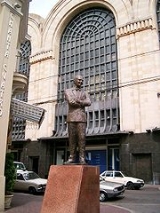
Carlos Gardel was a singer, songwriter and actor, and is perhaps the most prominent figure in the
history of tangoTango, a distinctive dance and the corresponding musical style of tango music, began in the working-class port neighborhoods of Buenos Aires ; and years later in Montevideo, Uruguay; the area of the Rio de la Plata.-Etymology:...
. He was born in
ToulouseToulouse is a city in the Haute-Garonne department in southwestern FranceIt lies on the banks of the River Garonne, 590 km away from Paris and half-way between the Atlantic Ocean and the Mediterranean Sea...
,
FranceThe French Republic , The French Republic , The French Republic , (commonly known as France , is a unitary semi-presidential republic in Western Europe with several overseas territories and islands located on other continents and in the Indian, Pacific, and Atlantic oceans. Metropolitan France...
, although he never acknowledged his birthplace publicly, and there are still claims of his birth in Uruguay. He lived in Argentina from the age of two and acquired Argentine citizenship in 1923. He grew up in the
AbastoThe Abasto de Buenos Aires was the central wholesale fruit and vegetable market in Buenos Aires, Argentina, from 1893 to 1984. Since 1999, it has served as a shopping mall, Abasto Shopping. It is also famous for being in the area where the tango singer Carlos Gardel, known as El Morocho del Abasto...
neighborhood of
Buenos AiresBuenos Aires is the capital and largest city of Argentina, and the second-largest metropolitan area in South America, after São Paulo. It is located on the western shore of the estuary of the Río de la Plata, on the southeastern coast of the South American continent...
. He attended Pio IX Industrial high-school located in the
AlmagroAlmagro is a mostly middle-class barrio of Buenos Aires, Argentina.The neighbourhood is delimited by La Plata avenue and Río de Janeiro street to the west, Independencia avenue to the south, Sánchez de Bustamante, Sánchez de Loria and Gallo streets to the east, and Córdoba/Estado de Israel avenues...
neighborhood of Buenos Aires. He died in an airplane crash at the height of his career, becoming an archetypal tragic
heroA hero , in Greek mythology and folklore, was originally a demigod, their cult being one of the most distinctive features of ancient Greek religion...
mourned throughout Latin America. For many, Gardel embodies the soul of the tango style. He is commonly referred to as "
Carlitos", "
El Zorzal" (The Song Thrush), "
The King of Tango", "
El Mago" (The Magician) and "
El Mudo" (The Mute).
The unerring musicality of Gardel's
baritoneBaritone is a type of male singing voice that lies between the bass and tenor voices. It is the most common male voice. Originally from the Greek , meaning deep sounding, music for this voice is typically written in the range from the second F below middle C to the F above middle C Baritone (or...
voice and the dramatic phrasing of his lyrics made miniature masterpieces of his hundreds of three-minute tango recordings. Together with lyricist and long-time collaborator
Alfredo Le PeraAlfredo Le Pera was an Argentinian journalist, dramatist, and lyricist, best known for his brief but fruitful collaboration with the tango singer Carlos Gardel...
, Gardel wrote several classic tangos, most notably:
Mi Buenos Aires queridoMi Buenos Aires querido is a tango by Carlos Gardel and Alfredo Le Pera, released in 1934. It is the soundtrack of its eponymous movie by Julio Irigoyen ....
, Cuesta abajo, Amores de estudiante, Soledad, Volver, Por una cabeza"Por una cabeza", meaning "by a head [of a horse]" in Spanish, is one of the most famous and popular tango songs by Carlos Gardel and Alfredo Le Pera , written in 1935. Alfredo Le Pera was a Brazilian from São Paulo, the fourth most Italian-influenced area in Brazil, and also the birthplace of...
and
El día que me quieras.
Career
Gardel began his singing career in bars and at private parties. He also sang with Francisco Martino and later in a trio with Martino and José Razzano. Gardel created the
tango-canción in 1917 with his rendition of
Pascual ContursiPascual Contursi was an Argentine poet, singer, and guitarist. He composed lyrics for 33 tango compositions - many well-known.-Life and work:...
and
Samuel CastriotaSamuel Castriota was a pianist, guitarist and composer.He is the composer of the tango Mi noche triste.-External links:**...
's
Mi Noche Triste"Mi noche triste" was the first tango the singer Carlos Gardel recorded. Lyrics were written by Pascual Contursi and the music by Samuel Castriota. In 1951 it was the basis of a film; Mi noche triste.-History:...
. The recording sold 10,000 copies and was a hit throughout Latin America. Gardel went on tour through Argentina, Uruguay, Chile, Brazil, Puerto Rico, Venezuela, Colombia, and also made appearances in Paris, New York, Barcelona and Madrid. He sold 70,000 records in the first three months of a 1928 visit to Paris. As his popularity grew, he made a number of films for
ParamountParamount Pictures Corporation is an American film production and distribution company, located at 5555 Melrose Avenue in Hollywood. Founded in 1912 and currently owned by media conglomerate Viacom, it is America's oldest existing film studio; it is also the last major film studio still...
in France and the U.S. While sentimental films such as
El día que me quierasEl día que me quieras is a song composed by Carlos Gardel, an Argentinian singer-musician, with text by Alfredo Le Pera. It became a heavily recorded tango standard, even by artists outside of the realm of tango.-Luis Miguel version:...
and
Cuesta abajo lack lasting dramatic value, they were outstanding showcases of his tremendous singing talents and movie star looks.
In 1915 Gardel was supposedly wounded after being shot by
Che GuevaraErnesto "Che" Guevara , commonly known as el Che or simply Che, was an Argentine Marxist revolutionary, physician, author, intellectual, guerrilla leader, diplomat and military theorist...
's father, Ernesto Guevara Lynch, as a result of a bar room brawl in the
belle epoqueThe Belle Époque or La Belle Époque was a period in European social history that began during the late 19th century and lasted until World War I. Occurring during the era of the French Third Republic and the German Empire, it was a period characterised by optimism and new technological and medical...
Palais de GlaceThe Palace de Glace is a French-style Belle Époque building in the Recoleta neighbourhood of Buenos Aires, Argentina, located at 1725 Posadas street...
in the
RecoletaRecoleta is a downtown residential neighborhood in the city of Autonomous City of Buenos Aires, Argentina; it is an area of great historical and architectural interest, due, particularly to the Recoleta Cemetery located there...
district of Buenos Aires, although different versions assert that he was shot in the chest or in the leg. Yet another variation holds that it was not Che's father but rather Roberto Guevara, an upper-class boy often involved in quarrels, who shot him.
Death and ongoing profile
Gardel died in 1935 in an airplane crash in
MedellínMedellín , officially the Municipio de Medellín or Municipality of Medellín, is the second largest city in Colombia. It is in the Aburrá Valley, one of the more northerly of the Andes in South America. It has a population of 2.3 million...
, Colombia. Le Pera, two of their guitarists (Guillermo Desiderio Barbieri and Ángel Domingo Riverol) and several business associates and friends of the group died in the crash as well. It is believed that a third guitarist, José María Aguilar, died a few days after the crash. Others state that Aguilar lived until 1951, although he never regained full use of his hands and sight.
Millions of his fans throughout Latin America went into mourning. Hordes came to pay their respects as his body was taken from Colombia through New York City and
Rio de JaneiroRio de Janeiro , commonly referred to simply as Rio, is the capital city of the State of Rio de Janeiro, the second largest city of Brazil, and the third largest metropolitan area and agglomeration in South America, boasting approximately 6.3 million people within the city proper, making it the 6th...
. Thousands rendered homage during the two days he lay in state in
MontevideoMontevideo is the largest city, the capital, and the chief port of Uruguay. The settlement was established in 1726 by Bruno Mauricio de Zabala, as a strategic move amidst a Spanish-Portuguese dispute over the platine region, and as a counter to the Portuguese colony at Colonia del Sacramento...
, the city in which his mother lived at the time. Gardel's body was laid to rest in
La Chacarita CemeteryCementerio de la Chacarita in Buenos Aires, Argentina, is known as the National Cemetery and is the largest in Argentina.-Location:The cemetery is in the barrio or district of Chacarita, in the northern part of Buenos Aires...
in Buenos Aires. In the neighborhood of Abasto, Buenos Aires, Gardel's childhood home, the Carlos Gardel Museum opened in 2003.
Gardel is still revered from Tokyo to Buenos Aires. A popular saying in Latin America, which serves as a testimony to his long-lived popularity, claims, "Gardel sings better every day." The fingers of his life-sized tuxedo-clad statue on his tomb nearly always hold a burning cigarette left by an admirer. Another commonly used phrase in Latin America, which asserts that
Veinte años no es nada (
Twenty years is nothing), comes from his song
Volver. It is also common in Argentina, the phrase
sos/soy Gardel y Le PeraAlfredo Le Pera was an Argentinian journalist, dramatist, and lyricist, best known for his brief but fruitful collaboration with the tango singer Carlos Gardel...
(
I'm/You are Gardel and Le Pera) referring to the greatness of both; used when somebody excels at something.
Statues in Scotland
During 2009/2010 statues depicting Gardel are scheduled to be erected temporarily throughout twenty-five small villages and towns of
ScotlandScotland is a country that is part of the United Kingdom. Occupying the northern third of the island of Great Britain, it shares a border with England to the south and is bounded by the North Sea to the east, the Atlantic Ocean to the north and west, and the North Channel and Irish Sea to the...
, commemorating his tour of 1930 where the singer used funds from his well-paid appearances in
GlasgowGlasgow is the largest city in Scotland and third most populous in the United Kingdom. The city is situated on the River Clyde in the country's west central lowlands...
and
EdinburghEdinburgh is the capital city of Scotland, the second largest city in Scotland, and the eighth most populous in the United Kingdom. The City of Edinburgh Council governs one of Scotland's 32 local government council areas. The council area includes urban Edinburgh and a rural area...
to subsidize small unannounced concerts in rural venues. These impromptu (and free) appearances endeared him to the working population of Scotland and his legacy of passion and art endure through regular commemorative concerts and amateur productions.
Birthplace controversy
The place of Gardel's birth is a matter of considerable controversy that still provokes passionate debate in Uruguay and Argentina.
After his death, his legal representative, Armando Defino, produced a handwritten will, which he assured was written by Gardel himself, claiming he was born in Toulouse, France, to Berthe Gardès (1865–1943), and baptized with the name of Charles Romuald Gardes. It is not known who Gardel's father was. There is an original birth certificate of a child, Charles Romuald Gardes, born in Toulouse to Berthe Gardès on December 11, 1890. On 14 April 1937, the government of Uruguay declared Berthe Gardès to be Gardel's sole heir.
Reporters often wrote that Gardel was Uruguayan, born in Tacuarembó. In the newspaper
El Telégrafo (Paysandú, Uruguay, October 25, 1933), Gardel was reported as saying, "I'm Uruguayan, born in Tacuarembó" ["soy uruguayo, nacido en Tacuarembó"]. In the June 1935 issue of
Caretas magazine of Antioquia, Colombia, Gardel was reported as saying, "My heart is Argentinian, but my soul is Uruguayan, because that is where I was born" ["Mi corazón es argentino, pero mi alma es uruguaya, porque allí nací"].
In literature
Gabriel García MárquezGabriel José de la Concordia García Márquez is a Colombian novelist, short-story writer, screenwriter and journalist, known affectionately as Gabo throughout Latin America. He is considered one of the most significant authors of the 20th century. He was awarded the Nobel Prize in Literature in...
mentions Gardel in his novel,
Love in the Time of CholeraLove in the Time of Cholera is a novel by Nobel Prize winning Colombian author Gabriel García Márquez first published in the Spanish language during 1985. Alfred A. Knopf published the English translation during 1988...
. When Florentino Ariza and doctor Juvenal Urbino meet at the former's office in the Caribbean Fluvial Company, doctor Urbino unexpectedly asks Ariza, "Do you like music?". After seriously thinking the issue, Ariza answers, "I like Gardel."
Jorge Luis BorgesJorge Francisco Isidoro Luis Borges Acevedo , known as Jorge Luis Borges , was an Argentine writer, essayist, poet and translator born in Buenos Aires. In 1914 his family moved to Switzerland where he attended school, receiving his baccalauréat from the Collège de Genève in 1918. The family...
,
Julio CortázarJulio Cortázar, born Jules Florencio Cortázar, was an Argentine writer. Cortázar, known as one of the founders of the Latin American Boom, influenced an entire generation of Spanish speaking readers and writers in the Americas and Europe.-Early life:Cortázar's parents, Julio José Cortázar and...
,
Ernesto SábatoErnesto Sabato , was an Argentine writer, painter and physicist. According to the BBC he "won some of the most prestigious prizes in Hispanic literature" and "became very influential in the literary world throughout Latin America"...
, and
Jimmy BuffettJames William "Jimmy" Buffett is a singer-songwriter, author, entrepreneur, and film producer. He is best known for his music, which often portrays an "island escapism" lifestyle. Together with his Coral Reefer Band, Buffett's musical hits include "Margaritaville" , and "Come Monday"...
also mention Gardel in their works. Gardel appears as a fictionalized character in the play
El día que me quieras (1979) by the Venezuelan writer José Ignacio Cabrujas.
António Lobo AntunesAntónio Lobo Antunes, GCSE, MD ; born 1 September 1942) is a Portuguese novelist and medical doctor.-Life and career:António Lobo Antunes was born in Lisbon as the eldest of six sons of João Alfredo de Figueiredo Lobo Antunes , prominent Neurologist and Professor, close collaborator of Egas Moniz,...
wrote a novel entitled
The Death of Carlos Gardel in which one of the characters believes that Gardel didn't die in the plane crash in 1935.
In film
There are two films about Gardel, both in production as of March 2009:
Gardel 2008 (July 2009), starring
Gael García BernalGael García Bernal is a Mexican film actor and director.-Early life:García Bernal was born in Guadalajara, Mexico, the son of Patricia Bernal, an actress and former model, and José Ángel García, an actor and director. His stepfather is Sergio Yazbek, whom his mother married when García Bernal was...
as Gardel, and
Dare to Love Me (2010).
Dare To Love Me
In July 2003 Warner Brothers announced that they were working on a film version of Gardel's biography,
The Vision of Love (the original cast included
Jessica AlbaJessica Marie Alba is an American television and film actress. She began her television and movie appearances at age 13 in Camp Nowhere and The Secret World of Alex Mack . Alba rose to prominence as the lead actress in the television series Dark Angel...
, Ricardo Chavira and
Halle BerryHalle Berry is an American actress and a former fashion model. Berry received an Emmy, Golden Globe, SAG, and an NAACP Image Award for Introducing Dorothy Dandridge and won an Academy Award for Best Actress and was nominated for a BAFTA Award in 2001 for her performance in Monster's Ball, becoming...
), but production was postponed in spring 2005 until early 2006, by that time both Alba and Chavira had backed out of the film. In 2007,
Lindsay LohanLindsay Lohan is an American actress, pop singer and model. She began her career as a child fashion model before making her motion picture debut in Disney's 1998 remake of The Parent Trap at the age of 11...
and
Raoul BovaRaoul Bova is an Italian actor.Bova was born in Rome to Calabrian parents. At the age of 16 he became a local champion in the 100 meter backstroke. At the age of 21 he joined the Italian Army and performed his military duty in the Bersaglieri corps...
were cast in the lead roles of Gardel and La Ritana. It was left unknown when production would begin up until autumn 2008, when it was officially announced that production is set to begin on the film on 18 May 2009 and it will be released in late 2010. This was again postponed and no further news is available at this time.
In postage stamps
On March 16, 2011, the United States Postal Service issued a set of five "Latin Music Legends" stamps including one picturing Carlos Gardel. In the News Release announcing the U.S. Postage Commemorative Forever stamps, the Postal Service said "A superb and evocative singer, Carlos Gardel (1890?-1935) was one of the most celebrated tango artists of all time. Raised in Argentina, Gardel helped popularize the tango in the United States, Europe and throughout Latin America through his performances and recordings. Known as 'the man with the tear in his voice,' he also achieved fame as one of the stars of Spanish-language cinema."
Filmography
- Flor de Durazno (1917) (silent). This was Gardel's first film and was directed by Francisco Defilippis Novoa and was made in collaboration with Celestino Petray.
- Luces de Buenos Aires (1931) (filmed in Paris)
- Esperame
"Espérame" is a pop song recorded by Chilean singer and actress Denise Rosenthal and this song is the second single for her first solo studio album, El Blog de la Feña, released in Chile on August 11, 2008...
(1932)
- La Casa es seria (1932)
- Melodía de Arrabal (1932)
- Cuesta abajo (1934)
- El Tango en Broadway (1934)
- El Día que me quieras
El día que me quieras is a song composed by Carlos Gardel, an Argentinian singer-musician, with text by Alfredo Le Pera. It became a heavily recorded tango standard, even by artists outside of the realm of tango.-Luis Miguel version:...
(1935)
- Cazadores de estrellas (1935)
- Tango Bar (1935)
External links