
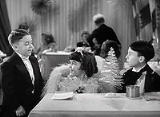
Carl Dean "Alfalfa" Switzer (August 7, 1927 – January 21, 1959) was an
AmericanThe United States of America is a federal constitutional republic comprising fifty states and a federal district...
child actorThe term child actor is generally applied to a child acting in motion pictures or television, but also to an adult who began his or her acting career as a child; to avoid confusion the latter is also called a former child actor...
, professional dog breeder and hunting guide, most notable for appearing in the
Our GangOur Gang, also known as The Little Rascals or Hal Roach's Rascals, was a series of American comedy short films about a group of poor neighborhood children and the adventures they had together. Created by comedy producer Hal Roach, Our Gang was produced at the Roach studio starting in 1922 as a...
short subjects series as
Alfalfa, one of the series' most popular and best-remembered characters.
Early life and family
Switzer was born in
Paris, IllinoisParis is a city in Paris Township, Edgar County, Illinois, USA, 165 miles south of Chicago, and 90 miles west of Indianapolis. The commission form of government was adopted in 1915. In 1900, 6,105 people lived in Paris, Illinois; in 1910, 7,664; and in 1940, 9,281. The population was 9,077 at...
, the second son, fourth and last child of Gladys C. Shanks (
néeA married name is the family name adopted by a person upon marriage, and in speaking of the many cultures where the practice is traditional for women, the maiden name is the family name that the married name replaces....
Doerr) and G. Frederick Switzer. He was named Carl after the Switzer family and Dean after many relatives on his grandmother's family. He and his older brother, Harold Frederick Switzer, became famous around their hometown for their musical talent and performances; both sang and played a number of instruments.
Our Gang
The Switzers took a trip to
CaliforniaCalifornia is the most populous state in the United States, and the third largest by area. California is the second most populous sub-national entity in the Americas, behind only São Paulo, Brazil...
in 1934 to visit with family members. While sightseeing they eventually wound up at Hal Roach Studios. Following a public tour of the facility, 8-year-old Harold and 6-year-old Carl entered into the
Hal RoachHarold Eugene "Hal" Roach, Sr. was an American film and television producer and director from the 1910s to the 1990s.- Early life and career :Hal Roach was born in Elmira, New York...
Studio's open-to-the-public
cafeteriaA cafeteria or cafetería is a type of food service location in which there is little or no table service, whether a restaurant or within an institution such as a large office building or school; a school dining location is also referred to as a dining hall or canteen...
, the
Our Gang Café, and began an impromptu performance. Producer Hal Roach was present at the commissary that day and was impressed by the performance. He signed both Switzers to appear in
Our Gang. Harold was given two nicknames, "Slim" and "Deadpan," and Carl was dubbed "Alfalfa."
The Switzer brothers first appeared in the 1935
Our Gang short,
Beginner's LuckBeginner's Luck is a 1935 Our Gang short comedy film directed by Gus Meins. It was the 135th Our Gang short that was released. -Plot:...
. By the end of the year, Alfalfa was one of the main characters in the series, while Harold had more or less been relegated to the role of a background player.
Although Carl Switzer was an experienced singer and musician, his character Alfalfa was often called upon to sing off-key renditions of pop standards and contemporary hits, most often those of
Bing CrosbyHarry Lillis "Bing" Crosby was an American popular singer and actor whose career stretched over more than half a century from 1926 until his death....
. Alfalfa also sported one of the most famous
cowlickA cowlick is a section of hair that stands straight up or lies at an angle at odds with the style in which the rest of an individual's hair is worn. Cowlicks appear when the growth direction of the hair forms a spiral pattern. The term "cowlick" originates from the domestic bovine's habit of...
s in pop culture history.
Switzer's country-boy sense of earthy humor could often be cruel. He enjoyed playing tricks on his fellow cast and crew members. One incident occurred when he put fishing hooks in the pants of
Our Gang co-star
George "Spanky" McFarlandGeorge Robert Phillips "Spanky" McFarland was an American actor most famous for his appearances in the Our Gang series of short-subject comedies of the 1930s and 1940s. The Our Gang shorts were later popular after being syndicated to television as The Little Rascals...
, and McFarland suffered severe cuts that resulted in his receiving stitches. Switzer tricked co-star
Darla HoodDarla Jean Hood was an American child actress, best known for her lead roles in Our Gang shorts during the late 1930s and early 1940s. She was born in Leedey, Oklahoma, the only child of James Claude Hood and Elizabeth Davner...
into putting her hand in his pocket, telling her he had a ring for her, but in reality it was a switchblade knife. Hood almost lost her fingers from that incident.
By the end of 1937, Alfalfa Switzer had supplanted Spanky McFarland, the series' nominal star, in popularity. While the two boys managed to get along (save for Switzer's pranks), their fathers fought and argued constantly over their sons' screen time and salaries. Ironically, Switzer's best friend among the
Our Gang kids was
Tommy BondThomas Ross "Tommy" Bond was an American actor. A native of Dallas, Texas, Bond was best known for his work as a child actor for two different nonconsecutive periods on Our Gang comedies, and also for being the first actor to portray the role of "Superman's pal" Jimmy Olsen on screen.-Early years...
, who played his on-screen nemesis "Butch". In Bond's words, he and Switzer became good friends because "neither of us could replace the other since we played opposites."
After Hal Roach sold
Our Gang to Metro-Goldwyn Mayer (MGM) in 1938, the now-adolescent Switzer's behavior was even more extreme, and he often sabotaged the production of the
Our Gang films. Once, during a break in filming, Switzer urinated on the set's lights. When filming resumed, the lights heated up and filled the set with such a stench that filming had to be halted for the rest of the day. On another occasion, intending to get back at a rude cameraman, Switzer forced the other kids to chew as much gum as they could, and stuffed wads of spent chewing gum inside the camera. Switzer's attitude towards authority impressed one of his younger
Our Gang co-stars,
Robert BlakeRobert Blake is an Italian-American actor who starred in the film In Cold Blood and the U.S. television series Baretta...
, who, as an adult, became known for his disposition as an iconoclast.
Adult years
The tenure of both Switzers in
Our Gang ended in 1940, when Carl was twelve. Carl continued to appear in movies in various supporting roles, including
I Love You AgainI Love You Again is a comedy film released in 1940. It was directed by W.S. Van Dyke and starred William Powell and Myrna Loy; all three were prominently involved in the "The Thin Man" series...
,
Going My WayGoing My Way, a 1944 film directed by Leo McCarey. It is a light-hearted musical comedy/drama about a new young priest taking over a parish from an established old veteran . Crosby sings five songs in the film. It was followed the next year by a sequel, The Bells of St. Mary's. This picture was...
,
Courage of LassieCourage of Lassie is a 1946 MGM feature film starring Elizabeth Taylor, Frank Morgan, and dog actor Pal in a story about a collie named Bill and his young companion, Kathie Merrick. When Bill is separated from Kathie following a vehicular accident, he is trained as a war dog, performs heroically,...
, and
It's a Wonderful LifeIt's a Wonderful Life is an American drama film produced and directed by Frank Capra and loosely based on the short story "The Greatest Gift" written by Philip Van Doren Stern....
and starred in the
John WayneMarion Mitchell Morrison , born Marion Robert Morrison, better known by his stage name John Wayne, was an American film actor, director and producer. He epitomized rugged masculinity and has become an enduring American icon. He is famous for his distinctive voice, walk and height...
film
Island in the SkyIsland in the Sky may refer to:*Island in the Sky , starring John Wayne*Island in the Sky, the Ernest K. Gann novel from which the film was adapted*Island in the Sky , a 1960 cartoon by Carl Barks...
where he coined the phrase "Whatever's customary," about the only line he spoke throughout the film, but one he repeated several times in it.
Switzer's last starring roles were in a brief series of imitation-
Bowery BoysThe Bowery Boys were a group of actors who made a series of films released by Monogram Pictures from 1946 through 1958. The group was a revamping of "The East Side Kids," who had been making films together since 1940...
movies; he reprised his "Alfalfa" characterization, complete with comically sour vocals, in PRC's
Gas House Kids comedies of 1946-1947. He returned to supporting roles, including a short stint as B-western sidekick "Alfalfa Johnson." Switzer preferred not to recall his
Our Gang work; in his 1946 resume he referred to the gang films generically as "M-G-M short product."
Switzer had a fleeting cameo in the 1954 musical film
White ChristmasA white Christmas, to most people in the Northern Hemisphere, refers to a Christmas Morning with snow on the ground. This phenomenon is far more common in some countries than in others...
where his picture was used to depict an Army buddy (named "Freckle-Faced Haynes") of lead characters (Wallace and Davis) played by
Bing CrosbyHarry Lillis "Bing" Crosby was an American popular singer and actor whose career stretched over more than half a century from 1926 until his death....
and
Danny KayeDanny Kaye was an American award-winning actor, singer and comedian.-Early years:Born David Daniel Kaminsky to Jewish Ukrainian immigrants in Brooklyn, Kaye became one of the world's best-known comedians...
and also the brother of the female leads (the Haynes Sisters) played by
Rosemary ClooneyRosemary Clooney was an American singer and actress. She came to prominence in the early 1950s with the novelty hit "Come On-a My House", which was followed by other pop numbers "Botch-a-Me " , "Mambo Italiano", and "This Ole House", songs which...
and
Vera-EllenVera-Ellen was an American actress and dancer, principally celebrated for her filmed dance partnerships with Fred Astaire, Gene Kelly and Donald O'Connor.-Early life:...
. He also did some acting for
televisionTelevision is a widely used telecommunication medium for transmitting and receiving moving images, either monochromatic or color, usually accompanied by sound. "Television" may also refer specifically to a television set, television programming or television transmission...
.
His final film role was in 1958's
The Defiant OnesThe Defiant Ones is a film which tells the story of two escaped prisoners who are shackled together, one white and one black, who must co-operate in order to survive...
and on the television series
The Roy Rogers Show, where he was called upon to reprise his off-key "Alfalfa-like" singing. Switzer's difficult reputation and his typecasting as "Alfalfa" made it difficult for him to find quality work.
Personal life
In the early 1950s, Switzer moved to
KansasKansas is a state located in the Midwestern United States. It is named after the Kansas River which flows through it, which in turn was named after the Kansa tribe, who inhabited the area. The tribe's name is often said to mean "people of the wind" or "people of the south wind," although this was...
. He lived and worked on a farm at
Pretty PrairiePretty Prairie is a city in Reno County, Kansas, United States. The population was 615 at the 2000 census.-Geography:Pretty Prairie is located at ....
, west of
WichitaWichita is a city in and the county seat of Sedgwick County, Kansas, United States. As of the 2000 census its population was 344,284. The 2006 estimated population of 361,420 made it the 51st largest city in the country and the most populous city in Kansas...
. There he met and married Diane Collingwood, the heiress of grain elevator empire Collingwood Grain. The marriage only lasted four months, but did result in the birth of a son whose name was a well-kept secret. In 2002, it was revealed that his son's name is Lance, per his cousin's statement on
ancestry.com.
In addition to acting, Switzer bred
hunting dogA hunting dog refers to any dog who assists humans in hunting. There are several types of hunting dogs developed for various tasks. The major categories of hunting dogs include hounds, terriers, cur type dogs, and gun dogs...
s and guided hunting expeditions. Among his more notable clients were
Roy RogersRoy Rogers , was a singer and cowboy actor, as well as the namesake of the Roy Rogers Restaurants chain. He and his second wife Dale Evans, his golden palomino Trigger, and his German Shepherd Dog, Bullet, were featured in over one hundred movies and The Roy Rogers Show...
and
Dale EvansDale Evans was the stage name of Lucille Wood Smith , a writer, movie star, and singer-songwriter. She was the second wife of singing cowboy Roy Rogers.- Early life :...
(Switzer's godparents), and
James StewartJames Maitland "Jimmy" Stewart was an American film and stage actor, best known for his self-effacing persona. Over the course of his career, he starred in many films widely considered classics and was nominated for five Academy Awards, winning one in competition and receiving one Lifetime...
.
In January 1958, he survived being shot in the arm while getting into his car. (His assailant was never identified.) Months later, Switzer was arrested in
Sequoia National ForestSequoia National Forest is located in the southern Sierra Nevada mountains of California. The national forest is named for the majestic Giant Sequoia trees which populate 38 groves within the boundaries of the forest. The Giant Sequoia National Monument is located within the forest...
for cutting down 15 pine trees. He was sentenced to a year's probation and ordered to pay a $225 fine.
Death
Prior to a hunting guide job, Switzer had borrowed a hunting dog from Moses "Bud" Stiltz. When the dog was lost, Switzer offered a $50 reward for the dog's return. A man found the dog a few days later and brought it to the bar where Switzer was working. Switzer paid the man $35 and bought him $15 worth of drinks from the bar. Several days later on January 21, 1959, Switzer and his friend Jack Piott decided that Stiltz owed Switzer the $50 paid to the man who found the dog. The pair allegedly arrived drunk at Stiltz's home in Mission Hills to collect the money Stiltz "owed" him.
He banged on Stiltz's front door, demanding, "Let me in, or I'll kick in the door." Once Switzer was inside the home, he and Stiltz got into an argument. Switzer informed Stiltz that he wanted the money owed him, saying "I want that 50 bucks you owe me now, and I mean now." When Stiltz refused to hand over the money, the two engaged in a physical fight. Piott allegedly struck Stiltz in the head with a glass-domed clock, which caused him to bleed from his left eye. Stiltz retreated to his bedroom and returned holding a .38-caliber revolver, but Switzer immediately grabbed the gun away from him, resulting in a shot being fired that hit the ceiling. Switzer then forced Stiltz into a closet, despite Stiltz having gotten his hands back on the gun. Switzer then allegedly pulled a switchblade knife and screamed, "I'm going to kill you" and was attempting to stab him with it, but just as Switzer was about to charge Stiltz, Stiltz raised the gun and shot Switzer in the
groinIn human anatomy, the groin areas are the two creases at the junction of the torso with the legs, on either side of the pubic area. A pulled groin muscle usually refers to a painful injury sustained by straining the hip adduction muscle....
. Switzer died of massive internal bleeding and was pronounced dead on arrival at the hospital.
Controversy
Jack Piott gave a second version of events to investigators. According to Piott, he and Switzer went to collect a debt from Stiltz, when an argument broke out. Piott said a brief struggle ensued and Stiltz brandished a gun and shot Switzer, who was unarmed at the time, in the
groinIn human anatomy, the groin areas are the two creases at the junction of the torso with the legs, on either side of the pubic area. A pulled groin muscle usually refers to a painful injury sustained by straining the hip adduction muscle....
. Then, according to police reports, only by begging was Piott able to save his own life.
The killing was held to be a
justifiable homicideThe United States' concept of justifiable homicide in criminal law stands on the dividing line between an excuse, justification and an exculpation...
. Switzer had allegedly pulled a knife; therefore, the shooting was judged to be
self-defenseSelf-defense is the act of defending oneself, one's property or the well-being of another from physical harm. The use of the right of self-defense as a legal justification for the use of force is available in many jurisdictions, but the interpretation varies widely...
. During the inquest regarding Switzer's death, it was revealed that what was originally reported as a "hunting knife" was in fact merely a
penknifeA penknife, or pen knife, is a small folding pocket knife, originally used for cutting or sharpening a quill to make a pen nib. Originally, penknives did not necessarily have folding blades, but resembled a scalpel or wood knife by having a short, fixed blade at the end of a long handle...
. It had been found by crime scene investigators under his body, but with no blade exposed.
On January 25, 2001, a third witness came forward and gave his version of the events of January 21, 1959. The witness, 56-year-old Tom Corrigan, son of Western movie star Ray "Crash" Corrigan and stepson of Moses Stiltz, was present the night Switzer was killed.
"It was more like murder," Corrigan told reporters. He said he heard the knock on the front door and heard Switzer say "Western Union for Bud Stiltz". Corrigan's mother, Rita Corrigan, opened the door to find a drunk and demanding Switzer complaining about a perceived, months-old debt. Switzer entered the house followed by Jack Piott and stated that he was going to beat Stiltz. Stiltz greeted Switzer with a .38-caliber revolver in his hand. Tom Corrigan claimed to witness Switzer grab the revolver and the two began struggling to gain control over it. Piott broke a glass-domed clock over Stiltz's head whose eye swelled shut. During the struggle the gun fired into the ceiling and Tom Corrigan was struck in the leg by a piece of shrapnel. After the initial shot, his two younger sisters ran to a neighbor's house to call for help. "Well, we shot Tommy, enough of this," he remembers Switzer saying before Switzer and Piott started to retreat. Corrigan had just stepped out the front door when he heard a second shot go off behind him. He did not see his stepfather shoot Switzer, but when he turned around he saw Switzer sliding down the wall with a surprised look on his face — shot in the groin. Corrigan said he spotted a closed penknife at Switzer's side which he presumed fell out of his pocket or his hand. He then witnessed his stepfather back Piott into the kitchen counter and threaten to kill him, but as the man begged for his life, they heard emergency sirens which is why Corrigan believed Stiltz didn't shoot him again. Corrigan recalled that his stepfather, Bud Stiltz, lied in his account of the event to the authorities.
Following the shooting, Corrigan claims a now-deceased Los Angeles Police Department detective, Pat Pow, interviewed him and asked him if he would testify before a judge. Corrigan claims to have agreed, although for unknown reasons he was never called before the coroner's jury. "He didn't have to kill him," Corrigan said.
Carl Switzer is interred at the
Hollywood Forever CemeteryHollywood Forever Cemetery is at 6000 Santa Monica Boulevard in the Hollywooddistrict of Los Angeles, California. It is adjacent to the north wall, or back, of Paramount Studios, who, with RKO Studios, bought by 1920. The Beth Olam Cemetery in the southwestern section of the cemetery is for...
in Hollywood, California. His death went virtually unnoticed in the media, as Switzer died on the same day as
Cecil B. DeMilleCecil Blount DeMille was a legendary American film director and Academy Award-winning film producer. He was renowned for the flamboyance and showmanship of his movies.-Early life:...
. Switzer received only minor footnotes in most newspapers, while DeMille's obituary dominated the columns.
External links