
All Topics  
Carl Gustav recoilless rifle

 
Carl Gustav Recoilless Rifle

   Email Print
   Bookmark   Link


Carl Gustav recoilless rifle


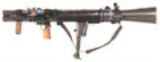
The Carl Gustav (also Carl-Gustaf and M2CG) is the common name for the 84 mm man-portable multi-role recoilless rifle
Recoilless rifle

A recoilless gun or recoilless rifle is a lightweight form of weapon that allows the firing of a heavier projectile than would be practical with a recoiling weapon....
 produced by Saab Bofors Dynamics
Saab Bofors Dynamics

Saab Bofors Dynamics, located in Karlskoga, Sweden, is a subsidiary of Saab that specializes in military materiel such as missile systems and anti-tank systems....
 (formerly Bofors Anti-Armour AB
Bofors

The name Bofors has been associated with the iron industry for more than 350 years. Located in Karlskoga, Sweden, it originates from the hammer mill "Boofors" founded 1646....
) in Sweden
Sweden

Sweden , officially the Kingdom of Sweden , is a Nordic countries on the Scandinavian Peninsula in Northern Europe. Sweden has land borders with Norway to the west and Finland to the northeast, and it is connected to Denmark by the ?resund Bridge in the south....
. The first prototype of the Carl Gustav was produced in 1946, and while similar weapons of the era have generally disappeared, the Carl Gustav remains in widespread use today. British troops refer to it as the Charlie G, while Canadian troops often refer to it as the 84 or Carl G.


Discussion
Ask a question about 'Carl Gustav recoilless rifle'
Start a new discussion about 'Carl Gustav recoilless rifle'
Answer questions from other users
Full Discussion Forum


Encyclopedia


The Carl Gustav (also Carl-Gustaf and M2CG) is the common name for the 84 mm man-portable multi-role recoilless rifle
Recoilless rifle

A recoilless gun or recoilless rifle is a lightweight form of weapon that allows the firing of a heavier projectile than would be practical with a recoiling weapon....
 produced by Saab Bofors Dynamics
Saab Bofors Dynamics

Saab Bofors Dynamics, located in Karlskoga, Sweden, is a subsidiary of Saab that specializes in military materiel such as missile systems and anti-tank systems....
 (formerly Bofors Anti-Armour AB
Bofors

The name Bofors has been associated with the iron industry for more than 350 years. Located in Karlskoga, Sweden, it originates from the hammer mill "Boofors" founded 1646....
) in Sweden
Sweden

Sweden , officially the Kingdom of Sweden , is a Nordic countries on the Scandinavian Peninsula in Northern Europe. Sweden has land borders with Norway to the west and Finland to the northeast, and it is connected to Denmark by the ?resund Bridge in the south....
. The first prototype of the Carl Gustav was produced in 1946, and while similar weapons of the era have generally disappeared, the Carl Gustav remains in widespread use today. British troops refer to it as the Charlie G, while Canadian troops often refer to it as the 84 or Carl G. In US service it is officially known as the RAWS or Ranger Antitank Weapons System, but often called the Gustav or simply the goose by US soldiers. In Australia it is irreverently known as Charlie Gutsache (gut
Gastrointestinal tract

The digestive tract is the system of Organ s within multicellular animals that takes in food, digestion it to extract energy and nutrients, and expels the remaining waste....
s ache
Ache

Ache may refer to:* Ache , a You've Got Foetus on Your Breath album* Ache Records, a Vancouver-based record label* Ache, a chronic, painful sensation...
, slang for stomach pain). In its country of origin it is officially named Grg m/48 (Granatgevär or grenade rifle, model 48) but is sometimes nicknamed Stuprör (drainpipe) due to the fact that the weapon mainly consists of a long tube.

History

The Carl Gustav was developed by Hugo Abramson and Harald Jentzen at the Royal Swedish Arms Administration (KAFT) and produced at Carl Gustafs Stads Gevärsfaktori from where it derives its name. The weapon was first introduced into Swedish service in 1948 as the 8,4 cm Granatgevär m/48 (Grg m/48), filling the same anti-tank role as the US Army
United States Army

The United States Army is the branch of the United States Armed Forces responsible for Army operations. It is the largest and oldest established branch of the U.S....
 Bazooka
Bazooka

A bazooka is one of a series of anti-armor and anti-bunker, man-portable rocket launchers that became famous during World War II. Technically named as the M9 Anti-tank Rocket Launcher, it was also called "stovepipe" and used to deliver high explosives into machine gun nests and hardened bunkers in all WWII theaters....
, British
United Kingdom

The United Kingdom of Great Britain and Northern Ireland, commonly known as the United Kingdom , the UK or Britain,is a sovereign state located off the northwestern coast of continental Europe....
 PIAT
PIAT

The Projector, Infantry, Anti Tank , was one of the earlier anti-tank weapons using a HEAT projectile. It was developed by the United Kingdom starting in 1941, reaching the field in time for the Operation Husky in 1943....
 and German
Germany

Germany , officially the Federal Republic of Germany , is a country in Central Europe. It is bordered to the north by the North Sea, Denmark, and the Baltic Sea; to the east by Poland and the Czech Republic; to the south by Austria and Switzerland; and to the west by France, Luxembourg, Belgium, and the Netherlands....
 Panzerschreck
Panzerschreck

Panzerschreck was the popular name for the Raketenpanzerb?chse , an 88 mm calibre reusable Anti-tank warfare rocket launcher developed by the Nazi Germany in World War II....
. Unlike these weapons, however, the Carl Gustav used a rifled barrel
Gun barrel

A gun barrel is the tube, usually metal, through which a controlled explosion or rapid expansion of gases is released in order to propel a projectile out of the end at great speed....
 for spin-stabilizing its rounds, as opposed to fins as used by the other systems.

The use of the recoilless firing system allowed the Carl Gustav to use ammunition containing considerably more propellant, firing its rounds at 290 m/s, as opposed to about 105 m/s for the Panzerschreck and Bazooka and about 135 m/s for the PIAT. The result was superior accuracy at longer ranges. The Carl Gustav can be used to attack larger stationary targets at up to 700 m, but the relatively slow speed of the projectile
Projectile

A projectile is any object propelled through space by the exertion of a force, which ceases after launch. In a general sense, even a Football or baseball may be considered a projectile....
 restricts attacks on moving targets to a range of 400 m or less.

The Carl Gustav was soon being sold around the world, and became one of the primary squad
Squad

In military terminology, a squad is a small military unit led by a non-commissioned officer that is subordinate to an infantry platoon. In countries following the British Army tradition this organization is referred to as a section ....
-level anti-tank weapons for many Western European armies. An improved version (M2) was introduced in 1964 and quickly replaced the original version. The current M3 version was introduced in 1991, using a thin steel liner containing the rifling, strengthened by a carbon fiber
Carbon fiber

Carbon fiber or is a material consisting of extremely thin fibers about 0.005?0.010 mm in diameter and composed mostly of carbon atoms. The carbon atoms are bonded together in microscopic crystals that are more or less aligned parallel to the long axis of the fiber....
 outer sleeve. External steel parts were replaced with aluminum alloys or plastics, reducing the empty weapon weight considerably from 14.2 kg to 8.5 kg.

In recent years the weapon has found new life in a variety of roles. The British Special Air Service
Special Air Service

The Special Air Service is a special forces regiment within the British Army which has served as a model for the special forces of other countries....
, US Special Forces
Special forces

Special Forces , also known as, Special Operation Forces is a generic term for highly-trained military teams/units that conduct specialized Military operation such as reconnaissance, unconventional warfare, and counter-terrorism actions....
 and United States Army Rangers
United States Army Rangers

The United States Army Rangers or simply Army Rangers are specialized, elite American Light Infantry special operations forces capable of conducting Direct action operations....
 use M3s in the bunker
Bunker

A military bunker is a hardened shelter, often buried partly or fully underground, designed to protect the inhabitants from falling bombs or other attacks....
-busting and anti-vehicle roles, while the German Bundeswehr
Bundeswehr

The Bundeswehr is the name of the unified armed forces of the Germany and their civil administration and procurement authorities. The States of Germany are not allowed to maintain armed forces of their own, since the Constitution determines that matters of defense fall into the sole responsibility of the Federal government....
 maintains small numbers of M2s for battlefield illumination. Many armies continue to use it as a viable anti-armor weapon, especially against 1950s and 1960s-era tank
Tank

A tank is a Continuous track, armoured fighting vehicle designed for front-line combat which combines operational mobility and Military tactics Offensive and defence capabilities....
s and other armored vehicles, which are still in use worldwide.

The Carl Gustav was used against Taliban defensive fortifications by soldiers of the Princess Patricia’s Canadian Light Infantry in operations in Afghanistan
Afghanistan

Afghanistan , officially the Islamic republic of Afghanistan, is a landlocked country that is located approximately in the center of Asia....
. They developed a new system for firing at night, which involved a night-scope equipped spotter firing tracer ammunition
Tracer ammunition

Tracer ammunition are special bullets that are modified to accept a small pyrotechnic charge in their base. Ignited upon firing, the composition burns very brightly, making the projectile visible to the naked eye....
s at the target, and the Carl Gustav gunner then aiming at the spot where the tracer rounds hit.

In a well-known incident during the Falklands War
Falklands War

The Falklands War , also called the Falklands Conflict/Crisis, was fought in 1982 between Argentina and the United Kingdom over the disputed Falkland Islands and South Georgia and the South Sandwich Islands....
, a Royal Marine damaged an Argentinian corvette
D'Estienne d'Orves class

The A69 type Avisos are small warships mainly designed for coastal anti-submarine defence, but are also available for high sea escort missions ....
 using a Carl Gustav .

Description


The basic weapon consists of the main tube with the breech-mounted Venturi
Venturi effect

The Venturi effect is the reduction in fluid pressure that results when a fluid flows through a constricted section of pipe. The fluid velocity must increase through the constriction to satisfy the Derivation of the Navier?Stokes equations#Conservation of mass, while its pressure must decrease due to conservation of energy: the gain in kin...
 recoil damper, with two grips near the front and a shoulder mount. The weapon is fitted with iron sights, but is normally aimed with the attached 3x optical sight with a 17 degree (300 mrad) field of view. Luminous front and rear sight inserts are available for the iron sights when aiming at night, but an image intensification system may also be used.

The Carl Gustav can be fired from the standing, kneeling, sitting or prone positions, and a bipod
Bipod

A bipod is a support device that is similar to a tripod or monopod, but with two legs. It provides significant stability along two Coordinate axis of motion ...
 may be attached in front of the shoulder piece. An operating handle called a "Venturi lock" is used to move the hinged breech to one side for reloading. The weapon is normally operated by a two-man crew, one carrying and firing the weapon, the other carrying ammunition and reloading.

Specifications

  • Calibre: 84 mm rifled (24 lands/progressive twist).
  • Crew: 2 optimal, 1 minimum.
  • Weights: 14.2 kg (M2); 8.5 kg (M3); 0.8 kg (mount)
  • Length: 1.065 m
  • Breech: Hinged
  • Rate of fire: 6 rounds per minute.
  • Sights: Iron sights; optical 3x; laser rangefinder; image intensification system.


M3 MAAWS

The M3 MAAWS is the US designation for the Carl Gustav M3 recoilless rifle. It is primarily used by USSOCOM
United States Special Operations Command

The United States Special Operations Command is the Unified Combatant Command charged with overseeing the various Special forces Commands of the United States Army, United States Air Force, United States Navy and United States Marine Corps of the United States Military of the United States....
 forces such as the United States Army
United States Army

The United States Army is the branch of the United States Armed Forces responsible for Army operations. It is the largest and oldest established branch of the U.S....
 Special Forces
United States Army Special Forces

The United States Army Special Forces is a Special Operations Force of the United States Army tasked with five primary missions: unconventional warfare , foreign internal defense, special reconnaissance, direct action , and counter-terrorism....
, 75th Ranger Regiment
75th Ranger Regiment (United States)

The 75th Ranger Regiment is a military unit of the United States Army. The Regiment, headquartered in Fort Benning, Georgia , operates as an elite light infantry United States Special Operations Forces of the United States Army Special Operations Command ....
, United States Navy
United States Navy

The United States Navy is the navy of the United States Armed Forces. It is one of the seven uniformed services of the United States. The U.S. Navy currently has approximately 331,682 personnel on active duty as of 31 December 2008 and 124,000 in the United States Navy Reserve....
 SEALS
United States Navy SEALs

The United States Navy Sea, Air and Land Forces, commonly known as the Navy SEALs, are the United States Special Operations Forces of the United States Navy, employed in Direct action and special reconnaissance operations....
, Delta Force
Delta Force

The 1st Special Forces Operational Detachment-Delta ? commonly known as Delta, Delta Force and as the Combat Applications Group by the United States Department of Defense ? is an elite United States Special Operations Forces and an integral element of the Joint Special Operations Command ....
, DEVGRU and MARSOC. When in use with the 75th Ranger Regiment it is known as the Ranger Antitank Weapons System (RAWS)

The M3 MAAWS fires the following ammunition:
  • High Explosive Dual Purpose (HEDP) round
  • High Explosive Anti-Tank
    High explosive anti-tank

    High Explosive Anti-Tank rounds are made of an explosive shaped charge that uses the Neumann effect to create a very high-velocity jet of metal in a state of superplasticity that can punch through solid vehicle armour....
     (HEAT) round
  • High Explosive
    Explosive material

    File:M112 Demolition Charge.jpgAn explosive material is a material that either is chemistry or otherwise energetically unstable or produces a sudden expansion of the material usually accompanied by the production of heat and large changes in pressure upon initiation; this is called the explosion....
     (HE) round
  • Illumination round
  • Smoke round
  • Area Defence Munition (ADM) flechette
    Flechette

    A flechette is a pointed steel projectile, with a vaned tail for stable flight. The name comes from French , ?little arrow? or ?dart?, and sometimes retains the acute accent in English....
     round


Ammunition

Improvements to the ammunition have been continual. While the older HEAT
Heat

In physics and thermodynamics, heat is any transfer of energy from one body or thermodynamic system to another due to a difference in temperature....
 rounds are not particularly effective against modern tank armor, the weapon has found new life as a bunker-buster with an HEDP round. In addition, improved HEAT, high explosive (HE), smoke and illumination (star shell or flare
Flare (pyrotechnic)

A flare, also sometimes called a fusee, is a type of pyrotechnic that produces a brilliant light or intense heat without an explosion. Flares are used for signaling, illumination, or defensive countermeasures in civilian and military applications....
) ammunition is also available. For full effectiveness, illumination rounds have to be fired at a very high angle, creating a danger for the gunner as the backblast from firing can burn him. For this reason several armies have retired the illumination rounds, while the US Army requires that they be fired from a standing position.

The following are Canadian designations (other countries use similar terminology, replacing the "FFV")

  • FFV441 is an HE round, useful in a "lobbed" trajectory to 1,000m, which can be fused to either detonate on impact or as an airburst
    Air burst

    An air burst is the detonation of an explosive device such as an anti-personnel artillery shell or a nuclear weapon in the air instead of on contact with the ground or target or a delayed armor piercing explosion....
    .
  • FFV441B is an HE round with an effective range against personnel in the open of 1,100 m. The round arms after 20 to 70 m of flight, weighs 3.1 kg, and is fired at a muzzle velocity of 255 m/s.
  • FFV469 is a smoke round fired like the FFV441, with a range of about 1,300 m. The 3.1 kg round is also fired at 255 m/s.
  • FFV502 is an HEDP round with the ability to be set to detonate either on impact or one-tenth of a second afterwards. Effective range is 1,000 m against dispersed soft targets such as infantry in the open, 500 m against stationary targets, and 300 m against moving targets. Minimum range is 15 to 40 m to arm the warhead. Penetration exceeds 150 mm of rolled homogeneous armour
    Rolled homogeneous armour

    Rolled homogeneous armour, or RHA, is a basic type of steel plate, used as a baseline to compare the effectiveness of military vehicle armour....
     (RHA). Ammunition weight is 3.3 kg and muzzle velocity is 230 m/s.
  • FFV545 is an illuminating starshell, fired up to 2,300 m maximum range, but with an effective envelope of 300 to 2,100 m. Suspended by parachute, the starshell burns for 30 seconds while producing 650,000 candela
    Candela

    The candela is the SI base unit of luminous intensity; that is, power emitted by a light source in a particular direction, weighted by the luminosity function ....
    , providing a 400 to 500 m diameter area of illumination.
  • FFV551 is the primary HEAT round and is a rocket-assisted projectile (RAP). Effective range is up to 700 m (400 m against moving targets) and penetration up to 400 mm of RHA. Ammunition weight is 3.2 kg and muzzle velocity is 255 m/s.
  • FFV552 is a practice round with the same ballistics as the 551.
  • FFV651 is a newer HEAT round using mid-flight rocket assistance for ranges up to 1,000m. In theory, it has less penetration than the FFV441, but it includes a stand-off probe for the fuse to improve performance against reactive armour
    Reactive armour

    Reactive armour is a type of vehicle armour that reacts in some way to the impact of a weapon to reduce the damage done to the vehicle being protected....
    .
  • FFV751 is a tandem-warhead HEAT round with an effective range of 500 m and ability to penetrate more than 500 mm of armour. Weight is 4 kg.


Users

- designated schwere Panzerfaust Carl Gustaf or Leuchtbüchse 84mm, replaced in the combat role by the Panzerfaust 3
Panzerfaust 3

The Panzerfaust 3 is a modern and disposable recoilless anti-tank weapon developed between 1978 and 1985 and put into service by the Bundeswehr in 1992....
, but still used for battlefield illumination. - designated under license as 84mm Recoilless Rifle - used by Royal Dutch Marines - used by paratroopers and special forces - used by USSOCOM
United States Special Operations Command

The United States Special Operations Command is the Unified Combatant Command charged with overseeing the various Special forces Commands of the United States Army, United States Air Force, United States Navy and United States Marine Corps of the United States Military of the United States....


See also

  • SPG-9
    SPG-9

    The SPG-9 Kopye is a Russian tripod-mounted man-portable, 73 millimetre calibre recoilless gun developed by the Soviet Union. It fires fin-stabilised, rocket-assisted High Explosive and High explosive anti-tank warhead projectiles similar to those fired by the 73 mm 2A28 Grom low pressure gun of the BMP-1 vehicle....
  • M40 recoilless rifle
    M40 recoilless rifle

    The M40 recoilless rifle was a lightweight, portable, crew-served 105 mm weapon intended primarily as an anti-tank weapon made in the United States....
  • M67 recoilless rifle
    M67 recoilless rifle

    The M67 recoilless rifle was a lightweight, portable, crew-served 90mm weapon intended primarily as an anti-tank weapon made in the United States by the department of the U.S....


External links